Thursday, June 22, 2006

Ghana vrs USA

Before


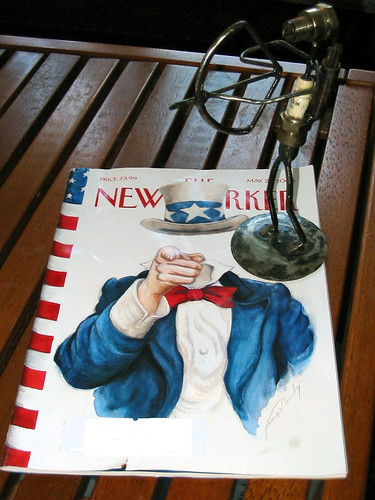
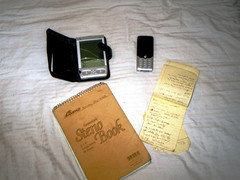
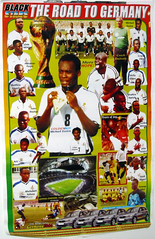
This happened to be on my living room table a few days ago. I'll reserve comment until after the Ghana USA match.

Ghana vrs USA


Our national anthem is playing. No more blogging...

Later


There is probably a parable to be made about a stick figure made out of spark plugs and improvised bent wire pointing a bow and arrow standing on top of Uncle Sam (a faceless Sam at that albeit with slick production values and glossy magazine accoutrements) but that would be reading far too much into an image...

[Ghana beat the USA 2-1]

Also, in case this was missed in the preceding posts, this was my mother's toli on the previous matches (To The Shout Of "Ghana", You Respond "Respect" and Firmly On The Map). She's heading our eight person family delegation to the World Cup.

The African Nation and The American Dream


I was going to save this photo for a piece I've been working on about immigrants and the diaspora but it seems strangely appropriate here. You can blame this juxtaposition on the journalistic impulse.

The American Dream!

The American Dream!
"You've got big dreams, we've got the big money!"
The exclamation point is of typographical importance. This is an advert for a mortgage company on the back page of the March 2006 issue of The African Nation, a free monthly newspaper for immigrants in the US that is often found wherever there's an "ethnic" grocery shop. Published mostly by Nigerians and Camerounians in Silver Spring, Maryland, it features the typical optimism and entrepreneurial spirit of the most vigourous of our West African brethren. The newspaper is billed as
"A success guide for Smart African-Americans, West Indians & Africans in the diaspora".
In short, it's an all-inclusive and expansive production. I will return later to dispense a critique of some of the paper's content (the articles on Nollywood, Green Cards, Obasanjo, corruption, Sudan, Frantz Fanon, the latest society weddings in DC, the latest immigration news, advertisements for lawyers, disquisitions on where we can get authentic comfort food, travel agencies that claim to find the cheapest rate for you to head home etc.). It is worthy of some focused commentary.

The Color of Memory


I first watched the World Cup in 1978 during a trip my mum and I made to Senegal to visit some family friends. It was my first trip outside Ghana and my first time on a plane. My only memories are of the color red in the marketplaces, a vivid red that I haven't seen since, the shimmering cloths the Senegalese wore (they pay attention to their looks to an extent that puts most Ghanaians to shame), the excitement about the Dutch team who played the most beautiful game, and the disappointment at their fate at the hands of Argentina. We watched all the matches on black and white TVs except for the final, and therein lies my other memory: the orange of the Dutch team and their fans. I'm still gutted about that match.

I have been waiting ever since for my team to be at the World Cup. This is something deep inside of me.

And it has been a long wait. Watching my favourite teams disappoint time and again: the Brazilians in 82 (Zico and Socrates slain by a baby-faced assassin named Paolo Rossi), Platini, Tigana and co in 82 and 86 (there was that perfidious Schumacher guy), Hoddle, Waddle, John Barnes and the like (the Hand of God) (and wherefore Gazza and Shearer?), Roger Milla and Cameroon, Gullit and Rijkaard, Nigeria causing ulcers and palpitations to everyone, Senegal exhilarating the last time around... The teams that Abedi Pele and Tony Yeboah led in the 1990s were arguably more talented than our current heroes but they proved incapable of qualifying for the world cup. Thus we had only the memories of Polo and Razak, the legendary Black Stars of the past, glorious in the African Cup of Nations or, of late, our success at the junior level or at the Olympics.

It is a good day to be a Ghanaian, but it has been a long wait.

Identity and Allegiance


I recently calculated that I have now spent more time in Cambridge than anywhere else, what with the university years and the Lotus/IBM years. This beats my stints in Ghana, France or England. Thus I am quite the conflicted soul about who to support and am typically mid-Atlantic in my sensibilities. The Brits have the "cricket match test' to sort out the "good" immigrants from the chaff and I wonder where I lie and whether I'll pass. This is a very difficult test when it comes to football, and especially the World Cup, because any fan of the game (and I am a great football fan) will find some tribal aspect to latch onto in every team.

Until their last match, I thought Ecuador were the best team from Latin America; they were my pick for the tournament since they seemed more "ready" than Brazil or Argentina. They still might come through and I hope they do. Of course I've rooted for all the African teams and, even if the Ivoriens are out of the tournament with the label of the best team not to progress, I can still find favour in those who beat them. I apparently have Dutch ancestry and the good Captain John Vanderpuje (or Vanderpoy as we pronounce it in Ghana) was surely smiling as that free kick rocketed into the Ivorien net and also at the way Arjen Robben played in Holland's demolition of Serbia and Montenegro. When I mentioned my Dutch connection to a friend yesterday, he noted that my allegiance would likely depend on my family history. My reply was that in the mist of the centuries that have passed, it is unclear whether said ancestor was a benign adventurer or a rapacious colonist. Identity is identity and many tribes can claim me. I, in turn, claim all those tribes through victory and defeat.

victorydefeat


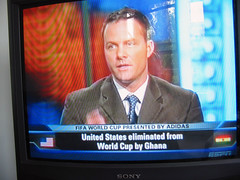
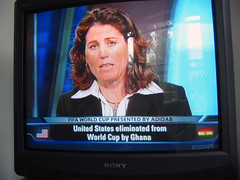
Note well the use of the deflating passive tense in the headlines that followed in the US, it isn't David beats Goliath, or even Ghana Through... Brazil next, it's rather US eliminated by Ghana. The frame is typical of the big media companies and their prevailing script: the US were the actors, the Ghanaians were the sideshow. This of course would be news to anyone who watched the match, but such is the Great Game of life. How does the song go again?
They're all political actors... 'Don't worry'. He says 'Don't worry.'
The only team that leaves me cold in the tournament is Switzerland. I can't figure out the reason for this since they are just as talented as any of the other teams and play fluent European-style football. Whither neutrality? I was hoping Togo would beat them yesterday if only because of the amount of money Eyadema père had stashed in those well-run banks. But it wasn't to be, and such is life. Hopefully Eyadema fils will repatriate some of that loot to Togo. There is a startling statistic about the number of public schools constructed in Togo since independence (less than five in almost 50 years, if my memory serves me right). That is worth pondering at the same time as matters of elation are considered. But that's also for later toli... In any case South Korea might oblige tomorrow and deal with the Swiss tribe.

Hearts of Oak


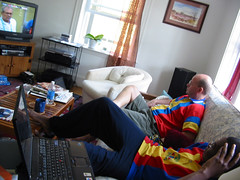
The Wife called the following photo "working from home" for some reason. I was a little surprised. I didn't pretend to be working for those two glorious hours, and Big Blue couldn't have made me work at such a time. In reality there was no dilemma, there was only ecstasy.

working from home


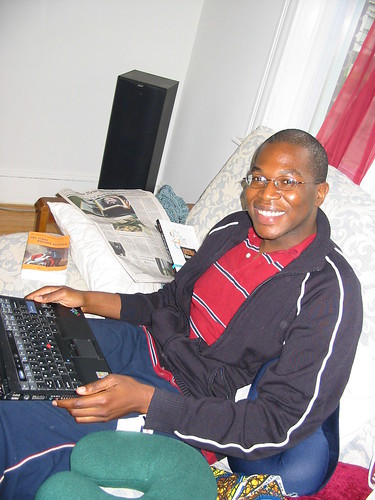
I had dug up my Accra Hearts of Oak shirts since the World Cup is all about tribes and belonging. A good friend was good-natured enough to wear one even though his allegiances were more in line with Uncle Sam. There is no tribe more loyal than the "Phobians", the Hearts of Oak fans. Really. Truly. We dig deep. You Red Sox or Arsenal fans have nothing on us.

Ghana leading the usa world cup


There's nothing like a football match to bring out the drama of life, and we see shattered dreams for some, and bite-sized triumphs for others. Michael Essien's second yellow card is the most painful thing he will endure in his life as he'll miss the choicest game we'll face, and it tempers the Ghanaian jubilation somewhat. My American friends might be hurting right now, but rather than devolving into recriminations (as it appeared would be the case judging by the later coverage on ESPN), this Phobian will suggest instead a transfer of allegiance to the Black Stars. I've been told that the latest hiplife rhyme back home is
Black Stars checked the Czechs and cleared the bush.
We play to a different drumbeat and with our own musicality. I'll conclude with the Hearts of Oak motto
Never say die until the bones are rotten.
Next step Brazil.

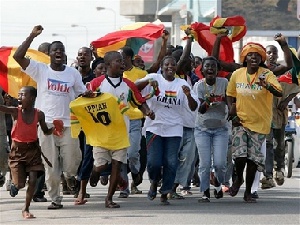
Ghana goes wild with joy


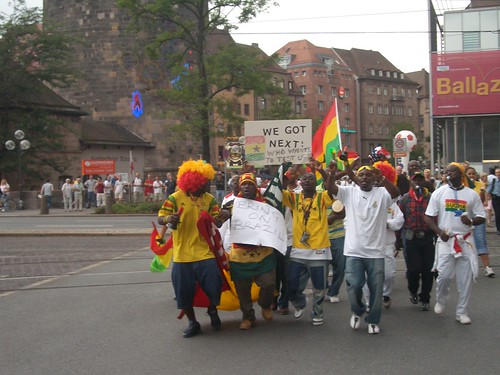
Bring on Brazil. We got next who wants to test us?

ghana celebration

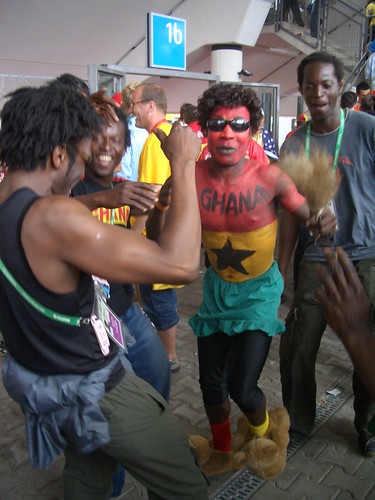
ghana celebration

ghana celebration

I nominate this note for the Things Fall Apart series, under the banner of Social Living.

Next: Friends Today, Enemies Tomorrow

See also: On IBM and Africa

File under: , , , , , , , , , , , , , , , , , , , , , , , , , , , , , , , , , , , , ,

Sunday, June 18, 2006

The Low End Theory of Networks

Ethan Zuckerman has been pondering generativity and aggregation, prompted by Jonathan Zittrain's paper, The Generative Internet and its implications. Many of these themes have been stewing in my head for quite some time so I thought I'd finally join in the conversation with some of my armchair punditry. As seems to be my custom, a one paragraph comment somehow turned into this note. Sadly I don't quite have a toli code to contribute to the fun, and I've already narrated a couple of gospels recently. Thus I'll switch tack and change the frame. This time I give you a theory: the Low End Theory.

Control versus Participation in Networks


It's interesting that the lawyers, from Lawrence Lessig on, are weighing in on these network things and it's about time... Generativity huh? Zittrain argues a legal case built on abundant economic evidence (and one hopes the linguists would also weigh in). It's a nice restatement of the End-to-End principle in terms palatable to lobbyists. And the argument is much like Lawrence Solum and Minn Chung's paper The Layers Principle: Internet Architecture and the Law from a few years ago.

Reed, Saltzer and Clark described the End-to-End principle quite simply in terms of systems design. The heart of the matter is this oft-overlooked sentence
Functions placed at low levels of a system may be redundant or of little value when compared with the cost of providing them at that low level.
They knew when they were writing that this notion had wider applicability than the telecommunication networks that were their initial focus hence they labeled their work "end-to-end arguments in system design". The costs that are borne by the "system" are a generativity tax if we use Zittrain's terminology.

In economic terms, if you read the system as a market, restating this principle turns it into a matter of preserving options value. Black and Scholes have a lot to say on this front.

I see this same notion everywhere in the software engineering that I practice. The most successful system in distributed computing has been the web which, by design (pdf) and to a fault, falls back on minimalist protocols and data formats to handle coordination costs and the human factor.

But there are also tensions at work in the design of any system, and hidden assumptions or vested interests at work.

There will always be a difference between the value of a system to its users and its value to its operators and this is perfectly expressed in networks. At issue in this discussion is who gets to see their utility maximized. As Martin Geddes puts it
If there’s one lesson of the Stupid Network, it’s that there’s a massive increase in consumer surplus. The value to users diverges from that to owners. You can’t measure user value by looking at industry revenue.
A priori you have no idea what options are possible at the edge of your market. This means that the design of the core of your system is a political decision. Like an options trader you are gambling on outcomes in the marketplace and attempting to manage risk. Your design decision is anything but neutral despite what the so-called "network neutrality" proponents say (even if I do agree with their endpoint market outcome).

We know that price discrimination is an optimal pricing strategy from many standpoints and, in market utility terms, it makes sense to optimize system design to enable some modicum of price discrimination. The evidence throughout history, however, is that participants in a market hate price discrimination and favour uniform or predictable pricing. For example, flat rate pricing made the fortunes of AOL, and block pricing is remaking the cell-phone industry. By analogy, Paris Metro pricing is not widespread in transportation systems and on the internet because of these explicit user preferences.

Part of the challenges the US airline companies currently face is that we aren't sympathetic to them. One major reason for our disdain is the pricing games that are played with plane tickets. We value fairness even though we are creatures of a rough jungle and there's likely an anthropological basis for our sense of indignation at price discrimination. Perhaps our past ancestors were optimistic planners by nature. However the presence of price discrimination in a market, coupled with flexibility of pricing, and the liquidity of relative transparency allows for the existence of middlemen and the possibility of arbitrage and disintermediation. On the whole, these are good market outcomes but, like many "options", they can't be characterized up front.

Where there are networks, we will find power laws that apply. Similarly where there are markets, we will have sharp elbows and monopolistic temptations as we scramble for the loot. There are echoes of F. Scott-Fitzgerald's notion that "the rich are very different from you and me". These factors are found in every part of the technology industry and, when combined, they play out in the Great Game of consolidation and lobbying. The big network operators will happily oblige in their strategies since lots of advantages accrue to the early movers and great powers, and they can leverage consumer inertia. In the internet we have many intermediaries at the network level; firewalls, middleboxes and the domain name system are potential, and actual, Great Powers (see the Verisign Tax ® we all pay and the "offers you can't refuse" that content delivery networks like Akamai make).

Moving up a level, intermediaries are acknowledged up front in the web architecture as design constraints. I have cast the web's embrace of visibility to intermediaries as Caesar's Tax Collector Principle and I think it is fitting, taxes are good, on the whole, and especially estate taxes - they keep the trains running and the streets clean at least in my neck of the woods.

The Rumsfeld Taxonomy of Networks


If we take Donald Rumsfeld's taxonomy of knowledge as the starting point for our analysis of networks, we find the following.

Unknown Unknowns


Legislators and vested interests tend to worry about "unknown unknowns" and, like Rumsfeld, will focus on threat models and such. This is a matter of governance and regulation; among the core competencies of most governments are the management of information and regulation. Excessive focus on these leads almost inevitably to data mining, intimidation, the co-option of a complaisant although ostensibly independent press, spying by the NSA , movie-plot security and the like, your basic Global Wars on Everyone.

Unknown Knowns


The "unknown knowns" are our unconscious biases that frame of the discussion of networks. The metaphors that different sides use are instructive and perhaps even my casting the conversation in terms of "sides" betrays my viewing this arena as a game of sorts (hopefully not Mortal Kombat or something). Others may view the networks scene as a Clash of Civilizations which would lead to apocalyptic wars and the End of History if one follows Manifest Destiny.

Known Knowns


The "known knowns" in networks have been visibly demonstrated in the economic verve and activity that is taking place on the internet. Even if the four horsemen of the internet ™ were oversold, we can still point to the ongoing transformation wrought by the Four Horsemen of the Web. As an engineer, I tend to think in terms of protocol, hence my nomination of The HUHXtable Quartet (HTTP, URI, HTML, XML) towards that designation. Your mileage may vary and various prognosticators seem to be weighing in with speculations about the identity of these horsemen. With corporations being legal humans, they have assembled an intriguing cast of characters to liven up the debate.

These same historical forces were at work in the history of communication and transportation networks (pdf) and, although we celebrate the Wright Brothers and Henry Ford, who is really celebrating Samuel Homfray, Richard Trevithick, and the various others who played a role in the history of railroads or even, more recently, the extraordinary innovation brought about by the lowly shipping container?

Known Unknowns


The sweet spots in our analysis are the "known unknowns". These are the things that make venture capitalists salivate, and monopolists turn to paranoia and worse. It's that seductive notion of the startup in the garage that can change the world, of the eBay or Craigslist economy, of the manufactured serendipity and furious and creative energy that has been on display in the past decade or so on the web. This is where that Long Tail notion comes into play, to shamelessly mine another meme. There is the sense that all you need is an idea, and good connections. The fully leveraged network can be a great leveler and promoter of the innovative forces in a system.

Sidenote: This bit about manufacturing serendipity on the road to riches meshes well with the American Dream ™ and it is worth commenting on a little. Paul Graham, in his hermetically-sealed world, apparently believes that a start-up culture is a particularism of the United States (or condensation as he puts it). What a peculiar notion. While he's sleeping soundly at night, after a lullaby of unshakable Manifest Destiny, I'm sure that some Teutonic engineering will suddenly emerge (and he misreads the German economy so completely that he's a front runner for the huhudious awards 2006), or would it be an easterly wind that blows in from Korea or thereabouts that will give him fits early in the morning. I would have thought that the lesson was that the unknowns by definition are unknowable and, if you go ahead, following the Rumsfeld example, and discount even the knowns, you end up traveling in a lightly-armored Humvee on the road from Baghdad airport with a convoy of outsourced mercenaries. Good luck on that front.

The Low End Theory of Networks


But back to my topic... I'll quote Martin Geddes again since he is, as ever, eminently quotable
the end-to-end principle is really an appeal to preserve option value in a world of rapid technology change and innovation. By resisting this force, you’re either betting you can suppress rival distribution channels for competing innovation, or you can yourself be a lead innovator.
Thus Zittrain's pitch about generativity versus responsibility boils down to a tension between architectures of control and architectures of participation (using a much broader sense of participation than the current buzzword).

Stated another way, and since I traffic in coinages, indulge me if you will with Koranteng's first postulate of networks:
The End-to-End Principle in networks is another incarnation of the Low End Theory.
Recall if you will the core tenets of the Low End Theory which follows the Rule of Four as any good code should. Such is the mantra that schoolgirls the world over are reciting as they study Technology Adoption and System Design 101, and it is worth dwelling on:
  • Ruthlessly leverage disruptions in the system
  • Lower coordination costs through layer stripping
  • Favour participation over control
  • Temper the human factor to encourage adoption
As should be clear, each tenet of the Low End Theory encourages externalities to accrue in the system in support of preserving options value. Combined, they harness the collective energies of participants and harness innovation. We see these building blocks at work in hardware, in distributed computing and in the various Great Games that are taking place in the technology world. In this respect, I've suggested previously that REST, the web style, was the Low End Theory of Distributed Computing and have also written about The Low End Theory in Hardware. I don't see any reason why networks shouldn't be able to join in the fun, hence my current synthesis.

I like that Ethan is shrewdly focusing on the question of aggregation - that is also a restatement of the examples of eBay and Amazon. A good marketplace will surely allow for middlemen and aggregators, that's the bit about favouring participation. Aggregation however is only one of the styles that are likely to prevail in the market. Astute participants can focus on different areas and make hay.

As an example, it pays to identify the disruptions that underlie the evolution of the system, if you can hitch a ride at the right point, you can build mansions in Redmond. As to the second plank of our game theory, layer stripping restates the end-to-end notion of overlay systems, intelligence at the ends, and the daily reality of leaky abstractions. Similarly the human factor is a double-edged sword. On the one hand, there is the incoherence of the Tower of Babel which is the bit about coordination costs. On the other hand there are network effects to be gained in communication and group forming that argue for emphasizing community features in the system. From hunter-gatherers on, anything that enabled collaboration has given selective advantages in our evolutionary systems. We want to encourage the sharing of knowledge and information but encounter considerable costs in doing so. The ongoing dilemma we face is about how to build systems recognize the people along with the processes.

Operational efficiency is something that companies like Wal-Mart and Dell are good at, and operational efficiency at the margins is all the rage in the staid banking sector. As Willie Sutton quipped about robbing banks, it's "Cause that’s where the money is". Thus there are other ways to prevail in this marketplace. Rather than optimizing your processes around innovation you can optimize around operations, billing, search, storage, creating markets, or lubricating whatever friction there is in the system. To take an obvious example, the economics of peering is an interesting problem to tackle. Briefly stated it's Animal Farm all over again: some peers are more equal than others. Or call it real estate: location, location, location.

Similarly we are only beginning to realize the social implications of mobility in networks, of intermittent connectivity, of periodic synchronization and of the fluidity of our communal relations. Mobility is thus another of the major disruptions at work in the network marketplace and one that many users have voted on with cold cash all over the world. I'll note anecdotally that many colleagues of mine who were working on desktop collaboration software just years ago are now firmly ensconced at Nokia.

Where there is the realm of the social, there is the realm of conversation and its corollary, the market. To raise the tenor of this conversation, I'll repeat the insight of those 20th century philosophers, the Pet Shop Boys, and their master treatise:
There's lots of opportunities

You've got the brawn
I've got the brains
Let's make lot of money
Thus there is room in the network game for the innovation of Juniper and Skype and all the companies weighing in on the disruption of the internet protocols, and the operational effectiveness of say equipment manufacturers like Nokia and Samsung, and the more astute network operators. Everyone has their own exemplars on this last front: phone, cable, cell, fiber, copper, fixed wireless, wi-fi, ethernet... The TCP/IP suite that is the core of the internet has succeeded and scaled because the abstractions used embraced transparency and existing systems. The incredible ascendancy of ethernet over three decades (and of late wi-fi) is a testament to the value of simplicity and uniformity in network system design, and the concomitant scale and leverage that the low end mass market provides. Like the personal computer, these technologies are canonical disruptions and those who embrace their Fung Wah Bus aesthetic are inexorably moving up-market.

Some have suggested that good starting points for determining strategy are tomes like The Gorilla Game or The Innovator's Dilemma, I believe the jury is still out and the MBA types are best positioned to expound on their merit. I would point to Jim Gray's Distributed Computing Economics as my favourite starting point in determining to the best strategy. In any case, the game is on. In the interim, we are simply picking and choosing which of the hard problems we want to address. Still game theory remains theory; in real life games we have that nagging human factor.

Engineers are currently hobbled in our advocacy of the internet because we don't have good instruments for determining metrics for things like resilience and adaptability that could inform the decisions of policy makers, lawyers, economists, and those who really matter: Mr. and Mrs. Big Money. Politicians everywhere like statistics and large numbers in what passes for their policy debates, especially in this current silly season of nostalgia. We do have large numbers in the internet, the users, but unfortunately we only have waffly options pricing to throw around as statistics. I would hazard that muttering "options value pricing for networks" doesn't quite cut it when compared to the red meat of the corn and sugar lobbies or the pork of the military industrial complex.

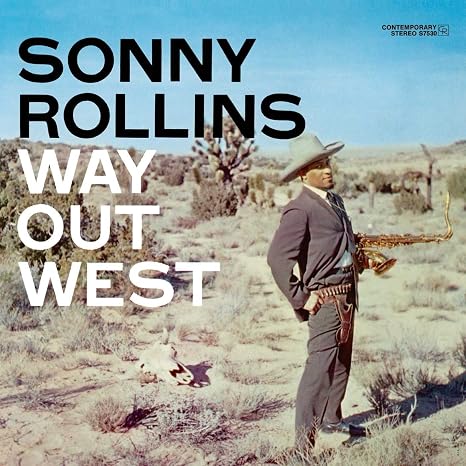
Sonny Rollins Way Out West


One needs to dangle some glitter when we talk to congressmen, or votes or something. Thus I'm an alchemist searching for Black Gold. They told me it was a goldfield; it turns out that it's an abandoned coal mine in Pennsylvania, a dud concession. Still I've heard there are good things Out West on the frontier, that area called the internet, that web style I need to adopt. Thus the Low End Theory is a work in progress and one could easily get taken to the cleaners by the loaded dice of the other players.

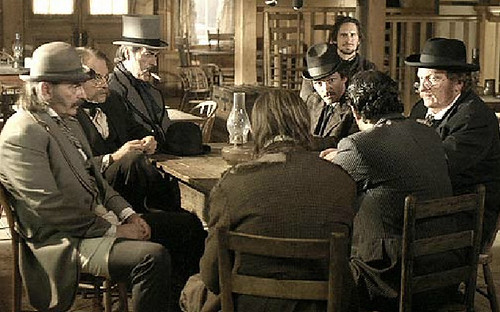
Deadwood


Everybody wants their cut and, if you can tilt the playing field at whatever level you reside at in the network ecosystem, it makes sense to do so, especially if you are judged every quarter by the baying hounds of Wall Street. If you take the market view, the lobbying capabilities of large corporations, a long history of regulation in this sector, and governments' existential need to pass laws or exercise control or compliance of some sort (whether in the name of security, expedience or getting things done) are going to weigh heavily.

We engineers have been lucky to have built enough of the internet and web infrastructure before the lawyers, lobbyists and governments realized what was there. The underlying architecture has proven sound enough to have scaled several orders of magnitude and looks set for several more as the next few billions of humanity come on board. The fact that the internet (after three decades) and the web (in its second decade) are now treated as infrastructure says it all, and this is a Good Thing ®.

The language is also important, and I continue to wince at George Gilder's revolutionary talk although he is now (slightly) chastened. My reading is that we need to emphasize a sedate, gray-suited discourse to keep the bankers and traders happy and the loud "content" industry at bay. Infrastructure should be boring despite the breathless prose we see in the business rags. Technology was made prematurely sexy in the dot com era; the implications of technology are what are important, not the technology itself. The markets for cement and most other commodities don't raise eyebrows and nor should networks. The logical lesson of the end-to-end principle is that communication networks are about connectivity, everything else is gravy.

I'll suggest then that normalcy is what engineers should aim for in this discussion. The Generative Internet is a good contribution to the debate as it is rooted in an understanding of the engineering insight of the end-to-end principle and the way platforms are developed and evolve. The dissection of the personal computer industry is instructive too as an argument by analogy in the technology world. The exploitation of Moore's Law and the black gold of silicon, the sweet spot of the mass-market where Intel and now AMD have been able to make hay, the platform effects that Microsoft has been able to leverage in the mass market etc., all these continue to drive that Great Game.

The weakest part of Zittrain's paper is where he declares that the end-to-end argument needs to be superseded and that "end-to-end does not fully capture the overall project of maintaining generativity". The primary reason for this postulate is the rhetorical strawman he constructs of end-to-end neutrality. Those advocating what they call "network neutrality" are simply being cute. They are implying, for quite pragmatic and rhetorical reasons (read effectiveness of lobbying), that there are no costs to neutrality; that neutrality is value neutral. It's a nice trick as far as framing a debate goes, but it is a trick nevertheless and it should be discounted accordingly.

Odlyzko has noted that spending on communication services (and especially the connectivity component) is huge, dwarfing many other segments of the economy (and before Rumsfeld's folly it was even trending towards the amount spent on national defense in the United States). Those vested interests and a $300 billion dollar sector will buy lots of slick rhetoric and astute framing. Zittrain carries on to suggest that the inevitable endpoint of the end-to-end argument is a network teeming with, on the one hand, viruses and spam and, on the other, silos and walled gardens. Having raised the spectre of these undoubted bogeymen that obviously need regulation, we then require new paradigms and frameworks.

This is either misguided or flawed, depending on where you stand. The end-to-end argument, as restated in the low-end theory, stands up well to these charges. It is an argument about lowering coordination costs. Nowhere is it acknowledged in the original paper that there are no costs to be borne, or that there is any such thing as end-to-end neutrality. To take a concrete example of engineering expediency at work consider the implementation of congestion control in the TCP/IP suite of protocols. This is characterized by some purists as a layering hack. The upshot of current practice is that we have repeated injunctions for other network applications to be "TCP friendly" in order to preserve the commons and the kind of congestion collapse that was observed as the internet began to see increased usage in the 1980s. We can and do embed functions inside of the network systems that we develop and sometimes we even cross layers if necessary, this is simply pragmatism at work.

Thus the very premise of the end-to-end argument is that this is a matter of tradeoffs and decisions about who bears costs. Engineering decisions are never neutral, the low end theory is political and is competing with different styles in the marketplace. Its emphasis on favouring participation over control simply aims to tilt the marketplace in a direction that encourages externalities to accrue to the end rather than the core. Similarly layer stripping as a design principle in the core is about reducing complexity. In other words, it suggests a strategy for those who run the network about how they can reduce their operating costs and accrue their value in the marketplace.

Lastly I'll note that everybody has to deal with gremlins and parasites and, as Cory Doctorow has noted, "all complex ecosystems have parasites"; they are transaction costs in every marketplace. Things always fall off the back of a lorry, the banking sector tolerates a certain level of fraud etc. Further, these transactions costs are acknowledged upfront in the end-to-end argument. Also, the empirical evidence throughout human history is that silos and walled gardens (from the Berlin Wall to CompuServe) are unsustainable in the long run and that it is shrewd to bet on participation over control (and I hope Burma and North Korea don't give the lie to my optimistic outlook). Still this prognostication is only a small part of Zittrain's remit and perhaps detracts from his wider argument.

I'll acknowledge here that linguistically the generative internet is a good coinage, and perhaps it even works better than End-to-End when pitched to the average congressman. This suggests to me that the enduring value of Zittrain's analysis is likely to be in the branding of the debate. Still as the lawyers and economists gear up and build up their legal frameworks and paraphernalia of economic models to throw at us about the design of networks, we engineers should confront them with prosaic notions of building communities and enabling conversations and marketplaces. I hope the Low End Theory can similarly enrich our vocabulary in this light.

We do have secret weapons in this debate... My grandmother is a surprisingly fierce and effective lobbyist when she puts her mind to it, on topics that sometimes mystify me. Her desire to interact with her progeny and to get on the web to converse with us should not be underestimated. The evidence is clear that she'll even tolerate any amount of spam and the ever-present gremlins and parasites that prevail - in moderation of course. More generally there is the desire to reconnect with old friends (and perhaps old flames), the socialization impulse that lurks in all of us. This is why I try at every opportunity to advocate pragmatism and that we strive to build Sexy Mom Factor Software. Where soccer moms are the demographic the politicians go after, in networks we need to encourage the Grandma Lobby like those cunning financial folks who went after Scottish Widows.

To conclude, participation is winning out over control for the moment, but it is the eternal struggle and I am hoping that the current ascendancy on the internet is not a temporary respite. As with democracy in the Great Game of Politics, eternal vigilance must be our watchword. And to paraphrase he of blood, sweat and tears
End-to-End systems, or Stupid Networks if you like, are the worst form of networks except for all those others that have been tried.
The story is the same as it ever was in the Great Game of Networks and I argue here that the Low End Theory is King, or President, if like me you are a republican (with the lowercase r).

Postscript


I've decided that I like the freedom I've found living within the constraints of a series hence I'll cast this note as part 1 of The Great Game of Networks Series which itself is an offshoot of The Great Game of Technology Series which I hereby retroactively announce. The latter series started last year with some musings on The Great Game of Chips.

Soundtrack


The Low End Theory soundtrack once again comes courtesy of A Tribe Called Quest's 1991 album.

The Low End Theory by A Tribe Called Quest


This time we'll hum along to Jazz (We've Got) and nod our head's to Ron Carter's bass:
Stern firm and young with a laid-back tongue
The aim is to succeed and achieve at the age of 21...

[The internet hit the prime time around the age of 21 with the arrival of the web]

So push it, along, trails, we blaze
Don't deserve the gong, don't deserve the praise...

[innovation and manufactured serendipity continues]

A brand new twist with the homie-alistic
So low-key that ya probably missed it...

[low end should be low key infrastructure]

Competition, dem Phifer come sideway
But competition, dem must come straightway

[violators need not apply, we can see you coming]

I take off my hat to other crews that intend to rock
But the Low End Theory's here, it's time to wreck shop

We've got the Jazz (x4)


So peace to that crew, and peace to this crew
Bring on the tour, we'll see you at a theatre nearest you


Next: Disruptions in Networks. Ergo, what's there to leverage?

Print version

File under: , , , , , , , , , , , , , , , , , , , , , , , , , , , , , ,

Saturday, June 17, 2006

Ecstasy = Ghana 2 - Czech Republic 0

We're not tourists... That's what I'm talking about. And it should have been 4-0 or more.

My uncle, who has never traveled outside Ghana in his life let alone been aboard a plane, managed to get a visa and ticket to attend the World Cup with the rest of the family. When he showed up at the airport for his long trip to Frankfurt, he was dressed in white from head to toe.

I know exactly what he meant.

Hotel Hi-jinks


[Update 2 hours later]: My family have somehow made it to the party at the team hotel. Pandemonium is the only word to describe what is going on there. I could barely hear them over the sounds of jubilation. I can't even imagine what the streets of Ghana are looking and sounding like. We are mindful of previous premature celebrations but for now it is only elation.

Wedding Toli


[Update a day later]: This is some toli I can't pass up even if it might cause a continued paternal boycott of this joint...

It was my cousin's wedding yesterday back in Ghana. For some reason, the ceremony had been scheduled at a time, 4:30pm, that overlapped somewhat with the football match. I'm assuming that things were set in place months ago, hence I'll reserve comment about foresight and the like. In any case, she and her groom were standing at the altar and the Reverend was delivering her encomium (in addition to her pastoral duties, the priest was a senior member of the Ghana Educational Service). All of a sudden there was a shout from the congregation. A text message had undoubtedly been delivered: Ghana had scored a goal. I believe it was the second goal, the one that put the result beyond any doubt; most of the guests had watched the great start of the match and had been in good spirits, if a little nervous, throughout the ceremony.

Hallelujahs then poured forth from the church seats and the Reverend began pronouncing all kinds of glories from the altar. There was singing and dancing in the aisles, alarming my father and uncle who are of the more sedate school of establishment propriety. With the priest's encouragement the congregation then went into joyous hymns. As my dad put it "they actually proceeded to sing two full choruses". My dad refused to clarify what praise song it was that was sung, or indeed whether the couple joined in, but you can imagine the commotion. After that celebratory interlude, the ceremony resumed and the couple was duly and quite properly married. As they left the church, the match had ended and the big party that Ghana embarked on last night began. I can't wait to see the video footage of their wedding, these ceremonies are so important in our traditions and we strive to bear witness even if football intrudes. Still, I now know that part of my wedding gift to them will be the DVD of the match that they missed but lived through.

I'm told the ensuing reception was wonderful.

Original Toli


It turns out that my mother has returned to her journalistic roots for the month at hand, and has been writing up her experiences as a Ghanaian fan attending the World Cup for the Ghanaian Times. The first of her dispatches has been posted online and the ones about the Czech game should be up shortly at the Times website. You can get a taste of the original toli monger with her World Cup Diary and see where I get my lines from.
  • My World Cup (Part 1: Preparations and Part 2: The Italy Match)
    "GHANA", we shouted, "ITALIA" they shouted back, they were the most good humoured group of fans you had ever met.
  • To The Shout Of "Ghana", You Respond "Respect" (Part 3)
    There was a determined Swede who appeared intent on making me strip so he could have my top. Fortunately for everybody and the horses that might have been frightened, I am no longer that brave, so I only gave away bandanas.
  • Firmly On The Map (Part Four)
    It is the Czechs who are asking the most questions. Losing to Ghana had not been on their agenda, but now that they have lost, they are very keen to know who we are, and so are their friends.

Pandemonium


As is my custom, I'll offer a soundtrack:

Pandemonium


The first track of The Time's great 1990 album Pandemonium is called Dreamland and that is where some 20 million Ghanaians are living right now.

The soulful and funky "Minneapolis Sound" wrought by the Purple One, Jam and Lewis, Morris Day, Jerome Benton and Jellybean Johnson sharply suits our purposes here.

As the former Gold Coast, we are quite partial to things that glitter, thus it is fitting that the Black Stars can rest tonight with a ballad titled Donald Trump (Black Version).

Ghana's greatest export being cocoa, it goes without saying that the first side ends with the aptly-titled Chocolate.

World Cup Croissant, Bacon and Eggs


I'll conclude with a look at how breakfast is served during the World Cup. There's been a slight adjustment to my previous setup after some suggestions from toli readers. A card table was manufactured from the basement and moved to the living room allowing hunger to be assuaged, a more comfortable desk arrangement for any computer activity, the use of my comfy office chair, and most importantly, satisfactory world cup viewing. The Wife seems strangely supportive of this business, bless her.

world cup croissant bacon and eggs


File under: , , , , , , , , , , , , , ,

Sunday, June 11, 2006

Dilemmas

The following case study came unbidden, and thoroughly disrupted my carefully arranged plans. I tend to accept these twists of fate these days. Thus I give you a diversion that I nominate as Part 10 of the Things Fall Apart series, another entry that falls under the banner of Social Living. Do let me know if it fits the bill.

An Examination Question


Date: Saturday June 10, 2006
Time: 8:55 am EST

Problem Statement


You are manager of Toli inc., a small but growing concern. The following situation presents itself to you. Discuss how you would resolve the various competing concerns. Provide enough detail to satisfy the reporting requirements of the Sarbanes-Oxley act in light of the corporate history of Enron and recent judicial verdicts.

Constraints


Hunger: You haven't had any breakfast although you woke up at 6 am on the dot as is your custom this time of the year. The reason for the delayed breakfast. Well...

Dying computer: Your desktop computer has been giving you fits for the past 3 hours as the power supply cuts out every five minutes as a result of being subjected to one too many lights out. More disaster recovery in prospect.

Laundry: There are at least 3 loads of laundry that need to be washed if you want to have something to wear this evening beyond tracksuits.

World Cup: the England vrs Paraguay match starts at 9am. 5 minutes.

French Open: the women's final starts at 9am. Or has it started already? Henin-Hardenne against Kuznetsova.

Day job: Need to check in the code that you promised the team this week. You want to be the Karl Malone of Lotus: "The Mail Man, I deliver". Prospects are dim.

Marriage: Desire for quality time with The Wife. 'Nuff said.

Groceries: Probably a good idea to do. See also: marriage.

Family: The mother-in-law is in town. You should see her sometime today. Also: need to do weekly phone calls to Ghana and all the cousins and friends. You remember that 8 members of the family are due to head to Germany today to support the Ghana team. You need to find out whether they got visas. Basically, catch up with people, talk football.

House: A mess. See also: mother-in-law.

Reading: you normally curl up with a book or three on weekends.

Futures: The Great Move West beckons, you have a month or so to finalize on the moving company, pack your apartment, and purge your possessions. Would be good to get a head start. See also: house and marriage.

Bills: The usual suspects need to addressed. Corollary: day job.

Preliminary Solution


Prioritize: football, laundry, house, mother-in-law, bills, reading, The Wife, day job, hunger (you'll work the rest out later).

Risks: marriage (justification: "in good times and bad"), day job (justification: well it is Saturday), tennis (life is like a box of chocolates), groceries (whatever), The Move (next week).

You're an engineer but technology can only help so much... You could use a Tivo, but even if you had the prescience to have bought one, it would only be good for pausing if you have to run out for a minute. With an event like the World Cup, you can hear the screams of people in nearby houses and in your building. Your upstairs neighbour, like you, is living every moment of the matches and your ceiling felt every half chance yesterday. Unlike that guy at the office who got his Tivo installed on Monday, you have procrastinated. You don't even have VHS tapes to record the games on your old vcr. Also your old TV doesn't have split screens. In any case, you don't like switching during football matches. Well maybe rolandgarros.com, there's an idea: laptop deals with tennis and day job in one stroke...

The immigrant workers outside your window have a radio blaring as they work, so they too are in the mix.

workers outside

The Set-Up


1. The TV situation


Yesterday you started looking into the furniture business and adjusted the TV stand so that the angle is more amenable for long term viewing. Final is July 9th.

Within reach are two of The Wife's travel neck pillow things. They might come in handy since you are using your 10 year old bachelor futon: furniture from hell and source of chronic back pain and worse. Resolve: Burn it during The Move.

You have six pillows to fashion the futon into some semblance of comfort.

Remote control for switching back and forth with tennis. Check.

Sleep cloth, Dutch wax. Check. Good Ghana boy.

New cell phone. Check. No longer a high-tech Luddite.

high-tech Luddite


Cordless phone for landline. Oops. Need to recharge it. Head to study.

Broom. Within sight.

2. The Laptop Configuration


You don't like to use laptop keyboards for extended periods, you normally use a full-sized keyboard and monitor on your desk in the study. This situation however calls for a laptop intervention.

You borrow The Wife's Cool Pad to prevent the scorching of the family jewels. The wireless access is all set... You decide you need to order one of your own pads. You open up a tab in the browser, search for "Cool Pad" at Amazon... open up another tab for Froogle "laptop accessories pad", another one for PriceScan

You get up to grab the laptop power cord from your study, you don't want to run on battery today.

3. Reading Material


1 copy of Friday's New York Times. You only buy the hard copy on Fridays and Sundays and don't have home delivery, it forces you to go to the convenience store to commiserate with that Persian guy about Dubya bombing his hometown two weeks before the upcoming November elections. Jesus wept. You bought said copy during the hour between games yesterday but have only read the front page... Remaining: the arts section, Krugman and that whole Zarqawi thing...

Kwasi Wiredu - Cultural Universals and Particulars, An African Perspective. Some philosophical reading for the theme for your Social Living series.

Madison Smartt Bell - The Stone that the Builder Refused. You've been carrying this novel around for two weeks and it's getting great. Haiti. Toussaint L'Ouverture. Napoleon. Revolution! Things fall apart.

All set for World Cup.

9:02am. Laundry. Quarters. Quick: downstairs. 5 minutes to go.

World Cup setup

The Match


9:06am. Couch. Remote. TV. Okay.

American TV channels don't show the build up of the games unless the US is playing, the broadcasts start on the hour so you only get 7 minutes of pre-game commentary. There's barely enough time for analysis and you don't get to hear the national anthems unless the US is playing... And then there's the fact that if it's on ESPN there's that annoying ticker taking up the bottom of the screen. They are literally missing the big picture... Univision of course delivers on the comprehensive coverage but their image quality is worse and your Spanish? Well... ¿Se Habla Español? Well the game's on ABC today and they do full screen, so you'll try the English language commentary.

Sometimes you do want to hear the national anthems that the crowds sing, watch the players pretend to know the words, and soak in the tribal atmosphere. You've missed that today. Most Americans won't know what they are missing. Their country is becoming the Third World in the globalization sweepstakes, and some even seem proud about it... Well hopefully their team will do well in Germany and the underground football nation that I know lurks might manifest itself. Of course, I hope that Ghana will beat them handily, we need a little soul uplift.

Game on. Psyched.

Hmmm... the Paraguayan goalkeeper sustains an injury and has to leave the game.

The American commentator notes, "this is the second fastest substitution of a goalkeeper in World Cup history".

What the hell? You yell at the screen, "What does that have to do with the price of potatoes? This isn't baseball, football isn't a game of statistics."

Well anyway, experiment over. You promptly switch to Univision, they must be talking about things that matter. Anyway you'll need to know Spanish in Mexico, I mean California. (Justification: The Move).

It's a good game, England are looking great. Joe Cole terrorizing everyone, John Terry, Frank Lampard and Becks: the Axis of Solidity. Steven Gerrard, mon dieu. Peter Crouch: the hardest working man in the business... The whole team is shining and on the basis of this start, they could beat anyone. Meanwhile laptop on. Connect to Big Blue network, download latest build. Check rolandgarros.com.

Paraguay is keeping it close. Free kick. Beckham bends it...
"Gol! Gol! Gooooooooool".
Excitable announcer. Another one: "Goooooool".

Loud thumping overhead. A few shouts from neighbour. You shout. "Gooooooooooool".

Workers cheer from outside, must be Boston Irish or something.
"Here we go, here we go, here we go..."
workers safety


Sounds of Wife stirring in bedroom...
"Gol! Gol! Gol!... Bravo. Goooool... Impressionante... Bravo... Gol... Mundialiasta... La pelota... Gol!..."
Remote. French Open briefly. Hmmm... Back to football. Start thinking about your glory days.

me freshman football glory

Laptop down. Pick up newspaper. Put down newspaper, match is too exciting.

Half time. Mexican adverts come on, skimpy dresses, rhumba dancing, eye-candy. Hmmm, you really need to learn Spanish... Still, remote: switch channel to French Open. Henin-Hardenne ahead. Whatever. Come on Kuznetwhatever. New York Times, now on page 4.

Oh! Laundry. Time to change the loads. Run downstairs.

Back upstairs. Hmmm. Hunger, food. Let's see...

Wife is up and about in the kitchen and looking grim... She's having breakfast but with that butter knife in hand, you need to tread carefully, you might get the macho treatment.

You try small talk and start muttering something lighthearted about the World Cup, widowhood and dilemmas... and begin to explain the various things on your plate, and talk about the match so far.

"You should eat", she says.

Good idea. More small talk... The food preparation business is not going too well, you turned on the kettle for the tea, but there was a noise on the TV, so you run there. False alarm, excitable commentator. You head back to pick up the toast. The broom is in your other hand. Start sweeping. Meanwhile more banter about glory days long gone...

me freshman football


You hear: "You're all over the place. You can't go on like this... not a bachelor anymore... A mess..." You nod your head and reach for the butter knife. Fridge. Marmalade. Milk.

The Wife is off in a huff (see also: evil eye). She comes back (avoids your eyes), grabs her laptop and heads for the bedroom.

Yesterday was your boycott day, it seems she's taken your message to heart and is boycotting you today.

Whatever. Justification: The Shankly Code (Shankly, Bill)
"Some people believe football is a matter of life and death. I'm very disappointed with that attitude. I can assure you it is much, much more important than that."
Second half is starting. There's the day job business. Food, laptop, cushions. Remote. Check French Open briefly. Switch. Watch.

10 minutes later, she shouts your name....

"What's up?", you yell between munches.

"I sent you an email".

Uh-oh. A deft multi-tasking effort now takes place.
  • You put down the slice of buttered toast and marmalade and the bowl of Frosties (well Frosted Flakes in the US; the same Tony the Tiger, they're great!)
  • You turn to the laptop, note that the build has long since finished downloading, start the install.
  • Switch to Firefox and open up a new tab.
  • You note that Peter Crouch just got a yellow card... Damn... England are looking like the most interesting team in the World Cup but yellow cards might be their downfall. Gerrard and now Crouch?
  • You click on the Gmail icon in the browser toolbar.
You take a guess on the title of the email that should have shown up in your inbox:
Ultimatum.
Once again The Wife proves her fortitude and you read
From: The Wife
To: Koranteng@Toli

Subject: Fwd: The World Cup at the Enormous Room

Maybe you can see the match with some friends... Maybe I can meet their widows.

---------- Forwarded message ----------
From: Soul Africa Bulletin
Subject: The World Cup at the Enormous Room
To: Boston Crew

Greetings,

The Enormous Room is hosting live Telecasts of the 2006 World Cup every day for the month of June. The 12 pm and 3pm games will be shown live. The 9am games will be recorded and played after the 3pm games. The bar will be open, but the kitchen will not open until 5:30pm. Feel free to bring some lunch.

see you there.
You smile. Great idea, the Africans in Boston are rallying... Commerce mixed with community. You could do that tomorrow and for the rest of the month, you vaguely hope they have Wi-fi so you could perch there during the work day. The World Cup is a 9 to 5 occupation for a month every four years, you wish you could get paid for it. Still there's no time today.

You fiddle around, back and forth between the Bloglines and delicious tabs, copying and pasting links and titles of things you remember reading yesterday.

You compose the reply in Gmail and hit the send button
From: Koranteng@toli
To: The Wife (Disgruntled and long-suffering)
Subject: Widowhood

Great idea...

See also from my internet friend Noel and his wife Elissa.

Avoiding World Cup Widowhood

Avoiding World Cup Widowhood -- a Guide for the Uninitiated (pdf)

Close game so far.

Cheers.
Back to the game... Paraguay getting close. What gives with England?

Day job: not much progress. New York Times: nope, too tense.

The game ends, England wins... A Google search about your nagging concern "World Cup 2006 yellow card policy first round", nothing obvious.

Ah yes, remote; you switch to the French Open... Henin-Hardenne wins the last point and throws her hands in the air 6-4, 6-4. She deserves it although you prefer Kuznetsova. Better luck next time.

What do you do next?

You head into bedroom to face recriminations.

They are blistering as expected... "In good times and bad". You're in a good mood so you continue with the small talk: lots of things that you're juggling today, talk about the match.

It's not working... Whatever. More football banter... Still not working... more football banter, reminisce about distant glories....

me pennypacker crew victorious


But then she softens for a moment at your evident enthusiasm and asks:
"When is the next match?"
"I don't know, I have to check."
"12pm".
One hour to go before the next match...

Arrggh! You forgot the laundry. You turn. Vague thought: you can't do the groceries in that time... after the next match maybe.

You gather up the towels and such for the next load... You would have washed the sheets too but you don't fancy your chances of survival if you try to remove them while The Wife is lying in them...

You rush down to get to the laundry before that other desperado you met at half-time gets there (you recognized the type, he's also doing laundry and watching the game).

Made it... Arggh! You don't have enough quarters... remember that inflation calypso you were singing six months ago... prescience huh?

You run back up to get some quarters, you almost trip on the narrow stairs.

You steady yourself... there's no need to rush, nice and slow. Quarters. Back down the stairs.

You nod your head at the guy who arrives as you put the quarters in...
"Good game."
"Yeah, England might well win the whole thing."
"Those yellow cards though. Do they carry over?"
"I don't think so. Google it."
"Will do. Again."
You start humming Jerusalem as you walk slowly back up the stairs, it's been on your mind recently
And did those feet in ancient times
Walk upon England's mountains green
You break out in full song as you open the door to the apartment.
"..pleasant pastures seen..."
Hold on, the Belgian national anthem is playing on the TV, the trophy is being awarded.

You settle down on the sofa and take up the cool pad and the laptop
".. builded Jerusalem..."
Kuznetsova is praising Henin-Hardenne. Justine looks as cool as Belgian beer and chips.
In England’s green and pleasant Land.
End of hymn. You need some more music... but the remote for the Rotel amplifier is out of reach, and the universal remote that you have doesn't control said Rotel amplifier, they said it was universal.

That Rotel remote is the worst remote you've ever had the misfortune to use, you remember that you were going to blog about its design flaws at some point. Laptop, you open up Notetab, open toli-ideas.txt and write this nugget down. Later.

So you do the next best thing, you start to sing the next hymm in the Boycott Hymnal: To Hunt the Wren
How will you kill him?
With sticks and stones
You have 54 minutes before the next game: Trinidad and Tobago against Sweden... Now you're talking, The T & Ts are the Dream Team in the World Cup, there's a shortage of Trinidad T-shirts. Like the Ghanaians, Togolese, Angolans and Ivoriens, they are in it for the first time...
ghana road to germany 2006


Oh yes order the cool pad, it worked fine. Lets see... Where's that credit card?

Portugal will be playing Angola somewhere near the town of Marburg. You take pride in that you see things that others can't. You hum along:
Hatchets and cleavers
Honouring his bones
You decide to do the dishes. Ah yes, the kitchen. Then sweep. Then you'll run to the convenience store across the street to get some blank VHS tapes talk with the guy about his relatives in Tehran and their preparations.

The question is what do you do when you come back?

You've just read the answer.

See also Ecstasy

File under: , , , , , , , , , , , , , , , , , , , , , , , , , , , , , Risks: Day job, perception. Next: Ghana vrs USA

Thursday, June 08, 2006

Boycott and The Gospel of Toli

I received a note that I almost discarded so slight was it. It was quite troubling at first glance and I reproduce it here in full; make of it what you will.

Part 3 of the Boycott Day Trinity

The Gospel of Toli


Recently scholars unearthed a scorched parchment underneath a library located in bowels of the slums of Nima, in Accra, Ghana. It was found by a young child, Wednesday born, who was playing football (also known as soccer to our American brethren). Barefoot and wearing a tattered Stephen Appiah-labeled Black Stars jersey and khaki shorts (he was skipping out of the library early), he stumbled over a wooden plank that was jutting out of the side of the adjacent chop bar, Mama Opus's Spot. At the sound of his alarming cries (something to do with nails or something), the elders were summoned to investigate the stigmatized youth and they uncovered a heavy wooden chest that led to a serpentine series of catacombs that run under the library and the nearby compound, owned by a wizened retiree who refused to give his name "What is a name after all?", but who, we have since learned, goes under the moniker of Kweku Ananse.

The paths delineated by these tunnels run along the Prime Meridian. It is well known that the line of the Greenwich Mean Time runs from fair London to the heart of darkness in Africa and passes through Nima, that dank armpit of the Dark Continent. Inscribed on the last page of the scrolls that were later discovered was a barely decipherable scrawl that handwriting experts now believe reads: The Gospel of Toli. After painstaking forensic investigations over the past 33 years, including the delicate removal of 6 films of Palm Wine, Schnapps-encrusted dust, and several layers of used kelewele oil, National Geographic is proud to exclusively announce the preliminary findings of this extraordinary and idiosyncratic document which will cause humanity to question its received wisdom. We intend to serialize the scholarly findings in the magazine.

Apparently negotiations are in progress and several Nollywood studios are leading the bidding for the inevitable film treatment. Samuel L. Jackson has been said to desire the role of Papa Ananse and that well known former child star Jamie Bell was also said to be seeking a role portraying the Messiah figure. It was unclear who the frontrunners were for the female leads, the Proud Marys of the plot although Tina Turner and Patti Labelle were whispered to be in the mix. Do note that any leaks on this topic in the so-called blogosphere should be treated as Gnostic misdirection.

The text of the Gospel hews quite closely to the Torah although there are some striking divergences in parts. The first discrepancy in this Apocryphal Gospel concerns Genesis Chapter 2 which has long been thought to read:
Thus the heavens and earth were finished, and all their multitude, And on the seventh day God finished the work that he had done, and he rested on the seventh day from all the work that he had done
Verse 2 has been radically transformed in this "extraordinary rendition" (termed for some reason in this arcane script: erustication). The verse now reads
Thus it was written that on the seventh day God grew so frustrated with things that she engaged in a boycott of all the work that she had to do.
The Good Pope, the erstwhile Cardinal Ratzinger, was said to be studying the issue closely, and his spokesman assured us that an encyclical would undoubtedly be forthcoming from the Holy Church.

Anonymous sources close to the papacy, who asked for anonymity because they wanted a Rove/Libby style protection, were quick to weigh in on the matter to our intrepid reporters.
"First of all, there's the issue of the gender of the deity. If the "s" is confirmed to not be an oily smudge, it would challenge 20 centuries of past practice, and cause us to re-examine the previously thoroughly-discredited Magdalene Propositions in a new light. Further, the notion of a boycott could be construed as an existential threat to the very authority of the Holy Church, a challenge on the order of Martin Luther's Ninety-Five Theses. About the only constructive insight I can find in this tendentious note is that God still has work to do for humanity. Lastly, I am very curious about one of the hieroglyphic symbols that is used throughout the text. The best translation seems to be a biblical concept similar to modern day voice mail. That is deserving of further study and this is where we are concentrating our efforts".
The remainder of the chapter is reproduced exclusively below. Further epistles will be featured exclusively in National Geographic and accompanying DVD and official website.

The Boycott Parable


That's it. I'm opting out. I've had enough. How the hell am I going to remember this many passwords, changed this frequently, at these irregular, staggered and idiosyncratic intervals, with these many different, obscure and undocumented restrictions, with all these different regulations on how often one can repeat said passwords and usernames? Oh sure I can, and do, use Password Safe to manage these things but still, having reached 50 different passwords for the various applications and databases I use, I might be changing things every week...

And now this insanity is being applied to the voicemail systems, increasing the length of the passwords beyond comprehension. I'm supposed to type this absurdly long and ever-varying chain of alphanumeric characters on a numeric keypad? Usability right? It might have made sense on paper to "strengthen password requirements" but did someone actually try to enter that many characters on that small a device?

I give up.

The figures are there I'm sure; someone deep in the bowels of the corporation can calculate the amount of help desk incidents devoted to resetting passwords. Or maybe not, that could well be an outsourced component. In all likelihood this same recipe is cooked in all companies

The Regulation Twist

  • Apply some IT Corporate security standard or other. The actual standard doesn't matter, the most important component is the security bit.
  • Lather with some bureaucratic bromide from the ivory tower, "Operational execution" or similar
  • Rinse with an outsourcing and "efficiency" rationale, belt tightening "to beat this quarter's numbers".
  • Sit back and watch employees do the regulation twist.
I'm working on a toli remix to update the song and dance with a funk break beat; I never realized that the phrase and phenomenon of breakdancing was an ironic commentary on modernity and ludicrous "traditions".

The Great Game of Sarbanes-Oxley, Homeland Security or IRS regulatory arbitrage proceeds apace - a typically American corruption of process that leads to dysfunction, to sleaze at the seams, and absurdity in general.

I know I'm tilting at windmills here but I thought that we were about emphasizing the people while paying lip-service to the process. (Cheers Coté).

Arrggh.

To all correspondents (and that includes my managers and co-workers), don't bother leaving me voice mail messages any longer. It's not worth it, I can only get my password reset so many times before I get disheartened. My job description didn't include daily chats with the help desk - at least I can't recall that in the pitch twelve years ago. I can hear it in the voices: "It's him again... let's take bets on how long until we speak to him". I can only be apologetic or suitably shamed so much and I've long passed that threshold of woe. I have some sense of honour, even if I'm always smiling and nodding my head... From now on try instant messaging or email or something. And even with this last I can occasionally find your signals amongst the noise of spam and officious notes. As I look at the inbox, I note:
"Your action required!"

"Your [redacted] password is about to expire"

"Your [redacted] security token will expire in 14 days"

"Important - Please read [redacted something or other in breathy tones] ...
Sidenote: I wonder why the inbox still stands at around 3,000 unread. Hmmm.

"They", that amorphous they, have finally made the barriers to entry too great and I'm demurring. I thought we were championing Sign-on Simplification in one of our Great Initiatives ™. That can't come soon enough.

I can pinpoint the moment Lotus stopped being Lotus. It was a gradual process and ironically "process" was the culprit. Was it the computer security requirements? Was it that "mandatory legal training" thing to which one needed to breathlessly comply "by tomorrow" (on top of the Business Conduct Guidelines we sign off on every year without fail)? Are we like the American army in Iraq, 3 years into a war and now having to undergo "values training" and re-education about "quaint" Geneva conventions? After a while all these processes became overbearing and I knew I was no longer in Kansas (or Cambridge) anymore. Oh sure I do get work done and I've installed those compliance-checking software thingimijigs (a.k.a. corporate-sanctioned viruses) on (one of) my machines. Still this whole Trusted Computing rhetoric sounds Orwellian...

That layer stripper Bill DeHora was going on recently about web frameworks, terraforming and such and the technical arteriosclerosis analogy is apt for organizational behaviour
It's remarkable that something like a website can have a geology, layer after layer of frozen accidents. Integrators will be used to seeing that in non-web systems. But the difficulty is you can't terraform this kind of site - reskinning means editing every single page.
We seem to be freezing processes in place as part of some intelligent design scheme, I'm hesitating here in believing that it is accidental evolution, it's rather a terraforming (or is it terrorizing?) of corporate peons. There must be a reason that that show called Office Space has been so popular or that Dilbert speaks so deftly to the world every morning.

In queuing theory and operations research one of the key things we try to measure is the balking rate, that is the proportion of users in a system who refuse to join the line or perform the task, and leave for whatever reason. In physics the analogous concept is branded as dark matter and apparently the majority of our universe is made up of this substance. It's been over a year and I still haven't finished writing that article on the dark matter of communities but it looks like I'm accumulating source material daily in my company conclaves. If you want us to use tools to get work done, don't make the process so overbearing that we balk. Or perhaps that's the strategy, as in politics, if you make things distasteful enough, perhaps you can appeal to apathy in your opponents and your motivated base will be the only ones that show up on election day.

Then again, and I repeat myself here, there was that email that I received a couple of years ago asking me to validate that I really did need my office phone (Bean Counting on a mission to Planet Absurdity). And while repeating myself, this is a matter of community dynamics:
The identity of a community is to be found in the most unlikely of things. The things that draw people together to form a cohesive whole are not the explicit things that one thinks, it's not a kind of warlike territoriality or dedication to some mission statement or other, it is rather in small insignificant items that the tribal instinct is articulated.
What are we saying to ourselves when we let patently-ridiculous processes run our lives, when we live in fear of an amorphous "them", when we huddle together and decide not to make waves.

Ben Hyde who makes it his business to study organizational politics and networks recently pointed to an old piece about Exit, Voice and Loyalty that is worth repeating
Members of an organization have three broad choices about how to respond when the organization goes into decline.
  • Exit - They can leave.
  • Voice - They can argue for change.
  • Loyalty - They can remain silent and loyal.
It would be a stretch to say that a company is in decline based on contortionist password requirements for voice mail and I hope I'll be taken to task for even indirectly suggesting as much (for the record, and for gospel readers who can't get by the rhetorical filter, I'm not suggesting so). Still what is it that they say about canaries and mineshafts?

Having read The Organization Man, I am mindful of leavening my dissenting voice with the necessary amount of honey or satire to make it go down well, and agitating for sanity by considered argument, running code, and the occasional call to arms. Still when you focus on small things as your strategy you often loose heart at the repeated losses in your daily battles. I do try to choose my battles with care and I hope this voice mail business isn't my last stand, last straw, or tipping point following Mr. Gladwell.

The Boycott Epistle


  • Elmore Leonard - Last Stand at Saber River

    Elmore Leonard - Last Stand at Saber River

    This is one of "Dutch"'s great westerns, taut, stark and poignant. Like the major protagonist, I just want to be left alone minding my flock and family or something and getting work done.

The Boycott Hymnal

  • Jerusalem (traditional)


    My second favourite hymn is Jerusalem with words by William Blake. My family is fairly secular in its religious traditions with an interesting mix of the devout and the dissolute. The one thing we have in common is a love of hymns. Even the Fabian Socialist types will sing along with the Presbyterians, the Anglicans (Episcopalian for the Americans), or even the normally sedate Quakers and part-time African traditionalists. It is quite interesting that Jerusalem unites us, especially given the lyrics.
    And did those feet in ancient time
    Walk upon England’s mountains green?
    And was the holy Lamb of God
    On England’s pleasant pastures seen?

    And did the Countenance Divine
    Shine forth upon our clouded hills?
    And was Jerusalem builded here
    Among these dark Satanic Mills?
    In boarding school in England I had a friend, Adeel, from the United Arab Emirates, who used to chafe about being forced into our daily chapel services. He was becoming quite a devout Moslem and used to get into furious arguments with House Masters and such about his attendance. The Brits don't believe in separation of church and state and, in an independent school, we know well what force his words carried. We had fought similar battles to no avail but we watched the conversation with amusement over the two years we were classmates. It was always incongruous to me, that my Third World crew of friends would spend our days learning about the outrages committed against our ancestors in the colonial past and post-colonial present and that we would then gather every morning to sing about fair England and the like. Those missionaries got us with their hymns, psalms and that Song of Solomon business. As a sidenote: currently, one of the most popular ringtones in Ghana is the Hallelujah chorus.

    The funny thing is that both of us, Adeel and I, loved this hymn and we could often be found singing it aloud in the most inappropriate of places, sad fellows that we were, we lost a lot of credibility especially with the fairer sex... For some strange reason we loved the line about England's mountains green. I still do.

    I've been thinking seriously of late about this notion of pleasant pastures and perhaps I've been lucky to have found Lotus's equivalent in the community I've been working with over the past decade. On the other hand, blue industrial soot is looming large these days and reviving my childhood asthma... Still I take heart in Blake's protestant work ethic and existential defiance
    I will not cease from Mental Fight,
    Nor shall my Sword sleep in my hand,
    Till we have built Jerusalem
    In England’s green and pleasant Land.
    I must want to build Jerusalem or something...

    The dark Satanic Mills are password requirements and version hell.
  • To Hunt the Wren

    This traditional was the other standby around Christmas time at Aldenham although this was more properly a Boxing Day song. As I remember it, the lyrics were
    Where are you going?
    To Hunt the Wren
    This Christmas morning
    Calls for hunting them

    How will you kill him?
    With sticks and stones
    Hatchets and cleavers
    Honouring his bones.
    It's quite a bloodthirsty song but, sweetly sung, it is as soothing as a Spanish Inquisition. And why not bushmeat or grasscutter, I always wondered, even as I sung Alan Vening's arrangement? When was the last time an African hunted a wren? Still I feel like a wren these days with these passwords being the hatchets and cleavers honouring my bones. Not to mention that the song didn't conclude on an upbeat note, the bit at the end was about
    Yea and Requiem
    Yea and so Amen
    All together now.
  • Michael Jackson - Man in the Mirror


    Keeping things on the gospel front with a soulful tinge, we turn to Mr. Jackson's great anthem, one of my favourite songs of his.
    I'm starting with that man in the mirror
    I'm asking him to make that change
    If you wanna make the world a better place
    Take a look at yourself and make that change.
    There was a performance at which he was so in the moment that he dropped to his feet dramatically during the energetic chorus and split his shins which meant that he couldn't do all the usual moves and limped during The Way You Make Me Feel which followed.

    With regards to my theme, it is sad that MJ changed his appearance and that I'm now boycotting my voice mail. I don't quite think that that was the underlying message of the song but perhaps the Corporate Song booklet could be augmented with this track, especially that "take a look at yourself and make that change" line.
  • Al B. Sure! - Had Enuff


    Have you had enuff? Swingbeat ebonics from the great Al B. With his exclamation point on the Sure! serving as a precursor in punctuation prolixity to Yahoo!, this is an offshoot of the irritation playlist.
  • Prince - Golden Parachute


    This song, on the unreleased High album, is the current soundtrack of my low life. I do wonder about the faceless executives who signed off on the changes to the voicemail password requirements. I wonder about the nature of their pastures. Are they still with us in the commons? Do they have assistants that handle their telephony arrangements? Or am I the only one struggling with this? Can I get a golden parachute to cushion my forthcoming fall?
  • Abide With Me by Henry Francis Lyte (traditional)

    My favourite hymn hands down is Abide With Me, it has everything you could ask for, the lyrics, the melody, the comfort provided by the performance etc. Thelonious Monk did a 55 second rendition at the start of Monk's Music and that was when I knew that I loved Mr. Sphere. On that album, it was followed up with Well, You Needn't and that's the right idea for a boycott especially the point at which the exuberant Monk shouts "Coltrane". The rest is history and Monk is the truth.

    Thelonious Monk - Monk Music

Today is Boycott Day in this joint and with this, the third part of the Trinity, the Holy Ghost can be assuaged. I suspect that I've gone on entirely too long and crave your indulgence if you've read this far. Thankfully the World Cup beckons so maybe I'll shut up about these small things (for the next month or so)... Perhaps...

So dear toli readers: can I get a witness? What are you boycotting these days? Or to put it differently, when was your last boycott day? And when is your next one?

Boycott!

The Boycott Day Trinity is a minor diversion in the Things Fall Apart series.

File under: , , , , , , , , , , , , , , , , , , , , , , , , , , , , , , , ,