Showing posts with label bubble. Show all posts

Tuesday, January 07, 2025

The Master and the Sea

The great man, Master of the Royal Mint,
Was possessed by a seminal lunacy
Much to his chagrin, he lost most of his fortune in the damn'd South Sea
After first doubling his money, he became infected with animal spirits
The madness of the crowds, he'd plain forgotten the lesson of the tulips

He doubled down repeatedly,
Fully taken in with the heights of delusion
Plain greed overtook the age's premier scientist,
A whiff of collective hubris
For judgment goes missing in action when in the throes of a mania
The most dubious schemes seem to garner a golden sheen of hysteria

The erstwhile Warden of the Mint,
Who recoined the very fabric of the state
Someone so well versed in finance,
Considered the ultimate sophisticate
Days consulting on the search for Longitude,
Leading the Royal Society
A large retinue of servants,
Evenings entertaining visiting dignitaries

Enter the alchemists, the boosters, the miscreants and the storytellers
So compelling were their promises, there was no doubt returns would be stellar
Well he lost his shirt when the bubble popped,
along with many other notables
History would be an unforgiving judge,
indeed his dismay was ever quotable

That he poured half of his net worth into soon to be worthless stock
To great amusement in the House of Commons and the many press reports
A lesson for the ages this episode,
an alternative reading of Newton's Principle

"I can calculate the motions of the heavenly bodies, but not the madness of people."


M.C. Escher


After reading See also: A Seminal Lunacy

A Seminal Lunacy, a playlist


A soundtrack for this note (spotify version) ...

Timing is everything
Observers are worried


File under: , , , , , , , , , , , , , , , , ,

Writing log. June 21, 2022

Sunday, December 07, 2008

A Debt Foretold

Asked if she would use a credit card if one were given to her, Ms. Zhang looked confounded. "What's a credit card?" she asked, adding, "We have everything we need."

China's Economy, in Need of Jump Start, Waits for Citizens' Fists to Loosen
Indeed, I ask. Indeed. Ms. Zhang has vocalized the existential question of our age. What's a credit card?

Everyone is asking similar questions these days. "What's a bank?", for example, is something that markets the world over are pondering. We're finding out that there are many things that are bank-like entities — from insurance companies through mortgage companies to even car companies, and others, nominally called banks, that had very odd ideas about what a bank was actually supposed to be or do. But I digress, let's stick to the matter at hand: what's a credit card?

Well the credit crunch hit home in a minor way last week. The message, delivered in a plain white envelope, was resonant in its simplicity:

Dear Mr O. Amaah

We are writing to you because we noticed that this credit card account hasn't been used for at least [redacted] months. We believe this may indicate that the account no longer meets your financial needs. With this in mind, the account has been closed.

[redacted closing pleasanteries]

So there you have it, ever so pithy. It kicked the bucket; there's one less credit card in the world today. A little piece of plastic was duly snipped, shredded, and recycled. And that was that, you might say. Still, there's a tale lurking behind that note, a petit divertissement perhaps, an object lesson about the current global reassessment of risk, or if you are so inclined, a parable about the meaning of credit. Consider the following credit card toli a chronicle of a debt foretold...
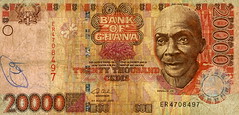
ephraim amu 20,000 cedi note

My introduction to Generation Debt (USA edition) was with a First USA credit card that I signed up for sometime in 1994 in order to finance a conference that a bunch of African students decided to put on that year. Not being favoured sons and daughters of Harvard, donors were not being forthcoming with spare change to help our efforts. But we were bloody minded enough to want to put Africa on the university's agenda, for a weekend at least — we knew our limits. So I picked up the three credit card applications that had been crowding my university mailbox, filled and returned them in their glorious postage-paid envelopes.

I have to admit, I was shocked when a sleek credit card duly arrived in the mail a week later. I was doubly shocked when I saw the number of digits in the credit line assigned to me. I still can't believe that a bank would extend almost $12,000 of credit to a mere African student who was earning $8.50 an hour working weekends as a dishwasher in the Harvard dining halls. Well, this meant that the show would go on, my $300 bank balance be damned. I dug this plastic exemplar of American bravado. Sidenote: one of the other applications had been promptly rejected, and after a longer period, the third was approved (with a credit line of $500).

Incidentally the first purchase made on this card — and the card's claim to fame, was a plane ticket for Ellen Johnson-Sirleaf to bring her to the conference. At that time she was a humble bureaucrat at the United Nations Development Program who, if I remember correctly, had initially suggested that she would even contemplate driving up from DC if we could find someone to car-pool with her... You'll recall that Liberia and Sierra Leone circa 1994 was prime warlord running riot material. She, in contrast, simply wanted to talk to the students. How refreshing.

Anyway, the eventual budget for the conference was around $22,000 of which approximately $15,000 was put on credit cards that were bestowed on yours truly over the next two months.

Now I see you shaking your head. I understand. It's OK, go ahead, shake your head, titter away. I can handle a lot of head shaking, rolling of eyes and the like. I certainly am shaking my head as I remember the things I charged on that card. You see, thrift runs deep in my family. Further, there's a certain conservative streak and reputation that is very much belied by this, my first encounter with a credit card. In mitigation perhaps, I'd note that I was just a year past the sophomore stage so you could place this anecdote under the banner of youthful indiscretion.

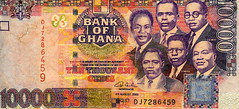
10,000 cedi note

Returning to our original question — remember we're trying to clarify things for Ms. Zhang — what can we say so far?

Well a credit card is claimed to have something to do with meeting financial needs — that is what my credit card company suggested even as they terminated our dalliance.

The anecdotal evidence also shows that a credit card is something that changes one's relationship to risk, and indeed risk assessment.

A further reality illustrated here is that a credit card is something that allows sophomoric impulses to move beyond mere bravado to full-blown fiscal train wreck, all within a 25 day (or 20 day) billing cycle - for these things can change at little notice per the small print.

It turns out that there's nothing like having $15,000 bills to concentrate the mind - well at least to concentrate my Ghanaian student mind. It also turns out that, statistically speaking, credit card debt doesn't concentrate the minds of most Americans - students or otherwise. It must be a cultural thing. It is confounding, isn't it? A credit card is a puzzle.

Suffice to say that I sweated a lot for the next few months as I applied to various funding sources to try to get reimbursement so that I could pay off my credit card bills. That $15 minimum payment that was cheerily suggested to me seemed a little out of proportion to the actual bills in question, on the order of a thousand times the amount of said bills. A credit card is a hassle.

If you were in Cambridge in those heady months and had even a faint whiff of money about you, you would have made my acquaintance. The idea was that I'd beg, steal or borrow to repay this debt. I visited more foundations, Harvard-affiliated or not, wrote more letters, made more phone calls, appeared in more student council meetings or board meetings, than I care to remember. I discovered reserves of argumentation and negotiation skills that I never knew I possessed. Some looked for polish in the presentation and others wanted you to dance for the money. I had no shame, and was chameleon-like in my affectations. For a surprisingly large number of organizations, it appeared that it paid to look very skinny, malnourished, child-like and/or poor - there's a certain image of Africa that loosens wallets. Normalcy wasn't a feature that they cared for. Well, I obliged. I remember someone wondering aloud why we needed to bring all these mid-level African professionals (Johnson-Sirleaf, Djibril Diallo etc.) to the conference when an expert like Samuel Huntington was available (and local). I kept my mouth shut. A credit card is a hustle.
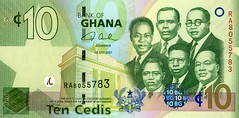
10 cedi note

I learned a lot in those days about money, power, time, and especially about debt. On the question of time, I learned one of Einstein's dreams about the perception of time: there's that notion of time dilation as evidenced by the interval between when someone says they will give you money and the actual moment when you receive said money. A credit card is an alarm clock of sorts.

There were many lessons learned, perhaps too numerous to enumerate here. The American facility and close companionship with debt will forever remain a source of fascination to me.

My sweat paid off, money trickled in, the conference went on and I managed to pay off those initial credit card bills on time. A couple of months later, I got another letter from First USA: the credit card company duly increased my credit limit to $15,000. A credit card is a dream.

When you read about the psychology of conmen, you'll find a lot about misdirection in language and verbal framing. They fact that they call it "credit card" is quite a tell when it is actually a "debt card". The verb credit has positive associations of honour and achievement that enable the crucial leap of faith. Truth in advertising, if you will. A credit card is a confidence game.

The Story of O


Having a long and hyphenated name, I was always wary about using my now dearly departed credit card - even as First USA's issues in the realm of e-commerce were being worked out. For one, my full name didn't fit in the required space on the card's front so the first part of my last name became the initial O, and a new identity was minted, Phoenix like. For fifteen years, an entire area of forest and countless trees have been sacrificed to the cause of junk mail offers to that guy with the O initial. I tell you, Mr O. Amaah has been positively deluged by marketing offers after First USA promptly sold my details to its marketing partners. A credit card is an alter ego.

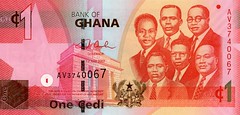
1 cedi note

Returning to our story. In time, First USA was bought up by Bank One which was bought up by Chase Manhattan bank (later renamed Chase), which was bought up by JP Morgan to become JP Morgan Chase. The card name changed accordingly. A credit card is a chameleon.

When I lost my wallet and bag a few years ago, and tried to cancel the card, I had to go through a whole rigmarole with customer service trying to determine what the name of the card was. I always remembered it as my First USA card but there were at least four different entries in their records. Who knew? A credit card is a complication.

I am not one for debt. I had this card for almost 15 years but I found myself preferring the second card which, you'll recall, came with a lower credit line and on which my full name could be printed on its front. I only use credit cards as a convenience and am one of those termed deadbeats by the credit card industry, ergo one who pays his bills in full.

Truth be told, I stopped using it because of fickle and aesthetic reasons. I didn't want to pretend to be Mr O. Amaah any longer. I was skeptical of that entire identity conjured up out of missing pixels and thin air. A credit card is a sleight of hand.

Still, I kept the card around for sentimental reasons – you always remember your first credit card, your lost virginity in commercial debt. It was the prodigal card, or perhaps the card that the builder refused in biblical terms. Well no longer. My credit card is dead.

JP Morgan Chase received a bailout in the form of a $25 billion equity injection from the United States Treasury under the authority of the TARP legislation. Presumably as the company absorbs its Bear Stearns and Washington Mutual acquisitions, the bean counters have decided that hoarding cash is the name of the game. Risk managers the world over are doing much the same thing – that's why they call it a credit crunch, innit? They no longer relish the prospect of yours truly being seized once again by a seminal lunacy and taking advantage of the now $23,000 credit line that they had since extended to him. Oh well, their loss.

I suspect it will take a few years for Mr O. Amaah to stop receiving junk mail. While I might (briefly) mourn my First USA card, I can't wait for my alter ego's disappearance. In the grand scheme of things, I'm doing fairly well in life. I have health and loving family and friends. I applaud those faceless credit assessors for cutting me off — even if abruptly and without notice. I'll echo the words of a confounded Chinese woman:

"What's a credit card?" Adding later, "We have everything we need".

A credit card is a debt foretold.

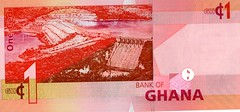
one cedi note

Light Reading


Credit in Film


One of my favourite films of the 1990s is the Dutch film Karakter (Character). It's a tale of Oedipus meets Inspector Javert with the prospect of bankruptcy looming and debtors' prison. A wonderful period thriller founded on the themes of identity and duty — the duty of repaying one's debt; that Dutch sense of rectitude.

Soundtrack for this note


Some music for the soul.

Next: What is a bank?

Some further context

File under: , , , , , , , , , , , , ,

Monday, October 27, 2008

Mindless Speculation

I. Geopolitics

The fellow with the fufu usually moves over to the man with the soup, never the other way around.

Elechi Amadi, The Great Ponds
This delightful Nigerian saying distills a lot of economic insight - and it translates quite well even if you've never had the pleasure of eating fufu and light soup. It's a folk lesson that is learned very early in human life and certainly ingrained by the time you master the hard knocks of school playgrounds - or streets as the case may be. Gil Scot-Heron once phrased the sentiment as "all consumers know that when the producer names the tune the consumer has got to dance".

In times of crisis, economists talk about the "flight to quality" or deleveraging; political scientists, in turn, form models about the calculus of power relations. It's not quite a matter of rats and sinking ships but it surely comes down to the perception that the pepper soup would greatly enhance a depleted stock of pounded yams, cassava or plantain fufu.

Anecdotally, we then start reading articles about Americans (belatedly) trying to find jobs in the Middle East
Europeans in investment banking and other financial fields already have been flocking to the oil-flush Persian Gulf for months, propelled by the hope that emerging economies of the East will ride out any global recession better than New York or London. In a phrase often cited by British brokers and bankers, "it's Shanghai, Mumbai, Dubai, or goodbye."
This is at the level of the individual response but presumably this phenomenon extends to the societal scale. Tribes, companies, and countries the world over are now searching for soup.

These days, the men with the soup - or capital, or cash, or credit, or liquidity, or savings, or solvency if you prefer, ostensibly live in places where phrases like "sovereign wealth", "nation of savers", "oligarchy" or "oil producers" are bandied around. If they are called to finance bailouts, they might well extract their pounds of flesh - to continue on the metaphorical route. And yet that is the crux of the matter: who is going to finance bailouts and on what terms?

Warren Buffet is a happy shopper and is very exacting with the terms he demands before deploying his checkbook. Japan's Mitsubishi banking group almost caused Henry Paulson to go into cardiac arrest when it started renegotiating the terms of its proposed bailout of Morgan Stanley. Iceland, to take the other obvious example, was even negotiating with Russia for its bailout before others finally stepped in - the price of Russian army bases on the soil of a NATO member is too high apparently.

Negotiations are always tricky things of course, but when you have the soup you have the benefit of knowing that others will come to you. In this respect the most poignant geopolitical maneuvering has been pointed out by Bernhard of Moon of Alabama and it concerns China and Taiwan.

Item: Selling Out Taiwan To Finance The Bailout
"The Chinese president also praised the good momentum of the development of the Sino-U.S. ties in recent years in various areas.

He said China is ready to work with the U.S. side to intensify dialogue, exchanges and cooperation, and properly handle issues concerning mutual interests and of major concern, particularly the Taiwan question, in a bid to push forward the sustained and steady development of the Sino-U.S. constructive and cooperative ties."

Translated from diplo-speech: "Give us Taiwan and you'll get the loan."
Dig: the reaction was swift
Regulators in Taiwan ordered insurers to limit their holdings of Freddie, Fannie, and Ginnie Mae paper...
The Taiwanese also have some soup they can withhold it appears. These are fascinating times for geopolitics, everything is being laid bare.

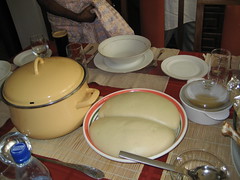
fufu


When confronted with empty bowls and covered pots, you really start to wonder if indeed there is any soup available. More to the point: who's got the soup?

II. Estate Planning


Apropos the notion of death and taxes I was thinking recently about the sad and tragic death of Kenneth Lay, former CEO and erstwhile looter of Enron. I was reminded of the mindless speculation about its timing, for indeed, from some points of view, it was a very convenient death for his estate, coming as it did after his fraud conviction but, and this is crucial, before his sentencing, which meant that said conviction was abated - and the prospect of punitive damages and restitution to those who suffered at his hands disappeared in a coronary heartbeat - or lack thereof. Of course one shouldn't begrudge his family in their time of loss for the consequent beneficial preservation of capital. Still it would have been good to be able to hear his expert opinion on the current "global financial crisis" (as the BBC have branded the current mood - sidenote: the Motley Fool term it Panic 2008) and speculate as to its causes...

The mind is a funny thing and I then remembered the part of The Godfather II where Robert Duvall's Tom Hagen pays a visit to Michael Gazzo's weary Frank Pentangel on a military base and reminisces about the old school Roman solution for unsuccessful conspirators. The good soldier subsequently took those musings to heart. That scenario is the kind of thing that only happens in fictional movies - even if these days people worryingly encourage it in their anger. Moving right along...

Along the same lines, the always astute Floyd Norris was indulging in some mindless speculation himself recently
If Congress takes no action in 2009, the estate tax will fall to zero in 2010, and then bounce back to 2001 levels in 2011. That would create what the Tax Policy Center report, written by Leonard E. Burman, Katherine Lim and Jeffrey Rohaly, delicately calls "grotesque tax planning initiatives." What they mean is that there would be a great temptation to do in dear old (very rich) dad before midnight on Dec. 31, 2010.
There hasn't been much remorse among those who have made out like bandits in the bubble years, it seems however that the gig is up - or at least, pace the observation about who now has the soup, that the shell game will have different winners in the near term.

One starts to wonder what will get in the head of the dissolute offspring of modern day aristocrats when they contemplate the prospect of ill-gotten gains disappearing by fiat as the mandated clawback (albeit a quite lenient clawback) begins. It is quite fitting that those who thrived on moral hazard might find themselves targets of the ineluctable financial logic of perverse incentives. Time will tell, I suppose, if this idle speculation has any grounding.

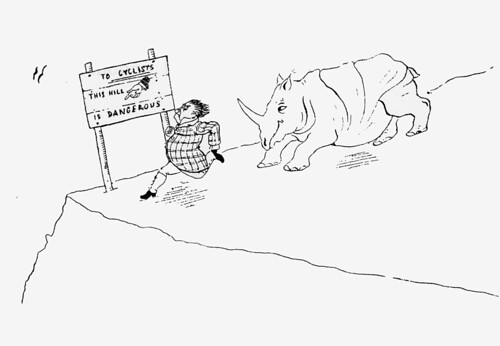
the rhinoceros


On a slightly related note I was reminded of the following poem

Lord Finchley


Lord Finchley tried to mend the Electric light
Himself.
It struck him dead: and serve him
right!
It is the business of the wealthy man
To give employment to the artisan.


Hilaire Belloc's Cautionary Verses
Periodically the social compact that Belloc identified a century ago is forgotten - that is the realm of trickle down economics. When The Masters receive their comeuppance, the reaction is not necessarily one of class warfare - everybody knows their place in society, but rather it is a distinct lack of sympathy for those who fall from grace. A debacle prompted by overblown real estate leads, as it were, to some furious estate planning.

III. A Pepper Soup Soundtrack


A fufu and soup playlist

  • DJ Palm Butta - Fufu N Soup
    The message delivered in this cheeky Liberian hiplife reworking of the Chicken Noodle Soup fad is clear: "with some okro on the side... that fufu and soup is sweet". True enough, we live in an era of microwave fufu, but even with such modern conveniences, we also need some soup. It goes without saying that Palm Butta also has the follow up track Cook My Pepper Soup which dives into the heart of the matter.
  • Eastern Ministers Guitar Band - Uwa Tuto Uwa Fufu
    As discussed at the indispensible Likembe, the literal translation of the title is "The World is Sweet and Painful", the fufu of the title is perhaps the pain, the soup is the sweet.
  • Digable Planets - The Art of Easing
    You had to be there perhaps, but if you flowed with the vibe that was the Blowout Comb album, you'd know all about the art of easing, of laying back in the cut.
  • James Brown - Escape-ism
    Some hot sauce to go with some hot pants, JB delivered wisdom in spades
    You know when you forget that grits is... when you forget that grits is groceries and that eggs is poultry, you lose your thing. Now, you can lose your thing out there wandering around.
    Fred Wesley's horns and the various incarnations of the JBs band were the soup to James Brown's fufu.
  • Donald Byrd - Fufu
    Donald Byrd's 1973 album Kofi is one of my favourite in the jazz funk canon. Perhaps the excursions trips to Elmina and the consequent African-inflected rhythms place this music on the funky jazz side of the spectrum. Whether it is the driving soul jazz of The Loud Minority or the intricate interplay of title track or the blowing session that is Fufu, this is simply inspired.


    I could listen to this for hours on end and indeed, to harken to another song on the album, I do have Perpetual Love for Byrd's music.
The received wisdom is that it was mindless speculation that got much of the world into our present belt-tightening. As things take on serious notes, one hopes that we can at least comfort ourselves with some mindless speculation. I've made my opening contribution, I await yours.

Let's place this note as part of an occasional series, observers are worried.

File under: , , , , , , , , , ,

Tuesday, September 16, 2008

A Seminal Lunacy

No one was responsible for the great Wall Street crash. No one engineered the speculation that preceded it. Both were the product of the free choice and decision of hundreds of thousands of individuals. The latter were not led to the slaughter. They were impelled to it by the seminal lunacy which has always seized people who are seized in turn with the notion that they can become very rich.

The Great Crash 1929 by John Kenneth Galbraith
I was reading Galbraith's tome last summer in an attempt to clear my thinking about bubbles and their typical aftermath. Later in his life Galbraith would cover financial euphoria more closely, but here it was all about its counterpart: the crash. He surely had a twinkle in his eye as he made his felicitous coinage of "seminal lunacy", lowering the reader's guard before proceeding to skewer at will. The book was a tonic for him to write and it is accordingly a tonic to read.

animals in the sky


News headlines are replete with mantras about sound fundamentals, healthy economies that are resilient, innovations that are safe, disruptions that are contained and so forth. On this trend he had some cutting observations:
By affirming solemnly that prosperity will continue, it is believed that one can help insure that prosperity will in fact continue. Especially among businessmen the faith in the efficiency of such incantation is very great.
Stated another way, this is merely a tactic for dealing with ignorance.
That much of what was repeated about the market - then as now - bore no relation to reality is important, but not remarkable. Between human beings there is a type of intercourse which proceeds not from knowledge, or even from lack of knowledge, but from failure to know what isn't known. This was true of much of the discourse on the market.
It is often effective.
We are a polite and cautious people, and we avoid unpleasantness.
Social beasts that we are, we follow the herd.
Others pointed out that the prospects for business were good and that the stock market debacle would not make them any less favorable. No one knew, but it cannot be stressed too frequently, that for effective incantation knowledge is neither necessary nor assumed.
There is perhaps an echo of Walter Bagehot's observation in Lombard Street
Every great crisis reveals the excessive speculations of many houses which no one before suspected.
the world of riches


We have the spectre of bemused and gray suited serious technocrats making pronoucements with great alacrity. And a wary public begins to ask whither regulation. But that is by the by
One of the oldest puzzles in politics is who is to regulate the regulators. But an equally baffling problem, which has never received the attention it deserves, is who is to make wise those who are required to have wisdom.
The great crash, like other seminal lunacies, caused much revision of the conventional wisdom.
What six months before had been a brilliant financial maneuver was now a form of fiscal self-immolation. In the last analysis, the purchase by a firm of its own stock is the exact opposite of the sale of stocks. It is by the sale of stock that firms ordinarily grow.
There are likely many contemporary equivalents to the deficiencies pointed out about buying your own stock. Modern finance has been shown to favour opacity over transparency and the consequent costs are mounting.

Looking forward we can expect lots of hearings, meetings and busy work. Politicians shown to have been asleep at the wheel will now demand answers.
The rite of the meeting which is called not to do business but to do no business... one of the oldest, most important - and unhappily, one of the least understood - rites in American life.
Action is the theme of the day
Men meet together for many reasons in the course of business. They need to instruct or persuade each other. They must agree on a course of action. They find thinking in public more productive or less painful than thinking in private. But there are at least as many reasons for meetings to transact no business. Meetings are held because men seek companionship or, at a minimum, wish to escape the tedium of solitary duties. They yearn for prestige which accrues to the man who presides over meetings, and this leads them to convoke assemblages over which they can preside. Finally there is the meeting which is called not because there is business to be done, but because it is necessary to create the impression that business is being done. Such meetings are more than a substitute for action. They are widely regarded as action.
When histories are written about our present disillusionment they will surely read like Galbraith's summary of the reasons behind the crash:
In 1929 the economy was fundamentally unsound...
  • the bad distribution of income... highly unequal income distribution meant that the economy was dependent on a high level of investment or a high level of luxury consumer spending or both...
  • the bad corporate structure... the vast new structure of holding companies and investment trusts...
  • the bad banking structure...
  • the dubious state of the foreign balance...
  • the poor state of economic intelligence
By harkening to "fundamentally unsound" and ending with a note about "economic intelligence", Galbraith puts the knife in Herbert Hoover and others of his ilk.

traumatised
It requires neither courage nor prescience to predict disaster. Courage is required of the man who, when things are good, says so. Historians rejoice in crucifying the false prophet of the millenium. The never dwell on the mistake of the man who wrongly predicted Armageddon.
There are lots of emotions when it comes to finance, concern chief among them. During a crash or panic, emotions turn darker and this can be a perilous time.
Despite a flattering supposition to the contrary, people come readily to terms with power. There is little reason to think that the power of the great bankers, while they were assumed to have it, was much resented. But as the ghosts of numerous tyrants, from Julius Caesar to Benito Mussolini will testify, people are very hard on those who, having had power, lose it or are destroyed. Then anger at past arrogance is joined with contempt for present weakness. The victim or his corpse is made to suffer all available indignities.
And a parting warning for those erstwhile masters:
One trouble with being wrong is that it robs the prophet of his audience when he most needs it to explain why.
Shell games do have costs.

A brief soundtrack


File under: , , , , , , , , , , , , , ,

Tuesday, August 14, 2007

Home Economics

The Wife and I have been thinking of buying a house for the past year and, since spring, have been mostly bemused at the huhudious prices that were being quoted to us (with straight faces, mind you) for mostly depression era houses. Thus we've been getting an education on the hard sell during our few months of attending open houses, and also some lessons in home economics.

follies

The New Mathematics


After last week's action, some new mathematics is in effect. We have the following equation:

Maximum prudent ™ house price = $521,250 = $417,000 (maximum federally-insured mortgage) + 20% downpayment

Note: prudent ™ denotes a conforming loan and home financing deal that wouldn't raise the eyebrows of even the staidest banker.

Note: the days of 20 percent downpayment have been out of fashion for a long time (we live in a subprime era) so we'll relax our stringent banker conservatism and use a 10 percent downpayment as our baseline. This reduces the maximum prudent house price to $463,333.

Note: the conforming loan limit of $417,000 is the maximum federally-insured mortgage above which point we are in the realm of jumbo mortgages which have all of a sudden become quite scarce.

uncompleted mansion

Voodoo Economics


The median price of housing listed in the Bay Area was said to be $785,380 in February 2007 when we started looking in earnest. That was the listing price and not necessarily the sale price but, regardless, that was sticker shock by any definition.

In June 2007, the median housing price paid in the Bay Area was $665,000, a new peak. See also a trend graph of an earlier data set.

The typical monthly mortgage payment in the Bay Area was $3,219. "adjusted for inflation, current payments are 24.0 percent above typical payments in the spring of 1989, the peak of the prior real estate cycle." Jumbo mortgages "represented 62 percent of the purchase loans" made in the area.

taos pueblo

Jumbo Jitters


Putting these things together, it is clear that something does not compute. The force of gravity will make itself felt and the $200,000 gap - the fat on which the housing sector in the Bay Area has been feasting on for the past 15 years - will of necessity be closed. The only questions are how much the gap will narrow and how long it will take.

The typical price of the only reasonable houses we have seen during our search was $750,000 (The Wife has called much of the rogues gallery that were shown to us "illegal dwellings"). We thought we'd seen an overheated market in Boston but the Bay Area has redefined our perceptions on that front. A software engineer and history professor ought to be able to afford a starter house.

The hard sell and the real estate shell game was in earnest and it was as if the whole town was in on the con. The pinnacle was the university housing officer who advised her academic client that we could easily afford a $700-800,000 mortgage - if you ran the numbers, monthly housing payments (circa $5,000) would far exceed the salaries of most academics which prompted said academic's quip "I'm not going to spend that much on a depression era bungalow" to the surprisingly-shocked agent. I suppose I would have put it as the Emperor has no teeth.

Even if we could afford such imprudent things we'd rather spend our money traveling to more congenial settings, we are modern travelers and exiled souls after all. The funny thing is that if you spend enough time talking about housing in the Bay Area, you could almost convince yourself that everything was normal. Nobody blinked in conversation; the stratospheric prices were just the way things were — indeed it was so surreal and you could very easily allow yourself to be bamboozled — there was a week where we almost succumbed. Almost...

modest

There's lots of moral hazard in the mounting chorus to bail out the fiscal wizards. Many are lobbying for the limits on Fannie Mae and the like to be lifted or for interest rates to be cut. Sidenote: the language of financial panics is always interesting: credit crunch, mortgage meltdowns, debacles etc. Fed chairman Ben Bernanke has been known for his "cautious experiments" in the past and will surely come up with some kind of intervention. When well-heeled bankers start invoking the spectre of millions out on the street you can almost hear the subliminal "think about the children" message. John Kenneth Galbraith is sorely missed.

In any case, we continue to search for a home... For the first time last week, we saw advertised a condo in a nice neighbourhood that was priced under the new mathematics at $469,000 - some sellers obviously need to cash out quickly (similar houses were priced at $650,000 just a few months ago). Hopefully we'll start seeing more of these things and it might even become a buyer's market. I won't hold my breath however; there's a surplus of unreality in the Bay Area.

no hurry

In closing I'll note that Ikea was packed last weekend — everybody is doing home improvement, it seems. I don't think much of it was about putting a shine on show houses that you needed to flip ("one last try"), rather I suspect that it was belt-tightening at work, and making do with what you have. Time will tell and we'll be waiting this one out in our rented nest.

A Subprime Playlist


Some music for those inclined to home economics...
  • Dionne Warwick - A House Is Not A Home
    Dionne really came into her own when she sang the Burt Baccarach songbook. It was a sublime case of pathos, operatic pop as it were featuring Baccarach's lyricism distilled in that delicate voice. All her later monetary triumphs stemmed from the magic of those wonderful interpretations.
  • Kool Moe Dee - They Want Money
    I was going to pick Money Jungle by Duke Ellington, Charlie Mingus and Max Roach for this playlist - the song (and album) is suitably jarring and tense, but I thought that Kool Moe Dee would be more appropriate. The title of the album is a key indicator: Knowledge is King. Laymen are always the last to get bailouts hence education is key to prepare for the periodic shocks of the grifter impulse. They Want Money is the soundtrack for Jim Cramer's crew, its blaring horns an ode to Alan Greenspan's politically expedient teaser rates, its rapid-fire lyrics are dedicated, with respect, to all those who have been selling a bill of irresponsible goods in the housing market.
  • Simply Red - Money's Too Tight To Mention
    Social commentary of hard times and explicit lyrical harkening to Reaganomics. Mick Hucknell saw the darker side of trickle down economics and told it like it was. There are of course thousands of "no money" blues but when rendered in this pop vein, never have they been so upbeat or danceable. Perhaps one should also mention here Money to Burn by Wrinkars Experience in the reggae vein and round things off with the Wu-Tang Clan's C.R.E.A.M. ("Cash rules everything around me, cream get the money, dollar, dollar bill y'all")
  • Luther Vandross - A House Is Not A Home
    I really need to do an appreciation piece on Luther who, like Aretha, had the uncanny ability to make any song his own. Simply put, his version is the definitive version - it's not even close. Soul music with all the accoutrements, lush and emotional.

A house is not a home, how true.

village huts by K. Baka
File under: , , , , , , , , , , , , , , ,