Showing posts with label quotes. Show all posts

Monday, April 06, 2020

The Mosquito Principle

"As they say, mosquitos don't discriminate... We're all singing the West Nile Blues these days. Some call it globalization; I know it as the Mosquito Principle."

— extract from The Books of Nima

Honam mu nni nhanoa
(Humanity has no boundary)

— Akan proverb

Takes behaviour to get along.
Lots of behaviour to get along.
Do you really, really know that?
Social Living is the best

Do you know?
Social Living is the best

— Burning Spear - Social Living

II. Insatiable Appetites

"...Some have insatiable appetites & are never satisfied (politics?)."

— Donald Trump ostensibly complaining about the governors of certain states, but perhaps rather projecting his impulses onto others. (April 2 2020)

The U.S. allegedly snatched a planeload of 60 million Chinese-made medical masks that were initially intended for France, a French official said.

"A French order was bought out with cash by Americans on the tarmac, and the plane that was to fly to France took off for the U.S. instead".

— Snatched from the tarmac. (April 2 2020)
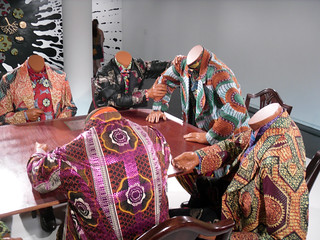
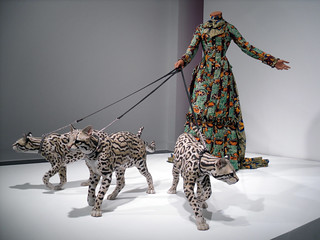
Yinka Shonibare MBE at Brooklyn Museum

We need the masks. We don't want other people getting them.

— Donald Trump, April 3 2020
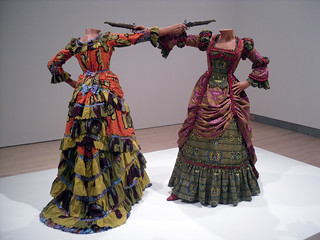

Insatiable Appetites


The German capital ordered 200,000 special FFP2 and FFP3 masks that are used to protect emergency staff and care workers from infection with coronavirus.

Andreas Geisel, Berlin's interior minister, confirmed that the consignment had been “confiscated” in Bangkok and never reached Berlin.

"We consider that an act of modern piracy," he said. "You don't treat your transatlantic partners like that."

— US swoop sees 3M masks allegedly diverted from Berlin (April 3 2020)

Yinka Shonibare MBE at Brooklyn Museum

— Scenes from The Berlin Conference of 1894
Scramble for Africa by Yinka Shonibare at Brooklyn Museum (2005) - credit: DK

III. Manifest Destiny
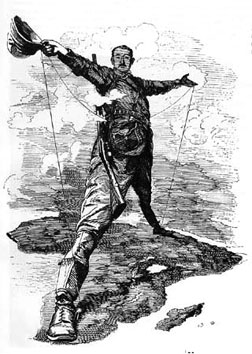
cecil rhodes astride africa

From Cairo to Cape Town, The Rhodes Colossus (Punch 1892)

"I contend that we are the finest race in the world and that the more of the world we inhabit the better it is for the human race. Just fancy those parts that are at present inhabited by the most despicable specimens of human beings what an alteration there would be if they were brought under Anglo-Saxon influence, look again at the extra employment a new country added to our dominions gives...

We know the size of the world we know the total extent. Africa is still lying ready for us it is our duty to take it. It is our duty to seize every opportunity of acquiring more territory and we should keep this one idea steadily before our eyes that more territory simply means more of the Anglo-Saxon race more of the best the most human, most honourable race the world possesses."

— Confession of Faith by Cecil Rhodes (1877)
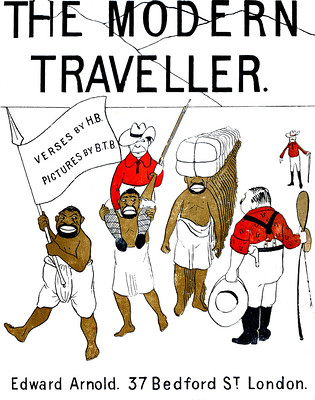


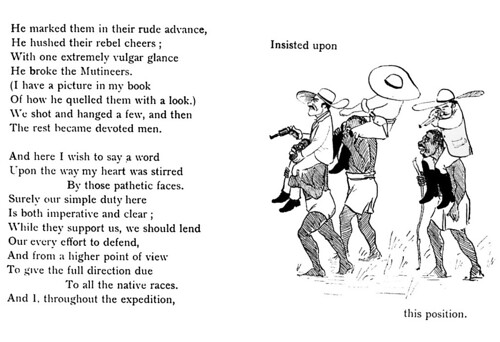
The Modern Traveller by Hilaire Belloc

Surely our simple duty here
Is both imperative and clear;
While they support us, we should lend
Our every effort to defend,
And from a higher point of view
To give the full direction due
To all the native races.
And I, throughout the expedition
Insisted upon

To give the full direction due to all the native races - the modern traveller

              this position.

— The Modern Traveller by Hilaire Belloc (1898)
The modern conservative is engaged in one of man's oldest exercises in moral philosophy; that is, the search for a superior moral justification for selfishness.

— John Kenneth Galbraith (1963)

The modern Republican Party is the result of collusion between a movement to take U.S. jurisprudence to the pre-Depression era, and a movement to take culture back to the pre-Enlightenment era. It is doomed because the latter would like a theocratic state to regulate culture, and the former want to smoke dope and look at dirty pictures.

— Maxspeak Maxim IX, Max Sawicky (2006)

IV. The Mosquito Principle (Redux)

"You don't make the timeline, the virus makes the timeline"

- Anthony Fauci on the novel coronavirus

Later: "There is no region in the country, in my mind, that's going to be exempt from an outbreak"


If you win mainly by convincing THEM that they are losers, and convincing them to give up fighting — and all of us, not just Trump, do this sort of adversarial reality distortion to a degree — what do you do when THEY is a virus? What do you do when there are no credible substitutes?

— taken from a discourse on our current global narrative collapse in Plot Economics

See also: You Can't Gaslight a Virus

In these days of insecticides and drained swamps, those of us who live in the rich, temperate world have become accustomed to the luxury of not thinking very much about mosquitoes and the risks they carry. But the insects are still killing more than eight hundred thousand people a year, primarily in Africa.

— How Mosquitoes Changed Everything

Item: The exact origin, locations, and natural reservoir of the Ebola virus remain unknown. Current suspicions are founded on cynomolgous monkeys, civets or bats...

Dig: The pressure of marauding warlords roaming the bush has forced many to start eating animals that had previously been left alone in the bush.

— Ebola and Marburg virus musings in Angola

Europe turned into a petri dish and travel from there impacted the world, with its most damaging effect in Africa and Latin America. “The colonial legacy lives in viral movements. I wasn’t surprised that Belgian travel preceded DRC’s first known case,”

— Coronavirus Started in China, but Europe Became the Hub for Its Global Spread
Walking the pets

V. Pandemic Toli

Mosquitos don't discriminate

Previously: "You welcome the US to the fun of the Third World" - West Nile Blues

Virus lays bare the frailty of the social contract
— The Financial Times editorial page ostensibly advocating for social insurance and a rebalancing of modern economies. A Road to Damascus moment. (April 4 2020)

The mitigation strategies have varied throughout humanity's long shared history with malaria and other mosquito-borne diseases. There has been genetic adaptation (sickle cell disease), the observation that colder climates are less hospitable to mosquitos, quinine from the bark of a cinchona tree, good sanitation, (of late) artemesin, bed nets and an entire panoply of public health measures.

Only occasionally do we get a glimpse of the universality of the struggle (see the spread of Zika that threatened Rio's Olympics, outbreaks of chikungunya, Dengue fever and the like). That's when you'd read: "The mosquito is ubiquitous... You don’t need to travel to get the disease". Consider also the spread of West Nile Virus in California that resulted from Delinquent Mortgages and Neglected Swimming Pools in the aftermath of the Great Recession. Collateral damage of huhudious financial malpractice.

Rapacious vultures at the Berlin Conference by Yinka Shonibare

Still, to a large extent in the West, a sort of natural equilibrium has been established, even as we operate elsewhere under Mosquito Rules. Structurally, malaria and other mosquito-borne dieseases have been contained in the First World through strenuous public health efforts. In the third world, however, mosquitos remain a poverty tax.

Diseases like Ebola that jumped hosts and spread disastrously in repeated outbreaks in recent decades are thought to be confined, to the global, poorer south. The 3 years of Ebola epidemic that affected 10 countries and decimated 3 countries that could hardly afford it (recovering as they were from gruesome civil wars) didn't make a lasting impression. Similarly SARS and MERS were big scares in recent memory but, at length, they too were largely contained. The West was largely unscathed fron the calculus of contagion.


Hilaire Belloc had keen insight about the complacency in the face of a common enemy, and the almost liquidationist impulse that drives the Social Darwinist attitudes, and Empire writ large. Think about the past several months squandered in the face of clear and present danger. The following panel perhaps captures the insouciance, and the attempts to deny, or cage, the dangers of the predator. Call it the herd immunity strategy.
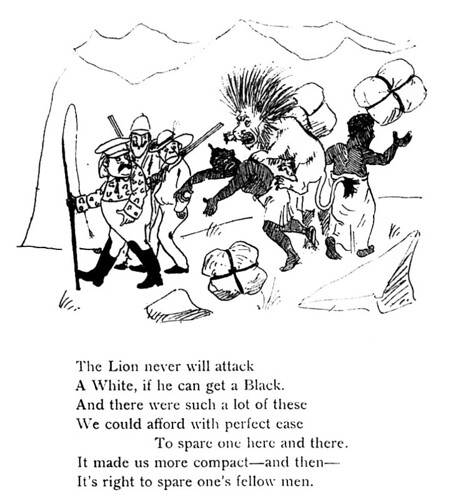
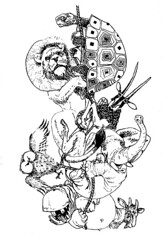
Lions attack the modern traveller - p.50
The Lion never will attack
A White, if he can get a Black
And there were such a lot of these
We could afford with perfect ease
To spare one here and there.

It made us more compact - and then -
It's right to spare one's fellow men.

If COVID-19 is the pandemic disease of the moment, the novel coronavirus, SARS-CoV-2, is just a virus; it is not a parable or extended metaphor. Like the plasmodium falciparum, and the mosquito that transmits it through its bite, this coronavirus doesn't discriminate. Whether spread by symptomatic or asymptomatic carriers, it is no respector of princes or prime ministers. It is oblivious to all boundaries, navigating between its unknown primary host (bats?), its intermediate hosts (say that initial pangolin or civet in the Wuhan wild animal market or that tiger at the Bronx zoo), and the human prey that it afflicts with COVID-19. It merely reproduces, evolves, and occasionally mutates its RNA as it navigates between hosts.

The current flight to safety in this covidious depression may be to US bonds - that, after all, is the financial norm that befits the US having the world's reserve currency. The literal airplane flights, and the longer-term larger scramble, however, may now be to China. The evidence is already there: if that Cairo to Cape Town railway is indeed ever built, it will be financed by China's belt and road initiative. In just a few more weeks, Wuhan province may well prove to be safer than New Orleans and Catalonia. Just weeks ago, African elites were precipitously withdrawing their children from European boarding schools. Thousands of Chinese students are yearning to be repatriated from the US rather than take their chances, uninsured in America where bad faith actors keep beaches open against all sense.
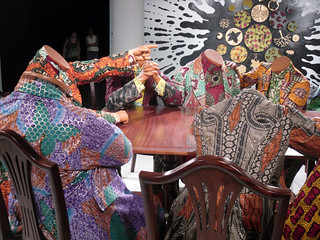
Rapacious vultures at the Berlin Conference by Yinka Shonibare

We are all passengers on cruise ships (operated by soon-to-be bankrupt Princess Lines, flying their Liberian flags of convenience). The underpaid crew (essential workers with compromised immune systems) labor to find a port of respite working with creaking infrastructure, hollowed by austerity policies, offshoring and deferred maintenance. We pray that we are being piloted by sensible Captains (no Ahabs or Blighs). Some of us, however, have been dealt the mayor from Jaws preaching herd immunity and necessary sacrifice, hucksters touting quack remedies, or contrarian chancers with no naval experience save navel gazing.

We are all rather wishing we were being steered by no-nonsense Taiwanese or Singaporeans crisis managers. At this stage, locked down and self isolating in windowless interior cabins, we'd gladly accept plane shipments of personal protective equipment from China or South Korea. We worry and look askance at Italian or Spanish tourists, and especially the quiet Americans (quiet, perhaps, in dismay at the observed competence of their political leaders measured in the mounting, grim body count). Africans facing the pandemic would gladly substitute the gunboat diplomacy of yore for Asian supply chain competence, German engineering efficiency, and a Danish social safety net. Such is life in a state of narrative collapse this season of coronavirus. Our lifeboats are soap and running water, face masks, social distancing and, in extremis, ventilators. We can't breathe.

By all rights, solidarity should overcome rapacious hoarding or looting. There are tensions between the demands of capital, labour and now public health. If power is never given up willingly, it is clear the costs of the pandemic we are facing are human lives, thousands already, and perhaps millions of them. There is a marketplace of ideas and cooperation, human ingenuity, and the systematic application of science and operational excellence ought to be our guiding posts, acknowledging our common humanity

There is an emergency on planet earth. As far as coping strategies go in dealing with the Mosquito Principle, I suggest we revisit The Great Game, eschew the insatiable appetites of Manifest Destiny, and embrace Social Living.

Soundtrack for this note

I give you fifty songs on the theme starting out with Burning Spear's take. He had it right: Social Living is the best. I'm also quite fond of Amel Larrieux's injunction to "tap into your magic" and D'Angelo's ecological lament, 'Til it's done.

Bonus playlists:
  • Manifest Destiny (liner notes)
    A soundtrack of irony
  • Insatiable
    You can't go wrong between Prince and Omar
  • Contagious
    From Taja Sevelle's infectious pop confection, Love is Contagious, to The Isley Brothers and Chanté Moore's soap opera (the record's producer is currently muted and worried about the coronavirus in federal jails), and The Whispers' shiny 80s electro-funk.

And the band played on...

This note is part of the Things Fall Apart series under the banner of Social Living.

Previously: Ode to Betty Brown

File under: , , , , , , , , , , , , , , , , , , , , , , ,

Friday, January 28, 2011

All Available Indignities

As the ghosts of numerous tyrants, from Julius Caesar to Benito Mussolini will testify, people are very hard on those who, having had power, lose it or are destroyed. Then anger at past arrogance is joined with contempt for present weakness. The victim or his corpse is made to suffer all available indignities.

— The Great Crash 1929 by John Kenneth Galbraith

The growth of his power and fame was matched, in my imagination, by the degree of the punishment I would have liked to inflict on him. Thus, at first, I would have been content with an electoral defeat, a cooling of public enthusiasm. Later I already required his imprisonment; still later, his exile to some distant, flat island with a single palm tree, which like a black asterisk, refers one to the bottom of an eternal hell made of solitude, disgrace, and helplessness. Now, at last, nothing but his death could satisfy me.

— Tyrants Destroyed by Vladimir Nabokov
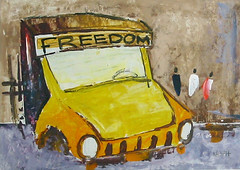
freedom kagyah
"The widespread anarchy and the disillusion of the masses... made this revolution necessary. In the years since independence, fundamental human rights were brutally violated by the government. People were denied the right to live in freedom and with mutual respect. They were not allowed to have their own opinions. Organized political gangsterism and the politics of falsehood turned all elections into a farce. Instead of serving the nation, politicians were busy stealing. Unemployment and exploitation were on the rise, and in their sadism toward the population, the small clique of feudal fascists in power knew no bounds."...

Optimism quickly turned to disenchantment and pessimism. The people's bitterness, fury, hatred was now directed against their own elites, who were rapidly and greedily stuffing their pockets.

— The Shadow of the Sun by Ryszard Kapuscinski. Here, he quoted a statement by a youth movement and observed the aftermath of Nigeria's 1966 coup.

There is no one, or hardly any one, so wicked or so stupid as to deny the democratic ideal. There is no one, or hardly any one, so perverted that, were he the member of a small and simple community, he would be content to forgo his natural right to be a full member thereof. There is no one, or hardly any one, who would not feel his exclusion from such rights, among men of his own blood, to be intolerable. But while every one admits the democratic ideal, most men who think and nearly all the wiser of those who think, perceive its one great obstacle to lie in the contrast between the idea and the action where the obstacle of complexity - whether due to varied interests, to separate origins, or even to mere numbers - is present.

The psychology of the multitude is not the psychology of the individual...

Look at a crowd when it roars down a street in anger — the sight is unfortunately only too rare today — you have the impression of a beast majestic in its courage, terrible in its ferocity, but with something evil about its cruelty and determination. Yet if you stop and consider the face of one of its members straggling on one of its outer edges, you will probably see the bewildered face of a poor, uncertain, weak-mouthed man whose eyes are roving from one object to another, and who appears all the weaker because he is under the influence of this collective domination....

Now it is peculiar to the French among the great and independent nations, that they are capable, by some freak in their development, of rapid communal self-expression. It is, I repeat, only in crises that this power appears.

— A Force in Gaul by Hilaire Belloc (from On Something)

As the Tunisians, and now Egyptians, are currently demonstrating, this quality of "rapid, communal self-expression" is certainly not a Francophone singularity. History, contra Belloc, has forever shown that crowds can turn from inchoate to determined in mere hours. All tyrants and their Lady Macbeths are on notice. Still, a little sweat on their part, and the dismayed sensitivities of onlookers at the sight of turmoil in their marriages of convenience, are, all things considered, a small price to pay.


He who tests the depth of a stream with both feet must be prepared to swim.

— Ewe proverb, Ghana
File under: , , , , , , , , , , , , , , , ,

Saturday, October 11, 2008

Mood Markers

These three songs and a stanza captured much of my mood over the past week. I wonder, what was your soul therapy?

  • Winter in America by Gil Scot-Heron and Brian Jackson
    The full lyrics paint a picture of decline and fall. A harsh season has arrived early and, from all appearances, doesn't want to leave anytime soon.

    People know there's something wrong
    Feels just like winter
    It's winter in America
    Truth is there ain't nobody fighting
    Cause nobody knows what to save
    I used to mishear that last line as "cause nobody knows what to say" and was glad for the ambiguity: say versus save. Are these pieces of the same thing? Which is preferable: being tongue-tied or overwhelmed? Is it the sound of sirens or the sound of silence that is more disquieting in these time?
  • Anger in the Nation by Pete Rock and C.L. Smooth
    Well the title says it all doesn't it? I'm not normally a believer in ritual humiliation nor indeed the incantation of politics as theater, but I did find solace watching a few investment bank executives squirm under the questionning of US congressmen (notwithstanding the fact that said congressmen have been poor regulators). Thinking about the collateral damage that friends and family have already experienced made me appreciate the spectacle of these small discomforts and the promise of more to come. Of these small things are made comfort suites.
  • All Your Goodies Are Gone by Parliament
    The languid rhythm of the track belies the message namely "Let hurt put you in the loser's seat". A essential soundtrack for anyone who deals with the stock market in the year 2008.
  • Ezra Pound's Hugh Selwyn Mauberly is often cited as the great anti-war lament, I rather harken to his characterization of moneyed charlatans and the damage they do
    walked eye-deep in hell
    believing in old men's lies, then unbelieving
    came home, home to a lie,
    home to many deceits,
    home to old lies and new infamy;

    usury age-old and age-thick
    and liars in public places
    .
    Perhaps the silver lining of the current moment will be some good art. I certainly look forward to it.

Mood Markers, a playlist

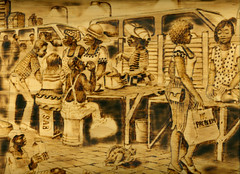
City (Accra) by Hilton Korley Boye


Next: Heart of Darkness, a playlist


File under: , , , , , , , , ,

Tuesday, September 16, 2008

A Seminal Lunacy

No one was responsible for the great Wall Street crash. No one engineered the speculation that preceded it. Both were the product of the free choice and decision of hundreds of thousands of individuals. The latter were not led to the slaughter. They were impelled to it by the seminal lunacy which has always seized people who are seized in turn with the notion that they can become very rich.

— The Great Crash 1929 by John Kenneth Galbraith
I was reading Galbraith's tome last summer in an attempt to clear my thinking about bubbles and their typical aftermath. Later in his life Galbraith would cover financial euphoria more closely, but here it was all about its counterpart: the crash. He surely had a twinkle in his eye as he made his felicitous coinage of "seminal lunacy", lowering the reader's guard before proceeding to skewer at will. The book was a tonic for him to write and it is accordingly a tonic to read.

animals in the sky


News headlines are replete with mantras about sound fundamentals, healthy economies that are resilient, innovations that are safe, disruptions that are contained and so forth. On this trend he had some cutting observations:
By affirming solemnly that prosperity will continue, it is believed that one can help insure that prosperity will in fact continue. Especially among businessmen the faith in the efficiency of such incantation is very great.
Stated another way, this is merely a tactic for dealing with ignorance.
That much of what was repeated about the market - then as now - bore no relation to reality is important, but not remarkable. Between human beings there is a type of intercourse which proceeds not from knowledge, or even from lack of knowledge, but from failure to know what isn't known. This was true of much of the discourse on the market.
It is often effective.
We are a polite and cautious people, and we avoid unpleasantness.
Social beasts that we are, we follow the herd.
Others pointed out that the prospects for business were good and that the stock market debacle would not make them any less favorable. No one knew, but it cannot be stressed too frequently, that for effective incantation knowledge is neither necessary nor assumed.
There is perhaps an echo of Walter Bagehot's observation in Lombard Street
Every great crisis reveals the excessive speculations of many houses which no one before suspected.
the world of riches


We have the spectre of bemused and gray suited serious technocrats making pronoucements with great alacrity. And a wary public begins to ask whither regulation. But that is by the by
One of the oldest puzzles in politics is who is to regulate the regulators. But an equally baffling problem, which has never received the attention it deserves, is who is to make wise those who are required to have wisdom.
The great crash, like other seminal lunacies, caused much revision of the conventional wisdom.
What six months before had been a brilliant financial maneuver was now a form of fiscal self-immolation. In the last analysis, the purchase by a firm of its own stock is the exact opposite of the sale of stocks. It is by the sale of stock that firms ordinarily grow.
There are likely many contemporary equivalents to the deficiencies pointed out about buying your own stock. Modern finance has been shown to favour opacity over transparency and the consequent costs are mounting.

Looking forward we can expect lots of hearings, meetings and busy work. Politicians shown to have been asleep at the wheel will now demand answers.
The rite of the meeting which is called not to do business but to do no business... one of the oldest, most important - and unhappily, one of the least understood - rites in American life.
Action is the theme of the day
Men meet together for many reasons in the course of business. They need to instruct or persuade each other. They must agree on a course of action. They find thinking in public more productive or less painful than thinking in private. But there are at least as many reasons for meetings to transact no business. Meetings are held because men seek companionship or, at a minimum, wish to escape the tedium of solitary duties. They yearn for prestige which accrues to the man who presides over meetings, and this leads them to convoke assemblages over which they can preside. Finally there is the meeting which is called not because there is business to be done, but because it is necessary to create the impression that business is being done. Such meetings are more than a substitute for action. They are widely regarded as action.
When histories are written about our present disillusionment they will surely read like Galbraith's summary of the reasons behind the crash:
In 1929 the economy was fundamentally unsound...
  • the bad distribution of income... highly unequal income distribution meant that the economy was dependent on a high level of investment or a high level of luxury consumer spending or both...
  • the bad corporate structure... the vast new structure of holding companies and investment trusts...
  • the bad banking structure...
  • the dubious state of the foreign balance...
  • the poor state of economic intelligence
By harkening to "fundamentally unsound" and ending with a note about "economic intelligence", Galbraith puts the knife in Herbert Hoover and others of his ilk.

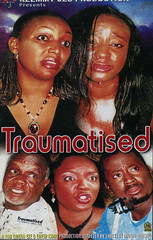
traumatised
It requires neither courage nor prescience to predict disaster. Courage is required of the man who, when things are good, says so. Historians rejoice in crucifying the false prophet of the millenium. The never dwell on the mistake of the man who wrongly predicted Armageddon.
There are lots of emotions when it comes to finance, concern chief among them. During a crash or panic, emotions turn darker and this can be a perilous time.
Despite a flattering supposition to the contrary, people come readily to terms with power. There is little reason to think that the power of the great bankers, while they were assumed to have it, was much resented. But as the ghosts of numerous tyrants, from Julius Caesar to Benito Mussolini will testify, people are very hard on those who, having had power, lose it or are destroyed. Then anger at past arrogance is joined with contempt for present weakness. The victim or his corpse is made to suffer all available indignities.
And a parting warning for those erstwhile masters:
One trouble with being wrong is that it robs the prophet of his audience when he most needs it to explain why.
Shell games do have costs.

A brief soundtrack


File under: , , , , , , , , , , , , , ,

Wednesday, August 27, 2008

Bite-sized

A little inaccuracy sometimes saves tons of explanation.

— Saki, The Comments of Moung Ka

It's so convenient when one can tell the truth.

— Graham Greene, Travels with my aunt

Honesty hath no fence against superior cunning.

— Jonathan Swift, Gulliver's Travels

It is always a relief to believe what is pleasant, but it is more important to believe what is true.
— Hilaire Belloc, The Silence of the Sea
These clippings from some recent reading were meant to anchor a number of pieces I've been working on. It struck me however that the verbiage that I might have attached didn't add much, and the plain juxtaposition of these bite-sized pearls sufficed. The first two statements, weighing the expedience of honesty, are paradoxically uttered by notorious dissemblers in the context of the stories in which they appear. Saki and Greene's mouthpieces share their author's sense of irony. In contrast Swift and Belloc are more satirical. [Insert disclaimer: we've all learned that honesty is the best policy.]
He was as American as folding money and waging war.

— George Pelecanos, The Night Gardener

He liked his epiphanies American: brief and illusory.

— Colson Whitehead, Apex hides the hurt
These last musings on America, by two of the sharpest and hungriest current wordsmiths, seem a little bleak and capture a certain malaise about the country. In the same book (it's nothing too weighty incidentally, and hopefully his next novel will have a greater impact), Colson Whitehead adds this choice piece of cynicism:
It was a good place to make a bad decision, and in particular, a bad decision that would affect a great many people.
I think I'd call this Blues 2.0 - we might as well add a version number to the sentiment.

Soundtrack: Me'Shell NdegéOcello - Elliptical

Taken from an album with the paradoxical title The world has made me the man of my dreams, this is one of the most fluid musical movements I've heard in the past couple of years.

File under: , , , , , , , ,

Thursday, March 29, 2007

The Great Game

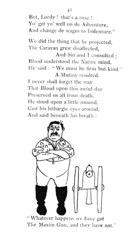
Whatever happens we have got
The Maxim Gun, and they have not

— Hilaire Belloc in The Modern Traveller, 1898

Have no fear of atomic energy
For none of them can stop the time

— Bob Marley - Redemption Song, 1980
the modern traveller


Iraq isn't Africa, Iraqis shoot back.

— Robert Baer in Iraq's Mercenary King: Politics & Power, 2007

We see Africa as probably the greatest open field of manoeuvre in the worldwide competition between the [communist] bloc and the non-communist.

— President John F. Kennedy, 1962

All for you
It is all for you

— E.T. Mensah & The Tempos - All For You, 1948
cecil rhodes astride africa
Cecil Rhodes - From Cairo to Capetown


How long shall they kill our prophets
While we stand aside and look?
Some say it's just a part of it
We've got to fulfil the book

— Bob Marley - Redemption Song

When you came you had the Bible and we had the land. Now you have the land and we have the Bible.

— Unknown 'native', 19th century

And freedom is the issue. The stakes are that high.

— Ronald Reagan, 1986
freedom kagyah


There are no rules in [this] game. Hitherto acceptable norms of human conduct do not apply. If [redacted] is to survive, longstanding American concepts of "fair play" must be reconsidered... It may become necessary that the American people be made acquainted with, understand and support this fundamentally repugnant philosophy.

— Report of the United States Hoover Commision, 1950

One man struggles while another relaxes.

— Massive Attack - Hymn of the Big Wheel
elegance and chaos
Beirut, Lebanon, summer 2006


A belligerent state permits itself every such misdeed, every such act of violence, as would disgrace the individual. It makes use against the enemy not only of the accepted ruses de guerre, but of deliberate lying and the deception as well - and to a degree which seems to exceed the usage of former wars.

— Sigmund Freud - Thoughts for the Times on War and Death, 1915

There are only people behaving, and sometimes behaving monstrously.

— Ian McEwan disputing the notion of evil, 2002

Takes behaviour to get along.
Lots of behaviour to get along.
Do you really, really know that?
Social Living is the best

Do you know? Social Living is the best

— Burning Spear - Social Living

Honam mu nni nhanoa
(Humanity has no boundary)

— Akan proverb, Ghana

Ex Africa simper aliquid novi
(Always something new out of Africa)

— Pliny the Elder, 1st Century Rome
No Problem by Lalelani


Cultural interplay is the name of the Great Game.
I wonder: who is writing today's script?


This note is part of the Things Fall Apart series under the banner of the rough beast.

See also: The Mosquito Principle

Next: The Modern Traveller (Reclaiming the Maxim Gun)

File under: , , , , , , , , , , , , , , , , , , , , , ,

Sunday, August 14, 2005

Noblesse Oblige

A few quotes that have been helping me get through the past couple of weeks...

Satire is a sort of glass wherein beholders do generally discover everybody's face but their own; which is the chief reason for that kind reception it meets with in the world, and that that so few are offended with it. But, if it should happen otherwise, the danger is not great; and I have learned from long experience never to apprehend mischief from those understandings I have been able to provoke: for anger and fury, though they add strength to the sinews of the body, yet are found to relax those of the mind, and to render all its efforts feeble and impotent.

— Jonathan Swift - The Battle of the Books
The following struck me forcefully with its unerring similarity to the cadences and content of a Bush speech. The sentiment of course is an extremely diluted sense of noblesse oblige. On the prescience of satirists again...
A sermon delivered to the congregation of the Church of the Holy Monument in Boggington by the Chief Constable.

"I say unto you that unless we maintain the bonds of free enterprise and free endeavour we shall be bounden to do the Devil's work," he announced from the pulpit. "Our business in the world is to augment the goodness that is God's love with the fruition of free enterprise and to put aside those things which the Welfare State handed us on a plate and thus deprived us of the need to which we must pay homage. That need, dear brothers and sisters in God, is to take care of ourselves as individuals and so save the rest of the community doing it out of the taxpayer's pocket.

Only this week , I have been encouraged to see how many Watch Committees and Neigbourhood Watches have been set up to augment that splendid work being done by the Police everywhere and in particular by the men under my command. It is not often that I have a chance or, I might say, the opportunity to do the Lord's work in the way he would have me do, namely, like your goodselves, to encourage others to free themselves from the shackles of passivity and acceptance and to go forth into the world to bring the positive and active blessings of health, wealth and happiness to those less fortunate than ourselves.

This is not to say that we must bow the knee to social need or so-called deprivation. Instead we must make of ourselves and our gifts in business and in wealth whatsoever we can. As the Lord has told me, there are as many numerous spin-offs on the way to Heaven as there are handouts on the slippery road to Hell. It is one thing to give a penny to a beggar: it is another to beg oneself. And so I say to you dear friends, assist the police wherever you can in the prevention of crime and in the pursuit of justice but never forget that the way of righteousness is the way of self-service and not the other way around. And so let us pray."

— Tom Sharpe - The Midden (1996)
The shock of reading Jonathan Swift at his best cannot be discounted. The set up is done with a poker face and the exposition is so skilled that, when you realize just how far out of this world he has taken you, you can only laugh.
I shall now therefore humbly propose my own thoughts, which I hope will not be liable to the least objection.

I have been assured by a very knowing American of my acquaintance in London, that a young healthy child well nursed is at a year old a most delicious, nourishing, and wholesome food, whether stewed, roasted, baked, or boiled; and I make no doubt that it will equally serve in a fricasse or a ragout.

— Jonathan Swift - A Modest Proposal for preventing the children of poor people in Ireland from being a burthen to their parents or country, and for making them beneficial to the public.
As they say, Eating People is Wrong. File under: , , , , , , , , ,