Showing posts with label Bush. Show all posts

Tuesday, October 29, 2024

The Occasional Regret

Sometimes technology gets in the way,
There are ghosts in the machine, it seems
Or perhaps gremlins are the proper genus of the species
For when, in your haste to wish your interlocutor
Simple encouragements and the best of luck,
Your typed message got garbled by the darned computer
Transformed into choice obscenity before you could react
And now you wish that the whole interaction was something you could retract
Flush with mounting embarrassment
  And awkwardness that you're unable to deflect
All that is left is to bemoan it:
  The occasional regret of auto-correct

...

Sometimes when you're confronted with a choice,
You decide to take the easy way out
Unwilling, as you are, to listen to other voices
Or even entertain a scintilla of a doubt
You find yourself beefing up and promoting a patent scoundrel
Marshaling fraudulent arguments on the basis that he's a lesser evil
And now, without shame, he's hellbent on crudely screwing the pooch
The bodies are piled up high,
Unmitigated disasters while he cheerfully loots
  The uncouth rascal,
The hatchet jobs write themselves for even middling pundits
But now you have to stay silent as you were well and truly complicit
Call it buyer's remorse:
  The occasional regret of claiming to know what's best

...

Sometimes you decide to invade a smaller country
Might makes right and it will serve all your cronies
Fictitious claims, weapons of mass destruction
Vague but imminent threats and human rights violations
Ignoring, in your rush, all evidence to the contrary
Riding roughshod over any attempts at diplomacy
Wars of choice never lead to mission accomplished
After this catastrophic war on the wrong target, you are fully tarnished
Beyond the blood and lost valor,
  Your nation now entirely lacks credibility
Hell, even Putin can rightly accuse you of being part of an axis of hypocrisy
While badging his aggrandizing crimes with the same patina of manifest destiny
Oops, a cautionary tale:
  The occasional regret of the self-righteous mindset


At this point subsequent horrific events are still reversible - kodjo crobsen


Sometimes, a playlist


A soundtrack for this note (spotify version)
See also Regret, a playlist

See previously: The Writing's on the Wall and Regret is all

File under: , , , , , , , , , , , , , , , , , , ,

Writing log. June 4, 2022

Wednesday, December 05, 2018

Legacies (Munhango to Kennebunkport)

My proudest bit of publishing was an alternate history centered on Angola that someone gifted me late one night. "Here's to bad men" was the takeaway of that fevered dossier, a strand of the story of what historians now brand the "lost decades" in Africa and elsewhere. Stories are always unfinished, and the late KB Mensah shared some photos of Jonas Savimbi from his BBC archives that would have fleshed out that script. Also illuminating was Chester Crocker’s High Noon in Southern Africa (thank goodness for vanity, and used book stores). Its title and duel framing was inadvertently revealing; the outlook of cowboy diplomacy hard to resist. We have occasion to revisit the legacies of these political actors. If the prevailing view from Kennebunkport was of a cold-blooded, Cold War, on the ground in Munhango and Cuito Cuanavale, however, there were warm bodies that bore the brunt of abstractions: domino theories, linkage and containment. Collateral damage aside, the rest of us bear witness.

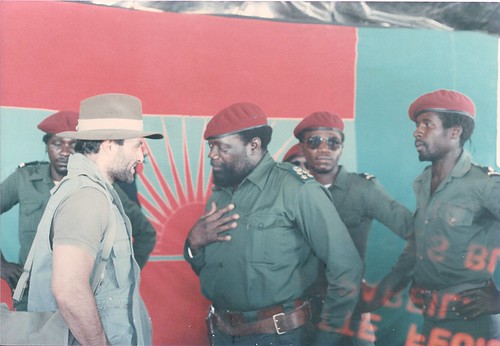
Jonas Savimbi

Apparently enough time has passed since the death of Jonas Savimbi that we are now urged to take a more nuanced view of his legacy. The caricature that was memorialized in the video game, Call of Duty: Black Ops II while apt for a rogues gallery of pulp fiction is said to be too simplistic.

Jonas Savimbi crowd

His family even sued for defamation at the blunt portrayal:

A lawyer for Activision Blizzard, Etienne Kowalski, has rejected the claim, stating that the game represents Savimbi as a "good guy" – and that he is portrayed fairly, "for who he was... a character of Angolan history, a guerrilla chief who fought the MPLA".
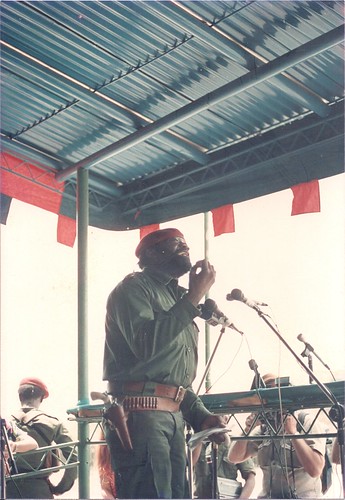
Jonas Savimbi gun address

The case was dismissed. The legacy remains contested.

The elder Bush in death will face similar contests despite the patrician image, New England privilege and attendant Yale legacy. Reputations need to be managed.

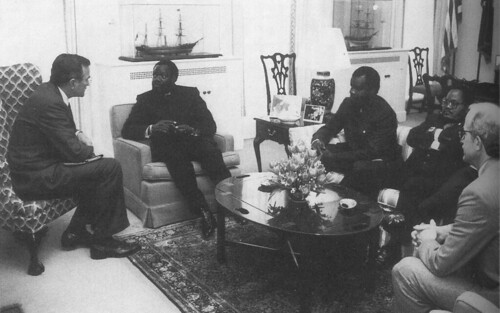
George Bush, Jonas Savimbi & Chester Crocker 1986

Chester Crocker looked on as Vice President George Bush met with Jonas Savimbi in the Oval Office in January 1986 to discuss the United States' continued assistance to UNITA in the Angolan civil war.

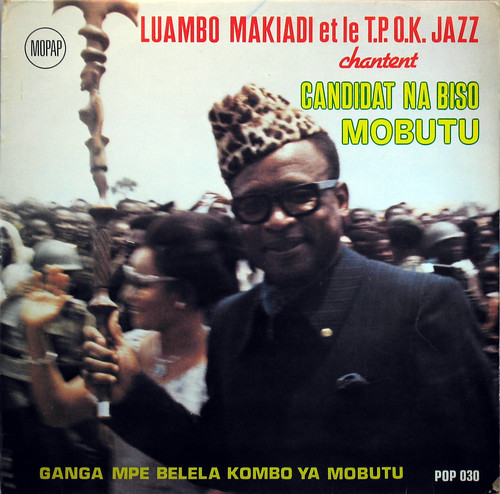
Item: Joseph Mobutu (a.k.a. Mobutu Sese Seko amongst other honorifics) was the most prized CIA asset in Africa from the 1960s until his death in 1997. He was a friend to every CIA director in his lifetime.

Dig: The Bush and Mobutu families spent vacations together.

The late Barbara Bush would recall in her memoir the visits with "President Mobutu, who wears a leopard skin hat and carries a tribal stick. He is very flamboyant, but charming."

Franco et le T.P. OK Jazz sing for Mobutu

High Noon in Southern Africa makes a quite long winded defense of US foreign policy, arguing that it was all in service of "making peace in a rough neigbourhood". Diplomats often have do such things: putting lipstick on a pig or, to mix metaphors, making palatable the unsavoury. Still Crocker doth protest too much. It was never about clean hands, it was naked self interest. Being on the wrong side of history, supporting apartheid, propping up dictators will always be thrown back at one's face.

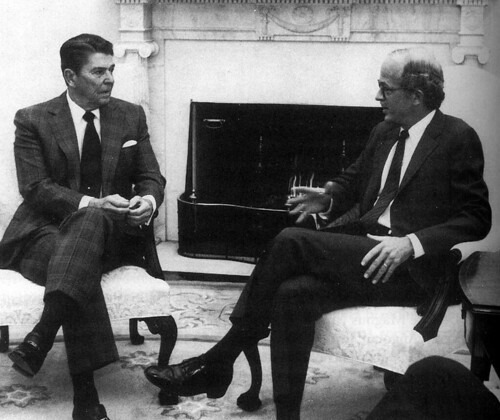
Ronald Reagan and Chester Crocker

— Ronald Reagan and Chester Crocker at the Oval Office in November 1984 discussing the US policy to vigorously oppose sanctions on the South African apartheid regime.

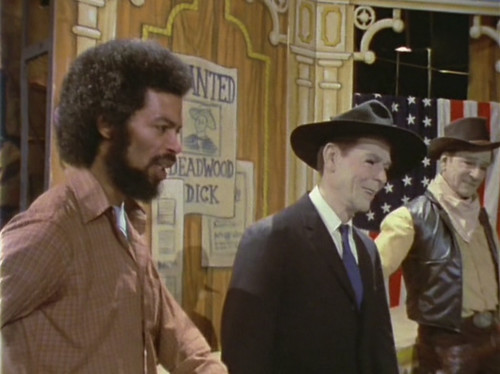
While Ronald "Ray Gun" was the ostensible target of Gil Scott-Heron's classic 1981 track 'B' movie, there was also this observation:

'The screenplay will be adapted from the book called "Voodoo Economics" by George "Papa Doc" Bush.'

Prescient as always, our Gil, and then this:

... all of a sudden we have fallen prey to selective amnesia - remembering what we want to remember and forgetting what we choose to forget.'

Ah right, Papa Doc and the Tontons Macoutes that ruined Haiti. Lest we forget.

gil scott-heron ronald reagan and john wayne - b movie american nostalgia

Squalid murder for the left of us, flowers to the right.

We've since learned of Donald Rumsfeld's notions that informed Bush the Younger's catastrophic reign:
Reports that say that something hasn't happened are always interesting to me, because as we know, there are known knowns; there are things we know we know. We also know there are known unknowns; that is to say we know there are some things we do not know. But there are also unknown unknowns – the ones we don't know we don't know. And if one looks throughout the history of our country and other free countries, it is the latter category that tend to be the difficult ones

The obvious problem with the Rumsfeld taxonomy of knowledge is that it ignores the "unknown knowns", that is, the unconscious biases that underlie an issue. This willed blindspot is the working mechanism of selective amnesia. We are living in a moment where nostalgia is key and we're anesthetizing ourselves with transactional, cowboy politics.

There was a recent clarification which reminded me of the title of an episode of The Wire: moral midgetry.

America First!

The world is a very dangerous place!

... the purchase of military equipment from Boeing, Lockheed Martin, Raytheon and many other great U.S. defense contractors

... maybe he did and maybe he didn’t!

— Statement from President Donald J. Trump on Standing with Saudi Arabia, November 2018

Arms sales (and preferably ours).

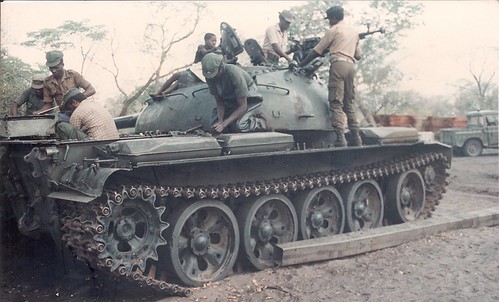
Jonas Savimbi angola tank

The B movie theory: manifest destiny revisited as farce. The politics of rehabilitation, reputation scrubbing, and legacies of blood and sin.

Soundtrack for this note

File under: , , , , , , , , , , , , , , , ,

Monday, March 14, 2016

Mango Madness

It strikes me that we don't talk enough about George W. Bush. He remains an erasure even as we all reap the fruits of his legacy.

The signal foreign policy achievement of the Bush administration was allowing the importation of mangoes from India.

Ghanaians will point fondly to the George W. Bush highway (fruit of the Millenium Challenge Accounts). As for the rest of Bush's legacy?

Recall that in 2005, the editors at CNN and Time magazine declared Bush the "fourth most fascinating person of the last quarter-century"

The headline on July 3rd 2007 read "Bush Commutes Libby Sentence, Saying 30 Months 'Is Excessive'" but it was the small things that rankled.

There were so many "last straws" under George W. Bush that I suppose this Great Recession (or Lesser Depression) remains an afterthought.

Gil Scott-Heron's band used to be called the Amnesia Express, proof of how keenly attuned he was to that deep vein of the American zeitgeist

The defense mechanism to George W. Bush's tenure has been amnesia and nostalgia. I had rather expected tissue rejection. The USA confounds.

Incidentally Indian mangoes have faced stiff competition from Latin American mangoes in the US due to transport costs. A race to the bottom.

George W. Bush has indeed proven to be a hard act to follow. Discuss this paradox among yourselves.

An elephant which is lean is still fatter than a cow. Ga proverb, Ghana.

Let's celebrate George W. Bush's brand of mango madness. Soundtrack: Mango Meat by Mandrill.

Alternatively: Legend In His Own Mind by Gil Scott-Heron

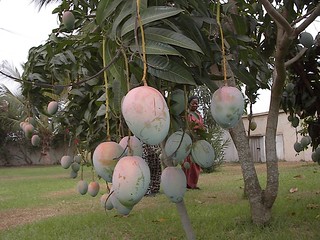
Mangoes in Auntie Akwele's Garden


File under: , , , , , , , , , ,

Friday, July 27, 2007

Anatomy Lessons

As part of an occasional series, a few items briefly noted, this time an anatomy lesson of sorts.

I. The Emperor's Teeth


Last year I pointed to an article that had brought me much comfort, the account of a wonderful taxicab conversation with the cab driver who — well, you should read all of it in his voice (it's a few paragraphs down the linked page).
"Funniest trip I ever had to make," said the taxi driver. "Now, you'll like this one..."

"So I gets a call on me wireless," he continued, "an' 'e says; 'Ere, I've got one for you.'

"I says, 'Oh, yeah,' and 'e says, 'Yeah, you're gonna like this one, I want you to go to this address, in Kensington, pick up Napoleon's tooth and take it to Swindon for auction.'

"I says, 'You what ?' 'E says, 'You 'eard. Napoleon's tooth. An' I 'ope you're insured 'cos it's worth 8,000 nicker.' ...
The humour gave me much comfort and I filed away the idea of eventually writing something of substance on said tooth, said transporter or whoever it was that had collected or bid for it.

Serendipity struck when I noted a related story last week; the headline: Napoleon's Toothbrush Finally Has a Home
The Wellcome Collection, as the new museum is called, includes early anatomical models, surgical instruments, prosthetic limbs and other examples of medical progress, as well as eye-catching objects ranging from Peruvian mummies and Chinese torture chairs to Greco-Roman phallic amulets to Japanese sex aids.

It also presents what can only be called celebrity curiosities, like Napoleon's toothbrush, Charles Darwin's walking stick, Benjamin Disraeli's death mask, Horatio Nelson's razor, Florence Nightingale's moccasins (worn during the Crimean War) and some locks of George III's hair.
I immediately wondered whether Henry Wellcome was the collector who had been the successful bidder for Napoleon's tooth and whether it was also part of his collection. And if not, the obvious question needed to be raised: was someone somewhere considering reuniting Napoleon's tooth with Napoleon's toothbrush? Inquiring minds want to know.

These are strange days and perhaps the cabdriver's eventual punchline bears repeating
"Well yeah, still, I'll tell you somefin'. You gotta 'and it to his dentist, 'aven't you? 'E shoves that tooth to one side, an' e says, 'I'll 'ave that and I'll keep 'old of it till someone invents eBay.'"
lion king


I wonder when Napoleon's tooth was excised. Was it before or after he crowned himself emperor? Would the course of world history have been different if he used a chewing stick instead of a toothbrush?

Some poetry is in order:

The Emperor's Teeth


The Emperor has no teeth
His toothbrush plain disappeared
But after much blood, sweat and tears,
Teeth and toothbrush were reunited after two hundred years.

II. The Bible and the Ganglion


I once had a recalcitrant ganglion — don't you love that word ganglion? It just sounds gangly, like an uncoordinated teenager in the throes of a growth spurt. Perusing dictionaries you'll read this definition: "rich fluid enclosed within fibrous tissue and usually attached to a tendon sheath in the hand, wrist, or foot". Well talking of growth spurts, one of the hundreds of ganglions in my body suddenly started swelling one day on my wrist. It was mostly benign, a little bump that I paid no attention to for a month or so, after which time, however, the enlarged fluid sack began to pinch a nerve on my wrist. That drew my attention because the pain was as most pain associated with the nervous system is, sharp and debilitating. The ganglion turned from recalcitrant to excruciating.

The American health care system may be a little sick these days but the university doctors that I consulted back then did their best to provide relief - a little syringe plunge to drain the fluid. I was a little curiosity for the trainee doctors. After a few months of weekly treatment "It will go away soon, just let us know if it gets too painful", and with their patient increasingly bewildered by the seeming randomness of the sharp pangs of pain, the surgeons were called in, and well, they did what surgeons do, they exercised their scalpels, dove in and snipped. They called the procedure a ganglionectomy - that word also sounds delicious and loopy and rolls off the tongue quite felicitously; I like the "nectomy" part especially, like the verb to dissect, it is onomatopoeic perfection. Incidentally the pill-swallowing post surgery was, how to put it, interesting, but that was another story.

In any case, my doctor uncle later on told me how he would have treated my case had he been consulted. What he had been taught at medical schools in England, Ghana and Nigeria was that the time-tested treatment for recalcitrant ganglions is the forceful impact of a heavy object.
"Sometimes a good whack cures this kind of thing."
Indeed his English resident had suggested holding the patient's wrist on the table and using a heavy book like the Bible to hit the bump. He was surprised that my American doctors hadn't done the deed, perhaps they were being too careful — afraid of the insurance companies and all that...

Every so often, as my eyes pass over the little scar tissue, my memento of that episode, I think to that incongruous image of a heavy bible dropping with vicious, but medical, intent onto my supine wrist.

I still wonder, did I really need to subject the Harvard endowment to $9,000 dollars worth of surgery when a twack with a King James bible would have done the efficacious deed? For that matter, did it matter what version of the Bible was used? Would a Revised Standard Edition have worked? Indeed did it have to be a bible? Would a telephone book have worked its numeric charm? Was there clinical significance in the choice of a holy book or was the religious designation simply a placebo effect of sorts? Was it a mere article of faith? Would a Koran, Torah or some other Holy Book have done the deed? I have visions of a rural hospital somewhere, say Libya, with a villager complaining of ganglionic discomfort. What would the Bulgarian nurse practitioner prescribe? What cultural sensitivity does the Hippocratic oath entail?

New Oxford Annotated Bible


I have a quite hefty New Oxford Annotated Bible (with the Apocrypha) on the bookshelf and it always give me pause when I read it because of the literal connection I've outlined between body and soul — sidenote: do the Apocrypha have relevance here? I'll note without comment that, serendipitously, said bible is nestled between Kwame Gyekye's Tradition and Modernity and Hans Christian Andersen's Fairy Tales, a delightfully-illustrated version. Would any of those tomes have provided faster relief?

Would The Riverside Shakespeare fit the bill, the Bard's comedies and tragedies have been known to work wonders elsewhere? Or does the weighty object need to be a softcover book? How did doctors come to learn about this remedy? Is it an old wives' tale that doctors spin to impressionable young trainees? What about Karl Marx's Capital Volume III - surely a Penguin classic, let alone a critique of political economy, might do, or would I need the later and slightly heftier volumes on the theory of utility and surplus value? Or, since I'm discoursing on matters dyspeptic and poetic, would Anthony Burgess's The Complete Enderby have worked? Or would a lighweight tome like Anthony Winkler's The Lunatic do the deed (a new edition came out last month)? There I was reading it last year.

Sidenote: I have a Nigerian friend who used to tell of how he and his siblings would be punished as children. They would be forced to walk up to their father holding up a bible to receive a few well-chosen whacks of the cane - at such times, dropping the bible was a definite no-no and it heightened the dread. I couldn't help but be reminded of that curious ritual (was the punishment corporal or psychic I wonder?) when I read Chimamanda Ngozi Adichie's Purple Hibiscus a few years back - the mystery of the African father and Serious Religion.

And to digress further on matters of the soul, I've heard that one of the reasons people in Northern Ghana vote the way they do is that the political bosses go around before election day accompanied by clerics, and make recalcitrant villagers pledge to vote the right way on the handy Koran. I've always thought that this was a stereotype of pork-barrel politics (or perhaps beef in this case) adapted for the supposedly religious, backward and illiterate northerners - even as said northerners are often far more worldly and cosmopolitan than the rest of Ghana. And surely our electorates were more sophisticated these days? But political scientists don't really know why voters do the things they do in the comfort of a voting booth. What has been happening in the USA recently after all? Perhaps the choice of book does matter.

But to return to matters ganglionic, this being the web, perhaps someone somewhere could eventually resolve these open issues, namely:
  • Has a doctor ever whacked your ganglion?
  • And if so, what book or implement did he or she use?
And Dear Toli Readers, what books would you suggest for a homebrewed ganglionectomy?

III. Faux Boils


Apropos ganglions:
"I'm tired of hearing about your faux boils"
That was what someone very dear to me exclaimed a couple of weeks ago in mock exasperation at one of my discursive tales. I believe she meant "foibles" although the notion of fake boils, beside being hilarious, also seemed to work. A sociolinguistic friend branded the malapropism as folk etymology rather than eggcorn. Still, I like the coinage and it seems relevant since I've been dealing with a plagiarized something-or-other these past few weeks. Ghana must go as they say.

IV. The President's Polyps


The novelist and gothic satirist Will Self is no stranger to anatomy and on it he tends to veer towards the grotesque. Last year he riffed on Haydn's Nasal Polyp:
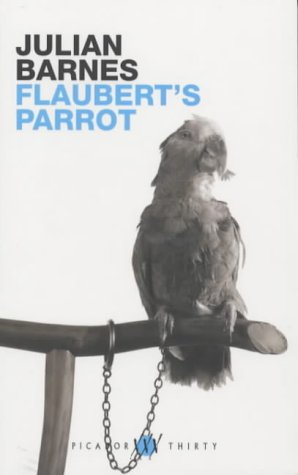
I've been toying with a short story of this title for years, ever since hearing – or thinking I heard – a Radio 3 announcer say, with predictably risible stuffiness: 'During the winter of 1772, Haydn, then resident in London, found himself unable to compose, so troubled was he by a nasal polyp..'. There was something about the notion of Haydn's nasal polyp – rather like Flaubert's parrot, or Lenin's brain, or Churchill's black dog – that seemed almost purpose-built for a story title. Not that I really wanted to write anything serious about Haydn: this was going to be more a piss-take of that particular strain in contemporary letters, perhaps exemplified by the titles above, that seeks out profundity by yoking a mundane, or curious, thing – parrot, brain, polyp – to a great name.
He then went on to note a case of literary serendipity shared with Ian Rankin apropos the conductor's nasal nostrum.

Flaubert Parrot


Now you can probably guess why I was drawn to that piece and its confluence of small things and cultural observations let alone the fact I'm a big fan of Flaubert's Parrot - Julian Barnes' novel that is.

Well yes, it was the polyp. What the hell was a polyp, I wondered? The word sounds polymorphous, polyandrous, poly-something-or-other. When you pronounce polyp, you feel as if you're missing something, it seems curt, abbreviated even. It stands to reason that it designates a tuft of tissue, a small growth or tumor.

This came to mind when it was announced that George W. Bush had five polyps removed in a routine colonoscopy last Saturday. There was a pleasing symmetry of the image of the keys to nuclear missiles being handed over to Mr Cheney just before the surgeon's scapels was applied to that area.

Now presumably nasal polyps have a different impact than polyps from you-know-where but it seemed that some dots needed to be connected. The President's polyps have now displaced the conductor's polyps in the panopticon, or rather the pantheon, of polyps. Hadyn must surely be turning in his grave. I wondered whether Haydn's music was the kind of thing Mr Bush listened to on the iPod his daughters gave him for his birthday.

I do hope that Will Self writes his piece and, further, that he manages to tie in the five presidential polyps to give the requisite historical sweep that this story deserves. If not I'll file that tidbit around and perhaps get around to writing something of substance with it, perhaps linking things to Napoleon's tooth — Emperor to conductor to Decider. In parting one has further questions:
  • Where will the five polyps live once the doctors are done with them?
  • Will they be preserved as a whole or separately to be studied by future generations?
  • Will the 43rd President of the United States change his stripes now that they have been excised?
  • Will the course of the American Empire later be judged to have turned on said polyps?
  • Furthermore, will future curators of the Wellcome musueum seek to gain access to them rather than the undoubted presidential museum that is being planned somewhere in Texas?
Needless to say: observers are worried.

V. Body: A Playlist


I was recently reading Mingering Mike: The Amazing Career of an Imaginary Soul Superstar and in the spirit of that chance discovery I've been thinking that if I ever decided to be the svengali of a boy band that I might well call them The Five Polyps. Their demo for their first album, Napoleon's Tooth, might be the breakout ballad, The Recalcitrant Ganglion. The b-side would be the funk track Faux Boils.

As usual, a short playlist founded in reality seems appropriate.
  • Raphael Saadiq - Body Parts
    An instant vintage affair from one of Oakland's sons of soul
  • The Jacksons - Body
    The Victory album doesn't get as much love as it should. I believe Jermaine and Tito orchestrated this dance track reminiscent of the earlier Shake Your Body Down To The Ground from the Destiny album
  • Sonny Rollins - The Serpent's Tooth
    On an album with Miles Davis, a young Sonny stretched out.
  • Ohio Players - Body Vibes
    The funk was on fire with these brothers
  • Bootsy Collins - Body Slam
    It's about the Pinocchio Theory as Bootsy would sing as he competed in those funky seventies. Did he deal with Haydn's nasal polyp one wonders? Wasn't he Parliament/Funkadelic's Sir Nose or is my attribution sloppy?
  • James Brown - Bodyheat
    The godfather of soul brought the motherlode of funk. He is sorely missed.
  • Nas - Don't Body Ya'self
    The dark prince of hip-hop goes pidgin on everyone and body parts start flying at the lyrical onslaught. 50 Cent got downgraded by a quarter.
  • Johnny Gill - Wrap My Body Tight
    Johnny Gill provides the counter and seeks comfort
  • R Kelly - Your Body's Callin'
    Hmmm. He is obsessed with bodily functions isn't he? No comment.
  • Me'Shell Ndegéocello - Body
    Me'Shell was seeking a comfort woman a few years ago. One hopes her search was conclusive.
  • Coleman Hawkins - Body And Soul
    Perhaps the greatest solo in jazz history, this 1939 excursion still delights with its emotion.
  • Dwele - Flapjacks
    I'll end with Dwele who was so great, exuberant and soulful in last night's concert in Oakland. There were many moments of musical genius but the most sublime was when he orchestrated an expedient audience choir on top of the laidback groove. The ladies in the audience would hum "la la la la la / da da da da da / paaaa daa daaaa" And the men would punctuate in harmony:
    "I'm digging your flapjacks"
    As The Wife and I sang and shook our behinds in soulful harmony we were sated by the celebratory vibe. We had paid our soul insurance and our bodies and soul could receive treatment from Doctor Soul himself. Amen. Hallelujah.

    Dwele Some Kinda


    Note: since this is a family blog I'll add the obligatory disclaimer. There is no need to elaborate on what body parts flapjacks refers to. It's a metaphor for the soul, not the body.

File under: , , , , , , , , , , , , , , , , , , , , , , , ,

Friday, May 18, 2007

On George W. Bush

I. On Knowledge

His had been an intellectual decision founded on his conviction that if a little knowledge was a dangerous thing, a lot was lethal.

Tom Sharpe - Porterhouse Blue
I turned to Tom Sharpe expounding on knowledge a quarter century ago for insight on the 43rd President of the United States. At first glance, I thought his bons mots were a succinct and definitive summary of what we have seen of said President's attitude towards knowledge. Some have speculated about oedipal reasons or ice queen mothering for his essential incuriousity. I demur; one should give him the benefit of the doubt and ascribe his outlook to conscious decision. He has asserted after all that he is "the decider". Also as Sharpe explained, incuriousity can be a deliberate policy, indeed one founded on conviction, if not an instinct towards self-preservation. This is only human and it is clear that there is a lot of conviction in the President. Upon reflection then, Sharpe's formulation can only be a partial rendering.

Knowledge is all the rage these days. Secretary of Defence, Donald Rumsfeld even proposed a taxonomy of knowledge, iconic in recent memory, in one his jawboning press conference performances — said taxonomy was incomplete as it turned out, he forgot the unknown knowns, and in the war policy he implemented, he discounted even the known knowns. Robert Waldmann recently added a few prescriptions on the matter. Political discourse in the United States of America has thus been all about knowledge: who knew what, when did they know it, should they have known it and so forth. There have even been acrobatics: "If I knew then what I know now, I would etc."

Well, who knew?

porterhouse blue

II. On Ignorance


It seems to me that one should turn to the other side of the coin in search of insight on the 43rd President of the United States. Thus we'll consider ignorance. For this we'll go back to 1907 and to Hilaire Belloc's delightful essay On Ignorance. As an avid proponent of the collage and remix, let's see how well a sampling of his toli can flesh out our portrait...
On Ignorance by Hilaire Belloc

There is not anything that can so suddenly flood the mind with shame as the conviction of ignorance, yet we are all ignorant of nearly everything there is to be known. Is it not wonderful then, that we should be so sensitive upon the discovery of a fault which must of necessity be common to all, and that in its highest degree? The conviction of ignorance would not shame us thus if it were not for the public appreciation of our failure.

... the biting shame of ignorance suddenly displayed conquers and bewilders us. We have no defence left. We are at the mercy of the discoverer, we own and confess, and become insignificant: we slink away.

... Note that all this depends upon what the audience conceive ignorance to be... Among very young men to seem ignorant of vice is the ruin of you, and you had better not have been born than appear doubtful of the effects of strong drink when you are in the company of Patriots...
Ignorance is an everyday occurence, something that affects every man. It isn't surprising that those who affect to be Everyman would not be immune from its effects.

One wonders about the moods of crowds. Why do people turn when they do? What is it that causes reassessments and shifts in the cultural zeitgeist? Tipping points are only part of the picture. I continue to ponder the essential difference between those two fables: the boy who cried wolf and the emperor's new clothes. This is not to suggest that the 43rd President of the United States is a wolf or indeed an emperor, although there may be latent aspirations to both characterizations. Rather I wonder about the reception to the messages of those boys in the fables. The one was ignored (he cried wolf too often) while the other was celebrated (everyone laughed at the emperor). When does danger or hubris become plainly evident to all? Perhaps everything is local and our evolutionary make-up conditions us accordingly.

But I digress. Back to ignorance...
Nevertheless... we should rather study the means to be employed for warding off those sudden and public convictions of Ignorance which are the ruin of so many.

These methods of defence are very numerous and are for the most part easy of acquirement. The most powerful of them by far (but the most dangerous) is to fly into a passion and marvel how anyone can be such a fool as to pay attention to wretched trifles...
No one can fault the 43rd President of the United States for lack of passion. He is focused. He is a compassionate conservative. He is a war president. Passion and focus on big, serious and era-defining issues are his concern. War by definition is as big an issue as humankind faces. Would it that small things were considered; that however would reek of Clintonian microsteps, trivialities in essence.

No. Crusades. Mushroom clouds. War. Terror. Big picture. Serious.
There are other and better defences. One of these is to turn the attack by showing great knowledge on a cognate point, or by remembering that the knowledge your opponent boasts has been somewhere contradicted by an authority...
The 2004 US presidential election campaign is perhaps a great illustration of this technique, and in this Karl Rove, sometimes labeled Bush's brain, was in full concurrence. John Kerry knows this all too well.
Yet another way is to cover your retreat with buffonery, pretending to be ignorant of the most ordinary things, so as to seem to have been playing the fool only when you made your first error. There is a special form of this method which has always seemed to me the most excellent by far of all known ways of escape. It is to show a steady and crass ignorance of very nearly everything that can be mentioned, and with all this to keep a steady mouth, a determined eye, and (this is essential) to show by a hundred allusions that you have on your own ground an excellent store of knowledge.

This is the true offensive-defensive in this kind of assault, and therefore the perfection of tactics...
The steady mouth, the determined eye, the repeated calls for resolve, the swagger, the obsession with fitness, the cowboy photo opportunities, the outdoors pose of a "Texan" stand in stark contrast to the Connecticut patrician upbringing. This is deliberate it would seem.

The notion of buffoonery is trickier however. The public gaffes during the Queen's recent visit are a case in point. One should ask: is the steady flow of homespun awkwardness calculated or genuine? Dwelling on bushisms as many do, only serves to lower everyone's guard and cause misunderestimation as the 43rd President of the United States so candidly and memorably put it.

This is a theme Belloc covered a decade earlier in The Modern Traveller, a book whose toli I'm a year behind in addressing (real soon now).

On Ignorance - The modern traveller

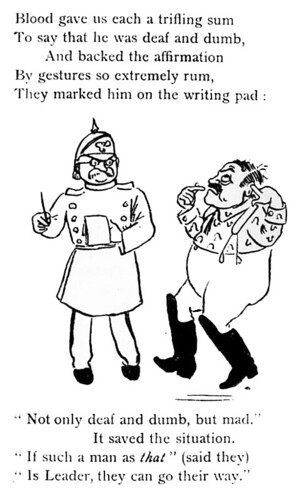
Note the name, Blood, and the reaction to his shrewd manoeuvers:
It saved the situation.
"If such a man as that" (said they)
"Is Leader, they can go their way."
That is an efficient take on ignorance, who has the time to scrutinize closely in this fast-paced world? By and large, our decision-making is done on gut feel and liminal signals, with only lip service paid to due diligence. Most of the time things work out, right?
Lastly, or rather Penultimately, there is the method of upsetting the plates and dishes, breaking your chair, setting fire to the house, shooting yourself, or otherwise swallowing all the memory of your shame in a great catastrophe.
I fear that this is the terrain of the current moment; the aircraft carriers ominously deployed in the Gulf, the saber-rattling on Iran, Syria and such bode ill for all of us. Setting fire to the house, whether to its finances or its foundations is a real temptation. One school of thought on the Middle East misadventures is that if you break eggs over there, the natives will be scrambling amongst themselves. "We fight them over there so that etc". This Scrambled Egg Theory of Mesopotamia is a rather dubious historical legacy I must say. I rather thought that blood was precious for most human beings but it seems that a powerful cohort, and the 43rd President of the United States is among equals in these elite ranks, are determined to provide existence proofs of the quantity theory of insanity. This young century is on course to equal the butchery of its predecessor.
But that is a method for cowards; the brave man goes out into the hall, comes back with a stick and says firmly, "You have just deliberately and cruelly exposed my ignorance before this company: I shall therefore beat you soundly with this stick in the presence of them all."

This you then do to him or he to you, mutatis mutandis, ceteris paribus; and that is all I have to say on Ignorance.
The closest we have come to this last method was when newly elected Congressman James Webb refused to shake the hands of the 43rd President of the United States. Decorum sadly did not allow the two to come to blows and thus provide catharsis one way or the other. Thus one must hold one's breadth until January 2009 keeping in mind, as his putative replacement has noted, that "the last throes can still be a violent period, the throes of a revolution".

The great contribution of American capitalism to the world is the notion that the customer is always right. In a London shop over the weekend, I was reminded that such a sentiment is not a cultural universal (don't ask). Indeed rhetoric can often be alienated from practice, witness no child left behind, heckuva job and so forth. In this vein, the popular majority that the 43rd President of the United States received in the 2004 elections causes me to discount the buyer's remorse that is the current, apparent collective hand-wringing. I actually agree with his notion that we've had an "accountability moment". Moreover, he was indeed clear about his intention of spending that capital. So yes, capital is being spent — in all forms. As to the rest, others can add their assessment. I omitted the dialog that Belloc provided out of a sense of dismay, it predicted too closely the discourse we have been treated to.

So, the 43rd President of the United States leads with his notions on knowledge and seems to be assiduously applying all of Belloc's playbook on ignorance. In this respect, he seems to be crossing the line from genial, if miscreant, rogue to fallen angel in the eyes of the American public. I suspect that this judgement, a fallen angel, is one he would be comfortable with. For my part, I only see Blood, but I have a jaundiced outlook on these things. All power to him I suppose, and history will tell the sorry tale. And that is all I have to say on George W. Bush.

Soundtrack for this note

  • Gil Scott-Heron - A Legend in his own Mind
    No comment.
  • Manu Dibango - Bush
    A little Afrobeat and jazz-funk excursion taken from the maestro of Makossa's 1975 original soundtrack to Countdown at Kusini. It's nothing too light nor indeed too deep. The bassline and driving horns are augmented by some demented guitar as the band steadily ratchets up the tension building towards the inevitable crash at the end.
File under: , , , , , , , , , , , , , , , , , , , ,

Tuesday, June 07, 2005

Supremely Supine

This summary is not available. Please click here to view the post.