Showing posts with label serendipity. Show all posts

Friday, January 07, 2022

Shock of the Familiar

It's uncanny when you first recognize a kindred spirit
When you find yourself in conversation with a long lost friend
Beholding that ineffable nous that immediately speaks to you
A substance and outlook that, you realize, tints your customary lens

For what is familiar to you, what you've long known as normalcy
Is not the same for others, rare are the cases of deep empathy
You wrote the tale of the lost stories in an attempt to find yourself
For it's not often that you recognize yourself on the book shelves

It's bracing to read them as they take you into their worlds, these writers
With their finely detailed narratives, it's the underlying story that matters
What with the shared love of limpid language and angular storytelling
We are children of Ananse, with words as music, lovers of social living

I have my tribe, masked in words, with whom I'm in episodic conversation
Members of my cohort who give me comfort with their singular discursions
Blood brothers and sisters, most of them badged as modern travelers
I don't need their likes or plaudits, their very presence is enough

Humorous anecdotes and elliptical notions thrown in for good measure
Unafraid to take our time and tell stories and let them take us where they may
There are distinctions for sure, I'm not one for some of their enthusiasms
Even when I disagree, I have a deep and specific connection with their artistic impulses

The long tail of community, kindred souls who risk and dare
We are normally dark matter, but clarifying with the stories we share
Each pushing our way towards the moment when you see your face in the mirror
But even with our undoubted self confidence, it can be the shock of the familiar

In a life of mixed metaphors: the middle passage and the torrid zone
I'd rather not face the challenge of humanity's curriculum alone
At once stranded mid-Atlantic, dislocation is our ultimate subject
A head nod to my fellow travelers engaging in the normalcy project

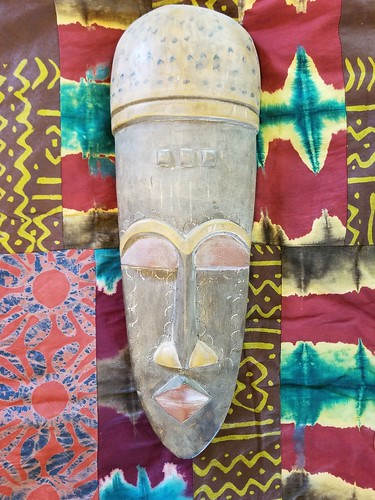
Aburi mask

Evocative, a playlist


The Friends playlist would normally be my first port of call, but this note seems to require something a bit more angular and evocative. Taken mostly from Massive Attack and Portishead who frankly won the 90s and finishing with the incomparable Stevie Wonder taking flight. (spotify version)
...

Timing is everything
Observers are worried

File under: , , , , , , , , , , , , , , , , ,

Writing log: March 25, 2021

Thursday, June 22, 2006

Ghana vrs USA

Before


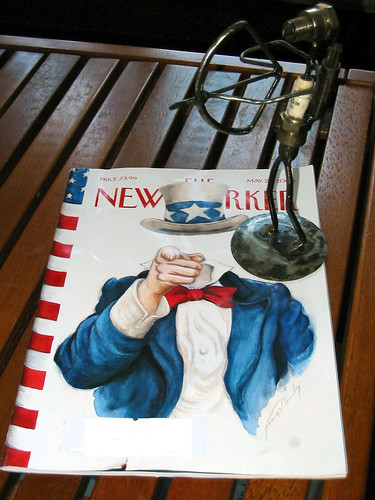
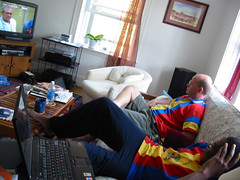
This happened to be on my living room table a few days ago. I'll reserve comment until after the Ghana USA match.

Ghana vrs USA


Our national anthem is playing. No more blogging...

Later


There is probably a parable to be made about a stick figure made out of spark plugs and improvised bent wire pointing a bow and arrow standing on top of Uncle Sam (a faceless Sam at that albeit with slick production values and glossy magazine accoutrements) but that would be reading far too much into an image...

[Ghana beat the USA 2-1]

Also, in case this was missed in the preceding posts, this was my mother's toli on the previous matches (To The Shout Of "Ghana", You Respond "Respect" and Firmly On The Map). She's heading our eight person family delegation to the World Cup.

The African Nation and The American Dream


I was going to save this photo for a piece I've been working on about immigrants and the diaspora but it seems strangely appropriate here. You can blame this juxtaposition on the journalistic impulse.

The American Dream!

The American Dream!
"You've got big dreams, we've got the big money!"
The exclamation point is of typographical importance. This is an advert for a mortgage company on the back page of the March 2006 issue of The African Nation, a free monthly newspaper for immigrants in the US that is often found wherever there's an "ethnic" grocery shop. Published mostly by Nigerians and Camerounians in Silver Spring, Maryland, it features the typical optimism and entrepreneurial spirit of the most vigourous of our West African brethren. The newspaper is billed as
"A success guide for Smart African-Americans, West Indians & Africans in the diaspora".
In short, it's an all-inclusive and expansive production. I will return later to dispense a critique of some of the paper's content (the articles on Nollywood, Green Cards, Obasanjo, corruption, Sudan, Frantz Fanon, the latest society weddings in DC, the latest immigration news, advertisements for lawyers, disquisitions on where we can get authentic comfort food, travel agencies that claim to find the cheapest rate for you to head home etc.). It is worthy of some focused commentary.

The Color of Memory


I first watched the World Cup in 1978 during a trip my mum and I made to Senegal to visit some family friends. It was my first trip outside Ghana and my first time on a plane. My only memories are of the color red in the marketplaces, a vivid red that I haven't seen since, the shimmering cloths the Senegalese wore (they pay attention to their looks to an extent that puts most Ghanaians to shame), the excitement about the Dutch team who played the most beautiful game, and the disappointment at their fate at the hands of Argentina. We watched all the matches on black and white TVs except for the final, and therein lies my other memory: the orange of the Dutch team and their fans. I'm still gutted about that match.

I have been waiting ever since for my team to be at the World Cup. This is something deep inside of me.

And it has been a long wait. Watching my favourite teams disappoint time and again: the Brazilians in 82 (Zico and Socrates slain by a baby-faced assassin named Paolo Rossi), Platini, Tigana and co in 82 and 86 (there was that perfidious Schumacher guy), Hoddle, Waddle, John Barnes and the like (the Hand of God) (and wherefore Gazza and Shearer?), Roger Milla and Cameroon, Gullit and Rijkaard, Nigeria causing ulcers and palpitations to everyone, Senegal exhilarating the last time around... The teams that Abedi Pele and Tony Yeboah led in the 1990s were arguably more talented than our current heroes but they proved incapable of qualifying for the world cup. Thus we had only the memories of Polo and Razak, the legendary Black Stars of the past, glorious in the African Cup of Nations or, of late, our success at the junior level or at the Olympics.

It is a good day to be a Ghanaian, but it has been a long wait.

Identity and Allegiance


I recently calculated that I have now spent more time in Cambridge than anywhere else, what with the university years and the Lotus/IBM years. This beats my stints in Ghana, France or England. Thus I am quite the conflicted soul about who to support and am typically mid-Atlantic in my sensibilities. The Brits have the "cricket match test' to sort out the "good" immigrants from the chaff and I wonder where I lie and whether I'll pass. This is a very difficult test when it comes to football, and especially the World Cup, because any fan of the game (and I am a great football fan) will find some tribal aspect to latch onto in every team.

Until their last match, I thought Ecuador were the best team from Latin America; they were my pick for the tournament since they seemed more "ready" than Brazil or Argentina. They still might come through and I hope they do. Of course I've rooted for all the African teams and, even if the Ivoriens are out of the tournament with the label of the best team not to progress, I can still find favour in those who beat them. I apparently have Dutch ancestry and the good Captain John Vanderpuje (or Vanderpoy as we pronounce it in Ghana) was surely smiling as that free kick rocketed into the Ivorien net and also at the way Arjen Robben played in Holland's demolition of Serbia and Montenegro. When I mentioned my Dutch connection to a friend yesterday, he noted that my allegiance would likely depend on my family history. My reply was that in the mist of the centuries that have passed, it is unclear whether said ancestor was a benign adventurer or a rapacious colonist. Identity is identity and many tribes can claim me. I, in turn, claim all those tribes through victory and defeat.

victorydefeat


Note well the use of the deflating passive tense in the headlines that followed in the US, it isn't David beats Goliath, or even Ghana Through... Brazil next, it's rather US eliminated by Ghana. The frame is typical of the big media companies and their prevailing script: the US were the actors, the Ghanaians were the sideshow. This of course would be news to anyone who watched the match, but such is the Great Game of life. How does the song go again?
They're all political actors... 'Don't worry'. He says 'Don't worry.'
The only team that leaves me cold in the tournament is Switzerland. I can't figure out the reason for this since they are just as talented as any of the other teams and play fluent European-style football. Whither neutrality? I was hoping Togo would beat them yesterday if only because of the amount of money Eyadema père had stashed in those well-run banks. But it wasn't to be, and such is life. Hopefully Eyadema fils will repatriate some of that loot to Togo. There is a startling statistic about the number of public schools constructed in Togo since independence (less than five in almost 50 years, if my memory serves me right). That is worth pondering at the same time as matters of elation are considered. But that's also for later toli... In any case South Korea might oblige tomorrow and deal with the Swiss tribe.

Hearts of Oak


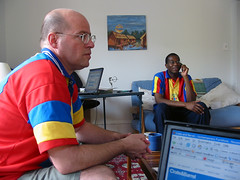
The Wife called the following photo "working from home" for some reason. I was a little surprised. I didn't pretend to be working for those two glorious hours, and Big Blue couldn't have made me work at such a time. In reality there was no dilemma, there was only ecstasy.

working from home


I had dug up my Accra Hearts of Oak shirts since the World Cup is all about tribes and belonging. A good friend was good-natured enough to wear one even though his allegiances were more in line with Uncle Sam. There is no tribe more loyal than the "Phobians", the Hearts of Oak fans. Really. Truly. We dig deep. You Red Sox or Arsenal fans have nothing on us.

Ghana leading the usa world cup


There's nothing like a football match to bring out the drama of life, and we see shattered dreams for some, and bite-sized triumphs for others. Michael Essien's second yellow card is the most painful thing he will endure in his life as he'll miss the choicest game we'll face, and it tempers the Ghanaian jubilation somewhat. My American friends might be hurting right now, but rather than devolving into recriminations (as it appeared would be the case judging by the later coverage on ESPN), this Phobian will suggest instead a transfer of allegiance to the Black Stars. I've been told that the latest hiplife rhyme back home is
Black Stars checked the Czechs and cleared the bush.
We play to a different drumbeat and with our own musicality. I'll conclude with the Hearts of Oak motto
Never say die until the bones are rotten.
Next step Brazil.

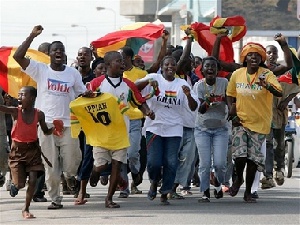
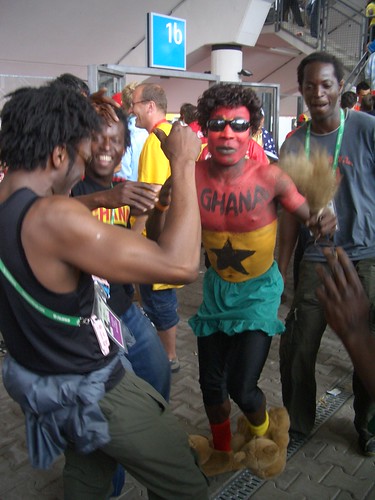
Ghana goes wild with joy


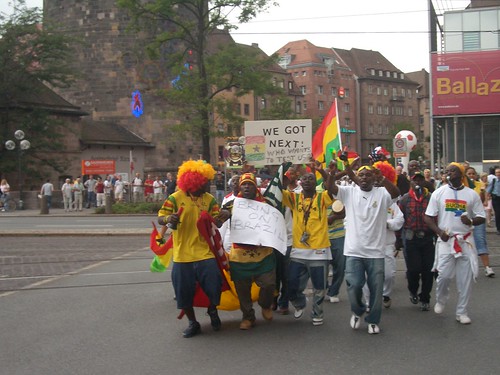
Bring on Brazil. We got next who wants to test us?

ghana celebration

ghana celebration

ghana celebration

I nominate this note for the Things Fall Apart series, under the banner of Social Living.

Next: Friends Today, Enemies Tomorrow

See also: On IBM and Africa

File under: , , , , , , , , , , , , , , , , , , , , , , , , , , , , , , , , , , , , ,

Tuesday, May 23, 2006

The Books of Nima

A note I've been meaning to write for perhaps 6 months to "Sir Sky", the author of The Sea and the Bells; a conversation about Nima, a neighbourhood of the mind.

Part 9 of the Things Fall Apart series, this time an entry under the banner of Social Living...

I was looking over your shoulder during your year in Ghana, perusing your travelogue that I came across in a case of web serendipity (the Ghana tag at Technorati, in case you're wondering). When I first read you, and learned that you were going to be staying in Nima, I was apprehensive. Yours would not be the typical volunteer or expat experience; you weren't destined to have the servants, the driver and car, or the air-conditioned office. I don't know if you knew what you were getting yourself into, that you'd be going local and doing the slum housing thing and worse. As an Accra boy, albeit transplanted to Cambridge, I know all about the school of hard knocks called Nima. It looms large in the Ghanaian consciousness, even if there are many worse places these days as you know. It's very far from ideal as an introduction to a visitor.
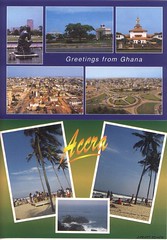
ghana postcards


The fact that you were willing to give of yourself to us was very generous, and I don't know if Ghana fully reciprocated the generosity... The years from 1982 to 1988 broke the back of the Ghanaian people, and ever since, we've been struggling to recover from scarcity and arbitrariness. Thus we demand a lot of outsiders and of anyone who's been abroad. This is changing, and our current quiet stability is restoring our confidence in parts; still, not everyone has read that script, and the neediness can wear you down. For what it's worth, you're not the only one labelled oburoni; my mid-Atlantic self gets that designation every now and then when I'm home.

I was tempted at many stages to jump in: to suggest creature comforts or avenues that would have made things less wrenching for you. But as is the norm on this web, I remained dark matter, absorbing your energy. Still in mitigation of the head nods I omitted to send your way, I think your experience is all the more richer for being yours alone. Like your country's peacekeepers, you are one of Canada's great exports, and after your experience in Ghana, you'll breeze through anything back home.

You lived through countless lights out and experienced the wasted time spent dealing with simple things like water, food and transportation. And of course, there were those untrustworthy and maddeningly inconsistent people... It's the simple fruits of poverty; we lack infrastructure, physical and otherwise.

You had the daily struggle in that library without resources, where you taught the adult literary classes and wrangled to teach those neighbourhood children. The ironies and absurdities about that task are worthy of a novel and hopefully you'll write one.

Osu library was the scene of some of my fondest memories of my childhood. It was well stocked and the librarians cared and worried about you. No one could ever tear me away from it, even at closing time. It was where I learned that books and ideas are important, where the parental challenges were investigated and puzzled over. Those books were a long winding road, to be read with care as their nuggets would reveal themselves, or the inconsistencies of an argument would appear in relief in the reading light. My greatest heartache about Ghana today is that very few children are getting the same opportunity. True, our lingua franca these days might be radio, television or this internet thing, but really, how many Ghanaians are participating in this conversational web? If only I could hear those missing voices... The notion that so few in my country can bury their heads in books on weekday afternoons or on a lazy Saturday morning at the library is cause for much distress. And don't get me started about what's happened to the Legon university bookstore. Must everything be utilitarian? Is a country without whimsy worth worrying about?
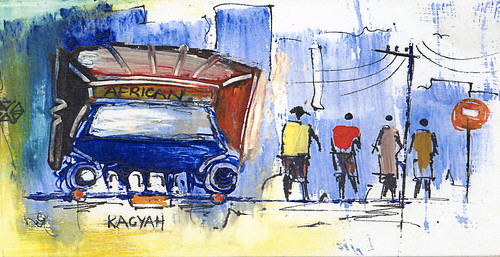
African by Kagyah


I think the emotional violence could have been avoided, and, certainly the physical violence should have been avoided. My heart leaped at such times, but still I kept silent and read on. Nima is such an insular place, it is very wary of outsiders as you probably found. In the past it was where rural migrants came to partake of the Accra dream in the Gold Coast. Thus it has always been messy, and developed in fits and starts as befits the residence of those who live on the fringe.

Even today, two shacks away from the homes of proud middle-class schoolteachers you'll find the "Nima boys", selling 'wee', guns or worse, right under the Kanda highway and close to the police station. The boys can always be counted on to roust any political opposition come election time, and their hard knocks usually come for cheap. True, the stereotypes of Nima boys as uncouth, brash, vicious, and ill-educated are extreme, but they carry a kernel of truth about a small minority that lingers even in the relative prosperity of the moment. Across is a chop bar serving the best banku and fetri in town; Auntie Maggie's spot is packed during the day and there's nice fresh tilapia at night, shantytown chic as it were. Just around the corner is a drinking spot with people playing oware or dominoes and downing bottles of Star beer and Guinness in the early evening. Nowadays there are the occasional interruptions when they'll whip out the latest mobile phone ostentatiously: "talking loud and saying nothing".

But you saw all that and more, you saw how people "disciplined children" and how they meddled in each other's business — or not. As you found out, that "it takes a village to raise a child" business isn't happening much in the slums of Nima; too often it is the garden-variety anomie and indifference of urban life, something that wouldn't be out of place in any big city. I saw the same mix in Soweto a decade ago, although that was more upscale at the time, and well, Inman Square is what it is. It is true that given a few decades of development, Nima could become the Catford of Accra, and, believe it or not, it is much better today than it was in the sixties and seventies, but perhaps that progress is cold comfort for the struggles you faced.

I dug your observations on the press and on street life of Accra. Your look at the street cleaning exercises that took place earlier in the year was priceless. In the year 2006, they're finally worried about rubbish and overflowing gutters! And only for two weekends. Ah yes, that culture of maintenance that was so evident in your encounters with us. Perhaps you too have the journalistic impulse. And that water shortage in certain parts of town, Accra is straining at the seams; I was in Ghana at the time and noted as much, although we had water in our neighbourhood. You picked up on our tro-tro wisdom, our folktales, and the languid way in which we view the world. You even taught me that proverb from Northern Ghana:
"Trust God implicitly but always tie your camel up at night."
I don't know if that's where Ronald Reagan got his "trust but verify" shtick, but it's close. Still, Kweku Ananse's cunning and laziness can be a curse; living by your wits, hustling in short, is no substitute for the prosaic work of development, although it can be quite enjoyable.

I suspect that a lot of Ghana has rubbed off on you; we can be quite infectious (and not just in matters of public health). Do be careful that you don't break out into pidgin when you're back home interviewing for a job; our deconstruction of the English language has its own musical logic, and not everyone is ready for it.
Take care-oh.
And you saw the other side too, the havens of those expats who saw Ghana as a holiday, who kept to themselves and didn't engage with the country and its people. Hell they might as well have been living in Eden; your garden was good old Nima. Well at least you got to know us intimately; that has to count for something. We claim you as our soul sister, and will keep your heart hostage in our town.

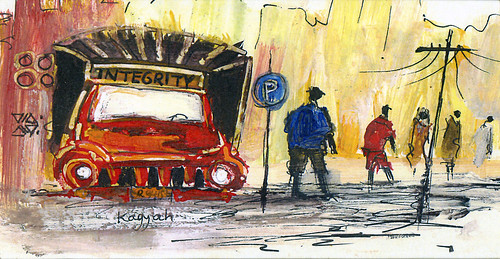
Integrity by Kagyah


You even reported on the beginnings of the cholera outbreak that I encountered last Christmas. When my father began to warn me about taking precautions if I decided to eat out in town, I nodded my head knowingly; for a time you were my favourite Ghanaian newspaper.

And of course there were those malarial episodes, the fevers, the Larium dreams and those hallucinations. How much energy was dissipated in those sweaty nights and days? Those mosquitos, and their cargo of plasmodium falciparum; they are a poverty tax. We may throw our herbal medicine and "bitters" at them, but that is after the fact, to deal with the symptoms. The full panoply of mosquito nets, sprays and lotions counts for nought if you don't deal with sewers and the ever-present pools of stagnant water, or if parents will use their children's nets. And we all know about drug resistance: Darwin's evolution is intelligent design. Still, as they say, mosquitos don't discriminate. Not in Ghana, not on the island of Reunion, and certainly not in Cambridge. We're all singing the West Nile Blues these days. Some call it globalization; I know it as the Mosquito Principle.

You may only have lived in Nima for a while but you got the full Ghanaian experience, unvarnished and cacophonous; three centuries taking place simultaneously in those twisted back alleys. I'll admit to a sense of wistfulness in seeing my country anew through your eyes, and I want to hear more of your thoughts going forward as you carry Ghana in you. I hope we don't weigh too heavily on you. I wish I had been there on the ground; it's hard to be living vicariously through a Canadian woman.

As you'd expect, it's very painful for me as a proud Ghanaian that, almost 50 years after independence, we are still relying, nay depending on you, to teach us how to read, or even to school us about the importance of a book. To read, for God's sake. Hundreds of years after our chiefs started sending their children to Europe to learn these things and we haven't internalized the lessons... But then it works in the other direction, the West relies on people like me to make sense of its world - the technology world in my case. And your southern neighbour, that United States of Anomie, can be a similar school of hard knocks, and not just for lowly immigrants; you don't need to visit New Orleans to get the daily evidence. Still, I wish the cultural interplay was more balanced, that we could each walk tall, rather than smile sheepishly as we do and say, "Only in Ghana" or "That's how it is in Ghana". As if we can't do anything about it. As if it doesn't have to be this way.

You quoted Anthony Hopkins playing C.S. Lewis in Shadowlands:
"Experience is a brutal teacher. But you learn. My God, you learn."
I'll suggest in response, our poet Kwesi Brew's book, African Panorama, and I'll quote one of his elegiac poems. You should recognize the subject matter.

The Slums of Nima


Three neighbours met,
And after a hurried, "I give you rest"
The two young men stood aside for the old man
to pass and then picked their way
in the opposite direction towards the alley on the left.
They were thieves who robbed with violence
But still they stood aside for the old man
And he thanked them.

In a bereaved world questions and comments
Fall on unhearing ears.
Only silence, understanding and
Belonging can put
A blind man's stick in the hands
Of a searcher in that night.

The crumbling walls have leaned
On their chests for decades!
The toll of breathing has shredded
Their lungs, and their eyes are sore
With the smoke of the wicker lamps.
And now we all stand at the edge
Of an abyss
Afraid to plunge headlong, or
Return to the dark of the night with them!
kwesi brew


Ghanaians are natural storytellers. We are cultural interpreters and urban griots; not for us Anglo-Saxon brevity. Even as we consider Kwesi Brew's abyss, or that heart of darkness, you'll hear the musical laughs and see our urge to understand. We want to change the perspective and open things up through observation and humour. As he wrote in another poem, and I won't give the punchline away, things must be sweet for Ghanaians:
How else could they laugh
Like they do when they should weep;
Remembering the voiceless days of the past.
It is quite poetic that you arranged for your class to travel outside Accra - to the beach no less, and even managed to get them that helicopter ride over the city. We are all so caught up in our black boxes, strangers in our own country. It is eye-opening to glimpse those different perspectives, and you too were being a cultural interpreter, making people see themselves anew. It was a small victory in your ongoing journey.

I really hope you don't take your journal down as you threatened recently. The pearls of experience therein are too rich to be simply discarded in the dustbin of the lost web. Allow Google to stumble over your throwaway experiments - they provide comfort even for an audience of one. I dug a lot of the writing (without a doubt, you're on the road to many books). The sound of a voice trying to make sense of an unfamiliar, frustrating yet endearing environment, the large and the small observations, all these things make for a historical document done in best tradition of the web style. The Sea and the Bells, at least that year's version, is a great snapshot of Ghana in the years 2005-2006, a personal introduction to be sure, but it constitutes a compendium of small things to be duly celebrated.

As you might guess, my preferred response to Things Fall Apart is small things: short cuts and bite-sized conversations that engage in the marketplace of ideas. I know you only as "Sir Sky" and the conversation has been one-sided until now. Consider this my opening gambit, my "so what's your name?" approach. I hope you like my brand of small talk; it's known as toli.

Dig: I'm sending some books to the Osu library. I hope it's still there and that someone will receive them. I can only hope that people are still reading. I've been carrying them all these years but never did anything about them; they make a glorious floorscraper. They'll be delivered in your name, and inscribed with the word Nima.

A belated head nod to you.

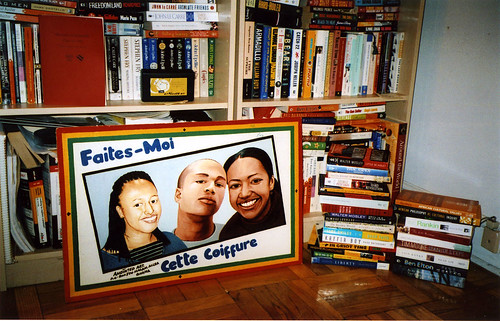
barbershop portrait and books


Next: Dilemmas.

See also: Poetry as Cultural Memory

File under: , , , , , , , , , , , , , , , , , , , , , , , , , , , ,

Saturday, November 13, 2004

On The Wire

A blogospheric parable of sorts...

In the midst of discussing Porter Goss's upcoming (or rather ongoing) pogrom of those in the CIA who tried to leak just enough to cause Bush to lose the elections, Matt Yglesias reaches out to The Wire and cites Omar

"If you come at the King, you'd best not miss"
Brad Delong counters with a more classical reference from Alessandro Farnese
'He who draws his sword against the prince needs to throw away his scabbard.'
Arcane Gazebo then trumps both pointing to Cersei Lannister
"When you play the game of thrones, you win or you die."
As someone whose professional life has been spent trying to develop software tools that allow serendipitous group-forming this is all music to my ears. Not to mention that I'm also a fan of the show being discussed and admire its sense of language.

If I was a Clay Shirky type, I'd be talking about how such exchanges are the natural outgrowth of the confluence of ease of publishing with tools like Blogger and Moveable Type, standards like Atom/RSS, HTML and XML, the ubiquity of REST-ful platforms based on HTTP, URIs and distributed hypermedia as well as search infrastructure like Google and Technorati that has come to terms with end-to-end intelligence and the virtue of the link.

I'd say all that and more. I'd add in some theory about how this infrastructure is helping us harness those beneficial network effects bounded by Metcalfe's Law and Reed's Law. That such fun and informed repartee is the endpoint of contributors from Gutenberg on etc.

Now I suppose that policy wonks and Berkeley economists would be inevitably part of the same community. But would someone like me have been able to add in my own take in this debate without that great global water cooler conversation engine that is the blogosphere?

Surrounding all this commentary is the shared context of a novelistic TV show. It helps to have to some artist mining the cultural zeitgeist, the kind the social lubrication I pondered in that Sign Of The Times piece. This is what sociologists like Elster call The Cement of Society: the shared cultural context of literature, music, religion, history, film and, yes, also the infrastructure that smoothes these exchanges.

I'm positive that this is what David Simon and Ed Burns set out to do when they conceived of the show. They have assembled a fine set of writers who weave these gritty urban tales together. To my ear, it's probably novelist George Pelecanos (now also a producer on the show) who authored Omar's line. It's the kind of classicism I've read in some of his works like The Big Blowdown and Soul Circus. In this season, they've also reached out to such crime novel stalwarts as Dennis Lehane and Richard Price. I'd also note the as yet unheralded Rafael Alvarez who was the conscience of the Greek dockworkers of the second season. With such fireworks in the writing department, boosted by an amazing cast and strong direction by the likes of Ernest Dickerson, it stands to reason that we'd be drawing on its lessons in our own discourse. The framework they have set down is quite simple: Baltimore city as a character, bureacracies on both sides The Law and The Street, the occasional mavericks, doomed but sympathetic characters like Bubbles and an ear for language that rings true to life. So now let me add some more fodder to the conversation from The Wire.

Consider the always quotable Proposition Joe wrapping up a Godfather-like gathering of drug crews in a conference room in a Baltimore hotel, the dealers have just decided to set aside lethal differences to combine resources to buy better drug product from New York.
"For a cold-ass crew of gangsters, y'all carried it like Republicans an' shit."
Isn't that akin to the coalition that came together to re-elect Bush?

Or from the democratic standpoint, what about Blind Butchie who notes in his inimitable trancelike way:
"Conscience do cost"
when Omar has to cough up $1,500 to retrieve a cop's lost gun and return it to the authorities. Detective Bunk's tirade about predatory people like Omar (who incidentally was only a few years behind him in high school) touched a nerve and Omar tries to asuage the unease Bunk raised when he evoked the old days
"We had us a community back then".
Doesn't that stand close to the kind of wrangling half of the country is going through (and the rest of the world I might add) as it anticipates what will be lost of its soul in the next four years under Bush?

Excusing the street ebonics if you will, I tend to agree: conscience do cost.

File under: , , , , , , , , , , , , , , , , , ,

Wednesday, July 14, 2004

More serendipity - this time on religion

So first I read the headline, Onward G.O.P. Soldiers, of a New York Times editorial on the Bush/Cheney's harnessing of religious right for their campaign - the full church/state separation thing blurs when it comes to vote-getting (incidentally it's appearing a week after the story was broken by other papers). Then I read the following passage in the current novel I'm reading, David Lodge's How Far Can You Go?. The context is a chapter discussing the changes in the Catholic church and society in general in the 60s (e.g. the rise of the effective contraception with the Pill, the permissive society, and their effect on a group initially 'spiritually innocent' in the 50s

These developments were not, of course, universally welcomed. Evelyn Waugh, for instance, did not welcome them and wrote furious letters to the Tablet saying so. Malcom Muggeridge did not welcome them and wrote a polemical piece in the New Statesman in 1965 urging "Backward, Christian Soldiers!"... What people needed from the Catholic Church, according to Muggeridge, was its "powerful pessimism about human life, miraculously preserved through the long false dawn of science"
I'll leave the commentary about the actual quote, interesting in it's own light for another time and simply note the sublime juxtaposition: 'Onward' versus 'Backward' for the 'Christian soldiers'.

The novel has been entertaining so far, I guess I'll review it at length when I'm done with it. It's a wry comedy, looking at a group of young catholics coming of age in the 50s and their progress through the social upheavals of the 60s and 70s. It has much to say about Catholicism, traditional mores, modernity, birth control etc. Of course, I'm quite partial to anything that touches on Evelyn Waugh and Graham Greene (a struggling catholic with some of my favourite novels see "A burnt out case" and "The power and the glory") and David Lodge is peerless when it comes to the 'novel about academic life' or campus humour (well add in Kingsley Amis's Lucky Jim and Jane Smiley Moo, Tom Sharpe Porterhouse Blue). This is a different novel from his Changing Places/ Nice Work/ Small World) academic satires but it's full of sharply detailed observations.

I guess I'll have more to say later about Catholicism in general, the English catholics in particular, and other musings on the ongoing competition between religions (case study Ghana). Stay tuned.

File under: , , , , , , ,

Shuffle serendipity

When you have a large record music collection like mine - checking my library in Winamp, I note that I have 8706 songs taking up 60GB on my hard drive - and this is just the songs I like, I didn't bothered to rip the occasional filler on some of the albums I possess - you often just put it on shuffle instead of relying on playlists. Oftentimes the shuffling will juxtapose songs that just seem to fit together. There's even software that attempts to analyze your listening patterns, figure out what you like, and when and how you like it. Other programs use some collaborative filtering based on user ratings to figure out what would make a good mix. I haven't tried to use these, preferring randomness to prevail.

In any case, I just had a case of 'thematic' serendipity. 3 of the last 4 songs that just played were basically about remembering the good old days:

Mavis Staples - The Old Songs from Time waits for no one (Paisley Park 1989)

"turn the radio on / they're playing the old songs / how to bring back memories / of the way love used to be / backtrack along with me / to that old sweet melody"

Prince - Musicology (2004)

"don't you miss the feeling music gave ya back in the day / Let's Groove, September: Earth, Wind and Fire / Hot pants by James / Sly's gonna take U higher"

Beres Hammond - Rockaway (2001)

"those were the days/ oh I miss those days / I miss those days / remember the songs that make you rockaway / those were the days / when love used to reign / we danced all night to the songs they played / we can came again / do it just the same"

These are very different songs: Mavis's is just an old school soul jam reminiscing of her time with the Staple Singers, Pops and all - it even quotes the melody from Ben E. King's Stand by me. Prince's cut is just a funk groove in the vain of James Brown. Beres's is pure Lovers Rock. And yet, like the liner notes for Beres' album say, they are all "waxing nostalgic for a bygone era... evoking a time when great singers like Patti Labelle, Stevie Wonder and Aretha Franklin were in the prime".

Intermixed amongst these songs was Ronnie Foster's Mystic Brew - the classic jazz funk instrumental that was sampled to perfection by A Tribe Called Quest in Electric Relaxation which from the first seconds it played took me back to November 1993 driving down to Yale for the Harvard/Yale game with the rest of the African students from HASA and the various parties we attended at which this was the jam. There is still the controversy about what the chorus is - whether it's: Relax yourself girl, "please set-tle down", "peace-out Premier", "be so clear", ""preset plan" or some other variant. I guess this song also fit the mood of reminiscing.

Other rare shuffle juxtapositions are old soul classics to be followed by the hip-hop records that sample them - perfect fodder for a crate digger like me.

Shuffle Serendipity, a playlist


File under: , , , , , , , ,