Showing posts with label Angola. Show all posts

Wednesday, December 05, 2018

Legacies (Munhango to Kennebunkport)

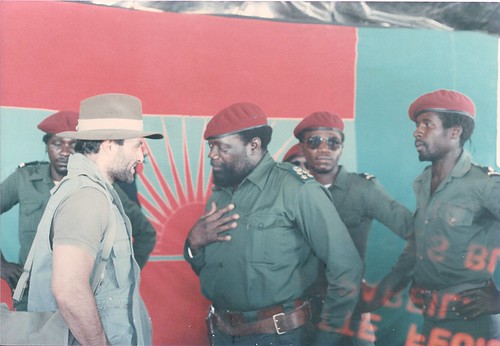
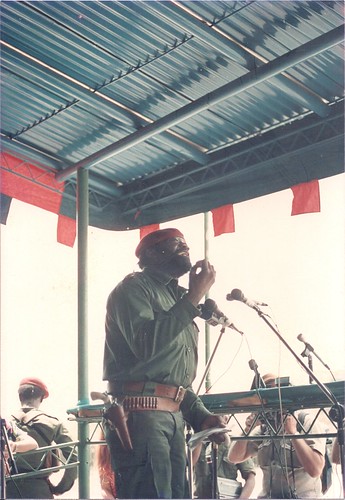
My proudest bit of publishing was an alternate history centered on Angola that someone gifted me late one night. "Here's to bad men" was the takeaway of that fevered dossier, a strand of the story of what historians now brand the "lost decades" in Africa and elsewhere. Stories are always unfinished, and the late KB Mensah shared some photos of Jonas Savimbi from his BBC archives that would have fleshed out that script. Also illuminating was Chester Crocker’s High Noon in Southern Africa (thank goodness for vanity, and used book stores). Its title and duel framing was inadvertently revealing; the outlook of cowboy diplomacy hard to resist. We have occasion to revisit the legacies of these political actors. If the prevailing view from Kennebunkport was of a cold-blooded, Cold War, on the ground in Munhango and Cuito Cuanavale, however, there were warm bodies that bore the brunt of abstractions: domino theories, linkage and containment. Collateral damage aside, the rest of us bear witness.

Jonas Savimbi

Apparently enough time has passed since the death of Jonas Savimbi that we are now urged to take a more nuanced view of his legacy. The caricature that was memorialized in the video game, Call of Duty: Black Ops II while apt for a rogues gallery of pulp fiction is said to be too simplistic.

Jonas Savimbi crowd

His family even sued for defamation at the blunt portrayal:

A lawyer for Activision Blizzard, Etienne Kowalski, has rejected the claim, stating that the game represents Savimbi as a "good guy" – and that he is portrayed fairly, "for who he was... a character of Angolan history, a guerrilla chief who fought the MPLA".
Jonas Savimbi gun address

The case was dismissed. The legacy remains contested.

The elder Bush in death will face similar contests despite the patrician image, New England privilege and attendant Yale legacy. Reputations need to be managed.

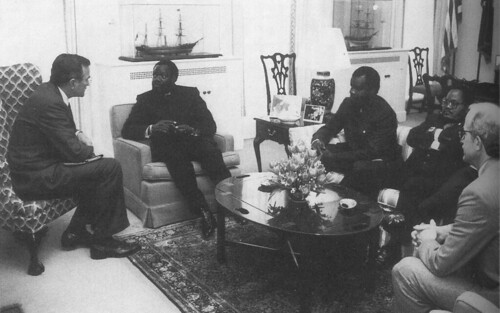
George Bush, Jonas Savimbi & Chester Crocker 1986

Chester Crocker looked on as Vice President George Bush met with Jonas Savimbi in the Oval Office in January 1986 to discuss the United States' continued assistance to UNITA in the Angolan civil war.

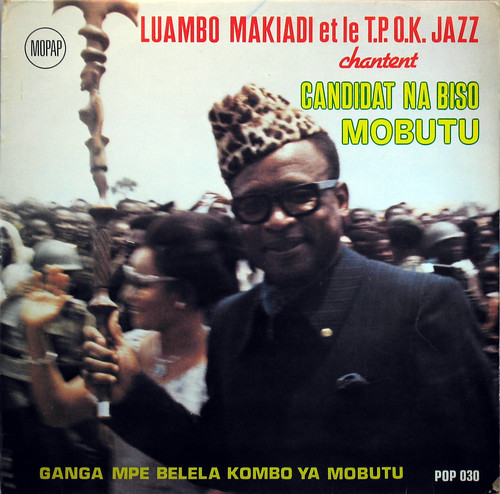
Item: Joseph Mobutu (a.k.a. Mobutu Sese Seko amongst other honorifics) was the most prized CIA asset in Africa from the 1960s until his death in 1997. He was a friend to every CIA director in his lifetime.

Dig: The Bush and Mobutu families spent vacations together.

The late Barbara Bush would recall in her memoir the visits with "President Mobutu, who wears a leopard skin hat and carries a tribal stick. He is very flamboyant, but charming."

Franco et le T.P. OK Jazz sing for Mobutu

High Noon in Southern Africa makes a quite long winded defense of US foreign policy, arguing that it was all in service of "making peace in a rough neigbourhood". Diplomats often have do such things: putting lipstick on a pig or, to mix metaphors, making palatable the unsavoury. Still Crocker doth protest too much. It was never about clean hands, it was naked self interest. Being on the wrong side of history, supporting apartheid, propping up dictators will always be thrown back at one's face.

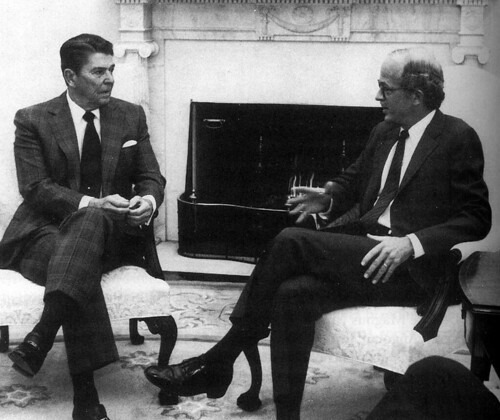
Ronald Reagan and Chester Crocker

— Ronald Reagan and Chester Crocker at the Oval Office in November 1984 discussing the US policy to vigorously oppose sanctions on the South African apartheid regime.

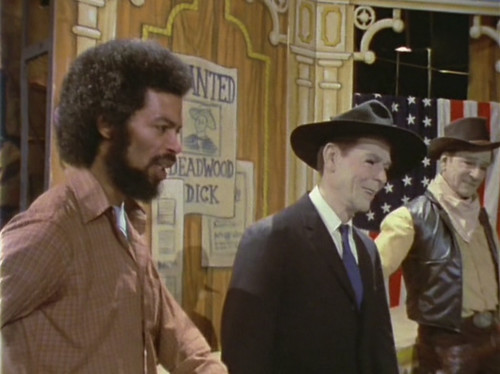
While Ronald "Ray Gun" was the ostensible target of Gil Scott-Heron's classic 1981 track 'B' movie, there was also this observation:

'The screenplay will be adapted from the book called "Voodoo Economics" by George "Papa Doc" Bush.'

Prescient as always, our Gil, and then this:

... all of a sudden we have fallen prey to selective amnesia - remembering what we want to remember and forgetting what we choose to forget.'

Ah right, Papa Doc and the Tontons Macoutes that ruined Haiti. Lest we forget.

gil scott-heron ronald reagan and john wayne - b movie american nostalgia

Squalid murder for the left of us, flowers to the right.

We've since learned of Donald Rumsfeld's notions that informed Bush the Younger's catastrophic reign:
Reports that say that something hasn't happened are always interesting to me, because as we know, there are known knowns; there are things we know we know. We also know there are known unknowns; that is to say we know there are some things we do not know. But there are also unknown unknowns – the ones we don't know we don't know. And if one looks throughout the history of our country and other free countries, it is the latter category that tend to be the difficult ones

The obvious problem with the Rumsfeld taxonomy of knowledge is that it ignores the "unknown knowns", that is, the unconscious biases that underlie an issue. This willed blindspot is the working mechanism of selective amnesia. We are living in a moment where nostalgia is key and we're anesthetizing ourselves with transactional, cowboy politics.

There was a recent clarification which reminded me of the title of an episode of The Wire: moral midgetry.

America First!

The world is a very dangerous place!

... the purchase of military equipment from Boeing, Lockheed Martin, Raytheon and many other great U.S. defense contractors

... maybe he did and maybe he didn’t!

— Statement from President Donald J. Trump on Standing with Saudi Arabia, November 2018

Arms sales (and preferably ours).

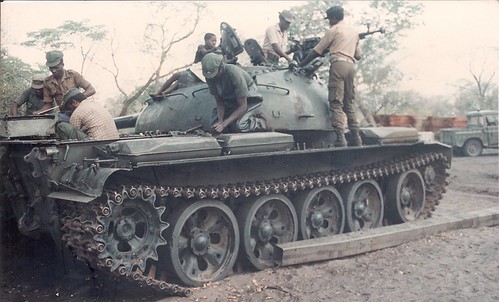
Jonas Savimbi angola tank

The B movie theory: manifest destiny revisited as farce. The politics of rehabilitation, reputation scrubbing, and legacies of blood and sin.

Soundtrack for this note

File under: , , , , , , , , , , , , , , , ,

Monday, December 14, 2009

Africa 1989

It struck me that we haven't heard many African voices in all the recent reminiscing about the year 1989. Anniversaries abounded. From Tienanmen Square, through the Soviet withdrawal from Afghanistan, to the fall of the Berlin Wall, we've had retrospectives on these momentous happenings. 1989 evokes loaded images, especially poignant amongst these being the transformations in Eastern Europe and beyond that affected the whole world. The year is a convenient stand-in for epochal change, Cold Wars fizzling and so forth. 1989 was similarly epochal in Africa even if our headlines were filed in the inside pages of our collective newsprint. Africans weren't mere onlookers and enjoined in the global conversation of those heady days.

I then came across some fragmentary notes I had on the year in Africa, notes I'd written when I was in a more jaundiced mood - they verged on the bleak. Writing today, however, I am more sanguine about that year, and hopeful, even as I look back. I can point to many items that genuinely warm the heart. You have to take the long view when it comes to Africa, and perhaps this accounts for the dissonance one feels about our past. Perhaps you'll be able to detect the keys in which different parts of the following were written.

I. The Reign of Locusts


Item:
Although political transformation in the 90s proved to be of variable intensity and longevity, often turned out to be new wine in old bottles, the change on the continent has been lasting. The incidence of military coups has dropped so far as to become negligible and there is an indisputable increase in functional democracies. In 1989 only three countries in Africa could claim to have democratic governments.

— Akwe Amosu musing on Democracy in Sub-Saharan Africa: Trends and Transitions (pdf) in 2007
Dig:
I've often wondered what it was like to attend, say, an OAU meeting circa 1989. That must surely have been a rogues gallery sans pareil. Could you shake hands with everyone in that room and look at yourself in the mirror the next day? For that matter, could you sleep that night? And what did the small talk of the nifty fifty sound like? Scratch that, what exactly was their big talk? Inquiring minds want to know.

Excellent Discussions

Having looked at Africa in 1966 (when innocence was lost) and written about the promise of Ghana in 1969, the faint glimpses of hope in 1992, and the pre-millennial tension of Africa 1999, and with an evident itch to scratch, I thought I'd give the toli take on continent in 1989. The 1970s and 1980s have been termed The Lost Decades in much of Africa — almost as if a plague of locusts had the run of the continent. We should tentatively file these notes under the banner of fallen angels.

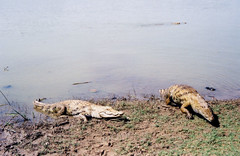
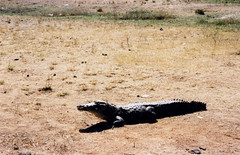
crocodile

Let's start with this: Robert Mugabe of Zimbabwe would likely have been the golden boy at the OAU meeting in 1989.

With 20 years hindsight, it is hard to believe that Zimbabwe was the example that the rest of Africa was being lectured about to emulate by the donors. Its vibrant economy, well managed agricultural sector, deep focus on educational achievement, and its democracy seemed without equal. Where its neighbours were basket cases, Zimbabwe appeared to be moving forward, it was the "success story". Mugabe's "egalitarian socialism" was being studied by Western cognoscenti. A stereotypical halo of smugness would surround my Zimbabwean friends of the time (side note: my Sierra Leonean comperes exuded similar confidence). Suffice to say that things can go wrong or right in a hurry.

He of The Little Green Book, Colonel Muammar Gaddafi, would have been a few years removed from the US bombing attacks that aimed to kill him, and a year removed from the reaction over the skies of Lockerbie. A French jet would suffer a similar fate in September 1989 when a bomb would kill all 170 people on board as it flew over the Sahara. There were even more potent, and certainly uncontested, acts, however, in his interaction with the West: the Provisional IRA was in full murderous effect in 1989, equipped with significant supplies of his explosive Semtex and sundry weapons; it would rotate members for training in the Libyan desert. As I recall, public transportation in London was an exercise in bomb threat delays followed on occasion by actual locomotion. The implications for West Africa of He of The Little Green Book's unmoored rage would be far more bloody I am sad to say. He was just about to unleash Charles Taylor and Foday Sankoh from nearby camps in his grand project of revolutionary agitation, and more on Liberia and Sierra Leone anon.

I won't bore you with by enumerating the long list of dictators that ruled and the havoc they caused, it makes for dismal reading (3 democracies out of near 50 countries remember). From "Comrade" Siad Barre in Somalia to Master Sergent Doe in Liberia and Sergent Eyadema in Togo, it was repression as usual. Most significant, perhaps, in this dreary military vein was that Omar al-Bashir came to power in Sudan in a coup on 30 June 1989. His regime brooked no opposition and promptly took Sudan's civil war into high gear. The legacy of Lost Boys and such ensued. Civil wars are never pretty and Sudan's was long and ugly.

crocodiles emerge at paga pond

Structural Adjustments


For what it's worth, in my native Ghana, Flight Lieutenant Rawlings's PNDC was typically authoritarian throughout 1989 as our Truth and Reconciliation commission has outlined. Apparently it was no contradiction for a supposed Marxist to be implementing the unpopular IMF Structural Adjustment Program, he was an early adopter on this front. General Ibrahim Babangida of Nigeria was of the same mind, and followed suit with the IMF and the World Bank. Expediency trumps everything if the preservation of power at all costs is the overt motive. Popularity or economic sense in policy doesn't matter much when you have a military regime, your populace will have to cope with whatever you dictate. It is the very definition of dictatorship. Structural Adjustment, then, was the great agenda in Africa, and many countries were being put through the wringer its paces. I'll note in passing that the term "Washington Consensus" was coined in 1989 at the very height of authoritarian rule in Africa. The Cold War bred strange bedfellows but none so ironic as the combination of mild-mannered Western financial technocrats and African dictators.

The inevitable backlash was felt from civil society, large enough to have necessitated a bit of rebranding and message massaging. In 1989, we started to hear about "structural adjustment with a human face" and its counterpart "sustainable growth with equity". This revelatory exercise in linguistics only betrayed the apparent irony that inhumanity had been the prevailing concern, with equity as an afterthought. In fairness, the legacy of these programs is mixed: the economies of most African countries did need reform after all. What is beyond question, however, is that the success stories that were being touted in 1989 were nothing of the sort, most of the gains were chimeric. Ask any Ghanaian if the 80s were good years if you want to hear a hearty guffaw. Would that the development aid cohort had their current restraint in those years, their swagger was hard to take. Some of us have long memories...

Francophone Africa presented a perfect picture of client states. Smooth operators like Omar Bongo (President of Gabon) and Houphouët-Boigny (President of Côte d'Ivoire) mixed the requisite post colonial trappings at home with the luxurious core of sleazy quasi-corporate patronage of the French political class. Call it equal opportunity looting or mere cronyism, enabled by Mitterrand and the revolving board of Elf-Aquitaine and others. France regrets those good old days. Who wouldn't, I wonder?
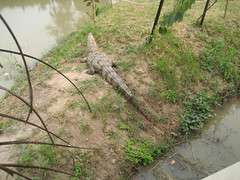
crocodile

Mobutu of Zaire was in full flight, an unchallenged dictator systematically breaking down the social fabric of his country while breaking world records in kleptocracy. Interestingly enough, by 1989 he was a little fed up with some of the shenanigans that some of the other African rogues leaders were getting up to. These parvenus were beginning to spoil the game for everyone. In mitigation, and in a rare act of regional statesmanship, he even helped broker a peace deal (promptly broken) in Angola. Now Mobutu was not one to do anything without a pecuniary motive hence inquiring minds are wondering what he was promised for his efforts. We'll no doubt have to wait until the State Department declassifies records in 2014 for the answer. Accordingly, I've already scheduled my FOIA request in Google Calendar.

It is worth dwelling on the Angolan case. Jonas Savimbi broke the barely 2 month old ceasefire, the fruit of years of negotiations, and resumed the civil war in Angola. Master of the huhudious, Savimbi declared:

"The Angolan people, to their infinite sorrow, accept that the war has restarted."
That, without any doubt, has to be the quote of the year 1989. He was the one who decided to break the peace, he didn't ask anyone, he presented the Angolan people with war as a fait accompli. He was to deepen their infinite sorrow for another 13 years.

Human Right's Watch began their Africa Watch in 1989 in their world report with a look at the Angolan case. Again it is instructive:

This refusal to criticize rebel abuses stems from the Bush administration's unwavering support of UNITA and its leader, Jonas Savimbi. For 14 years UNITA has been seeking to topple Angola's post-independence government in a war that to date has resulted in the deaths of over 100,000 people, most of them civilians. The U.S. policy of funding UNITA, first initiated by President Reagan in late 1985, has if anything been solidified under President Bush. Even before President Bush took office, he wrote to Savimbi assuring him that "all appropriate and effective assistance" would continue. Then, in 1989, to compensate for the loss of South African military and economic assistance to UNITA, the Bush administration increased the level of U.S. covert aid for Savimbi to close to $50 million. Although termed "covert," U.S. assistance is widely characterized as an "open secret." Savimbi himself made a public statement in June that Congress had renewed his aid, and was also quoted in Jeune Afrique magazine as saying that he had received $35 million in funding from the Central Intelligence Agency. Characterizing the aid as "covert," however, helps minimize Congressional and public scrutiny.

The lesson of Angola is that Africa was never innocent.

The corollary perhaps is that marauding phenomena like Jonas Savimbi did not operate in a vacuum. Proxy wars were a legacy of the Cold War, and Africa was a bloody battleground. Africans paid a heavy price. Enough.

paga crocodile eats chicken

II. The Great Awakening


The global conversation in 1989 was all about democracy. Mali led the way in Africa. Their president, Moussa Traoré, was your garden variety military ruler: no ideology to speak of save for the unvarnished exercise of power. With Mali being a poor landlocked country, he must have figured that he would have free reign. There would be no strategic interest for the Americans or the Soviet Union, the colonial power, France, had bigger and more lucrative fish to fry, and neighbouring countries only cared if refugees started streaming over the border. Everything seemed perfect and the years passed. 1989 must have been a rude awakening (1990 would be a nightmare, and 1991 would be the end). The Malian body politic and social compact reacted to his rule as if to an emetic. Malians were simply fed up with military rule and the attendant violence and arbitrariness. Slowly and systematically from 1988 on, they organized themselves to take back their country. It was a truly impressive sight throughout 1989. No external motivation was needed, a society simply decided to change its direction and moved.

Historians ask the same question about Leipzig in 1989. Why did people lose their fear? From the trade unions, to the students, the teachers, the lawyers and other professionals, all the way to the farmers, the consensus was that multi-party democracy was the way forward. Newspapers appeared without approval and served as forums for discussion over the shape of democracy to come. It wasn't unanimous, and the process had its twists and turns but the atmosphere changed. Those sensible Malians lost their fear and brought about lasting change. The proviso, with this being Africa, was that there would be needless deaths along the way (a massacre of 300 protesters in 1991 being the final straw). The miracle in Mali is how we now call it. Mali was the first to turn the tide to genuine democracy in the 90s, an impressive beacon for the rest of the continent.
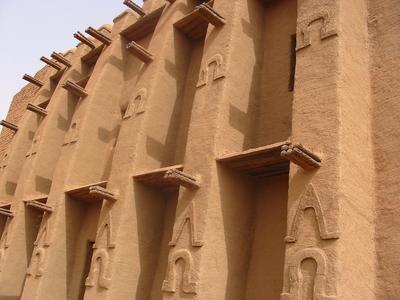
Malian Architecture

Ghana's version of 1989 was in a minor key and actually started over the course of a few weeks in 1987. It was a series of public lectures by a history professor, Alfred Adu-Boahen, on a sober topic: The Ghanaian Sphinx. Reflections on the Contemporary History of Ghana, 1972-1987. It is hard to believe that there was a time when such comparatively mild criticism would have condemned you to harassment, jail or worse, but that was the case at the height of the reign of Flight Lieutenant Rawlings' junta. Arbitrariness, and a malign and heavy hand were the weapons of choice. The only forms of resistance in the eighties were exile on the one hand, or the culture of silence on the other. Said culture of silence was attacked head on during these lectures and the spell was decisively broken.

The metaphor of the Ghanaian Sphinx - that puzzling acquiescence to authority and silence in the face of privation and worse, was outlined and a solution was proposed. It was a simple formula: plain speaking about the history of Ghana since independence and calling things by their name with lucidity. His argument made a difference and the atmosphere in the country changed. The fight for democracy was enjoined and much of Adu Boahen's blueprint has been followed over the years. If only there had been more such profiles in courage. Would that more had stood up and been counted.

The immediate and major difficulty in this effort was that political parties were not allowed in Ghana. 8 years of military rule had cowed the opposition. To the extent that there was any politics in the country it was to be found in social groups without any agenda. Ghanaians vied to compete to be secretary of football supporters' associations, book appreciation clubs or bible study groups. Even the Danquah lectures were framed as simply educational lectures. It would require considerable reorientation to force the issue. Still a conversation was started and Ghanaians began to organize themselves. Indeed in 1990, a Movement for Freedom and Justice was formed to pressure for change and a return to civilian rule. The first fruits of this pressure was with the news media. The Catholic Standard resumed publication (religion being the major (only) growth industry in the country). More crucially, a few independent newspapers were allowed to come into existence, the Ghanaian Chronicle the most significant among them. Over a next decade, these newspapers and then the new FM radio stations that started broadcasting would prove crucial in securing democratic gains - monitoring elections being one of their essential contributions.
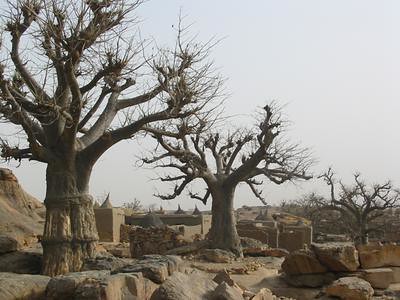
Dogon Hillside

Another history professor, Laurent Gbagbo, was speaking up in Côte d'Ivoire against President Houphouët-Boigny whose recently completed basilica, Our Lady of Peace of Yamoussoukro, was the largest church in the world. By then he had been in power almost as long as Castro and Kim Il Sung of North Korea. The sly fox was nothing if not resilient and hanged on to power until his death a few years later. With hindsight, it would have been better if Gbagbo had been successful in his efforts in 1989 (or for that matter in the 70s when Houphouët first put him in jail). He was a very different (read compromised) man when he would come into power in 2000. The damage was done to the social fabric of Côte d'Ivoire during the lackluster years of the 1990s when each leader in the political class outdid themselves in demagoguery and never failed to disappoint their compatriots.

Algerians turned out in masses and overwhelmingly approved a new constitution at the start of 1989 to pave the way to multi-party politics. The generals seemed to go along with the decision but would have second thoughts about democracy at the culmination of the process in 1992 when it appeared that Islamist parties were poised for victory. A murderous civil war then ensued. In 1989 however things were looking up. In most of Africa, there seemed to be a great awakening and signs of life.

The strongmen in Africa fought these encroachments on their freedoms like all powerful men are wont to do: tooth and nail. It was the eternal dynamic of the confronted authoritarian: delay, ignore, suborn, bribe when expedient, divide and conquer and that old standby, the demonstration of violence. After 1989 there would be less room for maneuver and many had to tone down their outrages against human rights and democracy. The result was that the 1990s would see a spate of elections. True, in many countries, it was only lip service that was being paid in these elections, hence the frequent resort to of vote rigging; in other countries, however, there would be genuine transitions. 1989 gave impetus to these nascent movements.

baobab by kagyah

III. A South African Detour


A conventional reading of South Africa in 1989 would run with the Great Man theory, namely that the secret negotiations that had began with an imprisoned Nelson Mandela in 1988 continued throughout the year and would culminate in his release in 1990. All this would understate the complications on the ground and the considerable effort expended to rid the country of apartheid.

There was continued internal pressure by the banned ANC, persistent strikes by the trade unions and general defiance in the townships. There were significant external pressures, whether through economic sanctions or consumer boycotts, that forced the divesting of holdings of South African enterprises and a shunning of exports. Military, diplomatic and cultural pressures weighed on the regime.
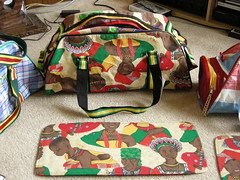
jo bag: ghana must go in South Africa

There was a lot of geopolitics involved and some point to the crucial impact of the battle of Cuito Carnival the previous year in Angola where South Africans and their proxy army, Jonas Savimbi's UNITA movement, were forced to a stalemate by the MPLA and their Cuban reinforcements. After much diplomatic untangling of the situation, the Cubans went home, South Africa agreed to Namibian independence, and Angola's MPLA agreed to a truce with UNITA. You can read Chester Crocker's self serving memoir, High Noon in Southern Africa, for the naive account of what transpired... The irony of the book's title and indeed the outlook it betrays will be tackled later. Sam Nujoma would lead Namibia to independence in 1990 after what had been long hard-fought war. South Africa would begin to stop meddling in its neighbour's affairs.

In 1989, the world learned that hit teams of South African police were assassinating people "in Swaziland, Lesotho, Mozambique, Zimbabwe and Britain, as well as inside South Africa". All opponents of the apartheid regime were fair game. The moral opprobrium against P.W. Botha's would weigh on his successor De Klerk. The optics were not in their favour. The rest of Africa made their thoughts clear. The ANC proposed, and the OAU adopted its Harare Declaration on August 21 1989

We recognise the reality that permanent peace and stability in Southern Africa can only be achieved when the system of apartheid in South Africa has been liquidated and South Africa transformed into a united, democratic and non-racial country. We therefore reiterate that all the necessary measures should be adopted now, to bring a speedy end to the apartheid system, in the interest of all the people of Southern Africa, our continent and the world at large.
Note, if you will, how the same story was reported in the New York Times: "South Africa Rebel Blueprint Backed by Regional Leaders".

The spin in the paper of record reflected the prevailing conventional wisdom in the USA. We must never forget that Ronald Reagan, George Bush the first, Margaret Thatcher and their bagmen, still saw themselves as allies of the apartheid regime. To their dying day, they should be tarred with their association, nay commission, with some of the most awful lot in history. There were many misadventures and much blood spilled in the Great Games of the Cold War; the support by these governments for apartheid is unambiguously egregious.

jo bag: ghana must go in South Africa

And it bears reminding that the struggle for liberation of South Africa was still a close run thing - note the headlines from that same day: "New Wave Of Arrests In S. Africa; Apartheid Resisters Go Into Hiding"

Leaders of a three-week-old campaign to defy apartheid restrictions began going into hiding today to elude a new wave of arrests by South African police as the government of acting President Frederik de Klerk intensified its crackdown on activities aimed at disrupting next month's segregated elections for Parliament.

The Cape Province turmoil has been viewed as a campaign against elections for the tricameral Parliament, in which Coloreds and Indians have separate-and mostly powerless-chambers. South Africa's 23 million blacks have no representation in Parliament.

The police crackdown on dissent appears to be the government's response to criticism by the far-right Conservative Party that de Klerk has gone "soft" on security, especially after the announcement that the acting president will travel to Zambia next Monday to meet with President Kenneth Kaunda, Africa's leading patron of the exiled African National Congress, which is South Africa's most powerful anti-apartheid resistance group.

Still the sensible folks prevailed:
We believe that a conjuncture of circumstances exists which, if there is a demonstrable readiness on the part of the Pretoria regime to engage in negotiations genuinely and seriously, could create the possibility to end apartheid through negotiations. Such an eventuality would be an expression of the long-standing preference of the people of South Africa to arrive at a political settlement.
That thankfully came to pass. The ANC won the 1994 elections.

At the end of the year, the General Assembly of the UN adopted its Declaration on Apartheid and Its Destructive Consequences in Southern Africa (pdf). Again this was over the strenuous objections of Bush and Thatcher. Lest we forget.

IV. Decentralization


In many arenas in 1989, Africans were beginning to route around central governments. The Big Men still mattered but civil society looked to assert itself. Change was in the air and decentralization was the result. The caveat as ever would be that the institutions took some time to follow the lead of the people; it is the African way it appears. A few years later, Yassin El-Ayouty would write "the world has completely changed since 1989; the OAU has not, since 1963" (The Organization of African Unity After Thirty Years). As someone who rails against stodgy institutions, I am heartened by the decentralization that continues to take place throughout Africa, it keeps leaders on notice.

Where the Organization of African Unity was barely more than a club for the "big men" first of African independence and then of cold war politics, with a gentleman’s agreement not to interfere in each others affairs, the African Union is a institution whose statutes affirm the importance of substance, of accountability, of human rights, and the obligation to uphold those rights not only at home but in your neighbor’s back yard too. Undoubtedly in practice, these aspirational standards are often not met and the development of these institutions is a work in progress; but the challenge is no longer the lack of standards but enforcement.

— Akwe Amosu - Democracy in Sub-Saharan Africa: Trends and Transitions (pdf)

In the field of health care and public policy, The Bamako Initiative was beginning to bear fruits. Again, starting from Mali, we got concerted efforts in health care and population issues. The emphasis was on decentralization and getting local communities involved in decision making that affected them. The strategy would inform later efforts at poverty reduction.

The most useful document I've found to evaluate Africa in 1989 is a long-term perspective study by the World Bank: From crisis to sustainable growth - sub Saharan Africa (pdf). It is comprehensive and fodder for historians, social scientists and mere bloggers.

Decentralization has been essential in bringing about change in Africa and often times it hasn't been a matter of conscious policy. It turns out that things like cell phones and FM radios are the great equalizers for democracy and help move beyond social communication to the political and economic realm. We should all search for more in that vein.

V. Enter The Gremlin


He could have been a mere footnote, but it wasn't to be. He was a mere anecdote for me on Boxing Day of 1989. Annoyed as I was that my mother had worked on the holiday, she deflected my irritation by mentioning this man who had called up the BBC and told her that he had invaded Liberia. That was most people's introduction to Charles Taylor and his unique brand of malevolence. It was bemused entertainment for a journalist but he gave such good copy, a fluent mixture of hubris and cold calculation. He was going to "bring the bitterness of war to Liberia", launch a revolution throughout Africa, and overthrow Master Sergent Doe.

From the first 10 men who joined him from Libyan camps to all the subsequent marauding armies that came into play, Charles Taylor has destabilized no less than eight countries. The casualties and the brutality was impressive. The callousness was biblical, the innovations of small boys units in warfare absolutely diabolical, and the savagery simply unmatched. Much as I wish to dwell on democratic change that 1989 presaged, I have to admit that Charles Taylor and the civil wars that he fomented since 1989 loom large throughout Africa. He may sit these days on trial in The Hague but he casts a dismal and influential shadow. Liberia and Sierra Leone suffered the most in the bloody free-for-alls; Cote d'Ivoire vacillates and many others are picking up the pieces twenty years later. The events of the past year in Guinea can even be read as further aftershocks of the Charles Taylor earthquake.

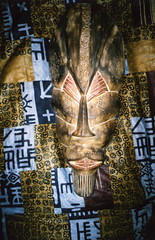
Aburi mask - strange days

Blood and sin was Charles Taylor's unique contribution to Africa.

The pervasiveness and intensity of looting, pillage, and plunder by the leaders and the rank and file, the lack of a stable and systematically organized structure of command and control among the armed bands, the criminal misuse of children, the employment of strategies of confidence artistry, the opportunistic use of a variety of cultural symbols, the orchestration of a state of anarchy as the normal environment of operation are all constitutive of the behavior of gangsters who use terror as their ultimate instruments of control. This mode of control draws from the worse aspects of an array of cultures ranging from the culture of urban gangsters and small town confidence artists of western society, and the area boys and swindlers of West African cities to marauding murderers.

— Amos Sawyer - Violent Conflicts And Governance Challenges In West Africa: The Case Of The Mano River Basin Area (pdf)
It is a dubious legacy, and it all started in 1989.

VI. A Year in Music


There was lots of politics on the agenda in 1989, and lots of dancing too. A playlist for your listening pleasure

What were your memories of Africa in 1989?

File under: , , , , , , , , , , , , , , , , ,

Tuesday, April 11, 2006

Angola

Part 7 of the Things Fall Apart series... Perhaps I've read far too much James Ellroy and enjoyed his paranoid style, or is it that I admired that dark series, Millennium, spawn of the conspiratorial X-Files, at the end of the last century? In any case, consider yourselves Marlow travelling down the river Congo. You may not like the encounter with Kurtz... But here goes, you were warned. This one is for my good friend Sozi...

A package was slipped under my door late one night, a year ago today. Enough time has passed for me to share its contents. I think you'll understand the delay as you read. It was marked Angola, and had a note scribbled on it in crimson red that read, "You like strange bedfellows, don't you?"

Cover Letter


From: Anne Aliste, Research Dept.
To: [Redacted] - Director, Toli inc.
Date: April 12, 2005

What an extraordinary dossier. I've never had to do a workup on such curious material, and apparently this is just the tip of the iceberg. Anyway this preliminary analysis is based on the first stack of pages, We're working on decoding the rest. We've managed to discern (at least) 4 source documents
  • Marburg and Ebola Musings
    Briefing material on recent outbreaks of those hemorrhagic fevers caused by those newfangled viruses.
  • Ronald Reagan: Forward For Freedom
    The text of Ronald Reagan's celebrated speech from 1986. Verbatim.
  • Lizards and Bullets
    Extracts from a report recounting the proceedings of a rogues' gallery operating alternatively in the US and Africa. Lots of clippings to digest. Details of the operation are murky; your basic black ops but the connection seems to be Angola. Some of the names are very interesting, Savimbi seems to be a key figure (he's safely dead). The reference to lizards is an ancient Ghanaian proverb scribbled on the reverse of one of the clippings: "Just because a lizard nods its head doesn't mean it's happy". Similarly, the reference to bullets is a Gambian proverb: "Words are like bullets. When you release them, you can't call them back". More research is needed on these connections.
  • American Tabloid
    The preface to James Ellroy's novel on the Kennedy years, he writes your garden variety pulp fiction, think L.A. Confidential. Mostly anodyne stuff.
I've annotated where appropriate but it should be easy to follow. Put together, it's an interesting analysis, almost an alternate history. The authors (and there are multiple) seem to have taken to heart a recent missive about voices inside and the effect is akin to a Greek chorus. We're doing textual analysis to unscramble the idiosyncratic code.

We're revisiting our files in light of this material but it will take a few weeks to do a thorough workup. You might want to do a blind release to one of those non-traditional outlets, an African blog or something, see if it shakes anything out. This stuff is going to come out eventually, we should prepare our response and scrub things thoroughly.

A.A., Research Dept.
Attached: dossier and annotated clippings.


The Dossier


Ronald Reagan - Forward For Freedom
"But I do want to make a comment here on some recent history and let you draw your own conclusions."

Charles Barkley
"I don't know anything about Angola, but I know they're in trouble."
Africa was never innocent. All that cradle of mankind jazz... Whatever. There were always those willing to play The Great Game of power and expediency. Safaris for the kids? [redacted] Feed the children? Yeah right.

Europe was never innocent. All that White Man's Burden crap. God, Gold and Glory? Spanish Inquisition more like.

GTFOOHWTB.

[Note: this might be some kind of codename, we're checking.]

James Ellroy - American Tabloid:
"America was never innocent. We popped our cherry on the boat over and looked back with no regrets."
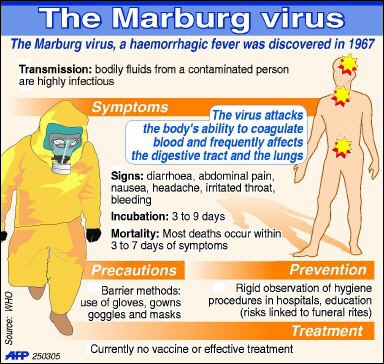
Item: Marburg hemorrhagic fever is a rare, severe type of hemorrhagic fever which affects both humans and non-human primates.

Item: Ronald Reagan was the fortieth President of the United States.

Dig: Jesus was in the wilderness for forty days.

Item: The Marburg virus was first recognized in 1967, when outbreaks of hemorrhagic fever occurred simultaneously in laboratories in Marburg and Frankfurt, Germany and in Belgrade, Yugoslavia (now Serbia).

Dig: They called it Operation Quarantine.

[Note: We know of no operation of that name. Might be a referral to obscure author Jim Crace who wrote an alternate history of that biblical fable. He's already on our subversive file but we'll refer him to the Homeland guys]

Item: The exact origin, locations, and natural reservoir of the Ebola virus remain unknown. Current suspicions are founded on cynomolgous monkeys, civets or bats.

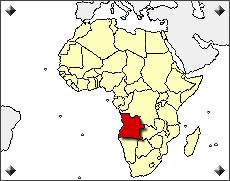
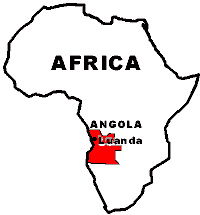
map of angola


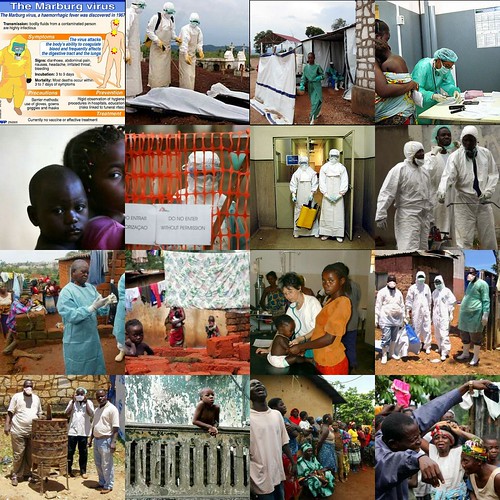
Item: There was an outbreak of the Marburg virus in Angola in April 2005.

Angola Marburg


Clipping A [source appears to be Victoria Brittain's obituary of Jonas Savimbi. Note: we've used her in the past: Museveni, Rawlings etc.]
"It was a long fall from his heyday in the 1980s, when Chester Crocker, the longest serving US Assistant Secretary of State, and the Reagan administration's top official for Africa described him as "one of the most talented and charismatic of leaders in modern African history"."
American Tabloid
"You can't ascribe our fall from grace to any single event or set of circumstances. You can't lose what you lacked at conception."
Item: Jonas Savimbi, was nicknamed "The Black Cockerel" by his supporters.

Dig: Jesse Helms, the US Senator from North Carolina, was Jonas Savimbi's biggest promoter.

Item: The armies of 13 countries have been in the Congo as Mobutu's regime crumbled and the Rwandan genocide and its aftershocks played out.

Item: An outbreak of Ebola occurred in 1995 in Kikwit, Congo and surrounding areas.

Dig: Dr. Matthew's Passion [NYT]
"Biomedical researchers admit profound ignorance about Ebola, a viral bleeding fever that first appeared in Africa in the late 1970's. There is no cure, and researchers do not know where the virus hides between human outbreaks. They do know, though, that the blood of an acutely ill Ebola patient is one of the most infectious and deadly substances on earth.
Ronald Reagan
"Last September, at the Lomba River in southern Angola, when a force of UNITA rebels met an overwhelmingly superior force of government troops directly supported by the Soviet bloc, the UNITA forces defeated the government troops and drove them and their Communist allies from the field"."
Item: Jesse Helms became Chairman of the Senate Foreign Relations Committee in 1995. His later nickname was "Senator No".

Dig: The pressure of marauding warlords roaming the bush has forced many to start eating animals that had previously been left alone in the bush.

Clipping B [source appears to be BBC article Angola's town of fear and lonely death - known foreign liberal outlet]
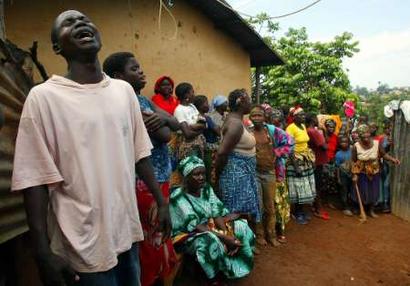
"They looked like spacemen, utterly out of place in this poor neighbourhood on the edge of Uige. It is no wonder that some local people fear the health workers, believing they are wizards or sorcerers.

They entered the hut, but not before spraying the door with chlorinated water. Then they picked up the tiny body, and wrapped it in white plastic."
Angola Marburg bodies


Item: In 1980, George H.W. Bush became Ronald Reagan's presidential running mate despite earlier criticism of Reagan's "voodoo economics". He had previously been Director of the Central Intelligence Agency (CIA).

Item: The South African regime combined with UNITA to invade Angola in August 1975, six months after that country's independence was gained from Portugal to kick its civil war into high gear. War would rage on and off for the next two decades.

Clipping A
"Savimbi was the toast of the Reagan White House, feted by the rightwing establishment in many countries and a friend to African tyrants. He was a willing tool of the cold war, the key figure in America's and apartheid South Africa's destruction of independent Angola's nationalist ambitions, and responsible for suffering and death on a scale barely comprehensible outside his ruined country."
American Tabloid
"Mass-market hagiography gets you hopped up for a past that never existed. Hagiography sanctifies shuck-and-jive politicians and reinvents their expedient gestures as moments of great moral weight."
Item: The Rwandan genocide took place in 100 days starting in April 1994. The Red Cross stopped counting bodies at 800,000. Remnants of the génocidaires fled across the border into Congo taking millions of Hutu with them.

Item: In 1998, an outbreak of Marburg fever occurred in Durba, Democratic Republic of the Congo.

Item: It is said that along with eating tainted meats, traditional funeral practices in Angola and Congo exacerbate the spread of the Marburg and Ebola viruses. Hear it from the Gray Lady:
But Angolans have resisted the public health messages, because they do not want loved ones taken away and put into isolation wards where family cannot visit and because they resent interference with funeral traditions of washing the body and kissing it goodbye. Funerals must be conducted properly to show respect and affection for the deceased and to avoid neglecting spirits who might turn vengeful.
Dig: Joseph Mobutu (a.k.a. Mobutu Sese Seko amongst other honorifics) was the most prized CIA asset in Africa from the 1960s until his death in 1997. He was a friend to every CIA director in his lifetime.

Clipping C [source appears to be subversive article, The terrible legacy of the Reagan years, The Guardian, known liberal UK newspaper]
"Over the Atlantic and down a bit, and we have Reagan welcoming Jonas Savimbi of the Unita organisation to the White House and speaking of his murderous outfit in Angola."
Ronald Reagan - Forward For Freedom
"In the history of revolutionary struggles or movements for true national liberation, there is often a victory like this that electrifies the world and brings great sympathy and assistance from other nations to those struggling for freedom. Past American Presidents, past American Congresses, and always, of course, the American people have offered help to others fighting in the freedom cause that we began. So, tonight, each of us joins in saluting the heroes of the Lomba River and their leader, the hope of Angola, Jonas Savimbi."
Item: Angola has oil, diamonds and more. Congo has reserves of gold, copper, tin, tantalite, coltan and almost every valuable mineral that exists.

Item: The Angolan army were in Congo chasing UNITA. The Rwandans and Ugandans were there too chasing the génocidaires and the Lords Resistance Army respectively. Mugabe sent a crew from Zimbabwe too, as did Sudan (both sides), Chad (all sides) and others. Various soldiers of fortune from Ukraine, Serbia and elsewhere came to ply their trade.

Dig: They say at least 3 million people have died, mostly of starvation, during Africa's World War centered on Congo.

Dig: The mines have continued operating throughout the conflict.

Dig the scene: Stalking a Deadly Virus, Battling a Town's Fears [NYT]
"For the people of Uíge, rampant death is now joined by the near equivalent of a space invasion: health workers encased in masks, goggles, zip-up jump suits, rubberized aprons and rubber boots as they collect corpses in the stifling heat. The garb is all white, a symbol of witchcraft here."
Marburg virus


Chew on this one: [Zaire's Mobutu Visits America - Heritage Foundation Research. Our people!]
"In Angola, Mobutu has been a catalyst, in supporting the U.S. objective of reconciliation between Angola's warring parties and, though he denies playing such a role, reportedly in assisting the U.S. in supplying Jonas Savimbi's UNITA Freedom Fighters."
Item: The Bush and Mobutu families spent vacations together.

Clipping C
Actually what Savimbi was doing was prolonging a civil war in which the UN estimates that 300,000 children died directly or indirectly during the Reagan years, and Angola was covered in landmines. Human Rights Watch reports that UNITA's indiscriminate use of landmines, caused there to be more than 15,000 amputees in the country by 1988, ranking the country alongside Afghanistan and Cambodia in the league of blown-off limbs.
American Tabloid
"Our continuing narrative line is blurred past truth and hindsight. Only a reckless verisimilitude can set that line straight."
Ronald Reagan - Forward For Freedom
"So, you see, like the Panama Canal in 1976, foreign policy issues like defense spending and aid to the freedom fighters may prove the sleeper issues of the year."
Dig the locals:
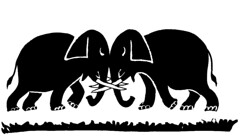
"When two elephants fight, it is the grass that suffers." - Angolan proverb.
spraying disinfectant


Dig: The symbol of the Republican Party (a.k.a. the Grand Old Party, GOP) in the United States is the elephant.

Item: The Soviet Union, and later Russia, was a key financial and logistical backer of the MPLA movement in Angola. Cuba also provided significant military aid up until the fall of the Berlin Wall.

Clipping D [source appears be report on Operation Babushka - ref. [redacted] Bantustan. TPMCafe, known subversive outlet.]
"The [International Freedom Foundation] IFF was ostensibly founded as a conservative think-tank, but was in reality part of an elaborate South African military intelligence operation, code-named Operation Babushka. Established to combat sanctions and undermine the African National Congress, it also supported Jonas Savimbi and his rebel Angolan movement, Unita."
Item: Nelson Mandela spent 27 years in prison, mostly doing hard labour on Robben Island, South Africa.

American Tabloid
"They were rogue cops and shakedown artists. They were wiretappers and soldiers of fortune and [redacted] lounge entertainers. Had one second of their lives deviated off course, American History would not exist as we know it."
Clipping D
"From '85-'88, Grover Norquist, who worked with [Jack] Abramoff at the College Republicans, served as Savimbi's Economic Advisor and was registered with the Justice Department as a foreign agent of Angola. [PK]" [Note: we're investigating the PK initials, spin it: Paul Krugman?]
Millennium


Clipping E [A blast from the past - Mail & Guardian, South Africa]
"For several years after its launch in 1985, [Jack] Abramoff (47) was the Washington face of Pacman, code name for the International Freedom Foundation (IFF). In 1995, the New Nation reported former security policeman Paul Erasmus as describing the IFF as a stratcom-military intelligence (MI) project designed to sway world opinion against the anti-apartheid movement."
Clipping D
"In 1995, [Williamson] described the IFF to Newsday as an instrument for "political warfare" whose job was "undercutting ANC credibility". The operation was constructed to prevent people knowing "they were involved with a foreign [South African] government. They ran their own organisation, but we steered them"."
Item: Claude Allen was Jesse Helms' campaign spokesman in 1984.

Dig: Ronald Reagan and Margaret Thatcher argued vociferously against sanctions imposed on the South African apartheid regime by the United Nations.

Dig the locals:
"A woman who wants a child doesn't sleep in her clothes" - Angolan proverb.
Toxic


Ronald Reagan
"So, let me urge you all to return to your organizations and communities and to tell your volunteers and your contributors that the President said that they're needed now as never before, that the crucial hour is approaching, that the choice before the American people this year is of overwhelming importance: whether to hand the government back to the liberals or move forward with the conservative agenda into the 1990s."
Clipping E [Jonas Savimbi, Unita's local boy - BBC]
"Some of the harshest criticism has come from those who once knew and admired Savimbi, but have since admitted they were duped by his charisma into overlooking serious character flaws. [Note: suggest we follow this talking point]

A former backer in Washington once conceded ruefully: "Savimbi is probably the most brilliant man I've ever met, but he's also dangerous, even psychotic"."
Clipping F [Jonas Savimbi profile Final Call, 2002 - Detroit)
Depending upon when and where he was interviewed, Savimbi appealed to tribalism, nationalism, anti-communism, or revolution, whichever suited his needs at the time. When speaking to Black American audiences, he would claim friendship with Malcolm X, and with international revolutionaries, he would invoke the spirit of the Argentine, Che Guevara, who became a leader of the Cuban Revolution. In European capitals and in Washington, D.C., Savimbi became the darling of the most racist right wing elements, and they handsomely financed his terrorist struggle against the peoples throughout southern Africa for nearly 30 years.
Item: Jesse Helms was chairman of Senate Agriculture Committee in the 1980s.

Dig: Claude Allen was appointed as Assistant to the President for Domestic Policy in January 2005

Clipping D
"After quitting the IFF in 1989, [Jack] Abramoff released Red Scorpion, an action movie that portrayed a Savimbi-like anti-communist guerrilla commander supported by Washington and Pretoria. Crystal said the IFF was not involved in the film's production. According to Williamson, however, it was "funded by our guys", who also provided military trucks, equipment and soldiers as extras."
Red Scorpion


Dig: Swedish actor Dolph Lungdren tends to play Russian roles. He is best known as Ivan Drago in Rocky IV. In Red Scorpion, he plays a KGB agent Nikolai. [Undetermined significance.]

Item: The Tale of Red Scorpion: "The manager of one of the major cast members, who did not want to be named, said that, according to her client, many of the actors and crew were never paid at all"

Dig: There was a Red Scorpion 2. "It went straight to video in 1994 and did not star Lundgren."

Ronald Reagan - Forward For Freedom
"My fellow conservatives, let's get the message out loud and clear. The Washington liberals and the San Francisco Democrats aren't extinct; they're just in hiding, waiting for another try. Well, let's make it clear to the American people that they must choose this year between those who are enemies of big government and the friends of the freedom fighters and, on the other hand, those who are advocates of Federal power and a foreign policy of illusion. So, let the choice be clear. Will it be "blame America first," or will it be "On to Democracy" and "Forward for Freedom"?"
Clipping G [Africa's Gems: Warfare's Best Friend - New York Times, 2000]
"Diamond money paid for Unita offensives that in the 1990's elevated Angola's civil war to a new plateau of savagery. Highland cities like Cuito and Huambo were all but flattened by artillery shells. More than half a million Angolans were killed. Land mines maimed about 90,000. Fighting displaced 4 million Angolans, and about 1 million continue to depend on foreign food aid. The United Nations Children's Fund now ranks Angola as the worst place on earth to be a child."
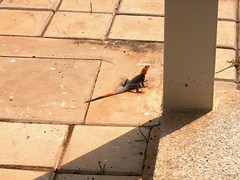
Item: "Just because a lizard nods its head doesn't mean it's happy." - Ghanaian proverb.

Lizard


Ronald Reagan
"And freedom is the issue. The stakes are that high. You know, recently Nancy and I saw together a moving new film, the story of Eleni. It's a true story. A woman at the end of World War II, caught in the Greek civil war, a mother who, because she smuggled her children out to safety, eventually to America, was tried, tortured, and shot by the Greek Communists."
American Tabloid
"The real Trinity of Camelot was Look Good, Kick Ass, Get Laid. [Jack Kennedy] was the mythological front man for a particularly juicy slice of our history. He talked a slick line and wore a world-class haircut."
Ronald Reagan
"It is also the story of her son, Nicholas Gage, who grew up to become an investigative reporter with the New York Times and who, when he returned to Greece, secretly vowed to take vengeance on the man who had sent his mother to her death."
Dig: Claude Allen oversaw the White House Task Force that coordinated the response to Hurricane Katrina in 2005.

Item: Bird flu found in stone marten in Germany [Associated Press]
"A weasel-like animal called a stone marten was infected with the deadly bird flu virus, marking the disease's spread to another mammal species... Cats are believed to have caught the virus by eating infected birds. Given the species' similar eating habits, Ulrich Arnold, a scientist at the University of Marburg's Institute for Medical Microbiology, said the discovery was "no new situation for Germany"."
American Tabloid


Dig: Laurent Desiré Kabila, installed as President of Congo by Rwanda and Uganda in 1997, was murdered by his bodyguard 3 days after the inauguration of the 43rd American president in 2001. His "adopted son", Joseph Kabila, assumed power after his death.

Ronald Reagan
"But at the dramatic end of the story, Nick Gage finds he cannot extract the vengeance he has promised himself. To do so, Mr. Gage writes, would have relieved the pain that had filled him for so many years, but it would also have broken the one bridge still connecting him to his mother and the part of him most like her. As he tells it: ".. her final cry, before the bullets of the firing squad tore into her, was not a curse on her killers but an invocation of what she died for, a declaration" how that cry was echoed across the centuries, her cry was a cry of love "My children!" A cry for all the children of the world, a hope that all of them may someday live in peace and freedom."
Dig: The B-Movie Theory [known African-American subversive poet/singer Gil Scott-Heron, we've got a workup ready on him]
The idea concerns the fact that this country wants nostalgia.

And when America found itself having a hard time facing the future, they looked for people like John Wayne.
But since John Wayne was no longer available, they settled for Ronald Reagan
And it has placed us in a situation that we can only look at like a "B" movie
Ronald Reagan
"And how many times have I heard it in the Oval Office while tryng to comfort those who have lost a son in the service of our nation and the cause of freedom. "He didn't want to die," the wife of Major Nicholson said at Fort Belvoir last year about her husband, "and we didn't want to lose him, but he would gladly lay down his life again for America"."
Clipping H [source appears to be Africa's Gems: Warfare's Best Friend - New York Times, April 2000]
"At Andulo, Unita's headquarters in the central highlands of Angola, Mr. Savimbi personally haggled with arms merchants and diamond traders who flew in from Europe. The rebel boss bargained using small bags of diamonds, each of which contained several million dollars worth of gems."
American Tabloid
"Lies continue to swirl around his eternal flame. It's time to dislodge his urn and cast light on a few men who attended his ascent and facillitated his fall."
Ronald Reagan
"So, we owe something to them, you and I. To those who've gone before - Major Nicholson, Eleni, the heroes at the Lomba River - and to the living as well - Andrei Sakharov, Lech Walesa, Adolfo Calero, Jonas Savimbi - their hopes reside in us as ours do in them."
Savimbi


Item: The battle of Cuito Cuanavale (1987-1988) in Angola was critical in the Angolan civil war, one in which the marxist MPLA, helped by the Cuban army, faced off against UNITA and the South African army. Each side played the indecisive military outcome off as a propaganda victory. The costs to Cuba and South Africa were primarily political and economic.

Dig: In 1990, Nelson Mandela was freed from captivity after 27 years. He had been having secret negotiations with the South African government. The first formal meeting was in May 1988.

Ronald Reagan - Forward For Freedom
"Some 20 years ago I told my fellow conservatives that "You and I have a rendezvous with destiny." And tonight that rendezvous is upon us. Our destiny is now. Our cause is still, as it was then, the cause of human freedom. Let us be proud that we serve together, and brave in our resolve to push on now toward that final victory so long sought by the heroes of our past and present and now so near at hand."
Item: "Words are like bullets. When you release them, you can't call them back" - Gambian proverb.

map of Angola


Item: Angola is the seventh most important source of oil for the United States which imports 433,000 barrels per day from it.

Dig the profile for Angola:
"The top foreign oil companies operating in Angola are US-based ChevronTexaco and ExxonMobil, France's Total, UK's BP, UK/Dutch Shell, and Italian Agip/Eni Oil Company."
Dig the headline: China expands ties with oil-rich Angola [CNN]

Clipping I [Columbia University press release]
"Researchers at the Greene Infectious Disease Laboratory at Columbia University's Mailman School of Public Health, led by Thomas Briese, associate professor of epidemiology, have developed a rapid, comprehensive diagnostic test for viral hemorrhagic fevers caused by the Ebola and Marburg viruses, as well as others."
Clipping J [Jonas Savimbi profile - London Review of Books, March 2002]
Jonas Savimbi stole just about everything and he should not be pitied. His greatest wish was to take possession of Angola, not as a common felon but as a feudal grandee, a Naipaulian Big Man, who would stride out of the bush, fully empowered by elections or force majeure - it didn't much matter - and preside over the capital Luanda, the decadent enemy heartland of half-castes, Marxists, philanderers and oil-profiteers. This was not possible. In the attempt, which lasted roughly thirty years, he robbed Angolan peasants of just about everything and several well-known politicians of their plausibility. Jeane Kirkpatrick, the Reagan Administration's henchperson at the UN, described him as 'one of the authentic heroes of our time', and Reagan himself is reported to have likened him to Abraham Lincoln.

elephants


Even as he ceased to serve the purposes of Washington and Pretoria at the end of the Cold War, he continued to persuade Western right-wing lobbyists and anti-Communist crusaders to part with their money: 'hearts, minds and purses' was the Savimbi strategy on this front and it paid off handsomely. He also pilfered and cannibalised greater reputations to advance or tweak his own: he proclaimed himself a Maoist before Maoism became an anathema and a devotee of Che when fashion features in the Face were still decking out pretty boys from Epping or Harrogate to look like jungle revolutionaries. Ingenuity, coupled with immense reserves of courage, cruelty and amour propre, was the ingredient that allowed him to continue his 'armed struggle' in Angola for so long, and to turn the country into one of the unhappiest on earth. At the same time, he was a consequence of Angola's place in the Cold War jigsaw, and the speed at which the Angolan anti-colonial struggle became an internationalised civil war fought by large numbers of non-nationals.
Dig: The civil war in Angola lasted for 26 years.

Item: George H.W. Bush served one term as president of the US. His eldest son is currently in his 5th year as president of the US, Jeb Bush is currently governor of Florida and Neil Bush leads a relatively charmed life.

Dig: Jesse Helms retired from the US Senate in 2003, in his latter years he was pursued in a charm offensive by UN Secretary General Kofi Annan. The two were said to have become quite good friends and made a curious couple around Washington.

Dig: Jack Abramoff pled guilty on January 3, 2006 to three criminal felony counts in federal court related to the defrauding of Native American tribes. "Jack Abramoff and a former business partner were sentenced to five years and 10 months in prison for fraud related to their 2000 purchase of the SunCruz Casinos gambling fleet. The sentences were the minimum under their plea agreement in the case." 266 eminent persons including congressmen submitted character references for his sentencing. In his plea bargain biography, he claimed to be "appalled at the violence in Red Scorpion". There is no word on his feelings on the sequel that he produced, nor indeed any reference to Jonas Savimbi, Angola, Nelson Mandela or South Africa.

Item: Claude Allen, who resigned in February 2006 as President Bush's top domestic policy adviser, was arrested March 2006 in Montgomery County for allegedly swindling Target and Hecht's stores out of more than $5,000 in a refund scheme, police said.

Dig: Grover Norquist is president of the anti-tax lobbying group Americans for Tax Reform with close connections to the White House. He is most famous as the architect of the political strategy known as Starve the Beast.

American Tabloid
"It's time to demythologize an era and build a new myth from the gutter to the stars. It's time to embrace bad men and the price they paid to secretly define their time.

Here's to them.
"
Dig: Jonas Savimbi was shot to death, his body riddled with bullets in February 2002 after being chased down by Angolan troops. Within weeks, UNITA sued for peace and the decades-long civil war was nominally over.

Ronald Reagan
"Thank you. God bless you."
Dig: There are stories that the remnants of UNITA are still roaming around the forests in Congo and Angola, serving as soldiers of fortune in that ongoing Great Scramble. They have company in the Rwandan Hutu génocidaires and the Ugandan Lords Resistance Army among other miscreants.

Item: Ronald Reagan passed away in June 2004 after a long battle with Alzheimer's disease. He was "the most fascinating person of the last quarter-century", according to a Top 25 list compiled by CNN and editors at Time magazine in 2005.

Dig: George W. Bush was fourth in that survey.

Angola Marburg 2005

Renewal


Angola is a state of mind.

In the United States, it refers to Angola, Louisiana, the prison state of hard knocks and cruel disappointment that Gil Scott-Heron sang about or that gritty late night documentary you might have watched on cable television - Gary Tyler and all that. Angola used to be a slave plantation but it is now a maximum security prison.

There is more to the story of Angola however. There's that other story, of that other Angola, over there on that "Dark Continent", that other place called Africa. That story is of the civil war that raged for decades, fomented by opportunistic gremlins and parasites. Oh they had themselves a field day of collateral damage. Russia, Cuba, South Africa, the United States and their willing local companions.

Yet somehow, Angola has prevailed even as things fell apart. You can hear it in the music, see it in their eyes. The Angola that I know has resilience that illuminates that moral abyss and ineffable loss. The landmines that dot its territory are intermixed with diamonds, oil and, at its heart, a spirited people. The marauders will always be fighting for the loot but they will never extinguish the soul of Angola

Soul of Angola


There is much pain still, and we have returning war heroes contemplating the landscape; a generation striving to regain their footing. Like their Mozambiquan neighbours, it's a case of getting back to the farms and manning the factories. In short, a time to rebuild. Missing limbs are a matter of course but ingenuity abounds, and perhaps with kind words, good will, and a decade of quiet, the potential will be fulfilled.

angola hero


Now there is investment galore, millions to be made, they say. Angola is a US ally, there's Big Oil, Texan bankers and that War against Terror. Hell, the Chinese have joined in the fun. Hell indeed. We can no longer tolerate those inconvenient remnants of the UNITA movement roving around as soldiers of fortune. We're buying them off one at a time, they too need a piece of the proverbial pie. Reconciliation they call it. If properly directed, petrodollars should go some way to assuaging any latent guilt and restoring lost limbs.

Well let's just say that's the prevailing script: all is well, let us forget. Still, no one comes out of a civil war untainted, let alone the vicious, dirty proxy war waged for so long in that land.
I read the dossier.
I buried it for a year.
It's the Heart Of Darkness.

I saw a man raise his eyes to the sky.
I remembered another man's face.
I heard a rousing speech.

I want to believe.
Believe me.
I want to believe.
I take comfort in the Angola that I know, the one that is full of visions of hope. I treasure it in my sleepless nights. And even if those dreams founder, I know we'll always have Carnaval in Angola, glorious, exuberant and joyous.

To cap things off, last year Angola qualified for the first time for the 2006 World Cup to be held in Germany. I so look forward to this summer.
Dig this last one: the town of Marburg is at the center of the triangle of towns in which Angola is due to play its first round matches.
Angola Marburg Virus 2005


Print version

Next in Part 8: Huhudious (or Silly Season)

File under: , , , , , , , , , , , , , , , , , , , , , , , , , , , , , , , , , ,