Showing posts with label Côte D'Ivoire. Show all posts

Thursday, December 23, 2010

Electoral Fictions

Shamelessness is an essential component of the how to hand over to yourself blueprint but, as our Ivorian brethren are currently demonstrating, there is still room for innovation within that framework, and depths of crassness that can yet be plumbed. We live in a world of politics as theater and where elections are the ultimate in stage-managed human drama. Suspension of disbelief is essential in any fiction, and disingenuousness mandatory in electoral fictions.

I write this of course after watching events in Côte D'Ivoire over the past few weeks. The initial emotion was bemusement and indeed laughter - how can one not laugh at the spectacle of someone literally tearing up election results to prevent them from being declared. Still the inept antics only brought back the automatic, unrequited cringe I've had at Ivorian politics for the past decade. I remembered that I'd even awarded Laurent Gbagbo, his wife and their death squads an award of sorts, and looking over their 2004-5 citation, all the elements were there: the needless waste of everyone's time, the hubris, the threats and the violence. Still I have been holding my breath, a neighbour's house is still on fire.

Of course we've long since moved beyond laughter to the realm of tears. It's the usual litany, the West African yearning for normalcy: why should the conduct of elections be cause for fraught headlines? Why seal borders? And those death squads and the obligatory evacuation of foreign nationals? And so forth, it's a depressing lament. Most Ghanaians are gearing up to receive the refugees who have already started leaving the place. Sidenote: if refugees are leaving Côte D'Ivoire to go to Guinea and even Liberia, a country recovering from 14 years of civil war, how many more can we expect in ostensibly stable and oil-producing Ghana?
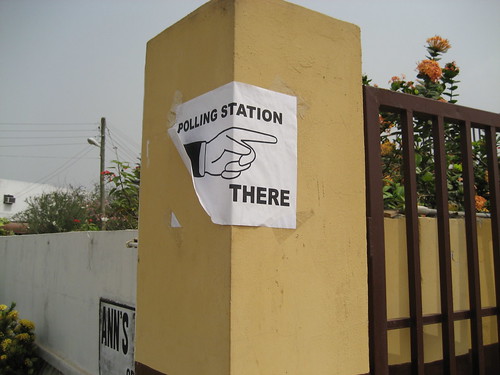
polling station there

Incidentally, we were on notice as to how ugly things might turn out. Recall if you will, the September story about that Ivorian man arrested in California attempting to buy arms to smuggle in contravention of the UN embargo. The salient quote:

"$1.9 million wired to the US as a 50 percent downpayment on the weapons... the shipment of 4,000 handguns, 200,000 rounds of ammunition and 50,000 tear gas grenades to Ivory Coast."
As you watch the distressing news footage, imagine the additional damage this consignment would have wrought in light of the violence, reports of militias, mercenaries and nighttime disappearances. The fact also that millions of dollars were so readily transferred surely indicates the importance the old government placed on the military option and indeed the kind of planning that was involved (the International Criminal Court should take note). But anyway all that is a matter of ruthlessness, let's deal with lighter topics: shamelessness, political theater and electoral fictions.

We have seen problematic elections in this season - consider Burma as the archetype, or might you prefer the thuggish Egyptian variant held on the same day, or perhaps even the Belarusian just this past weekend. It is striking that Ivory Coast takes the cake even in such abject company. The usual saying goes that "It's not who votes that counts but it's who counts the votes"; we are witnessing new clauses being added to that formulation. Call the Ivorian innovation on this front the Gbagbo Imbroglio, if you will. Their singular contribution to the body of electoral fictions is nothing less than the fictitious election.
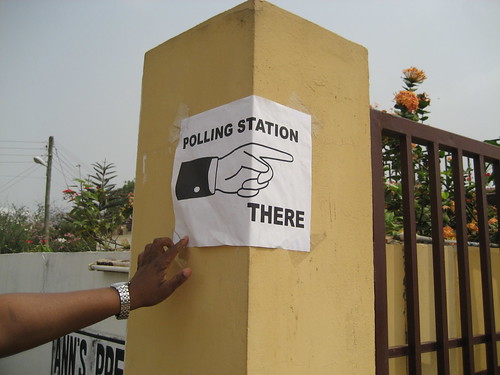
polling station

The usual practice when handing over to oneself is to hold back declaring results in your strongholds and wait until you know how many votes you need. In Chicago or Kansas City in the past, this was a matter of figuring out how many cemeteries to mine for the requisite ghost names. In Ghana in the 1990s, results from the Volta region always came in suspiciously late, later even than the Northern regions, and 98 percent votes in favour of the incumbent and 100 percent turnout (or more) would be the norm - shades of Mobutu or perhaps referendums in Stalin's time.

Gbagbo and company couldn't manage to do this, indeed the electoral commission that this sitting government had put in place took its job seriously and was remarkably independent - as well it should since a tremendous amount of effort had been put in place by Ivorians and the international community to stage these elections. The resort, then, was to say that the electoral commission did not have the right to declare the results. Which brings me again to that video clip I noted earlier that I've been stewing over ever since (and hopefully the BBC won't mind my using their image, I recommend to everyone their closing line: "the elections have been canceled six times in the past five years."). I haven't seen a more perfect piece of political theater in years. Every actor played their part brilliantly.

tearing up election results

When the next day, the head of the electoral commission did manage to sneak out and declare the results, the Gbagbo camp would remark that the declaration was invalid since it hadn't been made within the requisite timeframe. In other words, the declaration that could have been made the prior night had turned into Cinderella's carriage once midnight had passed.

What then followed would clearly demonstrate that Ivory Coast has had a fictitious election.

It would only be after the election results were declared that a 'Constitutional Council' would throw out the votes of 12 percent of the country so that the "results" would be in Gbagbo's favour. Surely this must be the most innovative response to an electoral contest. I can't imagine a greater slap in the face short of actual physical slaps in the face - and these have since been forthcoming.

First for 15 years ago, you say that a large part of your countrymen are not Ivorians, then you say that they are but that they can't register, then you delay for 5 years, then you allow only some to register as you then delay registration and again delay the vote. Then the whole country votes and even your folks vote against you so that the opposition win. And now you go and nullify their votes even though most of the irregularities were in your strongholds. Words fail me.

When Laurent Gbagbo would wrap himself in the flag and declare himself president, it would only bring to mind coronations of yore.
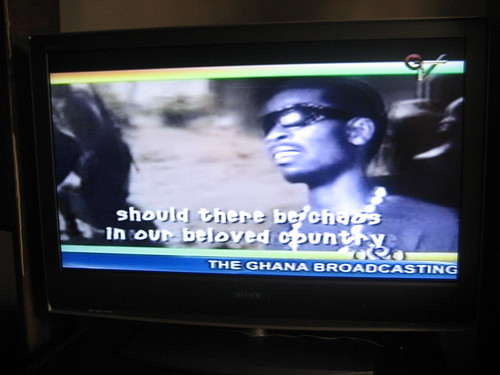
should there be chaos in our beloved country

The question at the outset was whether Gbagbo's generals would follow the Burma blueprint and make his opponent, Outtara, an Aung San Suu Kyi of sorts. Burma of course outdoored its own electoral fictions recently - said elections were timed to occur while the Nobel laureate was under house arrest serving her expediently conferred and lengthy sentence. Just to make sure of the outcome, her party was essentially banned in any case.

Earlier on, one wondered if it would it be the Algerian Algorithm that would be applied: simply don't hold the second round since you know how it would go.

There was also the option of the Abacha Abrogation - with Nigerian bluntness, simply call things off.

The Baker barrage - I'm referring to the slickness of the Bush-Gore 2000 business where James Baker was consigliere: run the clock down. Recall that group of Republican lawyer types that stormed counting offices in Florida. Then the Supreme twist - a legal opinion that should not be construed as a precedent, mutterings about irreparable harm notwithstanding.

A close counterpart is the Mugabe Mutation, a variant of the rope a dope: lose in the first round of elections and resort to the 'or else'.

Finally I suppose there is the Lukashenko option

Perhaps six out of nine Belarusian presidential candidates were in jail. One of them, Uladzimir Neklyayev, was beaten unconscious and then dragged away from the hospital wrapped in blankets.
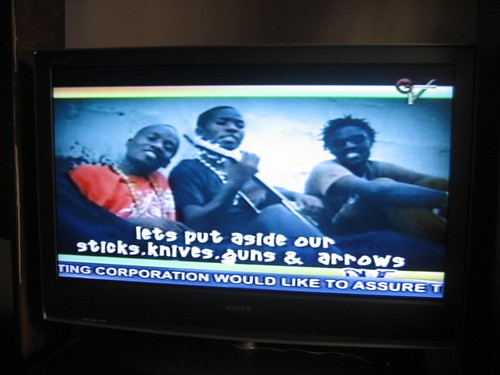
let's put aside our sticks, knives, guns and arrows

Laurent Gbagbo has already served an extra term as President - five whole years beyond the end of his mandate. We have been on notice as to his willfulness and are watching in almost despair as he does his worst, hoping against hope. I have a pet theory that someone who has been a political prisoner will do exactly what he wants to do (pace Mugabe, and Mandela notwithstanding). It is vain to think he will do otherwise.

The irony is that Gbagbo was on the receiving end of a famously rigged election. When I wrote my 1993 piece, I was in awe of the slick manner in which Houphouët-Boigny had used his considerable powers of incumbency and dealt with his opposition in 1990.

Given all the precedents one had expected a certain finesse or perhaps panache in the electoral strategy. As a Wikileaked cable from the US embassy in Abidjan put it in July 2009, "There will not be an election unless President Gbagbo is confident that he will win it -- and he is not yet confident of the outcome."

As well he should have been. The cable also noted that it was unlikely the elections would be held in early 2010 as expected since Gbagbo would undoubtedly want to preside over the jubilee ceremonies of 50 years of independence. "The prestige and celebrity that goes with hosting such an historic event" was insufficient as we have seen.
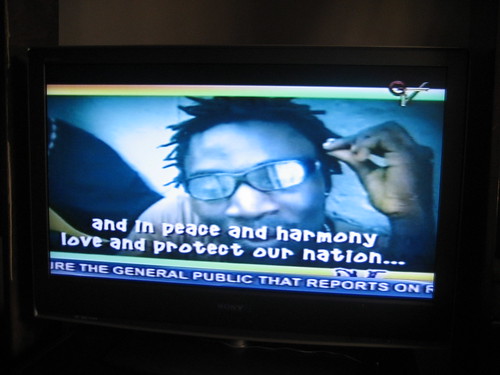
in peace and harmony protect our nation

All of that came to pass. This was a long game and Laurent Gbagbo has never missed an opportunity to disappoint. The exasperating and novelistic playbook has been followed to a fault. Delay, suborn, browbeat, bludgeon, deny, wrap yourself in the flag, bluster, and, if need, be suppress and kill - those death squads.

We tell ourselves stories about elections, but it isn't often that the reality surpasses the myth. It has been a colossal waste of everyone's time. We have gone from electoral fictions to fictitious elections.

File under: , , , , , , , , , , ,

Saturday, April 02, 2005

How To Hand Over To Yourself

As I listened to reports of the results of the voting in Zimbabwe's Parliamentary elections supposedly anointing Robert Mugabe with enough of a majority to (yet again) modify the constitution at will and rule until the age of 100, I thought that there was a sense of deja-vu about all of this. Hence I looked into my archives and found the following article I wrote in 1993 for Roots & Culture magazine. Back then, I was a cynical Harvard man reflecting on the first batch of stage-managed and flawed elections in the democratic thaw of the early 1990s.

Surprisingly, a fair bit has changed in the intervening years in sub-Saharan Africa with some notable successes (Mali and Ghana, for example, have emerged with robust democracies after decades of misrule) while other countries are works in progress (say Mozambique) and some are frankly catastrophes (Sierra Leone, Liberia, Congo and Zimbabwe being the worst). We'll see what transpires in Togo in the coming months (post-Eyadema The First) and cross our fingers that things might work out there. Yet if even Ukraine (modulo poisonings), or the more recent Kyrgyzstan (modulo opportunist politicians) can see change, maybe there's cause for some tentative (if limited) optimism.

Not that I care for the Heritage's foundation's libertarian politics or their methodology with the primacy being given to economic (as in their peculiar free-market-when-it-suits-us dogma) rather than political freedom, but this year's chart of their Index of Economic Freedom is a decent stand-in for the state of the sub-region. By their reckoning with the notable exceptions of Senegal and South Africa, most countries fall into the "mostly unfree" or the frankly "repressed" categories. I prefer to use the UNDP's Human Development Report or the World Bank's World Development Report to assess the state of the world but the broad strokes that these kinds of reports outline speak to how far Africa needs to go.

It was a fun article to write yet sadly, as I contemplate the tragicomedy of Robert Mugabe's reign in Zimbabwe, it's still relevant today. Herewith then the article:

How To Hand Over To Yourself

Helpful Hints From African Dictators


In this, the last decade of a tumultuous century, change, political and otherwise, seems to be on the agenda in most parts of the world. The post-Cold-War era sees the reawakening of democracratic sentiments long suppressed for reasons of political expediency. The consensus seems to be that governments must perform what they are supposed to, or at least display a certain measure of respect for the common-folk of their countries. The West, after looking for so long to containment in the East, has begun the process of looking inwards. However during this transition period, donor nations look towards former battlegrounds in the South with some disquiet. The existence of such a large number of dictators, plain thugs, and thieves of all sorts, installed, and sustained by shortsighted foreign policies, is an embarrassment few leaders can afford at such times. The scrutiny of donor nations, looking to a normalization of economic and political processes in the south, will consequently be most severe during the next few years. The "trustworthy" dictators and strongmen of southern nations have thus arrived at potentially hazardous crossroads.

African rulers, whose excesses have arguably been the most destructive, seem to have a restricted number of options at their disposal when faced with this unusual examination. A possible avenue they may choose is simply to ignore the West and carry on plundering, albeit at a more restrained pace. This, though, is problematic since it leaves open the door to further tightening of donors' purses. Add to this the very likely prospect of further riches once this unfortunate period is past, and one might reasonably predict only a few takers to this proposal. The other option, though, will tend to be more palatable to the temperamental and theatrically-minded characters that have governed African nations for a good number of years. The plan is to generously allow the good people, on whom you have been trampling for so long, to consecrate you and ask you to stay on. By handing over to yourself, you appease the donors and quash the cries of the opposition movements in the country at one stroke. The fruits of appearing legitimate are plainly evident. The unspoken plan is, of course, to declare a State of Emergency in a year's time, and shut down the irritating parliament.

Such an ingenious option will probably be the only conceivable one to people who have already done the impossible by "conquering" a whole country. Certainly it does not require a great leap of faith to imagine Houphouet-Boigny of Ivory Coast, Eyadema of Togo and other venerable old men of the continent proceeding down this avenue. Why, Daniel Arap Moi of Kenya, and even President (for Life) Banda of Malawi (!!!), have announced elections!!! The quest to legitimize oneself will undoubtedly attract its fair share of harassed leaders. An examination of the tactics of the pseudo-democratic Paul Biya of Cameroon, and the "mercurial" Flight-Lieutenant Jerry Rawlings of Ghana in their recent elections, may prove instructive as we await similar events all over the continent.

From the outset, 'leaders' start off with advantages that are nigh insurmountable. For all, the method is simply to tilt the playing fields in the desired direction using deceit, intimidation, or any other means. Plain intimidation would probably be a thug's instinctive action and indeed, the nearly-fatal attempt on the life of Silvio Olympio, the popular Togolese opposition figure, should be seen along the lines of Eyadema reverting to type. In Ghana, the laws allowing detention-without-charges on the order of the Executive, were still in place a month prior to the elections.

Rawlings built on this foundation by simultaneously being a candidate, judge, as well as the jury of the electoral process. He was able to force his own timetable on the process, and, like Biya, started his 'campaign' a year before official campaigning was supposed to begin. Political parties, on the other hand, were given less than six months to form and were only allowed to start campaigning three months before the elections. In any case, the Flight Lieutenant was the only one who knew when the elections would be scheduled, packed the Electoral Commission with lackeys and, the best stroke, chose to hold elections on November 3, the day of the American presidential elections. A strongly-worded condemnation by State Dept officials would clearly be impossible on that date and therefore suspicious results could be entered in through the back door. The recent attempt by Moi of Kenya to hold elections barely months after allowing political parties to form, is an ominous development along the same lines. Another possible path might be to cajole some money out of the World Bank and/or the I.M.F. to help your campaign. It was announced two months before the Ghanaian elections that all public servants would enjoy a 50(!!!) percent pay rise: the first pay rise in 11 years of military rule.

If all these gestures fail to bring any tangible popularity, the obvious thing to do is simply rig the elections. After all, the intention is to pretend to submit to the democratic process. For Rawlings this was in the main achieved by adding almost 2 million fictitious voters to the electoral register and by denying a large number of potential voters the chance to register. The use of pre-marked ballot papers is another option that should not be discounted and indeed appears to have been used extensively in both the Cameroonian and Ghanaian elections. In the latter case though, the level of vote rigging seems to have been a touch unsubtle: in some parts of the country, fully 100 percent of the votes were supposed to have been cast in Rawlings' favour; the implication being that even the opposition candidates voted for him in their wards. Fraud though, could be conducted with greater subtlety; the sight of 99.99 % election results might strain donors' credulity too far.

With a little fine-tuning of the above methods and perhaps a little improvisation, one might expect incumbents to win by relatively comfortable margins in a number of forthcoming elections. It is not implausible that many leaders overcome their current difficulties and live to chuckle even louder at their good sense. Indeed with such advantages, it is hard to imagine other outcomes.

As for the people? Well Africans have long seen frauds come and go. It would be almost out of character for them to rise up and put an end to the plain nonsense played out daily by many of their 'leaders'. Still, the continent-wide apathy towards politics and central authority gives cause for concern because it goes against the grain of traditional African life. Community government has always been an integral part of African culture, and it should continue to be important to all in the new Africa. Reassuringly though, there are signs that the slumbering African giant is being awoken, more angry than ever. The spontaneous rioting in many parts of Ghana after the extent of Rawlings' vote-rigging became apparent is probably an indicator of things to come. Similarly in Cameroon, the shock and immediate anger at the announcement of the 'official' results might indicate that an unspoken line has been crossed. Handing over to oneself might well break the camel's back.

Taken from Root & Culture magazine, Spring 1993. Vol. 1 No.2

A publication of the Harvard-Radcliffe Carribbean Club and the Harvard African Students Association

(Roots & Culture was a precursor to the latest publication from
HASA, The Harvard African)

See later: File under: , , , , , , , , , , , , , , , , ,