Showing posts with label Cameroon. Show all posts

Tuesday, March 21, 2017

An African Leader Bestiary

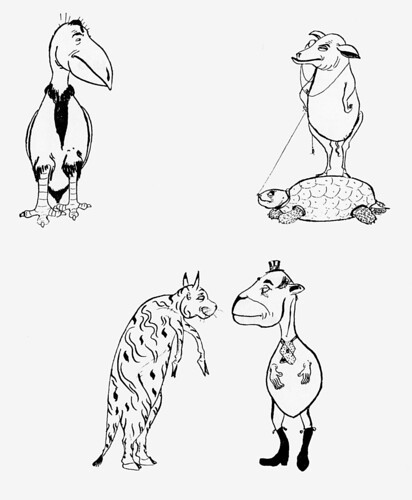
"When you are surrounded by vultures, try not to die", goes the Ivorian proverb, a touchstone for many post-colonial Africans. Changing the perspective somewhat in light of the unnatural longevity of Africa's leaders, I've been pondering the survival tactics of these scavenging creatures that have been our omnipresent companions. Cast yourself back to the middle of one of those lost decades in Africa and consider a magazine cover from 1984 featuring a representative trio of the time: Biya, Buhari and Rawlings. These names are still in the news thirty years on, but their paths have diverged. Most have stayed true to authoritarian form - albeit pretending to shed skin on occasion, and yet some have been reformed. Mitterrand, Thatcher, Gorbachev and Reagan have passed on but their African contemporaries have endured. What accounts for this tenacity? If the initial frame was the good, the bad and the ugly, something more elemental proved a better fit. Consider the following as fragments of an African leader bestiary of sorts.
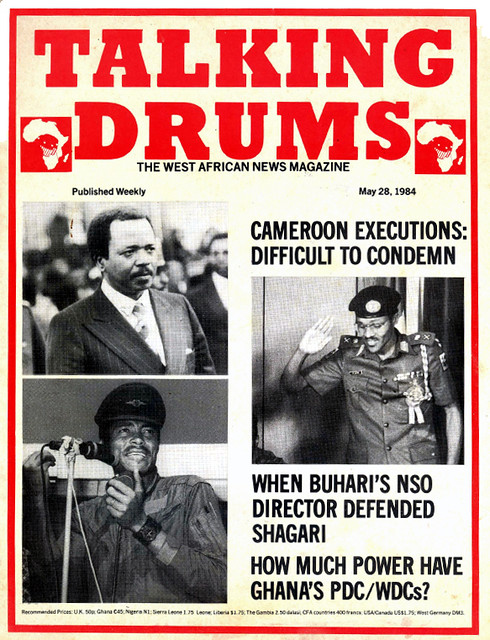
talking drums 1984-05-28 Cameroon executions Biya - Buhari - Ghana's PDC-WDCs Rawlings

Conversion Narratives

Muhammadu Buhari is the exemplar of reform and reinvention. In his early career, he was an unabashed coup maker, repeatedly stopping Nigeria's nascent though imperfect democratic experiment in its tracks (1966, 1975). A severe military man, he came out of the shadows as head-of-state leading the December 1983 coup that ended the Second Republic. His mantras, such as they were then, were all about cleaning house, stopping Shehu Shagari and company's corruption (although the military proved in practice to be the most vicious and corrupt actors in the country's history), and most notably, a War against Indiscipline. He would be later be memorably satirized by Fela (who he imprisoned) as a Beast of no Nation.

Make you hear this one / War against indiscipline, eei
Na Nigerian government, eei / Dem dey talk eei
"My people are useless, my people are senseless, my people are indisciplined".
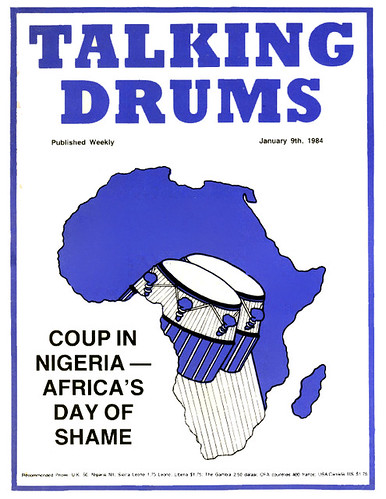
talking drums 1984-01-09 coup in Nigeria Africa's day of shame
The tumult that the grim-faced military put the country through under Buhari is not remembered with fondness by anyone, even if what followed (Babangida, Abacha) was perhaps more catastrophic in economic terms. These stronger, and more venal, predators stepped into his opening and overthrew him in short order in 1985. This was a rather friendly palace coup - a disagreement among wolves as it were, and he wasn't liquidated. Licking his wounds and withdrawing from the fore of Nigerian political life, Buhari was able to craft a second life. There has been reform and, with the passage of time, and three attempts (in 2003, 2007 and 2011), Nigerian democratic hopes, long disappointed in the intervening three decades, were pinned on him and his party in the 2015 presidential elections. There was no one Road to Damascus moment, but rather a pragmatic adjustment to multi-party democracy, the man calls himself a "converted democrat". The Nigerian political machine has accommodated him as much as he has accommodated the system. Given how large Nigeria looms in African fortunes, one prays for success of this experiment.

Blood

J.J. Rawlings had his two coups and 18 years in power in Ghana, ostensibly shedding his military uniform after a decade in 1992, and handing over to himself in a couple of shrewdly rigged elections to bring in the millennium. Dictator-no-more was the story although the authoritarian instincts persisted during the 1990s even in his civilian guise. The thin reed of political relevance that he stands on these days is making the occasional unreflective pronouncement about the probity of others, all the time hoping that no one confronts him about the bloodshed he amnestied his regime for. Surely the best indicators about Rawlings' enduring legacy were the 16,878 votes cast for his wife in the recent 2016 presidential elections. A full 0.16% of the electorate still paid obeisance to unbounded vanity. By and large, Rawlings as a phenomenon is healthily ignored. Still, as befits spent, but still viable, carrion, there will always be the occasional discarded carcass of the Ghanaian body politic that he can feast on.
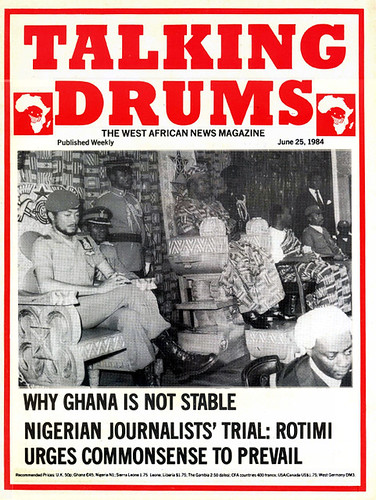
talking drums 1984-06-25 why Ghana is not stable - Nigerian journalist's trial Rotimi

His progeny, the NDC, had another bite at power, feeding at the trough of pork barrel politics for the past 8 years. But looting and purely transactional deal-making can't stand for long in a country as politically sophisticated as Ghana. For a cabal that originally proclaimed populism if not socialism as their ideological markers to be revealed as a pack of common traders, if not mediocre, wannabe oligarchs, ought to be humbling. That is, of course, only possible if they were capable of shame and the jury is still out on that. The real sadness about Ghanaian politics is that a healthy opposition is needed for democracy to thrive.

Sin

And so we come to Paul Biya... What can one say? Well Monsieur Biya is having the last laugh - all at the expense of the Cameroonian people. It has been the most charmed life for the past 42 years, living most of the year in luxury villas in France, Geneva, Brussels and the like. Where some American presidents could golf their way while bombing others, insouciance a l'Africaine is really a quite rarified thing. Like Omar Bongo, he didn't have to take up arms to remain Prime Minister or President. He wasn't a strongman per se, but one-party systems have their own logic. It has rather been the shrewd exercise of patronage politics and cronyism, his modus operandi is to buy everyone off and compromise everyone. He skillfully adapted to the veneer of elections and multi-party democracy that became obligatory with the donors after the changing winds of Africa 1989. If five years of Biya was already enough in 1987, what could one say now, thirty odd years later?
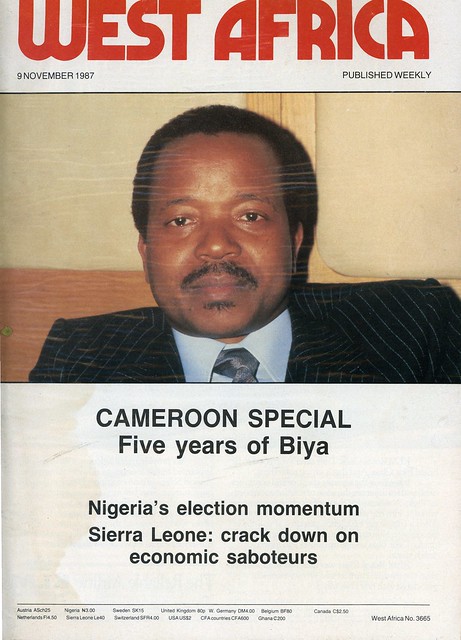
west africa 1987-11-09 5 years of Biya Cameroon Nigeria election momentum Sierra Leone economic saboteur

To his credit, the Biya brand of autocratic rule hasn't caused as many direct deaths as others on the continent, but there has been quite severe collateral damage to the Cameroonian soul. Cronyism causes pervasive decay and long periods of decay corrupt everything in sight. We all vie to see how obsequious one can be, bowing down cravenly to gain favour with the old man. A quarter century ago, everyone was asking whether Biya could survive the transition to multi-party democracy? He laughed then and is laughing now. We have long stopped asking that question, instead articles marvel at his longevity as we wait him out

The danger, of course, is that a hollowed state could well be his legacy and, as with Bokassa and Bozizé in the Central African Republic, Houphouët-Boigny in Cote d'Ivoire, and especially Mobutu in Congo, we may still be picking up the pieces long after he is gone. Boko Haram, for example, may not be bought off as easily as recalcitrant French politicians. Sectarian and economic grievances long suppressed are fertile ground for opportunistic mischief. All it will take is for Anglophone Cameroon, to take a recent troubling example, to explode is the rhetoric of the right populist. We have seen in our neighbourhood what a few bloody minded people willing to do their worst can do. The recent examples are not pretty.

For too long the original sin in African politics was our colonial legacy and the external meddling. We can no longer blame Francafrique. Paul Biya's generational mismanagement proves that we were never innocent, indeed it is all sin.
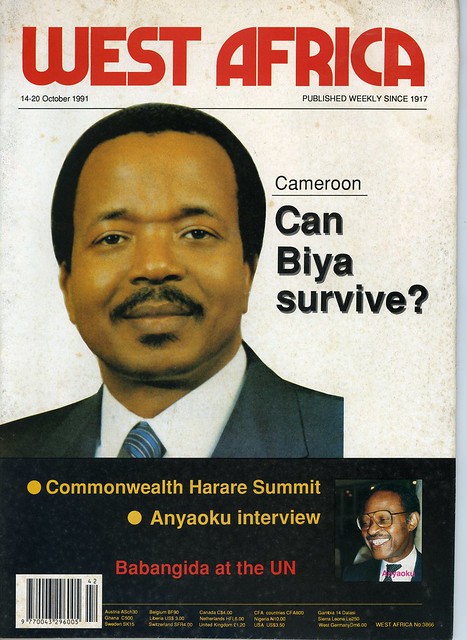
west africa 1991-10-14-20 Cameroon Can Biya survive Nigeria Babangida at the UN

Further Reading

  • En Attendant Le Vote Des Betes Sauvages by Ahmadou Kourouma

    The definitive anthropological study of the bestiary of Africa rogues that have led the continent astray. The English translation is fine, we are all waiting for the wild animals to vote.

  • A Feast for Crows by George R. R. Martin

    There are no winners in the African Game of Thrones

  • Farting Presidents and other poems by Tope Omoniyi
    A lovely chapbook full of quotable witticisms
    or who does not know
    that rotten eggs and doublespeak
    are recipes for the broth of chopped justice
    logs in the eye or a nation?
    and well-deserved anger
    And I wonder endlessly how the hell
    Chicken generals figured they could run a nation
    from their DIY book of trash
  • A Goodbye to Arms by Kwesi Brew

    Where the green khaki struts and grinds
    its marijuana terror into unarmed hearts,
    They come as men-at-arms
    Badged as justice, grim of face.
    And then at last, dissembling cloak removed.
    A pack of common traders stained in violence

    Wresting bread out the mouths of babies
    only to give it back to them at a price
    so kind are they who betray us.

    from Return of No Return

Soundtrack to this note

sundry beasts
File under: , , , , , , , , , , , , , , ,

Sunday, April 29, 2007

A Taste of Africa

It is a truth universally acknowledged that the sight of a grandmother running a kitchen in a restaurant brings a sense of warmth to the stomach of any man. The anticipation is further heightened in the sub-species known as the seasoned bachelor. I have seen grown men regress to their misspent and gluttonous youth, instantly shedding the heady shackles of responsibility as fond memories visibly surface. A certain look comes over the face and, for an instant, monosyllabic grunts are all that one is capable of. A food coma in prospect, the salivary glands go into overdrive. You'll notice a lot of involuntary licking of lips. If you listen closely you'll hear them whisper the adjective 'mouth-watering' under their breath. If only one could bottle up that instant cheer. I should know. Even though matrimony has been treating me well, that was me this Saturday.

Food is like that. Homecooked food, made with expert care is like that. Comfort food is by definition richly valued and time-tested, and the visual cues, those Auntie or Grandma figures, are rightly emphasized in advertising. An authentic real-life grandmotherly intervention is to be prized above almost all else.

And there it is, front and center, as you enter: you see her. Smiling her warm welcoming smile, she's surrounded by the pots with perhaps a ladle in hand, stirring, prodding, orchestrating a small slice of culinary nirvana. She's in full control, cooking with glee. You'll hear her dispensing pearls of wisdom, advising the others on spices and such. Still it's her show.

She's a grandmother. It's her thing, she's in it for love. It's the usual story: her reputation for homecooking was outsized, it wasn't just the extended family, but also the friends, and their friends. They all knew. She liked to cook, that's all. First it was a little joint a few blocks away, not much more than a little trailer, yet it kept going for 8 years. Now there is more capital, so it's a full-blown restaurant. They've lost the training wheels as it were; the revamp and grand-opening was late last year. Moving on up like Curtis Mayfield sang.

It's one of those crossroad neighbourhoods. The signs of recent gentrification are mixed with the usual pre-gentrification remnants and indeed holdouts. Transition in short. The restaurant is near the Berkeley/Oakland line, thus it's close enough to the heart of the City of Liberals to be a favourite of the Peace Corps crowd - those wanting to reminisce about a time when life had meaning, while maintaining the close ties to the soulful parts of the Oakland brethren and sistren - you know, those who keep it real. And then of course, there's your tribe of patrons: Africans in America. Ah nostalgia.

It's a family affair. Her daughters and sons cook, serve and clean. On occasion the little grandchildren drop by. I think the word is cute. It's really like spending time in a family home, it doesn't feel like a Formal Restaurant™. You wouldn't come dressed in opera wear.

It's not a dive, but it's suitably intimate, seven or eight tables, perhaps seating 25 inside, and a dozen out on the patio when the weather is right as it often is on this side of the San Francisco Bay. You get the red, gold and green painted exteriors, you get some batik prints. Was there a mask or two? Above all you get food from the Grandmotherland. Glorious Cameroonian cuisine is what you get. Ambiance and comfort are the fringe benefits.

Ethnic food in the Bay Area is mostly Asian (Chinese, Korean, Indian, Indonesian) and obviously the ubiquitous Mexican. African food is represented by the numerous Ethiopian restaurants, their delicate civilization having a strong presence in these parts. Of course there's much more to African food and culture than Ethiopia and slowly that awareness is seeping into the public consciousness.

We live near the Gourmet Ghetto in Berkeley, home to Chez Panisse and 15 or so restaurants. World-renowned, haute cuisine, Californian New World fusion cuisine with complicated ingredients - typical descriptions read like a Restoration Hardware label. You know what I mean: the expensive wines, the high snob quotient, the feel-privileged factor. Your mileage may vary but colour me unimpressed. When I need soul as I often do, living as we do in the midst of God's own people, I like to head out to our people, my people. I try to support the burgeoning West African community. There's Ghanaian Tropical Paradise down the street and, ever since I discovered it in the new year, there's A Taste of Africa.

Thus you might find me there on certain lazy weekend afternoons, sporting my fresh haircut from the nearby barbershops (I have to cross over to the Oakland side of things to get the right hair treatment), sipping on a glass of their homemade ginger delight drink (the last time, I almost declaimed spontaneous poetry in appreciation), chatting with all and sundry, or perhaps quietly reading a novel as the whim might take me. I'll be there taking in the atmosphere, nodding to the music as the family get to work, conjuring up the meals. They chat amongst themselves with the back and forth and intimacy that comes from knowing. It's the easy familiarity of, well, a family.

This is not fast food, it's homemade and unhurried, prepared with care. The menu is only a guideline, a starting point for a conversation. Ask for whatever is good that day. The menu alternates and Ma will cook whatever is her fancy.

"What do you have today?" "Well... I think... today... well... you see... you might like...."
And so forth. The pauses and rhythms are eternal. The sense of time is African. You'll wait a while as the food is prepared. The sweet smell of the fried plantains, the sule as the Cameroonians call it, will gently waft in from the nearby kitchen tickling your sensibility. It's ten feet away; if you could you'd take a few leaps and pick up a few slices, hot off the fryer. But, well, you control yourself. As they say, good things come to those who wait.

By the time the food arrives, you're ready. You dig in. What else is there to say? It's the main course, the main event, the main everything. I shall skip the ludicrous amount of pleasure you derive but I suppose I should describe the food somewhat.

Let's start with the ndole. A sauce of peanuts, spinach, garlic, ginger and something special. Throw it on everything, you can't go wrong. I exchanged a look of delight with a grandchild, perhaps 4 years old, she knew the score about the ndole she was similarly wolfing down.

The jollof rice is different from my customary Ghanaian fare, they don't seem to use long-grain rice, it's not the usual Basmati business, and the tomato treatment makes for a less intense taste. I like it though. Topped with Ndole, the fat lady sang. For the uninitiated, jollof is... well you can google it. Suffice to say that that it's my kind of thing. The sule, as I've suggested is great - again with a twist, I couldn't detect the ginger that would be in Ghanaian kelewele.

The suya, well, that's something else altogether. The spice on the kebab is phenomenal. Cameroon's proximity to Nigeria comes in handy in this respect, the Nigerians have the greatest tradition of khebab. Suya. Suya. Suya! A chorus of approval.

Try the pepper soup, typically with lamb or goat meat - or vegetarian if you must. Of course, this is West African food, so there's the obligatory fufu to accompany it (pounded yams in this case). There's more of course: moi moi or acara (various takes on black eyed peas), ewole which is the essence of Cameroon, egusi, okra and more. I'll let you discover for yourself.

I was struck that everything was light; she cooks with a delicate touch. Some African restaurants go all out with heavy fare that the part of the clientele that are cab drivers appreciate. You will eat a lot here and you won't regret it. You are reminded that the beautiful people live in California. There's sensitivity to the market. Astute, I must say.

Midway through your sustained attack on the delights at hand, she might take a walk around the place surveying the fruits of her labour. She doesn't need to ask; it's a done deal. But she does anyway. And yeah, she knows all right. She's seen it before: your appreciation is plainly evident from the precursors of sweat on your face, even before you launch into the obligatory mumbled 'it's ummm sooo ummm goo umm oood". She smiles. You smile. 6,000 miles away from the continent, diaspora, exile life is forgotten. For an hour of so, you're transported back home. You've gotten your taste of Africa. You're in the realm of the sated.

A Taste of Africa is in Berkeley, California.

Tell Ma I sent you. It's the least I could do.

Soundtrack for this love letter


Al B. Sure! - Just A Taste Of Lovin'

File under: , , , , , , , , , , , , , , , , , , ,

Saturday, April 02, 2005

How To Hand Over To Yourself

As I listened to reports of the results of the voting in Zimbabwe's Parliamentary elections supposedly anointing Robert Mugabe with enough of a majority to (yet again) modify the constitution at will and rule until the age of 100, I thought that there was a sense of deja-vu about all of this. Hence I looked into my archives and found the following article I wrote in 1993 for Roots & Culture magazine. Back then, I was a cynical Harvard man reflecting on the first batch of stage-managed and flawed elections in the democratic thaw of the early 1990s.

Surprisingly, a fair bit has changed in the intervening years in sub-Saharan Africa with some notable successes (Mali and Ghana, for example, have emerged with robust democracies after decades of misrule) while other countries are works in progress (say Mozambique) and some are frankly catastrophes (Sierra Leone, Liberia, Congo and Zimbabwe being the worst). We'll see what transpires in Togo in the coming months (post-Eyadema The First) and cross our fingers that things might work out there. Yet if even Ukraine (modulo poisonings), or the more recent Kyrgyzstan (modulo opportunist politicians) can see change, maybe there's cause for some tentative (if limited) optimism.

Not that I care for the Heritage's foundation's libertarian politics or their methodology with the primacy being given to economic (as in their peculiar free-market-when-it-suits-us dogma) rather than political freedom, but this year's chart of their Index of Economic Freedom is a decent stand-in for the state of the sub-region. By their reckoning with the notable exceptions of Senegal and South Africa, most countries fall into the "mostly unfree" or the frankly "repressed" categories. I prefer to use the UNDP's Human Development Report or the World Bank's World Development Report to assess the state of the world but the broad strokes that these kinds of reports outline speak to how far Africa needs to go.

It was a fun article to write yet sadly, as I contemplate the tragicomedy of Robert Mugabe's reign in Zimbabwe, it's still relevant today. Herewith then the article:

How To Hand Over To Yourself

Helpful Hints From African Dictators


In this, the last decade of a tumultuous century, change, political and otherwise, seems to be on the agenda in most parts of the world. The post-Cold-War era sees the reawakening of democracratic sentiments long suppressed for reasons of political expediency. The consensus seems to be that governments must perform what they are supposed to, or at least display a certain measure of respect for the common-folk of their countries. The West, after looking for so long to containment in the East, has begun the process of looking inwards. However during this transition period, donor nations look towards former battlegrounds in the South with some disquiet. The existence of such a large number of dictators, plain thugs, and thieves of all sorts, installed, and sustained by shortsighted foreign policies, is an embarrassment few leaders can afford at such times. The scrutiny of donor nations, looking to a normalization of economic and political processes in the south, will consequently be most severe during the next few years. The "trustworthy" dictators and strongmen of southern nations have thus arrived at potentially hazardous crossroads.

African rulers, whose excesses have arguably been the most destructive, seem to have a restricted number of options at their disposal when faced with this unusual examination. A possible avenue they may choose is simply to ignore the West and carry on plundering, albeit at a more restrained pace. This, though, is problematic since it leaves open the door to further tightening of donors' purses. Add to this the very likely prospect of further riches once this unfortunate period is past, and one might reasonably predict only a few takers to this proposal. The other option, though, will tend to be more palatable to the temperamental and theatrically-minded characters that have governed African nations for a good number of years. The plan is to generously allow the good people, on whom you have been trampling for so long, to consecrate you and ask you to stay on. By handing over to yourself, you appease the donors and quash the cries of the opposition movements in the country at one stroke. The fruits of appearing legitimate are plainly evident. The unspoken plan is, of course, to declare a State of Emergency in a year's time, and shut down the irritating parliament.

Such an ingenious option will probably be the only conceivable one to people who have already done the impossible by "conquering" a whole country. Certainly it does not require a great leap of faith to imagine Houphouet-Boigny of Ivory Coast, Eyadema of Togo and other venerable old men of the continent proceeding down this avenue. Why, Daniel Arap Moi of Kenya, and even President (for Life) Banda of Malawi (!!!), have announced elections!!! The quest to legitimize oneself will undoubtedly attract its fair share of harassed leaders. An examination of the tactics of the pseudo-democratic Paul Biya of Cameroon, and the "mercurial" Flight-Lieutenant Jerry Rawlings of Ghana in their recent elections, may prove instructive as we await similar events all over the continent.

From the outset, 'leaders' start off with advantages that are nigh insurmountable. For all, the method is simply to tilt the playing fields in the desired direction using deceit, intimidation, or any other means. Plain intimidation would probably be a thug's instinctive action and indeed, the nearly-fatal attempt on the life of Silvio Olympio, the popular Togolese opposition figure, should be seen along the lines of Eyadema reverting to type. In Ghana, the laws allowing detention-without-charges on the order of the Executive, were still in place a month prior to the elections.

Rawlings built on this foundation by simultaneously being a candidate, judge, as well as the jury of the electoral process. He was able to force his own timetable on the process, and, like Biya, started his 'campaign' a year before official campaigning was supposed to begin. Political parties, on the other hand, were given less than six months to form and were only allowed to start campaigning three months before the elections. In any case, the Flight Lieutenant was the only one who knew when the elections would be scheduled, packed the Electoral Commission with lackeys and, the best stroke, chose to hold elections on November 3, the day of the American presidential elections. A strongly-worded condemnation by State Dept officials would clearly be impossible on that date and therefore suspicious results could be entered in through the back door. The recent attempt by Moi of Kenya to hold elections barely months after allowing political parties to form, is an ominous development along the same lines. Another possible path might be to cajole some money out of the World Bank and/or the I.M.F. to help your campaign. It was announced two months before the Ghanaian elections that all public servants would enjoy a 50(!!!) percent pay rise: the first pay rise in 11 years of military rule.

If all these gestures fail to bring any tangible popularity, the obvious thing to do is simply rig the elections. After all, the intention is to pretend to submit to the democratic process. For Rawlings this was in the main achieved by adding almost 2 million fictitious voters to the electoral register and by denying a large number of potential voters the chance to register. The use of pre-marked ballot papers is another option that should not be discounted and indeed appears to have been used extensively in both the Cameroonian and Ghanaian elections. In the latter case though, the level of vote rigging seems to have been a touch unsubtle: in some parts of the country, fully 100 percent of the votes were supposed to have been cast in Rawlings' favour; the implication being that even the opposition candidates voted for him in their wards. Fraud though, could be conducted with greater subtlety; the sight of 99.99 % election results might strain donors' credulity too far.

With a little fine-tuning of the above methods and perhaps a little improvisation, one might expect incumbents to win by relatively comfortable margins in a number of forthcoming elections. It is not implausible that many leaders overcome their current difficulties and live to chuckle even louder at their good sense. Indeed with such advantages, it is hard to imagine other outcomes.

As for the people? Well Africans have long seen frauds come and go. It would be almost out of character for them to rise up and put an end to the plain nonsense played out daily by many of their 'leaders'. Still, the continent-wide apathy towards politics and central authority gives cause for concern because it goes against the grain of traditional African life. Community government has always been an integral part of African culture, and it should continue to be important to all in the new Africa. Reassuringly though, there are signs that the slumbering African giant is being awoken, more angry than ever. The spontaneous rioting in many parts of Ghana after the extent of Rawlings' vote-rigging became apparent is probably an indicator of things to come. Similarly in Cameroon, the shock and immediate anger at the announcement of the 'official' results might indicate that an unspoken line has been crossed. Handing over to oneself might well break the camel's back.

Taken from Root & Culture magazine, Spring 1993. Vol. 1 No.2

A publication of the Harvard-Radcliffe Carribbean Club and the Harvard African Students Association

(Roots & Culture was a precursor to the latest publication from
HASA, The Harvard African)

See later: File under: , , , , , , , , , , , , , , , , ,