An open note to my some of my favourite loosely-coupled people Phil Wainewright, Jon Udell, Sam Ruby, Tessa Lau and Monsieur Feinberg amongst others (connecting once again).
Glue Layer People
You may not all know each other but in
my folksonomy I've tagged you as "
Those who live in the Glue Layer", fellow travelers for whom composition is second nature. Erik Benson has recently added music and movies to the books in the new
allconsuming.net. Intriguingly he added an "Other material" category, I've been wondering if people will fit in that space.
Day after day in Bloglines and other venues, I see all of you pondering a whole host of buzzwords, trying to figure out whether there is depth there or if it is all breathless post-millennial hype (as opposed to the pre-millenium tension of yore).
This current note was triggered by watching some of you grapple with the
WS-Fabric and
Enterprise Service Bus,
Service-Oriented Architectures and other complex frameworks. This is the kind of discussion that brings your systems architect stylings to the fore and I admire the healthy inquisitiveness you display as you roll your sleeves up and start to explore - and debunk.
On these last topics, WS-* and ESB, I suspect that there's a lot of work going on and certainly the stack of Powerpoint slides is impressive. Now I started my professional life working on Freelance Graphics and our convertors to and from Powerpoint were always 1 or 2 releases behind (darn those cunning monopolists), something always got
Lost in Translation with the latest must-have version that was being pitched. And metaphorically speaking I am missing a few slides about many of these buzzwords.
I know that you and other folks are getting
down and
dirty in the
code. You are all pragmatic types with a skeptical bent and can-do attitude. Life in the glue layer is about the outside-in. Pipes and filters are your abstraction of choice, you might dream of Markov chains, the calculus of design heuristics and those old standbys, the rules of thumb, as you attempt to put order and infer structure where there was none.
Down in the trenches however, a lot of these newfangled buzzterms (as Jon's felicitous coining goes) seems reminiscent of the futility of Esperanto, work that is prone to degenerate into a Tower of Babel. Closer to home I hear about roadmaps galore that often bear no relationship to the technical issues I am grappling with daily. Forgive me if I am similarly a touch skeptical about most of these buzzwords.
Thinking back, I can even remember having to fix a couple of bugs in that last bus that everyone wanted to get on 7 years ago. Remember the
InfoBus from back when Java, thin clients and the Network Computer were the great bandwagons? True you might say that the InfoBus was addressing a different issue than this new "Enterprise Service Bus" but it was a bus nevertheless and everyone got off rather quickly.
Now I don't want to be too flippant; we all understand how these things work in the marketplace of ideas. As far as technology adoption goes, we can all play the standards game and some are actually useful (e.g. XML 1.0 was the last great specification that I've read and perhaps Atom will be the next), we know all about platform neutrality, no one wants to get locked in, we've learned heavy lessons about monopolies and so forth. Like
David Clark said
We reject: kings, presidents, and voting.
We believe in: rough consensus and running code.
It's just data, right?
Suffice to say that if it is a matter of getting on the bus, my company will readily ship busloads of consultants your way. This past weekend, my uncle was talking about an upcoming jamboree or cruise that IBM's marketing folks were taking him on in coming weeks. Last year's pitch was SOA and Workplace (neither of which convinced him, he's a conservative kind of architect) but he was willing to listen to what they had to say and maybe with hard work we'll get there. Someone with his budget can afford to have 5 year plans like the old Soviet regimes and take a broader view on things. He was looking forward to revisions to the pitch this year, ESB and WS-* were on the cards he noted. O to be a fly on the wall of that pitch. Maybe I'll ask him to send the materials they give him; I'm curious to see the relationship of those marketing brochures to my daily work. Truth be told, he admitted that he was also looking forward to sampling their champagne.
Our services guys are chomping at the bit to fix your engine and to throw in lots of extras. Like mechanics at the autoshop, they will tune your Ford Escort forever and for a fee. Meanwhile those little Honda Civics are getting on with it...
Where Mel Brooks'
2000 year-old-man considered Saran Wrap the greatest invention, I suspect for you it's duct tape, spackle and wrenches (or spanners as my Brit-colonized ears would prefer). For you it's all Perl, Python, Ruby, shell scripts, URIs, bookmarklets and the like. I'm with you on a few of those but my facility with some of your tools of choice is suspect at best. I try, but it's a work in progress.
As an application designer my perspective has mostly been "inside out" and I've been forever amazed at the serendipitous magic that you glue layer people have been able to do with things I've built. My goal in life is to find a way to encapsulate and codify the design patterns that would make your jobs easier. I need to internalize that style as the best practices in what I develop. In my current work on forms, I've stumbled into a area where I have to start thinking about glue (at the very least I can handwave a little in that direction). Forms applications are indeed the glue of
people and processes. The hope is that Bosworth's notion of
simple, sloppy, standards that scale will be something that can be leveraged in this area; it is certainly something I'm working on. I'm coming to realize that the glue layer that you folks live in could become my kind of thing...
Technology Adoption and Systems Design
Jon
recently quibbled with
Rich Turner about his invoking the
stupid network and the
end-to-end argument in this tangled conversation. I actually think it is fair game; any question about technology adoption and systems design should start with the wonderful insight of Reed, Saltzer and Clark. Thus I have a rare disagreement with Jon, but here it is not for the reason that one would think.
One of my contributions to knowledge and my only good deed in the past few weeks (if you've noticed, I've been
beaming like an idiot throughout), was to point Dan Lockton, who is doing a great PhD dissertation on
Architectures of control in product design, in the direction of
Andrew Odlyzko's work on
price discrimination (pdf) architectures (pdf) and their
economic implications for the Internet. The terrain of those papers is the history of telecommunications and transportation systems.
If you read Odlyzko, his basic line is that companies have forever been trying to price discriminate and that the internet affords much opportunity to continue in this vein. His is a more grounded and, to my mind, insightful version of
Lessig's flashy Code and Other Laws of Cyberspace argument. Sometimes price discrimination can be beneficial, economists affirm that insight in their calculations of utility functions. At other times, for example with almost all DRM (and the obvious example of region-coding of DVDs), it is
downright awful and the negative externalities that arise are roadkill for enthusiasts and grandmothers everywhere.
Arguing by analogy once again, I would say that although the ESB and the WS-* stack are being pitched as this loosely coupled utopia (along with things like
SDO), I suspect rather that it is a play at building a complicated overlay network, a run-of-the-mill "Architecture of Control" in other words, on top of this sloppy, stupid network of ours, that wonderful
horseless carriage web that Tom Coates speaks of.
Of course, I have a jaundiced outlook on things and have my own pet approaches that I quietly push. In my own fashion, I've even recently felt compelled to perform
A REST Intervention. In that piece I tried to take a pragmatic look at those august composable "service oriented architecture" thingimijigs. I suggested changing the frame, and pointed to the value of simple resource modeling and the show me the code impulse. In that dissent by analogy, my position was that leverage is the thing and internalizing the web style is all about leverage. I don't know if that is a message that will resonate but it's worth a try.
There has to be a response in writing, if not in code. Ideas don't exist in a vacuum and I shouldn't take to some ivory tower, with Fielding's bible on hand, Prescod and Baker as prophets in the wilderness, and Bray as curmudgeon and loyal oppositionist-in-chief all the while pointing to Apache, Amazon, Yahoo, flickr, del.icio.us and others as favoured offspring and self-evident existence proofs. That's not a sufficient response.
A Lighter Touch
But there's another way to look at my words. Despite all my caveats, last Friday saw Monty Python come into things and it became a case of
A REST InquisitionNobody expects the RESTifarian Inquisition!
Our chief weapon is surprise...surprise and tedium ...tedium and surprise.... our two weapons are tedium and surprise...and ruthless disregard for unpleasant facts.... Our three weapons are tedium, surprise, and ruthless disregard ...and an almost fanatical devotion to Roy Fielding
Bill de hÓra then laid in with
REST and the dead WS spec ParrotsMr. Praline: Never mind that, my lad. I wish to complain about this specification what I purchased not half an hour ago from this very boutique.
Owner: Oh yes, the, uh, the Big-Wizzdl...What's,uh...What's wrong with it?
Mr. Praline: I'll tell you what's wrong with it, my lad. it's dead, that's what's wrong with it! Owner: No, no, it's uh,...it's RESTing.
Mr. Praline: Look, matey, I know a dead specification when I see one, and I'm looking at one right now.
Owner: No no it's not dead, it's, he's RESTin'! Remarkable spec, the Big-Wizzdl, idn'it, ay? Beautiful appendix!
Mr. Praline: The appendix don't enter into it. It's stone dead.
Owner: Nononono, no, no! it's RESTing!
Michael Champion immediately rejoined that it was a case of
The Semantic Knight
HACKER: What?
SEMANTIC KNIGHT: None shall pass without using all sorts of semantic meta-meta-meta-stuff that we will invent Real Soon Now!
HACKER: I have no quarrel with you, good Sir Knight, but I must get my work done on the Web. Stand aside!
SEMANTIC KNIGHT: None shall find anything on the Internet without semantic metadata!
HACKER: So be it!
HACKER and SEMANTIC KNIGHT: Aaah!, hiyaah!, etc.
[HACKER chops the SEMANTIC KNIGHT's first argument off by building efficent statistical/heuristic search engines]...
All of this hit too close to home for me even as I was laughing for an hour. I keep my hair short but some might call me a
RESTafarian.
The Soul of a Company
James Governor recently called IBM a broad church that he respected, see
IBM Software Group: The Baby Eating Starts Here. He added:
The more I think about what service oriented architecture means the more I realize loosely coupled has to go beyond lip service. Organizations as much as architectures must be decoupled, so they can be remixed. Its just so much horse manure to talk about SOA without a formal commitment to loose coupling. That is, open documented interfaces across granular components or services, with no funny business and hidden calls. Interoperability is not just a marketing term. You can't have SOA and attempt to drive lock in.
The more I think about the problems of SOA the more its clear the culture of a company will be as important in delivering it, from a vendor perspective, as any set of technical assets. Monoliths are not service oriented. But, we can't break them down without freedom of disassociation.
I responded that sometimes I felt like a prophet in the wilderness, someone who didn't know how to play the game, and indeed living at the ground level, you can be easily picked off by those with the broader picture and sharper elbows.
Governor's quick comeback was
Don't forget that both Jesus and Moses were once prophets in the wilderness. I am sure you don't want to be crucified, but the influence would be good ;-)
He has a point, those two were no slouches.
For another perspective on things however consider Pete Lyons who has definitively and succintly put things together in another look at the IBM software culture:
Senior Technical $#1% Manufacturer.
Pete is a great loss to Lotus and to IBM. He is a prophet who simply couldn't handle not being recognized in his own village. He saw the writing on the wall about his John the Baptist stylings, and sensed the Salomes of this world lurking in the background, eyeing his head. He jumped ship and left on his own terms. I wish him well in his new endeavours.
Thus there is much food for thought in this conversation.
Where does the soul of a company lie? Where does it rest its head?
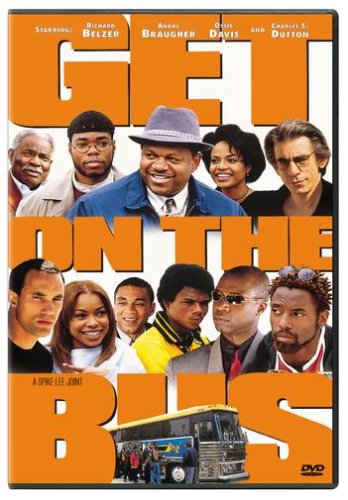
Get On The Bus
Spike Lee's 1996 film
Get on the Bus was actually a return to form (
Girl 6 was a disappointment even though it was visually wonderful; the
Prince soundtrack was better than the film). But looking back at things with the hindsight of 9 years, it seems like much ado about nothing, a trifle, a bit of a damp squib in reality. I actually prefer his latest work (the great
25th Hour and even that male lesbian fantasy that was
She Hate Me).
I mean the
Million Man March was great and all. My
barbershop even sent a delegation and they have the photos on the wall that we can point to whenever the conversation lags on Saturday afternoons and we become reflective. But let's not forget that it was Farrakhan who put that joint together. I hesitate to bring up that name since it has an inflammatory context in the US. My own exposure to Brother Farrakhan was in his fawning trips to the friendly
rogues and dictators that proliferate in my sub-region - a case again of
Strange Bedfellows. Thus I was a little skeptical about that bus episode.
On the Local Bus
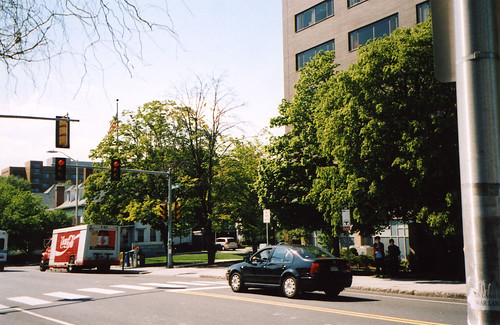
I've been taking the 69 bus to work down the streets of East Cambridge for the past 9 years. It works for me but I'm aware that that kind of commute is not for everyone. And perhaps the following is illustrative...
Yesterday morning I was accosted by a nervous and scruffy man coming out of the Psychiatric Emergency unit of Cambridge Hospital which is right opposite my bus stop. Twitching constantly, and furiously smoking a cigarette, he was in his 40s, tall, lean and unkempt. He was a literal nervous wreck as he made a beeline for me and almost got hit by the passing traffic. The Portuguese and Haitian women who were waiting with me for the tardy bus instinctively crossed their arms and put their game faces on - the latter pulled the child she was babysitting close to her skirt.
His name was Charles, as I was soon to learn, and he is part Lebanese Christian, French-Canadian and New Englander. His education however was in the school of hard knocks of South Boston.
His problem is that "sometimes he acts out" and "not everyone understands him". Also, as he put it he "can
see things that others can't".
Right after those preliminaries, he asked for a couple of dollars to head home, which I gave since I'm in a giving mood these days. In the calculus of weighing "madmen", sometimes you figure that people are just having a bad day. Thus sometimes you don't walk away and instead stand your ground and humour them. My Ghanaian equivalent of "Take Our Daughters To Work" day was to spend time visiting my uncle at work at the psychiatric hospital at Asylum Down in Accra. Much like African prisons, I would hazard that African asylums are not places fit for anyone let alone children. Still what was refreshing about those repeated visits was seeing the essential humanity in things: how people just got on with life despite being understaffed and overworked and having to deal with overcrowded, insanitary, and plainly harrowing conditions.
Thus encouraged, he felt he wanted to establish some bonafides. To impress me a little, he told of when some people tied his legs up with a belt and tried to throw him out of the window in Chelsea when he last had acted up. That must be his most shocking tale. I can certainly imagine such
Mystic River episodes showing up in Dennis Lehane's next work. Then he segued into how he "hallucinate(s) frequently" and how "sometimes I'm scared of my shadow, you know". Every sentence he said in the next 15 minutes was eminently quotable. If it wouldn't have been rude, I would have taken out my little yellow pad and written notes.
For people like Charles, social conventions are a little difficult. He was completely oblivious to my wearing headphones and listening to the first track from my Mellow My Man playlist - the glorious horns of
Pete Rock and C.L. Smooth's T.R.O.Y (They Reminisce Over You) which have to be heard loud.
His idea of
small talk (the kind that David Weinberger praises) was to ask me out of nowhere whether I liked The Supremes. After a pause, "Is his maniac for real?", I replied that I liked most of Motown but not The Supremes. The Four Tops, The Temptations or Smokey Robinson and The Miracles perhaps, but not The Supremes. Hmm... For the next minute, as we felt each other out, we simply name-dropped. For his Otis Redding, I retorted Sam Cooke and then Bobby Womack - our man Bobby was "too modern for him". He came back with Anita Baker (thumbs up) but then spoilt it by using Natalie Cole on Unforgettable. I said "what about her father's version 40 years prior, why don't we go back to the source?"
Gaining confidence, he confided that "he thought he was black". To empathise with me he said that "You know, they say that the Lebanese are the sand-n*****s of the world". I have my own mid-Atlantic identity crises so I replied that the Lebanese were rather the great glue of the world, that they were the great merchants and that one can find them on every coast lubricating social intercourse and commerce. I don't quite think he'd ever been to Lebanon and or that he knew that some of my best friends growing up in Ghana were Lebanese (there's a huge and successful Lebanese population back home) or indeed that I had some pita bread and hummus in my lunch bag. I suspect there had been a lot of teasing about his ethnicity in the Southie playgrounds he grew up in, open wounds that still hurt 30 years on.
Thus once we got onto the bus he greeted each of the black teenage school kids that came on board with a "What's up bro?". Now that's a dangerous thing to say to some of the army fatigue and FUBU wearing kids (and the occasional obnoxious predators) that ply the streets of urban anomie that I tread daily. Sometimes even a little bump on the way to the back of the bus can bring out a bewildering display of testosterone-fueled aggression.
Much to the dismay of the others on the bus, he continued to perform. The bus driver had seen it all before at the hospital stop and wasn't about to intervene. Thus after a while, he came and sat next to me. Now I had gone and deliberately sat next to this short Latino guy so that I would be done with him. Undeterred, Charles came and menacingly stood right in front of the guy who promptly moved to greener pastures.
There was tart little smell to him; his teeth were yellow smokers' teeth. Snuggled up next to me and my bags, you could tell that he had indeed been through a lot in life. There were lots of wrinkles and the roots of his prematurely grey hair showed signs of stress.
He was an
unattractive nuisance in other words.
Perhaps I should have behaved like that other Cantabrigian sandal-wearing woman with that awful Joseph-rainbow bag and Nepalese shawl who came on at a later stop engrossed in her headphones. Charles almost pinched her, he was so excited, "I keep running into her on my rounds... She's one of my women!". Anyway, in that slightly louder voice that all Walkman and now iPod people assume, she explained that she was listening to "the sounds of the wild", one of those nature cds that help her meditation. Thus she ignored him, and us all, and slipped back into trancendental environmental bliss.
Instead, over the loud beat of
The Brothers Johnson McFadden and Whitehead in my headphones, "
Ain't no stopping us now", which he started singing loudly, and despite my attempts to finish my novel ("You must be educated since you're reading, the brothers around here don't read"), we talked of art, his paintings and the time he was kicked out of the art class at the Cambridge Adult Education Center for acting up. "The professor was so intelligent but he didn't understand what I was about. I know I shouldn't have acted up but I couldn't quite help it".
We talked about the artists of the Renaissance, I drew a blank on the names he threw out (where he mentioned Antonnelli, I was thinking Angelina Jolie), but when he went further back to Narcissus, I of course knew all about the reflection in the pond. I worried a little when he asked "Does this all exist or is it just a dream?". Solipsism is sometimes a prelude to suicidal thoughts which I've had to deal with in the past in some dear friends. Thus without blinking, I told him that it's just life and that we simply have to get on with things. Instead I provocatively hipped him to the
B-movie theory, Ronald Reagan and Gil Scot-Herons's take on things.
"And if you're sensing, that something's wrong,
Well just remember, that it won't be too long
Before the director cuts the scene. yeah."
"This ain't really your life,
Ain't really your life,
Ain't really ain't nothing but a movie."
That paranoid style actually resonated with him.
When I mentioned that he should draw
Inman Square, that it and its denizens had a lot of flavour. He looked at me with newfound respect: "I see. So you've got the eye too."
Now perhaps I should have been alarmed when he asked repeatedly for my name and where I worked, but at that point
Me'Shell NdegeOcello's
Better by The Pound was ringing in my ears keeping me relaxed. And also, the kind of look that came on his face when it appeared that our great philosphical conversation was about to end as the bus reached Lechmere station would properly be said to have a hint of desperation about it. As we got off the bus, I noted that a canny MBTA marketing person had emblazoned the following slogan on the sign where the 69's destination would normally reside
Stay Cool on the T
Stay Cool indeed.
In parting Charles couldn't resist being provocative and outrageous, the last question he asked was "how do we know at what age women become sexually active?". Now I admit that at this last, I did look around to see if there were witnesses to our taking leave of each other and it was with some disquiet, or even panic, that I handed him the 5 quarters that I hastily managed to dig up from my bag, "for a coffee you know". In this vein, I made sure to give an alias, and to take a circuitous route to the office all the time checking that I wasn't being followed. Even though a sensitive soul like him is usually harmless, better be safe than sorry; one never knows. As I reached the office and unpacked my laptop, it was indeed
shuffle serendipity that Jamiroquai's
Virtual Insanity would be playing in my headphones. I listened to the
lyrics before my thoughts went back to XForms and glue layers.
And nothing’s gonna change the way we live
Cos’ we can always take and never give
And now that things are changing for the worse,
See, it’s a crazy world we’re living in
And I just can’t see that half of us immersed in sin
Is all we have to give these
Futures made of virtual insanity
Now always seem, to be governed by this love we have
For useless, twisting of our new technology
Oh now there is no sound for we all live underground...
And now every mother can choose the color of her child
That’s not nature’s way
Well that´s what they said yesterday
There’s nothing left to do but pray
I think it’s time I found a new religion
Waoh it’s so insane to synthesize another strain
There’s something in these futures that we have to be told.
But that is all part of the territory. That's the sloppiness of life on the bus. I suspect that some of you prefer the convenience of the car, mobile phones and other creature comforts. The aesthetic of my kind of bus is very local, and low-brow some have said.
On the Chinatown Bus
I also regularly take the
Fung Wah bus between Boston and New York. At
$15 for a roundtrip it's a great deal. I'm a little disappointed that these days they leave from South Station rather than from the gates of Chinatown. Back when it was a lower budget affair, there were no announcements, no preliminaries and only plastic bags for you to dump your sandwiches and dogeared newspapers in. You bought your tickets at the back of a bakery and gathered at the side of the street and performed mime language with the drivers and the organizer, typically an old chinese woman who didn't speak english. One wondered if the drivers had
licenses or were there illegally.
The kinds of buses that far too many people seem to be advocating (ESB, WS-* and SDO for example) are akin to the private jets of Enron or Tyco CEOs. I'd only note that Fung Wah is eating the lunch of Greyhound, Peter Pan
and Amtrak these days. Their no-fuss utilitarian bent has attracted first those cheap college students and of late even mild-mannered housewives. Now they have a website and you can even book a ticket online! They are moving inexorably up-market like some
others.
But anyway I digress...
I hope this has been a diversion. We've stretched our feet a little at the REST stop. I've gotten my Big Macs from the bored teenagers behind the counter, you probably got a caesar salad instead of fingerful chilis from Wendy's. We have to keep in mind that the Chinese bus driver is unemotionally apt to leave you behind in Connecticut if you don't pay attention and spend too much time navel gazing. Those Chinese will leave you behind.
In closing and as is my wont these days, I'll invoke the blog:
Lights Out.
Let's get back on the bus.
Koranteng (ducks)
P.S. I'm working on less frivoulous contributions to the debate and perhaps I will be able to share in coming weeks.
See also:
On the Importance of Biting Satire
Update 2005-05-10:
More Glue Layer People
See also: my other
REST writings.
File under: technology, adoption, standards, systems, web, programming, design, architecture, glue, ESB, REST, web, services, whimsy, toli, Cambridge, life, soul, bus, Chinatown, music, movies