Showing posts with label design. Show all posts

Tuesday, August 12, 2025

Sensor Calibration

The problem is often couched as one of recognition
The difficulty, as it were, of sensor calibration
For if you can't measure a signal as a matter of first principle
If you can't detect accurately, you might as well be invisible

The auto-focus systems in cameras that can't detect those darker than blue
The pulse oximeters giving false hope - the all clear, to those with a darker hue
Training data, darker skin tones - unusual, light exposure
Biometrics, facial recognition, fingerprint sensors

Architectures of participation and control
Resigned to playing the tenuous outsider role
In this rigged game of life (and death) with ever changing rules
Arbitrary boundaries, when lines are drawn, borders can be cruel

For those excluded from the system, then, a matter of quiet advocacy
A liberation struggle of sorts, forever teaching others how to see
File under the banner of cultural sensitivity in technology
Sensor calibration and relief from the burden of invisibility


disassembled


Sensor Calibration, a playlist


A soundtrack for this note, fodder for sensitive souls (spotify version)

See previously Cultural Sensitivity in Technology and Empire State of Mind

File under: , , , , , , , , , , , , , , , , , ,

Writing log: September 21, 2022

Tuesday, February 27, 2024

Root Cause Analysis

Time for the post mortem, as you know, some take it seriously
The need to revisit, the urge to explain what happened previously
For an ounce of prevention is said to be worth a pound of cure
Let's get to the bottom of things and figure out the root cause

Oftentimes it's a simple mistake, a moment of inattention
Or sometimes it's really just idle exploration
One minute you wonder, what does this button do?
Then the thing happens that you can't recant
Oops, you realize you just shut down the power plant

Human fallibility tends to be the root cause

Ah right, power. It's quite fitting in this era of modernity
That one can't sing too highly of the virtues of Electricity
So essential, we almost always overlook this august substance
We only rue its wonder when confronted by its absence
And now we've lost power and everything must stop
Oops, lights out. In Ghana we call it dumsor

Power failures are prime candidates for the root cause

The next affliction, sadly, is all too common
Like ants, human beings just like to burrow
When in a mad rush to lay down some pipes, it's nigh inevitable
So busy that we never checked to see what could be an obstacle
Dig: bureaucracy got in the way, they were moving too slow
Oops, the contractor cut the critical cable with his backhoe

All too often, cable cuts tend to be the root cause

Things fall apart, they say,
   equipment sputters, machines fail
They blow hot and cold, or crack when used,
   there's wear and tear
Material scientists make a roaring trade
   as do structural engineers
That, sadly, alchemists never overcame nature's challenge
   is the lesson learned
Oops, the widget broke,
   a reminder that no condition is permanent

In this industrial age, hardware failures are a likely root cause

Sometimes you're just too popular,
   so crowded no one can get in or breathe
Congestion is the operative word,
   in matters of scale, a crowd changes things
Your service is the flavor of the month,
   and now you've become essential
Oops, you're completely unprepared for when you go viral

Woe is me, lack of capacity is frequently the root cause

And then we come to the bad actors,
   forever on the attack
Always probing for an opening,
   for vulnerabilities in your stack
And that's even before we consider
   the gremlins and parasites
Iconoclastic beasts with distinctive manners
   and singular appetites
Every complex ecosystem in history
   has had to deal with grifters
Oops, your hospital is held to ransom
   by a band of sneaky hackers

Always protect yourself, a lapse in security is invariably the root cause

There's more in this vein,
   mankind has never built a system without error
From the Tower of Babel to that fancy car,
   or even that blasted word processor
The raw materials of life,
   whether it's the design or the initial conception
Imposing one's will,
   it might be a flaw in the ultimate implementation

You probably have your own experience and area of expertise
Your own rules of thumb about these puzzling mysteries
Let me tell you something
   from my profession of software engineer
If you only knew,
   to defend a system in depth is an exercise in fear
How close we come to catastrophe,
   partial or complete, every day
Trust me, you really don't want to see how the sausage is made

Now one could argue about the order
   of this short list of failure modes
It is only in retrospect that one is truly able to diagnose
The human burden is to keep moving
   in the face of systemic error
To mitigate the worst,
   to build the fail-safes and systematic procedures

Spare a thought for the moron in a hurry,
   for one day it could be you
That, through omission or commision,
   will be blamed for the miscue
We haven't scratched the surface
   of how much the human factor has an impact
Fall back to folk wisdom,
   suffice to say that curiosity killed the cat

And what of the wider world,
   say failed love affairs, or even wars?
It's only human to search for simple answers
   and the root cause
Our prophets and philosophers have long emphasized
   moral suasion and the golden rule
You could do hardly do worse than social living
   and the mosquito principle

Focus on best practices, usability, and layers of protection
Try to put a process in place and make it official!
Make sure that it takes many, many big red buttons
   to launch that nuclear missile
If there's any moral to this tall tale of root cause analysis
Take heed, and wherever possible, make use of the checklists


wide load coming through


After
  • How Complex Systems Fail (Being a Short Treatise on the Nature of Failure; How Failure is Evaluated; How Failure is Attributed to Proximate Cause; and the Resulting New Understanding of Patient Safety) by Richard I. Cook
  • a quip about network outages from Sean Donelan

Root Cause, a playlist


A soundtrack for this note (spotify version)
See also: The Dining Philosophers Problem, Resilience and Adaptability, and Version Hell Revisited

This belated entry on failure modes is part of the Toli Technology Series

File under: , , , , , , , , , , , , , , , , , , ,

Writing log: April 3, 2022

Tuesday, November 30, 2021

The Dining Philosophers Problem

The dining philosophers problem is well known in computer science
Dealing with matters of access, it has analogues in our headlines
Humanity's curriculum involves many rituals and traditions
Perhaps, then, it's worth explaining the problem's formulation

The diners that are gathered here today are five in number
Imagine, if you will, your favorite group of philosophers
They are initially presented in a state of silence at the venue
Around a round table, hungry they are, for spaghetti is on the menu

The central conceit is that each philosopher must alternately think and eat
Implicit also is that they are vegetarians or vegans, for there is no meat
The rules of the social game adds the constraint of manners as the main course
That they can only dig into their spaghetti if they have both left and right forks

After a philosopher finishes eating, but before launching into thought,
They must put down both forks to make them available for others.
Forks, in this arrangement, can only be held by one philosopher at a time.
The problem's construction teaches that sharing is caring at mealtime

To add realism to the scenario, we can assume there is an unlimited supply of food
And that our philosophers can eat long past the point that would normally be good
With these core ingredients: philosophers, spaghetti, forks (but no knives)
The problem is meant to illustrate the challenges of living parallel lives

An utter conundrum, this problem when it was presented to me at university
That, while I could discern that it had applications in the study of concurrency,
The problem was going from this set of instructions to designing an architecture
Full disclosure, I damn near failed this course on algorithms and data structures

The enduring challenge, if you think about it, is how to avoid deadlock
The fear is of resource starvation such that the actors find themselves stuck
We want a world in which no philosopher will starve and continue forever
To eat and think deep thoughts; a metaphor, this immortal philosopher

The Last Philosophers

Timing is everything in the choreography of actors
Finding a strategy to manage this human infrastructure
The fundamental issue at hand, the term of art, is mutual exclusion
A stark concept, therein lies the difficulty with the algorithm

The conventional solution involves a resource hierarchy
I found it quite unfair because it clearly lacks neutrality
But it can be proven to work, if one heeds the instructions and laws
It applies an ordering to the distribution of shared resources

Another strategy that has been advanced is arbitration
This one I tried out, as I'm a firm believer in conversation
Once you designate a mediator, and open yourself up to abide by their resolution,
As the song goes, it takes behavior to get along, diplomacy can be the solution

The philosophical issues are many with middlemen, think of Caesar's tax collectors
And of the oligarchs and monopolists who insert themselves as toll collectors
Who are the designers of these systems in humanity's curriculum?
Who gets to make the rules? And who pays soul insurance premiums?

Game theory can come into play, think of the prisoner's dilemma
The shortest path to success might be to seize resources - state capture
Write the ruler's rules, and steal power like a conqueror
Rehearse a coup drill following the lead of many a dictator

I found that the problem had all the makings of a cautionary fable
Earlier, you might recall, I held my fire at that philosopher's table
Where rage, and its contemporary uses, were the bone of contention
'Twas decidedly, I'd explained, a case of normalcy prohibition

I had been thinking about this modernity of parallel lives
Where some have the great privilege of their insatiable appetites
A state of the world in which no progress is possible
We would do well to study the Mosquito Principle

equality rosewood park

See previously:

The Dining Philosophers Problem, a playlist


A soundtrack for this treatise, bookended by the great divas (spotify version)
...

Timing is everything
Observers are worried

File under: , , , , , , , , , , , , , , ,

Writing log: March 28, 2021

Saturday, April 03, 2021

Empire State of Mind

A memory. An open day at the Electrical Engineering department at Imperial College for accepted candidates, the professors wanted to demonstrate their new face recognition software to the group. I demurred (shyness), but they insisted that I be the volunteer.

So I sat and watched for 15 minutes as nothing worked. "Smile", asked the graduate students. "Frown", asked the professors. Same result: no detection. Others were summoned. Invisible man.

It's a minor point, but I can't forget the sheepish grins. As I told the professors and their harried students: "You probably didn't train your algorithms much with many faces like mine."

Cultural sensitivity in technology is one of my perennial themes. And it's hard work even if you acknowledge your blind spots. The anecdotal failures continue to pile up. What was true back in 1991 is much the same in 2021, software and hardware are far more sophisticated and performant but face the same blindspots (provenance of training data, applicability to real world scenarios, ethical framing etc.)

The challenge for software engineering - which is still a craft, is to move beyond curve-fitting phrenology (and Deadwood) into its industrial revolution.

Sidenote: recruiters these days are all "big data, machine learning, cloud yada yada". Buzzword fatigue is an occupational hazard.

I miss the great mass amateurization and view source ethic of early web development and yet the developer tools and frameworks these days almost feel like a golden age is within grasp.

Obligatory citations:

Incidentally, Imperial College was the venue of my worst interviewing experience (and there have been many) - the low point of which was walking past the open door as I left the interview, and walking straight into the wall. This was after having flubbed almost every question I'd been asked.

The laughs and looks exchanged by the professor and the secretary as I turned around, shuffled back muttering an apology (why?) as I rubbed my sore head and headed out the door. Even English reserve and politeness could not deal with my Buster Keaton imitation.

I was admitted to Imperial College a week later.

I occasionally regret not having gone to Imperial or Cambridge for university. Without a doubt, I would be a stronger engineer and yet I suspect the eclectic toli monger you see before you would be repressed.

Guide to Lagos 1975 005 3m 191 revolutionary  copier

Imperial Visions, a playlist


A soundtrack for this note (spotify version). I've been neglecting the Toli Technology Series for years now, albeit I occasionally make a few gnomic pronouncements on Twitter, consider this some throat clearing to prompt a reboot.

File under: , , , , , , , , , ,

Thursday, September 10, 2020

Mixed Metaphors

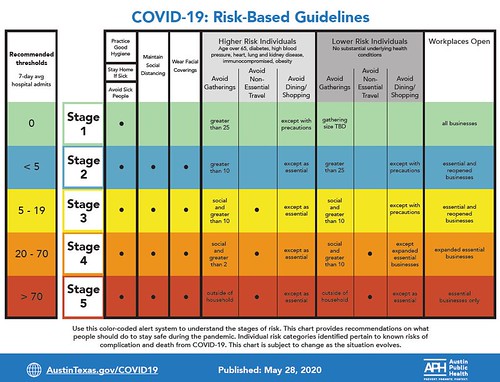
The COVID-19 risk guidelines in Austin, Texas present a design dilemma and a case of the blues (and more on that anon, see if you can spot what I mean). They also started with a political handicap when they were unveiled a few months ago. These are local city and county guidelines, drawn up by the Austin Public Health department, that were always likely to be ignored and run roughshod over by Texas's governor who was early in hailing The Grand Reopening of Texas, and has steadfastly proclaimed Positivity in the face of all contrary evidence.

Covid-19 risk guidelines Austin Texas May 28 2020

The earlier color-coded threat level Homeland Security Advisory System in the US has also been handicapped since its inception. While some critics focus on its bureaucratic unwieldiness, what irks me most is a catastrophic user interface and design failure. The failure, as you'll note, continues into the present.

The reason is that, in order to have green be the colour for the "all-clear" threat level, the natural spectrum of light, as normally seen in rainbows, has been altered in the Homeland Security scheme. Thus ice cool blue has been promoted to "guarded" whereas tropical green has been demoted to "low".

homeland security advisory systemrainbow

A bureaucrat or marketing person's intelligent design is at odds with evolution, physics and reality. Blame Osama bin Laden perhaps, but any number of people in the US government signed off on this mishap. Further, we are still living in this era of Recent Non-Specific General Threats almost two decades later.

The messaging and visual branding in the covid guidelines suffers from the very same flaw with the inversion of the colors of the rainbow spectrum. You can almost hear the designer's brain ticking: let's start with a traffic light metaphor, Red-Yellow-Green. But wait, they want 5 levels, let's add in orange and blue. Oh no, what about green? Argh, I give up, let's just invert green and blue. Mixed metaphor much?

Covid-19 risk guidelines Austin Texas May 28 2020rainbow over san francisco bay

Everytime I look at these charts, I suffer cognitive dissonance, there's something not quite right. I don't have to be color blind to be confused; I get a case of the misplaced blues. Could it be so hard, I ask myself? When I bought some paint to go after Tom Sawyer, things seemed easy, I ordered my 5 cans of paint and got a nice rainbow spectrum:

rainbow spectrum of colors

When I looked at my bookshelf at my stack of Unesco General History of Africa books, I noticed that there was a similar confusion if you organized things chronologically. I suspect the editors of that wonderful series weren't visually inclined but, in mitigation, they weren't dealing with a global pandemic and coming up with an urgent public health intervention. Still, the learning exhibited in that series stands the test of time. Even if later scholars have access to more material these days, those historical tomes were a real benefit for humanity. It was certainly wise to have the red volume be Africa under Colonial Domination. The blood of colonial era lingers on the ground. Alfred Adu-Boahen's opus of historical scholarship stared with clarity at the heart of darkness and eschewed Africans as scenery in the race to Fashoda.

But back to our covidious guidelines and rules and regulation... Once you move beyond the blue in green, as it were, a further problem is with naming and comprehension. If you use numbers for different phases, you have to consider the order. Do increasing numbers mean an easing of restrictions or an intensification of the lockdown? Are you considering opening or closing? In Austin, it looks as if Stage 1 is the all clear whereas Stage 5 is the fullblown lockdown stage, but I could see the reverse making sense too. Leaving aside the blues, where do epidemiologists stand on endianness and indeed on numerology?

Mind you, an interesting thing to note is that the misplaced blues is not a universal design failure. The Texas Medical Association coronavirus risk assessment of activities is at least in line with the rainbow spectrum. Different designers, most likely working down the hall from each other, came up with different solutions. No wonder humanity is afflicted with version hell and the Tower and Babel.

coronavirus risk assessment activities

The designers behind Harvard Global Health Institute's Global Epidemics site went with the Rule of Four instead, with the graphics for their Key Metrics for Covid Suppression. There is still the notion of the rainbow, but to avoid the case of the misplaced blues while fitting in with the traffic light metaphor, they added orange but decided that the blues could wait.

the path to zero

The British government in April was considering The traffic light exit strategy to free the UK from lockdown. A new economics paper suggested "a red-amber-green solution to safely ease us out of coronavirus restriction". That would be The traffic-light route to ending the economic lockdown by Gerard Lyons and Paul Ormerod (April 5 2020). It was noted at the time that this academic had sway in the past with Dominic Cummings so Mister Johnson was likely to pick up on this metaphor.

A few weeks later would read Coronavirus: 'Traffic light' system to lift lockdown in Wales
Ending lockdown could be in phases,"like a traffic light in reverse". There would be a move from red - some "careful and controlled" relaxation - to green, which would be "much more like the lives we had before the crisis hit". The amber zone would see more restrictions lifted and, if the virus is not re-emerging, Wales could then move to the green zone.

The UK would unveil its covid alert system in June rollowing the traffic light metaphor - the blues of the worst excess mortality were seeping in

uk covid alert levels system in June 2020

By July we were reading Coronavirus: Quarantine scrapped for arrivals from 'low risk' countries to England, a constrained reopening was in prospect
Last weekend the government said a traffic light system would be introduced, with countries classified as green, amber or red, depending on the prevalence of coronavirus... the Join Biosecurity Centre – which was set up to coordinate the government’s response to the pandemic – will be categorizing countries with a “traffic light” system.

Each country will be rated green, amber, or red. This will depend on the prevalence of coronavirus, the trajectory of the disease, and the center’s assessment of the data’s reliability. The quarantine will only apply to those countries rated red.

The UK Government Traffic-Light Quarantine System was said to be red amber and green.

rainbow installation at The Contemporary Austin

Chile launched its five step coronavirus prevention program to gradually reopen the country. They didn't bring in color to the mix, it was steps and numbers.

Seven Santiago neighbourhoods will transfer to Step 2 — they will be allowed to leave their houses freely on weekdays, with local shops allowed to reopen. The quarantine remains in place on weekends and holidays, along with a nighttime curfew every day.

La Araucanía joins fellow southern regions Los Ríos and Aysén in Step 4 of the prevention program. Here, rates of infection are significantly lower than other parts of the country. Restaurants, cafés, shops and cinemas can reopen with up to 25% capacity, while bars, clubs and gyms remain shut and the curfew stays in place.

If you were lucky enough to take advantage of lower interest rates caused by the downturn and attempt to refinance your mortgage, you would have faced the hard sell and the kind of mixed messages that ensue whenever traffic light meets rainbow, we always seem to get a case of the misplaced blues.

misplaced-blues-in-refinancing-look-to-the-rainbow

California's governor Gavin Newsom is hip to this game

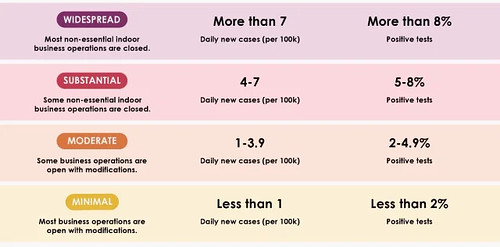
The governor said that the new four tier color-coded system would match a color to each of the four tiers with purple representing the highest “widespread” risk level for a county with more than seven new cases per 100,000 residents and more than 8 percent positivity rate. Red will represent “substantial” risk, while orange represents “moderate” risk and yellow the lowest level, “minimal” risk, with those lower levels being determined by reduced numbers in case and positivity rates.

“We don’t put up green because we don’t believe that there’s a green light that says just go back to the way things were or back to the pre-pandemic mindset”

california pandemic color coded system

The shiny Silicon Valley solution eschews the misplaced blues using purple instead, deftly forgoes green to flee the traffic light metaphor, and embraces the rule of four in pointing to simplicity for its color-coded county guidelines

Througout this pandemic, there has been a lot of mixed signals and confusion in the messages that the public has been inundated with. This inconsistent messaging goes against the best practices of public health messaging. The public is necessarily conflicted: stay home except when you shouldn't, wear a mask although you don't need to says the governor or the sherrif. Bleach and disinfectant is first presidentially recommended, and then immediately reviled and universaly ridiculed. This is the stuff of confusion, and I won't get into the stranger turns of hydroxychloroquine, or indeed the numerous cases of drinking of hand sanitizer - that last was a bridge too far for me, to mix my metaphors.

Colors abound in the discourse, yet the only consistent message is that red is bad, the hot zone or the torrid zone of infection. Heat is also at work; hot is bad, cool is good. And if some states go with colors, some with phases, some with steps, and yet others go with levels or stages. And when it comes to numbers, some go with high numbers while others prefer low numbers as the warning. Numbers are probably better than colors but again everyting is up for debate. Is higher better or worse?

One interesting thing is that we don't hear about black much in the messaging. We don't get black or white. The implied binary choices are too stark. Life or death, Stop or go. Perhaps it is because binary choices have an immediacy that force us to reflect on mortality. Three or more states is best, there are shades of gray in this business - these shades imply some degree of human flexibility and agency. Designers reached with intent into their toolkit and came up with traffic lights, with the rule of four, and always remember, as a best practice, if five or more states are needed, we should heed the actual rainbow.

Graphic designers are having a tough time achieving clarity during this coronavirus pandemic. There's no easy living when you have mixed metaphors in a covidious time.

rainbow installation

Mixed Metaphors


Traffic lights
Full circle rainbows
Prevention steps
Priority zones
Stage guidelines
Lockdown levels
Threat areas
Risk tiers
Confused warnings
The misplaced blues

mixed metaphors - covid guidelines meet the rainbow

Mixed Metaphors, a playlist


A soundtrack for this note, here's hoping we can find the blues or some black gold of the sun somewhere over the rainbow. (spotify version)

A ball of confusion is perhaps a good description for the novel coronavirus

See also: Colors, a playlist (spotify version)

This note is part of a series: In a covidious time.


File under: , , , , , , , , , , , , , , , , , , ,

Wednesday, July 01, 2020

Version Hell Revisited

A surprisingly large proportion of the issues a working software engineer deals with on a daily basis turn out to be cultural. My theory is that this is because software ultimately amounts to people problems, and that it's all about coordination costs and human factors, as I've written about previously. This is not to say that we don't deal with the hard problems, but perhaps the "soft" in software hints at the lingering craft aspect even as we try to escape from Deadwood and leap into our industrial revolution.

This is one reason that I've found that, similarly, a large proportion of the best software engineers I've encountered in my now 25 years experience have not been traditional computer scientists. The linguists, historians and even that rare anthropologist, some of whom picked up the profession on the side, or out of expedience as the web has allowed, have been the real dark matter of technology. The web with its radical simplicity, has allowed mass amateurization to prevail. Now mind you, you do need your stereotypical straight ahead just-the-facts engineers with blinkered and relentless nerdy application, and, increasingly as software becomes more professionalized, the guilds and dark factory mills have started appearing. But hold that thought for now, I have another story to tell, indeed you may call it a technology folktale.

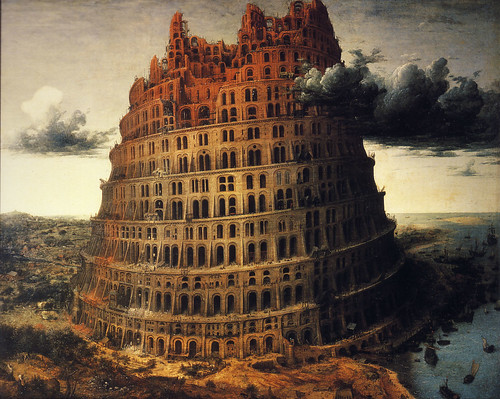
Tower of Babel

I came across this memo written a long, long time ago, in a far faraway land, (to be truthful, it was a Friday afternoon and I was fed up). Certain names have been changed to protect the guilty, and don't assume the anachronistic references mean that it is of recent vintage. Consider it perhaps a glimpse at the way the software sausage is made and we all know the scandal of slaughterhouses although we now call them meatpacking plants in polite society.

The context is some wrangling where at least 6 teams were pointing fingers at each other about who was responsible for uploading some tools that The Company was using. The flow of data through the system had at length been established, and it was now a coordination problem more than a design and architecture problem. The problem was that different teams were responsible for different components. The email chain had been playing out for months it seemed. I was stuck in the middle making arbitrary decisions mainly by virtue of having written a core piece of the system. I kept asking and everyone kept dodging my increasingly pointed questions. And so I wrote the following:

Previously in the same vein: Version Hell


The Memo


From: Koranteng@Toli
To: A long list of interested parties
Date: Friday afternoon, a long, long time ago
Subject: Toolchain versioning Re: provide version number Re: Signing Re: [snip]

I want to tease out the various strands because I'm finding it hard to serve the competing masters here.

Let me pitch it as a folktale, it's a pandemic and we all need comforting narratives.

Master Johnson, my director, would be paraphrased as follows:

Our current process is the moral equivalent of taking a USB stick dropped by our Vendor in our parking lot, and placing that software in our august data centers to sign our Crown Jewels. Now this may be what we're reduced to, but don't blindly use any old tools we are given, let's at least make sure that we track and bless known versions of this toolchain.

There were stronger words said at the outset back when we had our deep dive on our last integration project late last year.

Master Security Team pitched in, again paraphrasing...

Well, in this sorry business, we've normally done integrations of these tools for a given year. We're already overtaxed and busy and we burn weekends to get the integration working. But once we've got it working, we've got clean hands. We don't touch it anymore unless there's an error using them. We're not happy with this but ye olde signing tools ultimately come from the Ministry of Information team. We're middlemen here and the Signing and Software Release teams are the ones that integrate these tools into The Company's IT solutions.

Master Ministry of Information Team is also in a pickle. He receives vendor builds and has to produce release builds with the help of Butler Jenkins. These blasted tools are just one piece of the overall puzzle (you should see what else is on his plate). His main requirement is to be able to reliably sign and update this software for the lifetime of The Product, a decades long quest.

His junior sister, Miss Android Team actually works closely with Messers Qualcomm, Broadcom and Intel, and gets periodic updates from Vendor Google who changes signing requirements at a pace of its own choosing, those Mountain View people move at the speed of the web.

I'll omit the other players who are also similarly overtaxed, although I should make special mention of Mistress Software Release Team who actually owns the official release process and is always playing catch up integrating with Information and with Signing and other things I'm not even aware of.

Tower of Babel

Meanwhile I'm sitting like Ananse the Spider tending to my farm in the land of Signing and perhaps you can see the roots of my dilemma:

Each build could have a new version of the dismal signing tools.

Per Master Johnson, I can't blindly just sign with any old version of the Signing tools I am presented with. That man signs off on my annual review, so I cross him at my peril.

Per Mistress Software Release Team, I have a frozen API in place which doesn't specify the toolchain version. In any case, there is a long chain between Android, Information, Software Release to Signing, and the lead time to change things is measured in the cost of "Projects". We are booked for months, nay years ahead and agility is a problem here at The Company - The Company's initiatives on agility and the cloud native adoption notwithstanding.

Anyway my solution, as it is, is that I will support "blessed" versions of the toolchain. All that is left is for someone to upload these versions.

Now I'm stuck in the middle of all this, and so far it has been yours truly that is arbitrarily uploading versions of the toolchain based on what I've seen coming through in our test environment. I actually don't know what is a significant version and I don't really want to be in this loop. Further I am making decisions above my pay grade without any domain knowledge of these dismal signing tools.

The details matter and someone needs to own this and solve my riddle.

Again
  • Who is it that uploads the "blessed" versions of the toolchain to Signing?
  • More fundamentally, who decides what is a blessed version of the toolchain?
I'll end by invoking my friend Sam Ruby's Postulate
The accuracy of metadata is inversely proportional to the square of the distance between the data and the metadata.

I am clearly furthest from the data, so somebody closer needs to make the call. Perhaps I'm reading from the wrong playbook, but I'm merely trying to add value here.

Koranteng
--
Chief Toli Monger
The Company

[snip distressing long chain of emails going back 5 months of people passing the buck]

Tower of Babel

Postscript


I'd like to think that my late Friday email did have the clarifying effect I intended with its visions of Ruby's Postulate and The Tower of Babel. There were certainly calls for action, and immediate action at that. I learned that I had underestimated the extent of the dysfunction at The Company. There were actually at least 8 other teams that I might have added to my folktale, and they each had their own sorry origin story. The list of people inside The Company who I learned had read my missive was impressive and growing.

There were ruffled feathers however. People who should have dealt with the underlying organizational and communication issue were upset that I had revealed it so starkly. Lots of meetings were called. Action items were issued and so forth. I was advised to let others handle things at this stage. I was also reminded of John Kenneth Galbraith writing in The Great Crash of 1929.

... the rite of the meeting which is called not to do business but to do no business...

One of the oldest, most important - and unhappily, one of the least understood - rites in American life.

Men meet together for many reasons in the course of business. They need to instruct or persuade each other. They must agree on a course of action. They find thinking in public more productive or less painful than thinking in private. But there are at least as many reasons for meetings to transact no business. Meetings are held because men seek companionship or, at a minimum, wish to escape the tedium of solitary duties. They yearn for prestige which accrues to the man who presides over meetings, and this leads them to convoke assemblages over which they can preside.

Finally there is the meeting which is called not because there is business to be done, but because it is necessary to create the impression that business is being done. Such meetings are more than a substitute for action. They are widely regarded as action.

Everyone remembers the story of The Emperor's New Clothes, I should note however that Hans Christian Andersen didn't write the sequel about what happened to that little boy and his family six months later when The Authorities could finally deal with them.

Slightly related, the Gambian proverb goes "Words are like bullets, once you release them you can't call them back.

It is said that a prophet is never recognized in his own country and the verdict was still out on if I was to become The Company's John the Baptist. I won't tempt fate and leave it to the historians to make that determination. In closing, I'll again turn to Belloc

It is always a relief to believe what is pleasant, but it is more important to believe what is true.

— Hilaire Belloc

Office Tales


I'd previously pointed to this juxtaposition, a survival guide to life in any workplace

Office life, office politics, the organization man, managing humans, the bad child's book of beasts


Soundtrack for this note


File under: , , , , , , , , , , , , , , , , , , , ,

Thursday, August 21, 2014

The Ziploc Factor

The most attractive aspect of patents is their expiration. Built-in expiration, that "limited times" proposition, is similarly the appealing aspect of the Faustian pact one makes for copyright. In that vein, I would venture that one of the best things to have happened since the start of this century is the expiration of the patent for the ziploc. If you frequent the same supermarkets as I do, you would have noticed the ascendance of the ziploc form factor over the past decade. At first the spread was likely due to increased licensing in anticipation of the expiration of said patent, then, of course, once the crucial patent expired, the flood gates opened and generics came into play, to the extent that these days I can barely find regular plastic bags in store aisles. Permit me to present another item as part of an occasional series on bags, this time a brief cultural history of the ziploc, a foray into the grooves of technology and hardball business. Plastic bags I say, locks, knots, zippers, all have been changed. Ladies and gentlemen, consider the ziploc factor.
zip-loc display tsa state college airport 2007

I. Radical Transparency

The ziploc resealable plastic bag, sometimes called zip top, zip lock, one zip, slide lock, snap bag, zip-loc (if inclined towards hyphens) or zip snap depending on the brand or technology underpinning you lean towards, crossed the chasm of cultural inevitability in the summer of 2006 when liquids were banned on many flights due to a case of pure bureaucratic terror - call it a liquidity crisis in the skies if you will, for we were living in a era of recent non-specific general threats. Homeland Security restrictions made themselves felt, and within days the nascent ubiquity of ziploc bags could no longer be denied - indeed they were officially mandated. Air travel, already a ludicrously fraught endeavor after September 11 2001, now gained a set of extra contortions that have spoiled things for all who can't afford their private jet - and for all intents and purposes that is everyone. The ziploc was the palliative.
zip-loc TSA poster

The British were the first to impose restrictions since the ostensible liquid bomb plot had British airports as their target, but it was the TSA list of permitted and prohibited items that really soured things:

All liquids, gels and aerosols must be placed in a single, quart-size, zip-top, clear plastic bag. Gallon size bags or bags that are not zip-top such as fold-over sandwich bags are not allowed. Each traveler can use only one, quart-size, zip-top, clear plastic bag.

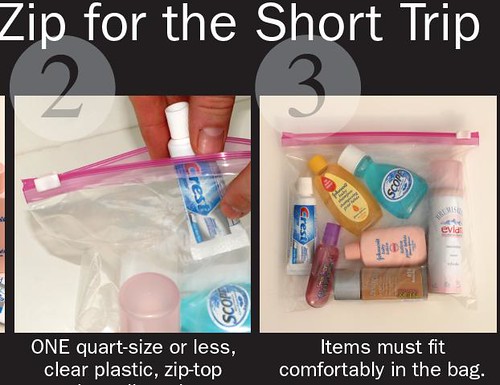
Early versions of the TSA list mentioned zip lock although later versions now mention zip-top - as we shall see this little-noticed change in nomenclature is significant in our history, but let's not get ahead of ourselves at this stage. We'll also skip over the size restrictions for the time being and concentrate on the specification of the bag which is a technology prescription backed with the coercive powers of American law enforcement: "clear" for transparency and ease of observation if not confiscation, and ziploc for ease of opening and sealing. The snappy slogan is "Bag and zip for a short trip" and undoubtedly some poor sod had to come up with a breezy mnemonic for the public education campaign on the new requirements:

3-1-1 for carry-ons (3 ounce bottles, 1 ziploc bag, 1 bag)

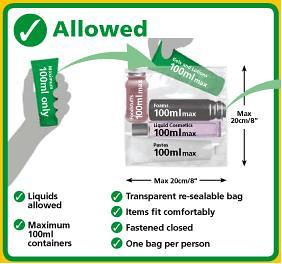
The equivalent British poster from the BAA doesn't have the same marketing flair (but who can compete with American salesmanship?) and gets the essential point across: the requirement is simply "a transparent, resealable bag". In practice of course, this boils down to a ziploc bag. The Brits sensibly don't refer to a brand in the BAA rules

Customers may take with them in their cabin bag limited quantities of liquids, gels and aerosols, including travel-size toiletries such as shampoo, suntan lotion, creams, toothpaste, hair gel and hair spray. Containers holding liquids must not exceed three American ounces or 90ml.

zip-loc BAA poster


Liquid containers must be carried in a separate clear plastic zip-top bag that does not exceed 20 cm x 20 cm or 8 inches x 8 inches or quart size. Items must fit in the bag comfortably and the bag must be completely closed.

The earliest revision of the British policy noted:

Only one bag per passenger is allowed. The bag must be clear and re-sealable, such as 'ziplock' bags or bags with pressable seals. Larger bags or bags that are not sealable, such as fold-over sandwich bags are not allowed
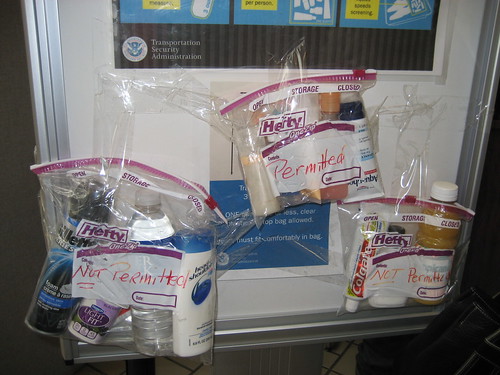
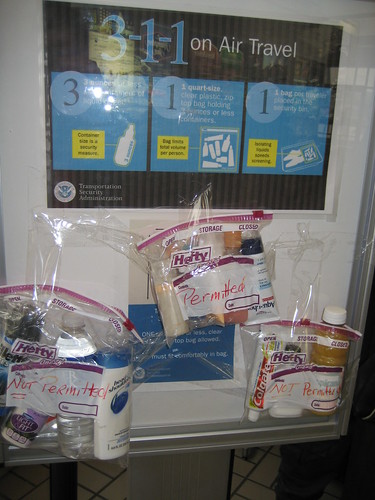
The ziploc regulation is one that requires constant reinforcement and it gives rise to frequently inventive exposition by TSA officialdom. Thus if you were to pass the TSA stand at State College airport, Pennsylvania, some time ago you might have spotted the following three-dimensional illustration of permitted and banned items.

zip-loc display state college airport 2007


The three bulging Hefty One-Zip bags were meant to augment the above 3-1-1 poster. Presumably the security attendants got tired of having to explain the cryptic 3-1-1 propositions and opted instead to show graphically to the traveling public the sorts of items that were and were not permitted.

Again note the type of ziploc bag that was used, it is more properly called a zip top. Recently at JFK airport, there was an information officer prowling the unsurprisingly long lines at the TSA whose sole purpose was to dispense Hefty One Zip bags. I don't want to suggest cronyism in the choice of brand of plastic bag but it was interesting to me that each time I've observed such actions, the brand of bag being proffered was a Hefty bag; there really must be a marketing effort at work.

II. Deformation and Displacement

The Hefty One Zip bag has a zip handle at its top, a satisfying target to clasp as you close - a moveable stub, in short, to enforce the close action. The most widely used ziploc bag on the other hand - made not coincidentally by Ziploc, simply has those pleated, interlocking grooves. By most reckonings, the Hefty variant is the gold standard of the form yet, in many ways, the broader Hefty versus Ziploc story is a reversal of the Coke versus Pepsi narrative. Indeed the owners of the Ziploc brand seems to have chosen the better name - ziploc has become the generic term for plastic, resealable bags, and as far as adoption goes, the 'worse' technology appears to have triumphed in the marketplace. What lies behind the workings of the ziploc factor? To find the answer, we need to undertake a minor diversion into the realm of patent histrionics...
ziploc sliding clasp fastener

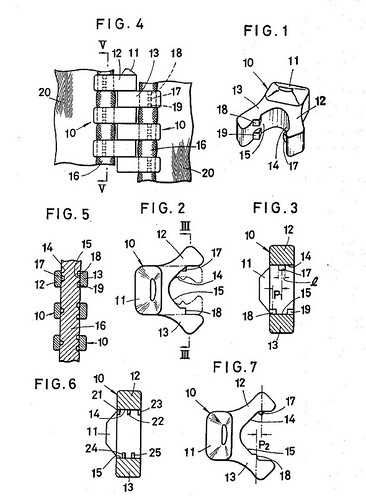
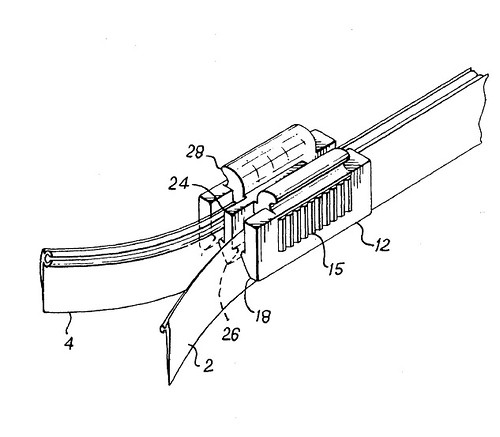
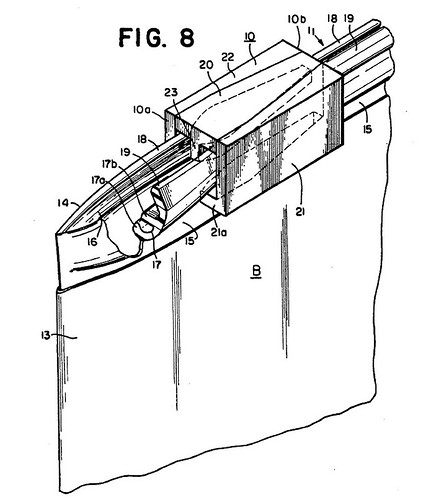
The essential ziploc innovation is US Patent 4262395 Sliding clasp fastening means. Filed in 1979, it was published in 1981. It refers to mating strips, coupling heads and sundry means of fastening through a sliding motion. Like most innovations, it didn't come in a vacuum; its inventors stood on the shoulders of giants. It builds on the work of the slide fastener, patent 4004327, filed in 1975, Japan. In the US, a further improvement was submitted in 1990 by Hefty, Patent 5007143 - Rolling action zipper profile and zipper thereof.

Broadly speaking, these devices take the notion of the zipper and apply it to plastic bags. If you read, you'll dive into a world of pairs of flexible plastic strips, reclosable interlocking male and female elements, extrusions and welding. In the US, since the 1980s, these ziploc patents stood their owners (ultimately controlled by Hefty) in good stead, and they were embodied in the marketplace as the Hefty One Zip bag which reigned supreme as the dominant resealable bag. There was, and continues to be, a hefty premium for a Hefty bag. There is a price to pay in order to get the satisfaction of that sliding, often purple, clasp fastener. The purple nub, standing out as it does atop the closing plastic strips at the top of the bag, gives a good closure indication and symbolizes the fulcrum of a conventional economic monopoly.

The chinks in Hefty's armor, the ziploc factor, as it were, came in two forms. The first weakness was in the name. The most serious competitor was the Slide Lock bag, later renamed Slide-Loc (since lock was a generic term), then still later renamed Ziploc. Simply put, ziploc is the better name for the resealable bag. The zip in the Ziploc name references the gold standard of the zipper (and the Hefty competitor), and the lock aspect identifies the sealing function of the bag.
ziploc rolling action zipper


The second chink built on the insight of the plain meaning of Slideloc/Ziploc name, namely that simply sliding an interlocking groove was good enough to produce a lock; you literally did not need a zip (or zip handle) to form a lock. True, the kind of seal that you get from snapping and sliding a groove in a plastic bag is not as tight as if you applied the pressure of a zip fastener, However, you can get a tighter seal if you increase the number of grooves that formed the lock. The pragmatic solution embodied in most ziploc bags that don't use zip handles is to simply add more grooves.

Slideloc/Ziploc versions of the bags started to get wide distribution in the late 1990s as the 20 year limit on the patents on the basic technology was coming up. This being American capitalism, of course, everything would get resolved in the courts (after the lawyers took their cut). Hefty, after issuing various cease-and-desist notices to the companies that were intruding on its turf, eventually filed a lawsuit based on the later 1990 patent.

The lawsuit, Pactiv (formally Tenneco) v. S.C. Johnson & Son and KCL Corporation was decided in November 2000 and found that ziploc slider bags didn't infringe on the relevant patent. It was a simple complaint:

The manufacturer of Hefty One Zip reclosable plastic storage bags, claims that the Slide-Loc reclosable plastic storage bag, manufactured by defendant KCL Corporation for defendant S.J. Johnson & Son, Inc., infringes U.S. Patent No. 5,007,143
The case turned on a matter of overreach, if a zipper handle is the core innovation of a process and a design omits that essential element, how can one claim that one's so-called intellectual property is being copied?
The fundamental difference between the '143 patent and the Slide-Loc in this regard, essentially ignored by Pactiv's experts, is that the '143 patent describes closing by a rolling action, whereas the Slide-Loc closes by deformation and displacement, with incidental rolling taking place at the very end of the process. The fact that some incidental rotation occurs does not alter the fact that the Slide-Loc closes in a very different manner than the '143 patent describes.
ziploc slide fastener

Deformation and displacement was thus the technical loophole that ushered in the era of ubiquity of the ziploc. By side-stepping the necessity of the zip handle, competitors could avoid the encumbrance of the Hefty patent monopoly. The long inhibited competition in the recloseable bags could proceed and the floodgates opened. Eagle-eyed billionaire investors sensed blood in the water long before the verdict was issued and, in 1999, you might have noted that Huntsman Packaging Corporation acquired KCL Corporation, the Indiana-based manufacturer of reclosable polyethylene bags that was subject to the lawsuit. The press release touted its "patented and proprietary technology in zipper and slider closures" and development of "patented slider technologies for both vertical and horizontal 'form-fill-seal' bagging processes".

Huntsman is of course the largest private chemical company in the US. Jon Huntsman Jr, billionaire heir to his father's fortune would go on to have presidential ambitions in 2012 - although the Republican Party ultimately wanted more red meat and less timidity. S.C Johnson & Son of course make everything from Windex, Pledge to Raid and are a veritable marketplace of consumer products. Hefty (originally owned by Mobil) is now owned by Reynolds Consumer products. I lay these items out to give a sense of the stakes involved in our ziploc contest. We have oil companies facing off against chemical companies and multinationals spun off from heavy extractive industries (oil, aluminium etc.) engaged in an ongoing battle.

The mythology of these brands is instructive
American ingenuity mixed with a bit of elbow grease. Reynolds Wrap foil was invented after aluminum was no longer needed for military use... Hefty waste bags were first developed with excess material from an early plastics innovator, creating another household essential.

The rest as they say is history, marketing and execution. The big boys jumped in, you can see any number of patents by Proctor and Gamble, Glad and the like that tackle the general notion of flexible storage bags. One wonders why Velcro which specializes in touch fasteners didn't get into the act (brand dilution perhaps?)... There were also those who saw the business opportunity in marketing ziplocs as part of the packaging machinery that all manufactures use. We have specialized companies like Zip-pak, Mini-grip and GT Zip that target industrial clients.

The engineering questions were difficult ones: how to efficiently evacuate air from a bag (an important worry if perishables were to be stored in them), how to create a tight enough seal, how to track the alignment and integrity of the seal, how to tweak the manufacturing process so that the marginal cost of adding a ziploc to one's bag is negligible. There were also usability questions, what kind of closure indicator to use? How, indeed does one indicate closure? It is obvious, if a zip handle is present, to determine with a quick glance if a bag is fully closed or not; not quite so with a plain ziploc. Is an audible signal appropriate? Is paying attention to the satisfying snap sound a good approach? As evidenced by the resilience of the Snap and Seal brand I keep encountering, that is an approach that is succeeding. There's also an arms race on ziplocs, some tout double zips, sometimes there are three seals. On the most recent ziploc I purchased, I see no less that 7 interlocking grooves. Like razor blades, more grooves are thought to be better.

III. War of the Fasteners: Knots, Rubber Bands, Ziplocs and Twisties

Ziplocs (mostly without handles) have been widely licensed and have found their way into the list of household essentials. In this era of liquid threats, it is a good thing to have some ziploc bags on hand when you travel by air. Articles abound about the applications: ziploc your stuff at airport security, Camera Zip-lock to protect in wet, dusty environments, multi-port laparoscopic surgical access devices, urn for ashes and so forth.


war of the fasteners: knots, rubber bands, ziplocs and twisties

The burgeoning ziploc tag at Delicious and the ziploc images at Flickr show how far these interlocking rib and groove bags have penetrated our cultural consciousness.

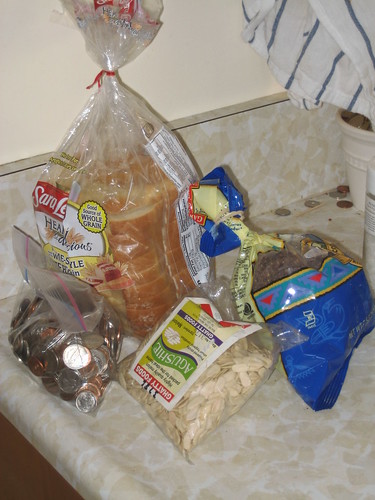
The convenience of ziplocs and their reassuring snap as their interlocking grooves are conjoined has changed the nature of the fasteners we use for our containers. We are spoiled with a wide variety of touch fasteners, from interlocking rib-type seal to plastic, paper, or clad-wire ties and on. Rubber bands have never quite worked as fasteners, we use them in to shift gears and such but we not generally as bag fasteners. Where once we used knots, in recent times we have graduated to twisties and to those little jagged plastic clips that we use to close bags of bread - sidenote: is there a better name for those nubs? Bibs or chokers perhaps?

Twisties, of course, are another great innovation in the vein of the ziploc but even they have their limitations: they are separate objects and often get separated from the bags they are meant to close. Thus there is almost always a little cognitive pause as you search for the little twistie ribbon on the kitchen counter or dining room table. Where exactly did you put it? It is always underneath. How much time is wasted in the search for the twistie? Is this inefficiency the driver of the faster adoption of the ziploc. Some baggies also attempted to prescribe a way to better preserve their contents, asking you to fold over the plastic before applying the twistie.

zip lock usage


The ziploc brooks none of these limitations. Like its zipper grandfather, the ziploc has the virtue of remaining part and parcel of the container - thus there is nothing to lose. Thus although we can read about epic battles such as that of Twist-Ties vs. Plastic Clips: Tiny Titans Battle for the Bakery Aisle, I'd hazard that the ziploc will be ultimate victor.

One downside of the ziploc and that other magical innovation, Velcro, is that the knowledge of knots and crosses that humans have passed down since time immemorial is now being lost. Only sailors, sadomasochists, magicians have the need for training in knots. One should perhaps add special forces grabbing enemy combatants for erustication to the coterie of knot aficionados - and even in the accounts of extraordinary rendition that we do have, the norm is for plastic hand-cuffs - or metallic if the gloves come off and stress positions are emphasized. Other than shoe laces then, the modern man has no more need for learning the time-tested art of knots - and no, tying up the boot of your car with your weekend haul from Ikea doesn't count - I should know, I was quite hopeless a few weekends ago.

Before concluding we should return to the liquid terror that prompted the ziploc's ascendance. When exactly will we get to the end of that pesky liquid ban? There have been many false sightings on that front since 2006 and everyone keeps hoping for a revision (see for example: EU to ease airport liquids rule in security revamp) but it is hard to see sanity returning, it is George W. Bush's most durable legacy. I imagine Al Qaeda or ISIS types periodically seeing these reports and saying "Why don't we send around a few emails around mentioning liquids, bombs and planes?". Our friendly NSA will duly notify the security establishment and the security tax that the entire world faces will continue. I fear the ziploc will be mandated long after my lifetime.

In an age of radical transparency it is all about the ziploc factor. Whether it is food packaging or cosmetics, all hail the ziploc. I wonder, Dear Reader, where you stand in the Hefty versus Ziploc contest, and what uses you put your ziplocs to? Deformation and displacement, young man, deformation and displacement.

The Ziploc Factor

Soundtrack for this note

  • Pete Rock & C.L. Smooth (ft. Grand Puba) - Skinz
    Better yet you could pass me a ziploc A bag of boom, and a 40 then some boot knock
    I've always loved this fragment of Grand Puba's celebrated verse in this 1993 ode to prophylactics, Skinz - a song about the importance of contraception in which they hilariously explore options from aluminium foil to ziploc bags before returning to plain old condoms - Catholics beware.
  • Prince - Ripopgodazippa
    Every stripper's favorite track, sexy funk that appropriately enough featured in that cult b-movie, Showgirls. The sound of the zipper

Obligatory disclaimer

In my line of work, software, expiration is typically seen as the only attractive aspect of patents.

There's a patent officially filed under my name filed from my last few months at IBM. It seemed then, as it seems now, like much ado about nothing (a tweak to the kind of auto-suggestion that you see every time you search) but I suppose technology companies like to build up defensive portfolios of patents, weaponry that they can lob over the wall when convenient. I plead guilty that I succumbed that one time. In contrast, one of the more interesting ideas I came up with back then was rather treated as an "invention disclosure" to be kept in IBM's back pocket, and was never filed with the patent office. I hope someone builds it.

File under: , , , , , , , , , , , , , , , ,