Showing posts with label image. Show all posts

Tuesday, August 28, 2007

Rapid Transit

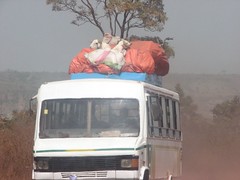
I. Wide Load Coming Through
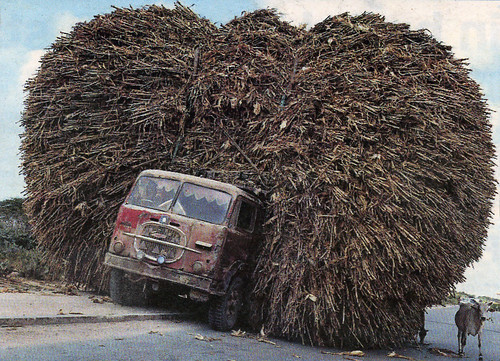

wide load coming through
A truck loaded with corn is parked on the side of a road in Mogadishu, Somalia. The delapidated city is the capital of the failed Horn of Africa state, where motorists have the choice of driving on the right or left hand side of the road, such is Mogadishu's anarchy. (Reuters). Circa 2004.
I've always wondered about this clipping, taken a few years ago, that The Wife used to have on her wall. At first I thought the scene was staged and that no one could possibly load a truck in this manner except to get the attention of foreign journalists. But it struck me that Somalia has indeed been party to this kind of nonsense for a generation or more thus anything goes - not to mention that this scene is only a matter of degree away from what I've witnessed in my own country, Ghana. It is the very definition of absurd.

II. A Heavy Load


a heavy load

A relatively famous scene from the Libyan desert circa 1978 (actually isn't Libya mostly desert?), fodder for picturesque postcards... I find the image interesting for the wide variety of bags that are attached to the truck. As you might know bags are my kind of thing.

III. Rural Concerns
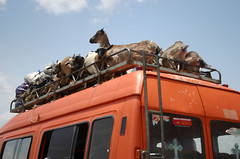

goats in transit

credit: Robin.Elaine

sheep in transit

credit: Johanne, licence: CC

A few months ago, there was lots of discussion about the transport of cattle in Africa. When you have mostly agrarian economies, you use whatever is expedient to transport goods, hence the sight of cattle on roads or on our trucks is nothing special. In the West per contra, you almost never see the animals from which your food is derived. Agribusiness is the rule rather than the exception. You receive your cold cuts of meat in the sanitized glass displays of your grocery store. The network of cattle cars, hog "finishers", meat renderers are an afterthought. Even the word butcher seems to be coming into disfavour such is the alienation from the practice; blood is taboo and it's simply the "meat department" in the grocery store.

The last few centuries have seen a sharp decrease in the segment of humanity that has to deal with food production. In the developed world we are reaching neglible percentages and in recent decades, especially in China and India, millions are trading in rural areas for urban slums. We are slowly losing the folk memory of agrarian past. Yet when it comes to food, we still have the visceral connection to the means of production in our ancestral past. That is why it is still theatrical when, every few summers, the French farmers go on strike and bring cattle into town to protest in front of city halls. The strength of the farm lobby will remain undiminished since they can always call on that hard-wired cultural connection.

IV. Infrastructure
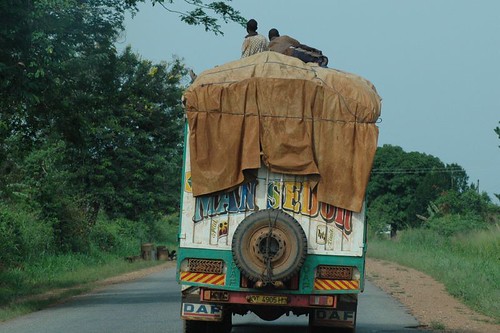

Man Sedon

credit: ellaroo

Ever since the troubles in Cote d'Ivoire started, there has been a massive increase in the road traffic in Ghana as the landlocked countries of West Africa, Mali and Burkina Faso chief among them, have been forced to divert their essential trade routes through Ghana. Even after the past few months of stability, it is a case of once bitten, twice shy - the Ivoriens may have blown it for good. The result has been that Ghanaian ports and roads have been struggling to cope with the extra flows.

Thus such scenes are a commonplace on the roads from the coast to the north: the heavily loaded trucks and the boys hitching a ride wherever they can. "Man Sit Down" is the slogan, fasten your seatbelts, you want to say.

For 30 years in Ghana and much of Africa, we were told by the traditional donors that there was no point to build dual carriageways and that our economies wouldn't support it. Apparently the great infrastructure buildout that separates the developed world from the developing world wasn't on the agenda. Instead we needed to open our markets, lower trade barriers, do structural adjustment and so forth in order to be good global citizens. Now our aid partners are changing their tune and well, those unfussy Chinese have had 15 years of slowly building up expertise doing infrastructure in Africa. They'll be the ones getting the contracts. Now even the DFID (England's development agency) is thinking about sanctioning major infrastructure as opposed to the small scale and NGO-focused approach that has been in vogue... We may even get a West African highway and the long-overdue regional integration out of this situation... Incidentally, only the Chinese seem to be interested in funding railways and it has been a very lonely 6 years for our Minister of Railways and transportation.

African leaders didn't inspire much confidence in the past but the messy business of development is all about infrastructure. The hope is that with the renewed focus on infrastructure in Africa we'll eventually have decent roads and transportation options and the rest will follow: cars that are roadworthy, drivers that are car-worthy and so forth. Baby steps...

Soundtrack for this note


Portishead - Roads

I've been thinking about Portishead - the band that is, and have been trying to find a way to weave them into the fabric of the blog. Roads, a deeply personal song seems apt as a soundtrack for mass transit. I still remember hearing their debut album, Dummy, for the first time. It was a promo cd lying around the radio station (WHRB) on a pile presumably to be discarded. I threw it in the player and was frankly stunned when I listened to it.

The first element of their appeal was a voice that seemed slight, ethereal and perhaps pained (or at the very least emotional). The lyrics come from some kind of turmoil deep inside Beth Gibbons. The drums are in the hip-hop vein, yet laidback and lazy. Geoff Barrows added all sorts of sonic niceties that befit a Bristol crew - samples of film dialogue, Isaac Hayes snippets, scratches, guitars and moog keyboards that made you feel you were in an old-fashioned movie theatre screening a film noir.

Of course we know that this became a "genre" and record companies quickly labeled works of this type "trip hop" that was a subplot to the 90s and indeed Portishead's music would be picked up in movies.

There wasn't a cover booklet with the cd which meant that it took some investigation to figure out the other ingredient that had so tickled my ear. The secret ingredient, the secret sauce, of the group was the theremin: it appears on perhaps a third of their songs - hence the cinematic connection.

Listening to Portishead play Mysterons or Roads is unnerving. You can hear the audience reaction on the Live: Roseland NYC album. The music is well, how to put it, haunting, mournful and more. It's the essence of the noir aesthetic - mood and cinematography translated to sound.

To me the theremin (or its Moog substitute) straddles worlds, creeping up on you and drawing your attention to something that lurks beneath, or that dwells in the shadows. I find comfort in the shadows of this music.

Oh, and I still don't have the dust jacket of that first Portishead album.

Obligatory video links: Roads, Mysterons

Alternate soundtrack: Fela - He Miss Road. Well, that's the African take on things...

File under: , , , , , , , , , , , ,

Sunday, March 05, 2006

Africa, 1966

Part 3 of the Things Fall Apart series... I've been sidelined for the past few days by a flu - my body perhaps taking too literally the theme of this series, hence I'll extend my admittedly arbitrary week schedule, reorder things and take a brief detour to ponder some photos. Hopefully you won't detect fevered intensity in this and later writings.

Today is Ghana's 49th Independence Day, an occasion to look back in history in order to look forward. I've been thinking however not about the halcycon days of 1957, the celebrations, the happy shrugging-off of the colonial mantle, but rather about the year 1966, prompted by finally being able to obtain a copy of Africa Report magazine from that year. I scanned and uploaded a few of the photos along with some of the articles therein. Why 1966? I was asked. It was a significant year for Ghana but more generally, 40 years ago was "when West Africa lost its innocence", as a good friend put it. The military coups in Ghana and Nigeria were a major reason for this assessment; Ghana being the first country in sub-saharan Africa to gain independence and Nigeria being the largest on the continent and casting a large shadow. Thus there is a sense of wistfulness about the path of the continent, promise gone wrong barely a decade after the initial excitement and optimism of independence. To add more context for the Nigerian case, 50 years ago, 1956, was when oil was discovered in the Niger River Delta - perhaps a clue to part of the reason for the subsequent unravelling but that is getting ahead of ourselves.

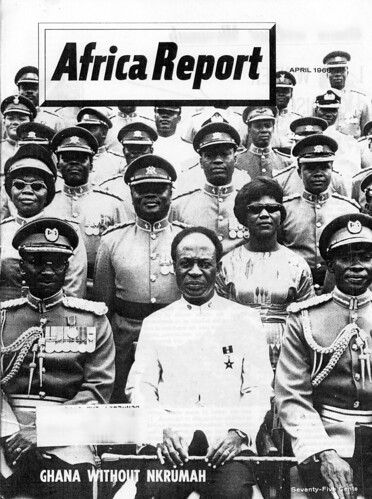
Ghana without Nkrumah


The image is at once iconic and, if you consider what happened months later, ironic. It features the President-for-Life, Kwame Nkrumah posing surrounded by army officers some of whom would shortly overthrow him. Is the fact that they are looking over his shoulder a foreshadowing of the long arm of the military in African affairs? Should one read ominous portents as the magazine's editors undoubtedly intended with its selection? The president looks confident in white with his ceremonial whip in hand, as well he should. At that point he was in full bloom, the one-party state enshrined in the constitution, titles and honorifics proliferating - Osagyefo, he appears secure in his power, surrounded by the obsequious and the sycophants. Everyone is smiling. One wonders who that woman behind him is (the one on the right) and where she ranks in the hierarchy. And those black shades!

Still there is another reading of the image, and it comes down to ego and insecurity that translated itself into government policy. Thus Nkrumah's regime imprisoned leaders of the political opposition, legislated their parties out of existence, and sent away the best and brightest or any who were inclined to question. Thus Kofi Annan and many other bright young Ghanaians were gifts to the rest of the world, sent out to the United Nations instead of causing trouble back at home. For Nkrumah and the CPP apparachiks who surrounded him, cronyism was a mundane fact of life; it was the simple exercise of power embodied in the direct manner of minister-without-portfolio Krobo Edusei a larger-than-life power broker and fixer. As a sidenote, the president-for-life moniker is not hyperbole, it was a little noted executive instrument in the law books discovered after the coup. The logic being that once the state is the party and the party's will is embodied in the leader then, well you get the idea...

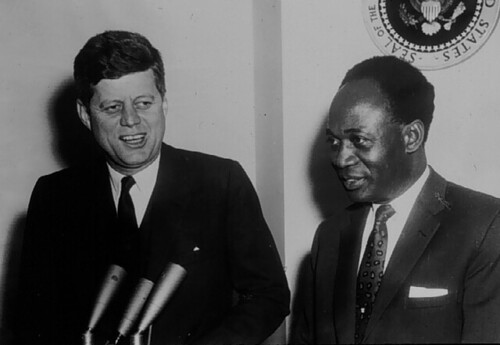
Now I suppose I shouldn't besmirch the legacy of a great man and erstwhile icon of pan-Africanism, black pride and the rest of it. It was said that the impact of seeing his triumphal trip to the United States and the image of John F. Kennedy holding up an umbrella to welcome him and feting him as he came to address the United Nations was to break a psychological barrier. Those countries that were perhaps hesitant about demanding independence could no longer wait. Sekou Touré of Guinea was one who succumbed to the irresistible glamour of it all. But still it is hard to bear the diversions into scientific socialism, the dissipation of the pan-African idea into overblown rhetoric, the sheer waste in other words... In Ghana, the popular overthrow of a regime that had started with much promise was perhaps a metaphor for the continent as a whole.

For those inclined for further reading, the feature articles in the issue may shed a little light
These articles are obviously products of their time, let's start with the title of the first: Winter of Discontent. When was the last time there was a winter in West Africa? But that is nothing new, metaphorical excess is the rule in writing about Africa. Heart of Darkness ruled the roost long before Things Fall Apart came along.

Markovitz posited that Nkrumah's choices for Ghana ranged from "Chinese communalization to Moshavism or laissez-faire capitalism". When was the last time you heard about Moshavism? 1966, we must then remember, was the height of the Cold War; the great elephants, East and West, fighting for world dominance and using the rest of the world as their battlegrounds. It is hard to believe the mindset and rhetoric of that era but perhaps our own era has its own tropes. As it was, regardless of the choices made by governments in Africa, in many countries the military stepped in. Some of the coups were inspired internally, some were indeed popular but in others, either the CIA, the socialists - the USSR vying for influence, or the former imperial powers (France, England, Belgium) weighed heavily. In Nigeria, the military as an institution decided that it would hold the reigns of power. In Ghana, the NLC was rather wanting to return to civilian rule but the precedent had been set and later in the 1970s and beyond, those who did step in were less benign.

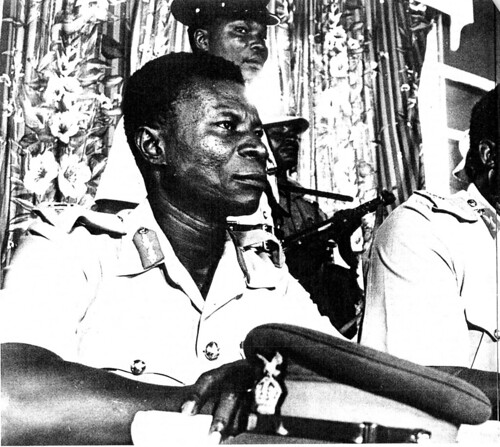
Major General Emmanuel Kotoka


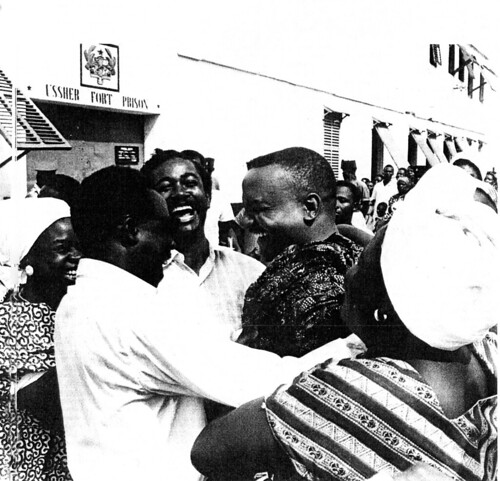
The enduring image of the year in Ghana is the sight of the political prisoners freed after the coup standing outside Ussher Fort being greeted by their families and friends. Some of the prisoners had been essentially starved to death or at best fed gari laced with sand - a quite macabre policy if you consider the already low nutritional value of gari. Well less said on that. I measure greatness based on what one does with power and on the whole African leaders have been poor in their exercise of power.

Ussher Fort freed prisoners 1966


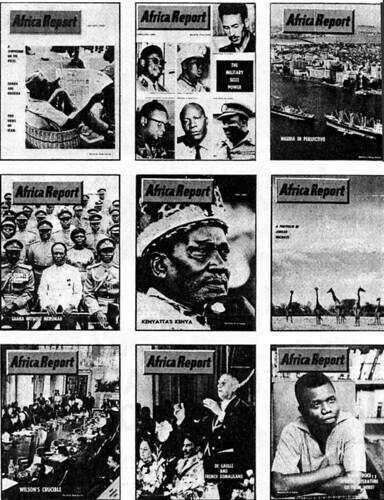
What of the rest of Africa in 1966? Here perhaps the covers of the issues of the magazine might shed some light.

Africa Report covers 1966


Politically, personality cults and strongmen abound (from Mobutu to Jomo Kenyatta with Eyadema looming in the background). Hastings Banda became president of Malawi in 1966 and 5 years later declares himself President-for-Life following other precedents. The Rhodesia question is still unresolved. The Biafra civil war is just a year away...

A young Alfred Adu Boahen completes Topics in West African History, perhaps the most influential history textbook on Africa and one that revealed the undoubted depth of African scholarship and accessiblitity. It featured prescient analysis of colonial rule and beyond. On his road to becoming the most influential scholar on Africa, he was busy writing the follow-up West Africa since 1800.

West Africa since 1800


Culturally, African literature, music and art in general is blossoming although there is a bittersweet tinge and here I'll simply note what was on the minds of the greats: 1966 is like a crossroads and a good point to take stock of Africa as a whole. Looking forward, independence was gained but many countries didn't start their post-colonial journeys on the right footing. Lots of things could go right and in many ways, there was a lot of promise on the horizon, but you could also see traces of the problems of the next few decades. There has been progress forty years on but sometimes I wonder if we are still at the same place.

Soundtrack for this note


Funkdadelic - Standing on the Verge of Getting It On

Riding High in 1961


Nkrumah and JFK


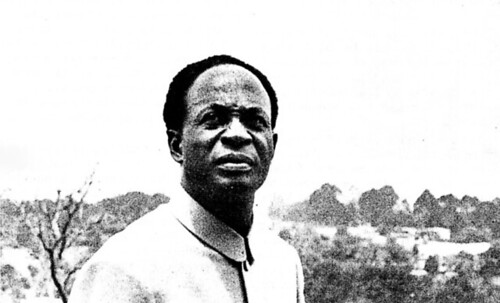
Circa 1965


Kwame Nkrumah circa 1965


Next in part 4: Chinua Achebe weighs in on the Voices Inside Things Fall Apart.

See also: The Busia Papers for another perspective.

File under: , , , , , , , , , , , ,

Wednesday, March 01, 2006

Things Fall Apart

Join me if you will for a short series - variations on a theme: Things Fall Apart.

It's about a state of mind and a culture. So far there have been musings on literature, from Chinua Achebe's novel to Joseph Conrad, Yeats, Evelyn Waugh and others. There's been music, poetry, history, coups, affairs, politics, strange bedfellows, technology, identity theft, terrorism, nostalgia, hard-boiled noir, lighthearted farce and boycotts. Looking ahead perhaps we'll deal with food, movies, cartoons, photography or more sedate topics. The starting place, as ever, is Africa, yet I find myself somewhere in the middle of the Atlantic, writing a cultural history of our times. I hope some of it might be up your alley. In any case welcome. (see series index)

1. School of Hard Knocks


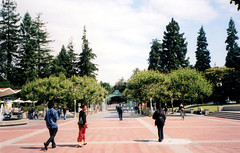
It was June, we were at the History department at Berkeley. The Girlfriend was filling out paperwork in anticipation of the next year's Great Move West and pondering the academic life teaching history (Africa! Science!). Tabitha was filling us in on the department, campus life, class sizes and how the program was structured. Truth be told there was a lot of trepidation and the small talk wasn't coming easily. Then I looked around seeking comfort from the surrounding books and, my goodness, noticed the magazines. I was so excited to find myself in an office that had a copy of Africa Report magazine from 1966. It was the issue written after the coup that overthrew Kwame Nkrumah in Ghana, something I had been searching for for the last 6 years. Duly effusive after my find, I really started to chat her up; Africa was on my mind and the questions poured forth. We warmed to each other in short order.

berkeley gates


Eventually I asked about the background of the students who come to study African history at the university.

What has changed, she said, is that these days the average student would have read Things Fall Apart by Chinua Achebe whereas previously it would have been Joseph Conrad's Heart of Darkness (or say Joyce Cary's Mr Johnson if they had a British background).

It seemed to me that a little milestone had been reached with her anecdotal testimony of Achebe winning out over Conrad in the memorability sweepstakes. Our man Achebe must surely be smiling at the response to his first novel written almost 50 years ago. Indeed it is apt that sub-Saharan Africa is also verging on 50 years of a post-colonial experience (in my native Ghana, preparations are underway for next year's 50th independence day celebrations).

The school of hard knocks that was Africa's colonial experience, and indeed the image of Africa itself, is now being perceived through the words of an African. The headline leaped out to me:
Things Fall Apart Beats Heart of Darkness
This is bittersweet news and progress of a sort. Beyond the purely literary however, the question remains:
Should Africans be content with Things Fall Apart? And if so, is the message of Brand Africa simply a celebration of the hard knock life?
As a participant in the ongoing narrative, I almost never pause to ponder the storyline. When I do manage to reflect on it, I get little comfort from the muddled headlines. Heads down and at a remove, I seek instead a sense of normalcy and to contribute to the occasional bite-sized triumph. After all, who knows which of the current grand plots will be tomorrow's conventional wisdom? Finally also, I wonder who is writing today's script and where they stand on the matter. I hope my exploration will provide one perspective.

sweet-candy

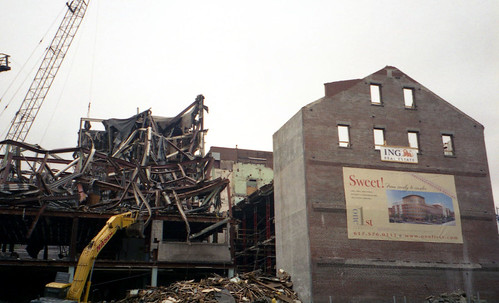
The sign reads "Sweet! From Candy to Condos". The old candy factory in East Cambridge is being "repurposed" into luxury condominiums.

The Things Fall Apart Series

Cultural observations and social interplay

Things Fall Apart

  • School of Hard Knocks
    Reading a new headline for Africa.
  • Identity Theft
    "Wake up one day / They say you're a bomber"
    The perils of a fragile center.
  • Africa, 1966
    Looking back at a pivotal year in African history in order to look forward.
  • Voices Inside (Things Fall Apart)
    Changing the perspective. An appreciation of Chinua Achebe's take on Things Fall Apart, with a Donny Hathaway connection thrown in for good measure.
  • Heart of Darkness
    "This Congo is a region of the mind."
    Burnt-out cases journey down the river: Joseph Conrad's tale and its influence on the literature and iconography of Africa - from Graham Greene to Evelyn Waugh, through Abdulrazak Gurnah, Francis Ford Coppola and more.
  • Frisson de Folksonomie
    "I have a crush. There, I finally said it. I feel better already... I can no longer stand this conflicted life..."
    "Affairs" in social bookmarking, literature and music.
  • Angola
    "When two elephants fight it is the grass that suffers" — Angolan proverb.
    A dossier, or rather a B-movie, featuring Jonas Savimbi, Ronald Reagan and other special guests.
  • Huhudious (or Silly Season)
    Illustrating The B-movie Theory
  • Ode to Betty Brown
    Yes, that was Betty Brown, self-effacing even in her obituary.
  • Structural Adjustments
    The trade deficit of unanswered questions
  • June 4th
    The Coup Drill. Stand up and be counted.
  • Herd Immunity
    The phantom thread of greed lies at the heart of the matter
  • Open House
    A full frontal stare
  • The Bad Seed
    Suborn was his favorite verb
  • Internal Exile
    They made the best of things

Social Living

Social Living is the best

The Comfort Suite

I need relief

The Rough Beast

Who is writing the script?

Fallen Angels

Doctor Simbo

Soul Insurance

  1. Ananse and the Chief's Scribe
  2. Enter the Claims Adjuster
  3. An Audience with the Linguist
  4. Pity the Mink
  5. Short Sale
  6. Excessive Liabilities
  7. Premiums Due
  8. Soul Insurance, a playlist
  9. Indemnity Provisions
  10. Full Circle
  11. Enforcement Actions
  12. The Die is Cast

South Africa, 1994

The Bulsa Way

The Boycott Day Trinity

And the Lord said unto them: Boycott!

Things Fall Apart - the photo essay

Things Fall Apart - The Playlists


tag cloud: Things Fall Apart


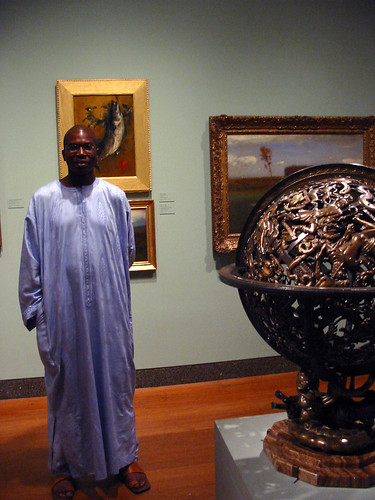
Koranteng globe portrait


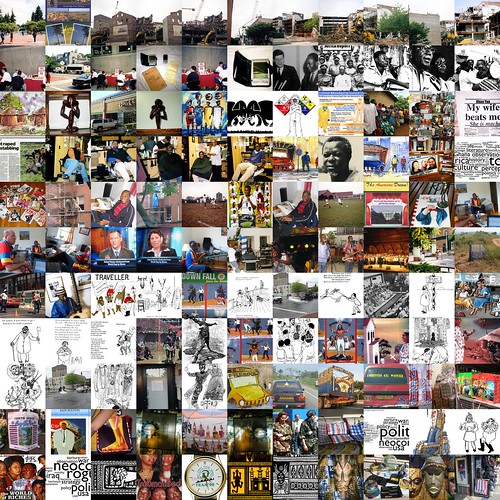
Things Fall Apart collage


File under: , , , , , , , , , , , , , , ,