Samory's Old Camp
The image was deeply disturbing, archival footage from a colonial scrapbook
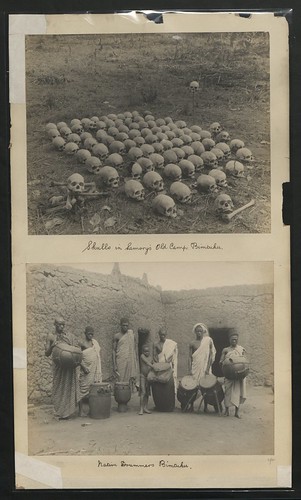
Above was the skull garden, and below were the native drummers at Bimtuku
The caption in the Colonial Office's collection mentioned Samory's old camp
The skulls of ninety-odd souls arranged in mostly neat rows on the ground
I had just read that post about King Leopold's ghost and iconic legacy
That laid bare the man's haunting misdeeds and colonial cruelty
The images that had galvanized Edward Morel's campaign to bear witness
The type of experiences that triggered Conrad to write Heart of Darkness
And then I came to this page nestled in the UK National Archives release
Of part of its digitized collection. What was one to make of this?
Certainly it was through a colonial lens that we viewed these images of Africa
But this hit close to home, for these were historical images of Ghana
And now, a century at a remove, I faced the archivist's mystery
I wondered if this image was a colonial record of an atrocity
The archives were soliciting contributions from the public to help update
The records. Perhaps, with millions of eyes on this, we could elucidate
But I could only go by the fickle metadata
I was, as it were, on the horns of a dilemma
I'm no Errol Morris but I can do amateur research
Opened a new tab, off to Google to type in a search
The town of Bimtuku is lost to history,
as are its striking mud mosques
Although their lore is faded,
the photos are part of the colonial record
These are the Gold Coast archives
so we do have a few clues about the location
We know that somewhere in what is now Northern Ghana,
there was a skull garden
...
I had come onto this material with a nostalgic but gimlet eye
The archives evoked, in my mind, a wide range of responses to empire
Fodder for addressing uncertainties - albeit never reparations
A longstanding focus of mine being truth and reconciliation
If this was the past as prologue, where, indeed, were the poetics?
Could I detect in those images where the seeds of our troubles were sown?
Or should I focus on surface matters and questions of aesthetics?
And simply savor a fugitive glimpse of a world largely unknown
A treasury in short, 714 photos,
with the usual suspects, say Nkrumah
Typical images of empire,
the exploits of His Excellency the Governor
Some chiefs and their retinues
with whom he occasionally palavered
Enactments of Confederacy,
signing ceremonies approved by Queen mothers
Journeys up the various rivers, inspecting outposts,
the trappings of trade
The gold mines foremost, and the timber concessions
where they cut with saw blades
Architectural details to behold,
visions of old Accra and the then new hospitals
Beaches, churches, schools,
and sessions of the Gold Coast legislative council
The names are mostly familiar to me,
it's a thrill to see the old Kings
Of Mampong, Kokofu and Juaben.
Not to mention Bekwai, Insuta and Wonki
The ceremonial details,
witness the bearing of the chief sword bearers
Next to the nubile Adda Girls
fetching water at the mouth of the Volta River
There's quite a bit of nudity,
the young girls at Sekasoko were known to be demure
Very easy on the conqueror's eyes
who came with intentions impure
Some of the photographers also seemed fascinated
with the hairdressing styles
But just then, you behold another young girl
dressing her hair by the roadside
She's completely at ease with her body, and you can't avert your eyes
Her photo is next to a Seribe (what is a Seribe?) of Bimtuku
As you ponder, you click to turn the page and behold the photo
Of the skull garden that I shall now endeavor to describe
...
One of the skulls is mounted on a stick, elevated as if on a pike
One has a tibia or arm bone almost lodged where the mouth would go
Another skull, on the side, sits uneasily on a pile of leg bones
The rest, in their rows, are exposed to the elements, this is their home
They are mostly well preserved,
only a couple of the skulls have cracks
But you're no forensic scientist,
and don't really know what question to ask
The skulls were not going anywhere, it is fair to say
But what were they doing in the old camp of Samory Touré?
Many societies have traditions of ossuaries
I've even visited some of the catacombs in Paris
There's a fascination with the norms of death,
and the intimation of our mortality
Expressed in the way we treat the dead,
and raising issues of cultural relativity
And we all know of fraternal societies,
for example the Skull and Bones at Yale
Charles Taylor, at his trial, tried to justify his atrocities
so beyond the pale
Pointing to the mysticism of Western institutions
such as the Freemasons
That made use of dead bodies
for secret rituals and sundry traditions
Skull gardens throughout history have been the epitome
Of that very human heart of darkness and the mystery
Of how, through massacres, we frequently break all taboos
Of love, respect, shame, and our shared humanity
From school, I thought that Samory's empire
was more to the west of the coast
I knew that it might have extended
at the easternmost point to Burkina Faso
But it stands to reason that the Wassoulou
and Mandinka Empire stretched to Ghana
This would explain the interest in the Gold Coast colonial record - they'd conquered
Could one theorize about the image
when looked at through the governor's eyes?
The colonists were always looking for evidence
of bloodlust and human sacrifice
The practices of the savages
that were beyond the bounds of civilization and crude
Thus a skull garden would be fodder for the old saying: exterminate the brutes
Did the photo document an actual relic of ongoing savagery?
Or simply how they dealt with the dead in a commonplace ossuary?
Some societies cremate instead of burying their dead
In Samory's old camp perhaps they just preserved the heads
...
We do know that in Bimtuku there were dye pits
And not too far from there resided the High Priest
And of course this was the Gold Coast, so there were sellers of gold
But was the fetish priest party to what went on at Samory's camp of old?
There are few other pictures of Bimtuku,
it must be near Bole in Northern Ghana
Just north of the Bui National park,
and close to Adarranu near the Black Volta
What is the history of these old villages
on the Awuna Lagoon, near Kitta?
The colonial record branded these as hinterlands
that were the home of the Soma
There's a dissertation for sure in expanding the historical record
One that probes whether there is further evidence of anything untoward
Some anthropologist should visit Northern Ghana
and rediscover Bimtuku
Talk to some people, for it's elusive
compared to the more famous Timbuktu
Some of the names resonate to any Ghanaian child
They are part of our long and storied history
But, I suppose, to most readers, there are merely exotic and wild
And, in this case, part of the great African mystery
For Ghana finds itself in the crosslines on the Prime Meridian
A through line running right through the center of the world
We fancy ourselves a great civilization, guardians of humanity's home
Proudly located on the gold coast, at the heart of the torrid zone
What to the outside observer appears shocking and unfamiliar
With enough context, may be only natural to the bearer
Those who venture on the pain of others conceive the essential mystery
The ineffable human experience, a photo can leave an iconic legacy
What our soul insurance providers behold as underlying conditions
The landscapes of human drama, the narratives and the fictions
The tale of the lost stories, storytelling is how we learn
Everything is written in sand, to dust we shall surely return
Ultimately, with just a photo in a scrapbook, the rest is history
We're left to speculate on what might have been, and behold the mystery
That sometime in Bimtuku back in the late nineteenth century
In Samory's old camp, there was a skull garden, an ossuary
Mystery, a playlist
A mysterious soundtrack for the old camp. (spotify version)
- Exotic Mysteries by Lonnie Liston Smith
- Mystery by Anita Baker
- Let the Mystery Be by Incognito
- Something Just Ain't Right by Keith Sweat
- Explorations by Lonnie Liston Smith
Timing is everything
Observers are worried
See also: White Graves
File under: history, Ghana, photo, mystery, culture, observation, perception, colonialism, tradition, investigation, storytelling, imagination, values, norms, death, ceremonies, Africa, Observers are worried, poetry, toli
Writing log. Concept: February 2, 2011; May 5, 2021

