toli: n. 1. A juicy piece of news. 2. The latest word or gossip. 3. The talk of the town, typically a salacious or risque tale of intrigue, corruption or foolishness. (Ga language, Ghana, West Africa)
He had cloaked himself with his layan zana
Touched the soft leather amulet with its coil of goat hair
The few grains of paradise and base of shea paste and kaolin
The talisman that worked to render him invisible to adversaries
Skimping on protection, he was mindful of what many forgot,
That, for greater effectiveness of camouflage, one also needed baduhu
But you take what you get in these foreign lands, what have you
Moreover these were inflationary times, you made do with what you could afford
Still, you had to be careful when sitting to not show your soles
Avoiding also that the leather bag would touch water - taboo
Worn close to the body, he whispered thrice the name of the jinn
Spirits alighted and settled next to this Cartesian thinker
He could never understand those who closed the door to the unseen
Was it the faint hope that the invisible would pass them by? Hubris
It was a wonder that otherwise intelligent folk would speak mockingly
Of naive superstition, countering with harsh words and disbelief
A full grown man, degrees and all, steeped in the best of western education
In his business, he dealt with derivatives and complex financial transactions
A weariness overcame him, for he knew that even with the best preparation
It was touch and go with the spirit world, the strength of his protection
He'd heard the arguments about proof, reproducibility and evidence
That the signs and wonders we'd all witnessed were mere chance events
They'd plead so-called logic, rational they'd say, appeals to authority
And dismiss known cases as one-offs, charms that spoke to religiosity
And it was not even a matter of African electronics
Rather it was an unearned fealty to methods scientific
Oh well, he'd keep his juju close to his heart as if for safekeeping
As the proverb went, you can't convince someone who's sleeping
The height of fulfillment for a Ghanaian woman
The measure of a life well lived
Is to be surrounded by loved ones
Sought out for consultation
And to leave a trunk of fabric
Packed almost full with cloth, new or barely worn
To be shared amongst those she leaves behind
Kente, Dutch wax prints, indigos and batiks
Some with Adinkra designs, and lace too; these are heirlooms
True, some would also cite the beads and the jewelry
Gold sovereigns as befits the site of the Gold Coast
And yes, monies and land, cars - modernity, are fitting contributions
But it is the cloth that is the prized intimate legacy
...
Daa left me some fabric, my inheritance was a sleep cloth
Dark green, a GTP wax print, lightly faded
So soft after years of use that the merest touch
Transports me to happy places
Skin to skin, in contact with her quiet ways
Remembering her voice and her laughter
She left a scarf for our daughter
White lace, a welcome present
She'd held out to meet her, her great granddaughter
The yearslong campaign on her granddaughter-in-law
Had borne a delicate fruit
She carried her with joy that day
And fussed, and gave advice, we listened well
Ineffable joy, she slept well that night
Remembering the long journey, the twists and the turns
Those who had walked along with her
Those now lost, and those who still remained
The happy times - for there were many like today
The reversals, and the times of privation Internal exile and the hunger seasons
When some had to sell, to empty their trunks
To empty their very souls to provide for their family
But she had made it, and could pass something on
She was ready. She passed it on and carried a glow
She eased through the few weeks that remained of life
...
In this meeting of minds
The foundations of identity
Home, the veins of belonging
Sleep cloths for the children
Memories rest on the fabric itself
Pieces of intimate legacies
Venus would appear in its first guise as a morning star
Paving the way for the sun to rise a few hours later
And casting a faint shadow in its greatest illuminated extent
A waxing crescent state in the predawn hours
The liminal twilight before sunrise
In modern times, adjustments were needed amidst the man-made glare
To favor eyes unaccustomed to discerning such distant objects
How best to perceive its shape during the fleeting apparition
The advice was to first stare at the receding horizon
To habituate the senses to behold the roving vision
For the eye to truly gather a full glimpse
We had to learn anew how to see the wonders of this world
Still, the ancients would take its journey as an omen
In their urge to understand the paths of nature's higher bodies
A reminder, in its elliptical motion, of the proper order of things
Mankind's gaze recorded that Venus would precede the sun
Thus it was their practice to wake at the crack of dawn
To savor the quality of the light of the early morning sun
And they would make sure that those bearing the very young
Would be shielded in the shadows from the later burning sun
And the word was passed down, the stories were retold across the ages
Grandmothers would explain as they called you in, mine would speak in this way:
Spirits are often contemplated in the dark, messengers of the night
And Venus, in its full grandeur, visits humanity before sunrise
The Wife and kids will occasionally catch me enthusiastically singing a quite eccentric song, To Hunt the Wren.
It seems to tickle their funny bone as it's quite a bit different from my usual soul/jazz/blues/hip-hop fare but, well, there's a story there...
To Hunt the Wren is an old English folk song that is typically sung on Boxing Day as it commemorates a tradition where townsfolk would gather in the morning around Christmas to go hunting the titular wren - wrens being those cute (and tasty) little birdies.
The lyrics, as I recall, are:
Where are you going?
To hunt the wren
This Christmas morning calls for hunting them
How will you kill him?
With sticks and stones
Hatchets and cleavers honoring his bones
And so forth.... The bloodthirsty quotient quite accentuated by repetition
Anyway... people who attended my boarding school might well recall choirmaster's Alan Vening's arrangement that the whole school would spend a entire term practicing, I believe we had a school-wide Christmas performance; To Hunt the Wren was a big feature during my time there.
I guess it was a combination of the striking lyrics and the inspired arrangement that caused the song to be so firmly imprinted in my mind.
(Or perhaps it was the savagery of those English tribes that the song laid bare)
The felicitous way the tongue curls around "Hatchets and cleavers" is satisfying in its own sweet, merry way. In it, we can hear the deep origins of Maxim guns and future paeans to Rule Britannia.
The verve of the call of response too was fitting and had some swing to it. You wouldn't guess how often the "How will you kill him? / With sticks and stones" refrain is heard in our household, thirty odd years later.
Still the kids are quite blasé about the troubling lyrics - I suspect early exposure to such things fortifies the soul readying them for this neo-feudal world of organized gleeful violence visited on a (mostly) defenseless wren.
The imbalance of power. Peace starts at home.
To Hunt the Wren does have a certain incongruity in its imagery. For one the fascination and flair it finds in the act of killing. This is plainly a hands-on affair albeit with sticks and stones.
And then there is the fact that it is a single wren that is being hunted by the gathered crowd. Communal catharsis, perhaps, in the ceremony of blood. Is this a kind of Sussex scapegoating at work? Stonehenge atavism? Middle England savagery? Who knows?
The hunt of the wren does takes place after all on Christmas morning just days after the winter solstice. A celebration of harvests to come, the depths of these dark times, the light ever increasing going forward. I suppose you can deconstruct further meanings from the tune.
The web being what it is, you can hear the song for yourself. Sadly the online versions will never approach the melodious peaks that stay in my memory. The lyrics and arrangements are quite suspect, says this expert. Trust me, you'll have to come my way to hear the real thing
I notice that Natalie Merchant sings a version in her latest album!
These takes are far more mournful than what I grew up with. Interesting an Olde English sense, but they don't quite spark joy in the same way. Where is the joy, I ask?
So imagine, if you will, me crooning the peaceful coda on this Boxing Day morning
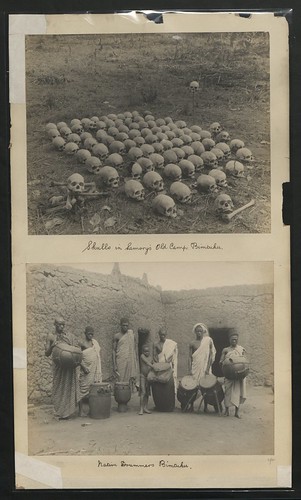
The image was deeply disturbing, archival footage from a colonial scrapbook
Above was the skull garden, and below were the native drummers at Bimtuku
The caption in the Colonial Office's collection mentioned Samory's old camp
The skulls of ninety-odd souls arranged in mostly neat rows on the ground
And then I came to this page nestled in the UK National Archives release
Of part of its digitized collection. What was one to make of this?
Certainly it was through a colonial lens that we viewed these images of Africa
But this hit close to home, for these were historical images of Ghana
And now, a century at a remove, I faced the archivist's mystery
I wondered if this image was a colonial record of an atrocity
The archives were soliciting contributions from the public to help update
The records. Perhaps, with millions of eyes on this, we could elucidate
But I could only go by the fickle metadata
I was, as it were, on the horns of a dilemma
I'm no Errol Morris but I can do amateur research
Opened a new tab, off to Google to type in a search
The town of Bimtuku is lost to history, as are its strikingmud mosques
Although their lore is faded, the photos are part of the colonial record
These are the Gold Coast archives so we do have a few clues about the location
We know that somewhere in what is now Northern Ghana, there was a skull garden
...
I had come onto this material with a nostalgic but gimlet eye
The archives evoked, in my mind, a wide range of responses to empire
Fodder for addressing uncertainties - albeit never reparations
A longstanding focus of mine being truth and reconciliation
If this was the past as prologue, where, indeed, were the poetics?
Could I detect in those images where the seeds of our troubles were sown?
Or should I focus on surface matters and questions of aesthetics?
And simply savor a fugitive glimpse of a world largely unknown
There's quite a bit of nudity, the young girls at Sekasoko were known to be demure
Very easy on the conqueror's eyes who came with intentions impure
Some of the photographers also seemedfascinated with the hairdressingstyles
But just then, you behold another young girl dressing her hair by the roadside
She's completely at ease with her body, and you can't avert your eyes
Her photo is next to a Seribe (what is a Seribe?) of Bimtuku
As you ponder, you click to turn the page and behold the photo
Of the skull garden that I shall now endeavor to describe
...
One of the skulls is mounted on a stick, elevated as if on a pike
One has a tibia or arm bone almost lodged where the mouth would go
Another skull, on the side, sits uneasily on a pile of leg bones
The rest, in their rows, are exposed to the elements, this is their home
They are mostly well preserved, only a couple of the skulls have cracks
But you're no forensic scientist, and don't really know what question to ask
The skulls were not going anywhere, it is fair to say
But what were they doing in the old camp of Samory Touré?
Many societies have traditions of ossuaries
I've even visited some of the catacombs in Paris
There's a fascination with the norms of death, and the intimation of our mortality
Expressed in the way we treat the dead, and raising issues of cultural relativity
And we all know of fraternal societies, for example the Skull and Bones at Yale Charles Taylor, at his trial, tried to justify his atrocities so beyond the pale Pointing to the mysticism of Western institutions such as the Freemasons
That made use of dead bodies for secret rituals and sundry traditions
Skull gardens throughout history have been the epitome
Of that very human heart of darkness and the mystery
Of how, through massacres, we frequently break all taboos
Of love, respect, shame, and our shared humanity
From school, I thought that Samory's empire was more to the west of the coast
I knew that it might have extended at the easternmost point to Burkina Faso
But it stands to reason that the Wassoulou and Mandinka Empire stretched to Ghana
This would explain the interest in the Gold Coast colonial record - they'd conquered
Could one theorize about the image when looked at through the governor's eyes?
The colonists were always looking for evidence of bloodlust and human sacrifice
The practices of the savages that were beyond the bounds of civilization and crude
Thus a skull garden would be fodder for the old saying: exterminate the brutes
Did the photo document an actual relic of ongoing savagery?
Or simply how they dealt with the dead in a commonplace ossuary?
Some societies cremate instead of burying their dead
In Samory's old camp perhaps they just preserved the heads
...
We do know that in Bimtuku there were dye pits
And not too far from there resided the High Priest
And of course this was the Gold Coast, so there were sellers of gold
But was the fetish priest party to what went on at Samory's camp of old?
There are few other pictures of Bimtuku, it must be near Bole in Northern Ghana
Just north of the Bui National park, and close to Adarranu near the Black Volta
What is the history of these old villages on the Awuna Lagoon, near Kitta?
The colonial record branded these as hinterlands that were the home of the Soma
There's a dissertation for sure in expanding the historical record
One that probes whether there is further evidence of anything untoward
Some anthropologist should visit Northern Ghana and rediscover Bimtuku
Talk to some people, for it's elusive compared to the more famous Timbuktu
Some of the names resonate to any Ghanaian child
They are part of our long and storied history
But, I suppose, to most readers, there are merely exotic and wild
And, in this case, part of the great African mystery
For Ghana finds itself in the crosslines on the Prime Meridian
A through line running right through the center of the world
We fancy ourselves a great civilization, guardians of humanity's home
Proudly located on the gold coast, at the heart of the torrid zone
What to the outside observer appears shocking and unfamiliar
With enough context, may be only natural to the bearer
Those who venture on the pain of others conceive the essential mystery
The ineffable human experience, a photo can leave an iconic legacy
What our soul insurance providers behold as underlying conditions
The landscapes of human drama, the narratives and the fictions
The tale of the lost stories, storytelling is how we learn
Everything is written in sand, to dust we shall surely return
Ultimately, with just a photo in a scrapbook, the rest is history
We're left to speculate on what might have been, and behold the mystery
That sometime in Bimtuku back in the late nineteenth century
In Samory's old camp, there was a skull garden, an ossuary
The lineup of Zimbabwe's football team includes Divine, Talent, Teenage and Knowledge. Marvelous is a substitute, and their coach is Sunday.
The Ewe and Akan of Ghana have great names too, full of vim and wonder. Names are said to give protection and delight in our traditions. See for yourself, I recorded a transcript of the climax of Saturday's Premier League match of WAFA versus Ebusua Dwarfs at Sogakope Stadium...
Match Highlights
Thy Will Be Done passes the ball to Your Cause Is Just who dribbles past No Adversity
And, this is inspired, he then sets up Troubles May Follow You who gets ready to shoot
Oh! foiled at the last minute by God Is Good. Goodness, that was a missed opportunity.
Jealous, on the other side is screaming, he was wide open facing an empty goal
Still, a wonderful last minute tackle there by God Is Good, world class
He had run back from just past the halfway line, streaming like a tornado
What? A full sixty yards down the pitch to save the day, the pocket dynamo
Anyway, Peace recovers calmly and gathers Chastity for the counterattack
Correction, it was rather Charity. They do look alike those two midfielders
Charity lifts his head, spots Love making a run and, with the outside of the foot,
Unleashes a devastating through ball, it simply cuts through WAFA's defence
Runs right past Wisdom and the straining brothers, Shadrach, Meshach and Abednego
Love collects with one touch on the sideline, beautifully done, what skill
He then lobs it diagonally, lofts it with a wicked swerve across the area
The half volley (was it?) finds the running Sword unmarked on the penalty spot
Sword's diving header is in the back of the net before anyone can react
Strange was helpless there, there was absolutely nothing he could do
Stranded on his goal line. That was brilliant, end to end stuff.
Just twenty seconds on from trouble and it's a goal. And what a goal.
A clinical finish. The game is on with just a quarter hour to go.
The captain, Wisdom, is furious and bellows at his teammates to not lose faith
WAFA must now seek an equalizer. Oh well, live by the sword, die by the Sword.
The above was just an excuse to highlight one of my favorite songs, Dynamos vs. Tornados by Zimbabwe's Real Sounds. The sounds of the football match commentary rendered against the background of an infectious soukous groove never gets old. It's quite unlike anything I'd ever heard, striking in its inventiveness. The bonhomie and cameraderie of our sports. What paradise have we lost?
I woke up to music just the other morning and I can safely say
That the most exhilarating nine minutes of recent memory
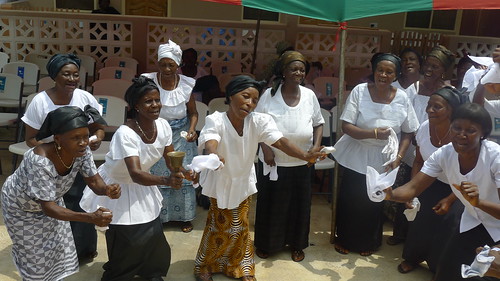
Was when The Seven Year Old and I took out our white handkerchief
And comfort blanket, respectively, and got down to our song and dance circle
Call it the musical antidote to the previous day's zoom funeral
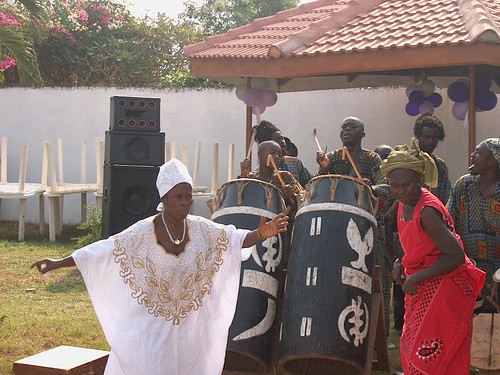
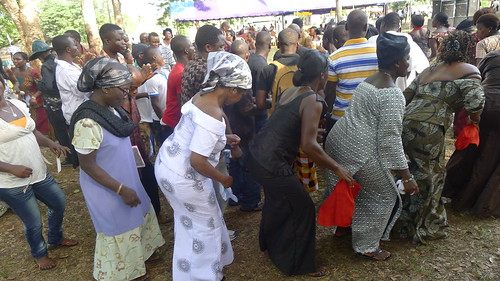
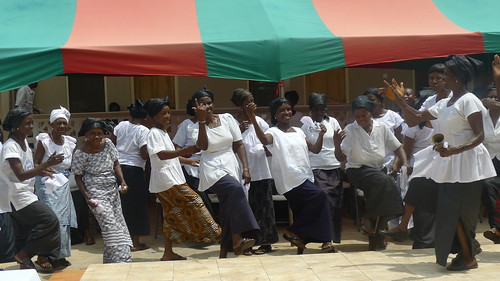
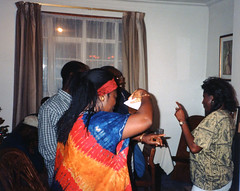
Even as I was paying penance in this ongoing season of grief Borborbor dances and other Abutia clan traditions soothe as remedies
Then I recalled the moment after we had lost Daa, when my Auntie
Briefly sublimated her pain and sorrow and lost herself in the dance
A few seconds of pleasure in fond remembrance of her mother
In a covidious time we live with the fear of the superspreader
The web gave a glimpse of African ceremonies of yore
This was the music of the Gods, what paradise have we lost?
...
Gee kindly Doctor Fauci
As a boy, I used to enjoy choir practice
That is, until my voice cracked
And hormones made my intentions mixed
These days, however, the danger is stacked
Singing in mixed choirs has been decidedly nixed
Until this pandemic's ended, we are well and truly stuck
The boy picked up a dandelion
Carefree as was his wont
But when it came to blowing it out
He was stymied by the face mask
No matter how hard that he huffed and he puffed
The fabric mesh that covered his mouth held fast
The mask against aerosols and other viral vectors
Did its duty of protection against childhood leisure
Thus whimsy was victimized by material culture
Revealing the extent of the plague's infrastructure
We were getting a truer measure of the pandemic's cost
Even as we asked, what paradise have we lost?
...
We passed our neighbor on our daily walk
But where we would usually stop and talk
We contented ourselves with a head nod and gave her a wide berth
Such are the rituals that are disappearing from this earth
Now alienation becomes common courtesy and a duty of care
The temporarary inconvenience of distancing as social welfare
That the breath of life carries tainted droplets is another irony
Anecdotal testimony abounds of the myriad covidious casualties
Biology imposes penalties and we weigh its shadow's burden
Deprived of touch and community, so many are truly hurting
This new normalcy, fraught and enforced, only exhausts
We are left pondering, what paradise have we lost?
I give you African Ceremonies, my photographic examination of some of the ties that bind us in Africa and the diaspora...
Back in 2006, I gathered some photos I'd taken into a slide show about African ceremonies. It was intended as a companion piece to an article I was writing about building software to support communities and how to highlight the periodic social events that all communities require - said article has sadly remained dark matter. Well that's my cover story, another theory is that I had 15 minutes to procrastinate...
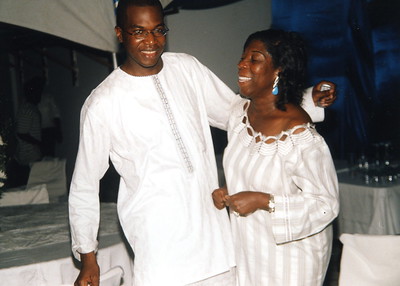
A curious few who happened onto the photos asked for a little narration to underline what I was getting at, and to explain some of what was taking place, the traditional weddings were intriguing it seems. There was also a withering comment about why I labeled it "African" rather than the more specific "Ghanaian" - but I'll dodge that one now as I did back then. I was vaguely hoping to start a trend and was hopeful that others from the continent or diaspora would add their own visions of their own ceremonies. I was early on the web and, for the longest time, if you searched for Ghana weddings, my happy day would have been your top search result (sidenote: a lazy Ghanaian journalist once did that search and used one of our photos to illustrate a story about sham Green card marriages which almost gave my poor mother a heart attack as she opened her newspaper one morning to see her son and daughter-in-law in glorious print and juxtaposed infamy - I really must dig up that paper from my archives).
I am well aware of the types and faces that we traditionally see of Africa. I've been pleased, in the years since, to see Africans adopt Flickr, Instagram, and what have you. As internet penetration advanced, and especially with the adoption of mobile phones, we are all putting out our own images and telling our own stories. Here comes everybody, as a prescient Clay Shirky intoned.
There is a tension however about putting one's family snaps out there, I am mindful of privacy concerns that may arise and have taken down promptly whenever alerted. I've found though that my loved ones have actually appreciated my amateur social historian impulses and the value of a simple link. Even when I've recorded painful interludes and genuine grief, the memories of our rituals and traditions have been the social capital and comfort that we draw on to go forward.
Then the pandemic intervened and, in this covidious interlude, I've had further time to pair all those images with a very special piece of music, a stunning version of Better Days Ahead by Gil Scott-Heron, recorded Live at the Fox Theatre Boulder Colorado in 1979, I believe - hat tip to Kalamu.
Herewith then an attempt to turn my amateur snaps into a "photo essay", a personal tour of African ceremonies...
African Ceremonies (Better Days Ahead by Gil Scott-Heron)
I also give you the linked video for viewing and listening pleasure. My liner notes follow below. At the very least, the music should be your blanket of soul. I found the juxtaposition of the images and the song moving for, even as I contemplated how things have fallen apart, I could harken back to these mementos of togetherness. It is no article of faith to expect that there will be better days ahead even as we ask: what paradise have we lost?
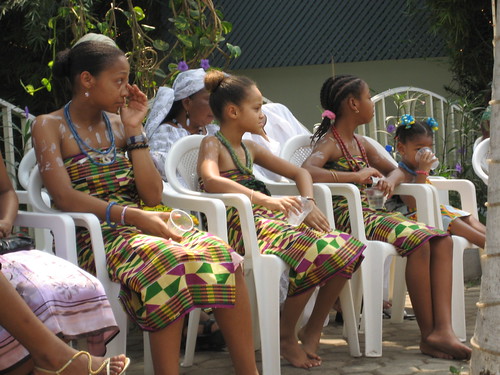
People like Angela Fisher and Carol Beckwith make coffee table fodder out of photography books like African Ceremonies and Africa Adorned. Those books are visually wonderful and they deserve all the acclaim (and money) they get. To my eyes however, their approach is a little too stylized; there's a loss of social and cultural context, and a sense of titillation. They omit the Coke bottles or cans, the white plastic chairs, the satellite dishes in the background or the goat-herders with the cellphones.
"Move that away", you almost hear them demand as they take the "authentic" photos. The end result is based purely on an aesthetic sense (albeit a very acute sense) and a view from the outside-in. Still I'm grateful that someone is documenting these affairs; so much of Africa's past has been ephemeral and lost in oral tradition. But the result is otherworldly and, I hesitate to bring up the word, exotic...
You don't need to point to the nativist stylings of Leni Riefenstahl whose penance for the Third Reich propaganda was a retreat to the most "traditional" Africa and a celebration of the Nuba of Sudan. It's a very different feel from the photos of African photographers like Seydou Keita or Malick Sidibe which are full of knowing wit that comes from breathing in life in the society.
This is also true if you monitor contemporary photos about Africa. The aesthetic of many of the photos in the Images of Africa pool at Flickr is quite different from that of those taken by "the locals" even if said locals have begun posting to that and other forums. This is understandable, holiday pictures of a safari, of wildlife, or of those who put on performances for your benefit will obviously be far different from the kinds of things you notice if you were involved in the occasion. Still as more Africans add to the collective pools, things are changing. The aesthetic of the more professional local photographers, say the "African Futurist" or say Blackwize is as vibrant as can be. I'm not a visual person, but whenever I've ventured into Instagram and such, I've never been disappointed. You can get a keen sense of the modernity and normalcy in their visions.
Tradition
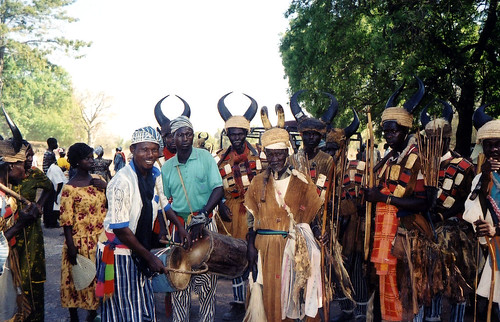
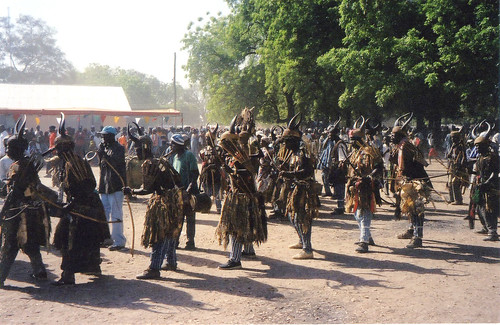
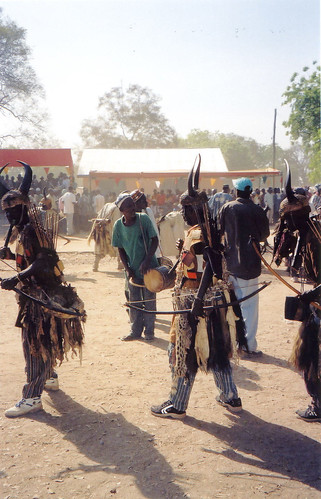
Take a ceremony like this, from Sandema in Northern Ghana (of which I'll later share a quite harrowing story).
The setting is the Feok Festival of the Builsa people where they re-enact the story of how their ancestors fought off the slave raiders. If you're ever in Ghana in December and can make it up north, you'll definitely enjoy the occasion: the elaborate choreography and exuberance of the warriors showing off their forebear's proudest moment.
Note if you will the Adidas and Nike trainers - how inauthentic, right? Angela Fisher would surely make them get some real hunter shoes, savanna grass and antelope hides or what have you before taking her photos.
One of the backstories to the photos is that these guys are all ex-policemen despite their posturing as "traditional" warriors. These days they settle scores with AK-47s instead of the cudgels and shepherd's crooks they carry here. Capturing them on the one day of the year when they ostensibly forgo their hair-trigger militia tendencies misses half the story. In many ways, they are seen by the rest of the country as a lost cause, almost akin to the Somali warlords - i.e. people to be mostly ignored or, at best, bought off to keep quiet. A quite dangerous state of affairs, but that's another story...
Pageantry
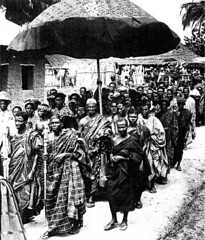
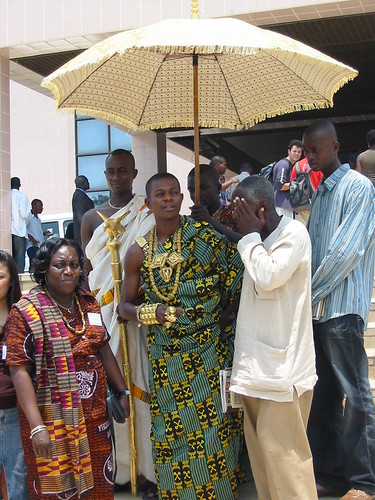
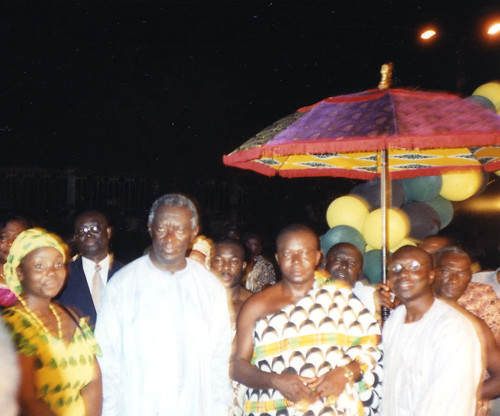
We do like our chiefs and the pageantry that comes with durbar rallies. Throughout our history we have put them on a pedestal or palanquin.
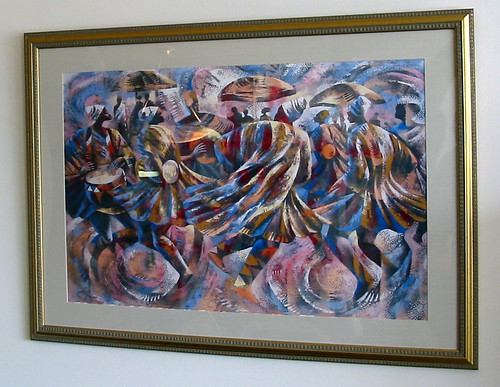
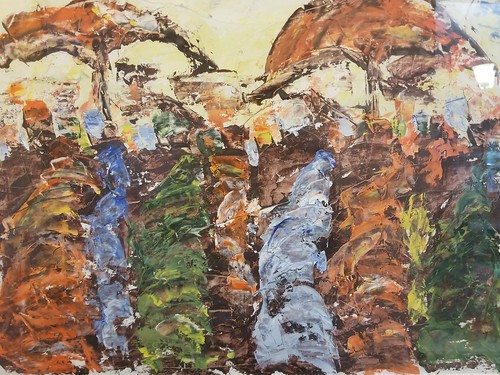
Durbars and the ceremonial umbrellas that accompany them are a recurring motif in our art.
While I like these glamourous and photogenic ceremonies, they are fairly infrequent. The majority of my experience of ceremonies has been of the more personal variety, and not quite so dramatic: births, engagements, weddings and funerals... Ceremonies are rites of passages and have importance in our communities given the impermanence and fragility of life in our part of the world.
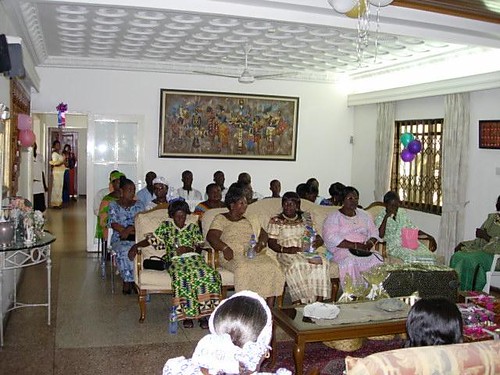
Let's start with an engagement ceremony - or "knocking" as we call it in Ghana. In our traditions this is where the two families ostensibly meet for the first time.
The man's family goes bearing gifts to the woman's family to "knock" on the door, introduce themselves, declare intentions and ask for woman's hand on behalf of their son. Basically it's the traditional wedding.
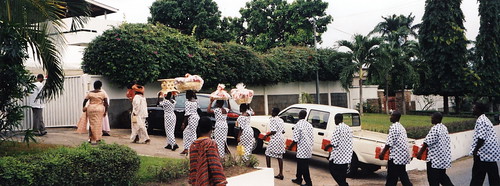
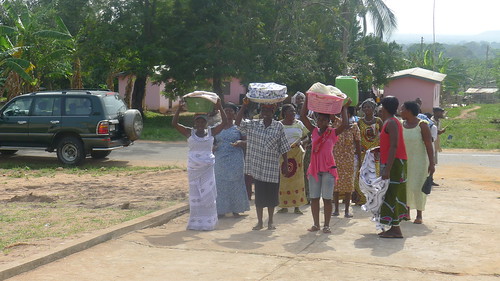
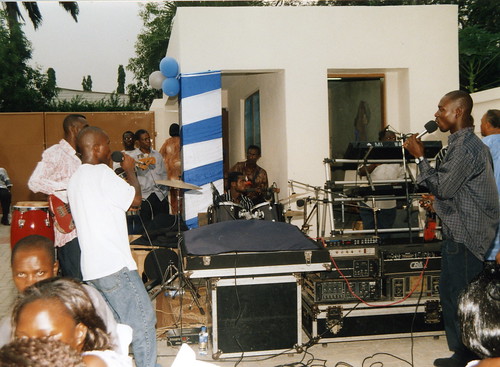
Sometimes for the more showy, you can hire carriers, a band or people - color-coordinated of course, to carry the gifts your side is bringing to the table and to come and sing praises. On the whole though it's an opportunity for the families to get to know each other. Depending on the tradition, attendance by the couple is optional, this is all about the two families becoming one.
More often though, you carry them yourself.
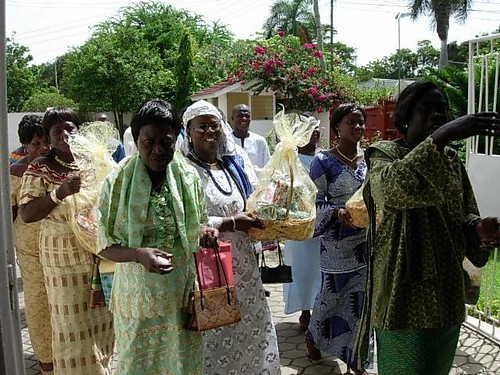
In the Ga tradition, the groom's family arrives at the gate of the bride's father's residence and "knocks" requesting entry. Typically you offer a nominal payment of 100 cedis (about $10) for entry.
You're making an entrance. In some traditions, there is a big to-do about the entrance. They won't let you in, pretend no one is there. Or the reception is grudging, "who are you people?". But it's all a theatrical pose.
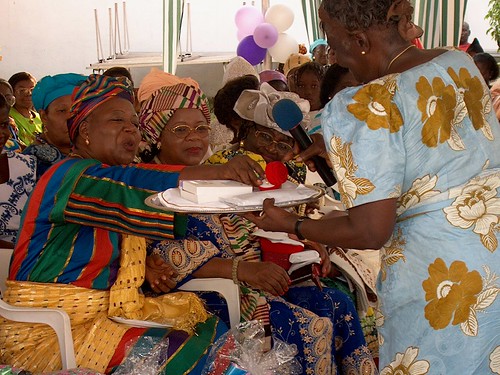
I know that in some traditions they bring out multiple ladies from the house and theatrically ask that you identify the desired, to see how well you know her. We come bearing gifts whether Schnaaps, cloth, jewelry, suitcases and cash. Gifts are symbolic although there is much ado about the list - e.g. approx 100 cedis ($10) to enter the gate, a suitcase for the woman's belongings, pieces of cloth, a ceremonial white bible, a few crates of drink, a stool etc.
We have spokesmen, or Okyeames, recounting the praises of the participants, using very ornate and flowery language. "Our son has spotted a beautiful rose in a garden." Knocking ceremonies, are mostly run by women, and indeed are for women, attendance by the men in optional.
One last thing: this was also the point at which one would openly discuss the lineage and antecedants of the couple - e.g. in the past this was the moment at which we checked with the family elders to prevent inbreeding.
Sometimes you get priests running things - with Ghana's new Christianity, you get a lot of prayer interludes. Occasionally it's silent prayer but often the exhortations are quite intense - and lengthy.
There's lots of fuss about the little things, the white bible, the ring, the cloth, the cakes, the little envelopes stuffed with cash bribes for members of the family,
the suitcases (sometimes a brand of suitcase is specified).
The people who come bring a lot of energy to the gathering. You may not see them often during the year but they want to affirm their membership in your community (I realize I'm writing here with software engineer's terminology, but you can sue me, my life informs my work).
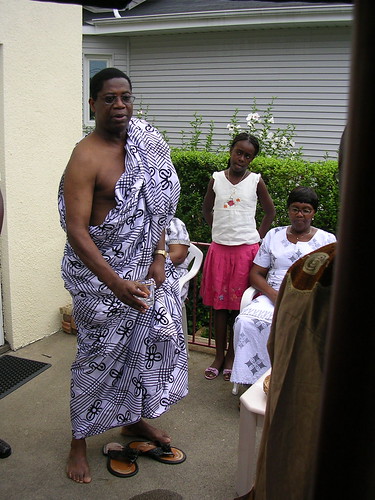
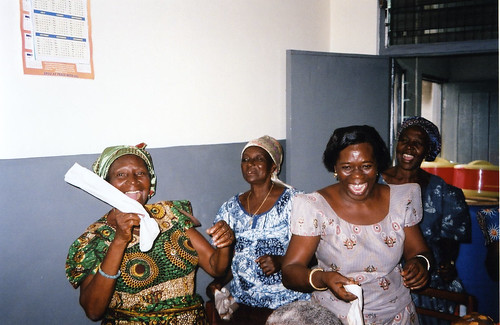
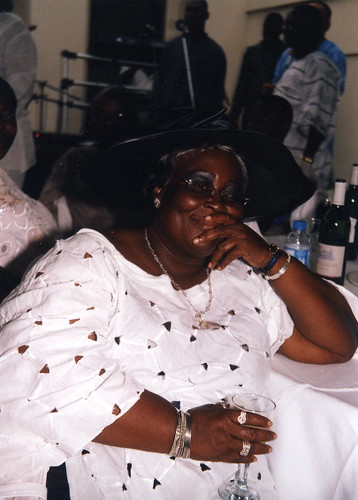
Some come with glint of mischief in their eye, or maybe a sense of the cantankerous.
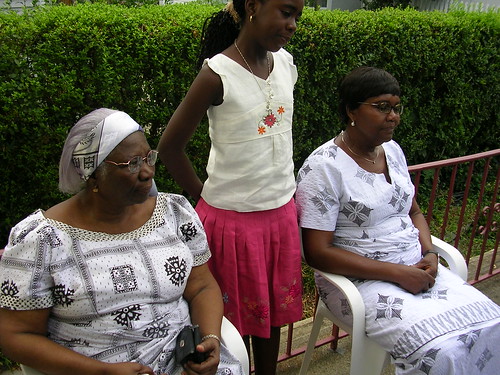
and perhaps pearls of experience
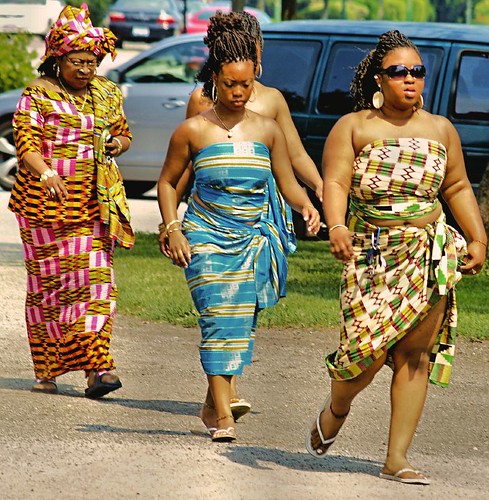
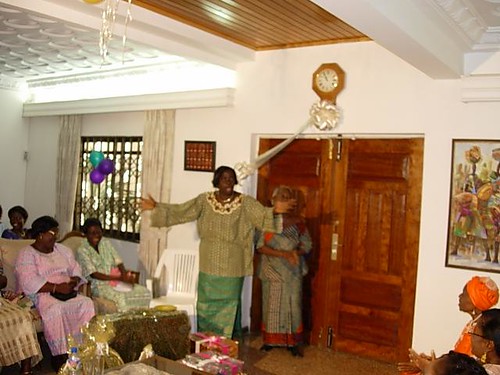
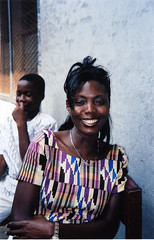
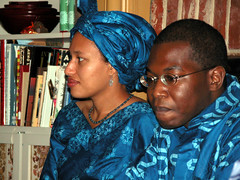
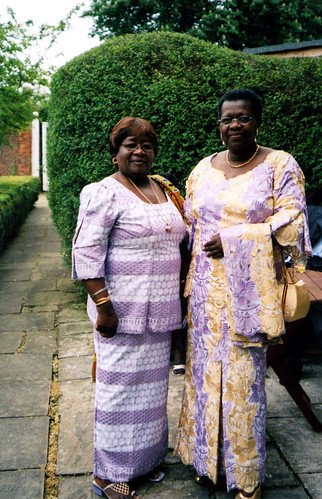
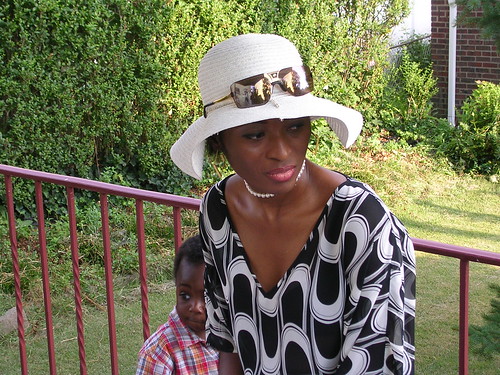
We all make an effort to dress up for the occasion.
Our seamstresses are kept busy
Lace style and pageantry is in order
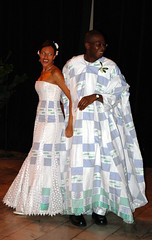
As are the kente stylings.
Funeral Minded
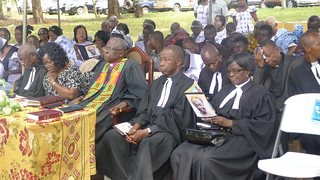
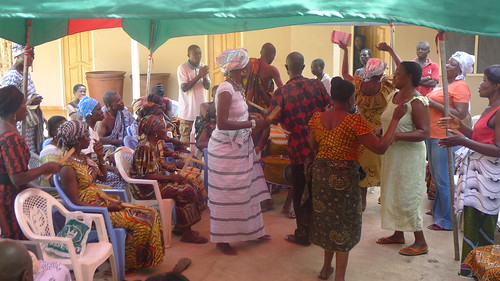
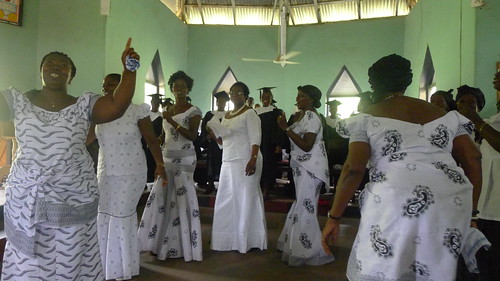
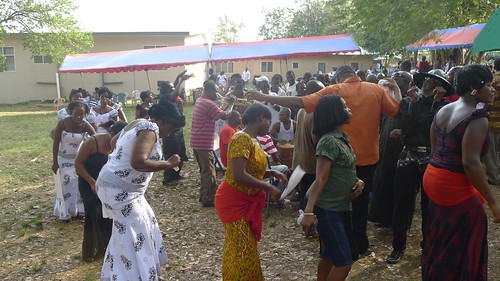
The iconography of funerals I've attended rhymes with that of engagments. Even in our moments of grief, tradition demands surety. Consider an Abutia clan funeral ceremony that takes place the day after the burial. The clan visits the bereaved family bringing gifts to commiserate, bring comfort, and share in the community's loss.
It was a painful moment for all of us, we had lost Da but you can see the exact second when my Aunt's grief was sublimated and she lost herself in the dance, in fond remembrance of her mother.
You're always surprised about who is most involved in the event. The dark matter of communities surfaces at such times. These social events are about participation and identification. Formalisms like invitations are a little much in Ghanaian traditions. If you hear that so-and-so has a baby or is getting married, it is your obligation to show up. You can imagine the uncertainty this causes. If you're organizing such an event, you should probably double your expectations about attendance. Like the South East Asians, it becomes a numbers game.
During our years under military rule the only outlet we had were these ceremonies, and once democracy returned and a middle class began to reassert itself, there has been a burgeoning industry of event planners. We believe in textiles, food and such.
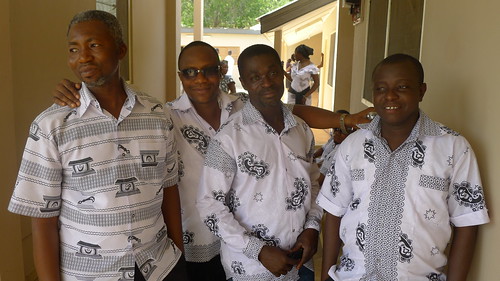
Members of the family and close friends would wear the same print.
It is well known that the Ga have made an industry, and art, out of their coffins, and well entrepreneurial spirit flourishes where there is a need.
We also mark the anniversary of the death as the 1 year and 10 year dates are important in our traditions. Our lost ones live through us and we remember and celebrate their legacy. These celebrations of life happen not just in Ghana but in New York, New Jersey or London.
Outdoorings
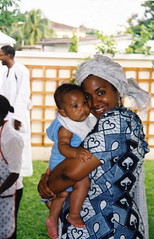
At the other end of the circle of life are outdoorings, the naming ceremony for newborns. These are traditionally held on the morning of the 8th day of life.
The Okyeame pours libation and formally presents the newest member of the family.
The colours are typically blue and white.
the children look on and learn
The grandmothers are beside themselves. They like to see that things are done properly.
We forget the daily grind of life in the diaspora
and embrace a certain aesthetic of ease on these occasions
Ceremonies qua Ceremonies
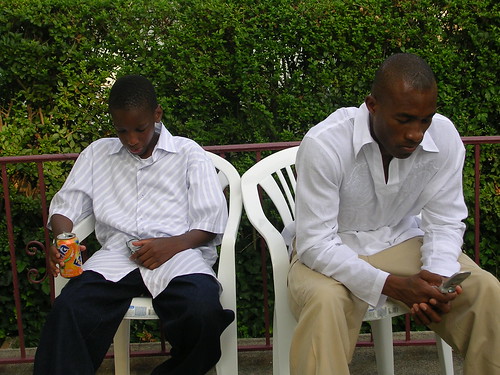
Mobile phones are de rigeur these days
The food is always something else, we like to throw a spread...
I normally make a nuisance of myself in the kitchen
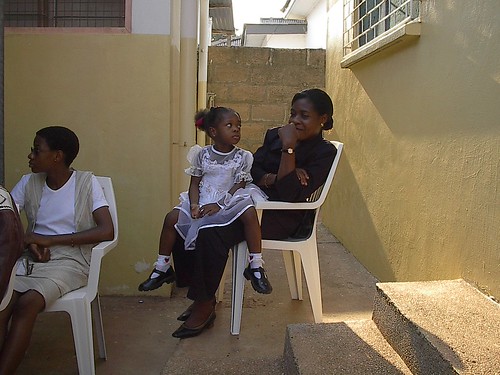
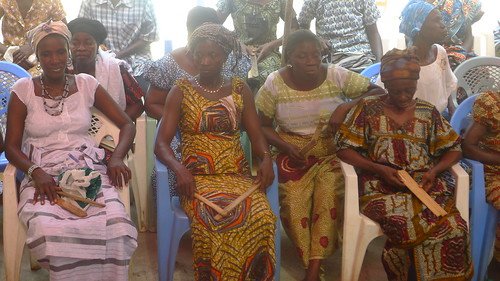
It's all about the chairs however...
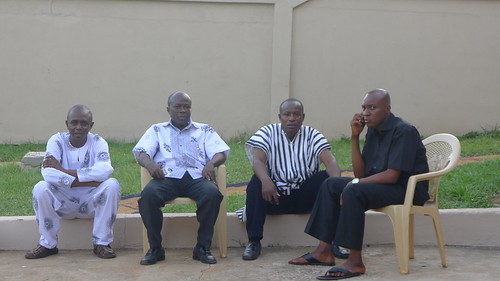
lots of chairs
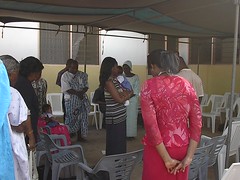
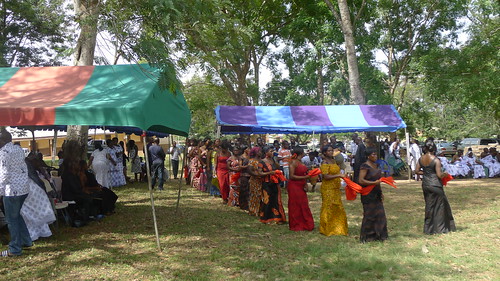
We spend lots of time in the heat, under canopies
plastic chairs, sunlight and waiting for tardy drinks
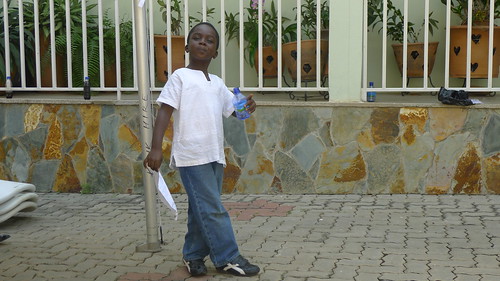
A surprising amount of time is spent simply waiting