Showing posts with label poster. Show all posts

Wednesday, August 08, 2007

Africa, 1999

I thought I'd share this poster of African leaders circa 1999 which has been lying around my study for just such an occasion — actually, I was cleaning things and stumbled upon it...
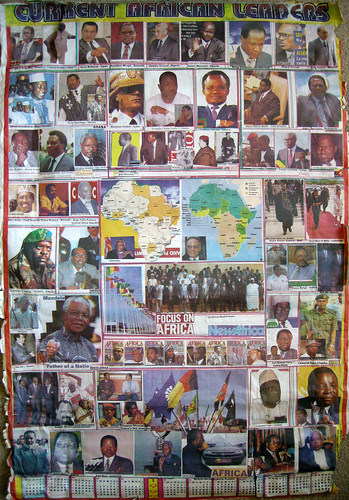
African Leaders 1999 edition


I've been mulling a piece on Africa in 1989 to give some depth to my ongoing series and trying without success to find the equivalent poster from that year - the high mark of rogues in Africa, hence I'll start with a request: does anyone have any similar photos from 1989? Photos of any OAU meeting would work for my purposes. As to the matter at hand, I suppose the more recent history of 1999 will do as a stopgap measure.

So. Africa. 1999. Here goes...

Posters of this sort are quite popular in Africa (large size), you'll find them at many of our newstands. I don't quite believe in the Great Man theory but, when it comes to Africa in 1999, one has to admit that leadership still mattered a lot unlike in other regions of the world. To take an obvious example, no one in their right mind would be putting up similar photos of EU leaders on the walls of their houses. Public apathy to leadership in the West is rightly the norm - modulo the occasional gremlin. In West Africa especially, where we know all too well about Big Men - and they are all men in the calendar, Ellen Johnson Sirleaf was barely on the horizon at that point, these posters serve as a kind of palliative: "Get to know your local strongman", wear their political cloths and so forth.

Even the good guys were larger than life in 1999; that was the year Nelson Mandela stepped down as president of the New South Africa proving his George Washington bonafides, the Good "Father of the nation" as the poster notes. In 1999, we didn't have many technocratic Thabo Mbeki or John Kufuor types as we do presently. Instead you'll note a lot of military uniforms and panache. The 2007 contingent are a mostly dour bunch other than say, He of The Little Green Book - Gaddafi that is, or Robert Mugabe, and Bad Bob has always worn a gray suit since hanging up his rebel spurs. That dourness is paradoxical progress, you don't want to live in revolutionary times. By contrast the typical words used in the western press about our leaders in 1999 were things like "mercurial, flair and flamboyant".

Strictly speaking it's not 1999, the calendar was produced in late 1998 as evidenced by the presence of the late, unlamented General Sani Abacha of Nigeria on the right hand side who died just months earlier. When people literally celebrate your demise to the point of dancing in the streets (as they did even in nearby Accra, Ghana), you've obviously been smothering them.

Still the 1999 crop of African leaders were a definite improvement on the 1989 crop but you could still see a high percentage of strongmen, thieves and incompetents. Even with the comforting gaze of Kofi Annan and Desmond Tutu (Julius Nyerere and Kwame Nkrumah are on hand to round out the nostalgia quotient), there is precious little comfort in this poster.

The Rogues Gallery


Charles Taylor (top left) was then president of Liberia, a decade after starting his mischief in the sub-continent. He had reached his peak of warlord power having coerced a terrorized populace into voting for him or else. And it was a case of "or else" that he proceeded to display: the white suits were flowing, the timber and blood diamonds were in abundance, the concessions had been granted to Pat Robertson, and the flowering friendships with Jesse Jackson and company proceeded apace. But he wanted it all, so Sierra Leone, Guinea and even Cote d'Ivoire would pay the price. May he suffer a lifetime of legal action, and the company of lawyers and bureaucrats.

Laurent Kabila the First, had been installed a couple of years earlier in Congo and was taking bids on concessions in the fashion of his predecessors in mischief, Mobutu and King Leopold... He was a disappointment to his Rwandan and Ugandan sponsors, refusing to deal with the Hutu génocidaires and indeed allying himself with them at times. The consequence of the free-for-all his inaction spawned was that the armies of 13 countries would scramble to get the spoils of Congo in the middle of Africa's world war. Sadly the headlines are much the same almost a decade later. The heart of darkness...

Gnassingbé Eyadema, the Prince of Darkness is ominous at the bottom right and for once depicted without his dark shades. To this day none of my Togolese friends discuss politics with me, so long a shadow does he (and now his progeny) cast.

Jonas Savimbi, Jerry Rawlings and Gaddafi are their customary gremlin selves - merchants of grist.

Jammeh of Gambia, in army gear (red cap just above the Africa maps), is holding up a little prop (sorry, I meant a little boy) - he wasn't claiming to cure AIDS back then (as was the case last year), but the visions of grandeur and the lucrative arms smuggling were going well.

The leaders of the various Guinea countries were grim. Conte of Guinea was simply corrupt - he still is. Joao Bernado Viera of Guinea-Bissau, having survived a 1998 coup and minor civil war, was cracking down on the opposition - he would fall in mid 1999 (he is back in power currently). The less said about Teodoro Obiang Nguema Mbasogo of Equatorial Guinea the better - 1999 was a typical year for his brand of malfeasance.

Al-Bashir of Sudan with the army uniforms behind him headed no-nonsense and efficient killers.

Buyoya of Burundi wasn't up to much good.

The military leader of Niger, Ibrahim Baré Maïnassara would be assasinated in April 1999. His replacement wasn't much better.

Kleptocrats and Autocrats


The usual suspects are there. Daniel Arap Moi of Kenya - stylish and mercenary, Paul Biya (and Wife) looting Cameroon, Hosni Mubarak the Egyptian hardman as usual. Like Mubarak, Ben Ali of Tunisia and bad old King Hassan of Morocco kept a lid on things in their countries. Too exuberant your expression of liberty and you risked the secret police. Algeria too was in the midst of that savage civil war; Liamine Zeroual, backed by the army — "Les décideurs" was what members of that cabal were called, was deciding for everyone. Idris Deby of Chad was caught between a rock and a desert and had no imagination. Blaise Campaore of Burkina Faso and Didier Ratsiraka, the canonical Big Man of Madagascar (the nickname: the Red Admiral) had quiet years. Omar Bongo was as usual enjoying and corrupting, spreading enough money around to compromise any opposition - as he continues to do, the Head Suborner. Nothing much to see here, let's move on...

The Disappointments


The biggest disappointment was Henri Konan Bédié of Cote d'Ivoire who was ensconced in that most comfortable chair. Despite being groomed for decades by Houphouët Boigny, he wasn't up to the task. His country is still paying the price for his small-mindedness.

Frederick Chiluba of Zambia (arms crossed and self-confident) was quickly losing his democratic lustre - he would be voted out of office a few years later and continues to face corruption charges.

Abdou Diouf of Senegal is an odd one. Ostensibly a democrat, he eventually handed over but he was increasingly autocratic the longer he was in power.

The Ethiopians (Zenawi) and Eritreans (Afewerki) decided they needed to engage in pointless border wars and old-fashioned trench warfare ensued. Tens of thousands perished.

Museveni was sowing his mustard seed in Uganda - democracy was for chumps in his considered opinion. One party state, baby.

Kerekou of Benin still can't point to any thing that he's done for his country; in 1999, the priorities were clear, it was all about the money.

The Mistakes


These posters are of the cut and paste variety and were put together in a hurry; sometimes one forgets to update things or misattributes. Thus Habayarima Juvenal of Rwanda, who had been killed to kick off the 1994 genocide, is still listed. Paul Kagame should be annoyed.

For Burkina Faso there is also the image of supposedly saintly Thomas Sankara, killed a decade earlier. File under misplaced nostalgia.

The Swazi king and the Lesotho prime ministers aren't listed for whatever reason.

Complications


Sierra Leone in 1999 was all complexity. President Tejan Kabba clearly had a precarious grip on power, the evidence being the enigmatic "Sierra Leonean rebel leader" in green beret and army fatigues on the left hand side who appears ominously on the same poster. And indeed Sierra Leone was in the midst of its long civil war.

Sidenote: the only unambiguous good deed in foreign policy of Tony Blair's tenure would come a few years later when he sent a detachment of British troops to save the day in Sierra Leone. For that alone, one might arguably cut him some amount of slack for the later hubris on Iraq. Arguably... But you won't get that argument from me, my litmus test was his eloquent silence as Israel was bombarding Lebanon last summer until the atrocities crossed his very flexible threshold of manufactured disgust. He did do the right thing on Sierra Leone, Africans will give him that...

In the other Congo, the situation was confused and confusing. Patrick Lissouba is depicted in the poster although he had been overthrown by that other gun runner Sassou-Nguesso; his militia did came close to overrunning Brazzaville that year. Years later, one assumes he is still itching for a return from exile.

Somalia, after a decade as a failed state, gets any number of warlords on the poster: Aideed, Ali Mahdi are the convenient stooges.

Not depicted is Monsieur Bin Laden who brought his brand of collateral damage to the continent in the 1998 Al Qaeda attacks on the US embassies in Kenya and Tanzania. The grass always suffers... Back in 1998/99, he didn't care much for the limelight.

Passing grades


I wouldn't want my jaundiced commentary to give the impression that there were no good leaders on the poster or in Africa in 1999. Indeed there were many good things happening on the continent and often inspite of the leaders. Also, and this is the great virtue of Africa at that moment, much of the action on the continent was in civil society, in entrepreneurs, in schools and in business. Governments mattered less.

Ange Felix Patasse of the Central African Republic and Miguel Trovada of Sao Tome and Principe could argue for a passing grade in 1999 (later is a different question). Similarly Konaré of Mali - a country that probably has the strongest democracy on the continent, did good. The leaders of Malawi (Muluzi), Tanzania (Mkapa) and Botswana (Masire) were all sense and sensibility. Heck even Chisano of Mozambique was proving reasonable in reconciling his countrymen after their long civil war. For what it's worth also, Sam Nujoma of Namibia did no harm in 1999.

Waiting for an Angel: Reading Africa in 1999


Between a Dream and a Nightmare was how Human Rights Watch described Africa in their 1999 world report. There's a touch of hyperbole perhaps, but there is much to commend in their lyrical commentary. Africa in 1999 was a case of baby steps.

Sidenote: Boston University had the idea to find sinecures for African leaders so that they would have something to do when they retired - basically give lectures about their embezzlement, grand visions and such. When I lived in the Boston area, I never attended the various symposiums that were organized - it irked me no end that these rogues would be feted instead of jailed. Perhaps I've mellowed somewhat, but I now think such efforts are a step in the right direction. Baby steps...

Back to reading 1999... There was the matter of angels and demons, and I've previously pointed to contemporaneous posters showing the way in which religion had gotten a big boost in much of Africa. We were in need of much faith healing and the reason was leadership. Popular culture and the literature reflected as much.

Nigeria, by virtue of heft, sets the tone for much of Africa hence, for the best reading material on Africa circa 1999, I'll turn to Helon Habila's Waiting For An Angel. This was actually a far more assured debut than that of The Anointed One in that is a novel that really sought to capture the totality of a society's experience of that moment.

Waiting for an angel


Habila is an ambitious writer and he presents a series of shifting but interlocking stories - the glue is a doomed journalist and a few students, but he covers considerable territory in his lyrical pages. In a sense it is the moral dilemma of Ayi Kwei Armah's The Beautyful Ones Are Not Yet Born, updated for the fin de siecle: will no one do the right thing?

His laconic tone and journalistic eye really captures the mood: the sense of dread and inevitability of life under Abacha. Simply put it was a time of suffocation, of repression and of corruption. To call what Abacha wrought in Nigerian society bad behaviour is to give bad behaviour a bad name. What took place in Nigeria was greed beyond belief and utter wickedness, leavened periodically with tawdry murders. Murder was most foul, theft was most blatant, and all relationships were corrupted.

I can also point to some maternal toli with observations about this period; in 1999, it was a matter of confidence in Nigeria. Nigerians are still picking up the pieces years later.

I haven't dwelled much on the francophone aspects but perhaps a few words are in order. France these days is having a touch of buyer's remorse at its back-scratching enablement of African rogues. One then should also add to the reading list Ahmadou Kourouma's En Attendant Le Vote Des Betes Sauvages completed in 1998. That too takes on the Eyadema figures (and many of those other knaves I've listed). Magic realism was our lot and the great wordsmith doesn't disappoint in his cultural observations.
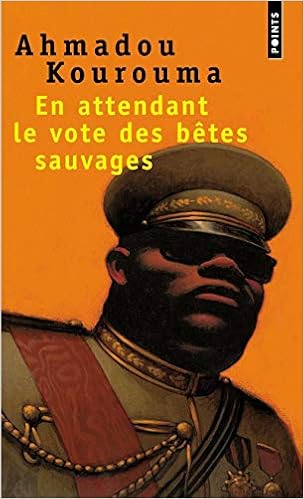
En attendant le vote des betes sauvages


Where Habila is waiting for an angel, Kourouma is waiting for the wild beasts to vote. A clear eyed look at the poster and at those leaders should explain why these two great stylists of African prose would write as they did about waiting for the next shoe to drop. If the one hoped for change for the better, the other was more cynical about the prospects - and perhaps given the slow pace of change in Africa, Kourouma had the clearer eyes. But as a matter of policy, I'll side with Habila; demons may have more fun but angels are more likely to inherit the earth.

Between a dream and a nightmare is a twilight zone of opportunity; that is the terrain of the great game and the temptations of the rough beast. As we have seen, leaders do matter, but I'd hazard that people matter more. It wasn't so in 1999 but with baby steps, perhaps it is more so today. Would it always be so.

Soundtrack for this note


  • Eric B. & Rakim - Follow the Leader
    Braggadocio and inner turmoil never sounded so good. Certainly Rakim never sounded so good, a microphone fiend he handed allcomers a musical massacre with his lyrics of fury. Follow the money, follow the leader.
  • Prince - 1999
    A double album opus with Linn drum programming mastery, the obvious line to contribute to the playlist is from the title track: "Party over, oops, out of time". I quite like some of the other, lesser-played songs on 1999: Delirious and the very apt Something In The Water (Does Not Compute). What say you Dear Reader?
  • Femi Kuti - Plenty Nonsense
    I was going to pick a Fela track to round of this playlist, perhaps Unknown Soldier - the line about Government Magic always gets me, but I think Femi had already proven himself by then and a more contemporaneous song was warranted. The title should speak loudly to my point: we're doing better these days but we all need to be vigilant about the plenty nonsense that goes on in our lands.
Baby steps.

P.S. It's been suggested that I should get some technology toli out the door, we'll see what we can come up with. Stay tuned...

File under: , , , , , , , , , ,

Sunday, April 01, 2007

Articles of Faith

Let's have a look at some pop art to continue the Things Fall Apart series, this time an entry in the Comfort Suite.

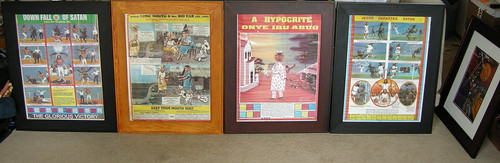
In considering the various responses to the themes of my ongoing series, I've been wondering what helps keep things together even when there is much cause for despair. Culture and art are the standard answers it seems. Another partial (if obvious) explanation in Africa is religion, and consequently the topic of this note is articles of faith. My entry point to the discussion will be a few Nigerian calendar posters that The Wife bought in Northern Ghana in 1999. Christianity and Islam are among the visible competitors in the cultural and political marketplaces of Africa and are no strangers to advocacy for our souls. Thus I direct your attention to a photoset: Articles of Faith.

The artist is a certain R. Nkwonta of CAS Creation; God's Providence Printers of Mushin, Lagos are the publishers. Posters and sign art of this sort are quite popular throughout West Africa. Nkwonta's are among the most distinctive I've seen. Religion and various social mores are his favoured topics and they are tackled with aplomb.

We are in the realm of pop art and agitprop - guerrilla marketing, in short, in the service of the Good Lord. Of late, there has been the move to digital presses but the motifs of traditional sign drawing have been preserved in these handpainted posters. The graphic style might be labeled folk art by ethnographers, or crude or primitive to certain eyes, indeed the strokes are broad and exaggerated. Much like traditional African theatre, or say the newfangled Nollywood movies, realism is beside the point. Rather it is all about the message, this is engaged art.

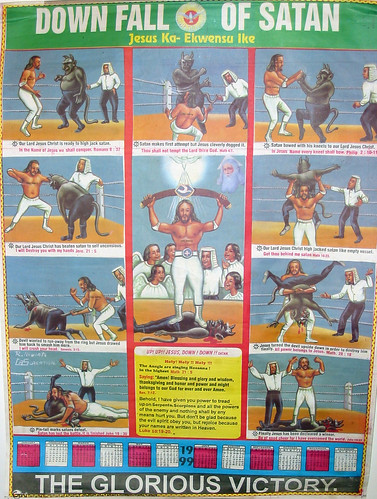
But less prose, let's start, if you will, with the downfall of Satan.

Fall from Grace


downfall of satan


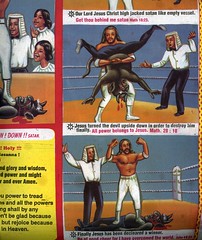
The story recounted in this poster is "The Glorious Victory" of Jesus over Satan in a hard fought wrestling match. It is worth paying attention to the panels of this low brow tale of angels and demons; a close reading is revelatory.

downfall of satan


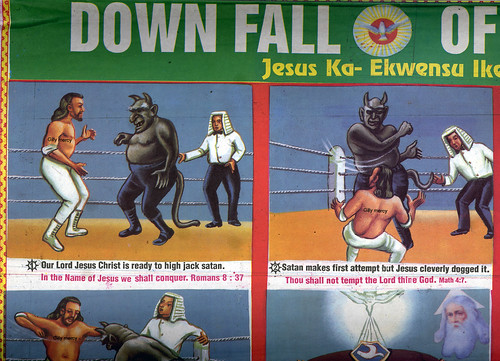
Each panel you'll note is accompanied with the requisite quote from scripture. A few typos notwithstanding, the point is easily conveyed. First:
Our Lord Jesus Christ is ready to high jack Satan.
Then:
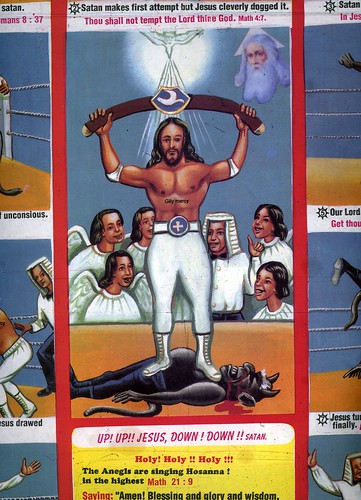
Satan makes first attempt but Jesus cleverly dodged it.
English is not the author's first language but we'll admit that the malapropisms are inspired: "dogged" is a good stand-in for "dodged" since the horned Satan is behaving like a vicious dog after all - not to mention his attire. The "high jack" spinebuster is an apt counterpoint to the "down fall" of the poster's title.

Presumably God, as the Supreme Justice, is the wigged-out referee in this wrestling bout. Also note that Jesus's tattoo, with the "Gilly Mercy" inscription, seems to shift position, from arm to back to chest, once again proving that the Lord works in mysterious ways. I hope one of my Nigerian friends can step in with a translation for Gilly (it is igbo right?).

downfall of satan 3


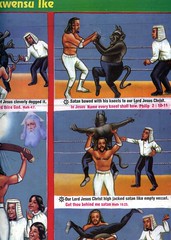
The fight is on and a curious dance seems to take place. It's not quite a foxtrot it's more like a capoeira. Nkwonta later explains that "Satan bowed with his knees to our Lord Jesus Christ". This is only fitting and we can treat the horned beast like the "empty vessel" he is.

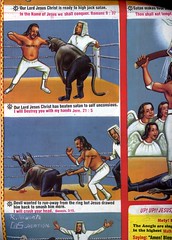
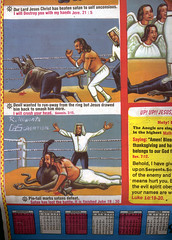
Soon enough we get to heart of the matter namely: "Our Lord Jesus Christ has beaten Satan to self unconscious". This is accompanied by Jeremiah's prophetic warning that "I will destroy you with my hands".

downfall of satan 4


The dripping blood from the wounded Satan is of no matter, this is an Old Testament aesthetic. We are told that "the Devil wanted to run away from the ring but Jesus drew him back to smash him more". As he drags Satan by the tail, Jesus's efforts are duly backed up with the words of Genesis 3:15:
I will crush your head.
My sunday school days of yore aren't too distant hence I would hazard that this verse refers to God admonishing Adam, Eve and the serpent.

Wrestling is a big tradition in certain parts of Nigeria. Nkwonta is undoubtedly a wrestling aficionado as are his protagonists who know all the high jacks and other sundry moves. We can only marvel at the technique displayed as "Jesus turned the devil upside down in order to destroy him".

downfall of satan 7


Thus we see that a "pin fall marks Satan's defeat" and, finally Of course, Jesus is declared the winner.

downfall of satan 6


"Up! Up!! Jesus, Down! Down!! Satan" is the ultimate message.

downfall of satan - victory


As the spirit descends in the form of a dove, Jesus, his six-pack abs rippling, holds his title belt aloft and delicately steps on the bleeding (and presumably permanently dealt-with threat from the perfidious Satan). Stepping on someone is about the most humiliating thing one can do; one can't understate the impact of the image is a society where respect and honour is paramount. All the time the angels smile and sing hosannas. My initial theory about God being the referee is proven mistaken, the bewigged referee is clearly part of the throng of angels. God is rather the spectral and enigmatic figure in the top right corner. The tropes of religious iconography have been duly satisfied.

Soul Struggle


We continue our discussion with a poster illustrating the ongoing competition for the soul of the African man.

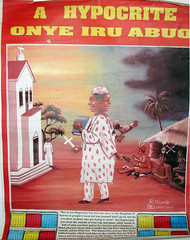
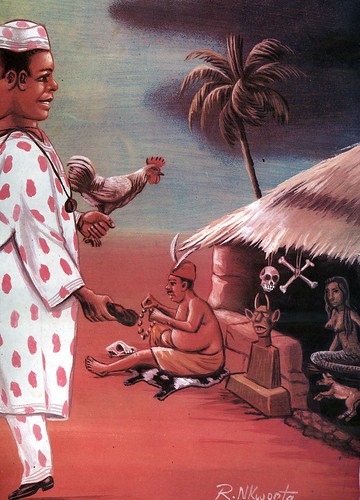
A hypocrite


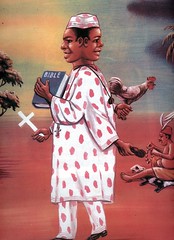
No words are minced in the case of a hypocrite. The overt purpose of this exhortation is the shaming of hypocrites: those who, on the one hand, take up the the cross and bible and, the next day, turn to 'darker' matters shall we say. This is of course is often framed as a matter of tradition and modernity. There is much gnashing of the teeth in these areas and it is not just in matters of religion that this contest takes place. As an example, doctors in contemporary Africa steeped in the expensive western medical tradition often have to worry about their patients visiting traditional healers (typically dismissed as fetish priests and the like). In that case there is very real concern about the interaction of the drug regimes with herbal remedies and the plant impurities often found in them.

A hypocrite - church


After heading to Church one day the hypocrite turns to worshiping of idols the next. Note the dark clouds forebodingly pregnant with tropical rain and worse. The chicken (or rather the fowl) to be slaughtered is at hand. The skull and bones, the dead animals, the bare-breasted woman in the shrine, this is the heart of darkness one might say. This is the popular conception of fetishes, juju, voodoo and traditional African religions. It is to be dismissed as superstition as testified to here by the clay or wood idolatry of the mask.

hypocrite locals


This has been a centuries old campaign in proselytizing of Africa in the encounter of Christianity and Islam with traditional African belief systems and religions. Those emblems of split allegiance are berated and ridiculed. The encomium is long
Woe to you hypocrites. You lock the door to the Kingdom of heaven to people's faces but you yourself don't go in nor do you allow in those who are trying to enter...
A sample headline in recent weeks in Ghanaian newspapers is along the same lines: Doom For Corrupt Leaders – Pastor Predicts
According to the Pastor, though this year 2007 biblically was a year of double blessings, any mischievous politician or reverend minister who intended taking undue advantage of his/her position to exploit the people especially the poor and less privileged was in for "double curses".
The accompanying image picked by the Ghanaweb editor to illustrate the devil is all pointy extremities as one might expect.

hypocrite


There is a long history behind Nkwonta's motif. Martin Meredith, discussing pre-independence Kenya, describes the oaths of loyalty the Kikuyu Central Association instituted in the 1920s:
the oath involved holding a Bible in the left hand and a handful of earth in the right hand pressed to the navel while swearing to serve the Kikuyu people faithfully.... [In the 1950s] the meat of a goat replaced the Bible... White farmers reported a mood of increasing truculence and incidents of cattle-maiming and sabotage.
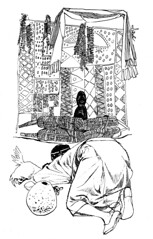
Back in Nigeria, Rems Nna Umeasiegbu spent a decade respectfully documenting Igbo traditions, customs and stories that appeared to be disappearing and published his findings in his 1966 book The Way We Lived. His illustration of a juju ceremony is in the same vein although perhaps a few minutes later than Nkwonta pictured it.

juju ceremony


The missionaries and colonists faced this intractable problem and the churches that were their legacy are still combating it and even apparently with greater fervour.

I recently noted that Busia commented on this issue when he asked "Has The Christian Faith Been Adequately Presented?". He framed the question as follows:
Some missionaries who have served overseas have unhappy recollections of trusted converts reverting, on certain occasions, to 'pagan' beliefs and practices. The experience was all the more stunning when the converts concerned were not the more recent ones, but Christians of long standing, sometimes with fine records of conspicuous service and loyalty. The problem takes on a new dimension when it is presented as part of the general problem of the encounter between Christianity and indigenous cultures.
He suggested a reversal of the typical context and advocated that the burden should be on the church to present itself as relevant to the local belief systems. In this vein, the art must reflect those themes - if only to subvert them; I suspect that Nkwonta is on board.

Match Made in Hell


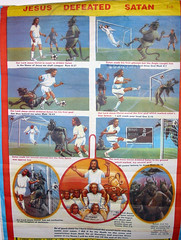
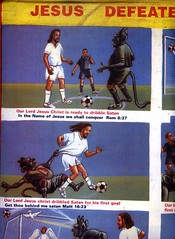
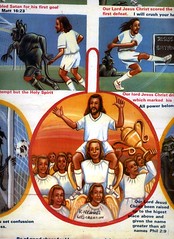
A living religion must strive to be relevant to its practitioner's lives and interests hence we return to the sports motif with a football match between Jesus and Satan.

jesus defeated satan 2-0


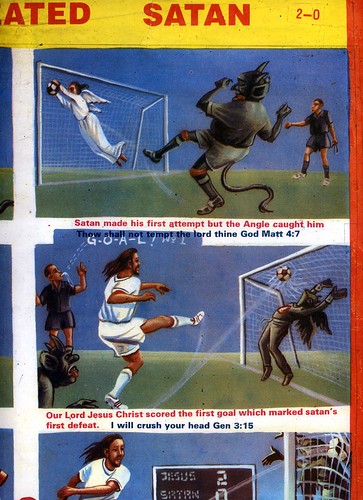
Despite the dastardly foul early in the game, Jesus dribbles past Satan for his first goal. As Matthew put it in his gospel "Get thou behind me Satan".

jesus defeated satan 1


A lot of fun was had in these panels and with economy in the illustrations. Observe the Angel flying to the right of the goal post to block Satan's first attempt with an athletic catch - Petr Cech would be proud.

jesus-defeated-satan 2-0


To punctuate Jesus Christ's first goal we return to that potent scripture quote: the crushed head business. Others translate it as "strike your head", regardless, trash talk doesn't get more direct.

The story proceeds:
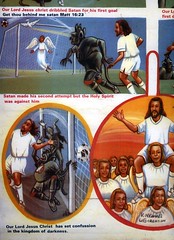
Satan then makes his second attempt but the Holy Spirit was against him.
The dove, embodying the spirit, diverts his attempt and the angel goalie, who had reacted tardily and would not have made the catch, skips happily, content at not having to make a difficult save. It pays to have friends in high places.

jesus defeated satan 3


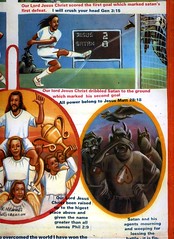
Note, later on, that Jesus heads the ball over the hapless defenders of evil. Evidently: "our Lord Jesus Christ has set confusion in the kingdom of darkness". Again the style displayed is akin to that of the writers of the New Testament gospels who strove in their depiction of Jesus's acts to underline the fulfilment of prophecies with pointers to passages in the Torah.

jesus-defeated-satan-04


Interestingly enough there is a third goal depicted "when the Lord dribbled Satan to the ground which marked his second goal". Given that the final score (in smaller print at the top right of the poster) is 2-0 for Jesus, it must mean that the header of the other panel was disallowed by the referee. Alternatively this discrepancy might be a reference to the eternal mystery of the Holy Trinity in Church doctrine. Catechists beware.

jesus defeated satan - victory


As one would expect, a victory celebration marks the end of the match.

There is much that can be asked about these posters but we'll keep our exegesis brief. Do note, for what it's worth, that all the angels seem to be women. I won't dive too deeply into this female subtext (The Magdalene Propositions); I'll only note that the issue of female clergy and ordination of such is currently rending the Anglican and Episcopal churches apart (along with the stance on homosexuality).

Similarly I'll pass over the issue of the ethnicity of Jesus. Is he simply very tanned? And what about the nappy hair? Are those dreadlocks or just your typical semitic features? The tattoo tradition? Is this simply artistic licence in the pursuit of audience empathy or is a more subversive reading warranted?

Morality Plays


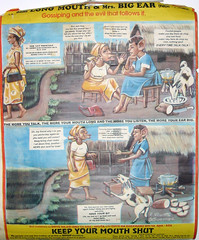
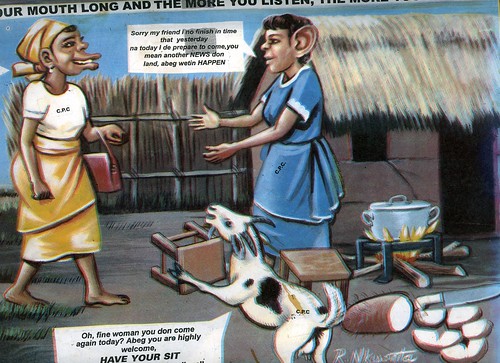
Overt religion is not the only mode that Nkwonta works in; social mores and behaviour fall under his purview - his is a complete worldview. Thus we turn to the case of Madam Long Mouth and Mrs Big Ear.

Madam Long Mouth and Mrs Big Ear


This poster is more in the vein of social commentary than religious admonition. He presents a typical morality play aimed at an audience who have recently left their rural abodes. The subject is "gossiping and the evil that follows it".

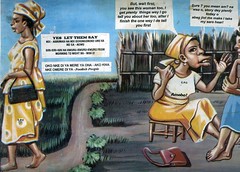
The object of her neighbour's gossip is saintly and minds her own business. "Yes let them say", she mutters to herself as she heads off to her good works.

Madam Long Mouth and Mrs Big Ear 1


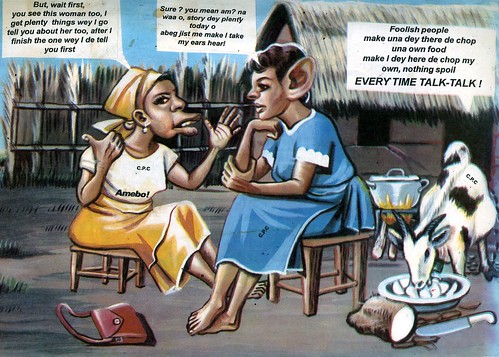
As for the neigbours, suffice to say that "every time talk talk". Long Mouth and Big Ear chat unconcernedly, neglecting their household duties, while the goat takes advantage to eat the yam from their plate.

Madam Long Mouth and Mrs Big Ear 2


The next day Long Mouth returns, presumably for more of the same. Big Ear is glad to hear that "another news don land". She asks "abeg wetin happen?". The goat is equally happy for the visit and brays:
Abeg you are highly welcome. Have your sit [sic].
Madam Long Mouth and Mrs Big Ear 4


The subtext is clear: "The more you talk, the more your mouth long, and the more you listen, the more your ear big."

The lesson is to "keep your mouth shut", your food and more will go to waste.

Nkwonta's versatility with the poster motif has been rightly picked up by a few ethnology publications. Social anthropologists would have a field day studying his full body of work. Take for example his poster of The First Lady Wine Tapper. Social uplift is his message.

Elsewhere, and less successful artistically, similar painted movie posters have been exhibited. In those cases, instead of social commentary or religiousity, it is in service of lurid commericalism as in Extreme Canvas: Movie Poster Paintings from Ghana. To my eye those don't attain the heights I've shown here.

Nigeria, like many other countries in Africa, has been struggling to regain confidence after several lost decades. Along with the millennial implications of 1999, Nigeria was then just emerging from the suffocation of the Abacha years - waiting for an angel as it were. One coping mechanism for the years of arbitrary misrule and hardship was a turn towards these new Christianities. In a matter of a few decades, these currents are now asserting themselves prominently in the zeitgeist.

You may think the sentiment here is cartoonish, or dismiss it as crude, that it could only work in developing countries where audiences are cupid. I believe that the appeal is rather in their ingenuous charm. You know where you stand when confronted with this kind of rhetoric as opposed to some of the sophisticates we see in the West that are neither here nor there. Perhaps a certain simplicity has mass appeal in these troubled times. The spread of charismatic churches has been noted in Africa. Evangelicals and baptists are on the rise everywhere. In the US currently the arguments are over conservatism, Darwin's God, atheism and the like. The new Pope, per contra, thinks we should talk more about hell these days. Milton in Paradise Lost didn't shirk from this notion and indeed dove in with the definitive account.

articles of faith


We often dismiss the opium of the masses as dangerous, doctrinaire and simple-minded. Yet there is considerable humour when presented with this kind of whimsy. The themes are expansive, appealing and direct. The hard knock life is a staple of the Great Game. We are starved for meaning and religious types and their printing presses are quick to fill those gaps and "educate" our souls. One needs to get down and dirty to compete in the marketplace of ideas. Hilarity is a weapon of choice.

Nkwonta seems to have fully internalized those beliefs; his creations are testament to ground level pragmatism. Springing from the trenches, he produces his tokens one panel at a time, bite-sized gestures towards a certain spirituality. This is a complex piece of advocacy, an expression displayed without artifice. Low brow it may be but this is art in full, and effective at that. You certainly can't be indifferent to these articles of faith.

Soundtrack for this note


A short playlist on our theme (spotify version)
  • Stevie Wonder - Superstition
    Mr Steveland Morris jumps in
    When you believe in things that you don't understand,
    Then you suffer
    Superstition ain't the way
    The alternative of course is the black magic of the wonderful Higher Ground from the Innervisions album.
  • Wayne Shorter - Juju
    Dense, tense and full of turmoil, this is the music of conflicted souls. It features Wayne Shorter's virtuoso saxophone pouncing from the dark on Elvin Jones drums and McCoy Tyner's piano.
  • King Sunny Ade - Juju Music
    Sunny Ade's laidback juju music continues to be a touchstone in West Africa. It is a conversation that calls out to listeners to participate. There are no boundaries between the musicians and the audience. Fodder for those late nights in urban spots, seductive sounds for all night comfort suites.

Next: Faith Healing

File under: , , , , , , , , , , , , , , , , , , , , ,