Showing posts with label wit. Show all posts

Tuesday, June 16, 2026

Recidivist

I murdered a metaphor
Crushed it after a long delay
I'll admit upfront, I was a repeat offender
And yes, my parole officer cautioned me about the terms of my probation
Severe he was, he reminded me about the restrictions on carrying weapons
And further advised me to not associate with writers wielding puns

But it was hard to resist the temptation
The twelve step program hardly had time to have an effect
Euphemism lingers in the body, I wondered if I would pass the drug test
Albeit irony works best at close quarters, I was afraid to use a gun
In the end it was appalling, I strangled it with my bare hands

I remember an earlier time when I didn't hesitate to plunge the knife
Trigger happy, I was especially fond of vicious verbal sallies
Flesh wounds, back then I was addicted to biting satire
The sting in the tail after lobbing hand grenades, double entendres
Or poisoning the well with exaggeration born of my misspent youth
After such lampooning, my many victims came to bloody ends

The teasing was drawn out in this case, it couldn't stand the torture
Begged me to put it out of its misery, I laughed while it murmured
As you know, in the torrid zone, many prefer the water treatment
I kept up the pressure, continued drip feeding wit for days on end
Believe me, with a steady diet of blood and sin, you get results
I tell you, the vivid scenarios I enacted, it was a veritable mess
You’ve, no doubt, heard in these parts of the heart of darkness

The ban on assault weapons had been revoked, I lived then in modern America
I'd sought refuge in wordplay, word fugitive, for such is my asylum
My predicament, internally displaced, it was a strange kind of life
I purchased soul insurance, prepaid the premiums due for the coffin
Literature only, funeral minded, it overwhelmed the senses

This, then, is my confession, it was not written under any duress
Mind you, I traffic in tall tales, I daresay I'm a recidivist
By the time you read this I'll have turned myself in to the authorities
To wit: yes, it was a dark and stormy night, in a far, faraway land
Something was in the water, when I murdered a metaphor again
At length I hammered away with my point and paid attention to the details
For when it comes down to it, to a writer, every story is a nail


tag cloud: Things Fall Apart


Murder, a playlist


A soundtrack for this note (spotify version) See previously: Soul Inspiration and The Early Bird Catches the Poem

File under: , , , , , , , ,

Writing log: February 5, 2023

Sunday, April 01, 2007

Articles of Faith

Let's have a look at some pop art to continue the Things Fall Apart series, this time an entry in the Comfort Suite.

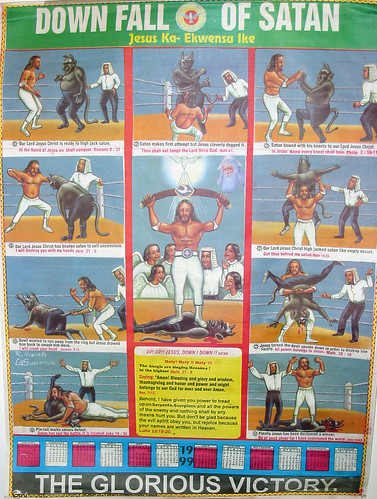
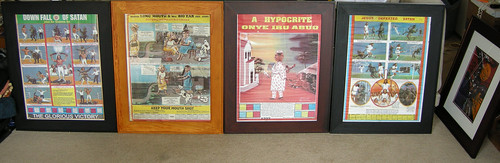
In considering the various responses to the themes of my ongoing series, I've been wondering what helps keep things together even when there is much cause for despair. Culture and art are the standard answers it seems. Another partial (if obvious) explanation in Africa is religion, and consequently the topic of this note is articles of faith. My entry point to the discussion will be a few Nigerian calendar posters that The Wife bought in Northern Ghana in 1999. Christianity and Islam are among the visible competitors in the cultural and political marketplaces of Africa and are no strangers to advocacy for our souls. Thus I direct your attention to a photoset: Articles of Faith.

The artist is a certain R. Nkwonta of CAS Creation; God's Providence Printers of Mushin, Lagos are the publishers. Posters and sign art of this sort are quite popular throughout West Africa. Nkwonta's are among the most distinctive I've seen. Religion and various social mores are his favoured topics and they are tackled with aplomb.

We are in the realm of pop art and agitprop - guerrilla marketing, in short, in the service of the Good Lord. Of late, there has been the move to digital presses but the motifs of traditional sign drawing have been preserved in these handpainted posters. The graphic style might be labeled folk art by ethnographers, or crude or primitive to certain eyes, indeed the strokes are broad and exaggerated. Much like traditional African theatre, or say the newfangled Nollywood movies, realism is beside the point. Rather it is all about the message, this is engaged art.

But less prose, let's start, if you will, with the downfall of Satan.

Fall from Grace


downfall of satan


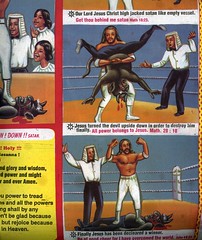
The story recounted in this poster is "The Glorious Victory" of Jesus over Satan in a hard fought wrestling match. It is worth paying attention to the panels of this low brow tale of angels and demons; a close reading is revelatory.

downfall of satan


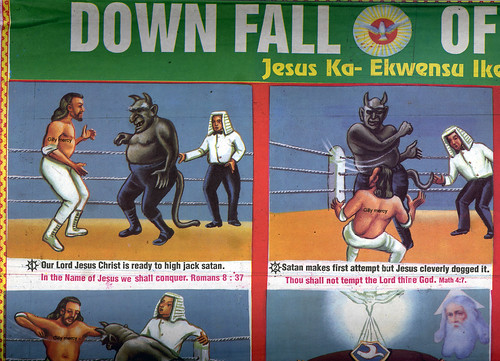
Each panel you'll note is accompanied with the requisite quote from scripture. A few typos notwithstanding, the point is easily conveyed. First:
Our Lord Jesus Christ is ready to high jack Satan.
Then:
Satan makes first attempt but Jesus cleverly dodged it.
English is not the author's first language but we'll admit that the malapropisms are inspired: "dogged" is a good stand-in for "dodged" since the horned Satan is behaving like a vicious dog after all - not to mention his attire. The "high jack" spinebuster is an apt counterpoint to the "down fall" of the poster's title.

Presumably God, as the Supreme Justice, is the wigged-out referee in this wrestling bout. Also note that Jesus's tattoo, with the "Gilly Mercy" inscription, seems to shift position, from arm to back to chest, once again proving that the Lord works in mysterious ways. I hope one of my Nigerian friends can step in with a translation for Gilly (it is igbo right?).

downfall of satan 3


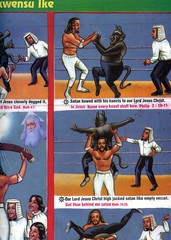
The fight is on and a curious dance seems to take place. It's not quite a foxtrot it's more like a capoeira. Nkwonta later explains that "Satan bowed with his knees to our Lord Jesus Christ". This is only fitting and we can treat the horned beast like the "empty vessel" he is.

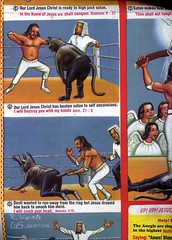
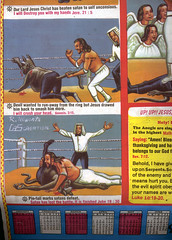
Soon enough we get to heart of the matter namely: "Our Lord Jesus Christ has beaten Satan to self unconscious". This is accompanied by Jeremiah's prophetic warning that "I will destroy you with my hands".

downfall of satan 4


The dripping blood from the wounded Satan is of no matter, this is an Old Testament aesthetic. We are told that "the Devil wanted to run away from the ring but Jesus drew him back to smash him more". As he drags Satan by the tail, Jesus's efforts are duly backed up with the words of Genesis 3:15:
I will crush your head.
My sunday school days of yore aren't too distant hence I would hazard that this verse refers to God admonishing Adam, Eve and the serpent.

Wrestling is a big tradition in certain parts of Nigeria. Nkwonta is undoubtedly a wrestling aficionado as are his protagonists who know all the high jacks and other sundry moves. We can only marvel at the technique displayed as "Jesus turned the devil upside down in order to destroy him".

downfall of satan 7


Thus we see that a "pin fall marks Satan's defeat" and, finally Of course, Jesus is declared the winner.

downfall of satan 6


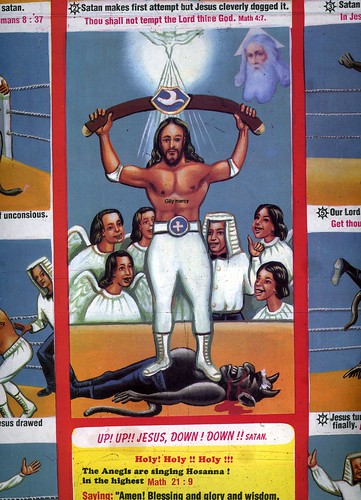
"Up! Up!! Jesus, Down! Down!! Satan" is the ultimate message.

downfall of satan - victory


As the spirit descends in the form of a dove, Jesus, his six-pack abs rippling, holds his title belt aloft and delicately steps on the bleeding (and presumably permanently dealt-with threat from the perfidious Satan). Stepping on someone is about the most humiliating thing one can do; one can't understate the impact of the image is a society where respect and honour is paramount. All the time the angels smile and sing hosannas. My initial theory about God being the referee is proven mistaken, the bewigged referee is clearly part of the throng of angels. God is rather the spectral and enigmatic figure in the top right corner. The tropes of religious iconography have been duly satisfied.

Soul Struggle


We continue our discussion with a poster illustrating the ongoing competition for the soul of the African man.

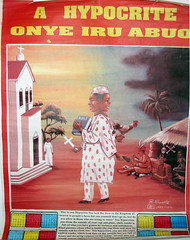
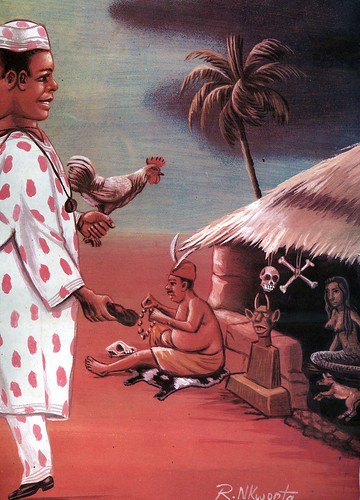
A hypocrite


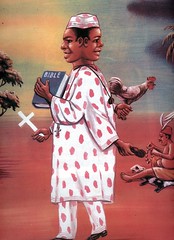
No words are minced in the case of a hypocrite. The overt purpose of this exhortation is the shaming of hypocrites: those who, on the one hand, take up the the cross and bible and, the next day, turn to 'darker' matters shall we say. This is of course is often framed as a matter of tradition and modernity. There is much gnashing of the teeth in these areas and it is not just in matters of religion that this contest takes place. As an example, doctors in contemporary Africa steeped in the expensive western medical tradition often have to worry about their patients visiting traditional healers (typically dismissed as fetish priests and the like). In that case there is very real concern about the interaction of the drug regimes with herbal remedies and the plant impurities often found in them.

A hypocrite - church


After heading to Church one day the hypocrite turns to worshiping of idols the next. Note the dark clouds forebodingly pregnant with tropical rain and worse. The chicken (or rather the fowl) to be slaughtered is at hand. The skull and bones, the dead animals, the bare-breasted woman in the shrine, this is the heart of darkness one might say. This is the popular conception of fetishes, juju, voodoo and traditional African religions. It is to be dismissed as superstition as testified to here by the clay or wood idolatry of the mask.

hypocrite locals


This has been a centuries old campaign in proselytizing of Africa in the encounter of Christianity and Islam with traditional African belief systems and religions. Those emblems of split allegiance are berated and ridiculed. The encomium is long
Woe to you hypocrites. You lock the door to the Kingdom of heaven to people's faces but you yourself don't go in nor do you allow in those who are trying to enter...
A sample headline in recent weeks in Ghanaian newspapers is along the same lines: Doom For Corrupt Leaders – Pastor Predicts
According to the Pastor, though this year 2007 biblically was a year of double blessings, any mischievous politician or reverend minister who intended taking undue advantage of his/her position to exploit the people especially the poor and less privileged was in for "double curses".
The accompanying image picked by the Ghanaweb editor to illustrate the devil is all pointy extremities as one might expect.

hypocrite


There is a long history behind Nkwonta's motif. Martin Meredith, discussing pre-independence Kenya, describes the oaths of loyalty the Kikuyu Central Association instituted in the 1920s:
the oath involved holding a Bible in the left hand and a handful of earth in the right hand pressed to the navel while swearing to serve the Kikuyu people faithfully.... [In the 1950s] the meat of a goat replaced the Bible... White farmers reported a mood of increasing truculence and incidents of cattle-maiming and sabotage.
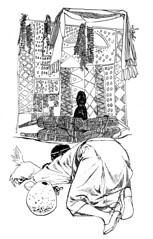
Back in Nigeria, Rems Nna Umeasiegbu spent a decade respectfully documenting Igbo traditions, customs and stories that appeared to be disappearing and published his findings in his 1966 book The Way We Lived. His illustration of a juju ceremony is in the same vein although perhaps a few minutes later than Nkwonta pictured it.

juju ceremony


The missionaries and colonists faced this intractable problem and the churches that were their legacy are still combating it and even apparently with greater fervour.

I recently noted that Busia commented on this issue when he asked "Has The Christian Faith Been Adequately Presented?". He framed the question as follows:
Some missionaries who have served overseas have unhappy recollections of trusted converts reverting, on certain occasions, to 'pagan' beliefs and practices. The experience was all the more stunning when the converts concerned were not the more recent ones, but Christians of long standing, sometimes with fine records of conspicuous service and loyalty. The problem takes on a new dimension when it is presented as part of the general problem of the encounter between Christianity and indigenous cultures.
He suggested a reversal of the typical context and advocated that the burden should be on the church to present itself as relevant to the local belief systems. In this vein, the art must reflect those themes - if only to subvert them; I suspect that Nkwonta is on board.

Match Made in Hell


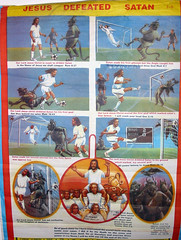
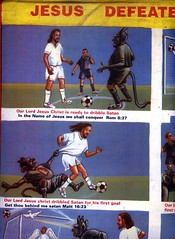
A living religion must strive to be relevant to its practitioner's lives and interests hence we return to the sports motif with a football match between Jesus and Satan.

jesus defeated satan 2-0


Despite the dastardly foul early in the game, Jesus dribbles past Satan for his first goal. As Matthew put it in his gospel "Get thou behind me Satan".

jesus defeated satan 1


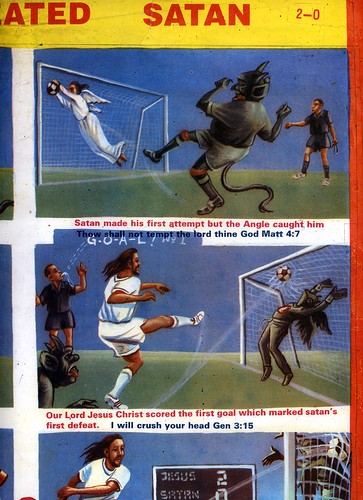
A lot of fun was had in these panels and with economy in the illustrations. Observe the Angel flying to the right of the goal post to block Satan's first attempt with an athletic catch - Petr Cech would be proud.

jesus-defeated-satan 2-0


To punctuate Jesus Christ's first goal we return to that potent scripture quote: the crushed head business. Others translate it as "strike your head", regardless, trash talk doesn't get more direct.

The story proceeds:
Satan then makes his second attempt but the Holy Spirit was against him.
The dove, embodying the spirit, diverts his attempt and the angel goalie, who had reacted tardily and would not have made the catch, skips happily, content at not having to make a difficult save. It pays to have friends in high places.

jesus defeated satan 3


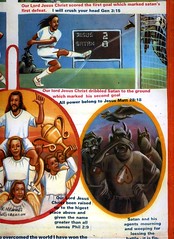
Note, later on, that Jesus heads the ball over the hapless defenders of evil. Evidently: "our Lord Jesus Christ has set confusion in the kingdom of darkness". Again the style displayed is akin to that of the writers of the New Testament gospels who strove in their depiction of Jesus's acts to underline the fulfilment of prophecies with pointers to passages in the Torah.

jesus-defeated-satan-04


Interestingly enough there is a third goal depicted "when the Lord dribbled Satan to the ground which marked his second goal". Given that the final score (in smaller print at the top right of the poster) is 2-0 for Jesus, it must mean that the header of the other panel was disallowed by the referee. Alternatively this discrepancy might be a reference to the eternal mystery of the Holy Trinity in Church doctrine. Catechists beware.

jesus defeated satan - victory


As one would expect, a victory celebration marks the end of the match.

There is much that can be asked about these posters but we'll keep our exegesis brief. Do note, for what it's worth, that all the angels seem to be women. I won't dive too deeply into this female subtext (The Magdalene Propositions); I'll only note that the issue of female clergy and ordination of such is currently rending the Anglican and Episcopal churches apart (along with the stance on homosexuality).

Similarly I'll pass over the issue of the ethnicity of Jesus. Is he simply very tanned? And what about the nappy hair? Are those dreadlocks or just your typical semitic features? The tattoo tradition? Is this simply artistic licence in the pursuit of audience empathy or is a more subversive reading warranted?

Morality Plays


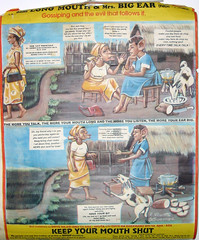
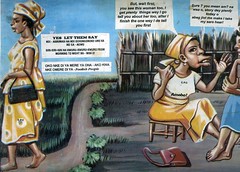
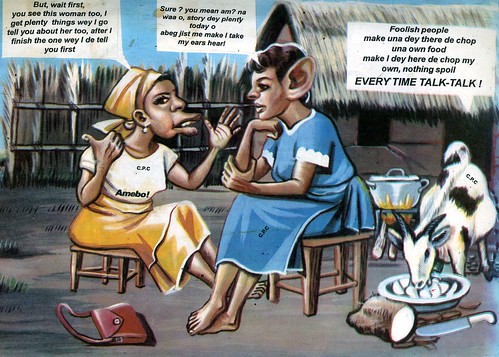
Overt religion is not the only mode that Nkwonta works in; social mores and behaviour fall under his purview - his is a complete worldview. Thus we turn to the case of Madam Long Mouth and Mrs Big Ear.

Madam Long Mouth and Mrs Big Ear


This poster is more in the vein of social commentary than religious admonition. He presents a typical morality play aimed at an audience who have recently left their rural abodes. The subject is "gossiping and the evil that follows it".

The object of her neighbour's gossip is saintly and minds her own business. "Yes let them say", she mutters to herself as she heads off to her good works.

Madam Long Mouth and Mrs Big Ear 1


As for the neigbours, suffice to say that "every time talk talk". Long Mouth and Big Ear chat unconcernedly, neglecting their household duties, while the goat takes advantage to eat the yam from their plate.

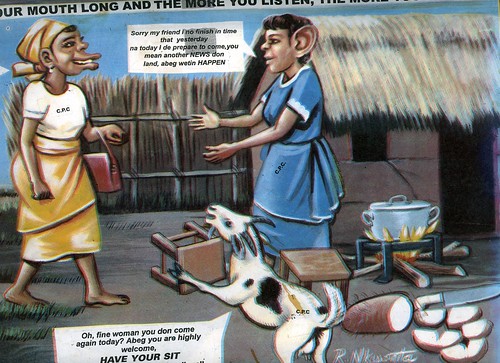
Madam Long Mouth and Mrs Big Ear 2


The next day Long Mouth returns, presumably for more of the same. Big Ear is glad to hear that "another news don land". She asks "abeg wetin happen?". The goat is equally happy for the visit and brays:
Abeg you are highly welcome. Have your sit [sic].
Madam Long Mouth and Mrs Big Ear 4


The subtext is clear: "The more you talk, the more your mouth long, and the more you listen, the more your ear big."

The lesson is to "keep your mouth shut", your food and more will go to waste.

Nkwonta's versatility with the poster motif has been rightly picked up by a few ethnology publications. Social anthropologists would have a field day studying his full body of work. Take for example his poster of The First Lady Wine Tapper. Social uplift is his message.

Elsewhere, and less successful artistically, similar painted movie posters have been exhibited. In those cases, instead of social commentary or religiousity, it is in service of lurid commericalism as in Extreme Canvas: Movie Poster Paintings from Ghana. To my eye those don't attain the heights I've shown here.

Nigeria, like many other countries in Africa, has been struggling to regain confidence after several lost decades. Along with the millennial implications of 1999, Nigeria was then just emerging from the suffocation of the Abacha years - waiting for an angel as it were. One coping mechanism for the years of arbitrary misrule and hardship was a turn towards these new Christianities. In a matter of a few decades, these currents are now asserting themselves prominently in the zeitgeist.

You may think the sentiment here is cartoonish, or dismiss it as crude, that it could only work in developing countries where audiences are cupid. I believe that the appeal is rather in their ingenuous charm. You know where you stand when confronted with this kind of rhetoric as opposed to some of the sophisticates we see in the West that are neither here nor there. Perhaps a certain simplicity has mass appeal in these troubled times. The spread of charismatic churches has been noted in Africa. Evangelicals and baptists are on the rise everywhere. In the US currently the arguments are over conservatism, Darwin's God, atheism and the like. The new Pope, per contra, thinks we should talk more about hell these days. Milton in Paradise Lost didn't shirk from this notion and indeed dove in with the definitive account.

articles of faith


We often dismiss the opium of the masses as dangerous, doctrinaire and simple-minded. Yet there is considerable humour when presented with this kind of whimsy. The themes are expansive, appealing and direct. The hard knock life is a staple of the Great Game. We are starved for meaning and religious types and their printing presses are quick to fill those gaps and "educate" our souls. One needs to get down and dirty to compete in the marketplace of ideas. Hilarity is a weapon of choice.

Nkwonta seems to have fully internalized those beliefs; his creations are testament to ground level pragmatism. Springing from the trenches, he produces his tokens one panel at a time, bite-sized gestures towards a certain spirituality. This is a complex piece of advocacy, an expression displayed without artifice. Low brow it may be but this is art in full, and effective at that. You certainly can't be indifferent to these articles of faith.

Soundtrack for this note


A short playlist on our theme (spotify version)
  • Stevie Wonder - Superstition
    Mr Steveland Morris jumps in
    When you believe in things that you don't understand,
    Then you suffer
    Superstition ain't the way
    The alternative of course is the black magic of the wonderful Higher Ground from the Innervisions album.
  • Wayne Shorter - Juju
    Dense, tense and full of turmoil, this is the music of conflicted souls. It features Wayne Shorter's virtuoso saxophone pouncing from the dark on Elvin Jones drums and McCoy Tyner's piano.
  • King Sunny Ade - Juju Music
    Sunny Ade's laidback juju music continues to be a touchstone in West Africa. It is a conversation that calls out to listeners to participate. There are no boundaries between the musicians and the audience. Fodder for those late nights in urban spots, seductive sounds for all night comfort suites.

Next: Faith Healing

File under: , , , , , , , , , , , , , , , , , , , , ,

Sunday, June 04, 2006

Jaundiced Zingers

Further nuggets for the toli scrapbook... ala Dictionnaire des Idées Reçus (Dictionary of Received Ideas) from Gustave Flaubert.

Hatchet Jobs

Choosing Denis Sassou-Nguesso over President Omar Hassan Ahmed Bashir of Sudan is sort of like passing up Idi Amin in favor of Moammar Kadafi.

— From an LA Times editorial, To lead Africa, commenting on the election of a new president of the African Union and how a gun-running rogue won out over the "slow genocide 'moderate' jihadist". The choices we have in Africa... God help us.

The anemic Mr. Shakespeare specializes in meaningful pauses and cryptic silences. A pastel watercolorist, a stylistic vegetarian, he is inadequate to the task.

— William Grimes on Nicholas Shakespeare's In Tasmania

The God of Small Things is a hit with coffeehouse book clubs now for the same reason that To Kill A Mockingbird was a hit with Reader's Digest types fifty years ago. Both affirm the dim simplicities: Children are innocent; grownups are bad. Love is good; prejudice is bad.

— John Dolan on Arundhati Roy: The Goddess of Big Lies, part of the "Great Literary Frauds of Our Time" series.

Now, I know it’s customary in D.C. journalism to understand Harry Truman the way Joe Klein does: as a symbol, as a lovable, plain-spoken guy from the "heartland" largely unconnected to actual politics... So maybe it’s a little unfair of me to call attention to what Truman actually said. But Mr. Klein’s repetitive invocation of Truman, plus a little regional pride in the man, compelled me to look up the Turnip Day speech. Having listened to a recording of it, I think Mr. Klein is right in insisting that it be regarded as a model for Democratic candidates. I can also report that what Truman said in the speech is in almost every particular the precise opposite of what Joe Klein advises contemporary Democrats to say.

— Thomas Frank on Joe Klein's Turnip Day. A great piece on the fetishization of "authenticity" which apparently only Joe Klein is able to discern accurately.

Wherefore The Vicar of Bray?


I do love a good savaging of some of the blowhards that pass for public intellectuals, it keeps them on their toes - well it occasionally serves to reduce the chutzpah quotient. I am still gearing up to take on Thomas Friedman whose intellectual acrobatics, like those of David Brooks or Joe Klein, continue to be a source of wonder. When I think about the malleability of their rhetoric, I turn back to the poem and song in which the case was best laid out about willing chameleons and their agility in retooling their message for the talking point of the day, the Church of Rome and its authoritarian ways.
The Vicar of Bray

In good King Charles's golden days,
When Loyalty no harm meant;
A Furious High-Church man I was,
And so I gain'd Preferment.
Unto my Flock I daily Preach'd,
Kings are by God appointed,
And Damn'd are those who dare resist,
Or touch the Lord's Anointed.
Indulgences are many...


Cryptonomicon consisted of nerdish Mary Sues afloat in a sea of Cliffs Notes for popular science books. Angels and Demons retains the nerd protagonists but adds a layer of cack-handed James Bond stuff.

— Kieran Healy cast his jaundiced eye on Dan Brown's Angels and Demons; the result was succint and savage.

The modern Republican Party is the result of collusion between a movement to take U.S. jurisprudence to the pre-Depression era, and a movement to take culture back to the pre-Enlightenment era. It is doomed because the latter would like a theocratic state to regulate culture, and the former want to smoke dope and look at dirty pictures.

— Max Sawicky - Maxspeak Maxim IX. See also Maxim V.

Dada by way of Funkadelic

What is the source of food for thought?
Ego-munchies
Image doggie bags
A me burger with I sauce on it
A myself sandwich
A personal burger
Hamburger
And a glass of constricted cola
Out to lunch with lunch meat
The fear of being eaten by a sandwich

Low calorie logic
Muscle brain, skinny brain
Count the calories of your thoughts

— Funkadelic - Promentalshitbackwashpsychosis Enema Squad (The DooDoo Chasers) from their 1978 masterpiece One Nation Under a Groove.

Singing during a Carterian window (pre-malaise) and shrewdly antipicating a Reagan retrenchment, Star Wars, Iran/Contra, El Salvador and crack epidemics, Mike Hampton's guitar, Bootsy Collins's bass and Bernie Worrell's keyboards laid a musical soundscape that meshed with George Clinton's escapism and scatological insight. The band were at their peak and Doo Doo Chasers and Maggot Brains were on the menu. How I wish the P-Funk crew would provide a musical deconstruction of the current moment. An Emersonian transformation is sorely needed.

On Napoleon's Tooth


A priceless cab ride; you should read it all
"Funniest trip I ever had to make," said the taxi driver. "Now, you'll like this one . . ."

"So I gets a call on me wireless," he continued, "an' 'e says; 'Ere, I've got one for you.'

"I says, 'Oh, yeah,' and 'e says, 'Yeah, you're gonna like this one, I want you to go to this address, in Kensington, pick up Napoleon's tooth and take it to Swindon for auction.'

"I says, 'You what ?' 'E says, 'You 'eard. Napoleon's tooth. An' I 'ope you're insured 'cos it's worth 8,000 nicker.'

[snip further hilarity]

"Well yeah, still, I'll tell you somefin'. You gotta 'and it to his dentist, 'aven't you? 'E shoves that tooth to one side, an' e says, 'I'll 'ave that and I'll keep 'old of it till someone invents eBay.'"

Sentences I Loved Writing

You know too the stereotype about black men, that we have large... vocabularies.

The ballads alone might cause unwanted pregnancies and bring opportunist politicians into your bedroom.

I know my place in America: at the intersection of Tenuous St and Hired Immigrant Worker Alley.

Rendition also reminds one of the worst practices of the meat rendering industry which we know indubitably leads one down the path to Mad Cow Square.

A Title for Future Toli?

Being emotionally in your pajamas.
I'm not quite ready to write something that does does justice to that title hopefully that could be next year's project. In any case feel free to use it.

Delineating Dysfunction


From one of my favourite songs of the past few years that I rediscovered last Christmas.
I really love it when,
I love it when we make mistakes
Because once again,
It gives me reason to complain

I love the battle lines
The battle lines we draw and cross in the mud
I love it when we fight
Standing on the verge of breaking up or making love.

What would I do if we were perfect?
Where would I go for disappointment?

Love without pain would leave me wondering why I stay.

I think of saving myself
But with nothing to complain about up in heaven what would I do?
Saving myself, but I really want to work it out
Down here in hell (with you)

Van Hunt - Down Here in Hell (With You)
I view this beautiful song (discussed recently at Breath of Life, my Sunday morning guilty pleasure) as an update of what Prince has sung: "what's this strange relationship that we hold on to?". In troubled times, when we are all singing the inflation calypso, we are prone to anaesthetize ourselves in nostalgia. Still, artists and grifters will always find a fertile ground celebrating the dsyfunction of the B-movie theory especially in America. It is no surprise that Elijah Muhammed and Berry Gordy arose during the civil rights movement or that Iceberg Slim wrote during Vietnam and Nixonian larceny and so forth. In this vein, it stands to reason that Van Hunt's father was "a part-time painter and a pimp" as he recounts in his musical autobiography. From this springs forth his ground level view of dysfunction and the hard sell. His observations of the hustler ethic informs his music and it leaves him "curious about what it was that happened during the day that makes people do what they did at night". As he puts it, "it is the inner turmoil and struggle to remain sane that stimulates" him. A personal sign of the times and melodious music to boot. You can sample the acoustic version of the song for the next few days.

The Fluidity of Ideas


Circa 1988 or so, I could often be found saying
Dancing is expressing in the perpendicular your intentions for the horizontal.
as part of my teenage flirtation arsenal. It served to lower people's guard in parties and the occasional nightclubs. I continue to use the expression since I believe in sticking with formulas that work. I never quite figured out where I got the witticism from and, for a while, was quite chuffed at myself. Of course that was just intellectual laziness and Google being the great Oracle, it took 0.3 seconds to get the correct source, George Bernard Shaw, and formulation:
Dancing is a perpendicular expression of a horizontal desire.
I prefer the original to the toli remix but I'm tickled also by the derivation. It stands to reason that back in 1988 I directed a George Bernard Shaw play, Passion, Poison and Petrification or the Fatal Gazogene. I was even rereading said play last month and considering giving it a toli remix in the things fall apart series. The sampling of music and hyperlinking of snippets on the web are proxies for the fluidity of ideas in the modern world. We're all standing on the shoulders of giants and I wonder how many other notions are being reinvented and reinterpreted these days.

This Fanon Paddy


There aren't many who write on Ghana in the blogosphere but those that do always bring different perspectives to the conversation and with sometimes startling turns of language. I quite like this pidgin deconstruction of Fanon's ideas.
If we all start live like Americans aa, the earth no go fit handle am.

Apart from that, America too have in own problems. One of den problems be public squalor versus private opulence. Even though most parts be ok, more yards be nasty whereas some other posses dey live in fantastic neighborhoods.

That no shedaa be dangerous for a place where dema middle class be large. But transport such an idea to Ghana den trouble... Few obscenely rich people and many poor people. That just be the recipe for armed robberies and Ataa Ayis, no be so?
Be so, Paa Kwesi, it be so.

Further Proverbial Zingers


A Ghanaian proverb I discovered from a French blog now sadly disappeared from the ether. Said blog apparently doesn't believe that permalinks should be permanent - this brittle web of ours.
Si tu transpire c'est qu'il y a un motif.
roughly translated as
There must be a reason that you find yourself sweating.
If anything the proverb is reminiscent of
where there is smoke there is fire.
It sounds quite nice when rendered in French, I wonder if 5 years from now the French will be claiming it as their font of wisdom. I hope therefore that someone can fill me in on the wording in the original language (is it twi?) I don't remember running across it previously.


I recently pointed out this one
Trust God implicitly but always tie your camel up at night - proverb from Northern Ghana
Nothern Ghanaians have a quite fatalistic outlook on the world as exemplified their proverbial sayings.

[Update] It turns out that the Prophet Mohammed as noted by Al-Tirmidhi was the origin of the above saying, the fluidity of ideas again. The story is that
One day Prophet Muhammad, noticed a Bedouin leaving his camel without tying it. He asked the Bedouin, "Why don't you tie down your camel?" The Bedouin answered, "I put my trust in Allah." The Prophet then said, "Tie your camel first, then put your trust in Allah"
If I recall correctly, Ali Mazrui has a bit about how Mohammed was the only one of the great semitic prophets (following the Rule of Four Mazrui meant Jesus, Mohammed, Marx and Freud) who experienced upward mobility during his lifetime and how it coloured the resulting outlook on life. Hence the practicality and some say dogma of Islam. One of my biggest blindspots in my reading of Africa is that I discount the Islamic influences. Well Mazrui is a good starting point to rectify that and Amazon will be getting more of my money...
If God breaks your leg he will teach you how to limp - Dagbani proverb, Ghana
It stands to reason that they deal with conflict in ways that mystify their fellow countrymen.


On my maternal side, in the Volta region, they are concerned with being prepared and using the right tool
When you have a club, you don't kill a snake with bare hands - Ewe proverb, Ghana
I wonder if the nail and hammer trope sprung forth from this notion or if it is the other way around? Cultural interplay is the order of the day.

Mobile Phone Wisdom


Mobile phones have taken off in a big way in Ghana in the past five years (I am due for some musings on the topic) and, as elsewhere, they are affecting our vocabulary. Thus:
"Out of coverage area."
That was the reply to a question about whether a friend back home currently had a boyfriend. I knew exactly what she meant.

There is much in my life that is out of coverage area, we need some soothing balms for these huhudious times. As it turns out, it is a simple matter of erecting cell phone towers everwhere and building redundancy into the system. But then there's the matter of getting over the "not in my backyard" business. Someone needs to build these metaphorical infrastructural edifices to preserve the commons. I know I'm trying to build a few in this joint. Your contributions are welcome...

See earlier wistful and proverbial zingers.

File under: , , , , , , , , , , , , , , , , ,

Wednesday, May 25, 2005

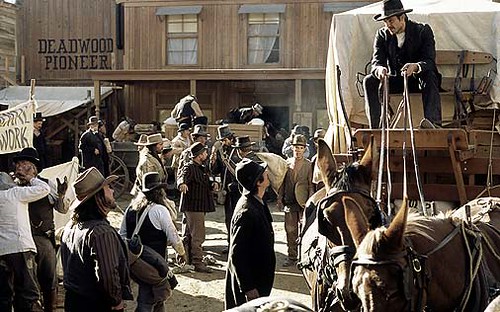
Deadwood and the Web Application Leap

I came across the following script in my travels. Thought I'd share. The note scribbled on it was:

A spaghetti western in the technology world of the town of Deadwood, Wild West, USA.

Elevator Pitch

My previous Ananse folktales seemed to go down well with a certain audience as a kind of biblical, Grimm's tales of "African magic realism" as The Guvnor put it. At the risk of carrying that Autumn of the Patriarch conceit too far, I was reminded of westerns, of the spaghetti variety, when I came across the following insightful tidbit from Rands in Repose who you can imagine as Sergio Leone surveying the state of the current technology world and deciding to go local. It's not quite the masterpiece that was The Good The Bad & The Ugly which saw a great print released last year or the earlier and crueler For A Few Dollars More, it's rather that first shot across the bow of B-movie legend, A Fistful of Dollars. So without further ado as your novice director, let me sit back in my chair.
Lights. Camera. Action.
A Fistful of Dollars

Scene I: The Web Application Leap

[Voiceover by "Rands" as a wagon pulls into town]
The size of the fervent rush towards the Ajax reminds me that folks are dying to discover the Next Big Thing. It's been awhile since we've had a Netscape-magnitude holy shit and while there are have been many false positives... has any Internet technology in the past two years seriously knocked your socks off? Well, Ajax has not knocked my socks off, but I believe it's a indication of a revolution that will involve all of us... but understanding that revolution will take one leap of faith on your part... It's illuminating that the first stumbling block folks who are playing with Ajax are finding is that damned back button. At my prior gig, we had the same problem. We gave our users a complex web application that provided all sorts of cool filtering and sorting controls.... that could be instantly totally nuked by the back button... a shift reload.... you name it... ka-blooey, your state is gone. Ajax's doesn't care about the stateless nature of a web browser. Ajax just wants to quietly update your current page... and that's the second part of the first leap:

Stop thinking of a web application as a collection of pages.

The back button is not a bug in Ajax, it's a flaw in the browser metaphor.

I hearby serve notice to the following browser controls: forward, back, home, reload, and that URL field. You need to die... unless I need you. These controls are (rightfully) designed around the idea of the web as a collection of pages, but an application is collection of objects where you, the user, are guided by a well designed interface to get your job done. We don't actually need to kill these controls because they do serve a purpose, but the web application developer should be able to choose when they're available because the developer is designing the application and they are incented to do what's right for their users.

No. The perfect web application will never be a direct replacement for your favorite native application. The medium, the technology that is the Internet, will always change the content that it delivers, but web applications are still in the dark ages. Take a leap with me and think about web applications that do not compromise in user interface, that do not settle for interaction models designed around a clumsy metaphor. All the richness of the best desktop application belongs in web applications.... all you gotta do is want it.
wagon arrives in Deadwood

Scene II: Every Man For Himself

With this increased interactivity comes a few pitfalls and lets hope people don't go overboard. For the vast majority of applications it should be a case of adding unobtrusive javascript to enhance the experience (mostly to reduce latency). Things like in-place editing without page reloads are fair enough. We should think clearly about some of the additional things that are indeed possible in the user interface. As people start experimenting with the drag and drop and the enhanced user experience that Lotus K-station and various other applications were implementing 7 years ago, lets be judicious about what makes sense.

Let's not forget the basic principles of interaction design and mundane things like bookmarking, the back button and the other familiar landmarks our users have come to expect. That's not to say that the browser is the be-and-end-all of user interface design. As we "innovate" in this Brave New World, lets think about best practices from the Old Country and codify the design patterns both in terms of the coding that we actually come up with but crucially also in terms of the user interfaces we develop.

Scene III: Deadwood

We're seeking a Beverly Hills of web applications not a Deadwood Wild West of Windows applications each with their idiosyncratic notion of how things are done.

I love cursing, outlaw justice, bodice ripping pimps, prostitutes, con men, adventurers, opportunists, charlatans and all sorts of entrepreneurial adventurers as much as the next guy. Truth be told, it has pretty much been a Wild Web for the past decade. But lets not forget the downside:

  • the grim sloppiness and greyness of it all
  • the stench of human and other waste
  • the corrosive effect of smoke
  • the pervasive mud soiling everything in sight

Let's not forget the hard and brutish lives of those indentured to 19th century brothels, the brackish drinking water, the syphillis and smallpox, the rampant infant mortality and young mothers dying while giving birth to children. And then let's not mention the life expectancy in this environment and the Chinaman's pigs eating up the detritus of dead bodies as a convenient disposal method for the canny, vicious strongman who really runs the town. The Chinese saying goes "May you live in interesting times" and indeed in these times of retrenchment of IT budgets, deficits, crusades and Global Wars on something or other, these are interesting times...

Scene IV: Frontier Justice

While I loved the Wild Wide Web, I've mostly hated the monopoly-induced stagnation of the past 5 years. It was jarring and a blow to the great momentum and innovation that had been built up in the early days of the web. Now that last comment might seem like a cheap shot but remember that in the movie, Clint Eastwood's Man with No Name is treacherously playing off rival gangs of criminals and smugglers against each other like in Yojimbo so bear with me.

In any case, as Dare Obasanjo keeps reminding everyone these days the XMLHttp voodoo that is now being exalted was developed by Microsoft. And he has the right idea, Internet Explorer 5.0 was indeed the first browser to have a reasonably complete Dynamic HTML implementation where one could treat the browser as a dynamic surface that could be manipulated programmatically. Indeed Netscape and Opera didn't have monopolies on innovation and adopted lots of the great ideas from Microsofties who sat alongside them in the same W3C and IETF mailing lists where the constitutionnal council of the web was hashed out. And yes Dare, we really need to celebrate all the marshalls who were part of Buffalo Bill's posse.

Scene V: Calamity Jane

When I was developing K-station, I might have complained about the long nights I had to spend pondering the sometimes willfully idiosyncratic syntax in MSIE, the numerous undocumented quirks, the constant battles with focus, the inexplicable modal dialogs, the buggy scripting engine (what is it about scope and JScript by the way? what was wrong with calling it JavaScript? and why did everything need a setTimeout call to work robustly in IE 5.0) and don't get me started about the quirks in the Trident engine's implementation of CSS box model which has caused much head scratching and even is the focus of countless QuirksMode sites and Usenet groups. But with pickaxes, perspiration and youthful zeal to survive, having crossed oceans to escape Potato Famines, religious persecution or plain "invitations with shackles" for those unlucky to hail from Dark Continents, those of us who arrived in Deadwood were able to make do of things as we found them and actually build useful things in browsers.

Madman that I am, I tried to wrangle that beastly rodeo horse called Netscape 4.7 and almost lost my mind. I certainly broke a few bones in the process: it was a thoroughbred that couldn't be tamed. Thus the competition wasn't pretty and was even lacking in parts although they had advantages in areas other than programmability: faster rendering, multiple platforms beyond broken windows, better standards support etc. But lets be clear, once the Netscape/Sun/Novell/IBM threat was dealt with circa 1999/2000, development of Internet Explorer was plainly mothballed. It was only once the rewrite-from-scratch coal miners in the caves of Mozilla-land struck gold that we now hear about Internet Explorer 7 and that that new features will be coming in the browser which apparently can evolve seperately from the operating system.

Since I've always wanted the code that I write to work in my browser of choice, I continued to try to make our portal framework run in Mozilla-based browsers and was a frequent visitor to the Bugzilla bar-rooms in the hope that I would see progress. The Mozilla 0.7 milestone was the point at which I could say that we had a new sheriff in town; Calamity Jane no longer had to stand alone mourning Wild Bill Hickok. Certainly it was the first release in which one could see part of the K-station portal user interface show up. At that stage there were still things like an incomplete scroll model, lack of xml serialization and easy xml loading. But that lack was understandable, as Creationist Pilgrims that had read from the gospel of the W3C, the Mozilla folks would only take features that were inscribed therein. It took some convincing for them to implement items that were useful even if not New Testament material: Apocryphal books from the Latter-Day Church of Redmond.

Once the Mozilla M8 milestone arrived, the air had cleared and the new sheriff was beginning to assert himself. I was able to unleash the Mozilla support in the portal on scared product managers everywhere. People began to take notice and a little ripple of excitement run through everyone in the bar.

Scene VI: Winner Takes All

I recall a memo from someone about getting hardcore about the web in the hazy past. Was that a flashback or repressed memory? But I haven't seen a single CSS box model issue addressed in 5 years (I hope to be proved wrong in this summer's release). I've seen security updates and of late a pop-up blocker but did an asteroid hit all the browser developers in Redmond when Y2K came about? Did Lee Van Cleef ruthlessly deal with them in his ugly but efficent way? Or was it rather that a bunch of Apaches, led by Burt Lancaster, raided The Alamo?

Now all of the above was written with tongue firmly in cheek of course. I've read the "Don't Pick Fights" injunction in IBM's blogging guidelines. More to the point, I'm sure that if Netscape/AOL, Lotus/IBM, Apple, Sun, Adobe, Novell, Oracle or any of these other players had their way in the game of high stakes poker that is the technology world, their behaviour would be similar to what we have seen and often, when they have a winning streak going, that's what we do see. There are no good guys in A Fistful of Dollars, we're all empire-building cads fiddling with loaded dice.

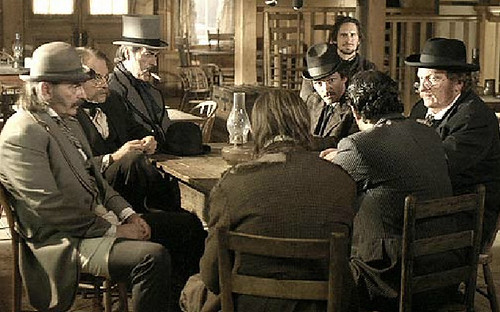
poker game

Coda in the Commons

Unlike many, what interests me is not who wins the game, it's rather the commons in the village.

Via Kingsley Idehen, I was recently reading Brad Cox's prescient 1990 article:

Planning the Software Industrial Revolution
The possibility of a software industrial revolution, in which programmers stop coding everything from scratch and begin assembling applications from well-stocked catalogs of reusable software components, is an enduring dream that continues to elude our grasp. Although object-oriented programming has brought the software industrial revolution a step closer, common-sense organizational principles like reusability and interchangeability are still the exception rather than the rule.

According to the historian, Thomas Kuhn, science does not progress continuously, by gradually extending an established paradigm. It proceeds as a series of revolutionary upheavals[KUHN]. The discovery of unreconcilable shortcomings in an established paradigm produces a crisis that may lead to a revolution in which the established paradigm is overthrown and replaced.

The software crisis is such a crisis, and the software industrial revolution is such a revolution. The familiar process-centric paradigm of software engineering, where progress is measured by advancement of the software development process, entered the crisis stage 23 years ago when the term, software crisis, was first coined. The paradigm that may launch the Information Age is similar to the one that launched the Manufacturing Age 200 years ago. It is a product-centric paradigm in which progress is measured by the accretion of standard, interchangeable, reusable components, and only secondarily by advancing the processes used to build them.

Whereas mature engineering domains define standard products and allow diverse processes to be used in making them, in software we do the reverse, defining standard languages and methodologies from which standard components are to magically ensue.

That's the concise articulation of what those who designed the web were thinking about. This sentiment goes under many names (loose coupling, object oriented programming, service oriented architecture amongst others) my favourite embodiment is a certain architectural style but I believe that no one has a monopoly on insight into these things and indeed the marketplace will sort these things out.

The question is how do we get from the Deadwood of 1877 through the plain industrialization of Henry Ford's assembly line and the infrastructure build-out of the past century in the West to say modern day San Francisco or to the marvelous gleaming skyscrapers of Manhattan and the state of the art in Europe and the Eastern Tigers. I am hoping we don't need to go through Great Depressions and World Wars in order to step into the metaphorical 21st century of software.

The internet of course doesn't stand still and the web development world has routed around the various tree trunks that blocked the trail: just look at the new canvases that are being drawn and the GreaseMonkeys popping up everywhere. But maybe that is being a little naive, everyone ultimately has to pay the bills. Maybe we are all inward-looking criminals and smugglers despite our protesting our good intentions and adherance to standards. Who knows?

What I'm really looking for, and I think the ultimate users, those citizens of San Miguel, are looking for, is an escape from the Wild West. We're not Searching for John Wayne or like Morgan Freeman seeking Forgiveness for our partners, we don't want to Dance with Wolves like Kevin Costner (his last decent movie, remember what followed: the execrable Waterworld and that thing called The Postman?). At the risk of sounding like an anachronistic "Why can't we all get along?" Rodney King, a character that our man Clint would surely clown with a characteristically raised eyebrow, how about this:
Let's try to build a Wonderful World-Wide Web. Lets try to build it together.

Wild Wide Web Soundtrack

Essential tunes to this movie
I used to live downtown 129th street
Convent everything's upbeat
Parties ball in the park
Nothing but girls after dark
We chill nobody gets ill
In the place we call the hill
But if you try 'em
That's when they will
Get wild but they don't fight they kill
At the...

Wild Wild West (Repeat 4x)
How ya like me now

Credits (a chat transcript)

James M. Snell Mixing metaphors can be dangerous to your health ;-)
Koranteng ;-)
K    6 million ways to die: choose one
JMS    Death by Back Button?
K    the Bad Guys Always Wear Back
JMS    how Refreshing :-)
JMS    guess we can only move forward from here
K    absolutely... the quote for which I am most famous during my time on Freelance Graphics was
"Lets not give users enough rope for them to shoot themselves in the foot"
Mixing metaphors is my kind of thing
JMS    heh. it's not the users I'm worried about. it's all the darn developers
K    yep... and it comes down to frameworks and wikis and faqs and View Source ... and ultimately to Googlejuice: when Jane Programmer does a search they had better get good results otherwise they'll be hung high by their copy-pasted stuff
JMS    indeed

See also: The Unloved HTML Button and other Folktales

File under: , , , , , , , , , , , , , , , , , , , , , , , , , , , , ,

Wednesday, May 11, 2005

The Unloved HTML Button and Other Folktales

A long, long time ago in a far, far-away land, there lived an HTML Button.

It lived happily with its parents, Mr HTML and Mrs Form, and its siblings: the older brother Text Entry Box and younger sisters, Drop-down List and Radio Button. As a family, they didn't look like much, but they got on with things. Indeed some would say that they had been second thoughts since grand-parents, Netscape, Microsoft, Apache and Berners-Lee, preferred to fawn and monopolistically squabble over cousins, Blink and Marquee Tag, the mobile duo, Java Applet and ActiveX, and the gruesome but quietly efficient twins, CSS and JavaScript. Let's not forget the ugly outlier, the Behaviour, and that perennial favourite of old Sir Tim, Semantic Purity. Still those pragmatic matchmakers, Fielding and Andreesson got together, sacrificed a few goats on the altar of sloppy expediency and dotcom hubris respectively and got the marriage together. The good Reverend HTTP was the officiating priest. Thus they called for a great many festivities and plenty palm wine and Schnapps was consumed by the merry populace. Yahoo! and Google, they ululated as they devoured the fatted Browser calf.

The Lord looked unto them and saw that it was good. He was pleased with his creation, thus he thundered: "Let my children prosper. Go forth and multiply forthwith". The VC Angel of the Lord blessed them with a strong essence and wide child-bearing hips. Verily I say unto thee, many offspring were spawned throughout the land. This allowed Uncle Amazon and Auntie eBay to garner many an oxen, selling little e-commerce gnomes on the child labour, and great work-ethic, of these precocious, and outsourced, children. The UPS town criers beat FedEx talking drums loudly and strew countless packages in villages from Kokomlemle in the south to Bolgatanga in the north, all the way to the far corners of this Flat Earth we live on. Big Blue-suited Armonkians day-dreamt of middleware and on-demand eBusiness, Oracles everywhere hummed expensive ballads of Databases, and itch-scratching Scandinavian Viking ants from the village of Linux (they were of the GNU genus) began to colonize many a continent.

Seeing all the fun they were having, Godfather Bray and Grand Wizard Paoli spawned another cousin to add to this fertile mix: the virtuous XML. Of course you have to understand that back in the old days, before all this boom-boom stuff, Real Men could hug each other without fear of overzealous prosecution.

XML was a boy genius. As an industrious type, he was singularly prolific and many offspring were issued from his legendary nightly encounters including the incomprehensible RDF and the Siamese twins XSL and XSLT (but we all have skeletons in our closets), and those sloppy but similarly prodigious critters, RSS and Atom, who founded a land called Blogosphere and struck fear into all and sundry so unruly was their behaviour. The Ananse's web that was woven was wondrous and resplendent in its glory. Hosannas were sung and there was much myrrh and frankincense which caused much mirth and frankly increased the joy felt by all who alliteratively assembled at the proceedings.

Periodically however, people got jealous and countless trials and tribulations were launched in the direction of this happy family. Where others would turn to ashes and sackcloths, throughout they kept the faith, and never complained about the insane contortions that those two wicked aunts, Gertrude UI Designer, and the quadruple-barreled Felicia Unsatisfied-Application-Framework-Developer, made them go through. Still, with the help of those Glue Layer People, Shadrach, Meshach and Abegnego who came armed with duct tape and spanners, they persevered in the righteous way. They were kindly sorts, steadfast, humble and true to the Lord. As I start my tale, the future looked ever so bright for them.

Lest you think I have too much time on my hands or that I don't have a day job, I should preface my folktale by saying that it was actually 10 months ago in Cambridge that I started writing a few fragments for what I codenamed the Toli Technology Series. And so, dear reader, the topic of this long-mulled note is that fair and foulweather friend of ours: the unloved html button and its form family.

Now 9 or more months from conception to birth is typical for me and for most mammals even if it is a long time in the technology world, and it leaves much opportunity for others to make much the same point and vividly so. Thus I can make no claims to originality or insight. I happen however to believe in Gabriel Garcia Marquez's maxim that

"Any idea that couldn't stand a few decades of neglect is not worth anything".
My first novel is certainly pushing in that direction but that is water under the proverbial bridge.

Before I get into our tangled tale of prodigal buttons, let me begin by recounting what prompted this current jaundiced delivery...


A case of mis-directed advocacy


Over the weekend, in one of my episodic eruptions, I found myself trying to knock heads together to make sure that the right lessons had been learned in the reaction to last week's release of the beta of Google's Web Accelerator (GWA).

To give some context, the GWA is simply a client-side proxy server application that can speed things up for the user by making use of Google's wonderful infrastructure. Of course Google have other reasons (read metrics) for introducing this product but there is some real innovation here (additional compression of documents, the insightful idea that only updates to documents are transferred, the so-called differential exchange, and, most of all, leverage of the scalability of Google's unparalleled and massively parallel server farm). The browsing experience for millions of people could be markedly improved especially for those on dialup if this product is widely adopted. This is plainly an opportunity for the immediacy of communication, conversation and plain social intercourse to further flourish. I won't even dwell on the likelihood of this product further lubricating promiscuous commerce throughout the land.

Thus it would seem a caching intermediary like Google's should be fair game. Caches are used everywhere in the internet and there were a lot of tradeoffs that were made in the architecture to accommodate them. HTTP bends over backwards to make possible the magic of such intermediaries. Indeed almost all the differences between the HTTP 1.0 and HTTP 1.1 specifications relate to this issue of giving visibility to intermediaries. Tim Berners-Lee's prototype was turned into the "product" we know by repeated contact with the real world.

The trouble however is that many people, almost since the beginning of our tale, have been abusing HTTP and misusing its semantics especially as regards HTML forms and their offspring. People regularly use hyperlinks, the kind that you would type in in a browser location bar, to cause side effects. This goes against the injunction in the good book that goes under the name of idempotency.

Google's web accelerator in barely a few hours exposed how widespread this abuse has been. Like an assiduous cache who had read those ancient tablets, GWA simply assumed that there would be no side effects to performing an HTTP GET on a hyperlink on a web page, it did so and tried to prefetch things intelligently. Of course since these hyperlinks were doing unsafe things, sometimes things got deleted. Now this train wreck was predicted in the wise counsel of the Reverend HTTP in his opening address and the toast that matchmaker Fielding gave at the wedding where the whole world was invited to witness. Apparently however, many of the guests were drinking too much; their calabashes runneth over with Schnapps. The Yahoo! and Google choruses were rather symptoms of their inebriated bubbly state.

That being said, I was actually surprised that some of the brightest and most inventive developers around were metaphorically caught with their pants down, dead drunk, and, even worse, that they were then protesting their good intentions and rectitude. I was therefore fulminant when I weighed in:
There is an architecture to the World Wide Web.

Truly.

Really.

I kid you not, there is an architecture to this messy thing that we live on. This architecture was worked out in blood, sweat and tears (and a lot of fun during the dot com boom) over the past 15 years in countless mailing lists, with countless dear lessons learned.

Now when you start a post in that vein, what is to follow might get a little heated. As ever, I should have been calmer and like Joe Gregorio framed that episode as a parenting lesson:

I'm sorry, I can't kiss it and make it better.
I firmly believe there are just some things that a child will only learn through experience (read pain). Many times children can just be stubborn, or choose not to believe you, and ignore your warnings. I understand this. I did this myself. No matter how many times my parents told me that the iron was hot, it wasn't until I actually touched it and burned my finger did I believe them. That feeds into my parenting strategy, if they misbehave and end up in pain, I believe that's the right time to reinforce the message, make sure the lesson is tightly coupled with the pain, that way they're less likely to forget.
Instead my discourse devolved into a case of I told you so, a kind of Old Testament view of things instead of the softer New Age stylings that are in vogue these days. Sure there was a little concern for the users that had been hurt by lost data, but there was almost no empathy for the developers who had to lose their weekends furiously reworking their applications to do the right thing especially because it appeared that they would rather persist in trying to do the wrong thing.

The sentiment behind that mini tempest-in-a-teapot however was a recognition of the fact that those who have been quietly evangelizing the web style were talking about the wrong thing and to the wrong people.

Advocacy is great on xml-dev and the various forums where the REST/SOAP debate is played out but it is missing entirely the audience that counts. We might as well ignore those RPC and "complicated framework people" even if their claims are sometimes so unbelievable. Thus I believed that my own REST intervention and the countless other inquisitions were a touch mis-directed. According to de.lici.ous, 30 people appreciated my piece; my efforts would have been best directed at the 3 million or more people out there who are simply trying to build web sites and web applications and proliferate those gnomes.

As a community, we should have been like the Web Standards Project who stuck to their guns and instead compiled a litany of examples of best current practices that everyone could have seen, understood and copied. There is no reason that developers should only now be sensitized that HTTP GET SHOULD be safe and not have side-effects.

Your first encounter with a web application or web site should have this lesson hardwired in it. The recipes that you did view source on to learn about the web (like the thousands of sites that have lifted the stylesheets from the CSS Zen garden) should have been had such practices encoded in them so that it would be second nature.

Zef Hemel (his tagline: "your daily tech snack"), who in my folksonomy is tagged with very little tongue-in-cheek as "The next Linus Torvalds" later admitted to this blindspot
But to be honest, I wasn’t so aware of the badness of using GETs for this purpose until yesterday.

All this to say that the things one thinks are obvious are often not.

The View Source imperative was crucial in how most people learned about HTML and the Web and to its widespread adoption.

As I wrote those words, I looked over to my bookshelf and saw my dogeared copy of the 1995 edition of Laura Lemay's Teach Yourself Web Publishing With HTML In A Week which should be a collector's item for all historians of science. I smote myself upside the head as I remembered how irascible young me had gotten onto this web of ours. I recalled that I first fully read the HTTP 1.1 spec in the year 2000 out of a sense of curiosity and when I saw that great dissertations were being written about the design philosophy behind it. I had heard rumours that there was much that was good in the web and like everyone had seen the daily evidence everywhere. Instinctively I had realized that some of the decisions that had been made at its formation were simply inspired and had subconsciously followed those design patterns and best practices that had been implicitly articulated. On the other hand, I had lived and written web software for 5 years with only the occasional peek at the HTTP spec to learn about things like content negotiation.

And that's the nub of the issue, who other than curmudgeons, has the time to read the HTTP spec where the importance of idempotency is prominently inscribed?

The vast majority of the world won't read long treatises. People will however copy and paste your code. Thus, in addition to good well-designed specs, we also need good samples and documentation.

Joe Gregorio's Show Me The Code tactic is the right way to go about education as is Mark Birbeck's quiet and repeated advocacy (first RSS Readers in XForms, then Google Suggest using XForms and now Google Maps using XForms). I bow down to these folks and others who are actually taking on this heavy task.

The prescient Ryan Tomayko of course was in the mix anticipating these sorts of things just weeks earlier: On HTTP Abuse
There's been a lot of good discussion around Udell's End HTTP abuse article. We need to get this figured out because it's almost embarrassing to be an advocate of standard approaches to building web applications when something as fundamental as the correct use of HTTP GET is butchered so often. Unfortunately, misuse of HTTP GET is just the tip of the iceberg. There's a whole slew of HTTP abuse going on out there (often in the form of neglect) that can be laid at the footstep of two parties: frameworks and evangelists. The frameworks suck and the evangelists aren't trying hard enough.
The small community that is coalescing around REST/HTTP should prioritize the following objectives above anything else at this point:
  1. Raise awareness of what HTTP is capable of.
  2. Fix the tools.

He then points the way to a more effective advocacy strategy namely
Can we take a page from their book? In my opinion, we're just as entitled to the phrase "Designing with Web Standards" as they are. We have a three legged stool too: HTTP, URIs, and XML. Except our stool is more like a three legged dog - you can get around but it is not quite optimal.

There is a lot more in that vein and it appears that there is a lot of soul searching among my fellow travelers. I would only add that there is also the problem that those lowly HTML Forms and Buttons are addressing. We can't afford to forget them in our efforts, indeed they might be more crucial than the rest.

The Unloved HTML Button


Thus I find myself turning back to that good friend of ours: the unloved html button.

It really doesn't get much love.

No one likes the standard HTML buttons and the other form elements. More precisely no one except users who are just trying to get on with things, and even they just see them as a means to ends that can range from awful bureaucratic process paperwork to buying that seductive, new-and-improved, ecommerce gizmo.

The first thing that Geoffrey UI Designer wants to do when he meets them is to change the appearance of html buttons. Designers just don't like them, they want to style them with cooler looking images or they want things to be hyperlinks instead. The stereotypical designers have come from the background of rich desktop applications where all sorts of interface excess has been possible. Also inevitably everyone wants to create "lickable" interfaces that make you drool. Not to be pejorative, but deep down every designer fancies themselves an aesthete ala Kai Krause or Steve Jobs and very few have looked to Web design patterns. Those Human Interface Guidelines of mundane standardization that made things like the Macintosh user interface much beloved by users everywhere are beside the point. Users might have liked them since after using just a few applications one would know how to use that darn computer thing without requiring expensive "training courses". But there was a sameness in the land and even Apple, prompted by that returned prodigal and effete Jobs, now breaks its own guidelines with increasing frequency.
"We want chrome! We want skins!", chanted the crowd as the unloved HTML button was dragged out for display.

As an application developer I like to get as close to the metal as I can and don't like having too many layers between me and the technology that I work with. Thus I often cuddle up in my midnight hours next to plain old HTML forms and buttons. In the land of the Long Tail of Application Authoring however, most people will use a framework to "program" their web site.

I would note that every web application framework has its own ideas about how forms and buttons should behave. Just in the past 6 months, the assortment of Three Letter Acronym frameworks that have been foisted on me (WCL, JSF and ODC) have each had their differing conceptions of how forms and buttons work. Needless to say, I've suffered mightily and all of these frameworks have caused much head-scratching. They leak mightily and that is because they are engaged in a war with our html forms and buttons.

In my weekend missive I inveighed, "read Joel Spolsky on Leaky Abstractions (more on that below). Let's not fight against the underlying architecture; let's understand what we're building on. The tradeoffs that were made in the complex system that is the web were not made without care."

When I got into the brave new world of XForms, I assumed that all of these lessons had been learned. Thus it was to my surprise that the first deviation from the XForms spec in IBM's first pass at an XForms Processor (on AlphaWorks) was a non-standard implementation of an image button trigger and a slider control. Now that processor was written as a guinea pig to provide input to the XForms 1.0 specification and indeed was an attempt to fit in with existing browsers. But some cunning UI designer or Framework Developer had gotten to them and they were trying, and failing I might add in these cases, to make more snappy UI widgetry within the confines of the native browser widgetry and infrastructure. Hmmm.

Now let's get concrete here ("You're so long-winded Koranteng. Boo. Hiss. Cut to the chase")

MBTA buttons


Since January 2002 and indeed just until yesterday, I haven't been able to purchase my monthly T bus Pass at the MBTA website. The web application framework that was being used in that site was only tested with Microsoft Internet Explorer. Having been true to Grandpa Netscape and Uncle Mozilla during the years in the wilderness, I would fire up the browser hoping to see a "Buy Now" button that simply never showed up in Mozilla. Thus 40 times in a row I was disappointed and tempted instead into my one monthly use of the great Internet Explorer (other of course than the frequent Windows Updates and the required testing of the products I develop). The story of Windows is of course another Book of Proverbs but that's for others to tell. I would hazard that eschatologists and numerologists everywhere would see some significance in the number 40. Presumably the Greek chorus of masses of unwashed Firefox users had more sway than my lowly monthly email missives to the MBTA tech support team about getting support for the aging Mozilla suite - again there's someone who doesn't get much love and who is being cast aside in this brave new firefoxy world.

Flickr buttons


flickr-flash-toolbar


In Flickr, I can't add a photo to a set or add a note because "To take full advantage of Flickr, you should install the latest version of the Macromedia Flash Player". Now I love Flickr, I have the greater part of the photographic record of my life on that service, but the very serious message they seem to be telling me is that they are above placing an ugly HTML button above my images. It is an affront to their sensibilities. I can understand that drag and drop organization of hundreds of photos might require Flash. But is it too demeaning to be able to simply click Add Note? It appears that they'd rather have the enhanced experience of Flash effects which can cause other issues as I've pointed out - see Cultural Sensitivity in Technology.

I can't blame them however, Gertrude and Felicia do have their seductive appeal, it does look prettier right?


Now that Buy Now button is one of those flashy mouseover-y kind of things. We're downloading 2 additional images instead of the five characters that came down with the page, slowing things up for those unfortunate to be on dial-up. There is no semantic value to the button. There's no tooltip to explain what it's for. The image doesn't have any alt text. It's less accessible wouldn't you agree? Users with different browsers had to beg for 40 months in order to be granted the courtesy to even click on it. If I had problems with my eyesight and needed to use a high contrast scheme, I couldn't leverage the operating system's built-in support for html buttons. If I had to use a screen reader, it would have been lost to me. As a developer, I would have had to write code to build keyboard navigation to the button to add tab indexes and the like. Ad nauseum.

I suppose I shouldn't complain, it is possible to style various html form elements many input or a submit buttons have lovely images. What gets me is when people don't use what facilities do exist and even worse go out of their way to avoid them.

What is wrong with a simple html button I sometimes ask?

But I lost that argument a long time ago. Indeed whenever I bring up the additional work required in the alternatives to HTML forms and buttons, since for example back in the old WebSphere Portal, I've had to clean up the accessibility and keyboard navigation messes of yore, I am treated as a wild-haired party-pooper claiming that the Emperor has no clothes. Recently I spoke of John the Baptist and Salome so perhaps this time I should say that I rather fear that a Delilah will crop my metaphorical RESTafarian dreadlocks, hence I tread carefully these days before I engage in Jeremiads...

Missing Blogger buttons


As a practical case in point of the perils of HTTP abuse, just fifteen minutes before I wrote this post, I had discovered a couple of broken links in my Best Left Unread post. Completist that I am, I was going through and adding technorati tags to my posts - the links were about the Completist Syndrome.

As a sidenote: you get a better idea of how to tag things with the benefit of hindsight. The categories or tags you place on things right after you've written something are not very good. Why is that?

Now it turns out that in Blogger's table listing of blog posts there are 2 links next to each other. Actually let's have a look at this:

2/24/2005 Edit Best Left Unread Koranteng


Let's leave aside the usability issue of why View and Delete are right next to each other. Deleting posts should typically be a rare occurence unless your former employer's lawyers object to your ruminations or more likely if the RIAA or MPAA come after you. But that's another story... Moving right along...

At 11pm, tired after a long day of work and with faulty muscle memory, I right-clicked on what I thought was the View link and opened it in a new tab. When a few minutes later, I switched to the tab I was a little perplexed by what I found. Thankfully, Blogger actually knew a little about idempotency and had a big "Are you really sure that you want to delete this post?" question with the post listed in its minor glory. But how was it possible for me to so easily get into this state? Why was it a link in the first place? I suppose that it's fair to put a trash icon next to a tag in Flickr, after all metadata is not that valuable. But a blog post?

Coincidentally, I sent the following enhancement request just yesterday to Monsieur Feinberg on a completely different issue:
Usability. At very first order right-align the "delete this post" link. In any case put it as far away from buttons that are typically used (Save and Cancel). Deleting shouldn't be a frequent activity. My own preference is to make the user have to look a little before deleting. There should be a little cognitive impedance before they delete. The system loses value when content gets deleted, let them work for it... Make them check a box and search for a button to click before deleting and make sure there's a great reason for them to do this...
Now as the Google Web Accelerator has made clear, this is not just an issue with parts of Blogger, Flickr or the MBTA. There is a fundamental problem with how people want to use forms, buttons and the user interfaces they build on the web.

HTML forms were indeed an afterthought. All the browser vendors wanted to lock you in their schemes of empire building and dreams of gold and glory. This meant that the forms that we did get were not as good as they could have been (they certainly aren't as pretty as they could be). I've gone through many midnight gymnastic sessions to try to get them to do things that Gertrude and Felicia asked. But they work, they are well known and their semantics widely understood. I would say to the my peers toiling away to fix their problem, let's tread very carefully and make sure the right lessons were learned.

Why Specs Matter and the Law of Leaky Abstractions


Your pedantic narrator actually reads and writes specifications. As you can tell, he doesn't just code or refer to himself in the third person, he can also write a lot. Indeed it is a pet peeve of his that not enough time is spent getting good specs together. Thus at this note's conception, he would write things like the following
It is sad fact of life that we don't get enough time to work on design and architecture; most of a developer's time is spent dealing with crazy schedules, task lists, status updates and the general drudgery of the "Software Process"... I was thinking about this during the rare design discussions during our meeting yesterday. So I thought I'd point out a couple of articles you might find interesting:
  • Mark Pilgrim does some of the best technology writing and also implements of a lot of cool software on the web. Here's his latest piece, a short one on Why Specs Matter. His language can be a little strong at times, but he gets the point across. You can defintely do without specs and we are often tempted to do as much; but a good spec really does make a difference. Think of XML 1.0, HTTP 1.0 and 1.1 or TCP/IP which have bred entire industries.
  • Similarly, think of 'leaky abstractions' the next time that someone tries to push their framework on you, whether it's EJB, WCL, EMF, SDO, JSF, Portlets or whatever the flavour-du-jour is. If you've ever had to spend an afternoon figuring out why the heck your tables or buttons don't do obvious things (the answer being that ultimately our output is html and no abstraction in an API can overcome the limitations of that underlying infrastructure), you'll know what I mean. Now understanding this is an argument for reducing the layers that you have in your software architecture. So for example in a case close to my heart XForms, if your underlying abstraction is HTTP, hyperlinks, XML Events and Schema and your output is HTML or some rich client UI, you should think very hard before introducing any additional layers with their own modeling and semantics since ultimately you're going to have to deal with that infrastructure. Joel Spolsky's Law of Leaky Abstractions is the final authority on that front. His canonical example is the ASP.Net framework's long crusade against my lamented HTML button.

My great friend Rob [redacted] (why don't you start a blog Rob instead of being a best-kept secret in [redacted subdivision of blue company]?) had this to say:
90% of everything is crap. That's Sturgeon's Law. Software is not excluded from this principle. We live in a mass-market, low-bid, first-to-market world. Our goal ultimately is to be less sucky than our competitors. Many of the quality things you point to, like XML Schema had amazingly long schedules, compared to our 8 releases a year, schedules so long that they could only be done by non-profits, or in a deep research group.

A written spec is key to giving an organization the flexibility to grow. Without it, adding new people to a project requires that the existing engineers take time out to bring the new members up to speed. This is the mechanism behind Brook's Law ("adding people to a late project only makes it later"). But a good set of project documentation can temper the effects of Brook's Law and provide some scalability. Imagine how much of an easier time we would have bringing new people on board, if we had a complete design doc for [redacted hotshot product].

The person in [redacted services organization] who wants to make a custom solution based on your component, the person in research who wants to use it as the base of a prototype, the co-op who wants to base a summer project on it, the lead of a new project in [redacted] who wants to reuse your code - all these people will seek information from you. You can either have a spec and a design document ready for them and be seen in a very positive light. Or you can come off looking like a fool. The difference is whether you are designing throwaway code, or code that has wings. Very little code goes far which does not have a spec or design document. You don't win an [redacted] Award for throwaway code.

Eventually we'll all move on to new challenges, and eventually active development of [redacted] will be canceled. Your code will be maintained by someone in [obvious redacted locations] who will have nothing but your spec and code to work from. And in 10 years, someone will try to revive part of your code, and without a spec, they'll be lost. Trust me, it happened to me, trying to revive parts of [redacted bemoaned product killed by monopolist] to write a [redacted useful feature] for [redacted new-and-improved hyped product]. So, if you don't write a spec, your name will be cursed in languages unknown to you in far away countries, and also by kids in middle school today when they try to figure out your code 10 years from now.

I can't add much more than that as far as development of software goes but that is sadly an unpopular perspective when it's often a case of aggressive, Real-Men-ship-code-and-batter-the-enemy warlike rhetoric (rest assured that Steve Ballmer types don't only exist at [redacted monopolist]). Sometimes a little estrogen is needed in the technology world. Further, as my own experience has shown, I know that specification-reading will likely remain an afterthought in the realm of application authoring.
View Source is the thing.

A Hyphenated Parable


I have a hyphen in my name. 2 generations back in the colonial Gold Coast, it was quite a popular thing to assert a family's identity and that is part of my story. Thus in modern Ghana you'd find many an Ofori-Adjei, Owusu-Ansah or Casely-Hayford. This assertiveness continues to this day. Naming is culturally important in my society; the outdooring ceremony of week old babies is their introduction to society and the ancestors are duly consulted so that the correct name is chosen. We pour Schnapps on the ground as the name is announced for the first time dressed as we our in ceremonial white and blue. A similar inventiveness in naming exists in those whose ancestors were 'invited' to cross the Atlantic Ocean in the past few centuries and, through various grisly legacies and traditions, I am now able to pursue 15 year searches for a certain Shaniqua who's got me woked. But I digress... In the French and Francophone traditions also, hyphens are big items: think Jean-François types. More generally in almost every culture, it is increasingly popular when people marry for a hyphen to unite the two families.

I like hyphens, they are promiscuous, sociable and attach themselves willy-nilly to all they encounter. Call me a hyphenphile if you will. It's no accident that my future wife has a hyphenated name (with the same initials no less); Freudians would say that this was a subconscious part of our mutual attraction. If we weren't patriarchal in our ethnic traditions, I might even be thoroughly modern and go for a quadruple-barreled billing for our children like Auntie Felicia.

The problem with hyphens is that well... Scratch that, let me tell you a bit about hyphens.

In computer science there is a general category of problems that have to do with delimiter characters (underscores, hyphens, colons, semi-colons, angle brackets and other special characters). Software is very concerned about structure and the parsers of our Tower of Babel file formats need to know where records begin and end. A similar issue is currently putting the tagging community into a tizzy with some favouring spaces (flickr, del.icio.us), commas (allconsuming) or semi-colons (furl) as delimiters. It's very confusing for someone who samples all these services and many an item has been mistagged by mistake.

I got my first credit-cards just as online ecommerce was picking up in the early 1990s so I have lived through the evolution of that industry's handling of hyphens.

I stopped using a certain Visa card, which was actually my introduction to Generation Debt, when it turned out that I couldn't use it for online purchases because certain backend systems couldn't handle the hyphen in my name. Circa 1999 however, this got sorted out. But that company lost the wool of the sheep I gifted to Uncle Amazon for half a decade. By and large these days, the credit card industry have fixed their issues, I am no longer forced to lose the hyphen when I order something online.

This is not the case with travel reservation systems however. The hyphen simply doesn't exist as far as they are concerned.

My very chatty travel agent was explaining all of this to me this past weekend, "The system doesn't take the hyphen. It's persona non-grata!", excited as he was to talk with someone who knew a little about the history of the Sabre system. I suspect that IBM built some of that core technology 50-60 years ago.

Most airline reservation systems handle hyphens gracefully but some don't, and, over the past few years, I've had instances where plane tickets that I thought had been purchased days earlier actually hadn't causing panicky travel agents to call me to figure out the mess so they could get their commission. I have literally lost hundreds of dollars when I've had to rebook the flights in question at higher rates. The curse of the hyphen struck repeatedly.

Thus I don't have my Delta frequent flyer number saved on Travelocity, Expedia or Orbitz. When I travel on that airline I have to remember to give my frequent flyer number at the check-in counter to get credit for mileage. As it is, I pretty much stopped flying Delta and indeed the last time I flew on Delta and gave my number, I was told that they had cancelled my frequent flyer account for non-activity... Such is life.

I booked a trip this past weekend and when I tried to check my itinerary on checkmytrip.com, I kept getting errors. I was worried and kept trying without success looking at my keyboard with bewilderment Caps Lock? No. Num Lock? No. Typo? No. etc. Then I remembered my conversation, checked my reservation slip, and realized that I had to log in with the hyphen removed from my name. Ofosu-Amaah became OfosuAmaah.

That's not the end of it however. I am regularly scrutinized by immigration or customs officials and of late, overzealous TSA officials on the lookout respectively for a certain class of economic migrant, drug smugglers and Al Qaeda splinter cells. I have always thought that my problems stemmed from the radioactive effects of carrying a Ghanaian passport, that reliable sign of economic desperation.

Another way to look at things however is that these officious officials are simply wondering if I am the hypenless person printed out on my plane ticket.

Thus they tilt their head askew as they scrutinize the face that I naively assumed soothingly said "trust me".

Hillary, when her husband's campaign made her become Rodham Clinton, chose not to use a hyphen and I think she's on to something. She may even accept campaign contributions from Delta Airlines as they struggle against bankruptcy. With some Schadefreude, I wonder if my double-barrelled hyphen boycott is having an effect on Delta.

Acela Blues


Similar fairy tales have been said about how the standards for rail gauges were developed in the US. Bob Frankston's sharp ears recently perked up when he heard about the current problems with the Amtrak's Acela trains and he speculated as follows: Acela -- A Casualty of Risk Aversion?
From the Boston Globe article on the Acela brake problems (22-Apr-2005)

Bombardier of Canada, the company that helped to manufacture the Acela, had to satisfy the Federal Railway Administration's "buy American" rules. This meant that parts for the train had to be designed for the United States. As a result, the Acela Express trains are twice as heavy as comparable European high-speed trains.

As I see it the issue is the constraints that lead to the trains being much heavier than the European trains. This is the price for risk aversion – it isn’t free. In the case of Acela trying to remove the risks by overbuilding creates its own problems and can increase the risk. Given their track record (sorry, I couldn’t resist) it seems that the Europeans made reasonable tradeoffs.

He backtracked a little with a possible correction a few days later
30-Apr-2005: Correction? A letter in today's Boston Globe noted that the heavier carriages were needed because unlike France and Japan the US trains work on existing rails. I can understand the design tradeoff between building new infrastructure and adapting to what is available. A reminder to be wary of stories that confirm ones expectations. Was it the right decision? Perhaps yes given a political climate that wouldn't accept the capital costs of a new rail line through the crowded Northeast Corridor.

And that was that you would say? But I don't think it ends there. It belies the question of why indeed the standard US railroad gauge is so different from those successfully used in continental Europe and Japan where the rail systems are models of efficiency. And this of course is fodder for historians of science and technology, train buffs and urban legend hoaxers (and debunkers alike) everywhere, nicely discussed here
The US standard railroad gauge (distance between the rails) is 4 ft 8 1/2 in (1.44 m). That's an exceedingly odd number.

Why is that gauge used? Because that's the way they built them in England, and the US railroads were built by English ex patriots.

Why did the English build 'em like that? Because the first rail lines were built by the same people who built the pre-railroad tramways, and that's the gauge they used.

Why did *they* use that gauge then? Because the people who built the tramways used the same jigs and tools as they used for building wagons, which used that wheel spacing.

[snip worryingly long 2,000+ year chain of plausible links]

So who built these old rutted roads? The first long distance roads in Europe were built by Imperial Rome for the benefit of their legions. The roads have been used ever since.

And the ruts? The initial ruts, which everyone else had to match for fear of breaking their wagons, were first made by Roman war chariots. Since the chariots were made by or for Imperial Rome they were all alike in the matter of wheel spacing (ruts again).

Thus we have the answer to the original question. The United States standard railroad gauge of 4 ft 8 1/2 in derives from the original military specification (MilSpec) for an Imperial Roman army war chariot. MisSpecs (and bureaucracies) live forever!

Now although this particular alternate history is something that many have tried to debunk, its essential appeal is that it serves as a fabulous object lesson about standards and how technology gets adopted when pragmatism and leverage is the key rule of thumb. Some things have longer lives than one would expect.

Update: Bob Franskton adds
You'd appreciate a show on the travel channel. If you take a train from China to Mongolia it goes through a stop where they change the wheel carriages for a difference in gauge and then the train moves on.

Perhaps I should ask my travel agent to book me a trip to Mongolia, I hope the rail reservations systems can handle hyphens.

Forms in Browsers


It seems to me that we have 2 ways forward to improve the experience of html forms on the web: the XForms and Web Forms 2.0 specifications.

If I were to return to my conceit, I would call them two tribes squabbling in the desert with Grandpa Mozilla feeding both sides at different times. On the one hand, you'd have the XForms buffs and there are many of them, who first saw the discord in the land: Gertrude and Felicia did have something of a point in that the Form family could be improved. Thus toiled mightily and tried to distill the kind of patterns that experience had shown were being solved in the wild.

Their advocacy problem is that they were tainted by their early association with that disreputable couple XSL and XML Schema from whom they adopted little XPath. Now XPath was a fair kid but would always be tarred by the brush of that loose XSL mother of hers. She had a few learning disabilities (or rather eccentricities) and insisted that all who entered her house take off their slippers and wear kimonos made of parentheses. Even visiting royalty, King True and Queen False from the land of Boolean were given her functional treatment.

Then there was the WHAT tribe, who were old browser calf types, now lean and mean, the stern and Operatic Håkon (screaming Howcome! Footprint! and Though shalt have no other solution except CSS and Javascript) along with latterday convert, the CSS prophet Hixie. The more pragmatic Hyatt who takes frequent Safaris may be receptive to the one but is a touch wary about how it might bite the Apple. The good Baron Brendan Eich is enigmatically philosophical about the whole thing as he nurtures the wily Firefox. Hopefully those grand viziers at the house of W3C will knock some heads together and all will learn to get along without suspicion. The jury is out for the next 18 months.

I have my hat working on the one but truth be told, I couldn't care which wins. I've pointed out some of the comprehension problems that might arise with XForms's choice of XPath see On XForms, XPath, CSS, Brevity, Syntax And More but even though I've been a heavy Javascripter I'd like to make sure that Jill Department Head doesn't have to learn script just to pull a survey together. Clearly this area remains a work in progress.

We are still in the baby years of the web, the idea is to do things right, to learn the lessons and fix problems quickly so that 50 or 5,000 years later people aren't hobbled in literal ruts about the descendants of HTML Forms.

Returning to the abuse of the buttons of my discursive tale, Phil Ringnalda devastatingly make a similar point

I wonder why buttons look like that:
(designers are looking for) an easy way of using JavaScript to tunnel their looks-like-a-GET link through POST.

Apparently in all the rush to read Section 9.1 of RFC 2616 and to misinterpret the meaning of SHOULD NOT, nobody is actually reading the part of Section 9.1 that says

This allows user agents to represent other methods, such as POST, PUT and DELETE, in a special way, so that the user is made aware of the fact that a possibly unsafe action is being requested.

Making the fire alarm look just like a light switch isn't an example of daring and innovative design, it's just dangerous. Pushing the table out of the way won't keep you from falling off the chair.

This is exactly Tim Bray's sentiment
"I can remember like yesterday a Content Management conference about 1997, a woman from a big computer company talking about how great it was when they switched their CM system over from custom clients to the browser: "It’s so great! The browser is so limited, so they had to throw away three-quarters of the buttons and sliders and pulldowns and options, and just do it with hyperlinks and simple forms... it was so much easier to use!"

The ugly duckling user interfaces of the web have worked to a surprising extent, if we do give them the extreme makeover treatment, I hope one will still recognise their fundamental utility. I can still see traces of little Michael Jackson in the face of the current train wreck.

Placing a cache closer to the user which is what Google have attempted is simply doing what Akamai have done at a different layer. And it makes sense, caches should be as close to the user as possible, the benefits in terms of the interaction experience are obvious.

I know that down at the ground level, one might be a designing a web site and the client might want prettified links instead of those unloved html buttons. The core of web user interfaces are not sexy yet they work, and users understand them. The visual cues about what may or may not be safe are well known.

As application developers we should ask for better forms, we should be demanding of browser makers things like XForms or Web Forms 2.0 to make sure that we can go beyond the kind of stilted usability that we currently have. Our users would appreciate our efforts in that vein but for now, they know what to expect. Until then application developers should push back when we are told to "do the wrong thing".

Pushing Buttons


Micah Dubinko who was one of the chief authors of the XForms spec has it right when he calls his blog push-button paradise. That is the nirvana we're aiming for: a Garden of Eden where Forms and HTML Buttons will finally get some love. Thus as I conclude my folktale, let me give you one glimpse of our teenager button. Go ahead click on him, he won't bite, there's nothing unsafe here, a few hormones perhaps. And I know a bit about idempotency so presumably I won't lose anything.


There. That felt good, didn't it?

See also Technical Arteriosclerosis and again On The Importance of Biting Satire

Update: James Snell drops further Proverbial Zingers in Not tonight honey, I'm having idempotency issues...

Update: Holy Serendipity Batman!. Those defending Hillary in the midnight hours, no doubt through an (idem)potent keyword-searching conversational engine brew or other, happened onto my hyphenated parable. My tags are accordingly updated. I do believe this land called Blogosphere is no Kansas. I love tomorrow.

(Enough already, with the puns. Like those buttons, get on with it.)

File under: , , , , , , , , , , , , , , , , , , , , , , , , , , , , , , , ,