Showing posts with label groups. Show all posts

Tuesday, April 28, 2026

Protection Racket

Militias, in Africa as elsewhere, have long meant pain and suffering
Intimations of blood and sneering menace underlie their extortion
The through line from self defense units to neighborhood gangs
The stuff of protection rackets imposed by outright thugs
In Haiti and the Central African Republic currently,
In Sierra Leone and Liberia memorably,
In Congo perennially, militias are a blight

If the area boys were initially benign
Touts, they now traffic in grim violence
Bodies for hire, their labor is all too physical
Offers you can't refuse, resolution by any means necessary
In the background, rivalries and monetary interests
Underlying conditions that motivate these predators
Apt to cut you for a nothing, some violation, a perceived slight

The bulk of their ranks, per the analysts, are the lumpenproletariat
Ever changing boundaries, uniforms and unspoken codes of conduct
Territory fiercely protected, lines that the unwary shouldn't cross
Space, the world shrinks down to corners, claustrophobia
The menace of the long walk past them, the unbearable scrutiny
Grudging respect for their power, glad you made it safely home today
Cold comfort, for when in their grip, all that matters is might is right


pathos the closed ghana restaurant after uruguay won on penalties in the world cup sigh

Protection Racket, a playlist


A soundtrack for this note (spotify version)
[Update March 2024]

Ten months after writing the above, I note that Haiti is descending into paroxysms of gang violence. It strikes me that this note still has a couple of years to go before being published. I'd rather be wrong about what I write.

File under: , , , , , , , , , , ,

Writing log: January 21, 2023

Tuesday, July 15, 2025

Sphinx Modalities

Docility is much prized by parents and tyrants alike
A double edged sword, however, for the former
For independence and agility of thought are also to be imparted
Lest raising lemmings ends up being one's enduring legacy

Thus the dilemma of the sphinx modalities
The puzzle of how we readily yield to authority
The virtues of critical thinking, prized, yet only obtained with difficulty
Weighed against the duty of protecting one's neck, raw survival's necessity

Organizations too, confront the question, albeit from a different viewpoint
Marx, it was, that wrote of the narcotic effect of all religions
Seeking to explain the evident acquiescence to oft imprudent authority
The silence in the face of privation and, worse, this baleful docility

Outlining the process that leads to overvaluing the herd mentality
The masses' suffering, the false consciousness of conformity
The shackles that bind our traditional respect and shame cultures
The surplus value that opportunists can extract and capture

Juvenal would lambast the enduring appeal of bread and circuses
The dulling of the senses, leaving one prone to domestication tendencies
The suppression of the iconoclast, our embrace of convenient fictions
Perception is everything, such are the dangers of the cattle inclination

The sphinx is an awesome beast, typically lying in repose
But terrifying when it moves, with suddenness and exacting purpose
Mythical in its grandeur, it plainly traffics in concealment
Opacity and judicious revelation, keeping close its terms of discernment

And yet, force majeure, in times of emergency
We see what lies simmering beneath the surface
When societies erupt and break the mask
And tyrants are destroyed and taken to task

In the heat of moment, when they face the inevitable comeuppance
The warnings unheeded, the memory of their unbearable arrogance
From those earlier days when all we could do was to bear witness
Came the silent message: don't mistake my kindness for weakness


Aburi mask


He who tests the depth of a stream with both feet must be prepared to swim.

— Ewe proverb, Ghana

Sphinx Modalities, a playlist


A soundtrack for this note. (spotify version) see previously Nothing to See Here and All Available Indignities

File under: , , , , , , , , , , , , , , ,

Writing log: September 11, 2022

Tuesday, August 06, 2024

Connective Tissue

Connective tissue
  Group membranes
The small things
  The ties that bind

A touch of whimsy
  The adoption of norms
Evolving mores
  The invention of tradition

Signaling membership
  Roll calls
Finding those who curate status symbols

Initiation rituals
  Necessary friction
The marketplace of human connection

Glue layer people are wont to start the celebration
Cultivating, as they do, the sense of belonging

In the social interplay of striving simians
One comes to find liminal sinews
And the dark matter of communities


agona swedru youth brass band


After a glimpse of a tag used by Ben Hyde, a frisson de folksonomie


Connective Tissue, a playlist


A soundtrack for this note (spotify version) File under: , , , , , , , ,

Writing log. April 14, 2022

Tuesday, June 18, 2024

Striving Simians

There is an art to being a great leader
We rightfully celebrate those few examples that we have
Many books and tomes have been written

There is also an art to being a bad leader
These last proliferated throughout history
Indeed, bad seeds are plainly in the majority

Still, despite the appeal of cautionary tales,
Far fewer tales are told about bad leaders
Heroes over zeroes, humanity prefers redemption stories

Ever the optimists, we celebrate triumphs rather than failure
Perverse incentives carried over from our antecedents in the savanna
The pathology of groups outlined in crass social behavior
Paradoxically, we reward bad leaders in equal measure as good leaders

Some contend it's even worse in the modern corporation
Namely, that we reward bad managers out of routine dysfunction
Call it the Peter Principle or what have you, they tend to fail upwards
Borne on the deep seated human need to be appreciated

Monkey dey work, baboon dey chop
The fear of being shunned
To be laughed at for being mistaken or ridiculous
The importance of grooming, the appeal of approval ratings
Fragility, we accommodate rogues for fear of shame
Ignorance is bliss, we blindly obey the rules
And stay quiet, lest our competence be impugned

The banality and burden of following the orders
The ever looming specter of the conqueror
Striving simians we are, not far removed from the savanna


chimp


Monkey dey work, a playlist


A soundtrack for this note, from afrobeat to blues by way of jazz funk. spotify version)
See previously: Restructuring Activities

File under: , , , , , , , , , , , , , ,

Writing log. April 22, 2022

Saturday, September 17, 2022

Ritual Tributes

Apropos public grief, herewith a sampling of tributes to Yuri Andropov by African leaders after his death, as reported in Talking Drums magazine (February 20, 1984)...

The public expression of grief can be confounding especially when rituals combine with politics and the performance of power. At such times, perception is all.

The institutions that have staying power in human history are well practised at the spectacle of ritual tributes. The Catholic Church, and as we are currently seeing, the British monarchy, are experts in this realm, putting on a finely-tuned display with the pomp and pageantry of a well oiled machine.

Africans understand well the importance of funeral ceremonies, death being our close companion. Effusive outpourings are to be expected, furrowed brows and florid rhetoric - albeit with a sober countenance, in celebration of the departed. During our lost decades, even the rogues who were busy feeding on the carcasses of our body politic, and who, in the main, weren't the most gifted of wordsmiths, could be counted on to give a felicitous toast and ritual tribute. Solidarity matters and we were treated to the keen expression of shock and sorrow.

Their counterparts of today may be more sensible but are equally eloquent and performative, it goes with the territory. Observe well the statements of condolences - and acts, upon the death of the good Queen Elizabeth II.

The Soviet Union didn't last a century and their leadership transitions were sometimes fraught affairs but the Communist Party well understood the necessity of ritual tributes. Their populace and their clients duly performed. Shock and sorrow was expected, shock and sorrow was delivered.

Tributes to Andropov by African Leaders

Talking Drums, February 20, 1984


News of the death of President Yuri Andropov was received in Africa with shock and sorrow as expressed in the various measures taken by African leaders in memory of the Soviet leader.

In Nigeria a delegation led by the Chief of Staff, Supreme Headquarters, Brigadier Tunde Idiagbon, and including the Chief of Air Staff, Air Vice Marshall Ibrahim Alfa and the Minister of External Affairs, Dr Ibrahim Gambari, were in Moscow to attend the funeral.

Ghana: Three days of national mourning were declared during which Flt-Lt. J.J. Rawlings, Chairman of the Provisional National Defence Council signed the book of condolence at the Soviet Embassy.

Earlier during a visit to Upper Volta, Flt-Lt. Rawlings had sent a message of condolence to the Soviet leadership noting that "the frailty of individual destinies should provide the world with fraternal solidarity that goes beyond ideological inclinations"

Benin: An extraordinary meeting of the Political Bureau of the sole party was convened followed by a declaration of three days national mourning. President Kerekou then sent a message of condolence to the Soviet leadership describing Andropov as "a worthy pursuer of Lenin's works."

Ethiopia: Addis Ababa radio reported Mengistu Haile Mariam's departure for Moscow and announced that flags would be flown at half mast in Ethiopia for three days.

Zimbabwe: Harare radio reported that Prime Minister Robert Mugabe was at the airport to see off President Canaan Banana and the Foreign Minister, Witness Mangwende to Moscow. Two days of national mourning were also declared as a further mark of the solidarity.

Guinea: The Prime Minister, Lansana Beavogui, delivered to the Soviet Ambassador a message of condolence from the people, party and President of Guinea describing Andropov as a man of peace. The Prime Minister was also in Moscow for the funeral.

Liberia: The Liberian leader General Doe sent a message of condolence describing Andropov as a staunch fighter for world peace

Congo: A statement issued by the Party's central committee declared two days of national mourning. President Sassou-Nguesso sent a message of condolence to the Soviet leadership describing the USSR as the rampart of peace, harmony, world co-operation and the progress of humanity."

Mozambique: President Machel was in Moscow to attend the funeral Earlier in his message of condolence to the Soviet leaders broadcast by Maputo Radio, Machel said Andropov had "wisely used his intelligence and serenity at a time when the aggressiveness of imperialism increasingly showed itself as a permanent menace against humanity's liberation."

Angola: Luanda radio reported the signing by President dos Santos of the book of condolence at the Soviet embassy and his description of Andropov as "a statesman and distinguished leader of the CPSU and a staunch fighter for peace, liberty and socialism."

Upper Volta: According to Ouagadougou Radio, there was a message from the Upper Volta leader, Capt. Sankara, saying that the loss of "this illustrious freedom fighter should further strengthen our revolutionary faith and vigilance."

...

coffin for head of state - fela graffiti contra Trump

(On election day 2020, this was the graffiti we came across on our walk. On the same trail we saw "Trump is the virus" and other unprintables by the same artist. I guess it was cathartic for them).

Soundtrack for this note


An ironic ritual tribute in Afrobeat. ...

I would normally be moved to a poem, the language in the above passage is tempting; the music to be found in the homilies of strongmen and the men in khaki. Also, as a time capsule of cold war perceptions from the south, much could be drawn out. Still, one is conflicted. Circa 1984 the Soviet Union and General Secretary Andropov were not supporting the apartheid regime as Reagan and Thatcher were, indeed they were actively on the side of many African liberation movements. Still it's hard to resist commenting on the expressions of grief from say Comrade Mengistu, who was then Chairman of the Organisation of African Unity (OAU), or the erstwhile Master Sergent (and then Doctor and General) Doe, the blood altogether blinds me.

Bread and circuses are not merely confined to monarchies. But this is a time of worldwide mourning and sober reflection, let's not pursue the thread...

...

Timing is everything
Observers are worried

See also: The Laws of Grief

File under: , , , , , , , , , , , , , , , , , , ,

Writing log: September 16, 2022

Thursday, September 14, 2017

Functional Defenestration

It’s almost been a Friedman unit since I published anything in this joint so, with due deference to that old standby public service pamphlet, What everyone should know about blog depression, and a head nod to Bertrand Russell's note In Praise of Idleness, here goes some throat-clearing toli.

I. Defanging Satire (or Editorial Genuflections in the Internet Age)


Defanging satire in the age of the internet (New Yorker edition)

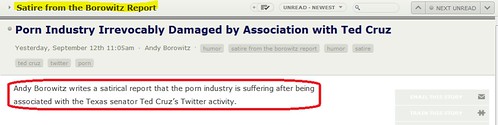
A highly paid editor at The New Yorker is now intervening to neuter the bite of Andy Borowitz's normally savage satire. The first injury came a few months ago with the retitling of the column and RSS feed from "The Borowitz Report" to "Satire from The Borowitz Report" as if to say “we must protect you from being a moron in a hurry”. Then the lasting, almost fatal, wound was the recent move to change the contents of the feed summary, which used to be the first few sentences of the article, to instead actively bash you over the head with a spoiler warning that each article is "a satirical report". Apparently the reader needs to be informed upfront that they are about to read a humorous article and protected from the dire possibility of being spoofed.

In other words, even for the most potent source of written content (and the New Yorker proclaims itself to have "the best writing anywhere"), it now of paramount importance to maintain its listing as a Google News "source" (and now with Facebook's Zuckerberg apparently faking concern about clickbait and fake news and the like, the audience needs to be coddled). The bean counters (and search engine optimizers) have run the numbers and, on the evidence, it is clear that telegraphing an article's intentions, and blunting its impact is worth the downside risk and what, I rather think, is grievous damage to art.

Up until a few months ago, the feed summary would have been the following (a pithy defenestrationof age-old hypocrisy)

WASHINGTON (The Borowitz Report) — The pornography industry has likely suffered permanent damage as a result of its unfortunate association with the Texas senator Ted Cruz, industry sources said on Tuesday.

It is soul-deadening to contemplate the considerable effort expended to actively sabotage noble hatchet jobs.

The only concession to art is that the editor didn't additionally prepend "Satire" to article titles as I noticed smaller publications starting to do routinely 12 or so years when Google News started being a dominant source of web traffic.

And here Dear Reader, as I wrote the foregoing sentence and began winding up to a thoroughgoing rant, I realized that I had been down this path before. Indeed I left a community (Blogcritics) back when its writing guidelines started to ask that writers explicitly tag their work and the site started messing with titles. The injunction then was that we needed to telegraph and prefix "Satire" to titles '(if you "make things up" or "bend the truth" notably to make a point, or for comedic effect)'.

Searching through the archives, I even found a cri de cœur written on the topic, Husbanding the Blogcritics Commons, a jeremiad-in-vain as it soon became a case of This Boring Headline Is Written for Google.

It is a disappointing development a decade later, that ostensibly powerful media outlets have thoroughly succumbed, even as one cannot deny their economic logic, pace Buzzfeed. And yet I remain a maximalist on the issue.

The story, I suppose, is about capitalism in the internet age. Per Jeff Hammerbacher by way of Allen Ginsberg, it is a case of "The best minds of my generation are thinking about how to make people click ads". Per contra, we could harken back to Slim Charles's folk wisdom from The Wire: "Game's the same, just got more fierce."

The existential question posed is how do we weigh the competing demands of popularity (as expressed by the Google News imperative) against whimsy (as expressed in satire). Sacrificing whimsy at the altar of attention is not a price worth paying, and I am yet to be convinced otherwise. Needless to say, I dissent.

II. Attention Mongering

Apropos attention, for a good decade, say right up to the Charlie Hebdo massacre, and much to my consternation, a note I had hastily written On the importance of biting satire was regularly the top search result on Google about satire. It has since found its proper obscurity, but my unexpected Googlejuice in the interim meant that the occasional student writing a term paper on “why satire matters”, “significance of satire”, “importance of satire” etc. would start mining this blog.

The early web was a great equalizer, one in which my rants occasionally trumped the combined insights of Jonathan Swift, Will Self and the like, hell even the encyclopedic Wikipedia was lagging in the Anglophone internet. Even as Jon Stewart and company started a revival of the satiric tradition in America, the clicks kept coming my way.

I don't know if I ultimately managed to convince 15 readers of the paramount importance of savage satire as opposed to the milder form that Americans favor, but I feel my ultimate insight is worth restating:

I like my satire savage. It should be vicious, biting and deeply heartfelt. The targets should feel a sharp wound. The whimsical and comic artefacts of the best satirists are side-benefits; their purpose is really to serve as social barometers and canaries in the mineshafts of our communities.

III. On Satire

Satire is a sort of glass wherein beholders do generally discover everybody's face but their own; which is the chief reason for that kind reception it meets with in the world, and that that so few are offended with it. But, if it should happen otherwise, the danger is not great; and I have learned from long experience never to apprehend mischief from those understandings I have been able to provoke: for anger and fury, though they add strength to the sinews of the body, yet are found to relax those of the mind, and to render all its efforts feeble and impotent.

Jonathan Swift - The Battle of the Books
Satire is an art form that thrives best on a certain instability and tension in its creator. The satirist is always holding him or herself between two poles of great attraction. On the one side there is the flight into outright cynicism, anomie and amorality; on the other there is the equal and countervailing pressure towards objective truth, religion and morality.

Will Self - Junk Mail
[Will] Self sees himself paradoxically both as a moral satirist and as a social rebel who is more interested in shocking his middle-class readers than in reforming them. "What excites me," he has said, "is to disturb the reader's fundamental assumptions. I want to make them feel that certain categories within which they are used to perceiving the world are unstable"

— Gillian Glover, as quoted in Brian Finney's The Sweet Smell of Excess: Will Self’s Fiction, Bataille and Transgression.
Of all the gifts of the pen perhaps the most fraught with danger is that which resolves itself into satire. It is indeed difficult to distinguish between cynicism and satire, perhaps the former is born of disappointment perhaps the latter is born of humour. Let it remain so and it cannot be called debased, let it become cold and let it die.

— Patrick Braybrooke writing on Hilaire Belloc as Essayist in Some Thoughts On Hilaire Belloc

Instability fundamentally disturbs markets which is why even the threat of boycotts so unmans even the most cynical modern corporations. The reverse of the coin however is that whimsy, that most valuable human concern, and its close counterpart satire thrive as disturbances to the mundanity of life. Reconciling whimsy in all its messiness to the demands of hard-nosed capitalism remains a struggle and yet struggle we must. For better or worse, we must humanize capitalism.

IV. Orphaned Thoughts

I once spent forty minutes on a subway sitting opposite a group of engineers and salespeople that worked at Functional Fenestration. They were attending a conference in Oakland about window hardware and automation, of all things. I was fascinated with their technical argot, the intricacies of the actuators, track and carriage systems and door automation that they were discussing. I marveled at the engineering arcana, and the fact that the windows and doors that we take for granted could have such complexity. Their deconstruction of the merits of some of their competitor's offerings and their strategizing about how to market the new feature of whatever widget they had just come up with (a slide handler if I remember correctly) drew me in. The intensity of the back and forth between the marketers and the technical folks reminded me of a comedy of manners of sorts, office politics writ large. Hypnotized as I was by the language and the context, I immediately imagined a novel or short story, something in the vein of Colson Whitehead's The Intuitionist and the title came unbidden, Functional Defenestration.

Most ideas are destined to be half-formed and ultimately, I never got beyond the few pages scribbled in my Moleskine, a meditation about a man unmoored by capitalism. The first sentence remains:

Man, it was hard to compete against those guys at Functional Fenestration, they were intense.
Run with it.

Soundtrack for this note

A playlist for those tilting at windmills.

File under: , , , , , , , , , , , , , , , , , , , ,

Friday, January 28, 2011

All Available Indignities

As the ghosts of numerous tyrants, from Julius Caesar to Benito Mussolini will testify, people are very hard on those who, having had power, lose it or are destroyed. Then anger at past arrogance is joined with contempt for present weakness. The victim or his corpse is made to suffer all available indignities.

The Great Crash 1929 by John Kenneth Galbraith

The growth of his power and fame was matched, in my imagination, by the degree of the punishment I would have liked to inflict on him. Thus, at first, I would have been content with an electoral defeat, a cooling of public enthusiasm. Later I already required his imprisonment; still later, his exile to some distant, flat island with a single palm tree, which like a black asterisk, refers one to the bottom of an eternal hell made of solitude, disgrace, and helplessness. Now, at last, nothing but his death could satisfy me.

Tyrants Destroyed by Vladimir Nabokov
freedom kagyah
"The widespread anarchy and the disillusion of the masses... made this revolution necessary. In the years since independence, fundamental human rights were brutally violated by the government. People were denied the right to live in freedom and with mutual respect. They were not allowed to have their own opinions. Organized political gangsterism and the politics of falsehood turned all elections into a farce. Instead of serving the nation, politicians were busy stealing. Unemployment and exploitation were on the rise, and in their sadism toward the population, the small clique of feudal fascists in power knew no bounds."...

Optimism quickly turned to disenchantment and pessimism. The people's bitterness, fury, hatred was now directed against their own elites, who were rapidly and greedily stuffing their pockets.

The Shadow of the Sun by Ryszard Kapuscinski. Here, he quoted a statement by a youth movement and observed the aftermath of Nigeria's 1966 coup.

There is no one, or hardly any one, so wicked or so stupid as to deny the democratic ideal. There is no one, or hardly any one, so perverted that, were he the member of a small and simple community, he would be content to forgo his natural right to be a full member thereof. There is no one, or hardly any one, who would not feel his exclusion from such rights, among men of his own blood, to be intolerable. But while every one admits the democratic ideal, most men who think and nearly all the wiser of those who think, perceive its one great obstacle to lie in the contrast between the idea and the action where the obstacle of complexity - whether due to varied interests, to separate origins, or even to mere numbers - is present.

The psychology of the multitude is not the psychology of the individual...

Look at a crowd when it roars down a street in anger — the sight is unfortunately only too rare today — you have the impression of a beast majestic in its courage, terrible in its ferocity, but with something evil about its cruelty and determination. Yet if you stop and consider the face of one of its members straggling on one of its outer edges, you will probably see the bewildered face of a poor, uncertain, weak-mouthed man whose eyes are roving from one object to another, and who appears all the weaker because he is under the influence of this collective domination....

Now it is peculiar to the French among the great and independent nations, that they are capable, by some freak in their development, of rapid communal self-expression. It is, I repeat, only in crises that this power appears.

A Force in Gaul by Hilaire Belloc (from On Something)

As the Tunisians, and now Egyptians, are currently demonstrating, this quality of "rapid, communal self-expression" is certainly not a Francophone singularity. History, contra Belloc, has forever shown that crowds can turn from inchoate to determined in mere hours. All tyrants and their Lady Macbeths are on notice. Still, a little sweat on their part, and the dismayed sensitivities of onlookers at the sight of turmoil in their marriages of convenience, are, all things considered, a small price to pay.


He who tests the depth of a stream with both feet must be prepared to swim.

— Ewe proverb, Ghana
File under: , , , , , , , , , , , , , , , ,

Thursday, June 08, 2006

Boycott and The Gospel of Toli

I received a note that I almost discarded so slight was it. It was quite troubling at first glance and I reproduce it here in full; make of it what you will.

Part 3 of the Boycott Day Trinity

The Gospel of Toli


Recently scholars unearthed a scorched parchment underneath a library located in bowels of the slums of Nima, in Accra, Ghana. It was found by a young child, Wednesday born, who was playing football (also known as soccer to our American brethren). Barefoot and wearing a tattered Stephen Appiah-labeled Black Stars jersey and khaki shorts (he was skipping out of the library early), he stumbled over a wooden plank that was jutting out of the side of the adjacent chop bar, Mama Opus's Spot. At the sound of his alarming cries (something to do with nails or something), the elders were summoned to investigate the stigmatized youth and they uncovered a heavy wooden chest that led to a serpentine series of catacombs that run under the library and the nearby compound, owned by a wizened retiree who refused to give his name "What is a name after all?", but who, we have since learned, goes under the moniker of Kweku Ananse.

The paths delineated by these tunnels run along the Prime Meridian. It is well known that the line of the Greenwich Mean Time runs from fair London to the heart of darkness in Africa and passes through Nima, that dank armpit of the Dark Continent. Inscribed on the last page of the scrolls that were later discovered was a barely decipherable scrawl that handwriting experts now believe reads: The Gospel of Toli. After painstaking forensic investigations over the past 33 years, including the delicate removal of 6 films of Palm Wine, Schnapps-encrusted dust, and several layers of used kelewele oil, National Geographic is proud to exclusively announce the preliminary findings of this extraordinary and idiosyncratic document which will cause humanity to question its received wisdom. We intend to serialize the scholarly findings in the magazine.

Apparently negotiations are in progress and several Nollywood studios are leading the bidding for the inevitable film treatment. Samuel L. Jackson has been said to desire the role of Papa Ananse and that well known former child star Jamie Bell was also said to be seeking a role portraying the Messiah figure. It was unclear who the frontrunners were for the female leads, the Proud Marys of the plot although Tina Turner and Patti Labelle were whispered to be in the mix. Do note that any leaks on this topic in the so-called blogosphere should be treated as Gnostic misdirection.

The text of the Gospel hews quite closely to the Torah although there are some striking divergences in parts. The first discrepancy in this Apocryphal Gospel concerns Genesis Chapter 2 which has long been thought to read:
Thus the heavens and earth were finished, and all their multitude, And on the seventh day God finished the work that he had done, and he rested on the seventh day from all the work that he had done
Verse 2 has been radically transformed in this "extraordinary rendition" (termed for some reason in this arcane script: erustication). The verse now reads
Thus it was written that on the seventh day God grew so frustrated with things that she engaged in a boycott of all the work that she had to do.
The Good Pope, the erstwhile Cardinal Ratzinger, was said to be studying the issue closely, and his spokesman assured us that an encyclical would undoubtedly be forthcoming from the Holy Church.

Anonymous sources close to the papacy, who asked for anonymity because they wanted a Rove/Libby style protection, were quick to weigh in on the matter to our intrepid reporters.
"First of all, there's the issue of the gender of the deity. If the "s" is confirmed to not be an oily smudge, it would challenge 20 centuries of past practice, and cause us to re-examine the previously thoroughly-discredited Magdalene Propositions in a new light. Further, the notion of a boycott could be construed as an existential threat to the very authority of the Holy Church, a challenge on the order of Martin Luther's Ninety-Five Theses. About the only constructive insight I can find in this tendentious note is that God still has work to do for humanity. Lastly, I am very curious about one of the hieroglyphic symbols that is used throughout the text. The best translation seems to be a biblical concept similar to modern day voice mail. That is deserving of further study and this is where we are concentrating our efforts".
The remainder of the chapter is reproduced exclusively below. Further epistles will be featured exclusively in National Geographic and accompanying DVD and official website.

The Boycott Parable


That's it. I'm opting out. I've had enough. How the hell am I going to remember this many passwords, changed this frequently, at these irregular, staggered and idiosyncratic intervals, with these many different, obscure and undocumented restrictions, with all these different regulations on how often one can repeat said passwords and usernames? Oh sure I can, and do, use Password Safe to manage these things but still, having reached 50 different passwords for the various applications and databases I use, I might be changing things every week...

And now this insanity is being applied to the voicemail systems, increasing the length of the passwords beyond comprehension. I'm supposed to type this absurdly long and ever-varying chain of alphanumeric characters on a numeric keypad? Usability right? It might have made sense on paper to "strengthen password requirements" but did someone actually try to enter that many characters on that small a device?

I give up.

The figures are there I'm sure; someone deep in the bowels of the corporation can calculate the amount of help desk incidents devoted to resetting passwords. Or maybe not, that could well be an outsourced component. In all likelihood this same recipe is cooked in all companies

The Regulation Twist

  • Apply some IT Corporate security standard or other. The actual standard doesn't matter, the most important component is the security bit.
  • Lather with some bureaucratic bromide from the ivory tower, "Operational execution" or similar
  • Rinse with an outsourcing and "efficiency" rationale, belt tightening "to beat this quarter's numbers".
  • Sit back and watch employees do the regulation twist.
I'm working on a toli remix to update the song and dance with a funk break beat; I never realized that the phrase and phenomenon of breakdancing was an ironic commentary on modernity and ludicrous "traditions".

The Great Game of Sarbanes-Oxley, Homeland Security or IRS regulatory arbitrage proceeds apace - a typically American corruption of process that leads to dysfunction, to sleaze at the seams, and absurdity in general.

I know I'm tilting at windmills here but I thought that we were about emphasizing the people while paying lip-service to the process. (Cheers Coté).

Arrggh.

To all correspondents (and that includes my managers and co-workers), don't bother leaving me voice mail messages any longer. It's not worth it, I can only get my password reset so many times before I get disheartened. My job description didn't include daily chats with the help desk - at least I can't recall that in the pitch twelve years ago. I can hear it in the voices: "It's him again... let's take bets on how long until we speak to him". I can only be apologetic or suitably shamed so much and I've long passed that threshold of woe. I have some sense of honour, even if I'm always smiling and nodding my head... From now on try instant messaging or email or something. And even with this last I can occasionally find your signals amongst the noise of spam and officious notes. As I look at the inbox, I note:
"Your action required!"

"Your [redacted] password is about to expire"

"Your [redacted] security token will expire in 14 days"

"Important - Please read [redacted something or other in breathy tones] ...
Sidenote: I wonder why the inbox still stands at around 3,000 unread. Hmmm.

"They", that amorphous they, have finally made the barriers to entry too great and I'm demurring. I thought we were championing Sign-on Simplification in one of our Great Initiatives ™. That can't come soon enough.

I can pinpoint the moment Lotus stopped being Lotus. It was a gradual process and ironically "process" was the culprit. Was it the computer security requirements? Was it that "mandatory legal training" thing to which one needed to breathlessly comply "by tomorrow" (on top of the Business Conduct Guidelines we sign off on every year without fail)? Are we like the American army in Iraq, 3 years into a war and now having to undergo "values training" and re-education about "quaint" Geneva conventions? After a while all these processes became overbearing and I knew I was no longer in Kansas (or Cambridge) anymore. Oh sure I do get work done and I've installed those compliance-checking software thingimijigs (a.k.a. corporate-sanctioned viruses) on (one of) my machines. Still this whole Trusted Computing rhetoric sounds Orwellian...

That layer stripper Bill DeHora was going on recently about web frameworks, terraforming and such and the technical arteriosclerosis analogy is apt for organizational behaviour
It's remarkable that something like a website can have a geology, layer after layer of frozen accidents. Integrators will be used to seeing that in non-web systems. But the difficulty is you can't terraform this kind of site - reskinning means editing every single page.
We seem to be freezing processes in place as part of some intelligent design scheme, I'm hesitating here in believing that it is accidental evolution, it's rather a terraforming (or is it terrorizing?) of corporate peons. There must be a reason that that show called Office Space has been so popular or that Dilbert speaks so deftly to the world every morning.

In queuing theory and operations research one of the key things we try to measure is the balking rate, that is the proportion of users in a system who refuse to join the line or perform the task, and leave for whatever reason. In physics the analogous concept is branded as dark matter and apparently the majority of our universe is made up of this substance. It's been over a year and I still haven't finished writing that article on the dark matter of communities but it looks like I'm accumulating source material daily in my company conclaves. If you want us to use tools to get work done, don't make the process so overbearing that we balk. Or perhaps that's the strategy, as in politics, if you make things distasteful enough, perhaps you can appeal to apathy in your opponents and your motivated base will be the only ones that show up on election day.

Then again, and I repeat myself here, there was that email that I received a couple of years ago asking me to validate that I really did need my office phone (Bean Counting on a mission to Planet Absurdity). And while repeating myself, this is a matter of community dynamics:
The identity of a community is to be found in the most unlikely of things. The things that draw people together to form a cohesive whole are not the explicit things that one thinks, it's not a kind of warlike territoriality or dedication to some mission statement or other, it is rather in small insignificant items that the tribal instinct is articulated.
What are we saying to ourselves when we let patently-ridiculous processes run our lives, when we live in fear of an amorphous "them", when we huddle together and decide not to make waves.

Ben Hyde who makes it his business to study organizational politics and networks recently pointed to an old piece about Exit, Voice and Loyalty that is worth repeating
Members of an organization have three broad choices about how to respond when the organization goes into decline.
  • Exit - They can leave.
  • Voice - They can argue for change.
  • Loyalty - They can remain silent and loyal.
It would be a stretch to say that a company is in decline based on contortionist password requirements for voice mail and I hope I'll be taken to task for even indirectly suggesting as much (for the record, and for gospel readers who can't get by the rhetorical filter, I'm not suggesting so). Still what is it that they say about canaries and mineshafts?

Having read The Organization Man, I am mindful of leavening my dissenting voice with the necessary amount of honey or satire to make it go down well, and agitating for sanity by considered argument, running code, and the occasional call to arms. Still when you focus on small things as your strategy you often loose heart at the repeated losses in your daily battles. I do try to choose my battles with care and I hope this voice mail business isn't my last stand, last straw, or tipping point following Mr. Gladwell.

The Boycott Epistle


  • Elmore Leonard - Last Stand at Saber River

    Elmore Leonard - Last Stand at Saber River

    This is one of "Dutch"'s great westerns, taut, stark and poignant. Like the major protagonist, I just want to be left alone minding my flock and family or something and getting work done.

The Boycott Hymnal

  • Jerusalem (traditional)


    My second favourite hymn is Jerusalem with words by William Blake. My family is fairly secular in its religious traditions with an interesting mix of the devout and the dissolute. The one thing we have in common is a love of hymns. Even the Fabian Socialist types will sing along with the Presbyterians, the Anglicans (Episcopalian for the Americans), or even the normally sedate Quakers and part-time African traditionalists. It is quite interesting that Jerusalem unites us, especially given the lyrics.
    And did those feet in ancient time
    Walk upon England’s mountains green?
    And was the holy Lamb of God
    On England’s pleasant pastures seen?

    And did the Countenance Divine
    Shine forth upon our clouded hills?
    And was Jerusalem builded here
    Among these dark Satanic Mills?
    In boarding school in England I had a friend, Adeel, from the United Arab Emirates, who used to chafe about being forced into our daily chapel services. He was becoming quite a devout Moslem and used to get into furious arguments with House Masters and such about his attendance. The Brits don't believe in separation of church and state and, in an independent school, we know well what force his words carried. We had fought similar battles to no avail but we watched the conversation with amusement over the two years we were classmates. It was always incongruous to me, that my Third World crew of friends would spend our days learning about the outrages committed against our ancestors in the colonial past and post-colonial present and that we would then gather every morning to sing about fair England and the like. Those missionaries got us with their hymns, psalms and that Song of Solomon business. As a sidenote: currently, one of the most popular ringtones in Ghana is the Hallelujah chorus.

    The funny thing is that both of us, Adeel and I, loved this hymn and we could often be found singing it aloud in the most inappropriate of places, sad fellows that we were, we lost a lot of credibility especially with the fairer sex... For some strange reason we loved the line about England's mountains green. I still do.

    I've been thinking seriously of late about this notion of pleasant pastures and perhaps I've been lucky to have found Lotus's equivalent in the community I've been working with over the past decade. On the other hand, blue industrial soot is looming large these days and reviving my childhood asthma... Still I take heart in Blake's protestant work ethic and existential defiance
    I will not cease from Mental Fight,
    Nor shall my Sword sleep in my hand,
    Till we have built Jerusalem
    In England’s green and pleasant Land.
    I must want to build Jerusalem or something...

    The dark Satanic Mills are password requirements and version hell.
  • To Hunt the Wren

    This traditional was the other standby around Christmas time at Aldenham although this was more properly a Boxing Day song. As I remember it, the lyrics were
    Where are you going?
    To Hunt the Wren
    This Christmas morning
    Calls for hunting them

    How will you kill him?
    With sticks and stones
    Hatchets and cleavers
    Honouring his bones.
    It's quite a bloodthirsty song but, sweetly sung, it is as soothing as a Spanish Inquisition. And why not bushmeat or grasscutter, I always wondered, even as I sung Alan Vening's arrangement? When was the last time an African hunted a wren? Still I feel like a wren these days with these passwords being the hatchets and cleavers honouring my bones. Not to mention that the song didn't conclude on an upbeat note, the bit at the end was about
    Yea and Requiem
    Yea and so Amen
    All together now.
  • Michael Jackson - Man in the Mirror


    Keeping things on the gospel front with a soulful tinge, we turn to Mr. Jackson's great anthem, one of my favourite songs of his.
    I'm starting with that man in the mirror
    I'm asking him to make that change
    If you wanna make the world a better place
    Take a look at yourself and make that change.
    There was a performance at which he was so in the moment that he dropped to his feet dramatically during the energetic chorus and split his shins which meant that he couldn't do all the usual moves and limped during The Way You Make Me Feel which followed.

    With regards to my theme, it is sad that MJ changed his appearance and that I'm now boycotting my voice mail. I don't quite think that that was the underlying message of the song but perhaps the Corporate Song booklet could be augmented with this track, especially that "take a look at yourself and make that change" line.
  • Al B. Sure! - Had Enuff


    Have you had enuff? Swingbeat ebonics from the great Al B. With his exclamation point on the Sure! serving as a precursor in punctuation prolixity to Yahoo!, this is an offshoot of the irritation playlist.
  • Prince - Golden Parachute


    This song, on the unreleased High album, is the current soundtrack of my low life. I do wonder about the faceless executives who signed off on the changes to the voicemail password requirements. I wonder about the nature of their pastures. Are they still with us in the commons? Do they have assistants that handle their telephony arrangements? Or am I the only one struggling with this? Can I get a golden parachute to cushion my forthcoming fall?
  • Abide With Me by Henry Francis Lyte (traditional)

    My favourite hymn hands down is Abide With Me, it has everything you could ask for, the lyrics, the melody, the comfort provided by the performance etc. Thelonious Monk did a 55 second rendition at the start of Monk's Music and that was when I knew that I loved Mr. Sphere. On that album, it was followed up with Well, You Needn't and that's the right idea for a boycott especially the point at which the exuberant Monk shouts "Coltrane". The rest is history and Monk is the truth.

    Thelonious Monk - Monk Music

Today is Boycott Day in this joint and with this, the third part of the Trinity, the Holy Ghost can be assuaged. I suspect that I've gone on entirely too long and crave your indulgence if you've read this far. Thankfully the World Cup beckons so maybe I'll shut up about these small things (for the next month or so)... Perhaps...

So dear toli readers: can I get a witness? What are you boycotting these days? Or to put it differently, when was your last boycott day? And when is your next one?

Boycott!

The Boycott Day Trinity is a minor diversion in the Things Fall Apart series.

File under: , , , , , , , , , , , , , , , , , , , , , , , , , , , , , , , ,

Husbanding the Blogcritics Commons

A open note to those who run the Blogcritics community.

First a question: what is wrong with these headlines?

Satire: Partition - A New Solution For Iraq

Satire: Attack of the Killer Immigrants

Satire: How to Write Good

Satire: No Mexicans, Get Congress On The Job!

Satire: Take Cover, There's a Kennedy at the Wheel!
In your mad rush to "professionalize" the Blogcritics community and "drive traffic" to the site, you are losing the plot.

I have been fairly inactive in the community but I have a few comments on the editorial changes that have been made in our joint.

First what's the deal with not allowing product links in the body of the text... The link is the only currency of the web. If someone goes to the effort to punctuate a point, to explain with hypertext instead of footnotes, that should be celebrated. Instead it's a matter of style. Well we have our style. It's the web style. You don't need a print style to become "an official Google News and My Yahoo! source", those folks are coming to you. Fetishizing search engine reach and arbitrage for attention in the current manner gives cause for concern. That style is not the native web style. You should know better.

Which leads me to my second point, what's the deal with the titles? Why that big Satire prefix? Even the New York Times, and that lady is all about style guides, wouldn't label Calvin Trillin's wit and wisdom as "Satire:". That goes under Opinion or Op-Art or something.

And good titles are important to be sure... it's always worth spending a few minutes getting a good title but then you spoil it all with that nasty prefix. It then becomes a case of This Boring Headline Is Written for Google or shall we say Snooze Headlines

The days of the catchy newspaper headlines full of wit and style and the occasional double entendre are fading to blah as a growing number of news outlets are bowing to the 'bots. Search-engine 'bots, that is, designed to scour online newspapers, magazines, and TV news headlines worldwide to rank and list news items for the likes of Google and Yahoo.

News organizations have been rewriting or distilling the traditional eye-catching headlines with more subdued, logical ones for software to catch. One California newspaper recently renamed some of its sections to make them easier for 'bots to find: "Real Estate" became "Homes"; "Scene" became "Lifestyles"; and the dining out section became a bland "Taste/Food." Ironically, search engines often rework their algorithms to avoid self-serving manipulation by news outlets.

I have been on a tear in recent months with lots of material that could well have featured on Blogcritics. After I'd written each piece, I'd first worry that the title I'd chosen would be changed. If I got over that threshold, I would then compose the draft and prepare to hit submit. Out of habit, I'd check the Blogcritics front page and without fail would see another one of those "Satire:" posts on the site and lose heart. To the extent that I've "lost traffic" in the interim that is a shame. But my writing is about changing the perspective and I can't buy into the primacy of traffic and the disembodiment of my writing. Thus I've been conducting a quiet boycott for the past few months.

I suppose if Jonathan Swift had submitted "A Modest Proposal for preventing the children of poor people in Ireland from being a burthen to their parents or country, and for making them beneficial to the public", you would have jumped in to make it more palatable. I can just see the title after it passes through the Blogcritics satirical filter

Satire: Irish Babies have nutritional value and should be eaten.
Why have titles like these?
Satire: How to Become an Onion Ring Connoisseur

Satire: A Deep Man Running for President

Satire: Q & A With the Bookologist
I haven't read the above articles, but really, why mess with the onion rings or the bookologist?

In your current policy you seem to be conforming to the worst stereotypes of Americans as overly earnest people and the notion that it takes "Old World" decadence to appreciate irony and satire. That hogwash about Puritans, Salem and such. At the very least fix the labeling of satire, categories are there for that, don't telegraph your intentions. Part of the shock of the best satire, the savage satire that I love, is that there is a sting of recognition and discomfort. We don't need to be protected from such things.

I dug the notion of the Blogcritics tagline, that "sinister cabal of superior bloggers on music, books, film, popular culture, technology, and politics". That sounds very much like that well-known English word, toli. More broadly, I make a living worrying about community software, hence I can see the classic warning signs of community drift and not just because I am currently drifting afloat in the brackish Blogcritics tide.

The Blogcritics commons is important, it's a community full of people bursting with ideas and wielding their keyboards irreverently. We are the unwashed masses that the energy of the web has unleashed. I love engaging with editors but it strikes me that in trying to tame that horseless carriage, you might neuter it into bland conformity. Consider me part of the dark matter of said community, I'm surfacing for a brief moment to simply say "pay attention to the commons and don't lose your soul". You may claim it's editorial necessity, at the risk of being perceived as deliberately provocative, I'll say it's just the commercial imperative. It appears that it's all about gaming search engines for attention as evidenced in the breathless tomes I read in the Blogcritics mailing list, "the traffic! the traffic!" echoes of that crazy baldhead known as Kurtz. Like that sign I saw on the subway in Boston read:

Buy something, you stupid consumer.
Needless to say I dissent.

The founding mythology of the Ewes, the Ghanaian tribe, my mother's people, is that they were chafing under the reign of an overbearing chief who was restricting them in countless little ways. They aired their complaints in the normal manner in town meetings but were roundly ignored over the years. They made their preparations over months, gathered up their children and belongings, and one night they snuck out through a hole they had secretly dug in the thick walls of the town (a precursor to those walled garden things). They walked backwards so that their tracks in the dust would confuse those who were sure to follow in hot pursuit come morning. It was a long journey until they found their promised land but it was worth it. That is why they don't have chiefs any longer, of if they do tolerate one, why everyone sits on stools at the same level in village meetings.

I am not so sure that clans as a means for social organization is effective - witness the degenerate case of Somalia, but it seems to work for the Ewes. Still they sometimes look longingly at the Akans, my paternal people, with a lump in their throat at their riches and prestige - you may have heard of the Ashantis. Still, things also work in the reverse direction, some of the other tribes look at their entrepreneurial spirit and fearlessness with a touch of wistfulness at the vibrancy that has been lost. And to pursue the analogy further, better financed and more "efficient" or organized sites may garner more traffic but they have far less soul and character. I wonder if you realize the depth of fortitude in your community and how important it is to husband its evolution. From another context, this was my take:

It is in small insignificant items that the tribal instinct is articulated.

Pagerank is not the reason we contribute to Blogcritics despite what you seem to think... Being "official Google News sources" is beside the point. Our irreverent and informed voices are the point.

In any case I've ranted enough, some editor will wordsmith this piece I suppose and make it fit the "official" style guide. I hope I picked a reasonable title, husbanding the commons sounds about right to me, but feel free to prepend some byline that fits the prevailing style (Rant, Nitpick, Satire or something) or maybe this:

Satire: Tempest In Teapot About Title Terminology and Traffic Tendencies
or perhaps:
Satire: Boston Blowhard Boldly Blows Bile on Bubbly Blogcritics Behemoth

With some tongue in cheek, you can consider this note as my raised hand at the village meeting in the blog commons; I've been making my own preparations. I do like the sinister cabal idea and wouldn't want to start walking backwards. Just recently I asked myself

"Must everything be utilitarian? Is a country without whimsy worth worrying about?".

Suffice to say that I'm wondering about Blogcritics in the same vein and those carnival things are looking more attractive. I miss the whimsy in our commons. So please, less of the breathless posturing, leaderboards and such... chill a little on the traffic obsession, and above all don't mess with the satire.

aburi

This is the second part of the Boycott Day Trinity: The Son

[Update] This piece is crossposted at Blogcritics although not under the "Satire:" category that I submitted it in; it got the "Opinion" label. The saga of its publication and the discussion that it is raising has given me ample material and incentive to complete a follow-up piece, something I have been procrastinating about for over a year now. The title of said piece is as relevant now as when it was conceived: The Dark Matter of Communities. Somehow it will write itself between world cup matches and an intense day job.

File under: , , , , , , , , , , , , , , , , , , , , , , , , , , , , ,

Sunday, May 08, 2005

On The Significance of Social Software

danah boyd posts the abstract of a paper she's writing on The Significance of Social Software for public criticism.

In this paper, I will explore the contributions of social software. I will argue that there have been notable technological advancements, but that their significance stems from the rapid iteration of development in ongoing tango with massive user participation. In other words, the advances of social software are neither cleanly social nor technological, but a product of both.

Social software represents a new generation of social technology development - a generation that is dependent on moving beyond the laboratory and into mass culture. Its manifestations are already staggering - ABC declared 2004 the Year of the Blog as blogging challenged everything from political discourse to identity production. Social networking services in the hundreds have motivated millions of people worldwide to construct and negotiate profiles and grapple directly with the social awkwardness of being more public than one thought. By allowing people to easily stumble upon the work of others, media sharing services have prompted new ways of organizing information and playing with the intention of producing media. These advancements complicate critical theoretical ideas about the nature of the public(s), the role of relationships in sharing, and the collective desire to organize information.

Flash in the pan or novel?


This certainly sounds like a paper that should generate much discussion and I can't wait to weigh in with my keyboard in dissecting it. I was reflecting on much the same question a couple of months ago in People, Processes and Things
The terms that have been used about software that aids collaboration have all been unsatisfactory. They have been mostly opaque terms (groupware, knowledge management etc) overloaded and hyped by marketing teams. Correspondingly also, lots of software in this area has been unsatisfactory even if very useful for some groups whether it's mailing lists, usenet. The flight to a quality term like "social software" that people like Clay Shirky have spurred in recent years is an exercise to escape the stigma of the reigning software. I heartily endorse that effort but when I pass the hungry salesmen in the corridor that are trying to sell software for my company, I know that that effort will be in vain. If it's between their year-end bonuses and calling something "social software", you know what's going to win. Thus I predict that our vocabulary for software that supports groups, organizations and communities will continue to be contaminated.
There is more than mere terminology here as danah points out; there is also the question of whether the newer sofware applications and the insight gained in developing them are significant.

From my standpoint, the only difference in the emergent software is that much of it is web-native and can leverage the delightful surprises and scale of the web platform (which thankfully has remained relatively open). Previously this type of software was typically on vertically-integrated platforms (e.g. Lotus Notes, Groove etc). Now if you lived in the ecosystems of those platforms, you would know that you can (in some cases) get much of the immediacy of the web. As an example, Notes has always had hyperlinks of a sort, there are database links, view links and doc links. Ray Ozzie even invoked Lotus Notes' hyperlinking fundamentals in a bid to save the browser from the Eolas lawsuit. The problem with Notes hyperlinks was that they weren't simple URIs - even if you could indeed copy and paste them in Notes; they were only useful in Notes clients. The ubiquity of the web could not be leveraged in other tools. I couldn't jot down the URI to a particular teamroom on a napkin or paste it in an instant messaging window to share. On the whole nobody cares what kinds of clients you use with web-native software.

Sociological Insight


When considering social software, you have to bring in the sociologists and hence I'd point to some older case studies to consider in this arena regarding the nature of the communities that the software in question is supposed to serve.
  • Wellman, Boase and Chen: The Networked Nature of Community Online and Offline
    Communities started changing from groups to networks well before the advent of the Internet. Initially, people believed that industrialization and bureaucratization would dissolve community groups and leave only isolated, alienated individuals. Then scholars discovered that communities continued, but more as sparsely-knit, spatially dispersed social networks rather than as densely-knit, village-like local groups....

    Given the movement from the local and densely knit to the far flung and sparsely knit ... it is useful to define community as networks of interpersonal ties that provide sociability, support, information, a sense of belonging and social identity.
  • Koku and Wellman: Scholarly Networks as Learning Communities: The case of TechNet
    "There's a shift from small groups to diffuse, variegated social networks. Boundaries are permeable, interactions are with diverse others, linkages switch between multiple networks, hierarchies are flatter and more recursive.... transient, virtual organizations.. work relations spill over nominal work group boundaries... even connecting to outside organizations"
The insight of such quotes is about the fluidity of the communities in this modern life of ours. They presage a notion of social networks with sometimes implicit rather than explicit webs of relationships. The kind of thinking required for networks needs to be flexible in order to deal with the diffuseness of our evolving patterns of discovery and social interaction. Handwaving a little, it is like the kind of shift in thinking that we have gone through in the move from desktop productivity applications (like the traditional office suites) to web applications that need to keep the network abstraction and usage patterns in mind.

On Metrics


I'd also throw in some Usage Statistics from Groove Networks but the details from that report seems to have vanished into the cyber ether although the summary is important in what it displays about how people actually use the software (as opposed to how the people who wrote the software thought it would be used). With appropriate metrics, those in the community can get measures of health (since as we know sometimes a group is it's own worst enemy - e.g. the kind of collaborative moderation on Slashdot). The metrics can also help those who are developing the community software.

Right now the server logs at del.icio.us, Flickr and Furl are among the most valuable pieces of property in the internet. Certainly for anyone interested in social software, the kind of insight that Joshua Schachter is gaining from his logs would be invaluable.

But this goes beyond research, potentially this is something that can be translated into features of genuine use by glue layer people or perhaps that can be monetized in some fashion (e.g. through advertising supported services). If you want to be intelligent in your design of social software, sometimes you need to go straight to the source and simply ask the users (e.g. the proliferation of "Report Spam" buttons in web mail clients). Enlist the users and get them to feed you their usage patterns (e.g. the Alexa toolbar). It's no wonder that Google is trying to do the same with the launch of its web accelerator.

Cross-posted at the Inside Lotus weblog.

File under: , , , , , , , , , , , , , ,