Showing posts with label South Africa. Show all posts

Thursday, July 18, 2024

First Responder

First on the scene, smell of sulfur
Spent cartridges, overturned tables
Kicked a hand grenade, it was live
Luck. Tonight was not my time
Out of the darkness, a mess
The bodies, the bodies. Look

No time to check for vital signs
Training kicked in, adrenaline
Secure the premises
Clear. Damage assessment
The bodies, the bodies. Count

Then blood, first aid. Hurry
Flesh distorted, unnatural positions
Wrenching. Anatomy lessons
The sounds, such sounds
Gasps. Screams. Sobs
The bodies, the bodies. Damn

The brutality of field triage
Tourniquets fashioned
Technique. Muscle memory
Blood, so much blood, a new smell
Broken glass, splinters
Eyes darting. Holding hands
Stay with me. Help is coming
The bodies, the bodies. Hold on

Out on the street, male cadaver
Too late, he lay in the gutter
Looked around, table cloth
Makeshift shroud, best you could do
Back inside. The golden hour. Help
First time for everything, terrorism
You'll never forget the bodies
First responder. Life and death
The bodies, the bodies. Baptism


digable planets


Soundtrack for this note


roots and culture hasa 1993-1994


See previously: Heidelberg Tavern Massacre

File under: , , , , , , , , , , ,

Writing log. April 8, 2022

Tuesday, May 21, 2024

Talking Drums on Apartheid in South Africa

Let's have a feature:

Talking Drums's coverage of the apartheid regime in South Africa.
Head on over to read it from the source. As usual, I have some commentary.

Talking Drums may have been billed as the West African news magazine but it covered the entire continent. Indeed there was something about South Africa in almost every issue. And not merely talk of boycotts, sanctions, or ritual denunciations. It reflected African opinions on the matter.

The two issues on which all African states agreed in the eighties were the resistance to the apartheid regime in South Africa and the demand for independence in Namibia. While some states favored opening up dialog, all were in favor of sanctions, and many actively supported the liberation movements even with arms.

(Western Sahara caused rifts - Morocco would leave the OAU over the matter; and most other issues were contested, after all, this was the height of the cold war and great games were playing out. African countries were highly fraught terrain - grass, elephants, pick your metaphors)

On the ground, there was a quite visceral reaction to the continued support of the South African regime by the US, West Germany and the UK (and Israel to some extent). Throughout those years, there was continued and increasing pressure for boycott, sanctions and an end to the apartheid policies of Pretoria

Ronald Reagan and Margaret Thatcher's disgraceful legacies speak for themselves, standing as they did on the wrong side of history propping up institutionalised racial discrimination. Not for nothing would Fela immortalize them as Beasts of no Nation when he got out of jail.

True, the die had been cast earlier by Henry Kissinger, but the rebrand of US policy (courtesy of Chester Crocker) as constructive engagement fooled no one. The commentary in the magazine was uniformly scathing.

There were the daily atrocities of apartheid in everyday life and then the lowlights, say the Langa massacre at Uitenhage in 1985. The National Party would undertake cross border raids bombing of its neighbors ostensibly to harrass the African National Congress whose local leaders were mostly in jails.

Cubans would commit troops to the fight in Angola and Mozambique. Cuito Cuanavale (1987-1988) would be the eventual tipping point but the early 80s were a hard slog. Especially since the US was actively involved propping up South Africa.

Bishop Desmond Tutu would receive the Nobel Prize, piling on the international pressure from the moral high ground albeit, some readers urged him to reject the prize. The apartheid regime, however, was long used to being a pariah.

talking drums 1984-11-05 Desmond Tutu Nobel Peace Prize - who is a Ghanaian - Amnesty report on west africa


(The Pope expressed "deep sadness" over South Africa, and who could blame him; the regime was unrepentant and bloody minded)

The efficacy of sanctions was debated at length - some called for military action in its stead. But inaction was intolerable. In the hundreds of references in the archive, I couldn't find any non-commital opinion.

Whenever there are sanctions, there are also attempts to evade them. Cue the Salem, the Liberian registered tanker affair: "scuttling the 214,000 ton Liberian tanker... after embezzling its oil cargo, owned by Shell, and selling it secretly to South Africa for $45 million." South Africa tried everything in this respect in its sanction-avoidance efforts.

But the pressure was felt and applied on many fronts. Campus activism urged divestment and boycotts. Sample headlines: President Abdou Diouf of Senegal was an eloquent advocate of sanctions and embargos, holding western governments to their stated values.
President Abdou Diouf for his part issued an appeal to Western countries to strengthen their economic sanctions against the Pretoria regime. He said, "with the system of apartheid one cannot even speak of violations of human rights, it is a question of their being purely and simply negated. This is the reason that African public opinion is less and less able to understand the passivity of certain Western governments, who are normally so sensitive to human rights' issues, in the face of what has become a real genocide of the black South African people today."
Beyond the grocery store boycotts of produce, there was real teeth to the resistance. The frontline states paid a price but persisted. It is easily to criticize the authoritarian tendencies and domestic policies of Kaunda and Nyerere but on South Africa they actively fought the good fight.

The boycotts of cultural exchange added to the isolation. It wasn't just music and arts, South Africa post-1994 would race to see what they were missing. Sports mattered a lot to the country's psyche. A few countries boycotted the 1984 Olympic games citing South Africa. Generally the boycotts hurt.

(Think of Israel currently facing worldwide opprobrium but proceeding without heed. Would Fifa, UEFA or similar organizations weigh in denying the Israelis their own creature comforts?)

When Thomas Sankara proclaimed Jamahiriyah(!) in Burkina Faso, following Gaddafi's lead, it also came with a pledge "to make 1986 a year of the final attack against apartheid, and of the proclamation of a democratic, free and independent state in South Africa."

Talking Drums would cover it all (even a bloodthirsty Mengistu of Ethiopia taking a break from killing at home to roundly denouce the South Africans when he assumed chairmanship of the OAU!!). The magazine would highlight the ironies and the twists and turns of the liberation struggle.

I compiled 70 or so pieces from the archive for this feature but there's much more. Read for yourself...

Apartheid years, a playlist


For good measures here's a soundtrack for this note.

Some Fela, Dudu Pukwana, Mahotella Queens, Ladysmith Black Mambazo and Soweto street jive that was reviewed in the magazine. Five hours of listening. Enjoy...


See previously: Talking Drums

File under: , , , , , , , , , , , , , , ,

Writing log: April 25, 2024

Tuesday, April 16, 2024

Bound Together

Bound together in blood and sin
An odd couple really, the mother and the leader
Death made the introduction, arranging their first encounter
Shock and loss exchanged small talk with guilt and responsibility
From those awkward beginnings there was a progression
Yet in their meeting of minds there was no consolation
There would remain something tentative about their manner
Even as others would be disconcerted with their ease with each other

Bound together by grief
To lose your daughter out of symbolism
Hatred that branded her as a target of opportunity
A target, disembodied. Acts of war they might dare say
It came to this, she'd been reduced to an abstraction
But from the fury came a leap of imagination
Contra despair came a choice to forgive
Once made, the decision would be all consuming
Not everyone would understand your life's new direction
To seek out the flesh that spilled your own blood

Bound together by guilt
You sent those young men out to do their damage
Two comrades enlisted on an armed footing
Equipped with guns and hand grenades that evening
They acted on your orders and were all too successful
Shots fired, they unleashed carnage on that tavern
Escaped cleanly to live another day, they made their return
The whole country would be shaken by this violent action
In the quiet moments of the aftermath and ensuing years
You steeled yourself with the knowledge of your part
But could never forget the burden of regret they brought back

Bound together, the irony of the journey
That comfort wasn't found with those who pulled the trigger
Their story was uncomplicated, they'd shed blood and murdered
They would confess to the commission, we were following orders
Politically motivated, the liberation struggle, we were foot soldiers
Rather, the connection was with the one who ordered the massacre
Instead of wrath and acrimony, the start of a conversation
Uncanny really, genuine and miraculous this pattern of exchange
Bound together, you started talking, you talk to this day

Bound together by a word, apartheid
Spectral, even now, it taints all it touches
Repressive, it leaves no heart unblemished
Daily horror brought home, mundane, it didn't spare any blushes
And now, in its place, hollows and absences
Death, not as a visitor, but as a live-in companion
Cruelty the midwife and, for the many, poverty
Grief as surrogate delivering the contracted newborn
Swaddling cloths dipped in blood to wrap your emotion
And sleepless nights to attend to your condition

Bound together in shame, it's all too tawdry
Picking up the pieces, rescuing comfort from the act of empathy
To make the best of things, finding the sacred even in ugliness

Bound together, and what of the others?
Those who lost loved ones
Those who still walk off-kilter, with injuries and pain

Bound together even at a remove
Those who put the can of peaches back on the shelf at the grocery
Boycott and sanctions, you see, we have to do our duty

Bound together, those who sang Free Nelson Mandela and advocated actively

Bound together, even those who were quick to claim it was ancient history
That is was time to move on from this unpleasant business

Bound together then, the mother and the leader
Bound together, a narrative of connection that goes beyond religion
Bound together, exploring the boundaries of the human condition
Bound together, seeking to understand motivation
Bound together to bear the costs of forgiveness and love
Bound together, the clarifying role of empathy
Bound together, the hard work of imagination
Bound together, the long journey towards truth and reconciliation
Bound together, we tread the hallowed ground paved by conversation


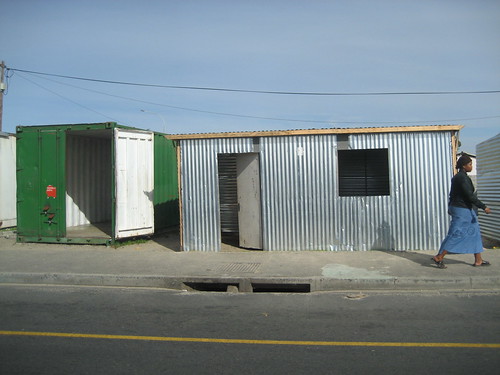
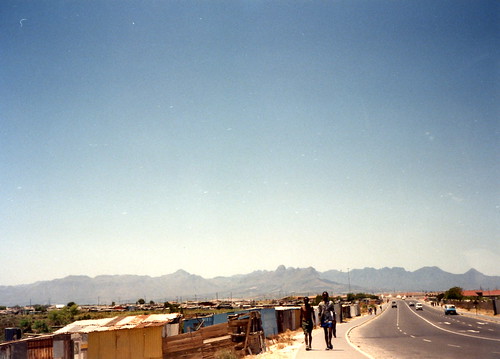
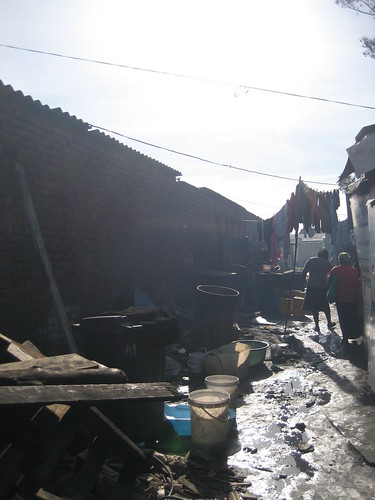
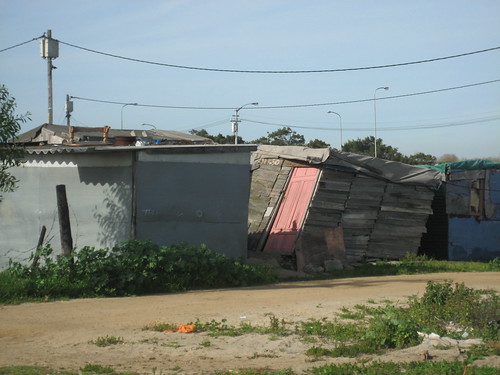
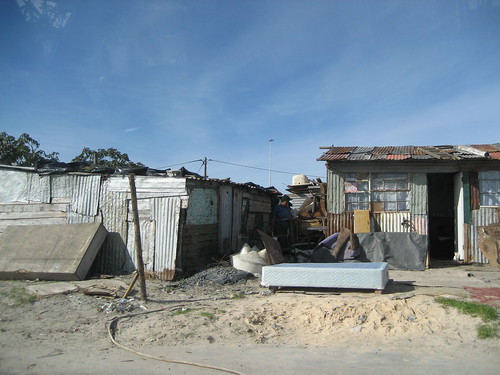
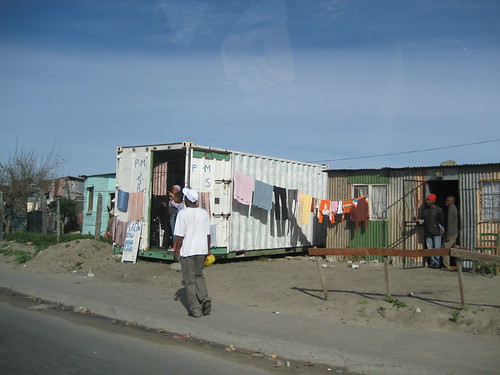
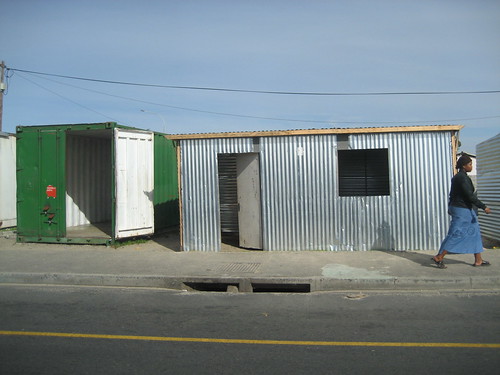
Khayelitsha container housing


Bound together, a playlist


A soundtrack for this note - returning to South Africa (spotify version) Bonus beats: a live version of Busi's urban zulu track

...

After reading The Cost of Reconciliation and learning about about Ginn Fourie, her daughter Lindi Fourie, and Letlapa Mphahlele.

See previously: Heidelberg Tavern Massacre

...

I nominate this note for The Things Fall Apart Series under the banner of The Rough Beast, which asks: who is writing the script?


File under: , , , , , , , , , , , , , , ,

Writing log. Concept: February 26, 2004. April 6, 2022

Saturday, December 30, 2023

Heidelberg Tavern Massacre

We'd passed the tavern on the same night
   but decided to go somewhere with more color
We woke in the morning to hear on the shortwave radio
   about an overnight massacre

As a good journalist,
   Mum grabbed her microphone and tape recorder
As a journalist's son,
   I made sure to grab my notebook and camera

No breakfast, we made our way to the scene
   from the university guest house
Checking the maps, we parked the rental car
   as close as the police allowed

The news didn't make for the best start
   to tomorrow's New Year
Ominous really, indeed,
   the country was in a state of suspended fear

It wasn't how we were planning to spend our short vacation
But the journalistic impulse is a lifetime occupation

Then again it was South Africa, forever on the verge of doom
There were elections planned in April, 1994 loomed


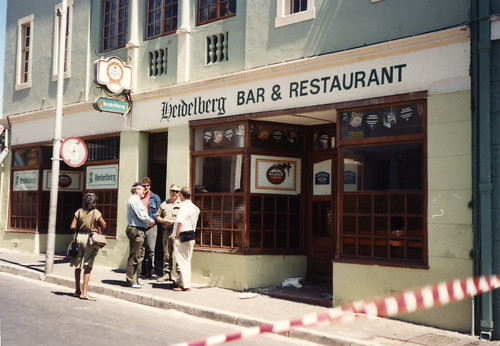
Heidelberg tavern massacre Cape Town


The BBC didn't have anyone in Cape Town,
   no boots on the ground
For things had not been as heated there as in KwaZulu-Natal

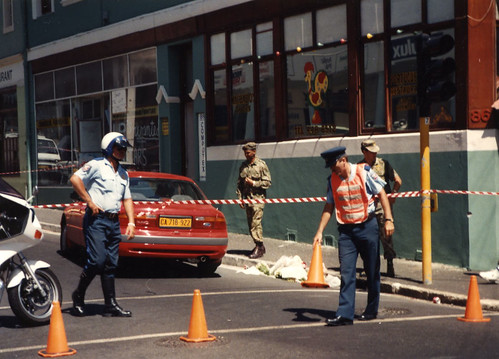
But now we could see the commotion,
   the heavy police presence
Flashing lights, weapons everywhere,
   and the sounds of sirens

Truth be told, it really felt as if we were in the middle of a war
Darn it, I had run out of film.
   Luckily, I spied a convenience store

Walked in briskly and asked what kind of film they had
Noting that I preferred Fuji but would gladly take Kodak

Taken aback, the shopkeeper,
   it felt as if I was integrating the shop
Ah right, should have known better,
   they'd never served black people before

The way he was startled, as if I had come in the wrong door
Was in the wrong place, an affront, and sullying his shop floor

It was so over my head.
   Had they really never been ordered around by my kind?
Well anyway, their countrymen would soon be doing the same,
   it was about time

"Where are you from?",
   a latter-day attempt at small talk over the counter.
"I'm on holiday, Sir. Came from the States.
   But I'm originally from Ghana."

"Ghana." "Yeah, West Africa."
   Rands proffered gingerly, patterns of exchange
I picked up water and a Twix bar.
   I told the owner to keep the change

Dad used to regale us with stories
   about his cohort of African diplomats
Integrating New York right after independence.
   This country was a throwback

I loaded the roll of film,
   would the memories I'd record be paparazzi gold?
Well it was South Africa, 1994 beckoned.
   Who knew what life would hold?


heidelberg tavern massacre - mum


Mum had already walked up beyond the security cordon
Her microphone a kind of spear that opened all doors

Looks of grudging respect from the soldiers and police officers
Badged as she was as a live representative of the foreign press

There was a local journalist on the scene
   who seemed to appreciate a colleague
It's not everyday that this kind of carnage
   comes to your quiet streets

It was only as she drew nearer
   that it struck me that it was a near miss
That it was only a matter of luck
   that we weren't yesterday's victims

This was the enlightened part of town
   where races supposedly mingled every day
Surprising really that the tavern would be singled out,
   a real case of dismay

An hour away, Khayelitsha had been rough,
   but this was quite different
This was the day, I guess,
   that Observatory had lost its innocence

Elsewhere, of course,
   Buthelezi's people and the ANC were going at it
That was the background of disquiet
   that was giving most of us fits

True, there were rumors of the apartheid death squads,
   the rearguard action
By and large however, on the ground
   there was a lot of empty posturing

Albeit we were learning the vocabulary of bloodletting
The country at large becoming connoisseurs of necklacing

But this was a terrorist attack plain and simple
Shooting up a bar out of some misguided principle

Students and others winding down the year
   with music and alcohol
Left for dead, maimed or injured,
   and now a cautionary symbol

Disconcerting,
   it's not that I'd discounted her war stories about being shot at
Sobering,
   even as I was well aware of journalists' occupational hazards

This was the new South Africa
   whose leaders were lawyers who spent time debating
At inordinate length, the finer points
   of the mooted constitutional provisions


heidelberg massacre - mum inspects damage


"It's bad." Onlookers murmuring, sidewalk symphony
"It's bad. They seemed to have shot up outside."

She gestured for me to come past the police tape.
"Come, you're my photographer."

"It's bad." What a refrain
"Oh it's bad. Damn." "It's bad." A chorus of pain

"Three dead at least." "How many?" "Three at least"
"It's bad. We don't know if the others will make it."

"It's bad." "What a shame."
"No responsibility declared." No one to blame.

"I counted ten, oh god. What a scene, it's bad."
"They found a bomb, it could have been even worse."

"Bomb squad was here. It didn't detonate. It's clear now"
"They say... You don't want to see inside. Believe me, it's bad."

"Come closer, take some photos."
   Not quite as intrepid, I was staying behind the tape.
Unabashed, she came and lifted the tape,
   pulled me over to the front. "Go on"

"Right here in Obz". Afrikaner accent
"Terrorists. I can't believe it."

"They should clean up the blood. It's bad, it's upsetting."
The broken glass dispersed, shards everywhere.

"It's bad. Oh, it's bad. I tell you. It's bad"
"Station Road. Right here in Obz. Oh, it's bad."

"Who was playing last night?" "Josh... so sad."
"Is he okay? I wonder." "Oh, it's bad"

There was blood on the ground and this was the aftermath
"Oh, it's bad", I couldn't help but join in with the refrain.


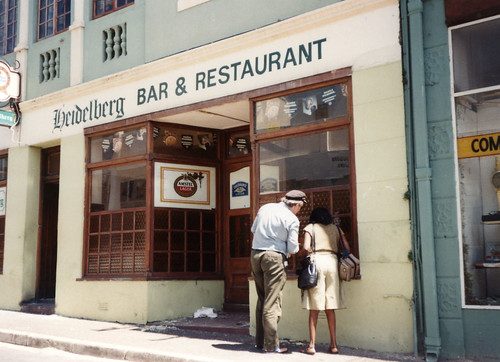
heidelberg tavern capetown


It took hours to interview everyone and talk to the police
Bystanders and witnesses, shocked
   yet wearing that mask of normalcy

Later we went to SABC, to the main studio, to call in her report
Filed for the African service, and then filed another for Focus

We weren't sure how the story would go over,
   the party line from Bush House
The news cycle doesn't afford the complexity
   that a long report allows

This wasn't the kind of story that anyone wanted to receive
No hearts would be warmed
   by this tale of blood on New Year's Eve

We decided to not get the film developed.
   Her copy would have to do.
By the time we finished reporting,
   it was late afternoon

We'd been so caught up that we'd forgotten to eat
   and now we were hungry
Thankfully I remembered my Twix bar,
   the cheap snack came in handy

We drove past the tavern again
   on the way back to the guest house
Canceled any nominal plans for the night,
   we'd had more than enough

Back in our rooms, it was time for some quiet reflection
Malevolence.
   We were shaken by our proximity to this unseemly action

Cape Town devoid of music, and turned into a place of hurt
Pain unbounded, the whole country holding its breath

The broken glass at the Heidelberg Tavern,
   death at the barrel of a gun
We would bring in the New Year very quietly that night,
   mother and son


heidelberg tavern cape town

Soundtrack for this note


The great guitarist Josh Sithole was holding court as ever at the Heidelberg Tavern on the night of the massacre. He was lucky to escape with his life but some of his audience, and someone from the next door checking in on what was happening lost their life. Casualties of a senseless deed.

...

Thirty years ago, I filled my notebook with some of the above impressions, I had yet to take everything in. I am still to write about the rest, what I later learned about the victims, the families and indeed the perpetrators. Having published my photos of the tavern online, I was often contacted as the legacy of the trauma was debated and processed over the years. All in good time, I suppose.

[Update]

Lost in Obs is an artwork commemorating the tragic events.

See previously: Truth and Reconciliation

Next: Bound Together, (a surprising aftermath) and First Responder

I nominate this slice of life for The Things Fall Apart Series under the banner of The Rough Beast, which asks: who is writing the script?


File under: , , , , , , , , , , , , , , ,

Writing log. Concept: December 31, 1993. February 3, 2022

Tuesday, August 08, 2023

An Hour Away

Cape Point. Near the southern tip of the continent
From the cliff, we watched the famed seascape
The blue waves that were said to rival Zanzibar
Then, the Cape of Good Hope.
Tourists. Escapism.

Later, an hour away lay the township
Punishing. We took in the juxtaposition
Apartheid painted from its drab palette
Khayelitsha.
Slum life. Journalism.

(South Africa, Christmas 1993)


capetown capepoint

capetown khayelitsha slum


Put all this behind you, the scripts were being readied
The recent unpleasantness was all ancient history
Welcome to the New South Africa, they'd started to say
After all, you know, the elections are only months away

A Temporary Inconvenience, a playlist


Some sounds from South Africa. (spotify version)


File under: , , , , , , , , , , , , , ,

Writing log: December 30, 1993, December 1, 2021

Friday, August 20, 2021

Scramble for Africa

Remembering the collective whiff of apprehension in the Harvard administration back in 1994 at the mere prospect of Winnie Mandela speaking at our African students conference. She tended to concentrate the mind.

Preparing for the 21st Century

Approaches were made, alternatives were immediately suggested, right thinking Harvard got into gear. I was sounded out by someone in the US State Department about our invitation. Unlike her husband, there was no good reason to deny her a visa but it was certainly being considered.

Recall that the ANC, per Ronald Reagan and George Bush, was officially designated a terrorist organization. Winnie's husband would need waivers, even post Nobel Prize, to visit the US and address the UN.

Hysteria to the left of us, amnesia to the right. (De Klerk would be feted years later at the Kennedy school). In any case, the pressure was on. The College Republicans had a new target. This was the first time I heard of Jack Abramoff.

Soundtrack: The Pressure by Sounds of Blackness

Some of us had a very different reading of Ronald Reagan's Forward for Freedom speech. It is an article of faith for me. It was written in Angola

In the event, Winnie had bigger fish to fry (the mother of all elections for one) and we went with less controversial speakers.

I wanted truth and reconciliation, and an end to apartheid and all I got out of it was a lousy t-shirt.

South Africa 1994, The mother of all elections

Still, I remember some administrator wondering aloud why we needed to bring all these "mid-level" African professionals (Ellen Johnson-Sirleaf, Djibril Diallo etc.) to the conference [to speak to African students] when an expert like Samuel Huntington was available (and local)

There was a silver lining, I applied for my first credit card in order to finance the conference, and got some whimsical toli out of it

Call it A Debt Foretold

My enduring theme is cultural memory, the legacies of men and woman, what we choose to remember and, crucially, what we choose to forget. I hew to the skeptic's credo and am determined to bear witness.

How else could they laugh
Like they do when they should weep;
Remembering the voiceless days of the past.

Kwesi Brew, African Panorama
The antidote to the scramble for Africa is Truth and Reconciliation:

Recall that well before Winnie's husband had assumed the mantle,
Long before the ink was dry on South Africa's new constitution
Their spokesmen were already calling apartheid ancient history
And, well, de Klerk would later join Kissinger in the rogues' gallery
Call it, of cold blooded murderers that have won the Nobel Peace Prize
The three musketeers of fate: irony, infamy and goddamn lies

A Temporary Inconvenience, a playlist


Let's have a minor soundtrack to celebrate my time as a temporary inconvenience to Harvard. Some South African music, sadly many of these great musicians are no longer with us (spotify version). ...

Timing is everything
Observers are worried

File under: , , , , , , , , , , , , , ,

Writing log: March 20, 2021

Tuesday, November 10, 2020

Truth and Reconciliation

The statues have been coming down of late
Their existence is at least contested these days
The shadows of impunity that were proudly erected by History
Are later seen as blind spots, per Auden's Archaeology
The legacies of men reexamined in a crisis's light
A change of perspective that provides newfound insight

That while one's forefathers may have looted and wielded the whip
It's no minor proportion of humanity that is descended from Genghis Khan
One needn't have been bloodthirsty to be a slaver in days of yore
We know foundational framers owned sour property on their sugar farms.
But wilful ignorance of sins past is quite the strange fruit
Turning your nose up at banana republics while forgetting your own crops
'Tis a blissful privilege to live, as the song goes, in unfinished sympathy
And to have to be actively taught about the importance of empathy

Recall that well before Winnie's husband had assumed the mantle,
Long before the ink was dry on South Africa's new constitution
Their spokesmen were already calling apartheid ancient history
And, well, de Klerk would later join Kissinger in the rogues' gallery
Call it, of cold blooded murderers that have won the Nobel Peace Prize
The three musketeers of fate: irony, infamy and goddamn lies

In my own life there was neither truth nor reconciliation
Our philosophy of survival meant that my countrymen rather embraced fictions
True, we always sought consensus and shared humanity
And our preferred political tactic was conversation
Yet this has meant a fraught and enforced civility
So even with my keen outrage - it comes with the territory
They're an open wound: those provisions of that amnesty
The depth of my feelings towards someone I used to call Uncle
The revulsion towards the Flight Lieutenant might prove to be a mistake
So while I view him as a sinner who drips blood in his wake
A living testament to unresolved matters of justice
His every utterance contemptible and scornful in practice,
That he still walks around unencumbered is too hard to handle

Still, I'm minded that my cousin once fell for one his daughters
The heart wills it wants, I heard the news and broke into kotokious laughter
Indeed, how could I even have forgotten? I was once her babysitter
It's just flesh and blood, hell, my mum was the woman's godmother
It just goes to show that social interplay is complicated
This is as it should be, harken back to Tristan and Iseult
Or Montagues and Capulets, wherefore art thou, Oduro
Inconvenient truths, and that modern saying, entanglement
Or rather that uneasy phrase, structural adjustment

The good professor would ask: is democracy of universal application?
The self-appointed general merely laughed at the quaint suggestion
An article of faith in the conqueror's catechism:
Impunity first, we'll loot to demonstrate dominance
The lessons of brute force, our country has learned in spades
We've been treated to imperialism, militarism, and even consciencism
The die was cast, I'll say we earned our lost decades
But those painful interludes were a temporary inconvenience
True, it wasn't easy living under rogue authoritarians
Yet history's arc would shift us away from those blows of providence

It all now falls to the next generation
To enact cultural revival and a quiet revolution
Yes, blood and sin remain at the heart of the matter
As, indeed, do cultural universals and particulars
The perils of greed and opportunism we'll have to suffer
And irony will linger as life's key register
The roots of our conflicts have always proven to be bitter
The search for a blanket of soul, a soothing balm for painful chapters
What profit a man? In this life, we're all political actors
Forgiveness and love, the anthem of Bloodbath, South Carolina


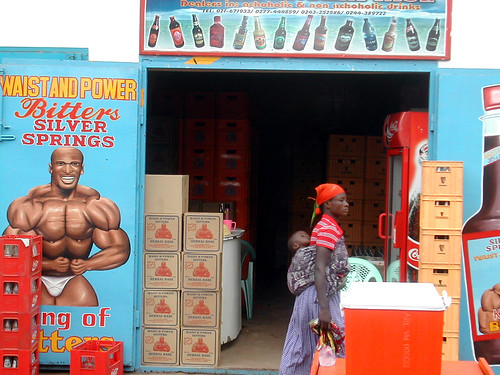
Containers: Bitters

Truth and Reconciliation, a playlist


A soundtrack to this note, a meditation on secrets and lies. (spotify version)


Photo credit: DK Osseo-Asare

I nominate this note for The Things Fall Apart Series under the banner of The Rough Beast, which asks: who is writing the script?


File under: , , , , , , , , , , , , , , , , , , ,

Saturday, December 17, 2016

Waiting for Godot (Khayelitsha)

Waiting for Godot - Khayelitsha, South Africa

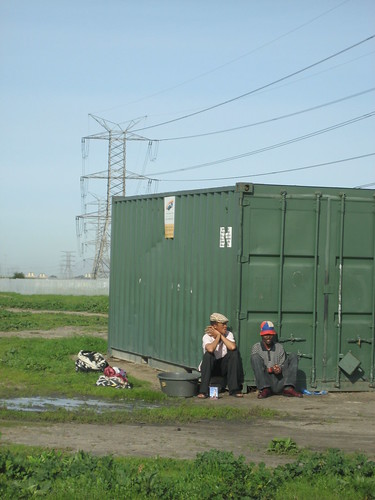
The two men sit outside a container waiting there in the middle of the field. There is an ease about them. We've caught them at a comfortable lull in the conversation or perhaps they are pondering a fond memory or the whereabouts of so-and-so. Their posture is relaxed, their clasped hands are mirrored. They've shared many stories, they'll share many more.

The one, perched on a couple of cement blocks, sports a plaid cap, a light pink polo shirt and slightly loose black trousers. Second hand. The other's multi-coloured off-brand Kangol bucket hat underlines the point. They are not rich obviously, for it goes without saying that the rich do not sit waiting outside containers in the middle of fields.

The power lines loom overhead, the hum of Tesla's crucifixes perhaps crackling occasionally to punctuate the high voltage cancerous flow. A basin sits to their right and there are a couple of piles behind them, clothes, it appears, that they are in no hurry to wash. The puddles of (dirty) water we assume do not disturb them now if they ever did. They are at ease in their patch of the the world. If it weren't for their skin tone, one would be tempted to call them Vladimir and Estragon, for indeed they do appear to be Waiting for Godot.

Waiting for Godot - Khayelitsha, South Africa

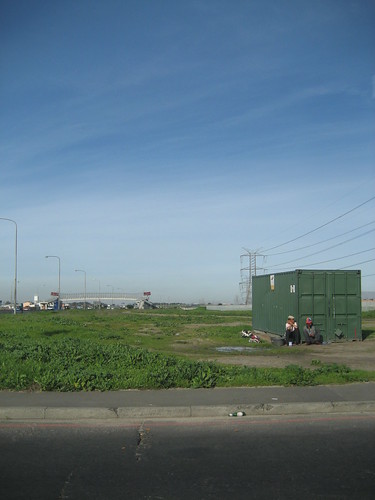
The earlier photo, taken at a further remove, is more classical. With its wider angle it captures more of the bluer sky, and places the men in their proper scale and perspective: insignificant like the discarded beer bottle at the curb, twenty meters away from the faded green container. Although it was winter in South Africa and it had snowed in Johannesburg for the first time in years, the environs of Cape Town could count on the milder weather that the men are enjoying. I understand why the photographer zoomed in, however. It's those details: that package at their feet, that blue plastic bag stuck under the locked container, the expressions on their faces, it's not so much resignation and despair as wist. Rather than the theater of the absurd, call the scene a mere portrait of modernity. I welcome other readings.

...

The Khayelitsha township near Cape Town, South Africa remains a foreboding place: poor, underdeveloped and a visible reminder of the lasting legacy of apartheid.

Khayelitsha slum

Still, even among the informal slum surroundings that might depress the most hardy,

Khayelitsha shacks precarious

there is a dynamism among the people that live here that belies the script that many have written for them.

Amidst the tin shacks (these days without the asbestos roofing of yore)

Khayelitsha shacks

and the containers

Khayelitsha containers and housing

those improvised, repurposed and ubiquitous containers

Khayelitsha container housing

and under the shadow of the electrical pylons and power plants,

Khayelitsha tower

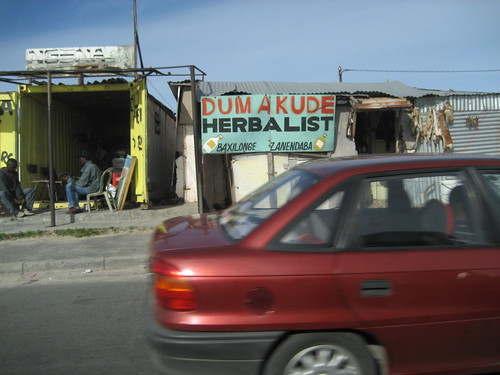
you'll find shops,

Khayelitsha containers Dumakude herbalist shop

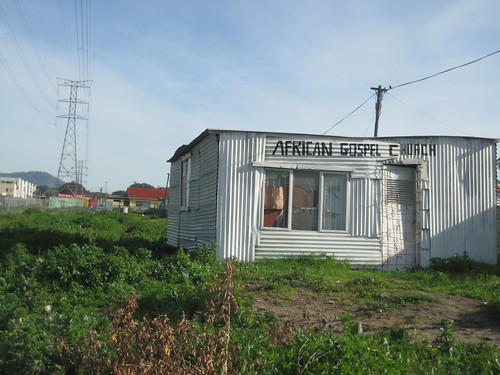
churches of sorts

Khayelitsha african gospel church

and, more importantly, the people with more ideas than you can absorb.

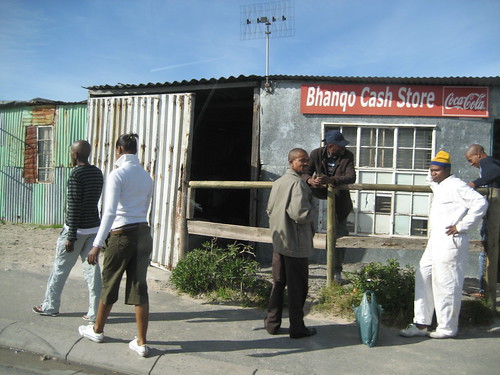
There's no time to dwell on any notion of nostalgia or the tragicomedy of poverty. This is the terrain of the hustle.

Khayelitsha bhango cash store

I trust the future is being written in Khayelitsha.

Soundtrack for this note


As is my custom, a playlist to augment this thoughts.

Obligatory disclaimer: I skipped the obvious songs about waiting since I was aiming for optimism rather than the blues (Prince's Still Waiting, Bob Marley's Waiting in Vain or say George Michael and Aretha Franklin's I knew you were waiting for me etc.) Also: these photos were taken by The Wife during a research trip in July 2007. I still haven't geared up to write up my own observations from my time in South Africa.

File under: , , , , , , , , , , , ,,

Friday, February 08, 2013

A Temporary Inconvenience

Five times in the last eight years, I've woken up one day having lost the hearing in one ear (the ear in question seems to alternate). It's a matter of physiognomy I've been told: the combination of poor drainage of my sinus cavities (their perversely shaped contours apparently don't help things), small ears, and a latter-day propensity for prodigious production of earwax. These episodes of partial deafness have typically lasted from as little as two hours to a few days. The current assault on my middle ear, however, at ten days and counting, is pushing beyond the realm of temporary inconvenience.

It's not just that I haven't been able to listen properly to the new José James album - hearing his golden voice in muffled mono as if coming from a locked trunk packed with ancient manuscripts hurriedly buried in a desert backyard in Timbuktu under Sharia law, is painful enough, it's that, as the days drag on, I'm beginning to contemplate what might happen if modern medicine and my body's defenses don't resolve things successfully. Incidentally, the album is rather ominously titled No Beginning, No End. Perhaps it's in that vein that I listened blithely (with my good ear) to a doctor cheerily informing me today that my hearing will "probably come back", and "most likely after a couple of weeks". Those hedging qualifiers were what I held on to rather than the alarmingly lengthy time horizon she contemplated.

I write, however, not to bemoan my lot because, obviously, things could be worse. The surprising thing also, once you get over the bewilderment of sinusidal oppression and hearing loss, is that one is able to carry on living a quite full life. Moreover, there's nothing like a temporary disability to make you rethink things; people don't think enough these days, they just act. I'm rather inclined to take the glass half full notion to being half deaf, heck, if you choose strategically where to sit in a hypothetical meeting, you'd avoid having to hear much that annoys you - and others would be none the wiser. And ear splitting cries, to take another example of occupational hazards, can easily become mere pantomimes, even hot air. But I digress..

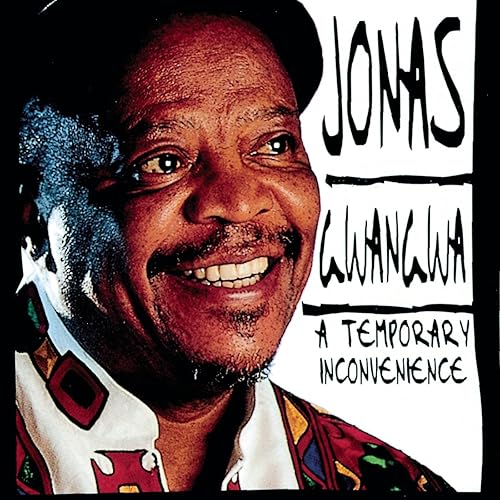
I write, rather, because my aural predicament reminded me of Jonas Gwangwa's song and album aptly titled A Temporary Inconvenience. The great trombonist's fulsome sound materialized in my imagination and got me thinking of a trip I made to South Africa in Christmas 1993, just months before the 1994 elections that marked the notional end of apartheid. Perhaps as I convalesce I'll find time to dig up my dusty notebooks and finally write up an episode that left quite an impression on me.

Jonas Gwangwa A Temporary Inconvenience

A South African playlist immediately conjured itself up. Start with the dearly departed Moses Taiwa Molelekwa, a brilliant jazz pianist whose Genes And Spirits captured the pre-transition mood - a mood akin to pre-millenium tension. Follow up with the the broken strings of Allen Kwela, fondly played wherever we went. Add in a touch of Busi Mhlongo's Urban Zulu for some funkified and righteous dance. And then think to Yvonne Chaka Chaka exuberantly singing Bombani invoking the enduring spirits of Mandela, Tambo and Mbeki père among others.

I'd like to think that the song, A Temporary Inconvenience, related to what Jonas Gwangwa and his contemporaries like Hugh Masekela and Miriam Makeba must have thought as they were first heading into exile from the apartheid state. As time passed and the temporary seemed to become permanent I wonder if they ever doubted they would return. For it was a uniquely unseemly state in world history. I'd certainly like to believe that, over the longue durée, apartheid itself will come be seen as a temporary inconvenience. That has been the challenge, I suppose, of the past 19 years, and perhaps that is the story that people were already suggesting even before Mandela was elected and inaugurated. It simply isn't the case, however, and much effort will need to be expended before that day will come. One wonders when the new South Africa will truly become "The New South Africa"...

But enough procrastination, time to summon up the courage to take that horse pill. I know the first thing I'll be listening to if, and when, my receptor cells resume their role as audio interpreters: the mellifluous trombone tones of a master musician.

A Temporary Inconvenience, a playlist


A soundtrack for this note (spotify version). File under: , , , , , , , , , , ,

Monday, December 14, 2009

Africa 1989

It struck me that we haven't heard many African voices in all the recent reminiscing about the year 1989. Anniversaries abounded. From Tienanmen Square, through the Soviet withdrawal from Afghanistan, to the fall of the Berlin Wall, we've had retrospectives on these momentous happenings. 1989 evokes loaded images, especially poignant amongst these being the transformations in Eastern Europe and beyond that affected the whole world. The year is a convenient stand-in for epochal change, Cold Wars fizzling and so forth. 1989 was similarly epochal in Africa even if our headlines were filed in the inside pages of our collective newsprint. Africans weren't mere onlookers and enjoined in the global conversation of those heady days.

I then came across some fragmentary notes I had on the year in Africa, notes I'd written when I was in a more jaundiced mood - they verged on the bleak. Writing today, however, I am more sanguine about that year, and hopeful, even as I look back. I can point to many items that genuinely warm the heart. You have to take the long view when it comes to Africa, and perhaps this accounts for the dissonance one feels about our past. Perhaps you'll be able to detect the keys in which different parts of the following were written.

I. The Reign of Locusts


Item:
Although political transformation in the 90s proved to be of variable intensity and longevity, often turned out to be new wine in old bottles, the change on the continent has been lasting. The incidence of military coups has dropped so far as to become negligible and there is an indisputable increase in functional democracies. In 1989 only three countries in Africa could claim to have democratic governments.

— Akwe Amosu musing on Democracy in Sub-Saharan Africa: Trends and Transitions (pdf) in 2007
Dig:
I've often wondered what it was like to attend, say, an OAU meeting circa 1989. That must surely have been a rogues gallery sans pareil. Could you shake hands with everyone in that room and look at yourself in the mirror the next day? For that matter, could you sleep that night? And what did the small talk of the nifty fifty sound like? Scratch that, what exactly was their big talk? Inquiring minds want to know.

Excellent Discussions

Having looked at Africa in 1966 (when innocence was lost) and written about the promise of Ghana in 1969, the faint glimpses of hope in 1992, and the pre-millennial tension of Africa 1999, and with an evident itch to scratch, I thought I'd give the toli take on continent in 1989. The 1970s and 1980s have been termed The Lost Decades in much of Africa — almost as if a plague of locusts had the run of the continent. We should tentatively file these notes under the banner of fallen angels.

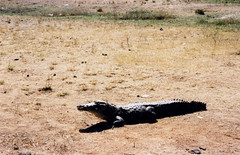
crocodile

Let's start with this: Robert Mugabe of Zimbabwe would likely have been the golden boy at the OAU meeting in 1989.

With 20 years hindsight, it is hard to believe that Zimbabwe was the example that the rest of Africa was being lectured about to emulate by the donors. Its vibrant economy, well managed agricultural sector, deep focus on educational achievement, and its democracy seemed without equal. Where its neighbours were basket cases, Zimbabwe appeared to be moving forward, it was the "success story". Mugabe's "egalitarian socialism" was being studied by Western cognoscenti. A stereotypical halo of smugness would surround my Zimbabwean friends of the time (side note: my Sierra Leonean comperes exuded similar confidence). Suffice to say that things can go wrong or right in a hurry.

He of The Little Green Book, Colonel Muammar Gaddafi, would have been a few years removed from the US bombing attacks that aimed to kill him, and a year removed from the reaction over the skies of Lockerbie. A French jet would suffer a similar fate in September 1989 when a bomb would kill all 170 people on board as it flew over the Sahara. There were even more potent, and certainly uncontested, acts, however, in his interaction with the West: the Provisional IRA was in full murderous effect in 1989, equipped with significant supplies of his explosive Semtex and sundry weapons; it would rotate members for training in the Libyan desert. As I recall, public transportation in London was an exercise in bomb threat delays followed on occasion by actual locomotion. The implications for West Africa of He of The Little Green Book's unmoored rage would be far more bloody I am sad to say. He was just about to unleash Charles Taylor and Foday Sankoh from nearby camps in his grand project of revolutionary agitation, and more on Liberia and Sierra Leone anon.

I won't bore you with by enumerating the long list of dictators that ruled and the havoc they caused, it makes for dismal reading (3 democracies out of near 50 countries remember). From "Comrade" Siad Barre in Somalia to Master Sergent Doe in Liberia and Sergent Eyadema in Togo, it was repression as usual. Most significant, perhaps, in this dreary military vein was that Omar al-Bashir came to power in Sudan in a coup on 30 June 1989. His regime brooked no opposition and promptly took Sudan's civil war into high gear. The legacy of Lost Boys and such ensued. Civil wars are never pretty and Sudan's was long and ugly.

crocodiles emerge at paga pond

Structural Adjustments


For what it's worth, in my native Ghana, Flight Lieutenant Rawlings's PNDC was typically authoritarian throughout 1989 as our Truth and Reconciliation commission has outlined. Apparently it was no contradiction for a supposed Marxist to be implementing the unpopular IMF Structural Adjustment Program, he was an early adopter on this front. General Ibrahim Babangida of Nigeria was of the same mind, and followed suit with the IMF and the World Bank. Expediency trumps everything if the preservation of power at all costs is the overt motive. Popularity or economic sense in policy doesn't matter much when you have a military regime, your populace will have to cope with whatever you dictate. It is the very definition of dictatorship. Structural Adjustment, then, was the great agenda in Africa, and many countries were being put through the wringer its paces. I'll note in passing that the term "Washington Consensus" was coined in 1989 at the very height of authoritarian rule in Africa. The Cold War bred strange bedfellows but none so ironic as the combination of mild-mannered Western financial technocrats and African dictators.

The inevitable backlash was felt from civil society, large enough to have necessitated a bit of rebranding and message massaging. In 1989, we started to hear about "structural adjustment with a human face" and its counterpart "sustainable growth with equity". This revelatory exercise in linguistics only betrayed the apparent irony that inhumanity had been the prevailing concern, with equity as an afterthought. In fairness, the legacy of these programs is mixed: the economies of most African countries did need reform after all. What is beyond question, however, is that the success stories that were being touted in 1989 were nothing of the sort, most of the gains were chimeric. Ask any Ghanaian if the 80s were good years if you want to hear a hearty guffaw. Would that the development aid cohort had their current restraint in those years, their swagger was hard to take. Some of us have long memories...

Francophone Africa presented a perfect picture of client states. Smooth operators like Omar Bongo (President of Gabon) and Houphouët-Boigny (President of Côte d'Ivoire) mixed the requisite post colonial trappings at home with the luxurious core of sleazy quasi-corporate patronage of the French political class. Call it equal opportunity looting or mere cronyism, enabled by Mitterrand and the revolving board of Elf-Aquitaine and others. France regrets those good old days. Who wouldn't, I wonder?

crocodile

Mobutu of Zaire was in full flight, an unchallenged dictator systematically breaking down the social fabric of his country while breaking world records in kleptocracy. Interestingly enough, by 1989 he was a little fed up with some of the shenanigans that some of the other African rogues leaders were getting up to. These parvenus were beginning to spoil the game for everyone. In mitigation, and in a rare act of regional statesmanship, he even helped broker a peace deal (promptly broken) in Angola. Now Mobutu was not one to do anything without a pecuniary motive hence inquiring minds are wondering what he was promised for his efforts. We'll no doubt have to wait until the State Department declassifies records in 2014 for the answer. Accordingly, I've already scheduled my FOIA request in Google Calendar.

It is worth dwelling on the Angolan case. Jonas Savimbi broke the barely 2 month old ceasefire, the fruit of years of negotiations, and resumed the civil war in Angola. Master of the huhudious, Savimbi declared:

"The Angolan people, to their infinite sorrow, accept that the war has restarted."
That, without any doubt, has to be the quote of the year 1989. He was the one who decided to break the peace, he didn't ask anyone, he presented the Angolan people with war as a fait accompli. He was to deepen their infinite sorrow for another 13 years.

Human Right's Watch began their Africa Watch in 1989 in their world report with a look at the Angolan case. Again it is instructive:

This refusal to criticize rebel abuses stems from the Bush administration's unwavering support of UNITA and its leader, Jonas Savimbi. For 14 years UNITA has been seeking to topple Angola's post-independence government in a war that to date has resulted in the deaths of over 100,000 people, most of them civilians. The U.S. policy of funding UNITA, first initiated by President Reagan in late 1985, has if anything been solidified under President Bush. Even before President Bush took office, he wrote to Savimbi assuring him that "all appropriate and effective assistance" would continue. Then, in 1989, to compensate for the loss of South African military and economic assistance to UNITA, the Bush administration increased the level of U.S. covert aid for Savimbi to close to $50 million. Although termed "covert," U.S. assistance is widely characterized as an "open secret." Savimbi himself made a public statement in June that Congress had renewed his aid, and was also quoted in Jeune Afrique magazine as saying that he had received $35 million in funding from the Central Intelligence Agency. Characterizing the aid as "covert," however, helps minimize Congressional and public scrutiny.

The lesson of Angola is that Africa was never innocent.

The corollary perhaps is that marauding phenomena like Jonas Savimbi did not operate in a vacuum. Proxy wars were a legacy of the Cold War, and Africa was a bloody battleground. Africans paid a heavy price. Enough.

paga crocodile eats chicken

II. The Great Awakening


The global conversation in 1989 was all about democracy. Mali led the way in Africa. Their president, Moussa Traoré, was your garden variety military ruler: no ideology to speak of save for the unvarnished exercise of power. With Mali being a poor landlocked country, he must have figured that he would have free reign. There would be no strategic interest for the Americans or the Soviet Union, the colonial power, France, had bigger and more lucrative fish to fry, and neighbouring countries only cared if refugees started streaming over the border. Everything seemed perfect and the years passed. 1989 must have been a rude awakening (1990 would be a nightmare, and 1991 would be the end). The Malian body politic and social compact reacted to his rule as if to an emetic. Malians were simply fed up with military rule and the attendant violence and arbitrariness. Slowly and systematically from 1988 on, they organized themselves to take back their country. It was a truly impressive sight throughout 1989. No external motivation was needed, a society simply decided to change its direction and moved.

Historians ask the same question about Leipzig in 1989. Why did people lose their fear? From the trade unions, to the students, the teachers, the lawyers and other professionals, all the way to the farmers, the consensus was that multi-party democracy was the way forward. Newspapers appeared without approval and served as forums for discussion over the shape of democracy to come. It wasn't unanimous, and the process had its twists and turns but the atmosphere changed. Those sensible Malians lost their fear and brought about lasting change. The proviso, with this being Africa, was that there would be needless deaths along the way (a massacre of 300 protesters in 1991 being the final straw). The miracle in Mali is how we now call it. Mali was the first to turn the tide to genuine democracy in the 90s, an impressive beacon for the rest of the continent.

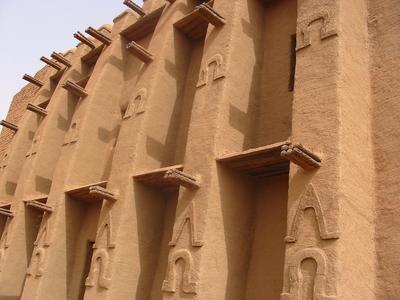
Malian Architecture

Ghana's version of 1989 was in a minor key and actually started over the course of a few weeks in 1987. It was a series of public lectures by a history professor, Alfred Adu-Boahen, on a sober topic: The Ghanaian Sphinx. Reflections on the Contemporary History of Ghana, 1972-1987. It is hard to believe that there was a time when such comparatively mild criticism would have condemned you to harassment, jail or worse, but that was the case at the height of the reign of Flight Lieutenant Rawlings' junta. Arbitrariness, and a malign and heavy hand were the weapons of choice. The only forms of resistance in the eighties were exile on the one hand, or the culture of silence on the other. Said culture of silence was attacked head on during these lectures and the spell was decisively broken.

The metaphor of the Ghanaian Sphinx - that puzzling acquiescence to authority and silence in the face of privation and worse, was outlined and a solution was proposed. It was a simple formula: plain speaking about the history of Ghana since independence and calling things by their name with lucidity. His argument made a difference and the atmosphere in the country changed. The fight for democracy was enjoined and much of Adu Boahen's blueprint has been followed over the years. If only there had been more such profiles in courage. Would that more had stood up and been counted.

The immediate and major difficulty in this effort was that political parties were not allowed in Ghana. 8 years of military rule had cowed the opposition. To the extent that there was any politics in the country it was to be found in social groups without any agenda. Ghanaians vied to compete to be secretary of football supporters' associations, book appreciation clubs or bible study groups. Even the Danquah lectures were framed as simply educational lectures. It would require considerable reorientation to force the issue. Still a conversation was started and Ghanaians began to organize themselves. Indeed in 1990, a Movement for Freedom and Justice was formed to pressure for change and a return to civilian rule. The first fruits of this pressure was with the news media. The Catholic Standard resumed publication (religion being the major (only) growth industry in the country). More crucially, a few independent newspapers were allowed to come into existence, the Ghanaian Chronicle the most significant among them. Over a next decade, these newspapers and then the new FM radio stations that started broadcasting would prove crucial in securing democratic gains - monitoring elections being one of their essential contributions.

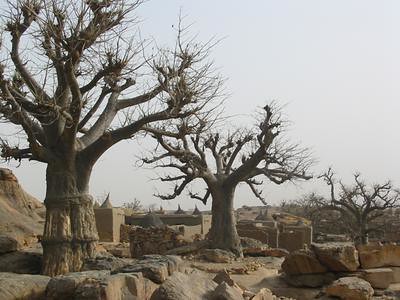
Dogon Hillside

Another history professor, Laurent Gbagbo, was speaking up in Côte d'Ivoire against President Houphouët-Boigny whose recently completed basilica, Our Lady of Peace of Yamoussoukro, was the largest church in the world. By then he had been in power almost as long as Castro and Kim Il Sung of North Korea. The sly fox was nothing if not resilient and hanged on to power until his death a few years later. With hindsight, it would have been better if Gbagbo had been successful in his efforts in 1989 (or for that matter in the 70s when Houphouët first put him in jail). He was a very different (read compromised) man when he would come into power in 2000. The damage was done to the social fabric of Côte d'Ivoire during the lackluster years of the 1990s when each leader in the political class outdid themselves in demagoguery and never failed to disappoint their compatriots.

Algerians turned out in masses and overwhelmingly approved a new constitution at the start of 1989 to pave the way to multi-party politics. The generals seemed to go along with the decision but would have second thoughts about democracy at the culmination of the process in 1992 when it appeared that Islamist parties were poised for victory. A murderous civil war then ensued. In 1989 however things were looking up. In most of Africa, there seemed to be a great awakening and signs of life.

The strongmen in Africa fought these encroachments on their freedoms like all powerful men are wont to do: tooth and nail. It was the eternal dynamic of the confronted authoritarian: delay, ignore, suborn, bribe when expedient, divide and conquer and that old standby, the demonstration of violence. After 1989 there would be less room for maneuver and many had to tone down their outrages against human rights and democracy. The result was that the 1990s would see a spate of elections. True, in many countries, it was only lip service that was being paid in these elections, hence the frequent resort to of vote rigging; in other countries, however, there would be genuine transitions. 1989 gave impetus to these nascent movements.

baobab by kagyah

III. A South African Detour


A conventional reading of South Africa in 1989 would run with the Great Man theory, namely that the secret negotiations that had began with an imprisoned Nelson Mandela in 1988 continued throughout the year and would culminate in his release in 1990. All this would understate the complications on the ground and the considerable effort expended to rid the country of apartheid.

There was continued internal pressure by the banned ANC, persistent strikes by the trade unions and general defiance in the townships. There were significant external pressures, whether through economic sanctions or consumer boycotts, that forced the divesting of holdings of South African enterprises and a shunning of exports. Military, diplomatic and cultural pressures weighed on the regime.

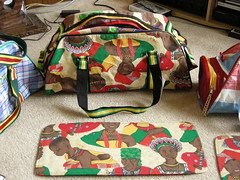
jo bag: ghana must go in South Africa

There was a lot of geopolitics involved and some point to the crucial impact of the battle of Cuito Carnival the previous year in Angola where South Africans and their proxy army, Jonas Savimbi's UNITA movement, were forced to a stalemate by the MPLA and their Cuban reinforcements. After much diplomatic untangling of the situation, the Cubans went home, South Africa agreed to Namibian independence, and Angola's MPLA agreed to a truce with UNITA. You can read Chester Crocker's self serving memoir, High Noon in Southern Africa, for the naive account of what transpired... The irony of the book's title and indeed the outlook it betrays will be tackled later. Sam Nujoma would lead Namibia to independence in 1990 after what had been long hard-fought war. South Africa would begin to stop meddling in its neighbour's affairs.

In 1989, the world learned that hit teams of South African police were assassinating people "in Swaziland, Lesotho, Mozambique, Zimbabwe and Britain, as well as inside South Africa". All opponents of the apartheid regime were fair game. The moral opprobrium against P.W. Botha's would weigh on his successor De Klerk. The optics were not in their favour. The rest of Africa made their thoughts clear. The ANC proposed, and the OAU adopted its Harare Declaration on August 21 1989

We recognise the reality that permanent peace and stability in Southern Africa can only be achieved when the system of apartheid in South Africa has been liquidated and South Africa transformed into a united, democratic and non-racial country. We therefore reiterate that all the necessary measures should be adopted now, to bring a speedy end to the apartheid system, in the interest of all the people of Southern Africa, our continent and the world at large.
Note, if you will, how the same story was reported in the New York Times: "South Africa Rebel Blueprint Backed by Regional Leaders".

The spin in the paper of record reflected the prevailing conventional wisdom in the USA. We must never forget that Ronald Reagan, George Bush the first, Margaret Thatcher and their bagmen, still saw themselves as allies of the apartheid regime. To their dying day, they should be tarred with their association, nay commission, with some of the most awful lot in history. There were many misadventures and much blood spilled in the Great Games of the Cold War; the support by these governments for apartheid is unambiguously egregious.

jo bag: ghana must go in South Africa

And it bears reminding that the struggle for liberation of South Africa was still a close run thing - note the headlines from that same day: "New Wave Of Arrests In S. Africa; Apartheid Resisters Go Into Hiding"

Leaders of a three-week-old campaign to defy apartheid restrictions began going into hiding today to elude a new wave of arrests by South African police as the government of acting President Frederik de Klerk intensified its crackdown on activities aimed at disrupting next month's segregated elections for Parliament.

The Cape Province turmoil has been viewed as a campaign against elections for the tricameral Parliament, in which Coloreds and Indians have separate-and mostly powerless-chambers. South Africa's 23 million blacks have no representation in Parliament.

The police crackdown on dissent appears to be the government's response to criticism by the far-right Conservative Party that de Klerk has gone "soft" on security, especially after the announcement that the acting president will travel to Zambia next Monday to meet with President Kenneth Kaunda, Africa's leading patron of the exiled African National Congress, which is South Africa's most powerful anti-apartheid resistance group.

Still the sensible folks prevailed:
We believe that a conjuncture of circumstances exists which, if there is a demonstrable readiness on the part of the Pretoria regime to engage in negotiations genuinely and seriously, could create the possibility to end apartheid through negotiations. Such an eventuality would be an expression of the long-standing preference of the people of South Africa to arrive at a political settlement.
That thankfully came to pass. The ANC won the 1994 elections.

At the end of the year, the General Assembly of the UN adopted its Declaration on Apartheid and Its Destructive Consequences in Southern Africa (pdf). Again this was over the strenuous objections of Bush and Thatcher. Lest we forget.

IV. Decentralization


In many arenas in 1989, Africans were beginning to route around central governments. The Big Men still mattered but civil society looked to assert itself. Change was in the air and decentralization was the result. The caveat as ever would be that the institutions took some time to follow the lead of the people; it is the African way it appears. A few years later, Yassin El-Ayouty would write "the world has completely changed since 1989; the OAU has not, since 1963" (The Organization of African Unity After Thirty Years). As someone who rails against stodgy institutions, I am heartened by the decentralization that continues to take place throughout Africa, it keeps leaders on notice.

Where the Organization of African Unity was barely more than a club for the "big men" first of African independence and then of cold war politics, with a gentleman’s agreement not to interfere in each others affairs, the African Union is a institution whose statutes affirm the importance of substance, of accountability, of human rights, and the obligation to uphold those rights not only at home but in your neighbor’s back yard too. Undoubtedly in practice, these aspirational standards are often not met and the development of these institutions is a work in progress; but the challenge is no longer the lack of standards but enforcement.

— Akwe Amosu - Democracy in Sub-Saharan Africa: Trends and Transitions (pdf)

In the field of health care and public policy, The Bamako Initiative was beginning to bear fruits. Again, starting from Mali, we got concerted efforts in health care and population issues. The emphasis was on decentralization and getting local communities involved in decision making that affected them. The strategy would inform later efforts at poverty reduction.

The most useful document I've found to evaluate Africa in 1989 is a long-term perspective study by the World Bank: From crisis to sustainable growth - sub Saharan Africa (pdf). It is comprehensive and fodder for historians, social scientists and mere bloggers.

Decentralization has been essential in bringing about change in Africa and often times it hasn't been a matter of conscious policy. It turns out that things like cell phones and FM radios are the great equalizers for democracy and help move beyond social communication to the political and economic realm. We should all search for more in that vein.

V. Enter The Gremlin


He could have been a mere footnote, but it wasn't to be. He was a mere anecdote for me on Boxing Day of 1989. Annoyed as I was that my mother had worked on the holiday, she deflected my irritation by mentioning this man who had called up the BBC and told her that he had invaded Liberia. That was most people's introduction to Charles Taylor and his unique brand of malevolence. It was bemused entertainment for a journalist but he gave such good copy, a fluent mixture of hubris and cold calculation. He was going to "bring the bitterness of war to Liberia", launch a revolution throughout Africa, and overthrow Master Sergent Doe.

From the first 10 men who joined him from Libyan camps to all the subsequent marauding armies that came into play, Charles Taylor has destabilized no less than eight countries. The casualties and the brutality was impressive. The callousness was biblical, the innovations of small boys units in warfare absolutely diabolical, and the savagery simply unmatched. Much as I wish to dwell on democratic change that 1989 presaged, I have to admit that Charles Taylor and the civil wars that he fomented since 1989 loom large throughout Africa. He may sit these days on trial in The Hague but he casts a dismal and influential shadow. Liberia and Sierra Leone suffered the most in the bloody free-for-alls; Cote d'Ivoire vacillates and many others are picking up the pieces twenty years later. The events of the past year in Guinea can even be read as further aftershocks of the Charles Taylor earthquake.

Aburi mask - strange days

Blood and sin was Charles Taylor's unique contribution to Africa.

The pervasiveness and intensity of looting, pillage, and plunder by the leaders and the rank and file, the lack of a stable and systematically organized structure of command and control among the armed bands, the criminal misuse of children, the employment of strategies of confidence artistry, the opportunistic use of a variety of cultural symbols, the orchestration of a state of anarchy as the normal environment of operation are all constitutive of the behavior of gangsters who use terror as their ultimate instruments of control. This mode of control draws from the worse aspects of an array of cultures ranging from the culture of urban gangsters and small town confidence artists of western society, and the area boys and swindlers of West African cities to marauding murderers.

— Amos Sawyer - Violent Conflicts And Governance Challenges In West Africa: The Case Of The Mano River Basin Area (pdf)
It is a dubious legacy, and it all started in 1989.

VI. A Year in Music


There was lots of politics on the agenda in 1989, and lots of dancing too. A playlist for your listening pleasure

What were your memories of Africa in 1989?

File under: , , , , , , , , , , , , , , , , ,