Showing posts with label Bulsa. Show all posts

Tuesday, June 24, 2025

Near the Weeping Trees

Poetic license, a grove of weeping trees
Is said to mark the spot where Babatu's wife perished,
Abandoned by his retreating raiders

Vitellaria paradoxa, the botanists would precise
The creeping shea tree takes 15 years to start to bear fruit
The site of her execution, an arboreal memorial of resistance

The historians would argue about the accuracy of oral history
Questioning how these stories have come down through the ages
That the battle of Sandema most likely took place
Somewhat at a remove from where we now celebrate it
That the invention of tradition prevails

That, yes, Babatu was the prime slave raider in those times
But that the invocation of Samory was a touch of artistic license
Embellishment by the griots,
Born of his fearsome reputation
For the record shows he confined his empire's reach
To the west of the coast

Thus, while Samory's troops did overrun Bole,
They never made it to Sandema
No, Babutu was the prime mover
In what is now northern Ghana

The Zabarima depredations he led
The forced marches, the trail of dread
Spilling over from the East and North - Niger
Shackled, back to the market at Salaga

It follows; the dread that the Gonja faced
Was in the same vein as what the Bulsa bore
The specter of their adversaries
Commingled in the tales of the griots
For it was the same threat, the same suffering,
And the same wounds

And, yes, Bulsa children should run
At the mere mention of either foe
The griots had it right:
What is 200 miles in the grand scheme of things?

So, Salaga market
Or Kasana market near Tomu
Ominous since their founding
The former now a tourist site a century later
With a few exhibits

The footpaths trod by captives,
Marched from Bulsa and Kasena areas
And shackles, so many shackles, symbolic,
And other items that bear reflection
Earth shrines in modern times,
Northern doors of no return

...

We leave faint traces in our stories,
Signposts of intimate legacies
Fumes marking cautionary tales,
The touchpoints and the villains
And heroes too.

Years later, we gather and celebrate the victories
Feok they call the annual festival,
Harvests, and a "time of plenty"
Where warriors gather in performance
And recount the shared memories
And it all happens - historians may debate,
Not too far from the weeping trees


Builsa Feok Festival Sandema


Near the Weeping Trees, a playlist


I recall when the then 3 year old entered the daycare center singing Burning Spear's refrain: "Do you remember the days of slavery?". The looks from the front desk, of those proper, Southern Texas ladies... I decided to keep things light with my playlists going forward. Still, these are living histories, the legacies of men.

A soundtrack for this note (spotify version) Bonus beats: a few live and dub versions of these joints

See previously Running Away, my first piece on the tales of Northen Ghana and, just to confuse things, Samory's Old Camp

This note is part of the Things Fall Apart series under the banner of The Bulsa Way.

File under: , , , , , , , , , , , , , , ,

Writing log: September 10, 2022

Tuesday, March 25, 2025

Running Away

The lyrics in the songs always mentioned running away. Flight, escape, danger in its many variations. Embedded in the outlook, punctuating the very choruses was a sense of precarity. And yet these were not dirges, these were not laments. They'd long made their peace with the world as they'd found it, nay, they were comfortable even if clear-eyed about this existence.

And they watched.

Running away, heading for the hills and the rocky terrain. Running away, heading for higher ground, for those parts that only those close to these lands would know. The caverns where they could hide, holding their breath, stifling all sounds, covering the mouths of the infants.

And they waited.

Holes in the ground, the entrances disguised, dark caverns where the ancestors were said to have sought shelter from previous predators. At most a dozen could fit in the largest ones so you had to be prepared to seek out other spots, ever calculating as you ran up over the rocks how many had already made it, and if you would be able to use this particular refuge.

Oftentimes it was a gamble.

To enter the hiding places, you crouched, crawled and wriggled. The earth would envelop you, surround you with its embrace. You could expect to taste the slightly acidic crumbs as you pushed your way in, to smell the faint trace of clay. The earth would resist the touch, implacable and stern, until it would yield all of a sudden, plunging you forward into the void of the cavern.

You hoped, you wished for a soft landing.

You had to be methodical even in the heat of the moment, deliberate even as the senses were heightened by the danger. First, to dislodge the covering by pulling at the right spot, the intricate branch structure that only careful hands could pry open, and then to preserve its camouflage so that it would appear undisturbed to the raiders in pursuit. The architecture of escape, the provisional sanctuary.

And they prayed.

No matter how many times they had practiced, no matter how many warnings, no matter how many songs they had sung, no matter how much advance notice they'd garnered, they knew that there would be something lost, that there would be someone lost. It was the nature of life in those times. Something, someone would be snatched from you. Pieces of yourself dispersed, shredded away, leaving only the memories.

And they wept.

Farmers and pastoralists, they never had a standing army. Millet and maize in small fields, custodians of the northern territories, eking out enough to support the clan, to trade some guinea fowl and kola nuts, to enjoy the gifts of the earth, to husband it. This patch of land on the lower Sahel was unforgiving but it was theirs.

And they stayed.

But, at length, there had to be some edge they could wield to surprise the raiders. Running away might ensure survival for many, but more was needed. They taught the youth about all the plants and their uses. Those they ate, those they treated with as part of aromatic bitters, those with properties that were prized, their nighttime potency recounted, astringency debated, and medicinal effectiveness evaluated. And once they proved adept and facile with the identification of the flora, they would learn about what in extremis could be used in the poisoned arrows that were always reluctantly fashioned. Weary, wary, reluctant but necessary.

And so they studied.

The elements of survival were well known. Swift recall, preparation, decisiveness under threat, knowledge of topology, and luck. For the gods were capricious. Even the fleetest of foot, the strongest, and the most agile could be brought low and fall prey to the human hyena that roamed the lands. And Babatu's men were implacable and determined trackers. Tears would be for nought when in their grip. Best to fight when caught, to resist with all one's heart. But, above all, to flee when attacked, to live to see another day, to rebuild and restore when these interlopers would leave, for they would surely leave as these lands only yielded bodies to them.

And they ran away.

Taboo. A famous dirge recounted how one of the twins was unable to stay silent, a hard demand of a toddler, let alone in the darkness of the cavern. Their position having been given away, tough decisions had to be made. Father and the one would give themselves up hours later, when it became clear that this set of raiders would wait them out, they were a patient lot. Mother and the other twin would retreat further into the second chamber, deep in the dank bowels of the earth and stay for three days. It was hard to breathe, it was hard to stay silent and still, and there was only one gourd of water and the few nuts hidden in the fold of her cloth. They clanged to each other, charged with the burden of loss, of memory, of survival. Pieces of themselves lost for good. But they lived to tell the tale, to recover possession of the land.

And they survived.

Strangers have come into our land
Raiders have come for our bodies
Take heed, my brother, and run, run away
Caution, my sister, and run, run away
For we will all, someday, be turned into sand
And all that will remain is our story


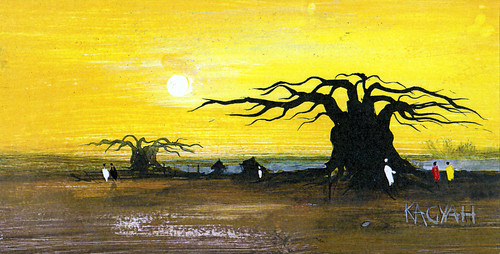
baobab by kagyah


Running Away, a playlist


A soundtrack for this note. (spotify version) Further reading:
A later discovery: Beyond Elmina: The Slave Trade in Northern Ghana by Joachim Jack Agamba mined similar terrain to great effect.

Next: Near the Weeping Trees

This note is part of the Things Fall Apart series. Do let me know what banner might be appropriate.

File under: , , , , , , , , , , , , , , , ,

Writing log. July 24, 2022