The grim stories from Haiti over the past couple of weeks are even more depressing than the steady drumbeat of bad news we've heard from there all year. Perhaps only genocidal Darfur, perennially shell-shocked Gaza and the West Bank, the complete disaster that is Iraq, or the parts of Sahelian Africa that are dealing with a biblical plague of locusts are comparable in the extent of desperation inflicted on the poor country. See Death Toll in Haiti Floods Rises to 1,650 or many other news stories about Hurricane Jeanne and photos to get a flavour.
True, some of the scenes from Gonaives that have emerged have even managed to make slight inroads into the solipsism of America's media; the dramatic images, of say people fighting for food or UN troops having to fire in the air to prevent looting, provide a more arresting diversion from the more orderly Florida evacuations or political navel-gazing of election season. But only for a few minutes. The media script that prevails is one that doesn't allow us to stare frontally at the abyss that is today's world. If we won't even dig into Abu Ghraib, what appeal can little Haiti have? Like the graffiti on the subway I noted proclaimed: "Buy Something, You Stupid Consumer!" That's really what it's all about in this society.
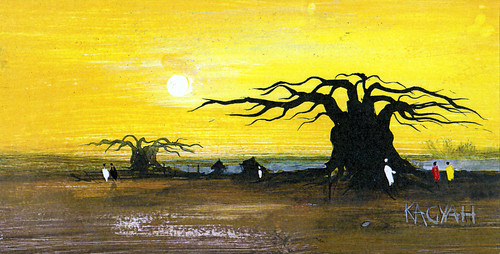
The Haitian Landscape
Still, Haiti has been a non-stop disaster
all yearFloods are particularly devastating in Haiti, the poorest country in the Americas, because it is almost completely deforested, leaving few roots to hold back rushing waters or mudslides. Most of the trees have been chopped down to make charcoal for cooking.
The storm came four months after devastating floods along the southern border of Haiti and neighbouring Dominican Republic. Some 1,700 bodies were recovered and 1,600 more were presumed dead.
Gonaives, the city where Haiti's declaration of independence was signed, also suffered fighting during the rebellion that led to Aristide's ouster and left an estimated 300 dead.
All this in a year supposed to be dedicated to celebrating the 200th anniversary of the country's independence from France. Haiti, the only country to launch a successful rebellion against slavery, was the world's first black republic.
In a sense this week's scenes are much like those of the Mozambiquan floods of 2000 (similarly epochal) and the
woman giving birth on treetops and being rescued by helicopter. You can't ignore the human drama of the natural disaster.
Of course, the irony is that the foundation for the disaster has been man-made (albeit taking place slowly over the past century). Over the past few years, geographer, physiologist and MacArthur Foundation 'Genius',
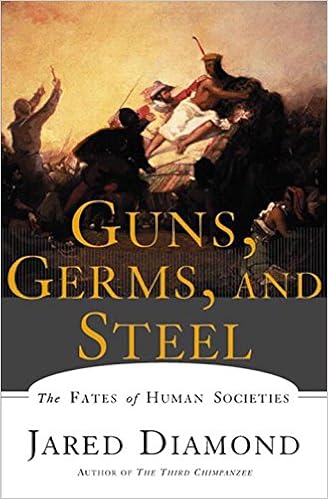
Jared Diamond, has been emphasizing the point he first made in
Guns, Germs and Steel
To take an example from last year, in an op-ed on Iraq in the LA Times (I can't find an online link, so this quote is from my copy), he talked about the decline of the Fertile Crescent (what we now call the Middle East and the cradle of civilization) and The erosion of Civilization
So how did Fertile Crescent peoples lose that big lead? The short answer is ecological suicide: They inadvertently destroyed the environmental resources on which their society depended. Just as the region's rise wasn't due to any special virtue of its people, its fall wasn't due to any special blindness on their part. Instead, they had the misfortune to be living in an extremely fragile environment, which, because of its low rainfall, was particularly susceptible to deforestation.
When you clear a forest in a high-rainfall tropical area, new trees grow up to a height of 15 feet within a year; in a dry area like the Fertile Crescent, regeneration is much slower. And when you add to the equation grazing by sheep and goats, new trees stand little chance. Deforestation led to soil erosion, and irrigation agriculture led to salinization, both by releasing salt buried deep in the ground and by adding salt through irrigation water. After centuries of degradation, areas of Iraq that formerly supported productive irrigation agriculture are today salt pans where nothing grows.
Once the Fertile Crescent began to decline for those environmental reasons, hostile neighbors helped speed the process. The original flow of power westward from the Fertile Crescent reversed in 330 BC, when the Macedonian army of Alexander the Great advanced eastward to conquer the eastern Mediterranean. In the Middle Ages, Mongol invaders from Central Asia destroyed Iraq's irrigation systems. After World War I, England and France dismembered the Ottoman Empire and carved out Iraq and other states as pawns of European colonial interests. As the end product of this history, the former world center of wealth, power and civilization is now poor in everything except oil. Iraq's leaders ensured that few benefits of that oil reached their people.
Iraq's decline holds a broader significance. Many other countries today face similar crippling environmental problems, including the deforestation, overgrazing, erosion and salinization that brought down the Fertile Crescent. Other countries already crippled or nearly so by such problems include Haiti, Somalia, Rwanda, Afghanistan, Pakistan, Nepal, the Philippines and Indonesia.
You may well detect a similarity between this list of looming environmental disasters and the CIA's list of overseas trouble spots, places prone to civil wars and violent regime changes ? places to which we often end up dispatching U.S. troops. Those two lists are related by cause and effect. When environmental damage makes people economically desperate, they are likely to suffer from poor health and short life spans, blame their governments, kill each other, end up with crazy leaders and seek to immigrate illegally to more favored landscapes.
Or for a more extensive treatment in a recent take on
Why Societies Collapse, consider this excerpt from a speech
If one asked an academic ecologist to name the countries in the modern world that suffer from most severe problems of environmental damage and of over-population, and if this ecologist never read the newspapers and didn't know anything about modern political problems, the ecologist would say "Well that's a no-brainer, the countries today that have ecological and populations, there are Haiti, Somalia, Rwanda, Burundi, Iraq, Afghanistan, Pakistan, Nepal, the Philippines, Indonesia, Solomon Islands." Then you ask a politician who doesn't know, or a strategic planner who knows or cares nothing about ecological problems, what you see is the political tinderboxes of the modern world, the danger spots, and the politician or strategic planner would say "It's a no-brainer; Haiti, Somalia, Rwanda, Burundi, Iraq, Afghanistan, Pakistan, Nepal, the Philippines, Indonesia, Solomon Islands", the same list. And that simply makes the point that countries that get into environmental trouble are likely to get into political trouble both for themselves and to cause political troubles around the world...
In trying to understand the collapses of ancient societies, I quickly realised that it's not enough to look at the inadvertent impact of humans on their environment. It's usually more complicated. Instead I've arrived at a checklist of five things that I look at to understand the collapses of societies, and in some cases all five of these things are operating. Usually several of them are.
- The first of these factors is environmental damage, inadvertent damage to the environment through means such as deforestation, soil erosion, salinisation, over-hunting etc.
- The second item on the checklist is climate change, such as cooling or increased aridity. People can hammer away at their environment and get away with it as long as the climate is benign, warm, wet, and the people are likely to get in trouble when the climate turns against them, getting colder or drier. So climate change and human environmental impact interact, not surprisingly.
- Still a third consideration is that one has to look at a society' s relations with hostile neighbours. Most societies have chronic hostile relations with some of their neighbours and societies may succeed in fending off those hostile neighbours for a long time. They're most likely to fail to hold off the hostile neighbours when the society itself gets weakened for environmental or any other reasons, and that's given rise for example, to the long-standing debate about the fall of the Western Roman Empire. Was the conquest by Barbarians really a fundamental cause, or was it just that Barbarians were at the frontiers of the Roman Empire for many centuries? Rome succeeded in holding them off as long as Rome was strong, and then when Rome got weakened by other things, Rome failed, and fell to the Barbarians.
- And similarly, we know that there were military factors in the fall of Angkor Wat in Cambodia. So relations with hostiles interacts with environmental damage and climate change. Similarly, relations with friendlies interacts. Almost all societies depend in part upon trade with neighbouring friendly societies, and if one of those friendly societies itself runs into environmental problems and collapses for environmental reasons, that collapse may then drag down their trade partners. It's something that interests us today, given that we are dependent for oil upon imports from countries that have some political stability in a fragile environment.
- And finally in addition to those four factors on the checklist, one always has to ask about people's cultural response. Why is it that people failed to perceive the problems developing around them, or if they perceived them, why did they fail to solve the problems that would eventually do them in? Why did some peoples perceive and recognise their problems and others not?
Soil erosion as big a problem as global warming
Societies in the past had collapsed or disappeared because of soil problems. Easter Island in the Pacific was a famous example, Prof Diamond said. Ninety per cent of the people died because of deforestation, erosion and soil depletion.
"Society ended up in cannibalism, the government was overthrown and people began pulling down each other's statues, so that is pretty serious. In another example, Pitcairn and Henderson island in the south-east Pacific, everybody ended up dead. Another example was Mayan civilisation in the Yucatan peninsula of Mexico and Guatemala. Again, people survived but about 90% of the population was lost," he said.
The horrific impact of deforestation on the Haitian condition is a modern and pressing concern but some might say that Haiti was cursed from the beginning and for that we have to look at other aspects of the Haitian landscape.
Slavery
Slavery throughout the Caribbean was awful but nowhere worse than in Haiti where colonists gave vent to the full flowering of racism and raw brutality, plumbing the depths of institutional degradation and humiliation. The legendary violence in Port-Au-Price and its environs still reverberates. If issues of race and its legacy still consume the US, imagine what it must be like where slavery received its highest formulations.
Patrick Chamoiseau hails from, and writes about, Martinique but this little fable about the old slave who decides to flee the cruel master and the huge mastiff that pursues him applies equally well to Haiti. This story is akin to
Ernest Hemingway's The Old Man and The Sea, written as a universal tale, in the exuberant voice of Creole.
Salman Rushdie's Haroun and the Sea of Stories is written in a similar tone although this time targeted at younger audiences.
Chamoiseau normally writes about life in the
slum (see
Texaco), and about oral history, language and modern-day griots (see
Solibo Magnificent), in a stylized language that is neither french nor creole but its own invention. This short book is a departure for him and allows him to focus on the essence of the caribbean experience of slavery and less on the style. His
Creole Folktales are more explicitly idealized.
Here both the language and the story are simple, drawn with broad strokes and the effect is dreamlike with sometimes astonishing details catching your attention. The master's huge dog that had demoralized all other fugitives into submission. The old slave that no one ever thought would flee, has spent his life caring for the family and the plantation. The master's rigid discipline over his domain, a firm and sometimes cruel hand - but only when necessary. The chase drawing these three characters further and further into the forest. It is a stripped-down journey of 150 pages that leaves you wanting to discover all you can about this living history that is the legacy of slavery in the Caribbean.
Voodoo
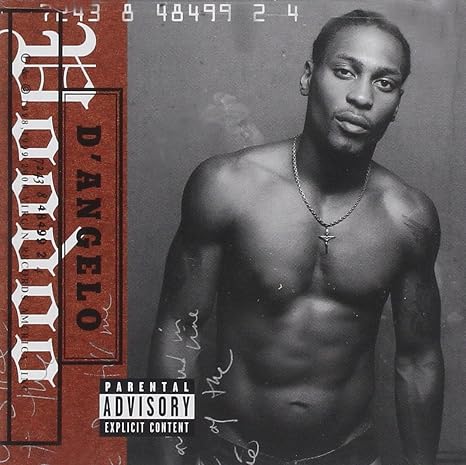
Voodoo too looms large in the popular imagination of Haiti. In music, we can look in recent years to
D'Angelo's
Voodoo album and its photos of bare-chested dancers in circles and chicken feathers floating in the air presumably about to be sacrificed. The music too is slow and mysterious, tilted towards New Orleans and Haitian Vodun and punctuated with occasional shrieks and sound effects providing ambiance. My favourite album of the past decade.
As I've mentioned
before, my neighbourhood's Haitian grocery is regarded with suspicion as a sort of Voodoo emporium. You wouldn't expect this given the large population of Haitians in metropolitan Boston and the large number of christian churches that they dominate still the perception of a primitive and nativist voodoo culture informs the haitian landscape.
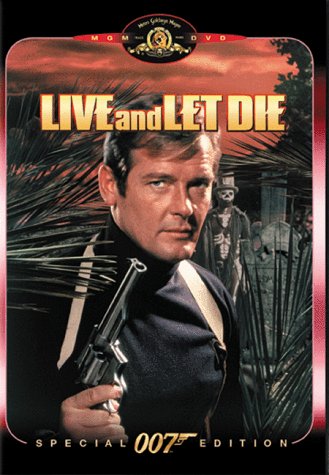
In movies too, Haitian voodoo is an ongoing motif. Take the James Bond staple,
Live and Let Die James Bond battling voodoo cultist and drug dealer, Yaphet Kotto, whose hold over the card reading Jane Seymour character, Solitaire, is organic and vaguely sinister - one of
Ian Fleming's best novels if an ordinary Bond film.
Or that great B-movie,
Angel Heart starring my first crush
Lisa Bonet and Mikey Rourke with its dark sounds, dances and atmospheric pathos and sense of dread.
Toussaint L'Overture is the most striking figure in Haiti's history - a former slave who practiced herbal and African healing, although he was not a Voodoo houngan. He was the most forceful, astute and successful of the generals who led the slave uprising that lead to the founding of Haiti's Republic challenging the French (even scaring Napoleon), the Spanish, and the mulattos. His story is tragic, abolishing slavery and founding the "First Black Republic (tm)" and dying in captivity in the Fort de Joux in Doubs, betrayed by everyone.
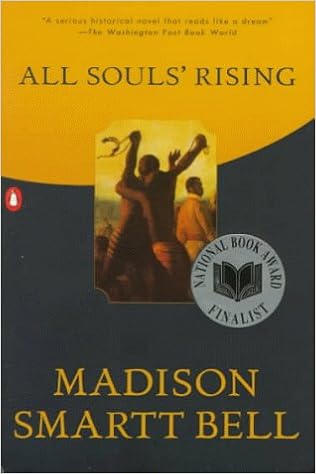
All Souls's Rising by Madison Smartt Bell
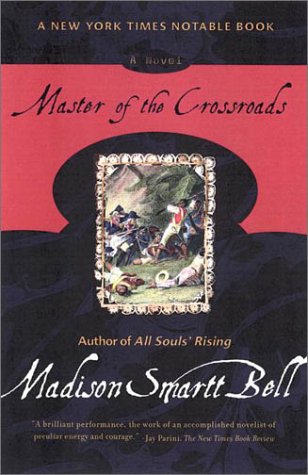
Master of the Crossroads by Madison Smartt Bell
The first two parts of
Madison Smartt Bell's masterpiece trilogy on revolutionary Haiti cover much of Toussaint and Haiti's story. I can't say enough about the achievement of these novels and am eagerly awaiting the final part due in November 2004. He displays astounding historical imagination in exploring the rich intricacies of the period. The expansive set of characters that we follow in this disturbing and violent tragedy is a sort of greek chorus. The conscience of the story, the good Doctor Antoine Hébert is mostly powerless in the face of the epic events that are taking place yet he tries to maintain his humanity all the while observing the great men and the small people who have to live with the decisions. We see Toussaint gaining tactical awareness and power and all the various forces at work: the colonists trying to keep their plantations, France in revolution and mostly the various factions of the slaves in revolt, the landed mulattos fighting to preserve their middle ground much like the 'coloreds' in modern day South Africa.
At the end of Master of the Crossroads, that "carefully drawn road map through hell", Smartt Bell reproduces a great document from his archival research: the "
Classification of Races in colonial Saint Domingue" with the 210 different hues of humankind listed according to the amount of black blood - a five pages tribute to how deeply engrained this institution was. A sample:
I. Combinaisons du Blanc.
D'Un Blanc et d'une Négresse, vient... un Mulâtre.
D'Un Blanc et d'une Mulâtresse... Quarteron.
D'Un Blanc et d'une Quarteron... Métis.
D'Un Blanc et d'une Métive... Marmelouque.
D'Un Blanc et d'une Marmelouque... Quateronné.
D'Un Blanc et d'une Quateronnée... Sang-mêle.
D'Un Blanc et d'une Sang-mêlée... Sang-mêle, qui s'approche continuellement du Blanc.
D'Un Blanc et d'une Marabou... Quateron.
D'Un Blanc et d'une Griffonne... Quateron.
D'Un Blanc et d'une Sacatra... Quateron.
Faulty biology may account for this emphasis on mixed blood - the Sang-mêle quoted above, but this skewed and awful dislocation of race writ-large continues to haunt that society to this day. You can imagine old society ladies evaluating new parvenues according to this code.
The Kingdom of this World - by Alejo Carpentier
Alejo Carpentier's novel delves deeply into the lurid and lugubrious depths of the years after Haiti's liberation from francophone colonial rule under the black king, Henri-Christophe. This was an era of chaotic, brutal, and horrific atrocities that gave full vent to the casual cruelty of the races. The writing is hallucinatory and surreal which suits the violent period he is covering. I suppose this is what magic realism is all about. We follow the events through the eyes of the old slave, Ti-Noel, a stoic guide to the Dante-esque corruption and superstition that ensues. The heights of sexual loathing and racial hatred are also emphasized here. Power and corruption are absolute.
Papa Doc and Les Tonton Macoute
The Comedians by Graham Greene
Graham Greene's 1966 novel deals with the macabre and grotesque era of "Papa Doc" Duvalier (1957-1986) that would carry on like a vicious hereditary disease under his son "Baby Doc" who now lives a life of comfort in exile in France. Haiti has never escaped social and political upheaval and here it's dictatorship as a theatre of the absurd, of pockets of arbitrary and savage violence erupting at will across the populace. As his author's introduction notes:
Poor Haiti itself and the character of Doctor Duvalier's rule are not invented, the latter not even blackened for dramatic effect. The Tonton Macoute are full of men more evil than Concasseur; the interrupted funeral is drawn from fact; many a Joseph limps the streets of Port-au-Prince after his spell of torture, and though I have never met the young Philopot, I have met guerillas as courageous and as ill-trained in that former lunatic asylum near Santo Domingo. Only in Santo Domingo have things changed since I began this book - for the worse.
Featuring an expatriate hotelier Brown, whose jaded, seen-it-all sensibility can't prevent him from getting embroiled in a doomed anti-Duvalier plot. This is not one of Greene's 'Entertainments' although there are elements of farce and how could it be? The subject matter of Haiti defies even tragicomedy. Incidentally for a very knowing look at Graham Greene see the following review:
Sinner Take All - Graham Greene.
I haven't read much of the more modern fiction on Haiti. I have
Edwidge Danticat's Breath, Eyes, Memory lying around somewhere, its Oprah's Book Club label insistently staring at me. I suppose I should really read more than the first 5 pages but it looks like one of those difficult reads. Maybe later.
For now though, the eight families (light skinned) who own almost all of Haiti are happy to continue living in their paradise, shopping in the best department stores in Miami and Paris. Hell I met a number of their offspring at Harvard, bright, cultured and highly recherché in their intellectual outlook - much resented by some of the more common Haitian stock, I might add. I wonder about that resentment though: no one ever willingly gives up privilege. For the rest of the country I suppose it's mostly your garden variety third-world drudgery: a wellspring of ecological hell, cocktails of charcoal, asbestos and cheap plastic Chinese imports, albeit washed down with sprinklings of CNN, the BBC, the latest Hollywood bootleg dvds, Brazillian football and global hip-hop and reggae.
If
Jean-Bertrand Aristide, eventually aided by a reluctant Clinton, brought a promise of change and restoration to Haiti in the 1990s, the result a decade later is clearly disappointing if not disastrous as he too is now in ignimonious exile and Haiti is in the news again as a poor desperado. His journey from priest to president to exile (twice) and the historical parallels are begging for a couple of novels or at least a movie.
In the world of art, it is easy to dwell on blood-soaked despair and Haiti gives much material for this vein. In the real world of Haiti however, we should always remember that there are simply people trying to get on with it under very trying circumstances. Reading the Haitian landscape is only part of the puzzle, a very proud and capable people stare back at you exuberant and expectant.
[
Crossposted at blogcritcs.org]
File under: Haiti, Caribbean, development, disaster, poverty, history, geography, collapse, ecology, economics, history, literature, review, music, politics, slavery, culture, antropology, voodoo, Jared Diamond, Graham Greene, Patrick Chamoiseau, D'Angelo, James Bond, Toussaint L'ouverture, Madison Smartt Bell, toli,