Showing posts with label murder. Show all posts

Tuesday, September 29, 2026

Forensics

The toxic strain was the innovation
Murder, they say, is a matter of imagination

Against the conqueror, it is said that poetry can be a weapon
Something quite potent that might trigger prompt retaliation

For in the throes of reactionary passions
These men in khaki oft favored assassinations

The tawdriness of the violence that becomes the thin skinned
The culture of silence they impose in pursuit of blood and sin

After the takeover, it was a matter of consolidation
Silence is golden, the poet embodied the opposition

In those early days of the coup, it was just another atrocity
Later, they would be more exotic and turn to dropping bodies

Pushing people out of helicopters over the Pacific ocean
In this case, the resort was to unnatural bacteria, botulism

The toxicologist's report would outline the matter, the dry minutia
The unlikelihood of natural occurrence of this strain of bacteria

Where the Bulgarians, contra Trotsky, used the poisoned tip of an umbrella
This toxic strain was plausible deniability for the likes of Kissinger

We only have interests, such are the wages of Pax Americana
To paraphrase: it was our son-of-bitch that poisoned Neruda


...

"I don't see why we need to stand by and watch a country go communist due to the irresponsibility of its people. The issues are much too important for the Chilean voters to be left to decide for themselves."

— The Kissinger Doctrine (New York Times June 27, 1970)

...

"If he had a toxic strain, how would it have gotten there?” said Charles Brenner, a forensic investigator from California who helped complete the report. “That is more a matter of imagination, and not science."

— Was Pablo Neruda Murdered? (New York Times, February 15, 2023)


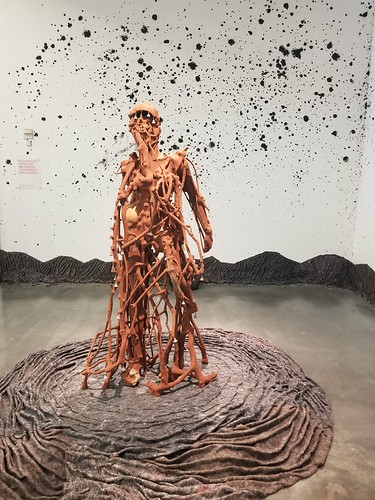
wangechi mutu

Forensics, a playlist


A soundtrack for this note (spotify version) File under: , , , , , , , , , , , , , , , , , , ,

Writing log: June 8, 2023

Sunday, January 11, 2026

On the Death of a Poet

That’s fine dude, I'm not mad at you
The masked man's video footage revealed the poet's last words

Some men can't bear the thought of not being feared
And, faced with an incandescent smile instead of a stare,
He fired three shots in rapid succession
He let her know who was who

In his own way, he dispensed some American home truths
Call it the imperial boomerang, that obscene point of view
Visit America before America visits you

I couldn't bear to watch the clip of the death of the poet
But from the still, I could see in her smile, the sense of bemusement
And knew all too well what would have happened, later, when she got home
That that masked man - puff, with his big weapon
Would end up as a minor character in a poem


After Renée Nicole Good


See previously: Prone

File under: , , , , , , , , , , , , , , ,

Writing log: January 10, 2026

Tuesday, January 17, 2023

Prone

Trained officers
A tough job, we all know,
Policing

Jogging
Uppity
A stare
Traffic stop
Or sometimes just reaching

One wrong move
And your life slips away,
Your chest is heaving

Pleading for God and your mother
Or simply lying there
Bleeding


edge by kristin willits


After the killing of Daunte Wright.

Soundtrack for this note


...

Timing is everything
Observers are worried

See previously: Goody Two Shoes

File under: , , , , , , , , , , , , , , , , , , ,

Writing log: April 13, 2021

Thursday, May 21, 2020

The Wages of Thermidor

I did not have to wait
For the distance of history
In order to pronounce judgement.

For theirs is a legacy of bloodstains and unnecessary suffering.
And it was scarred on our stunted bodies in real time.
The jagged marks of their chains endure.

Venality without compromise,
Wrath without provocation,
And vitriol as compensatory cover.

Neither do they deserve
The nuance they denied others
In their unseemly haste to spill blood on the earth.

We noted at the time
Their pecuniary motives
Those strutting peacocks
In khaki uniforms
Extorting bribes as they went,
In exchange for curfew passes,
Score settling amidst an orgy
Of all too common thievery

The rhetoric of grievance
Couched in class resentment
But masked as the moral midgetry
Of thin-skinned men.

I had a dream
Of tyrants destroyed
With all available indignities.
But when the voiceless sphinx awoke
It was to an unvarnished vision
And an unbidden gift:
The welcome irrelevance
Of that baleful cohort
Their evanescent stature
A fugitive reality

Yet revolutionary justice
Had soaked the ground,
Leaving those reflective pools.
Their essence was curdled crimson.
They caught the early morning light,
Flickering in the eye of a seeker
And so he stopped,
And made a mark next to the path,
Fixing a signpost there
For future travelers

Then he stepped aside
And continued on his journey
He stumbled at first,
Recalling his early crawl
Out of infancy
But soon he righted himself,
Serene about the memory.
The next steps were more resolute,
Tradition demanded surety
He would never forget the encounter
And always remember the wounded
With no amount of wist or nostalgia
And so on he proceeded,
Forever the modern traveler

And all this happened
Almost imperceptibly
Their dreadnought weight lifted
For such are the wages of Thermidor

talking drums 1985-03-11 rawlings brutalities at Gondar Barracks the pioneer experience


I suspect that one should read this updated fragment in its original context to fully savor the outrage I continue to feel about military strongmen and their rhetoric. As I've written previously, it's a visceral reaction, I'm blinded by the accompanying blood.

In any case, a little J'accuse never hurt anybody. There is truth, and there is reconciliation. Most consciences can surely handle the occasional volley of scribbled words softly lobbed towards their person. That is, of course, if said consciences could be located. The search parties haven't returned for the souls of many African despots, even as their shells are now dressed in Savile Row suits...

I'll close by invoking my favourite poet who wrote about the same crew far more concisely than I can ever hope.

When bad men
Pass through a place
The way is closed
Behind them by the injured,
Even to innocent men.

- The Force of Evil by Kwesi Brew

Fin.

I nominate this revised note for The Things Fall Apart Series under the banner of The Rough Beast which poses the question: who is writing the script?

See also: Structural Adjustments

File under: , , , , , , , , , , , , , , , , , , ,

Tuesday, March 17, 2015

Doctor Simbo

Prosecutor: And who was Doctor Simbo?

The working title was Close Encounters Of The Murderous Kind and the first entry of the planned series was in that vein but, once encountered, I felt that he deserved the eponymous treatment, let me know how it fits...

I. Close Encounters

Prosecutor: And who was Doctor Simbo?

Witness: He was a Ghanaian.

I first met him in the court transcripts and, within minutes, he evoked the same mixture of horror and recognition that Mr Hyde must have surely raised to Doctor Jekyll. Although I suspected that the name Simbo was a pseudonym, I had no reason to doubt the witness's notion that he was a doctor, nor indeed that he was a Ghanaian. And this last, I suppose, was what first alarmed me, his countryman. His appearance was a mere footnote to an overlong trial, the fugitive glimpse of the man, revealed during a fishing expedition by a prosecutor who really should have stuck to the wealth of stronger material at hand. But I appreciated the strategic ambition of that servant of the International Criminal Court, immersed as she was in all that murky talk of warlords; for there he was outlined in those few furtive paragraphs. Really! What was he doing there in that lugubrious free-for-all? What was he doing there amongst that gruesome lot, knee deep in their ruthless bloodlust? How did he come to be embraced by them, the most notorious proponents of summary amputations, surrounded by the most hallucinatory child soldiers we have seen. Hell, those guys even put the Lord's Resistance Army to shame. I had to reassess things even as I remembered all their victims. But I held on to the witness's statement: his name was Doctor Simbo, and he was a Ghanaian.

There are many who think that God watches over Ghanaians, keeping us from the brink whenever full blown disaster beckons. By contrast our Nigerian brethren seem to laugh at brinks and disdain cliffs. We congratulate ourselves that somehow we've avoided the kind of mess that is fodder for cautionary tales about Africa. It's a kind of faint praise really: things could be worse, things could have been much worse. I dissent from this kind of talk even as I recognize its power, for I obsess rather with how much better things should have been, how much better things should be now, and indeed how much better things should be going forward. But well, that's the claim, your mileage might vary.

The canonical example is the providential rain that fell one June night in 1982 that prevented the bodies of the three judges and a retired army officer that Flight Lieutenant Jerry Rawlings's junta had ordered murdered from being burnt beyond recognition. It was the dry, hot season and it hadn't rained in weeks. The death squad had set out, list in hand, supplied with curfew passes, operational permits and a Fiat jeep pickup obtained from the Head of State's wife's front yard (we have our Lady Macbeths too). The houses had been pointed out to them previously. They rounded up their prey from their homes and family, ostensibly for questioning (we were months into arbitrary military rule), or, more cruelly, to assist an ailing colleague. They drove their victims to the Bundase Military Range near Dawhenya and the Shai hills, sat them on concrete blocks, shot them, poured petrol on their corpses, and set them on fire.

Their disappearance was not supposed to be acknowledged. The country was rather meant to join the company of those with a community of 'disappeared'. The intent was terror, striking at the core of the Ghanaian establishment that was quietly opposing the "31st December revolution", a settling of scores for past slights, and, well, this was only meant to be a beginning. Breast-feeding mothers be damned, the revolution was moving too slowly. "Let the blood flow" was the refrain that was still echoing in the Castle, and Kojo Tsikata, Alolga Akata-Pore, and Jerry Rawlings were not afraid of other people's blood. A good culling, or more classically perhaps, a decimation was warranted.

The rain intervened and the bloodbath, the planned reign of Robespierran terror, was stillborn. A cattle herder came across the partially-burnt and maggot-infested bodies in the morning and the foul murders were discovered and investigated. Cold comfort as it is to the families of those slaughtered that day, the potential death toll of the planned campaign and, well, the course of Ghana's history was changed. Initially we were told that the murders were to be blamed on counter-revolutionary saboteurs who had "adopted the tactics of terrorists by the kidnapping and murder of innocent citizens in order to create an atmosphere of fear and panic among the population and to use this an an opportunity for further action". The contingency scripts had been readied and the complaisant Western media outlets played their part. Quickly however, the investigators unraveled things and it was found that the junta itself was responsible.

I shall skip over the inadequacies of the investigation, the performance of the regime's Attorney General, and the ensuing murder trial (held in one of those Public Tribunals that had been created to mete out rapid revolutionary justice). Those public servants did their best under the circumstances (after all, it's hard to point the finger at your boss or, indeed, the Head of State Security). I'll also gloss over the curious fact that the Leader of the Revolution felt the need to be Priest Confessor to his fallen comrade-in-arms, interrogating and tape-recording even as as the latter faced the firing squad a year later (presumably the need to secure an exoneration trumped all process and he obviously ducked out of the way just before the bullets started flying). Reading what we do have in the public record is disquieting; the casual tenor of the talk of these so-called radicals, their intrigues and their attitude towards blood, honor and betrayal. Personalized and vicious politics was our lot and clearly we had fallen on evil times. The revolution eats its own, I suppose, and I'd rather concentrate on its collateral damage.

The revulsion at the depravity of the PNDC reverberates to this day - amnesty provisions in the 1992 constitution notwithstanding. We had a glimpse of the abyss. We learned who was popping champagne on that rainy night. We learned in unchallenged court testimony about the dry run murders that had taken place earlier in the Volta Region. We learned about the various "special operations" that the Security Adviser to the PNDC and Head of Security had commissioned. We learned about the lists that had been drawn up in the previous months by these conspiratorial people who had conquered Ghana. We learned about the hundreds of people who were being coldly discussed at night while the rest of country was facing a curfew.

Closer to my home, the dinner table talk has occasionally drifted onto who else was on those lists of 'enemies of the revolution' targeted for liquidation in those heady days. People's positions in these lists are discussed stoically; visitors unaccustomed to such topics either shiver or laugh nervously as we talk. I should explain that my family history is replete with close calls with the wages of political violence in Ghana. From facing internal exile to being born in the shadow of death row, through an infancy of political prison and harassment, and a childhood of coup d'états, mere discussions of thugs and death squads are nothing new to me, or indeed to my family. We mask our heightened sensitivity to the wounds and wasted time with a kind of gallows humour. We always end by thanking the rain.

In the grand realm of things, the violence that military rule wrought in Ghana was not outlandish - albeit appalling, traumatic, and unnecessary of course. Our truth and reconciliation commission puts the death toll at 'only' a few thousand - open wounds on the scale of, say, a September 11th. Moreover the bulk of the killing and maiming took place spasmodically over the course of 20 years. Even at peak of the brutality (the frenzy of Rawlings coups), we can't really compare our lot to Chile, El Salvador or Argentina say, and, certainly, we got off lightly compared to other African imbroglios. Like many other African countries we had our lost decades after our bright post-independence starts. A couple of million Ghanaians went into exile - the bulk in the 1970s and 1980s, the rest embraced a culture of silence and quiet resistance. Simply put, we waited them out. Not for us civil war and fratricidal conflict. One of our great poets rather noted that we embraced the "mettle of invisibility", and developed our distinct philosophy of survival.

In any case, half of the country was born after democracy returned in 1992 and has no memory, or experience, of military junta rule. There have been hard times economically and otherwise since, but nothing compared to the deprivation of the 1980s. The larger economy has essentially grown every year since 1991 and, even when things have stalled, as presently, our political landscape has grown freer. There have been flashpoints, political violence and thuggery for sure, but we haven't had all out and widespread savagery. So yes, we had our close encounters, but Ghana didn't become Sri Lanka or Cambodia during the 80s, we didn't experience the scale of looting of our patrimony that Nigeria epitomizes, and we also didn't become the bloodied Kenya of early 2007 as repeatedly threatened during the 2008 elections. Such are the small mercies we live with.

I recounted the foregoing to set the stage for Doctor Simbo whose story I intend to unravel over the next few weeks, and I will raise the stakes here in light of what his very existence meant, because it seems that Ghana has been spared far worse: we're lucky that Ghana didn't become Liberia or Sierra Leone in upheaval. (Sidenote: I've previously discussed some of the larger forces that were arrayed in Ghana's recent political history, strange bedfellows ruled the roost in the 1980s. I've even worried about Ghanaian involvement and collateral damage in the 2005 London terrorist bombings).

Little did I know, however, that there were countrymen desperate enough to countenance the internecine civil war route. And let's put as plainly as can be: in the annals of iconic savagery, Charles Taylor's Liberian militias and Foday Sankoh's RUF of Sierra Leone are second to none, their stories are cautionary tales that should never be forgotten nor indeed emulated. So what was Doctor Simbo doing there with them? And as the prosecutor asked: who was Doctor Simbo? My belief in even the weakest kind of Ghanaian exceptionalism was shaken to the core as I read, and I still shiver when I think to the witness's answer: he was a Ghanaian.

See also

Some contemporaneous commentary:
  • But The Melody Lingers On from Talking Drums magazine, September 1983.
    The question sadly remains unanswered: "When is an action of a member of the PNDC an individual matter and when is it a matter for the Council?"
  • Politicians, Politics and Policies in Ghana by Emmanuel Hansen.
    Some of the clearest analysis of the time can be found in this book review from October 1984.

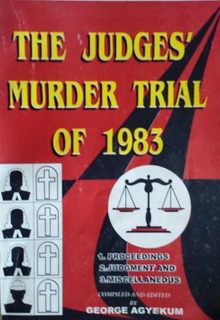
The Judges' Murder Trial of 1983 by George Agyekum

Soundtrack for this note

Next in Part II: To Make the Road Fearful
In which we read about dark matters at the Special Court


See also: Truth and Reconciliation


File under: , , , , , , , , , , , , , , , , ,

Sunday, February 06, 2005

King Leopold Haunts Congo Again

As a son of an African journalist, the BBC World Service tends to act as my alarm clock. And so on Thursday morning, I woke up to the sounds of a bizarre story:

A statue of former Belgian colonial King Leopold II has been re-erected in the centre of the Democratic Republic of Congo capital, Kinshasa.
Now it seemed clear to me that I must have been in the middle of a dream and so I thought nothing better of it. In the afternoon though, my curiosity stirred, I checked their news site and found to my amazement that indeed, it was true: Leopold's statue was back up.
King Leopold II set up the Congo Free State in 1885 as his personal possession and left arguably the worst legacy of all the European colonial regimes... He turned the country into a massive labour camp, made a fortune for himself from the harvest of its wild rubber, and contributed in a large way to the death of perhaps 10 million innocent people.

Culture Minister Christophe Muzungu said people should not just see the negative side of the king - they should also look at the positive aspects.

"We are restoring the history of our country because a people without history is a people without a soul," he said.

I sputtered and struggled to find the appropriate historical analogue to this decision. It was as if the Chechens had decided to put up Stalin's statue in Grozny - he who had decimated their ranks 60 years ago by deporting all of them from their lands in forced marches to Siberia - or perhaps as if the mayor of Gaza took it to his head to erect Ariel Sharon's statue (or a new monument to Saddam in Kurdistan?).

Leopold's depredations were so grotesque and occurred on such a scale that even the other colonial powers had to take pause in their scramble for African loot. The Belgian behavior was the kind of thing that would queer the whole colonial enterprise and indeed the twentieth century's first significant talk about human rights was on the Congo issue. In much the same way, the images from Abu Ghraib prompted a (slight) sense of unease in the recent US empire building. More to the point, the colonial experience under Leopold set Congo on a downward path that it has never been able to escape.

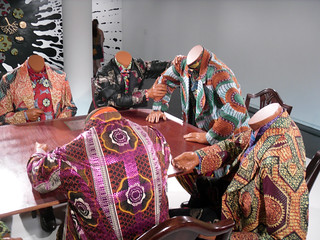
Yinka Shonibare MBE at Brooklyn Museum

Now I've read King Leopold's Ghost, Adam Hochschild's highly recommended study of that macabre period and was justifiably horrified at the historical record that he laid out: greed, megalomania mixed with atrocious labour camps, summary amputations, decapitations and outright larceny, all covered in the bromides of a missionary humanitarianism. Almost any page of that book would be a rejoinder to that Minister of culture's words. 10 million people died for God's sake, and he stole everything from you!

Perhaps the only decision Mobutu ever took that proved to be in the interest of his country was to tear that statue down early on in his reign, even though this measure did coincide with his self-interest as was the overriding norm for him.

If Mobutu's reign was to be the farcical follow-up of the Leopold's tragedy, one had hoped that whatever followed would begin to restore that country to some sense of sanity. Instead, in the Kabila interludes (first the elder, and now the hereditary son), Congo remains the site of a second Scramble for Africa (see here also).

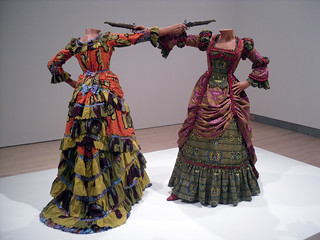
Yinka Shonibare MBE at Brooklyn Museum

Congo is so rich in natural resources that even normally sober Texan oilmen or South African diamond monopolists hyperventilate when they talk about it. It has copper, gold, diamonds, tin - you name it. It has uranium (if you wanna go nuclear) and even that rare tantalite that's in your cell phone.

At one point in the past decade, it was said that the armies of 13 countries were on its soil, not to mention Russian mercenaries and the usual cast of malfeasants - Africa's World War it was called. The resultant human cost of the ongoing Congo troubles, 3 million and rising, is approaching Leopoldian dimensions. The notion that a government would make such gestures says everything about the dysfunction of the country and tone-deafness of the opportunists who pass for politicians there.

Insatiable Appetites

The next day however, it appeared that the outcry had grown too large and the statue was removed: Leopold reigns for a day in Kinshasa
Residents of Kinshasa could be forgiven for rubbing their eyes in disbelief.

First, a statue of the late Belgian king Leopold II, whose rapacious colonial rule of Congo caused the death of millions of Africans, was reinstated in the heart of the Congolese capital.

Then, less than a day later, it was gone again, mysteriously removed by the same workmen who had erected it.

Officials were at a loss to explain the comings and goings at the end of June 30 Boulevard, the street named in honour of the date of Congo's independence from Belgium.

First indications from the government were that it might be part of a historical restoration. There are plans to erect a statue of Mobutu Sese Seko, the dictator who stole billions from the country during a 30-year rule that ended in 1997.

"We are restoring the history of our country, because a people without history is a people without a soul," said Christophe Muzunge, the minister of culture. He added that the six-metre (20ft) Leopold statue had been brought back to remind the people of their country's colonial past, so that "it never happens again".

But later there was no comment on why Leopold had been removed. Certainly the sudden apparition was not popular with onlookers.

"Look at what they did in Iraq," Mputu Melo said. "They destroyed the statue of Saddam Hussein. This shouldn't be in a public square."

King Leopold, who never set foot in the Congo, controlled the vast country as his personal colony from 1885 to 1908, when it was handed over to Belgian government rule.

During those decades his agents enslaved its people to harvest rubber, beating workers with a hippo-hide whip known as the chicotte and severing the hands of men, women and children who failed to meet their quotas.

As many as 10 million Congolese are estimated to have died as a result of executions, unfamiliar diseases and hunger.
While I am happy to see that this decision was reversed, do note the crucial line I emphasized above: there are plans for a Mobutu statue. Pity the poor Congolese, first King Leopold's ghost returns to haunt them, now they're going to have to endure Mobutu again! File under: , , , , , , , , , , , , , , ,