Showing posts with label patents. Show all posts

Thursday, August 21, 2014

The Ziploc Factor

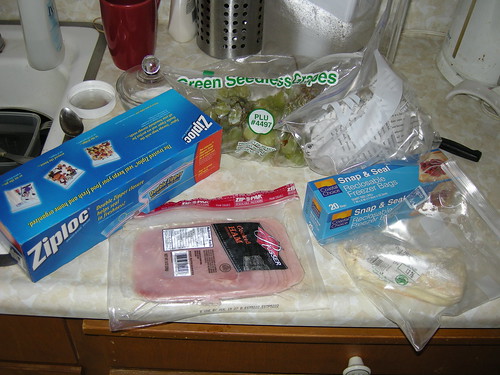
The most attractive aspect of patents is their expiration. Built-in expiration, that "limited times" proposition, is similarly the appealing aspect of the Faustian pact one makes for copyright. In that vein, I would venture that one of the best things to have happened since the start of this century is the expiration of the patent for the ziploc. If you frequent the same supermarkets as I do, you would have noticed the ascendance of the ziploc form factor over the past decade. At first the spread was likely due to increased licensing in anticipation of the expiration of said patent, then, of course, once the crucial patent expired, the flood gates opened and generics came into play, to the extent that these days I can barely find regular plastic bags in store aisles. Permit me to present another item as part of an occasional series on bags, this time a brief cultural history of the ziploc, a foray into the grooves of technology and hardball business. Plastic bags I say, locks, knots, zippers, all have been changed. Ladies and gentlemen, consider the ziploc factor.
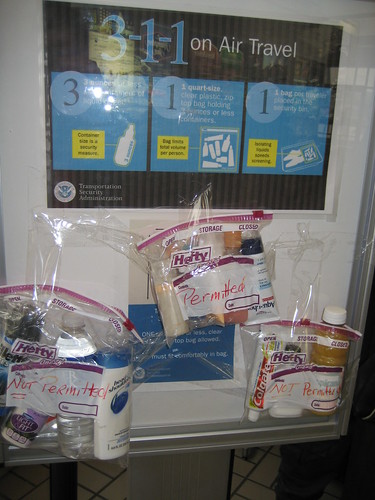
zip-loc display tsa state college airport 2007

I. Radical Transparency

The ziploc resealable plastic bag, sometimes called zip top, zip lock, one zip, slide lock, snap bag, zip-loc (if inclined towards hyphens) or zip snap depending on the brand or technology underpinning you lean towards, crossed the chasm of cultural inevitability in the summer of 2006 when liquids were banned on many flights due to a case of pure bureaucratic terror - call it a liquidity crisis in the skies if you will, for we were living in a era of recent non-specific general threats. Homeland Security restrictions made themselves felt, and within days the nascent ubiquity of ziploc bags could no longer be denied - indeed they were officially mandated. Air travel, already a ludicrously fraught endeavor after September 11 2001, now gained a set of extra contortions that have spoiled things for all who can't afford their private jet - and for all intents and purposes that is everyone. The ziploc was the palliative.
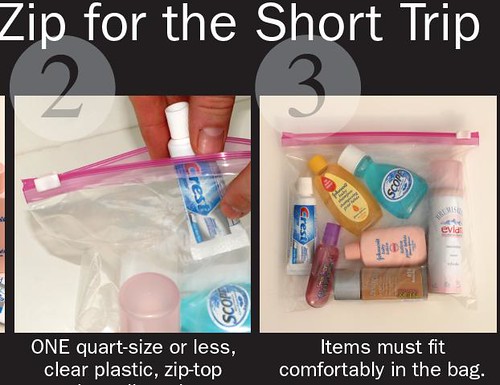
zip-loc TSA poster

The British were the first to impose restrictions since the ostensible liquid bomb plot had British airports as their target, but it was the TSA list of permitted and prohibited items that really soured things:

All liquids, gels and aerosols must be placed in a single, quart-size, zip-top, clear plastic bag. Gallon size bags or bags that are not zip-top such as fold-over sandwich bags are not allowed. Each traveler can use only one, quart-size, zip-top, clear plastic bag.

Early versions of the TSA list mentioned zip lock although later versions now mention zip-top - as we shall see this little-noticed change in nomenclature is significant in our history, but let's not get ahead of ourselves at this stage. We'll also skip over the size restrictions for the time being and concentrate on the specification of the bag which is a technology prescription backed with the coercive powers of American law enforcement: "clear" for transparency and ease of observation if not confiscation, and ziploc for ease of opening and sealing. The snappy slogan is "Bag and zip for a short trip" and undoubtedly some poor sod had to come up with a breezy mnemonic for the public education campaign on the new requirements:

3-1-1 for carry-ons (3 ounce bottles, 1 ziploc bag, 1 bag)

The equivalent British poster from the BAA doesn't have the same marketing flair (but who can compete with American salesmanship?) and gets the essential point across: the requirement is simply "a transparent, resealable bag". In practice of course, this boils down to a ziploc bag. The Brits sensibly don't refer to a brand in the BAA rules

Customers may take with them in their cabin bag limited quantities of liquids, gels and aerosols, including travel-size toiletries such as shampoo, suntan lotion, creams, toothpaste, hair gel and hair spray. Containers holding liquids must not exceed three American ounces or 90ml.

zip-loc BAA poster


Liquid containers must be carried in a separate clear plastic zip-top bag that does not exceed 20 cm x 20 cm or 8 inches x 8 inches or quart size. Items must fit in the bag comfortably and the bag must be completely closed.
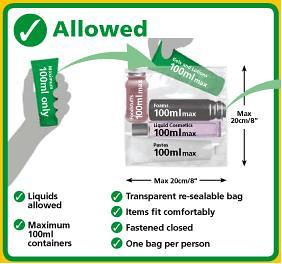
The earliest revision of the British policy noted:

Only one bag per passenger is allowed. The bag must be clear and re-sealable, such as 'ziplock' bags or bags with pressable seals. Larger bags or bags that are not sealable, such as fold-over sandwich bags are not allowed
The ziploc regulation is one that requires constant reinforcement and it gives rise to frequently inventive exposition by TSA officialdom. Thus if you were to pass the TSA stand at State College airport, Pennsylvania, some time ago you might have spotted the following three-dimensional illustration of permitted and banned items.

zip-loc display state college airport 2007


The three bulging Hefty One-Zip bags were meant to augment the above 3-1-1 poster. Presumably the security attendants got tired of having to explain the cryptic 3-1-1 propositions and opted instead to show graphically to the traveling public the sorts of items that were and were not permitted.

Again note the type of ziploc bag that was used, it is more properly called a zip top. Recently at JFK airport, there was an information officer prowling the unsurprisingly long lines at the TSA whose sole purpose was to dispense Hefty One Zip bags. I don't want to suggest cronyism in the choice of brand of plastic bag but it was interesting to me that each time I've observed such actions, the brand of bag being proffered was a Hefty bag; there really must be a marketing effort at work.

II. Deformation and Displacement

The Hefty One Zip bag has a zip handle at its top, a satisfying target to clasp as you close - a moveable stub, in short, to enforce the close action. The most widely used ziploc bag on the other hand - made not coincidentally by Ziploc, simply has those pleated, interlocking grooves. By most reckonings, the Hefty variant is the gold standard of the form yet, in many ways, the broader Hefty versus Ziploc story is a reversal of the Coke versus Pepsi narrative. Indeed the owners of the Ziploc brand seems to have chosen the better name - ziploc has become the generic term for plastic, resealable bags, and as far as adoption goes, the 'worse' technology appears to have triumphed in the marketplace. What lies behind the workings of the ziploc factor? To find the answer, we need to undertake a minor diversion into the realm of patent histrionics...
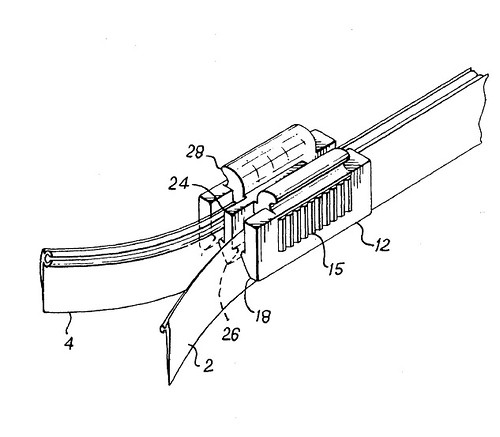
ziploc sliding clasp fastener

The essential ziploc innovation is US Patent 4262395 Sliding clasp fastening means. Filed in 1979, it was published in 1981. It refers to mating strips, coupling heads and sundry means of fastening through a sliding motion. Like most innovations, it didn't come in a vacuum; its inventors stood on the shoulders of giants. It builds on the work of the slide fastener, patent 4004327, filed in 1975, Japan. In the US, a further improvement was submitted in 1990 by Hefty, Patent 5007143 - Rolling action zipper profile and zipper thereof.

Broadly speaking, these devices take the notion of the zipper and apply it to plastic bags. If you read, you'll dive into a world of pairs of flexible plastic strips, reclosable interlocking male and female elements, extrusions and welding. In the US, since the 1980s, these ziploc patents stood their owners (ultimately controlled by Hefty) in good stead, and they were embodied in the marketplace as the Hefty One Zip bag which reigned supreme as the dominant resealable bag. There was, and continues to be, a hefty premium for a Hefty bag. There is a price to pay in order to get the satisfaction of that sliding, often purple, clasp fastener. The purple nub, standing out as it does atop the closing plastic strips at the top of the bag, gives a good closure indication and symbolizes the fulcrum of a conventional economic monopoly.

The chinks in Hefty's armor, the ziploc factor, as it were, came in two forms. The first weakness was in the name. The most serious competitor was the Slide Lock bag, later renamed Slide-Loc (since lock was a generic term), then still later renamed Ziploc. Simply put, ziploc is the better name for the resealable bag. The zip in the Ziploc name references the gold standard of the zipper (and the Hefty competitor), and the lock aspect identifies the sealing function of the bag.
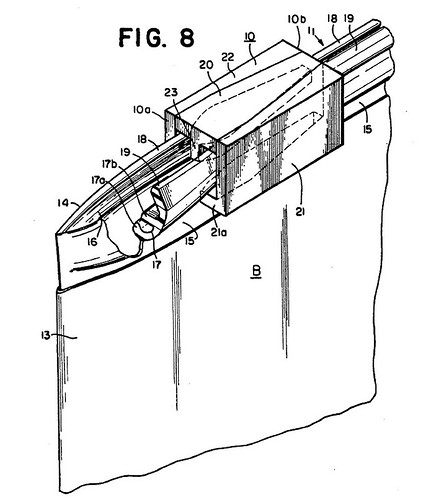
ziploc rolling action zipper


The second chink built on the insight of the plain meaning of Slideloc/Ziploc name, namely that simply sliding an interlocking groove was good enough to produce a lock; you literally did not need a zip (or zip handle) to form a lock. True, the kind of seal that you get from snapping and sliding a groove in a plastic bag is not as tight as if you applied the pressure of a zip fastener, However, you can get a tighter seal if you increase the number of grooves that formed the lock. The pragmatic solution embodied in most ziploc bags that don't use zip handles is to simply add more grooves.

Slideloc/Ziploc versions of the bags started to get wide distribution in the late 1990s as the 20 year limit on the patents on the basic technology was coming up. This being American capitalism, of course, everything would get resolved in the courts (after the lawyers took their cut). Hefty, after issuing various cease-and-desist notices to the companies that were intruding on its turf, eventually filed a lawsuit based on the later 1990 patent.

The lawsuit, Pactiv (formally Tenneco) v. S.C. Johnson & Son and KCL Corporation was decided in November 2000 and found that ziploc slider bags didn't infringe on the relevant patent. It was a simple complaint:

The manufacturer of Hefty One Zip reclosable plastic storage bags, claims that the Slide-Loc reclosable plastic storage bag, manufactured by defendant KCL Corporation for defendant S.J. Johnson & Son, Inc., infringes U.S. Patent No. 5,007,143
The case turned on a matter of overreach, if a zipper handle is the core innovation of a process and a design omits that essential element, how can one claim that one's so-called intellectual property is being copied?
The fundamental difference between the '143 patent and the Slide-Loc in this regard, essentially ignored by Pactiv's experts, is that the '143 patent describes closing by a rolling action, whereas the Slide-Loc closes by deformation and displacement, with incidental rolling taking place at the very end of the process. The fact that some incidental rotation occurs does not alter the fact that the Slide-Loc closes in a very different manner than the '143 patent describes.
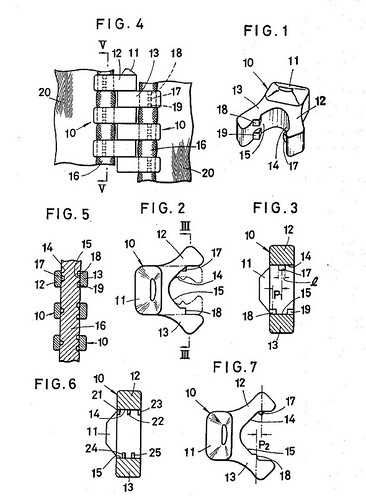
ziploc slide fastener

Deformation and displacement was thus the technical loophole that ushered in the era of ubiquity of the ziploc. By side-stepping the necessity of the zip handle, competitors could avoid the encumbrance of the Hefty patent monopoly. The long inhibited competition in the recloseable bags could proceed and the floodgates opened. Eagle-eyed billionaire investors sensed blood in the water long before the verdict was issued and, in 1999, you might have noted that Huntsman Packaging Corporation acquired KCL Corporation, the Indiana-based manufacturer of reclosable polyethylene bags that was subject to the lawsuit. The press release touted its "patented and proprietary technology in zipper and slider closures" and development of "patented slider technologies for both vertical and horizontal 'form-fill-seal' bagging processes".

Huntsman is of course the largest private chemical company in the US. Jon Huntsman Jr, billionaire heir to his father's fortune would go on to have presidential ambitions in 2012 - although the Republican Party ultimately wanted more red meat and less timidity. S.C Johnson & Son of course make everything from Windex, Pledge to Raid and are a veritable marketplace of consumer products. Hefty (originally owned by Mobil) is now owned by Reynolds Consumer products. I lay these items out to give a sense of the stakes involved in our ziploc contest. We have oil companies facing off against chemical companies and multinationals spun off from heavy extractive industries (oil, aluminium etc.) engaged in an ongoing battle.

The mythology of these brands is instructive
American ingenuity mixed with a bit of elbow grease. Reynolds Wrap foil was invented after aluminum was no longer needed for military use... Hefty waste bags were first developed with excess material from an early plastics innovator, creating another household essential.

The rest as they say is history, marketing and execution. The big boys jumped in, you can see any number of patents by Proctor and Gamble, Glad and the like that tackle the general notion of flexible storage bags. One wonders why Velcro which specializes in touch fasteners didn't get into the act (brand dilution perhaps?)... There were also those who saw the business opportunity in marketing ziplocs as part of the packaging machinery that all manufactures use. We have specialized companies like Zip-pak, Mini-grip and GT Zip that target industrial clients.

The engineering questions were difficult ones: how to efficiently evacuate air from a bag (an important worry if perishables were to be stored in them), how to create a tight enough seal, how to track the alignment and integrity of the seal, how to tweak the manufacturing process so that the marginal cost of adding a ziploc to one's bag is negligible. There were also usability questions, what kind of closure indicator to use? How, indeed does one indicate closure? It is obvious, if a zip handle is present, to determine with a quick glance if a bag is fully closed or not; not quite so with a plain ziploc. Is an audible signal appropriate? Is paying attention to the satisfying snap sound a good approach? As evidenced by the resilience of the Snap and Seal brand I keep encountering, that is an approach that is succeeding. There's also an arms race on ziplocs, some tout double zips, sometimes there are three seals. On the most recent ziploc I purchased, I see no less that 7 interlocking grooves. Like razor blades, more grooves are thought to be better.

III. War of the Fasteners: Knots, Rubber Bands, Ziplocs and Twisties

Ziplocs (mostly without handles) have been widely licensed and have found their way into the list of household essentials. In this era of liquid threats, it is a good thing to have some ziploc bags on hand when you travel by air. Articles abound about the applications: ziploc your stuff at airport security, Camera Zip-lock to protect in wet, dusty environments, multi-port laparoscopic surgical access devices, urn for ashes and so forth.
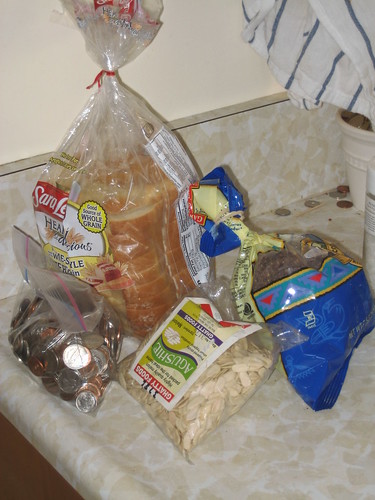

war of the fasteners: knots, rubber bands, ziplocs and twisties

The burgeoning ziploc tag at Delicious and the ziploc images at Flickr show how far these interlocking rib and groove bags have penetrated our cultural consciousness.

The convenience of ziplocs and their reassuring snap as their interlocking grooves are conjoined has changed the nature of the fasteners we use for our containers. We are spoiled with a wide variety of touch fasteners, from interlocking rib-type seal to plastic, paper, or clad-wire ties and on. Rubber bands have never quite worked as fasteners, we use them in to shift gears and such but we not generally as bag fasteners. Where once we used knots, in recent times we have graduated to twisties and to those little jagged plastic clips that we use to close bags of bread - sidenote: is there a better name for those nubs? Bibs or chokers perhaps?

Twisties, of course, are another great innovation in the vein of the ziploc but even they have their limitations: they are separate objects and often get separated from the bags they are meant to close. Thus there is almost always a little cognitive pause as you search for the little twistie ribbon on the kitchen counter or dining room table. Where exactly did you put it? It is always underneath. How much time is wasted in the search for the twistie? Is this inefficiency the driver of the faster adoption of the ziploc. Some baggies also attempted to prescribe a way to better preserve their contents, asking you to fold over the plastic before applying the twistie.
zip lock usage


The ziploc brooks none of these limitations. Like its zipper grandfather, the ziploc has the virtue of remaining part and parcel of the container - thus there is nothing to lose. Thus although we can read about epic battles such as that of Twist-Ties vs. Plastic Clips: Tiny Titans Battle for the Bakery Aisle, I'd hazard that the ziploc will be ultimate victor.

One downside of the ziploc and that other magical innovation, Velcro, is that the knowledge of knots and crosses that humans have passed down since time immemorial is now being lost. Only sailors, sadomasochists, magicians have the need for training in knots. One should perhaps add special forces grabbing enemy combatants for erustication to the coterie of knot aficionados - and even in the accounts of extraordinary rendition that we do have, the norm is for plastic hand-cuffs - or metallic if the gloves come off and stress positions are emphasized. Other than shoe laces then, the modern man has no more need for learning the time-tested art of knots - and no, tying up the boot of your car with your weekend haul from Ikea doesn't count - I should know, I was quite hopeless a few weekends ago.

Before concluding we should return to the liquid terror that prompted the ziploc's ascendance. When exactly will we get to the end of that pesky liquid ban? There have been many false sightings on that front since 2006 and everyone keeps hoping for a revision (see for example: EU to ease airport liquids rule in security revamp) but it is hard to see sanity returning, it is George W. Bush's most durable legacy. I imagine Al Qaeda or ISIS types periodically seeing these reports and saying "Why don't we send around a few emails around mentioning liquids, bombs and planes?". Our friendly NSA will duly notify the security establishment and the security tax that the entire world faces will continue. I fear the ziploc will be mandated long after my lifetime.

In an age of radical transparency it is all about the ziploc factor. Whether it is food packaging or cosmetics, all hail the ziploc. I wonder, Dear Reader, where you stand in the Hefty versus Ziploc contest, and what uses you put your ziplocs to? Deformation and displacement, young man, deformation and displacement.

The Ziploc Factor

Soundtrack for this note

  • Pete Rock & C.L. Smooth (ft. Grand Puba) - Skinz
    Better yet you could pass me a ziploc A bag of boom, and a 40 then some boot knock
    I've always loved this fragment of Grand Puba's celebrated verse in this 1993 ode to prophylactics, Skinz - a song about the importance of contraception in which they hilariously explore options from aluminium foil to ziploc bags before returning to plain old condoms - Catholics beware.
  • Prince - Ripopgodazippa
    Every stripper's favorite track, sexy funk that appropriately enough featured in that cult b-movie, Showgirls. The sound of the zipper

Obligatory disclaimer

In my line of work, software, expiration is typically seen as the only attractive aspect of patents.

There's a patent officially filed under my name filed from my last few months at IBM. It seemed then, as it seems now, like much ado about nothing (a tweak to the kind of auto-suggestion that you see every time you search) but I suppose technology companies like to build up defensive portfolios of patents, weaponry that they can lob over the wall when convenient. I plead guilty that I succumbed that one time. In contrast, one of the more interesting ideas I came up with back then was rather treated as an "invention disclosure" to be kept in IBM's back pocket, and was never filed with the patent office. I hope someone builds it.

File under: , , , , , , , , , , , , , , , ,

Thursday, July 14, 2005

The France IBM Connection

An allegorical foray wherein I suggest that one of the better analogies for IBM, and particularly its Software Group, is to consider it akin to France. Sacré bleu: a touch of whimsy on Bastille Day. As they say

Liberté, Égalité, Fraternité

The French Connection


I've been getting a little reflective as my 10 year anniversary at Lotus/IBM comes up next week. I'm not normally one for anniversaries but lots of things have been coming together (or falling apart) that make this a good time for some musing.

As I've written previously, this is an interesting moment in the technology world. After a quite severe retrenchment and some stagnation, all of a sudden there is a glimmer of light. Many companies are lighting a fire of innovation and building useful things on the web based on very simple primitives. We have absorbed the lessons of 10 years of Moore's Law in the data center, and as Joe Kraus has noted, it is a great time to be an entrepreneur (Mark Fletcher has piped in too). Still, lots of companies have lemons to sell and are falling back onto the hard sell of tone-deaf marketing to compensate for a lack of substance.

As an amateur historian of technology, I've been trying to consider where my company falls within this continuum. I like arguments by analogy and hence have been searching for a metaphor to describe the tribes of IBM.

The Governor of Redmonk characterized IBM as a broad church, a bazaar and melting pot
All views are present (and correct). All views are tolerated.
Others would have it be a cathedral, full of dogma and staid and obsolete blue-shirted mandates. In the 1990s, as that self-congratulatory pablum from Lou Gerstner went, it was about "trying to make an elephant dance", slashing and burning jobs, focusing on services and huge outsourcing deals rather than products and technology (the reviews in the previous link are quite revelatory). All of these characterizations are unsatisfactory, yet each have a grain of truth as with all coinages. Big Blue is all of these things and much more.

In conversations with colleagues and in reading the internal forums and blogs at IBM, there is an undercurrent of introspection and lot of soul searching. Sometimes this is even more critical and severe than from the outside. A sample:
Caring only about making the work numbers add up rather than actually improving the product doesn't seem to be real great way to a) run a business or b) get your developers to be passionate about their work.

Hopefully all of you will win your own innovation vs. mediocrity skirmishes in the future, and help that stock price edge higher :)

When I meet new people and tell them what I do for a living and who I work for, they are universally impressed yet each will have some story about how we could do better.

Cringely recently commented on dropping an applet developed by IBM and had this to say
"There was nothing wrong with IBM. Far from it - IBM Research was a terrific partner. But big companies have big licensing issues and smaller organizations sometimes give more personal support."

Might this be a trend, who knows? One must admit however that there is a perception of complexity, unnecesary layers or of bureaucratic overhead.

My only comment about a strategy that focuses on services is that
  • There is a straight line from complexity to consultants
  • No one really wants consultants
Per contra, as someone hired by Lotus, I have always wanted to work on things that people inherently want to use and buy rather than something they grudgingly accept. Aside from the effect in the market, there's that little matter of motivation for the day job in what is ultimately a creative endeavor.

In observing IBM Software Group's dealing with the Lotus portfolio over the years, I can say that it hasn't always been pretty and that the things that seem to be rewarded are very different from the aesthetic that actually seems to be "getting things done". In an era of mass layoffs and belt-tightening (raises anyone?), this is a little puzzling. Still it is a work in progress and we should simply strive to be more effective advocates and lead with running code as we play The Great Game. Thus I come to the France-IBM connection...

During my recent trip to London, I came across an article that I believe best expresses some of what I've been thinking about IBM, I reproduce it below. It is actually also one of the most illuminating pieces about France in the current moment. In reading it with my French cousins, we remarked that it was ironic that we had to read something so perceptive about France in English, and in London rather than in France. 5 very crucial years of my life were spent in France thus I empathize with the sentiment of the piece.

I'm suggesting then, that the correct analogy for IBM is to consider it akin to France.

Like all analogies, the France-IBM connection has its problems and I should say at the outset that it more precisely fits the IBM Software Group which is only a sliver of IBM. There are many parts of IBM that are completely alien to me. Handwaving a little, one can start by saying that France, like IBM in the technology world, is a Great Power with much clout. The grass typically pays close attention to what elephants are doing. Still, it is also the case that as a Great Power, it has seen better days and it can't fall back on the gravy trains of yore from its colonies and the dwindling list of post-colonial proxies. Its dirigiste economy might be like the "mandates from on high" and "Roadmaps ™" that I hear about but never actually read, or indeed follow. A colleague recently quipped that it was typical of IBM that a "roadmap would be put in place for radical simplification".

In my whimsical story, PITTs: Naming an Aesthetic where I struggled to label my own outlook on technology, I mentioned that William Pitt The Elder's ingenuity in The Seven Year War
"destroyed the military prestige which repeated experience has shown to be in France as in no other country the very life of monarchy, and thus was not the least considerable of the many influences that slowly brought about the French Revolution."

The analogue of England and Pitt for France, might be the rise of Microsoft, Intel and Sun in the past and all of those snappy web companies in the present for IBM. This has meant that the "No one ever got fired for buying IBM" line is no longer quite so true. In times of retrenchment, we are all picky about what we choose and will build it ourselves if possible.

I don't know much about the hardware side of IBM, but one could perhaps also handwave a little and compare IBM's losing out to Intel on supplying Apple to be reminiscent of Paris losing the bid for the Olympics to London. In this analogy, like France we were ever confident that we had the better facilities and roadmap, we were all about the enterprise and the high end. Perhaps with a touch of noblesse oblige, we ignored The Low End Theory. Was IBM simply Marie-Antoinette saying "Let them eat cake"?

In any case, this is just an allegory, let's see how well it works.
"Aux armes citoyens."

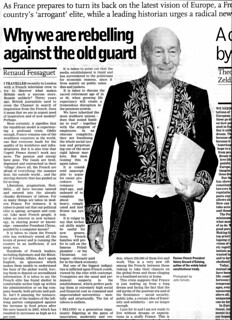
Why we are rebelling against the old guard

As France prepares to turn its back on the latest vision of Europe, a French writer vents his fury with his country's 'arrogant' elite.

by Renaud Fessaguet
The Observer, Sunday May 29, 2005
The old guard
I travelled recently to London with a French television crew to try to discover what makes Britain such a success story. Sounds unlikely? Thirty years ago, British journalists used to cross the Channel in search of inspiration from the French. Does it mean that we are in urgent need of inspiration and of new models? Perhaps.

I've been thinking about the various approaches to software development inside IBM and comparing them to what our competitors and especially our users actually do when they put technology to work for them. Many others have been advocating pragmatism internally and that IBM should do business much like the rest of the world is doing.
More certainly, it signifies that the republican model is experiencing a profound crisis. Oddly enough, France remains one of the wealthiest countries in the world, one that everyone lauds for the quality of its workforce and infrastructures.

IBM is the largest technology company in the world. Annual revenues tend to be around $100 billion.
But it is also true that l'esprit France doesn't work any more. The passion and energy have gone. The Gauls are tired, depressed and entrenched in their 'village'. Above all, the French are afraid of everything: the summer heat, the outside world ... and the stirring rhetoric that has guided us for so long.

See also: overheard. 13,000 employees laid off. Beating inflation these days?
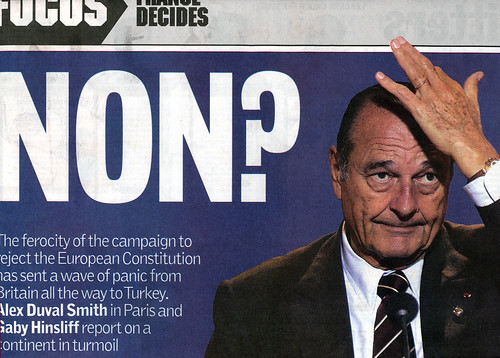
Liberalism, pragmatism, flexibility ... all have become tainted and entered into the already chunky dictionary of taboos. For so many things are taboo in modern France. For instance, it is taboo to point out that our political elite is ageing, arrogant and cynical. Like most French people, it takes no interest in new technology, in sharing power or knowledge - remember President Chirac, puzzled by a computer mouse?

What's the web? What's a feed? What's RSS/Atom? What are blogs? What are wikis?
It is taboo to claim the French elite has recklessly seized all the levers of power and is running the country in an inefficient, if not inept, way.

"What feature is it you might ask? there was no way to bookmark anything in WebSphere Portal?"
Hundreds of French leaders, including diplomats and the Minister of Foreign Affairs, don't speak English, an ignorance which makes them unable to understand the buzz of the global world, forcing them to depend on secondhand information.

What does it mean to be on the web?
It is taboo to say the French elite has found shelter in comfortable niches high up within the administration or on big company boards, both private and public. Isn't it amazing, for instance, that none of the leaders of the left-wing parties campaigned against the increase in food prices after the euro launch in 2002, which has resulted in increases as high as 6.5 per cent.

Buzzwords, buses, frameworks.
The dictatorship of diplomas, the system which demands a formal qualification for any job, which ignores raw talent, however extraordinary it might be, has produced a terrible paradox, empowering mediocrity and irresponsibility, a whole mentality overshadowing the schools, judiciary, media and, ultimately, our national life.

For diplomas, substitute patents and a concern for good products.

This last, the tyranny of patents is worth dwelling on. If one looks at software as a fungible thing and just as a springboard for career advancement, then you will have the notion of viewing the development organization as merely a technology incubator and treat it accordingly. There appear to be perverse incentives in what is rewarded by the organization. These incentives leads to a lack of balance between innovation as expressed in amassing a portfolio of defensive software patents, and innovation that comes from developing lightweight solutions and products that solve problems. The result is technology for technology's sake in other words, and a plethora of frameworks and buzzwords that ignores the effects of said technology on those who are simply trying to get on with things and have problems to solve. A little too often and, as the indoctrination of new hires attests, what is loudly trumpeted is that the way to advance, the way to grab the Fistful of Dollars at IBM, is by filing patents. Those slow pokes contemplating solid products and services are so passé.

See also: Why You Need a Degree to Work For BigCo
It is taboo to point out that the media establishment is timid and has surrendered to the politicians for economic reasons, since it lives mainly on public subsidies and junkets.

It is taboo to discuss the sacred retirement age of 55 or 60, when growing life expectancy will create a tremendous disruption in the pensions system.

We have inherited the most stubborn unions - does that sound familiar to you? - together with the stingiest of employers. In an obscene complicity, they are fossilising the whole social system and perpetuating one of the most rigid labour markets. But mentioning this is again taboo.
Just a paycheck, non?

Non. Chirac.

It is considered unacceptable to argue for easier procedures for company start-ups, and unheard of to complain about the heavy, complicated and inefficient tax system.

File under bureaucracy. See also: "Make sure to call the legal department before you ______." Breathe?
It is vulgar to say that technical skills might be useful for new generations. French families will prefer to call on the famous Polish plumber - or his Ukrainian colleague - obviously paid for in the black economy.
Busloads of consultants or software that enables Glue Layer People? I volunteer a few of these good folks and various others as the Polish plumbers of IBM (some even look the part).

Polish Plumber


Will they get turned away from Bordeaux like those Romanians who come to help with the wine crop are? To give some context, the French have erected internal border posts at the gates of Bordeaux to triage "Eastern European foreigners coming to work". Unlike the Brits who are welcoming new ideas and labour, the French are navel-gazing.
But one of the biggest indignities is inflicted upon French youth, viewed by the elite with contempt. Youngsters are the usual and permanent suspects to the establishment, which prefers parking them at extremely high social and financial cost in crammed and impoverished universities - mentally and structurally. The list of taboos is endless.
"We seem to only be hiring interns these days" - [redacted]
"The word is is that they can be more easily 'molded'." - [redacted]

The interns and the new hires (mostly computer scientists these days) are being treated as cannon fodder, made to work insane hours and to forget about the big picture... Any glory that comes will be on the manager who found them who can bask in the glow of being the only grown up around. You then hear talk about "One of so-and-so's 'finds'". As a colleague put it in another poetic analogy,
"At the end-of-summer country fair, managers will get to show off their prize vegetables. He who has the best manured fields claims the prize."
I asked, "do those people actually eat those vegetables or is it just for show?". The reply
Usually the larger they get the less flavor they have. All looks, no substance. Like California strawberries in February, great color on the outside, not flavor on the inside.
With tongue in cheek I would submit that it's a case of "The man from Del Monte, he said 'Yes'".
I belong to a generation impatiently fidgeting at the gates of innovation, modernity and creation. No wonder that more and more courageous and talented French people don't waste time with the unreal political scene. Don't expect them to vote on the referendum. They will most probably enjoy today meeting new challenges all over the planet.

Tessa reluctantly wrote about pragmatism, and I'll quote her again, if she doesn't mind, she is ever-quotable.

"I do whatever works. I strive to fail faster. It's the results that matter, and simplicity (stripping layers) is celebrated because time is precious. We don't have time to waste on complexity and buzzwords; we're already behind on inventing the future."
I have met remarkable French men and women in China, South Africa, America and now in London, where 250,000 of them live and work. This is a very new rift among the French: between those risking to take their chances on the global front and those clinging to a fossilised society at home.
Kubi, Bowstreet...
This crisis suggests that France is just waking up from a long dream and facing the fact that the old myths of the postwar era and of the Resistance - social security, public jobs, a certain idea of fraternity and solidarity - are no longer enough.

I just hit 45 and I am not ready to live without dreams or expectations in a stuffy France. This is why I will voice a frank and staunch yes to the European constitution.

We urgently need fresh air, the winds of modernity and pragmatism blowing on the banks of the Seine. But who will dare open the window?
I repeat my challenge:
"Are we prepared to change our corporate structure and have profits come more from well-designed and usable software as opposed to consultantware? Are we prepared to eat our babies and make products that have much lower operational costs?"

Renaud Fessaguet is a television journalist and producer.

Postscript


Even though the French said non on the inconsequential EU treaty, there's a great chance they will continue to reward Chirac and his cronies in the next elections. As a quote, put it,
Danielle shrugs: 'Les Français, ils sont un peu con. Ils sont jamais contents.' Roughly translated: 'They're awkward sods, the French. They're never happy.'

I am happy however. I was raised by a village called Lotus. As a native son, I make my own call to arms to that village and hopefully I will find fertile soil. The rest of France, well that is for others.

Le Cinema


The French will never let us forget that it was Les frères Lumière who invented le cinema. Still on this Bastille day, I'll rather celebrate France not with Truffaut, Melville or Godard but rather with a list of films by foreigners.
  • Paths of Glory

    Stanley Kubrick's masterpiece and one of the best war films. It also happens to be one of the most-powerful anti-war films I've seen. Quite relevant apropos central command, cannon fodder, the career advancement imperative, sacrifice, and idées fixes. The story of the French elite during the First World War is much the same today, this time however it is sclerotism and unemployment rather than those muddy trenches and mustard gas.
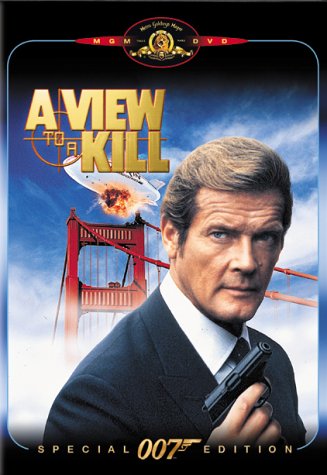
  • A View to a Kill

    This great B-movie, the prototypical James Bond flick isn't all about France even if the Tour Eiffel is among the scenic locations where Roger Moore fights it out with Christopher Walken & Grace Jones. Still the good and bad guys pass France by. Instead of being the name of the game it is just an occasional backdrop. Also note Duran Duran's excellent theme song of hubris.
  • L'Afrance

    L-Afrance


    L'Afrance is Alain Gomin's wonderful 2001 film about France, Africa, immigration and ultimately alienation. It is simply the best African film of the past 5 years and perhaps even the past decade. A no-frills parable about identity, culture and belonging, it continues to resonate strongly with me. Perhaps because it's the African immigrant who through bureaucratic ineptitude finds himself "out of status" and becomes an illegal alien. A great view of the frayed ends in French and African societies much like Dirty Pretty Things illuminated the underbelly of London. You can order the French dvd if you can handle dvd region coding.
  • The French Connection & The French Connection II

    french connection


    In each of these classic films, France is the subtext. In the first, the French villains are aloof, methodical and malevolent but the action takes place in the US. Director, William Friedkin, serves us the best and most manic car chase of all time. In the sequel, Gene Hackman's driven cop is lured over to France as bait in pursuit of those who got away, but gets caught by the bad guys and loaded up with drugs. The scenes of him trying to kick the heroin habit are among the most harrowing ones the silver screen has seen. Ironically, the chase that ends it all is of him on foot chasing cars and boats. John Frankenheimer is a genius.

La Bibliotheque


Some further reading on the France IBM connection:
  • The Soul of a Company
  • Act your age
    The key is to find a Pragmatist who is desperate, or as Moore says, a "Pragmatist in Pain". They have a problem, and they need it solved very badly. In fact, they are so desperate for a solution that they are willing to break ranks with their Pragmatist peers and be the first of their kind to try your product.
    I'm wishing that IBM were a pragmatist in pain, instead I've been seeing only pain from my lowly vantage point.
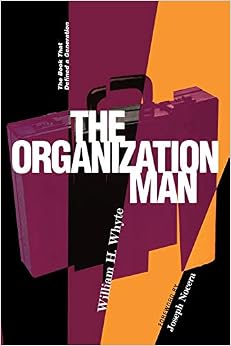
  • The Organization Man by William H. Whyte
    Thanks Tessa for the pointer to this book and that chapter about "The Fight Against Genius". Very illuminating.

    organization man
  • Office Politics by Wilfred Sheed

    I came across this novel through a delightful appreciation piece in the Washington Post and it seemed like a parable of sorts. I had to order immediately even though it has gone out of print. I don't know why reading this synopsis hit home, it couldn't possibly have wider applicability. It's just a novel after all and anyway it's not about France so I hope you'll pardon this juxtaposition.
    "...George is no longer sure there's much at the Outsider worth believing in. Its charismatic editor, a transplanted Brit named Gilbert Twining, has loads of facile charm and wields a keen editorial pen, but whether there's anything behind the charm is open to question. The rest of the magazine's tiny staff is a conglomeration of oddballs and misfits "hand-picked" by Twining, apparently "on some principle of interlocking incompatibility." One editor, Brian Fine, is "chubby and small" and, beneath a veneer of amiability, seethes with bitterness and frustrated ambition. Another, Fritz Tyler, is thin, supercilious and cynical. The accountant, Olga Marplate, longs to be a tyrannical efficiency expert, while the advertising man, Philo Sonnabend, wanders around in a fog of dotty incompetence.

    Individually and collectively they are spineless -- if Twining raised an eyebrow in his direction, "Brian Fine would topple over like a doll with a round base" - yet the office positively crackles with rivalry and intrigue. Brian invites George to lunch one day and lays out the alignment of forces - the alignment, that is, as Brian chooses to see it - in the course of which he says that Twining suffers from the "weakness of great men to keep their subordinates from growing." George is nonplussed. He thinks:

    "Wait a minute, you're supposed to be on their side. Don't you understand the game? Olga and Philo and one editor against Twining and me and the office boy. George found that the game, as game, was getting a stronger grip on him. CBS politics had been played on too large a field, so you couldn't see the players at the far end. This stadium was just the right size."

    So off they all go, conniving and conspiring and back-stabbing and all the other things that make life in the office - any office - so endlessly delightful and produce such delicious streams of office gossip. George tries to explain it to his wife: "Let's take an example: the office. A, let's say, wants to get rid of B. C agrees, but not on A's terms. They both approach D --" and when she interrupts with what he regards as quibbling objections, he insists that "the equation goes on all over town." Okay, he says, "just go down to any playground, and what do you find? A, B and C again. One leader, one whiner, one mischief-maker. . . . Sometimes there's a tricycle to fight about on the playground, and sometimes there's a nickel on the ground. But the jockeying of ego is the real story."
  • Why smart people defend bad ideas
  • Flaubert's Parrot by Julian Barnes
    Flaubert Parrot

    C'est moi.
    This remains one of my favourite novels.
  • The Myth of Sisyphus by Albert Camus
    I leave Sisyphus at the foot of the mountain! One always finds one's burden again. But Sisyphus teaches the higher fidelity that negates the gods and raises rocks. He too concludes that all is well. This universe henceforth without a master seems to him neither sterile nor futile. Each atom of that stone, each mineral flake of that night filled mountain, in itself forms a world. The struggle itself toward the heights is enough to fill a man's heart. One must imagine Sisyphus happy.
  • "Sharp-elbowed bureaucratic maneuvering"
  • On the limitations of Lotus Notes on the web
  • Les Misérables by Victor Hugo
    Well you can't exactly leave the bibliotheque without Hugo, that's like England without Dickens.

Le Cabaret


We need a cabaret soundtrack for this histoire. Évidemment.

Have a bottle of Bordeaux today. A bientôt...

File under: , , , , , , , , , , , , , , , , , ,