Showing posts with label street. Show all posts

Tuesday, August 13, 2024

Damage is Done

Mobs are unkind, bent as they are on destruction
Cruelty dispensed in the rush to street justice
Blood in the sinews fully primed for action
Apt to casually cut short the lives they surround
Swiftly maiming in sinister displays
On the flimsiest of evidence, wrath lays to waste
The chants that lead to screams
Proud weapons of the unquiet
Pain for certain. And the damage is done

Soul tectonics
Comes the taint of shame in the aftermath
The aftershocks on the psyche
Their effect lingers even on the most righteous
Despite themselves, perpetrators join victims
And off the curdled ground painted with their handiwork
They pick up scar tissue and red ligaments
To be imprinted on later remembrances
Thus bound together in disharmony, they stagger forth
Heavy with the burden of the extra weight
And the gods, for they are watching, exact a further price
The wounds of the beholder will not heal so easily
Regret perhaps. But the damage is done


salvador ruins


Damage is Done, a playlist


A soundtrack for this note (spotify version) See previously The Wages of Thermidor and June 4th

File under: , , , , , , , , , , , , , , ,

Writing log. May 1, 2022

Tuesday, July 11, 2023

67

Well, well, well, guess who turned 67 just the other day?
A neighbor distributed a flyer right at our doorway
Inviting us to a gathering to celebrate
   near the benches just before dark
Plum center, a photo of the birthday boy,
   the old man who lives in the park

Sadly, I couldn't rally to make it to the happy event
Even though I would consider myself one of his friends
Life intruded, parenthood and the pandemic's dismal reality
Meant that I missed out on the trappings of that ceremony

What do you give the man who has nothing but wants nothing?
I racked my brain:
   what could possibly be an adequate contribution?
Moreover, would he really want to be celebrated
   or, rather, left alone?
After all, when the party's over,
   the park would still be his humble home

At his age, one would traditionally be prime for retirement
Clearly though, besides his clothes and blanket,
   he has no safety net
Despite the gestures we've made
   to maintain a modicum of community
For all we know, he may not even be collecting social security

It can't be easy this life of his, being homeless
Street life, the whole world watching all your business
The soul of the neighborhood was the flyer's consensus
67, this old man. Think first, of the least of us


zinnias flower garden

The Old Man Who Lives in the Park (Redux), a playlist


A soundtrack for this note. (spotify version)

See previously: The Old Man Who Lives in the Park


This note is part of a series: In a covidious time.


File under: , , , , , , , , , , , , , ,

Writing log: September 11, 2021

Tuesday, August 03, 2021

The Bad Seed

Suborn was his favourite verb
He'd read it in the dictionary and it stuck
Indeed it was his very favorite activity
The thrill of meeting a girl down on her luck -
Freshfaced was best - and prey on her insecurity
He lived for the moment when, under pressure, she would turn
Inside he celebrated, it was all too easy
The school of hard knocks, those lessons learned
The fruits of smooth talking with the steel of coercion
A girl newly suborned was worth the price of admission

He would never betray himself, he kept a cool countenance
His style always approached, but was just this side of flashy
You had to know how to maintain the serene balance
For this was no mere vocation, to resist the lure of easy money
The family business was of no interest for him, no, not at all
No stodgy funeral home for him, no assisted living, why think small?
Why bother? Not when other players were parading around crack dollars

Drugs were too easy, the real challenge was breaking a spirit
That other word, misogyny, was for squares and without merit
Early forties, he'd seen it all, had hardened his mind to it.
A late bloomer perhaps and much to do, even if squalid

Not for him pimp arrest and all that jargon and slickness
That the cats who read too much Iceberg Slim would throw at you.
He bet most of them hadn't even read the books
Nah, start with Donald Goines man, Whoreson Jones
Bringing a prospect into the game was the endpoint
It was hard work, nothing like that show, Hookers at the Point

In the barbershop, he was holding court,
Just about turned it into a serpent's lair
I'd recognized him from the open house
As I sat two seats down in my chair

My barber had slowed to a crawl in crafting my low fade
It turns out that we were all transfixed listening to this man's escapades

I wondered if he remembered me and would treat me as a spoiler
Who'd seen him at a relative low point liquidating his real estate
If he did, he didn't skip a beat, and continued narrating his pot boiler
Again he would repeat:
   "It's all in the game, it's about how you communicate"
Deliberate, this man, there was a detachment to his diction
There wasn't a torrent of words as he spun his fictions
He made sure as he rapped to enun-ci-ate ev-e-ry syl-la-ble
I couldn't figure out what manner of cut he was getting,
   this smooth criminal

She'd been sitting in the corner reading back issues of Vibe
I hadn't paid attention but now realized that, to every man,
   she lowered her eyes.

He coughed, looked over at her and nodded.

She stood up, dropped her drape and started walking.

The legs: vertiginous
The hips: tremendous
The outfit: ridiculous

She walked.
That was all.

The subtext: lascivious
His intent: pernicious

She walked.
I was appalled.

He just wanted to show off his possession
To make a point with this barbershop exhibition

He nodded again.

She slowed and just paraded back and forth
Those few steps between the full length mirror and the front door

An unholy, impromptu airing of the possibilities of the flesh
Such was the shock, there was a collective intake of breath

Meanwhile he ignored the display, he was of a different bent
The promise of sex meant nothing to him, he continued to wax eloquent
About the new girl, the one out of Walnut Creek high school
Who just got her diploma, "I'mma teach her the rules"

She walked.
It could have been a tightrope or a catwalk

"18 and over, and she couldn't wait to come be an earner"

It was uncomfortable, those five minutes of sin
The walk and its soundtrack: the sound of this man droning

Hardly normal, this marshalling of the naked appeal to lust
How would I explain this scene? It amounted to a betrayal of trust

I suppose from the outside you might say
That she was just taking a stroll and stretching
But if you were in the room you knew full well
This was nothing less than slut shaming

I looked around, everyone was silent and amazed
Needless to say, there's a real violence to the male gaze

"Real prospects, man you should see her", he smiled
Then, on second thought, he pointed, "But nothing like..."

She kept on walking.

"Bottom."

She kept walking.

"Right there, my bottom."

She walked.
Turned as she reached the mirror.

Under the cape in the barber's chair
I couldn't help but continue to stare
Still, I couldn't stand this strange ritual
Unnerving, the plain reduction of an individual
Servitude of sorts, call it by its name, exploitation
There was no denying the upshot of this transgression

Yet she wore this woman's work with a mask of normalcy
Floating above it all, she only aimed to please
The blankness in her eyes only strengthened my unease

She walked.

Preening as he was, like an obsequious merchant
Displaying his fleshy wares in the barbershop bazaar
This was premium quality content, the matter at hand
Except that the goods presented weren't rugs or steak knives
The sale of a human soul, a dubious transaction to all eyes
Ashamed, in those few minutes, at the undoubted humiliation
Troubled, to see not resignation but the vacancy of her stare
It appeared to just be work, a thorough subjugation

She walked.

I guess we were the marks, the square johns
Who would never understand the sex worker's situation
Not that the phrase ever crossed his lips
It was rather a panoply of hoes and pimps
A grim masquerade, this march at the carnival
I couldn't bear the tension of that sordid interval

The minutes passed. She kept on walking
While this gremlin kept on talking
Spinning his web of aggrandizing spite
His heart was a full quiver of ice
Arrows of deceit, cunning and sleaze
Our collective souls abased to our hands and knees

She kept on walking.

Pacing, her motion ever more languorous
The simplicity of the act, yet this felt dangerous

All of a sudden he clapped. His haircut was done.
She stopped moving promptly. We remained stunned.

She went to fetch his suit jacket for him
Exquisite silk. She helped him put it on.
Fresh. Wrapped her arm around him as he offered his elbow.
His arm moved lower and tapped her waist just like so
Took a look around as if to inspect his audience
He expertly put on his hat
Then dropped his hand further, and patted her butt

"Bottom power"

The college footballer dropped his phone.
I averted my eyes, thoroughly embarrassed.
Then, an exchange between the two of them
She had never said a word in all this, it was telling
For the first time, she looked into everyone's eyes
Goddamn. I guess this was the temptation he was selling

I felt bad, sick to the stomach at the display of power so feral
Worried, about the corruption of my soul now placed in turmoil
The disturbance continued as they walked out the door
She'd grabbed her drape. Could innocence ever be restored?

There was silence for a few minutes
We were still taking in what what we had witnessed
The clippers hummed unhurriedly on the edge of din
That was the only sound in the aftermath of sin

Eventually: "How about that game?"
My barber unmuted the TV
"The Raiders ain't doing nothing this year..."
No one mentioned anything further
The unwritten code of the streets
"What happens in the barber chair,..."

He handed me the mirror, I inspected the close fade
I added an extra five dollars to what I usually paid

I made my departure from the joint with speed
Full of worry about the woman caught up in this perverse psychology
And those others prey to the admixture of bullying and sociopathy
The mounting alarm also
   about the unknown graduate from Walnut Creek

After the open house, I'd done some research
   but now I had his street name
Not that it really mattered, the pathology of Junior Eddie was the same

At this Player's Ball there was no delicacy
To this evocation, to these fifty shades of sadness
Spectators to this cold blooded glimpse of human brutality
I steeled myself for the journey back from the heart of darkness

When I saw The Roots, The Tipping Point tour, as I remember
After the show, they were passing out these funny flyers
That was in Boston's Combat Zone: The Pimps and Hoes Party
But here in Oakland, I was getting a heavy dose of reality

Back in Cambridge, I'd shared the same barber
   as that Harvard professor
Who skipped around the gates of weighty subjects as he held court
Now I was on the West Coast, living in the hometown of Too Short
The topics were no less troubling,
   but it was a different breed of street philosopher

I tried to commit the details to memory; I headed straight home
This rough trade in sin was material enough for a poem
The bad seed had left me shaken to the core by this encounter
There was no way today that I'd enjoy the food at the Taste of Africa

greece stamp eaahnikh ahmokpatia

Like a shopkeeper displaying his lengths of cheap cotton to country housewives, Parrinieddu unwound his roll of lies. His nickname of Little Priest was due to the easy eloquence and hypocrisy he exuded.

Leonard Sciascia - The Day of the Owl

roxy flier pimps & hoes party

...

I've never seen this couple again.
When I got home, I racked my brain
For what I could do to intervene
How to protect from this menace to society?
Who could act to relieve my anxiety?
To my shame, I could only pray for healing
For there was no balm that could truly salve.
My antidote: I then wrote the above.

The Bad Seed, a playlist


A soundtrack for this note, let me know if it fits. (spotify version)
See previously: Open House

The statute of limitations has passed and so I can belatedly nominate this piece for The Things Fall Apart Series.

File under: , , , , , , , , , , , , , , ,

Writing log. Concept: July 31, 2007, March 6, 2021

Monday, January 04, 2021

The Old Man Who Lives In The Park

The old man who lives in the park now has a dilemma
That's causing you and your neighbors further heartache
Not, paradoxically, that he sleeps under the benches,
For he's blessed, he always says to confound any pity
"I'm blessed to live in this here world"
"The Good Lord watches over all his creations. He is indeed my witness"
No, it's that Parks and Rec, just weeks ago, removed the porta potty
That has been serving as his bathroom and privy
For what seems like the past couple of years
And now, with no stand pipe or running water,
We can only expect a trail of tears

The park was ostensibly closed at the outset of the pandemic
But this new development ups the ante of discomfort
The practical questions mount: where will he relieve himself?
You're all facing the pressing matter of public health
You wonder if the flying toilets of Labadi Beach
Will make their appearance on these Austin Texas streets
Well, at least the garbage is still being regularly cleared
Appearances must be kept up, even as lockdowns take their toll
The prospect, however, is of walking through discarded toilet roll

He's always kept himself clean, tidy and well dressed
Dignified, with a sense of possession and no trace of stress
One has always wondered: where does he take his showers?
Still it's a consolation that the park benches
That he sleeps under at night are still there
For what it's worth, they provide some protective cover
He moves out early in the morning from this place he shares
To allow the yoga and exercise crowd to take them over

He had a good run this summer by every measure
The birthday party crew were stymied by the park closures
Thus he could sleep in, even on the weekend mornings
No anxious parents trying to stake out the benches
And mark their territory with prefab themed balloons
And other plastic decorations with which they festooned
No disposable tablecloths that they would tie down
No cups, coolers and fluffy pom poms
No banners and photo booths nor burgeoning cheer
For the show they later planned to put on
No bouncy castles, at least for the first few months
No barbecues, the smell of which draw out a great longing
Indeed for those months there were no gatherings
Of friends and family and their spawn

He must do odd jobs during the day for the folks at the restaurant
Perhaps they repay him in kind with their choice soul food
The sign says that they even serve meat from alligators
Or perhaps it's just his company that they enjoy that makes him a fixture
The owner raises a weary eye and his expression grows stark
Whenever you happen to mention the old man who lives in the park
There's a pause, then a sigh, born of longstanding concern,
A shake of the head, it's really a long story
Believe me, we've long since involved social services
At this point, it's not even a matter of charity
Interventions galore, there's no doubt a fraught history
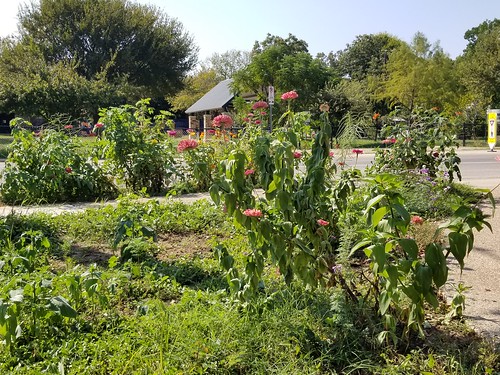
zinnias flower garden

When he disappeared for a month,
You wondered if he was lost to the pandemic
That was back in July, when that new urban soundtrack
The near constant sound of ambulances, almost made you panic
The Governor, despite the positivity rate,
Was hell bent on the grand reopening
You could only hang your head in dismay
At the fecklessness, will they ever learn?
So it was the most misbegotten kind of relief
When the old man who lives in the park made his return

We'd circled each other uneasily ever since we moved in across the park
The real estate agent couldn't have known he'd be our neighbor
The head nods proffered were only occasionally returned
There was indeed recognition, but always a pregnant silence
I later learnt that he was half blind
Which perhaps explained the diffidence
And his uneasy and languid way with locomotion.
Albeit he has a white cane that he twirls merrily,
But he seems to only use it as decoration
Thus he crosses the street willy-nilly
Invariably causing near crashes and commotion.

Came to find out that he was a veteran
There's a hardness under what you observe
You wonder which was the American
Foreign misadventure he was drafted in to serve
The word on the street is that his sister takes all his benefit checks
Such is the mystery of the arrangement, for he seems quite happy
And even compelled to spend his nights sleeping under the bench
So perhaps it's not about money but rather about penance
For sins past. Who knows the backstory of this kind of repentance

We first talked one August evening
As I watered my flowers and plants in the front yard.
Limping, he'd crossed the street from the park
As usual, ignoring the passing cars
He approved of my low tech approach
But suggested installing a sprinkler system
I didn't have the heart to show him the one right there under his nose
Given that I preferred getting out and about with my garden hose
Back to basics, Nyame had suggested, choose manual over automatic.
Such were the nuts and bolts guiding me through this pandemic
So while we live in this digital world, I prefer analog connections
The necessity of touch and meaningful conversation

Nevertheless he approved that I was taking care of the earth
And digging up and weeding on my hands and knees
"If all goes well, young man, with the passage of time
There'll be plenty of monarch butterflies and bees"

There's a musical quality to the cadences of his speech
As if, in another life, he could be moved to preach

"I'm blessed, Sir. I have two young ones, I couldn't be prouder.
The Good Lord is in control, don't mind that weather forecaster
You know, he had it wrong, claiming rain and thunderstorms
But what could he know about His ways and directions?"

"It surprises them when you call them Sir, but it doesn't cost you none.
Keep doing what you're doing, above all, be true, young man"...

"I see you have a couple of children, I can tell they bring you joy.
I'll be off now. Pleased to meet you, Sir, my own name is Delroy."

And so I turned off the water and coiled up the garden hose
And took off the homemade face mask that covered my nose
I made to turn on the light in front of my home
And walked back up to my study thinking of a poem
I gazed across the street at the incipient dark
Thinking, as I do at night, about the old man who lives in the park.

front yard

The Old Man Who Lives In The Park, a Playlist


A soundtrack for this note (spotify version)

See also: Frank and Frances (or 500 Steps)

This note is part of a series: In a covidious time.


File under: , , , , , , , , , , , , , ,

Saturday, July 31, 2004

Street Lit, Pulp Fiction and The Worst Novel Ever Written

The Post has an article about "street lit" - the bawlderized black pop "literature" that has become popular if not increasingly financially successful these days:New Books In the Hood

For good or for bad, street lit is eating up the African American book world at the moment. Walk into the Karibu bookstore in Prince George's Plaza and you'll see. It used to be there were just one or two small shelves of "street life" books. Now there's a whole section.

The titles of the paperbacks pretty much say it all: "No Way Out" by Zachary Tate, "The Last Kingpin" by Relentless Aaron, "Payback's a Bitch" by Marcus Spears, "Thugs and the Women Who Love Them" by Wahida Clark, "Bad Girlz" by Shannon Holmes and countless more. In the same way rap music muscled melodious soul tunes off the charts, street lit is altering the equation of African American publishing.

What is a street lit novel? The telltale signs usually include a shut-your-mouth title, straightforward sentences, vast amounts of drugs, sex and rap music and varying degrees of crime and punishment. An exemplary tale is a mixture of foul language, flying bullets, fast cars, a flood of drugs, fallen angels and high-priced frippery. It venerates grams over grammar, sin over syntax, excess over success.

Street lit, says Karibu co-owner Simba Sana, "is the hottest thing going right now."

The paperback fiction bestseller list at Karibu -- a local five-store chain featuring books by and about African Americans -- is dominated by street lit, aka urban lit, gangsta lit or hip-hop fiction. "Do or Die" by Washingtonian Darren Coleman is at the top, followed by Keisha Ervin's "Me and My Boyfriend," Thomas Long's "A Thug's Life" and "A Project Chick," the second novel by Nikki Turner. Karibu stores have sold nearly 3,000 copies of Turner's first novel, "A Hustler's Wife." [...]

First, the 'Iceberg'

The new street lit is not to be confused with the classic naturalistic style of Richard Wright or James Baldwin, some critics say. That would be a little like comparing P. Diddy to Duke Ellington. Street lit lacks the literary ambition -- and the power -- of great writing. Terry McMillan, Walter Mosley and Nichelle D. Tramble are literary fiction writers -- in the tradition of Wright and Baldwin -- who write about the streets. Their novels, however, are not street lit.

Street lit has always been more of a social than a literary movement. It can be traced to 1969 when Iceberg Slim, aka Robert Beck, published "Pimp," a memoir of his professional life. He was born in Chicago in 1918 and lived most of his life in the Midwest. Between the ages of 18 and 42, he worked as a procurer of prostitutes. He did some jail time.

While in solitary confinement in 1960, he decided to go straight. When he was released, he moved to California and wrote his memoir. He went on to write a lot of books, including "Trick Baby" and "Death Wish." The books were groundbreaking in their real-life, close-to-the-bone accounts of life, sex and death on the streets. And they were packed with urban patois, such as using "jasper" for lesbian and "macking" for pimping. Iceberg Slim died in 1992.

In the 1970s, Donald Goines picked up the thread. A former heroin addict and chronic convict, Goines produced in short order a slew of books including "Dopefiend: The Story of a Black Junkie" and "Whoreson: The Story of a Ghetto Pimp." The books came along with the rise of blaxploitation movies and hip-hop music. For a while, street lit fell by the wayside, but it returned in the late '90s, with a bullet, when Sister Souljah published "The Coldest Winter Ever."

Today's street lit has its champions. Many of the novels have a moral, says Mackey. "In most of them it's about people who have made wrong choices," she says. "The authors are making a conscious decision to say these people made bad choices and you don't have to. There is a moral fiber running through the whole book."

Plus, she says, "There is a blessing in all of this: African Americans are reading. They've picked up a book and they are reading."

Poet Sterling Plumpp, who taught at the University of Illinois for 30 years, says that contemporary hip-hop writing "is the most inventive thing happening to the language in a long time."

He believes it is more successful in fiction and poetry than in rap lyrics. "I'm not sure the music is there," he says.

Eventually, Plumpp says, great writers may emerge. "What you have is a very difficult situation for a lot of young African Americans," Plumpp says. "They did not inherit the legacy of W.E.B. Du Bois or Frederick Douglass in terms of literacy."

But, Plumpp continues, these young folks have life experiences that they want to express. "They have almost developed an African American language that is as estranged from the educated African American world as it is from the white world."

Street lit, he says, "should be promoted."
I think Bill Cosby would disagree with the above statement but it does have a utilitarian grain to it.
  1. If more people (and especially black people) are reading, then surely that is a good thing - there has been a bit of a todo of late about the declining numbers of people reading
  2. Popular culture does not need to address the academy; it has a life of its own. Tarantino for example has mined the shlock of b-movies to wonderful effect and we are all the better for it. Similarly some of the great writers of the past century made a living working in the pulp fiction genre.
  3. It not so much that street lit is at best a guilty pleasure. I have found more literary verve in Bill Marshall's slender novel Bukom about the slum of that name ["We are going to make folks in Bukom realise that I Ataa Kojo, and my children are forward looking. We are going to make folks envy us. We are going to build a whiteman's toilet in this house and the neighbours are going to come here and beg us to use it"] than in say Ayi Kwei Armah's entire oeuvre of weighty historical tomes on slavery like say The Healers. Similarly, and not to be so obscurantist, I'll take John Grisham's The Client or even Terri McMillan's Waiting To Exhale over Thomas Pynchon's V any day - literary pretensions be damned.
In the same vein, the most annoying (nay, the absolute worst book I've ever read) was The Unconsoled by Kazuo Ishiguro. I mention this as a public service announcement - avoid at all costs.

This must be the novel parodied by Martin Amis in The Information: the novel circulated to critics which induces severe headaches, nausea and worse to anyone who begins it, what with its circle of 8 unreliable narrators.

After 150 pages, I literally wanted to punch the author. After finishing the book - I unfortunately feel obligated to finish every book I start - exquisite torture was the only appropriate punishment.

The sad thing is that I've loved every other book by him. It goes to show that technically-adept writing without purpose can be a lethal thing. Let's have more "street lit", especially with soul!

File under: , , , , , , , , , , ,