Showing posts with label conversation. Show all posts

Tuesday, April 11, 2023

The Weight of Ideas

They talk about a density of ideas
As if this is a thing that has weight

Well we don't suffer from a lack of such
Nor is there a dearth of pungent metaphors

For even in the darkness we hold on tight
And carry the load like the porters of old

Uncomplaining, contemplating recent history
Those lost decades consigned to collective amnesia

The density of our thought
Manifestations of ingenuity

The weight of our ideas
A concentrate of deft potency

We were never on the wrong side of history
It is only that our timeframe extends past your event horizon

...

Bartering for hours it seems, at the bend down market
The old man quietly observes the proceedings
Then gestures, as if to say,
"Be patient, just wait a minute"
Then he brings it out from the back
He knew what you needed

...

Heavyweight thought is our concision
Sublimation, our purifying distillation

Not a word more, a sublime concentrate
Deny that brevity is for the weak

Future markets priced by the ounce of reflection
Ideas as intellectual projectiles in conception

Mining our fields of thought
Weaponized extractive industries

Cross the technical support of trending interest
A paucity, the bitterness of imperfection

...

Such is the half-life, ultimately, of our navigation
That we traffic in concealment and revelation

From social interplay we gain direction
For we hold that markets are conversations

The process of consensus
The patience of conversation

The virtue of listening And truth and reconciliation

Our ideas weigh a ton
And are integral to our identity

The weight of ideas, the nuts and bolts
Such is the cement of society


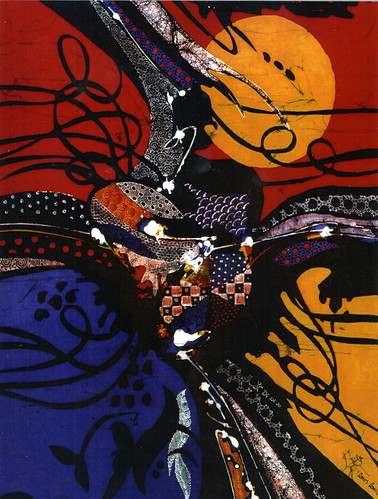
Fishing Home by Kofi Nduro Donkor

...

After Jon Elster

...

Timing is everything
Observers are worried

File under: , , , , , , , , , , , , , , , , , , , , ,

Writing log. Concept: February 2, 2019; May 7, 2021

Tuesday, November 29, 2022

The Chinese Ambassador

She'd normally do this kind of thing on her own
But fortunately I was back in Ghana visiting home
At the appointed time, we were scheduled to have dinner
And so off we went to meet the Chinese Ambassador

I didn't feel bound by the Chatham House rules, those we could surely ignore
For, indeed, neither I nor my mum were part of the diplomatic corps
The invitation was an opportunity for the Ambassador to meet and greet
And pick her brain, conversing in a setting that was quite intimate

The staff had done impeccable opposition research on my mother
But my very presence (improvised and unadvertised) was an X factor
That occasionally threw the Ambassador for a loop that was hard to measure
Like when I harrumphed, and made a point about the terms of my company's joint venture

Who was this Young Turk irreverently pointing out inconvenient truths
While quietly sipping his second glass of pineapple juice?
Who readily dug in to the more exotic fare, not your average dim sun
And mentioned the village of the chef of his favorite Chinatown restaurant

I'll admit, it was a lark, I was being provocative, it was indubitable
To see whether I could pierce the mask of the normally inscrutable
But there was a larger point, I suppose, we are a proud people
With a self confidence that can only abide being treated as equals

To his credit, the years of diplomatic training were so ingrained
That the Ambassador never came close to breaking the veil
He so deftly brought the conversation back onto his preferred topic
That I almost started to applaud his mastery of the arts diplomatic

The rest I'll leave to the mist of memory
Some details linger, the tea was legendary
The Ambassador's pragmatism about the fraught nature of the great game
And his respect for the small players who still beheld a culture of shame

The recognition of the ongoing perils of galamsey
Short term profiteering causing long term dismay
"But those kinds of things are private actions, not public policy, as you well know"
I couldn't resist the zinger: "It takes two to do the corruption tango"

I thoroughly enjoyed myself, that I must concede
This was very far from a symphony of deceit
An invitation to visit the motherland was duly extended to my mother
At the end of the evening, this lovely dinner with the Chinese Ambassador

Diplomacy means the art of nearly deceiving all your friends, but not quite deceiving all your enemies.

Kofi Abrefa Busia
hot summer by amos amit

The Chinese Ambassador, a playlist


A soundtrack for this embassy affair. We should all learn Chinese. (spotify version) ...

Timing is everything
Observers are worried

File under: , , , , , , , , , , , , , , , ,

Writing log: May 5, 2021

Tuesday, October 19, 2021

Normalcy Prohibition

We'd gathered after the cosmopolitan professor's lecture
At the round table, there was a little wine and conversation
In the Green Room at the Headliners Club,
   idle chat about its architecture
Members only, the joint was swank,
   believe me, you couldn't beat the location

Breathtaking views, it felt like floating,
   there, on the top floor of the Chase Tower
We were enjoying this dinner in honor of the renowned philosopher
Prime cuts of steak with all the trimmings, not your standard buffet
And for those otherwise minded, dinner options included a vegan entrée

The ethicist speaks of identity was the stated title of the talk
Typically lucid, he was promoting his latest book, he'd kept it short
A Cambridge man, he deftly navigated the day's fraught politics
No pointed commentary about the mogul-turned-President's antics

One of the participants at the round table was an august professor
You know the type, long praised for his robust, classical philosophy
He started to expound on the quality of rage throughout Western history
The uses of wrath and its unfortunate modern suppression despite its validity

From my seat at the table, I could see all too clearly where this was going
Emeritus, the man had a lifetime of captive audiences
   he was used to lecturing
He could build up a full head of steam
   and, at length, carry on pontificating
All the while pretending to never notice
   the slack mouths of those listening

A frisson of danger would carry his argument
   to its preordained conclusion
He brought up the droit de seigneur or some such grandeur and delusion
The lack of care for conventional wisdom and liberal pieties
He was used to pushing people's buttons and defying boundaries

I pondered the question, perhaps there was a subtlety I was missing
With an audience of academics who speak in code it pays to listen
In any case, I was there as a plus one, The Wife had Prof as her mentor
Which made me not a deep thinker but a mere spousal contributor

My own work, I'd offered earlier,
   explored the issue of neutrality in technology
And how recommendation systems could be brought to bear on society
Whether social platforms, and those who control them,
   could act out of spite
And how to design networks with transparency in mind to be forthright

By the time I mentioned the work on self driving vehicles
That was the recent part of my software practice
I rather feared I'd lost the audience with talk of miracles
And that they would pigeonhole me as an afrofuturist

Still, I don't know what possessed me,
   in the moment, to forgo quiescence
My usual strategy is to remain silent
   when confronted with arrant nonsense
Perhaps it was the fine wine on hand that loosened my normal reticence
I prepared to fortify my tongue to address the implied violence

With a smile as I sipped my red wine,
   I decided to engage in light criticism
I find it to be the strategy of choice in the face of misguided contrarianism
I have long experience dealing with those should have known better
My recommended action is to disarm with a choice proverbial zinger

It is a real privilege, I noted, to be able to afford rage
Not everyone in our societies is granted the honor of escaping the cage
Indeed, some people get quickly branded as uppity
   at the slightest umbrage
In my field, the concept is akin to the principle of least privilege

The least of us, it seems to me, deserve consideration now and again
The freedom of action, by definition, is granted to free men
But at the outset of the road to freedom, there was a touch of dismay
The constitutional settlement for slaves was to be counted as three-fifths
Partial personhood implies partial freedoms that come into play
When you are wrongly accosted on Texas streets by the sheriff

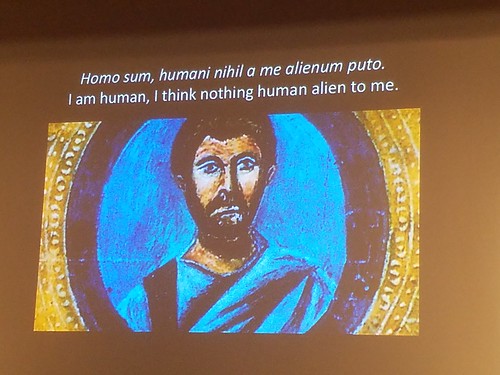
Our host had earlier quoted Publius Terentius Afer,
   better known as Terence,
That Afro-Roman Senator of yore,
   a paragon of uncommon wit and sense
And his enduring aphorism and motto

Homo sum, humani nihil a me alienum puto
I am human, and I think nothing human is alien to me
I left it there, there was no need to go further, you see

The old professor, finally silent, simply seethed
Daggers in his furious eyes were pointed at me
It was a wonder, given his discourse, that he could repress his rage
Thankfully, those norms of politeness came into play at this stage

I worried that there would be a response, and had prepared my rejoinder
Forgiveness and love was my own take, forbearance in social behavior
I held my fire, if he was to continue with his noxious agenda item,
As a software engineer, I've frequently solved the dining philosophers problem

The guest of honor was more practiced at these matters and promptly
Changed the topic, and brought up further examples in history
Honor codes were an example he'd covered in one of his books
Those duels and other misguided traditions that we now forsook

He conceded my point, but had nicely recovered the tenor of the dinner
With characteristic wit, he'd brought things down from a boil to a simmer
Whereas the lies that bind
   was his preferred framing of matters of identity
I favored truth and reconciliation, poetry as cultural memory

The notion is clear for those who have long borne masks of civility
Of the fool's paradise of considering philosophy detached from equity
Albeit internal displacement is my tribe's underlying condition
I'd like to one day escape from the state of normalcy prohibition

I am human I think nothing human alien to me

Normalcy Prohibition, a playlist


A soundtrack for this note. (spotify version) Timing is everything
Observers are worried

See previously: Internally Displaced

File under: , , , , , , , , , , , , , , , , , , ,

Writing log: March 10, 2021

Tuesday, August 03, 2021

The Bad Seed

Suborn was his favourite verb
He'd read it in the dictionary and it stuck
Indeed it was his very favorite activity
The thrill of meeting a girl down on her luck -
Freshfaced was best - and prey on her insecurity
He lived for the moment when, under pressure, she would turn
Inside he celebrated, it was all too easy
The school of hard knocks, those lessons learned
The fruits of smooth talking with the steel of coercion
A girl newly suborned was worth the price of admission

He would never betray himself, he kept a cool countenance
His style always approached, but was just this side of flashy
You had to know how to maintain the serene balance
For this was no mere vocation, to resist the lure of easy money
The family business was of no interest for him, no, not at all
No stodgy funeral home for him, no assisted living, why think small?
Why bother? Not when other players were parading around crack dollars

Drugs were too easy, the real challenge was breaking a spirit
That other word, misogyny, was for squares and without merit
Early forties, he'd seen it all, had hardened his mind to it.
A late bloomer perhaps and much to do, even if squalid

Not for him pimp arrest and all that jargon and slickness
That the cats who read too much Iceberg Slim would throw at you.
He bet most of them hadn't even read the books
Nah, start with Donald Goines man, Whoreson Jones
Bringing a prospect into the game was the endpoint
It was hard work, nothing like that show, Hookers at the Point

In the barbershop, he was holding court,
Just about turned it into a serpent's lair
I'd recognized him from the open house
As I sat two seats down in my chair

My barber had slowed to a crawl in crafting my low fade
It turns out that we were all transfixed listening to this man's escapades

I wondered if he remembered me and would treat me as a spoiler
Who'd seen him at a relative low point liquidating his real estate
If he did, he didn't skip a beat, and continued narrating his pot boiler
Again he would repeat:
   "It's all in the game, it's about how you communicate"
Deliberate, this man, there was a detachment to his diction
There wasn't a torrent of words as he spun his fictions
He made sure as he rapped to enun-ci-ate ev-e-ry syl-la-ble
I couldn't figure out what manner of cut he was getting,
   this smooth criminal

She'd been sitting in the corner reading back issues of Vibe
I hadn't paid attention but now realized that, to every man,
   she lowered her eyes.

He coughed, looked over at her and nodded.

She stood up, dropped her drape and started walking.

The legs: vertiginous
The hips: tremendous
The outfit: ridiculous

She walked.
That was all.

The subtext: lascivious
His intent: pernicious

She walked.
I was appalled.

He just wanted to show off his possession
To make a point with this barbershop exhibition

He nodded again.

She slowed and just paraded back and forth
Those few steps between the full length mirror and the front door

An unholy, impromptu airing of the possibilities of the flesh
Such was the shock, there was a collective intake of breath

Meanwhile he ignored the display, he was of a different bent
The promise of sex meant nothing to him, he continued to wax eloquent
About the new girl, the one out of Walnut Creek high school
Who just got her diploma, "I'mma teach her the rules"

She walked.
It could have been a tightrope or a catwalk

"18 and over, and she couldn't wait to come be an earner"

It was uncomfortable, those five minutes of sin
The walk and its soundtrack: the sound of this man droning

Hardly normal, this marshalling of the naked appeal to lust
How would I explain this scene? It amounted to a betrayal of trust

I suppose from the outside you might say
That she was just taking a stroll and stretching
But if you were in the room you knew full well
This was nothing less than slut shaming

I looked around, everyone was silent and amazed
Needless to say, there's a real violence to the male gaze

"Real prospects, man you should see her", he smiled
Then, on second thought, he pointed, "But nothing like..."

She kept on walking.

"Bottom."

She kept walking.

"Right there, my bottom."

She walked.
Turned as she reached the mirror.

Under the cape in the barber's chair
I couldn't help but continue to stare
Still, I couldn't stand this strange ritual
Unnerving, the plain reduction of an individual
Servitude of sorts, call it by its name, exploitation
There was no denying the upshot of this transgression

Yet she wore this woman's work with a mask of normalcy
Floating above it all, she only aimed to please
The blankness in her eyes only strengthened my unease

She walked.

Preening as he was, like an obsequious merchant
Displaying his fleshy wares in the barbershop bazaar
This was premium quality content, the matter at hand
Except that the goods presented weren't rugs or steak knives
The sale of a human soul, a dubious transaction to all eyes
Ashamed, in those few minutes, at the undoubted humiliation
Troubled, to see not resignation but the vacancy of her stare
It appeared to just be work, a thorough subjugation

She walked.

I guess we were the marks, the square johns
Who would never understand the sex worker's situation
Not that the phrase ever crossed his lips
It was rather a panoply of hoes and pimps
A grim masquerade, this march at the carnival
I couldn't bear the tension of that sordid interval

The minutes passed. She kept on walking
While this gremlin kept on talking
Spinning his web of aggrandizing spite
His heart was a full quiver of ice
Arrows of deceit, cunning and sleaze
Our collective souls abased to our hands and knees

She kept on walking.

Pacing, her motion ever more languorous
The simplicity of the act, yet this felt dangerous

All of a sudden he clapped. His haircut was done.
She stopped moving promptly. We remained stunned.

She went to fetch his suit jacket for him
Exquisite silk. She helped him put it on.
Fresh. Wrapped her arm around him as he offered his elbow.
His arm moved lower and tapped her waist just like so
Took a look around as if to inspect his audience
He expertly put on his hat
Then dropped his hand further, and patted her butt

"Bottom power"

The college footballer dropped his phone.
I averted my eyes, thoroughly embarrassed.
Then, an exchange between the two of them
She had never said a word in all this, it was telling
For the first time, she looked into everyone's eyes
Goddamn. I guess this was the temptation he was selling

I felt bad, sick to the stomach at the display of power so feral
Worried, about the corruption of my soul now placed in turmoil
The disturbance continued as they walked out the door
She'd grabbed her drape. Could innocence ever be restored?

There was silence for a few minutes
We were still taking in what what we had witnessed
The clippers hummed unhurriedly on the edge of din
That was the only sound in the aftermath of sin

Eventually: "How about that game?"
My barber unmuted the TV
"The Raiders ain't doing nothing this year..."
No one mentioned anything further
The unwritten code of the streets
"What happens in the barber chair,..."

He handed me the mirror, I inspected the close fade
I added an extra five dollars to what I usually paid

I made my departure from the joint with speed
Full of worry about the woman caught up in this perverse psychology
And those others prey to the admixture of bullying and sociopathy
The mounting alarm also
   about the unknown graduate from Walnut Creek

After the open house, I'd done some research
   but now I had his street name
Not that it really mattered, the pathology of Junior Eddie was the same

At this Player's Ball there was no delicacy
To this evocation, to these fifty shades of sadness
Spectators to this cold blooded glimpse of human brutality
I steeled myself for the journey back from the heart of darkness

When I saw The Roots, The Tipping Point tour, as I remember
After the show, they were passing out these funny flyers
That was in Boston's Combat Zone: The Pimps and Hoes Party
But here in Oakland, I was getting a heavy dose of reality

Back in Cambridge, I'd shared the same barber
   as that Harvard professor
Who skipped around the gates of weighty subjects as he held court
Now I was on the West Coast, living in the hometown of Too Short
The topics were no less troubling,
   but it was a different breed of street philosopher

I tried to commit the details to memory; I headed straight home
This rough trade in sin was material enough for a poem
The bad seed had left me shaken to the core by this encounter
There was no way today that I'd enjoy the food at the Taste of Africa

greece stamp eaahnikh ahmokpatia

Like a shopkeeper displaying his lengths of cheap cotton to country housewives, Parrinieddu unwound his roll of lies. His nickname of Little Priest was due to the easy eloquence and hypocrisy he exuded.

Leonard Sciascia - The Day of the Owl

roxy flier pimps & hoes party

...

I've never seen this couple again.
When I got home, I racked my brain
For what I could do to intervene
How to protect from this menace to society?
Who could act to relieve my anxiety?
To my shame, I could only pray for healing
For there was no balm that could truly salve.
My antidote: I then wrote the above.

The Bad Seed, a playlist


A soundtrack for this note, let me know if it fits. (spotify version)
See previously: Open House

The statute of limitations has passed and so I can belatedly nominate this piece for The Things Fall Apart Series.

File under: , , , , , , , , , , , , , , ,

Writing log. Concept: July 31, 2007, March 6, 2021

Wednesday, February 10, 2021

Guy Talk

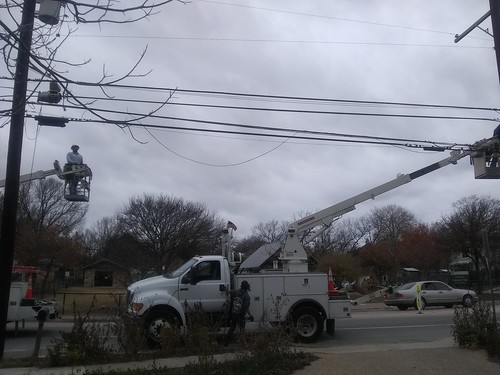
"Let me tell you about Charlotte, hell of a lay. She'll do anything, you know, try anything. And twice at night." As he worked up on the cables, he continued to wax eloquent about his entanglement. The supporting cast below egged him on for details. The assigned constable too.

wire maintenance

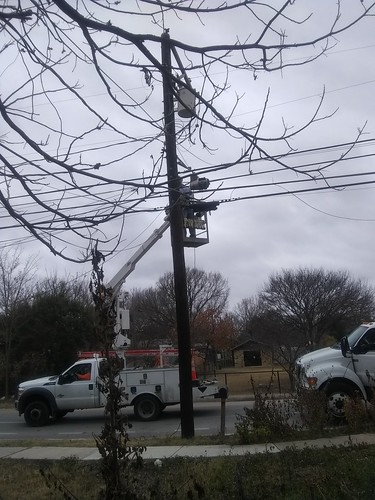
The electrical crew were talking up a blue streak while working on the wires as I stepped out of my house, parental advisories were in order. I learned a lot about Charlotte's prowess in the ensuing minutes. This was vicarious living.

"She kept me up 'til 5 am. I almost missed work. I'mma go back for more. I gotta say, I'm a happy man. Feenin'... Remember what Ray and them used to say?... Yeah man. Fire. Fire in the sheets." He kissed and he told.

"I'm up here - yo, throw that my way. I'm telling you, man. I'm not even thinking about... Nose wide open. I'm not even - She made me forget the pandemic. Where do I sign up? I'mma cash, I'mma cash in all my chips with her. Lockdown here I come." The guy controlling traffic dropped his sign.

Charlotte's web had thoroughly ensnared this man and his audience. I counted 12 of us, the work crew and those who, like me, had come out to observe the commotion, our morning's pandemic entertainment. My two female neighbors shook their heads but kept listening to the locker room talk.

This was unvarnished life. There was undisguised glee and juicy details: all manner of gymnastics were discussed enthusiastically and with aplomb - not explicit, mind you. This was very far from the unexamined life; Socrates would have approved. It took me 12 minutes to pick up my mail.

The Wife had remarked that we didn't need to go far for drama during this pandemic, we simply needed to open our eyes and ears. From the children's shoes and buried bones in the backyard, to the traffickers' house (or was it a brothel?) behind the alley, life was eventful chez nous.

And so I walked back inside the house smiling, my ear blue with bedroom talk. "Okay. Ready? Let's go on our walk". The 9 year old moaned, her younger brother went to hide in his room.

The Wife asked, "What was all that about?"

"They were fixing wires outside... Guy talk."

wire maintenance

Guy Talk, a playlist


A soundtrack to this anecdote (spotify version).

This blue note is part of a series: In a covidious time

File under: , , , , , , , , , , ,

Monday, January 04, 2021

The Old Man Who Lives In The Park

The old man who lives in the park now has a dilemma
That's causing you and your neighbors further heartache
Not, paradoxically, that he sleeps under the benches,
For he's blessed, he always says to confound any pity
"I'm blessed to live in this here world"
"The Good Lord watches over all his creations. He is indeed my witness"
No, it's that Parks and Rec, just weeks ago, removed the porta potty
That has been serving as his bathroom and privy
For what seems like the past couple of years
And now, with no stand pipe or running water,
We can only expect a trail of tears

The park was ostensibly closed at the outset of the pandemic
But this new development ups the ante of discomfort
The practical questions mount: where will he relieve himself?
You're all facing the pressing matter of public health
You wonder if the flying toilets of Labadi Beach
Will make their appearance on these Austin Texas streets
Well, at least the garbage is still being regularly cleared
Appearances must be kept up, even as lockdowns take their toll
The prospect, however, is of walking through discarded toilet roll

He's always kept himself clean, tidy and well dressed
Dignified, with a sense of possession and no trace of stress
One has always wondered: where does he take his showers?
Still it's a consolation that the park benches
That he sleeps under at night are still there
For what it's worth, they provide some protective cover
He moves out early in the morning from this place he shares
To allow the yoga and exercise crowd to take them over

He had a good run this summer by every measure
The birthday party crew were stymied by the park closures
Thus he could sleep in, even on the weekend mornings
No anxious parents trying to stake out the benches
And mark their territory with prefab themed balloons
And other plastic decorations with which they festooned
No disposable tablecloths that they would tie down
No cups, coolers and fluffy pom poms
No banners and photo booths nor burgeoning cheer
For the show they later planned to put on
No bouncy castles, at least for the first few months
No barbecues, the smell of which draw out a great longing
Indeed for those months there were no gatherings
Of friends and family and their spawn

He must do odd jobs during the day for the folks at the restaurant
Perhaps they repay him in kind with their choice soul food
The sign says that they even serve meat from alligators
Or perhaps it's just his company that they enjoy that makes him a fixture
The owner raises a weary eye and his expression grows stark
Whenever you happen to mention the old man who lives in the park
There's a pause, then a sigh, born of longstanding concern,
A shake of the head, it's really a long story
Believe me, we've long since involved social services
At this point, it's not even a matter of charity
Interventions galore, there's no doubt a fraught history

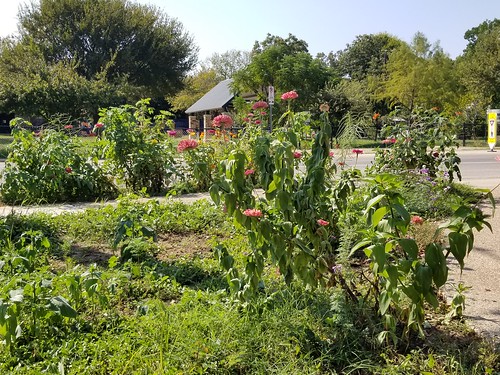
zinnias flower garden

When he disappeared for a month,
You wondered if he was lost to the pandemic
That was back in July, when that new urban soundtrack
The near constant sound of ambulances, almost made you panic
The Governor, despite the positivity rate,
Was hell bent on the grand reopening
You could only hang your head in dismay
At the fecklessness, will they ever learn?
So it was the most misbegotten kind of relief
When the old man who lives in the park made his return

We'd circled each other uneasily ever since we moved in across the park
The real estate agent couldn't have known he'd be our neighbor
The head nods proffered were only occasionally returned
There was indeed recognition, but always a pregnant silence
I later learnt that he was half blind
Which perhaps explained the diffidence
And his uneasy and languid way with locomotion.
Albeit he has a white cane that he twirls merrily,
But he seems to only use it as decoration
Thus he crosses the street willy-nilly
Invariably causing near crashes and commotion.

Came to find out that he was a veteran
There's a hardness under what you observe
You wonder which was the American
Foreign misadventure he was drafted in to serve
The word on the street is that his sister takes all his benefit checks
Such is the mystery of the arrangement, for he seems quite happy
And even compelled to spend his nights sleeping under the bench
So perhaps it's not about money but rather about penance
For sins past. Who knows the backstory of this kind of repentance

We first talked one August evening
As I watered my flowers and plants in the front yard.
Limping, he'd crossed the street from the park
As usual, ignoring the passing cars
He approved of my low tech approach
But suggested installing a sprinkler system
I didn't have the heart to show him the one right there under his nose
Given that I preferred getting out and about with my garden hose
Back to basics, Nyame had suggested, choose manual over automatic.
Such were the nuts and bolts guiding me through this pandemic
So while we live in this digital world, I prefer analog connections
The necessity of touch and meaningful conversation

Nevertheless he approved that I was taking care of the earth
And digging up and weeding on my hands and knees
"If all goes well, young man, with the passage of time
There'll be plenty of monarch butterflies and bees"

There's a musical quality to the cadences of his speech
As if, in another life, he could be moved to preach

"I'm blessed, Sir. I have two young ones, I couldn't be prouder.
The Good Lord is in control, don't mind that weather forecaster
You know, he had it wrong, claiming rain and thunderstorms
But what could he know about His ways and directions?"

"It surprises them when you call them Sir, but it doesn't cost you none.
Keep doing what you're doing, above all, be true, young man"...

"I see you have a couple of children, I can tell they bring you joy.
I'll be off now. Pleased to meet you, Sir, my own name is Delroy."

And so I turned off the water and coiled up the garden hose
And took off the homemade face mask that covered my nose
I made to turn on the light in front of my home
And walked back up to my study thinking of a poem
I gazed across the street at the incipient dark
Thinking, as I do at night, about the old man who lives in the park.

front yard

The Old Man Who Lives In The Park, a Playlist


A soundtrack for this note (spotify version)

See also: Frank and Frances (or 500 Steps)

This note is part of a series: In a covidious time.


File under: , , , , , , , , , , , , , ,

Monday, August 24, 2020

Bloodbath, South Carolina

It was only in the twilight,
When he felt that you had passed the test,
The now-empty bottles of choice liquor,
And the four and a half hours of roots reggae,
That he would admit that he was a prodigal son
Of Bloodbath, South Carolina.

"Raised on the ironic side of the tracks",
He would then clarify for you,
"And steeped in the muddy blues"
That last one delivered matter of fact.

He would keenly watch for the contours of your reaction,
The bloodlit eyes squinting as he nursed his drink.
I must have passed, as I didn't even blink,
And merely asked if he went back home often.

I guess I didn't realize that some people
Ran away from where they came from,
Never mind the curse of the hometown magic
My own roots are now located somewhere in the Atlantic
Not too far from the shores of the Gulf of Guinea
An exiled soul, rather, chased from the land of Aburi

Instead we turned the conversation back to music
Enjoying the bass response on the Tannoy loudspeakers
His favourites came either from the chitlin circuit
On the one hand, or some Caribbean island on the other
Roy C, first and foremost, was a touchstone singer
With his tales about life in Infidelity, Georgia
Burning Spear's Man in the Hills album
Would be on constant repeat, and perhaps the obvious dub plates:
Old Slavery Days or that old faithful refrain
Repeated twice to punctuate the sad claim

No one remember old Marcus Garvey

Maroons and borderlands were the order of the day
Any fences erected were for mere display
A reflexive disdain of The System's authority
Our conversations returned inevitably to matters of identity

Like his best friend, Bill, whose second home
Was just a stone's throw away
On the outskirts of Slaughter, Texas
He was, quiet as it's kept,
Full of wariness towards outsiders.

Bill, tall, broad-shouldered with his long red mane,
Would only share his last name, Sherman,
When he was comfortable with you, and
"Never in North Carolina, you know,
The old man was rough on them in that campaign"

And the memory hadn't faded one hundred and fifty years on.
Such careless whispers could get you burnt by the sun
That was a thing they shared, a kind of identity crisis
As if the sins of the great-great-grandfathers were visited on the sons
What more someone who had flirted at one stage
On the internet, with a recruiter from ISIS
They'd drop these harrowing pearls
In the middle of the nighttime conversations
Again observing your pupils for involuntary reactions.

The stain of Bloodbath, of course, lay much much deeper
Than even Bill's ancestor's civil war march of the grim reaper.
The river turned crimson and overflowed its banks
Its living memory would never get Hollywood's chance
Like Antebellum, Mudbound and Rosewood,
He weaved a tale of unglamourous and relentless lynching
There was no saving grace, and no stich up by avenging
Watchmen, rescuing set upon folks from Tulsa's Wall Street
They were quick to call Bloodbath, South Carolina ancient history,
And there was no small amount of irony,
For those blood vessels that came to rest on Sordid Creek
Belied the remains of a mass gathering of lost souls,
And presaged a strike for appropriated black gold.


...

Come Smoke My Herb from Meshell came up next,
Conversation turned to our comfort women
And long ago moments of bliss.
"I swear man, that woman could kiss,
I didn't care about anything else,
I would still die for those lips".

Man, trust him to raise the tenor of the conversation
Just after I had quoted him that Twi proverb
"Ababaawa animuonyam ne ne to"
A young woman's reputation lies in her buttocks.
He continued with a sharper retort,
Steady sipping quinine tonic on the rocks
"You guys keep going on about matters of ass.
I'm telling you, back in my town, we have slightly more class.
You wannabe hustlers talking about big pimping
While the reality of a flesh and blood woman
Would make you flee from her garden of Eden".
Touché, I was bloodied in this game of the dozens
Still, nothing I had said came close to barbershop heresy
I wore my mask of fundamental unseriousness for my own reasons.

At length, he got back on track talking about his town's legacy
And how you couldn't be wedded to a generation's insanity
Those scrolls he laid out had words written in blood and sin
He deciphered them for us, disdaining the town's eponymous gloom
I began to understand the complexities, that he was no cartoon
A burdened man like him only moved to his own tune
With wist and fortitude, drawing outside the prescribed lines
He lived with an outlaw's sensibility and attitude
A soul forlorn in his fortress of solitude
He preferred prickly cactus to a well-manicured lawn
And so I kept on listening until the crack of dawn
Shooting the breeze with these two children of men.

The soundtrack turned, and we moved away from the Jordan River
To cross the desert of Black Soul, we paused and shivered,
Then, my goodness, shuffle serendipity once again took hold
Her ethereal voice came back on over the futuristic dub undertones
Forgiveness and Love fittingly played for Messers Ebony and Ivory
An odd couple burdened by their parallel, intimate legacies

"Caution, take heed of our insatiable appetites
For even the lion can be brought down by a mosquito's bite
The victors may well write the initial tale with their spoils and glory
But look at you, only a century later, debating these fraught histories.
Narrative closure is an all too human necessity
Storytelling is a given in the affairs of men."
These were my parting comments as I left the two of them
"The tales that we weave will outlast our own timelines.
Bloodbath, South Carolina is a region of the mind."


Gold Coast by Kagyah (2002)

Bloodbath, South Carolina, a playlist


As usual a soundtrack for this note, a musical conversation, perhaps, on the legacies of men. (spotify version)


See previously: Touch

File under: , , , , , , , , , , , , , , , , , ,

Monday, October 29, 2007

By Way of Ionesco

It must have been a few months ago, I was heading home after work; it was the usual thing, a perfectly ordinary evening. As usual, I was fumbling with my various bags, headphones and such. As I switched trains at Oakland, my sharp elbows ensured that I obtained a seat; I find it pays to be equipped at rush hour. I settled down, rummaged around and found my book. I opened it and relaxed; there's nothing like getting lost in a good book on the commute. A muffled announcement predicted a delay. Oh well, I settled in for the long haul. After a few moments, I heard someone muttering from across the aisle: "Ionesco" or something.

"Yes, yes", I gestured at the distinctive cover of my book, "Ionesco".

The guy continued talking but I couldn't quite hear him since I was listening to music. As I fumbled around with the controls to the cd player (no ipod as yet), it struck me that I had been speaking in French. What I had actually replied was "Oui. Oui. Ionesco... C'est La Cantatrice Chauve."

As I finally removed my headphones (those tangled wires), I realized that the other guy had also been speaking in French.

Well, no matter. If you're reading a French book on the subway, odds are that a passing Frenchman would notice and engage you. Perhaps you look vaguely francophone. It would stand to reason that you would start to speak in French also. Indeed the reason I had been reading that book was one of my periodic attempts to keep up my French. Still it was uncanny how I had unconsciously slipped into that other language, perhaps a switch had been involuntarily flipped as sometimes happens to polyglots (pdf). I don't get to speak the language much these days - I am awful about keeping up with the part of my family in France. True, every few months or so I dream in French (don't ask, don't tell) but I know that my fluency in conversational speech is at risk.

So anyway, there was a little pause as we both assessed each other. A couple of relatively thin thirtysomethings, hungry engineer types. Not many people chat on the subway, one is always wary about being solicited or otherwise bothered. As the song goes: don't talk to strangers. How often, however, does one find someone interesting on the commute?

Well, the conversation began in earnest. Ionesco it was. His plays, his ideas, the theatre.

What do you know, I was sitting across from someone who had directed four Ionesco plays; a fellow Ionesco afficionado no less. I'd acted in Les Chaises during my brief theatrical career at school. Heck I still sometimes view the world through his jaundiced lens. The guy was clearly a creative type, steeped in the stage. A man after my heart. And he knew his stuff it seemed.

Pretty soon we were getting into the intricacies of Ionesco's world. What we liked: the playfulness of the language, the sense of rhythm, the stacatto effects that leapt from the page. The often startling juxtaposition of mundane minutiae with profundity. The pauses and the fumbling to find meaning and the consequent resort to words that obscure rather than reveal. Heady stuff in other words.

My spoken french is a little rusty and, a couple of times, I too struggled to articulate some of these thoughts. It's one thing to write or read about the intricacies of art and another to verbalize them even forgetting the setting. Still it was coming back slowly: the quintessential abstractions of extinct philosophers. The accent too - I was a scion of la Lorraine, straining my 'ains'. Perhaps the long lamented fluency would be returning soon.

Somehow we got onto the nomadic element in Ionesco's writing and the fact that he was Romanian and first gained fame writing in french in a piece about observing the English. What is it about outsiders being such stylists? Why are they often the best bridges and windows on society? Perhaps the margins provide a good standpoint for cultural observation. But what are the downsides of the lives of exiled souls? Does multi-lingualism or the crossing of linguistic borders sharpen one's outlook? We weighed the evidence. I brought up Nabokov who in later life turned out to be perhaps one of the great stylists of the English language. He wasn't impressed, he felt that Ionesco got closer to the gypsy element of modernity than Nabokov ever did. I demurred, both, I thought, were modern travellers that disdained boundaries and pushed the forms in which they wielded their pens. The response: well Ionesco carried less baggage. Anyway we got back to the plays.

la cantatrice chauve

He liked Rhinoceros and Les Chaises for their theatricality but for him La cantatrice chauve was the most playful with the language. We went back and forth on whether it was a play best performed in French. He didn't like the English productions he'd seen and claimed that they got the zaniness all wrong. I thought that so long as you got into the spirit of things, it didn't matter. To him the confusion started with the way the play's title was translated: he preferred The Bald Prima Donna to The Bald Soprano. Thus we found ourselves seriously arguing away in French about which English translation of a nonsensical phrase a Romanian playwright had promulgated was truer to the essence of the play. I can't imagine how we must have sounded to the rest of the train car: flurries of French intermittently interupted by English exclamations: "The Bald Soprano" or "Mais non. The Bald Prima Donna". C'est ridicule, n'est-ce pas?

Funnily enough we never actually mentioned the word absurd although the theatre of the absurd was our ostensible subject. Nor indeed did we get to Beckett who looms large in such matters. To my mind, Ionesco is the more formidable pillar of that theatre, if only because his conceptions weren't as arch as those of Godot's father. The discongruities of modern life are presented simply and with wit. I love Beckett to death yet his edifices were intricate constructions. Ionesco makes the absurd more mundane, it is through almost imperceptible distortions that you find yourself in the realm of the improbable. Each step on that road makes sense.

There was a brief diversion onto Sartre - we discussed Huis clos, and judged him impractical. More to the point, his dilemmas weren't weren't of the everyday variety nor indeed did they work on the stage. No, not quite.

I hipped him to the show I'd seen in Boston a couple of years ago, Ionesco not Ionesco, three rarely performed plays. The takeaway message: Ionesco as the aspirin for modern day life, the playwright of the fringe, the governor of the borderlands. You are easily underestimated if there is a humour to your approach and many did underestimate the fugitive notions of the man.

I forgot myself for a moment, soaking in the discussion, and looked around. The rest of the car looked utterly bemused at the sight of these young men vigourously discussing French literature in their midst, throwing out existential themes — the left bank transplanted to the subway car, heck all we were missing were the berets. No matter.

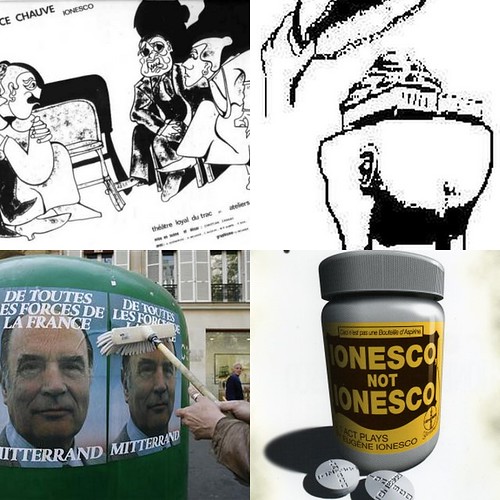
It was the week of the French elections and I mentioned the story about those old campaign posters of Mitterand that were being resurrected twenty years later as ironic commentary on the choices facing the French. He liked the idea and applauded the juxtaposition. A François Mitterrand 2007 campaign seemed appropriate for this dark time. We wondered how many votes he would get.

The Cold War deserved a Ionesco. The nuclear age deserved a Ionesco. Gremlins and parasites, thine playwright is Ionesco.

ionesco collage

We wondered who were the heirs to Ionesco's ethos. We decided that there was something to be said for plays even in this TV and film era. That the stage often had the right level of pathos for the strange incongruities of the human condition. As we parted (he gave a card, I told him to google me), we resolved that we should get back to the theatre, support it in whatever way we could. Who knows maybe we'll put together a production some time soon. It need not be Ionesco. Heck we would write our own plays.

...

When a week or so later, I received that secret tape of Negroponte meeting Gaddafi, I was struck by the element of malign play among in their discourse and world views. As I transcribed, I found it was all there: words intended to obscure, words that ostensibly communicate were instead combined into phrases that mangle reality: constructive engagement, collateral damage and so forth.

The playground of misdirection is often dominated by politicians but others too have their niches. The lowly bureaucrat and the well-meaning citizen play their part is adopting the language of bromides. Ionesco would have loved the notion of recent non-specific general threats and the obfuscation of the language of homeland security.

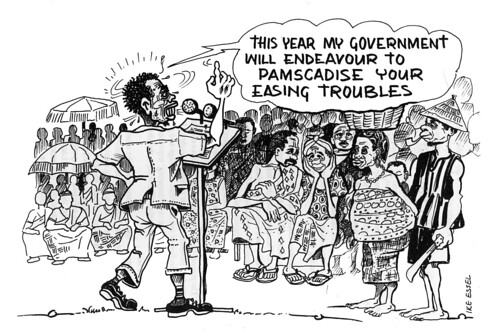
Pamscadise by kwesi yankah

In any case, it stands to reason that I am now being read by folks from both the US Navy Marine Corps and Libyan embassies around the world. I do try to bring people together in my writing. A belated welcome to the toli. Enjoy your stay. Excellent. Excellent discussions.

Salut Alex.

File under: , , , , , , , , , , , , , , ,

Wednesday, September 05, 2007

Conundrum 65: Taxi Driver Braking Style

The burning issue that has been exercising my mind for the past few hours is the way in which taxi drivers apply brakes to their cars. Thus I give you another entry as part of an occasional series, briefly noted...

So. Why do taxi drivers brake the way they do? What accounts for their peculiar relationship with their car's braking system? Why is that taxi drivers never want to idle their cars? And so forth...

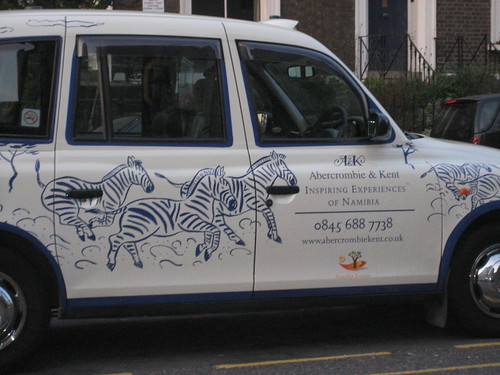
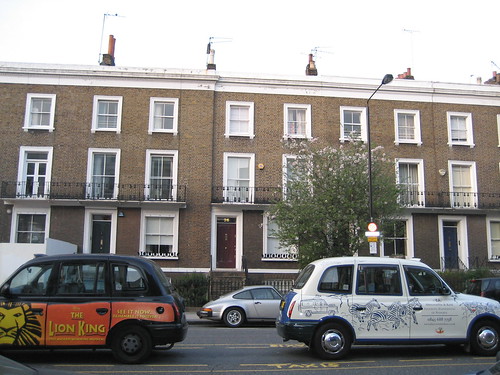
zebras and kitsch


When a cab driver sees a red light, she will do one of two things:
  1. Accelerate and simply speed through the light - daring oncoming traffic in a game of chicken.
    This behaviour is almost de rigeur if you want to obtain a taxicab medallion - an initiation rite of sorts. When your car is branded as a taxi, it is a signifier, almost a warning signal of recklessness to other drivers, and you can trade on this reputation to bully through most intersections. Such are the fringe benefits of every profession.
  2. Slow to a stop at the light if it is obvious that one can't beat the light.
    In this scenario, you'll almost see the subliminal scowl on the driver's face in the mirror and the accompanying sound of disgust under their breath.
It is the manner in which taxi drivers slow to a stop that is the source of today's conundrum.

A taxi driver never simply slows down to a stop like other drivers. There's an eccentricity to the gradual manner in which they apply their brakes. It's a little hard to describe exactly how they brake but it is different enough that I always notice it; let's simply posit for our purposes a Brake Eccentricity Index ™ and assign taxi drivers the maximum value, 10, on an admittedly arbitrary 10 point scale. Still, why do they brake in such an unnatural fashion?

Theory 1: Maximize the fare


I should be a little bit more precise about this, namely that I've mostly observed eccentric braking styles in cities that have metered fares for taxis. Of course correlation is not causation but I've always thought that it was the fact that meter fares are lower when the taxi is idle than when it is moving that drove taxi drivers to this behaviour.

The notion here is that by keeping the taxi moving for as long as possible you will reap fiscal rewards. Amortized over the length of a typical shift, perhaps you can sneak in an extra hour of fares at the higher, mobile rate. If you consider driving a taxi as a purely revenue maximization enterprise then the optimal economic strategy is all about minimizing engine idle time and maximizing the amount of time the car is moving. The braking style then is simply a matter of arbitrage; 5-10% extra revenue will be nothing to sneeze at (handwaving at the exact amount).

One piece of the puzzle however is that I sometimes observe as much even in countries where taxi rides are not metered transactions. What gives?

Some control experiments: presumably there should be increased eccentricity in braking style the larger the difference between moving and idle fares. Drivers in cities with greater idle premiums would exhibit a higher brake eccentricity. Anecdotally New York and Boston are more prone to the phenomenon than San Francisco.

The web being what it is, an armchair economist such as myself can validate such intuition...

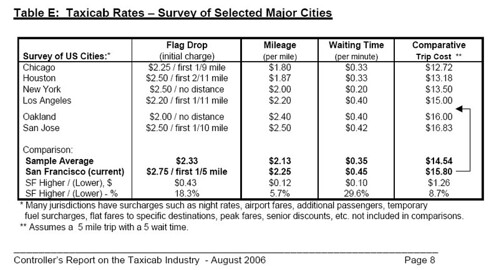
Consider this table taken from the San Francisco Taxicab Industry Report 2006 via the invaluable Taxi Library site. It is a survey of rates charged in various US cities.

taxicab rates 2006


We'll codify a proxy for our braking eccentricity quotient as the ratio of mileage rate to waiting time rate. In New York, this ratio is 10 (mileage rate per mile is $2.00 and waiting time per minute is $0.20). In San Francisco, the ratio is 5 (mileage rate per mile is $2.25 and waiting time per minute is $0.45). This would confirm the greater propensity of New York cabbies to work the brakes and even assign them 10 on our admittedly arbitrary index.

Out of interest, we have the following results: Chicago at 5.45, Houston at 5.67, Los Angeles at 5.5, Oakland at 6, San Jose at 5.95. In my experience, Oakland taxi drivers are more eccentric than San Francisco cabbies so this seems to be about right. The rate structure of fares provides serious incentives to taxi drivers to do everything possible to keep in motion, it is no wonder that they are irritated at having to wait, idle time literally robs them of revenue.

Theory 2a: Minimize fuel consumption and/or 2b. minimize wear on the car's brakes


Part of the utility function that a taxi driver has to account for is the impact of fuel consumption. With conventional internal combustion engines, the fuel that is used when the engine is idle is pure waste, hence it makes sense to minimize fuel consumption as part of the profit maximization function.

Wear and tear on the brakes is also something drivers need to worry about; perhaps it is indeed easier on the brakes to slow down the way they do. No one tells you that when you learn how to drive so this might well be a trade secret of sorts.

This last theory is counterbalanced by the frantic way brakes are applied when the driver misjudges and almost causes an accident (all too frequently judging by the statistics of road accidents involving taxis). Frequent near misses and even accidents are almost a cost of doing this kind of business and in those cases, brakes are manhandled. So a question for auto engineers, what is the best way to apply brakes? Incidentally I wonder if there is any research on the incidence of heart attacks amongst taxi drivers, but I digress...

Some control experiments:
  • hybrid cars are slowly being adopted into taxis fleets, these are cars in which the cost of idling has essentially been eliminated. Minimizing fuel consumption in one's Prius is thus a matter of running for as long as possible on electricity rather than on the conventional gasoline engine. Presumably Prius taxi drivers would not be as prone to brake eccentricity and the new technology might provide an insight into the relative importance of the fuel consumption factor. One should monitor the situation as hybrid adoption rates increase.
  • rising petrol prices should increase the fuel consumption premium so there should be increased eccentricity when we have higher prices. Metered fares after all aren't indexed to petrol prices and are only updated episodically. Anecdotally again, I've been noticing more braking shenanigans during the Bush years with the concomitant high oil prices.
With this in mind, perhaps we can add some additional dampening factors to our braking eccentricity index. I welcome your mathematical input.

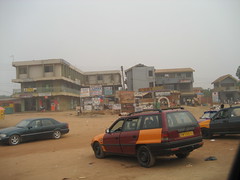
la paz


Exegesis


The obvious thing to resolve this conundrum is to simply ask taxi drivers why indeed they brake the way they do. The thing is that whenever I've observed this behaviour, I've typically been annoyed because I tend to lean towards the first theory, namely that the driver is engaged in an attempt to wring an extra dollar or so out of my inconsiderable wallet. With that at the back of my mind, it will come off adversarial to ask the driver about this, no matter how academic the concern is. Also you might change the behaviour merely by asking and make the driver self-conscious. Moreover, there's always something more pressing to talk about: politics, the economy, real estate, cars, relationships etc. In any case, small things like taxi driver braking styles are appropriate fodder for blog entries. I hope I've made a plausible economic case of cabbies being rational economic actors but of course I may be missing the plot. Perhaps others can come up with better analyses. The floor is yours...

On Metering and Automation


Now you might well wonder why indeed I'm spending time and virtual ink on this matter. Well it is in aid of a book of toli. The low end theory posits that one should temper the human factor to encourage adoption. Thus I've been digging around matters of human factors and automation. The obvious case study of the human factor in technology adoption is with taxis and the introduction of metered fares. A little digression and that's all she wrote.

The idea of meters, of standard fares introduced through regulation, meshes with an attempt to eliminate the vagaries of human discretion and bargaining around the negotiation of payment for rides. Prior to their introduction, one was at the mercy of one's skill and knowledge of prevailing rates when discussing fees with cab drivers, and often one would be at a considerable disadvantage in the conversation. The drive towards standardization and automation was almost inevitable in many communities; electronic meters were the technical solution to the legal and cultural problem. By metering you could reduce the amount of price discrimination that taxi drivers could do and gain some amount of consumer satisfaction at not having to bear the mental transaction costs.

Recently also there has been the introduction of GPS-driven radio dispatch into the taxi business in. One virtue is that this might prevent certain dispatchers from rewarding their favourites with the best jobs. I know that in the Boston area, Haitian cab drivers would always curse the often 'native' dispatchers, claiming that they wouldn't give them (the immigrants) jobs even if they were closer to the customers. Presumably technology in the form of location-aware optimization algorithms could add a measure of impartiality to the dispatching process along (potentially) with some extra efficiency. Of course as with all things in which the human factor applies this is not the end of the story. Wherever there is human discretion we will see the usual social and cultural cues and biases assert themselves in one form or another. For one, it all depends on what is coded and who gets to make the decision.

Indeed New York city taxi drivers will be going on strike against GPS devices in coming days:
The Taxi Workers Alliance opposes the installation of high-tech touch-screen video systems that will allow passengers to watch television, make credit-card payments and — using a global-positioning device that tracks the cab - follow their ride on an electronic map.

Some drivers have said that the global-positioning devices and the automated trip recording system are an invasion of privacy, and that the use of credit cards would diminish drivers' incomes, given the card transaction fees.

They also say they will take in less money because the system requires drivers to log on before each fare, and they object to the television noise and the heat from the monitors.
This last case is interesting in the bundling of two technologies, electronic payment systems and location aware devices. In both arenas, the proponents highlight the benefits in terms of consumer convenience: additional payment options and additional information (map data) that can empower the rider in the transaction with the driver. For example, a tourist, able to see a realtime map of their journey, will now be more liable to ask "Why the hell are you going in this roundabout way to my hotel?" and reduce the unscrupulousness of drivers.

Detractors similarly highlight the effects of payments and transaction costs. By introducing credit cards into the billing systems, the authorities are passing on increased costs to drivers, a tax of sorts. A slight digression here: the taxi profession has typically been a cash-is-king affair - hence for example its appeal for the informal sector often the domain of transients and immigrants etc. (e.g. for an extreme case of 'informality' you can read James Ellroy's novels on the appeal of taxi ranks for the Mafia).

Both sides of the debate conflate things. Who really wants to watch television in a cab? That is surely a byword for yet more advertising. And yet that is what Mayor Bloomberg is touting even as the agenda of the authorities is plainly to exert additional control on the profession. On the one hand, the argument about privacy that the drivers advance is probably not the core objection, it is rather the issue of control, about losing discretion in the way they do business and the burden of additional transaction costs (which can even be mental costs).

A few centuries ago, the Quakers brought sanity to the systems of measurement with their reputation for probity in the standards of weights they provided. Eventually, social norms and mores were codified in laws, regulations and sometimes in technological standards. It is interesting that we are seeing lawmakers seeking to impose technological standards to achieve social ends. As we have seen in the case of braking style, there will still be behavioural attempts to game the system — that is the realm of the human factor. In the low end theory framework, the best you can hope for is to temper these things.

This year in Accra, the Accra Metropolitan Authority introduced medallions for taxi cabs and even imposed a dress code on taxi drivers (although from what I understand, the dress code is not that widely adopted). The introduction incidentally lead to an immediate decrease in the typical crime methods where criminals would use cabs for their robberies. By getting control of licensing, the AMA has managed to better understand the scope of the taxi market, the public also can better identify taxis and further norms can be codified. One wonders whether metered fares will be the next regulation to be adopted in Ghana. As anyone would tell you, a large part of the experience of using public transit in Ghana is the bargaining that one must do. Taxi drivers will quote exorbitant fares to those they perceive as well-heeled or unaware of the prevailing rates - and you don't even need to be an obroni to feel cheated at times. Metered fares would have undoubted benefits in reducing this kind of price discrimination and the associated transaction costs but might also remove social and cultural lubricants, those aspects of conversation and market traditions. I wonder if this is a trade-off that should be made. What say you?

I'll close with a further digression... You might have seen me point to this Lion King decorated taxi a couple of weeks ago. The Wife caught it parked next to the zebras and kitsch taxi displayed above. I quite like the serendipity of the photos and the varying images of Africa expressed in taxicabs.

Lion Kings and Zebras and Kitsch, Viewing Africa in London


Abercrombie & Kent are merchants of "Inspiring Experiences of Namibia" hence the zebras crossing they use to advertise their escapist travel services. The Lion King of course is pure Disney nostalgia. Such are the types and faces we use on our taxis about Africa that mysterious land. The fantasy of Brand Africa.

A Taxi Driver Soundtrack


A playlist for this note

  • Loose Ends - Slow Down
    Apropos braking, we'll start our playlist with Slow Down, the brilliant showpiece of Loose Ends' Zagora album. Classic 80s soul music, eminently danceable and with an infectious chorus. It is often paired with the lead single Stay A Little While Child and the titles are fitting for the laidback theme of the band.
  • The La Drivers Union Por Por Group - Trotro Tour Of Ghana
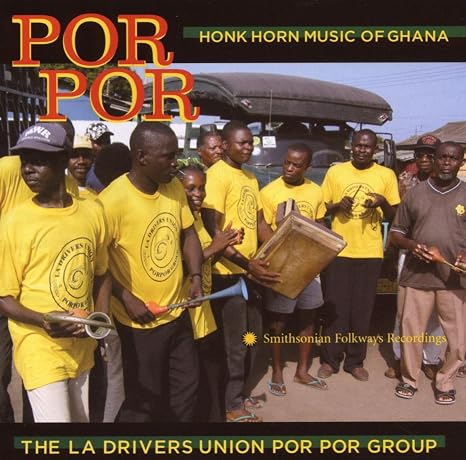
    The La Drivers Union Por Por Group - Por Por: Honk Horn Music of Ghana

    We'll continue with some music by taxi drivers, some honk horn music from Ghana. It's unlike almost anything you've heard, simply consisting of the horns and drums that you might here on the streets as these drivers vie for your trade and seek to attract your attention. This horn group has a 50 year history amongst other things, wielding their honk horns against the colonial regime. They continue to make music from the most unlikely of instuments.

    I quite like 'Driver, Take Me, The Train Has Left Me Behind' and the Kpanlogo Por Por Medley but perhaps it is "Trotro Drivers, We Love You So" that is the best song on the album. You can listen to the slightly more conventional yet still exuberant Trotro Tour of Ghana here.


File under: , , , , , , , , , , , , , , , ,