Showing posts with label textiles. Show all posts

Tuesday, October 28, 2025

Intimate Legacies

The height of fulfillment for a Ghanaian woman
The measure of a life well lived
Is to be surrounded by loved ones
Sought out for consultation
And to leave a trunk of fabric
Packed almost full with cloth, new or barely worn
To be shared amongst those she leaves behind

Kente, Dutch wax prints, indigos and batiks
Some with Adinkra designs, and lace too; these are heirlooms
True, some would also cite the beads and the jewelry
Gold sovereigns as befits the site of the Gold Coast
And yes, monies and land, cars - modernity, are fitting contributions
But it is the cloth that is the prized intimate legacy

...

Daa left me some fabric, my inheritance was a sleep cloth
Dark green, a GTP wax print, lightly faded
So soft after years of use that the merest touch
Transports me to happy places
Skin to skin, in contact with her quiet ways
Remembering her voice and her laughter

She left a scarf for our daughter
White lace, a welcome present
She'd held out to meet her, her great granddaughter
The yearslong campaign on her granddaughter-in-law
Had borne a delicate fruit
She carried her with joy that day
And fussed, and gave advice, we listened well
Ineffable joy, she slept well that night
Remembering the long journey, the twists and the turns
Those who had walked along with her
Those now lost, and those who still remained
The happy times - for there were many like today
The reversals, and the times of privation
Internal exile and the hunger seasons
When some had to sell, to empty their trunks
To empty their very souls to provide for their family
But she had made it, and could pass something on
She was ready. She passed it on and carried a glow
She eased through the few weeks that remained of life

...

In this meeting of minds
The foundations of identity
Home, the veins of belonging
Sleep cloths for the children
Memories rest on the fabric itself
Pieces of intimate legacies


Intimate Legacies


Intimate Legacies, a playlist


A soundtrack for this note (spotify version)

dutch wax prints and afghan knits from her grandmothers and great-grandmothers


Let's place this under the banner of Social Living

File under: , , , , , , , , , , , , , , , , ,

Writing log: September 22, 2022

Sunday, November 06, 2005

Kente, Lace and Champagne

Pondering a photo and poem to (belatedly) complete the London's Got Soul Trilogy...

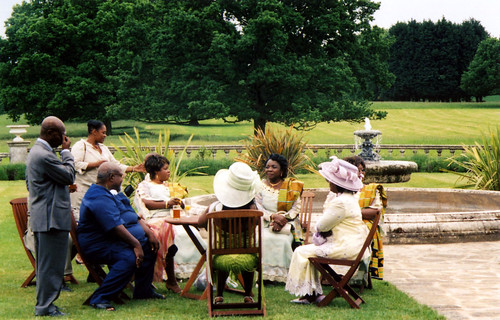
Kente Lace country chic


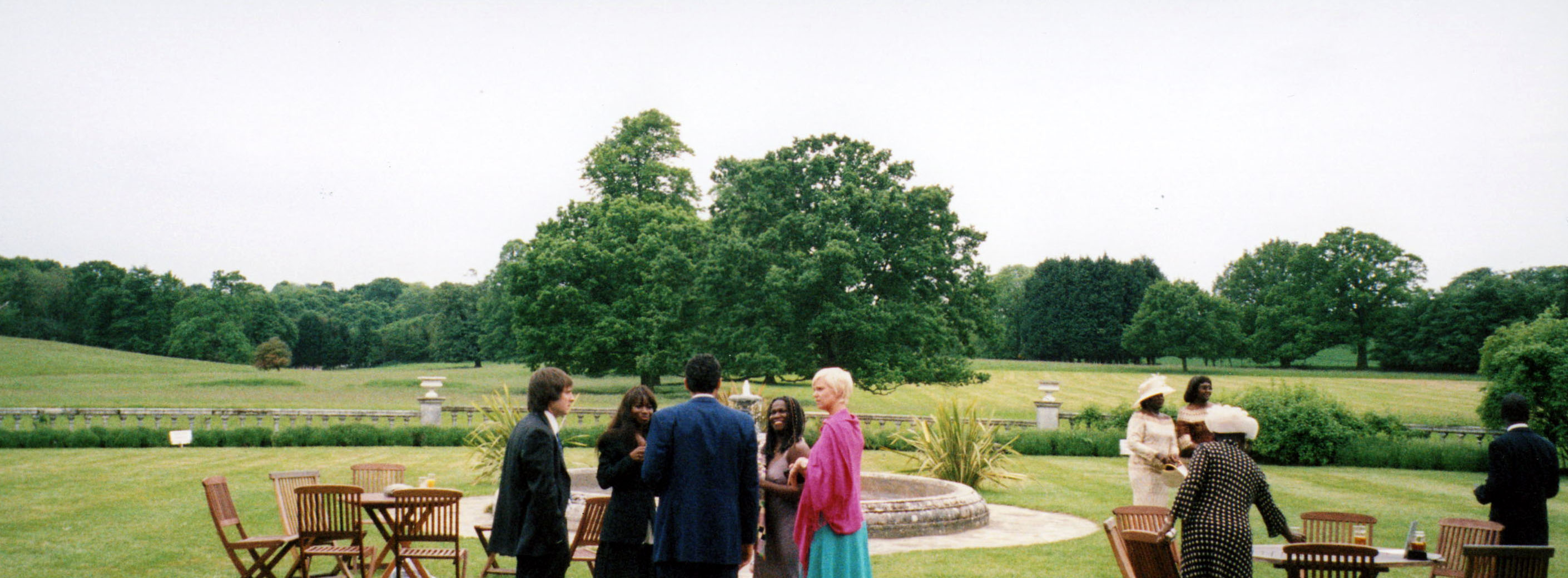
Photographers talk about seeing The Shot, knowing as they press the button that they have captured a great image. I'm not much of a photographer and have only come close to this once, 45 seconds before I took the above photo. As it turned out, it took me that long to find my camera and I missed the shot I wanted when additional people walked into the scene. The occasion was a friend's wedding. Still I think it turned out fine and the sight compelled me to declaim some spontaneous poetry, or doggerel as my friends labeled it.

The first two lines were obvious
Rolling hills of fair Essex
Stately homes and greener pastures
rolling hills of fair Essex


As was the eventual final line
Kente, Lace and Champagne

In between there was what you would expect: musings on the wonder of the Accra style

ken kukua ben issac


and Jamestown posturing melded with East London street smarts.

kobi bride ladies


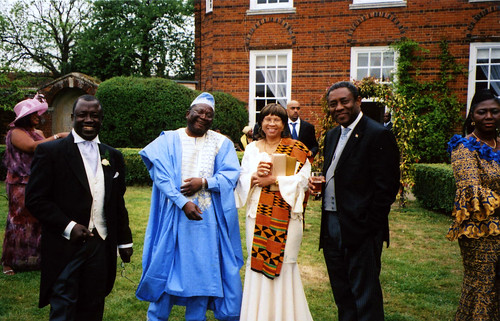
It appeared to me that all were trying to create high society. One can imagine everyone settling for high tea at Fortnum-and-Mason's what with the costumes and the hats on display. And yet these are all normally unprepossessing Londoners who hustle and bustle on crowded buses and the packed cars of the underground. But give them a happy occasion and a fine setting, and they'll be all Ascot top hats and (relatively) stiff upper lips.

When you mix lace style and kente chic with a London sensibility all that's missing is champagne.

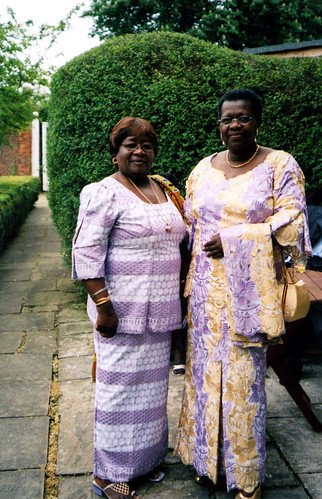
lace style


dad mary-ann


green kente smile


[Update July 7 2020]

I recently recovered my notes on the poem I had written - a kind of covidious dividend, and thought I should share instead of fussing and rewriting them as is my normal wont. Still, I suspect the title is too good and a different piece of toli may emerge later under its banner...

Kente, Lace and Champagne


Rolling hills of fair Essex
Stately homes and greener pastures

They may only see us as their care home cleaners
Invisible workers, some call us your infrastructure

For on weekdays and nights our game faces are firmly fixed
But on such an occasion the ceremonial mask slips

The light shines amidst the grey blandness of exiled time
We escape the torrid zone of the daily bread line

We are royalty back home, our traditions meet modernity
Agona Swedru expatriates dressed here in Jamestown finery

Your fashions were invented in our hometown cradles and pots
You might say cool was a word derived from our plush cloths

In your pursuit of black and all the other forms of gold
Our country chic of shimmering lace hints at our riches untold

Dresses hand sewn by seamtresess with craft and delicacy
We dance in the grand estate and enjoin all in the revelry

These African ceremonies are our relief from immigrant pain
We toast our brethren and sistren with kente, lace and champagne

Miscellany


And while on the topic of champagne and London, I came across this tidbit about the improbable ascendency of British wine in recent international competitions.
Champagne houses eye up English vineyards

From Kent's Isle of Thanel to the Sussex Downs, what began as a rumour, or a bruit as the French might say, may soon become a brut reality.

French champagne houses, impressed by the strong performances of English wines in international competitions, are looking to buy English vineyards.
The French, who have always looked askance at the culinary prowess of their now Channel Tunnel linked neighbours, of course were rather skeptical about this development. But they are nothing if not pragmatic when it comes to money hence they will scope out the competition.

The English reaction to this scrutiny is an interesting blend of stoicism and prickliness.
"Why should we help the French when we are already producing better champagne on our own?" he said. "We have exactly the same soil conditions and thanks to global warming the climate is actually better. The only difference is I'm not allowed to call our wines champagne."

"It's got to be better than growing cauliflower."

"At every English sporting event from Wimbledon to Ascot, we toast the victors with French champagne", he said. "We'll probably be toasting the anniversary of our victory at Trafalgar this summer with French brands too, it really gets my goat."

British wine?

Soundtrack for this note


A short playlist is in order

Kente, Lace and Champagne, a photo album

File under: , , , , , , , , , , , ,

Wednesday, July 14, 2004

On 'Bend Down' Markets and African Textiles - My Ragu theory

The LA Times has been doing a series on 'Living with Pennies' (those who live on less than a dollar a day - ergo Africans in the main). The first article is about eking out a living the second about starving off hunger.

Here's a snippet from an article on used clothing in Africa (mainly looking at Nigeria and Congo) tracing the path from the discard at say the Salvation Army or Goodwill drop-off point through the various middlemen wholesalers who buy by the pound down to the 'bend-down markets' common in Ghana - termed bend-down because wares are typically laid on the ground and everyone bends down to inspect them.

For sale -- cheap: 'Dead white men's clothing'

"These clothes make people's dreams come true," says Anorue, chairman of the vendors association at Yaba Market. "Everyone wears them, from insurance women, vendors, poor people to parliamentarians. When they put them on, you can't tell rich from poor."

Much of Africa was once draped in fabrics of flamboyant color and pattern, products of local industry and a reflection of cultural pride. But with half of its people surviving on less than a dollar a day, the continent has become the world's recycling bin. People scramble for 10-cent underpants, 20-cent T-shirts and dollar blue jeans discarded by Westerners.
I'm someone who is very interested in African textiles, always buying batiks and all types of cloths whenever I go to Ghana - whether "Dutch wax" prints, Kente or, of late, indigos (here also) and mud cloths.

It's a truism that traditional clothing in Africa is, by and large, being replaced by western clothes and, of course, it's only the used, second-hand clothing that is affordable. We've come to standardize business attire (even the Japanese use the western suits) and as far as the casual goes well right now it's hip-hop culture that rules. I can understand that going to work, sitting in a tro tro wearing cloth in our tropical weather is a bad idea. Furthermore, I may not wear the political suits of my dad's generation - a little too severe for my taste - although Nehru suits are still competitive in India, but I don't mind a smart batik during the summer even at Big Blue and make a point to wear them - I like them, they are comfortable, mostly hand-made and well tailored (the only issue is not to be too 'exotic' for my workplace).

Still, it is surprising how quickly these changes have taken place. I wouldn't have expected this trend to become so entrenched in West Africa given our rich textile and weaving traditions (my gross generalization of eastern and southern Africans is that they - I remember one day wearing one of my shirts, probably something batik and Munene asking me whether this was 'traditional dress' - not what I expected from a Kenyan - didn't they have 'traditional dress'? I asked in pan-african confusion. Of course this ignores say the great weaving traditions of Zimbabwe for example.

Anyway I suppose that this just capitalism/globalisation in action. The consolation is that traditional clothing and textiles are still going strong for festive occasions and ceremonies (weddings, funerals etc.) just ask the Nigerians or the Senegalese. The pity of course is that on the economic front these cheap imports are displacing fledging textile industries. I guess with things like AGOA giving african countries a tiny peak at the American market, Botswanans and Tanzanians are now making my Gap shirt - that's better than nothing.

I still wish that someone would crack the marketing. All the creative folks at Tech and the others who I seek out on every trip home just need a little branding, advertising, some strong business plans, and a little savvy about developing a local niche (ala FUBU). Of course, solving basic infrastructure issues (roads, water, electricity) would accelerate things but that will come. The current trend of simply targetting black america is not sustainable (how many kentes or batakaris will the Bill Cosbys and others buy. <gross generalization alert> African-americans are fundamentally conservative, they may skew and reinvent the culture (see their musical traditions), but by and large the overarching trend is to blend in, to belong - i.e. socially conservative although they vote liberal.

What is needed then is something more mass market, first targeted at building a strong internal market for these things and then scaling outward. I suspect that there is a larger market for African textiles than say Hawaiian shirts. I hope I win the lottery and am able to put my money there. To me, Italy's fashion and clothing industry is proof that high quality artisanal textiles can thrive. There will be a point of commoditization but it is a matter of application and branding. There you have it: Koranteng's "Spaghetti and Ragu" theory of african textiles.

As a sidenote: trusty google gives some interesting sites on Batik in Ghana.

A Gallery of Batik Wall Hangings from the National Geographic. This is obviously the artistic side, not the practical 'Prêt-à-Porter' clothing that is sold at the Gap or Macys.

As an example: Summer in Bolgatanga by Kwabena Kufuor Afriyie-Addo Jr. (also known as K. Baka)

Batik from it's original Java perspective.

From an artist's collective in the UK: What is Batik? and a gallery.

File under: , , , , ,