Conundrum 65: Taxi Driver Braking Style
The burning issue that has been exercising my mind for the past few hours is the way in which taxi drivers apply brakes to their cars. Thus I give you another entry as part of an occasional series, briefly noted...
So. Why do taxi drivers brake the way they do? What accounts for their peculiar relationship with their car's braking system? Why is that taxi drivers never want to idle their cars? And so forth...
When a cab driver sees a red light, she will do one of two things:
- Accelerate and simply speed through the light - daring oncoming traffic in a game of chicken.
This behaviour is almost de rigeur if you want to obtain a taxicab medallion - an initiation rite of sorts. When your car is branded as a taxi, it is a signifier, almost a warning signal of recklessness to other drivers, and you can trade on this reputation to bully through most intersections. Such are the fringe benefits of every profession. - Slow to a stop at the light if it is obvious that one can't beat the light.
In this scenario, you'll almost see the subliminal scowl on the driver's face in the mirror and the accompanying sound of disgust under their breath.
A taxi driver never simply slows down to a stop like other drivers. There's an eccentricity to the gradual manner in which they apply their brakes. It's a little hard to describe exactly how they brake but it is different enough that I always notice it; let's simply posit for our purposes a Brake Eccentricity Index ™ and assign taxi drivers the maximum value, 10, on an admittedly arbitrary 10 point scale. Still, why do they brake in such an unnatural fashion?
Theory 1: Maximize the fare
I should be a little bit more precise about this, namely that I've mostly observed eccentric braking styles in cities that have metered fares for taxis. Of course correlation is not causation but I've always thought that it was the fact that meter fares are lower when the taxi is idle than when it is moving that drove taxi drivers to this behaviour.
The notion here is that by keeping the taxi moving for as long as possible you will reap fiscal rewards. Amortized over the length of a typical shift, perhaps you can sneak in an extra hour of fares at the higher, mobile rate. If you consider driving a taxi as a purely revenue maximization enterprise then the optimal economic strategy is all about minimizing engine idle time and maximizing the amount of time the car is moving. The braking style then is simply a matter of arbitrage; 5-10% extra revenue will be nothing to sneeze at (handwaving at the exact amount).
One piece of the puzzle however is that I sometimes observe as much even in countries where taxi rides are not metered transactions. What gives?
Some control experiments: presumably there should be increased eccentricity in braking style the larger the difference between moving and idle fares. Drivers in cities with greater idle premiums would exhibit a higher brake eccentricity. Anecdotally New York and Boston are more prone to the phenomenon than San Francisco.
The web being what it is, an armchair economist such as myself can validate such intuition...
Consider this table taken from the San Francisco Taxicab Industry Report 2006 via the invaluable Taxi Library site. It is a survey of rates charged in various US cities.
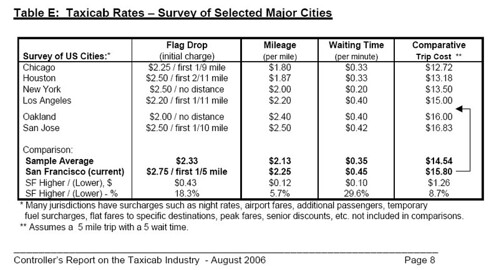
We'll codify a proxy for our braking eccentricity quotient as the ratio of mileage rate to waiting time rate. In New York, this ratio is 10 (mileage rate per mile is $2.00 and waiting time per minute is $0.20). In San Francisco, the ratio is 5 (mileage rate per mile is $2.25 and waiting time per minute is $0.45). This would confirm the greater propensity of New York cabbies to work the brakes and even assign them 10 on our admittedly arbitrary index.
Out of interest, we have the following results: Chicago at 5.45, Houston at 5.67, Los Angeles at 5.5, Oakland at 6, San Jose at 5.95. In my experience, Oakland taxi drivers are more eccentric than San Francisco cabbies so this seems to be about right. The rate structure of fares provides serious incentives to taxi drivers to do everything possible to keep in motion, it is no wonder that they are irritated at having to wait, idle time literally robs them of revenue.
Theory 2a: Minimize fuel consumption and/or 2b. minimize wear on the car's brakes
Part of the utility function that a taxi driver has to account for is the impact of fuel consumption. With conventional internal combustion engines, the fuel that is used when the engine is idle is pure waste, hence it makes sense to minimize fuel consumption as part of the profit maximization function.
Wear and tear on the brakes is also something drivers need to worry about; perhaps it is indeed easier on the brakes to slow down the way they do. No one tells you that when you learn how to drive so this might well be a trade secret of sorts.
This last theory is counterbalanced by the frantic way brakes are applied when the driver misjudges and almost causes an accident (all too frequently judging by the statistics of road accidents involving taxis). Frequent near misses and even accidents are almost a cost of doing this kind of business and in those cases, brakes are manhandled. So a question for auto engineers, what is the best way to apply brakes? Incidentally I wonder if there is any research on the incidence of heart attacks amongst taxi drivers, but I digress...
Some control experiments:
- hybrid cars are slowly being adopted into taxis fleets, these are cars in which the cost of idling has essentially been eliminated. Minimizing fuel consumption in one's Prius is thus a matter of running for as long as possible on electricity rather than on the conventional gasoline engine. Presumably Prius taxi drivers would not be as prone to brake eccentricity and the new technology might provide an insight into the relative importance of the fuel consumption factor. One should monitor the situation as hybrid adoption rates increase.
- rising petrol prices should increase the fuel consumption premium so there should be increased eccentricity when we have higher prices. Metered fares after all aren't indexed to petrol prices and are only updated episodically. Anecdotally again, I've been noticing more braking shenanigans during the Bush years with the concomitant high oil prices.
Exegesis
The obvious thing to resolve this conundrum is to simply ask taxi drivers why indeed they brake the way they do. The thing is that whenever I've observed this behaviour, I've typically been annoyed because I tend to lean towards the first theory, namely that the driver is engaged in an attempt to wring an extra dollar or so out of my inconsiderable wallet. With that at the back of my mind, it will come off adversarial to ask the driver about this, no matter how academic the concern is. Also you might change the behaviour merely by asking and make the driver self-conscious. Moreover, there's always something more pressing to talk about: politics, the economy, real estate, cars, relationships etc. In any case, small things like taxi driver braking styles are appropriate fodder for blog entries. I hope I've made a plausible economic case of cabbies being rational economic actors but of course I may be missing the plot. Perhaps others can come up with better analyses. The floor is yours...
On Metering and Automation
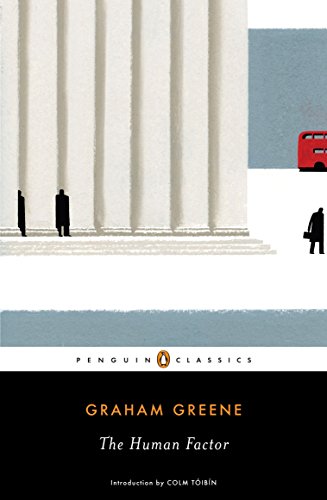
Now you might well wonder why indeed I'm spending time and virtual ink on this matter. Well it is in aid of a book of toli. The low end theory posits that one should temper the human factor to encourage adoption. Thus I've been digging around matters of human factors and automation. The obvious case study of the human factor in technology adoption is with taxis and the introduction of metered fares. A little digression and that's all she wrote.
The idea of meters, of standard fares introduced through regulation, meshes with an attempt to eliminate the vagaries of human discretion and bargaining around the negotiation of payment for rides. Prior to their introduction, one was at the mercy of one's skill and knowledge of prevailing rates when discussing fees with cab drivers, and often one would be at a considerable disadvantage in the conversation. The drive towards standardization and automation was almost inevitable in many communities; electronic meters were the technical solution to the legal and cultural problem. By metering you could reduce the amount of price discrimination that taxi drivers could do and gain some amount of consumer satisfaction at not having to bear the mental transaction costs.
Recently also there has been the introduction of GPS-driven radio dispatch into the taxi business in. One virtue is that this might prevent certain dispatchers from rewarding their favourites with the best jobs. I know that in the Boston area, Haitian cab drivers would always curse the often 'native' dispatchers, claiming that they wouldn't give them (the immigrants) jobs even if they were closer to the customers. Presumably technology in the form of location-aware optimization algorithms could add a measure of impartiality to the dispatching process along (potentially) with some extra efficiency. Of course as with all things in which the human factor applies this is not the end of the story. Wherever there is human discretion we will see the usual social and cultural cues and biases assert themselves in one form or another. For one, it all depends on what is coded and who gets to make the decision.
Indeed New York city taxi drivers will be going on strike against GPS devices in coming days:
The Taxi Workers Alliance opposes the installation of high-tech touch-screen video systems that will allow passengers to watch television, make credit-card payments and — using a global-positioning device that tracks the cab - follow their ride on an electronic map.This last case is interesting in the bundling of two technologies, electronic payment systems and location aware devices. In both arenas, the proponents highlight the benefits in terms of consumer convenience: additional payment options and additional information (map data) that can empower the rider in the transaction with the driver. For example, a tourist, able to see a realtime map of their journey, will now be more liable to ask "Why the hell are you going in this roundabout way to my hotel?" and reduce the unscrupulousness of drivers.
Some drivers have said that the global-positioning devices and the automated trip recording system are an invasion of privacy, and that the use of credit cards would diminish drivers' incomes, given the card transaction fees.
They also say they will take in less money because the system requires drivers to log on before each fare, and they object to the television noise and the heat from the monitors.
Detractors similarly highlight the effects of payments and transaction costs. By introducing credit cards into the billing systems, the authorities are passing on increased costs to drivers, a tax of sorts. A slight digression here: the taxi profession has typically been a cash-is-king affair - hence for example its appeal for the informal sector often the domain of transients and immigrants etc. (e.g. for an extreme case of 'informality' you can read James Ellroy's novels on the appeal of taxi ranks for the Mafia).
Both sides of the debate conflate things. Who really wants to watch television in a cab? That is surely a byword for yet more advertising. And yet that is what Mayor Bloomberg is touting even as the agenda of the authorities is plainly to exert additional control on the profession. On the one hand, the argument about privacy that the drivers advance is probably not the core objection, it is rather the issue of control, about losing discretion in the way they do business and the burden of additional transaction costs (which can even be mental costs).
A few centuries ago, the Quakers brought sanity to the systems of measurement with their reputation for probity in the standards of weights they provided. Eventually, social norms and mores were codified in laws, regulations and sometimes in technological standards. It is interesting that we are seeing lawmakers seeking to impose technological standards to achieve social ends. As we have seen in the case of braking style, there will still be behavioural attempts to game the system — that is the realm of the human factor. In the low end theory framework, the best you can hope for is to temper these things.
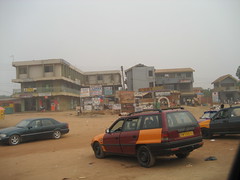
This year in Accra, the Accra Metropolitan Authority introduced medallions for taxi cabs and even imposed a dress code on taxi drivers (although from what I understand, the dress code is not that widely adopted). The introduction incidentally lead to an immediate decrease in the typical crime methods where criminals would use cabs for their robberies. By getting control of licensing, the AMA has managed to better understand the scope of the taxi market, the public also can better identify taxis and further norms can be codified. One wonders whether metered fares will be the next regulation to be adopted in Ghana. As anyone would tell you, a large part of the experience of using public transit in Ghana is the bargaining that one must do. Taxi drivers will quote exorbitant fares to those they perceive as well-heeled or unaware of the prevailing rates - and you don't even need to be an obroni to feel cheated at times. Metered fares would have undoubted benefits in reducing this kind of price discrimination and the associated transaction costs but might also remove social and cultural lubricants, those aspects of conversation and market traditions. I wonder if this is a trade-off that should be made. What say you?
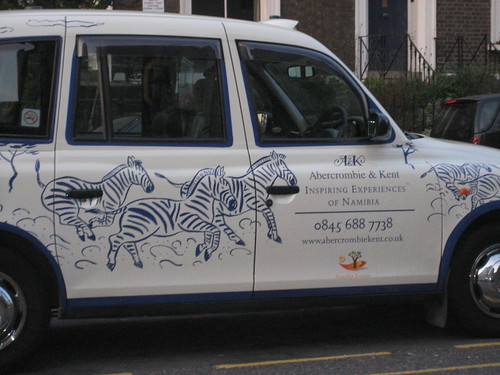
I'll close with a further digression... You might have seen me point to this Lion King decorated taxi a couple of weeks ago. The Wife caught it parked next to the zebras and kitsch taxi displayed above. I quite like the serendipity of the photos and the varying images of Africa expressed in taxicabs.
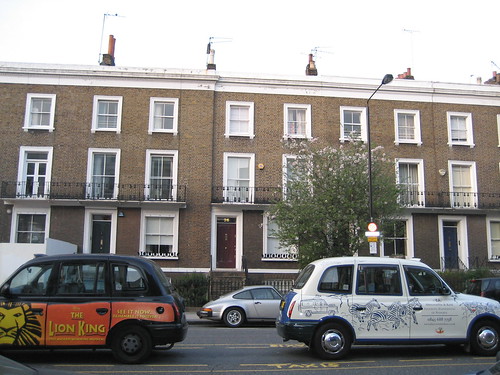
Abercrombie & Kent are merchants of "Inspiring Experiences of Namibia" hence the zebras crossing they use to advertise their escapist travel services. The Lion King of course is pure Disney nostalgia. Such are the types and faces we use on our taxis about Africa that mysterious land. The fantasy of Brand Africa.
A Taxi Driver Soundtrack
A playlist for this note
- Loose Ends - Slow Down
Apropos braking, we'll start our playlist with Slow Down, the brilliant showpiece of Loose Ends' Zagora album. Classic 80s soul music, eminently danceable and with an infectious chorus. It is often paired with the lead single Stay A Little While Child and the titles are fitting for the laidback theme of the band. - The La Drivers Union Por Por Group - Trotro Tour Of Ghana
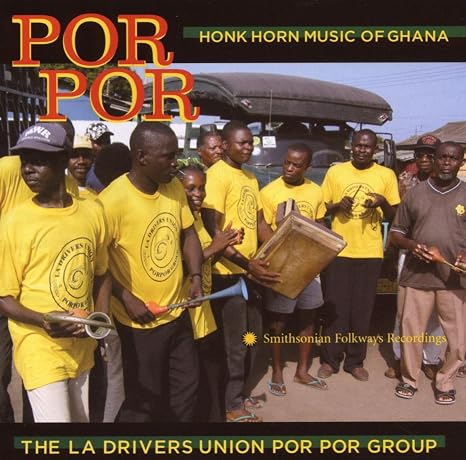
We'll continue with some music by taxi drivers, some honk horn music from Ghana. It's unlike almost anything you've heard, simply consisting of the horns and drums that you might here on the streets as these drivers vie for your trade and seek to attract your attention. This horn group has a 50 year history amongst other things, wielding their honk horns against the colonial regime. They continue to make music from the most unlikely of instuments.
I quite like 'Driver, Take Me, The Train Has Left Me Behind' and the Kpanlogo Por Por Medley but perhaps it is "Trotro Drivers, We Love You So" that is the best song on the album. You can listen to the slightly more conventional yet still exuberant Trotro Tour of Ghana here.
File under: taxi, economics, observation, markets, billing, transaction, costs, pricing, regulation, culture, conversation, technology, automation, adoption, human factors, price discrimination, toli