Showing posts with label human factors. Show all posts

Tuesday, February 27, 2024

Root Cause Analysis

Time for the post mortem, as you know, some take it seriously
The need to revisit, the urge to explain what happened previously
For an ounce of prevention is said to be worth a pound of cure
Let's get to the bottom of things and figure out the root cause

Oftentimes it's a simple mistake, a moment of inattention
Or sometimes it's really just idle exploration
One minute you wonder, what does this button do?
Then the thing happens that you can't recant
Oops, you realize you just shut down the power plant

Human fallibility tends to be the root cause

Ah right, power. It's quite fitting in this era of modernity
That one can't sing too highly of the virtues of Electricity
So essential, we almost always overlook this august substance
We only rue its wonder when confronted by its absence
And now we've lost power and everything must stop
Oops, lights out. In Ghana we call it dumsor

Power failures are prime candidates for the root cause

The next affliction, sadly, is all too common
Like ants, human beings just like to burrow
When in a mad rush to lay down some pipes, it's nigh inevitable
So busy that we never checked to see what could be an obstacle
Dig: bureaucracy got in the way, they were moving too slow
Oops, the contractor cut the critical cable with his backhoe

All too often, cable cuts tend to be the root cause

Things fall apart, they say,
   equipment sputters, machines fail
They blow hot and cold, or crack when used,
   there's wear and tear
Material scientists make a roaring trade
   as do structural engineers
That, sadly, alchemists never overcame nature's challenge
   is the lesson learned
Oops, the widget broke,
   a reminder that no condition is permanent

In this industrial age, hardware failures are a likely root cause

Sometimes you're just too popular,
   so crowded no one can get in or breathe
Congestion is the operative word,
   in matters of scale, a crowd changes things
Your service is the flavor of the month,
   and now you've become essential
Oops, you're completely unprepared for when you go viral

Woe is me, lack of capacity is frequently the root cause

And then we come to the bad actors,
   forever on the attack
Always probing for an opening,
   for vulnerabilities in your stack
And that's even before we consider
   the gremlins and parasites
Iconoclastic beasts with distinctive manners
   and singular appetites
Every complex ecosystem in history
   has had to deal with grifters
Oops, your hospital is held to ransom
   by a band of sneaky hackers

Always protect yourself, a lapse in security is invariably the root cause

There's more in this vein,
   mankind has never built a system without error
From the Tower of Babel to that fancy car,
   or even that blasted word processor
The raw materials of life,
   whether it's the design or the initial conception
Imposing one's will,
   it might be a flaw in the ultimate implementation

You probably have your own experience and area of expertise
Your own rules of thumb about these puzzling mysteries
Let me tell you something
   from my profession of software engineer
If you only knew,
   to defend a system in depth is an exercise in fear
How close we come to catastrophe,
   partial or complete, every day
Trust me, you really don't want to see how the sausage is made

Now one could argue about the order
   of this short list of failure modes
It is only in retrospect that one is truly able to diagnose
The human burden is to keep moving
   in the face of systemic error
To mitigate the worst,
   to build the fail-safes and systematic procedures

Spare a thought for the moron in a hurry,
   for one day it could be you
That, through omission or commision,
   will be blamed for the miscue
We haven't scratched the surface
   of how much the human factor has an impact
Fall back to folk wisdom,
   suffice to say that curiosity killed the cat

And what of the wider world,
   say failed love affairs, or even wars?
It's only human to search for simple answers
   and the root cause
Our prophets and philosophers have long emphasized
   moral suasion and the golden rule
You could do hardly do worse than social living
   and the mosquito principle

Focus on best practices, usability, and layers of protection
Try to put a process in place and make it official!
Make sure that it takes many, many big red buttons
   to launch that nuclear missile
If there's any moral to this tall tale of root cause analysis
Take heed, and wherever possible, make use of the checklists


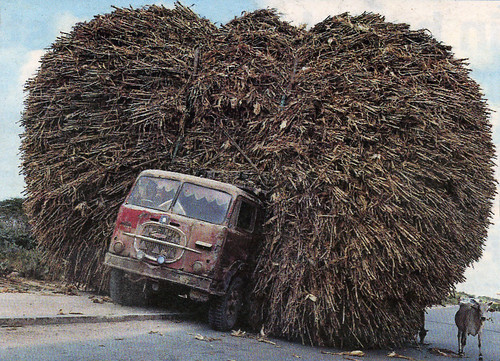
wide load coming through


After
  • How Complex Systems Fail (Being a Short Treatise on the Nature of Failure; How Failure is Evaluated; How Failure is Attributed to Proximate Cause; and the Resulting New Understanding of Patient Safety) by Richard I. Cook
  • a quip about network outages from Sean Donelan

Root Cause, a playlist


A soundtrack for this note (spotify version)
See also: The Dining Philosophers Problem, Resilience and Adaptability, and Version Hell Revisited

This belated entry on failure modes is part of the Toli Technology Series

File under: , , , , , , , , , , , , , , , , , , ,

Writing log: April 3, 2022

Thursday, November 18, 2021

A Taxonomy of Useful Idiots

Pondering a bestiary of useful idiots, a field guide to the species...

I once proposed a taxonomy of useful idiots: the ignorant, those who should know better, the reflexively tribal, and the professional opportunist. I have since recharacterized the mooted third category, the reflexively tribal, with a broader brush as the professional contrarian. The tribal intimation didn't fully capture the nuance that I sought, and the reflexivity I implied often overlapped with the contrarian impulse and with the actions of those who should know better. Not to mention that there was also the matter of intent. No, it wouldn't do; precision is needed in a hatchet job and I, for one, aim to deliver. Ah well, I've always been upfront that my brand of social anthropology was a work in progress. In any case, herewith some further musings...

To recap, here's the toli taxonomy of useful idiots:

  • the ignorant
  • those who should know better
  • the professional contrarian
  • the professional opportunist
Let's visualize this, in case you are that way inclined (forgive me Edward Tufte)

taxonomy of useful idiots

Useful idiots are a tribe that one encounters all too often in life. They cause a disturbance in the force, and no small disorder wherever they are found. They provoke anxiety and raise blood pressure with their confounding behavior. Their impact is particularly elevated in times of crisis, wars chief among them. During a pandemic, such as our covidious present, it can be a matter of public health and great urgency to be able to accurately identify these purveyors of grief. Prompt and targeted action is of the essence in order to blunt the impact of these merchants of chaos. We are all classifiers at heart, albeit we may not be good at it, but pattern matching is the human burden, it's what we do. It is worth investing the time and effort to understand the useful idiot, bear with me as I expound.

My poor man's Gartner quadrant lays out our populace of useful idiots plotting them against two axes: knowledge and intent. I hesitated in doing this as there is a fine line, of course, in discerning where candidates lie on a spectrum. How does one know for sure what someone knows or what their real motivation is? Mind reading is a skill lost to the ages - confiscated by the gods, humanity has to reach for heuristics. You don't have to reach to Hanlon's razor and "never attribute to malice that which is adequately explained by stupidity". Also we ignore The Basic Laws Of Human Stupidity at our peril. And, as we shall see, Carlo Cipolla's insight and the framing of his treatise on our species's stupidity is a key driver of our investigation. We'll take it as a given that, to the observer, overt demonstrations of ineptitude or dismay are hard to characterize. But we have to try anyway, it helps to know who you are dealing with.

The Ignorant


I have written on ignorance previously, launching off on its embodiment in the form of the incurious George W Bush. That affair was simply a matter of standing on the shoulder of giants; we all know that Hilaire Belloc should have the first and last word on ignorance.
There is not anything that can so suddenly flood the mind with shame as the conviction of ignorance, yet we are all ignorant of nearly everything there is to be known. Is it not wonderful, then, that we should be so sensitive upon the discovery of a fault which must of necessity be common to all, and that in its highest degree? The conviction of ignorance would not shame us thus if it were not for the public appreciation of our failure...
Belloc, in his opening salvo, lays out the well known terrain of uncertainty that the ignorant live in. Ignorance is a natural part of man's condition, indeed you don't have to harken back to the Garden of Eden to acknowledge that it is our default state. Further, ignorance is a social disease, one that stings the possessor when it is perceived by others. We are all striving simians not far removed from the savanna and the perception of fault, and potential ridicule, is a potent restraint. For ignorance to be identified, there must, of necessity, be the notion of shame.

Reading Belloc's insight, we can begin to see the outlines of a strategy for dealing with the challenge. Education is the standard remedy proposed for ignorance - call it applied knowledge as the antidote. Further insight here is based on understanding that shame, and the perception of discovery, are crucial in the working of ignorance. So long as there are vestiges of a shame culture, one might be able to counter the actions and effect of the ignorant useful idiot. The threat of revelation, and its karmic or reputational consequences, could be a potent inhibitor of the ignorant useful idiot.

The reverse of the coin is also obvious: societies long removed from the sway of a shame culture are acutely prone to the workings of useful idiots. Where scoundrels prosper freely, the useful idiot has firm ground on their side. Buyer beware.

Those Who Should Know Better


Those who should know better are a frustrating breed because they have tasted of the fruit of knowledge but it didn't resonate with them. Perhaps they thought it didn't apply to them, or worse, they assumed good faith of others. Whatever the reason, a common observation apropos those who should know better is that laziness, intellectual and otherwise, is their close companion. They often have their own narratives and idées fixes, their preferred view of reality, in other words. Those who should know better like their stories, and hold fast to them, however misconceived. They never heeded the call to trust but verify.

Viewed through an information theory lens, those who should know better have looked at the data pyramid repeatedly but are unable, or unwilling, to distill data into information, nor indeed, to translate experience into knowledge, let alone process it further. They are missing the machinery that goes under various names, wisdom and common sense, prime among them.

Those who should know better, however, can often be reached by advocacy, and be swayed to, in fact, know better. Sometimes a mugging by reality is all it takes - in the playground growing up, I have seen a few well-timed slaps sober up those who should know better. More generally though, one has to wait for events to take their course and to reveal the inevitable results of their wishful thinking coming to pass. "Experience is a brutal teacher," quoth C.S. Lewis, "But you learn. My God, you learn".

Revelations do occur, and road to Damascus incidents do happen. Consider the parade of useful idiots in the hard realist liberal crowd that have been lying low after their misbegotten advocacy of the Iraq war (or alternately their latter day shtick after foisting George W. Bush on us etc.). Pick your favorite mea culpa, for their number are legion. Now, mind you, if you were collateral damage to the Bush-Cheney misbegotten wars on the wrong target, you might rightly point out that there is no consolation to be had at the spectacle of someone who should know better belatedly realizing their mistake. It won't bring back the dead bodies, or the money squandered. And good luck locating the foregone prestige, call it a deadweight loss. There are slim pickings to be found in schadenfreude at those who should know better's comeuppance - their damage has already been done.

Still, the fact that there is a measure of self-awareness is a positive - lemonade out of lemons, as it were. It is always entertaining to see the moment when those who should know better realize that they have been used, or figuratively pimped out by the more cunning. The squirming and the attempt to reconcile themselves with the knowledge that they've been had, and might even be an object of scorn or ridicule.

Sidenote: ridicule cuts even deeper against those who should know better than against the ignorant, but for a different reason. The self image of those who should know better sees them operating at a higher status than the ignorant. To be cast in the same rank as the ignorant is quite damaging to the psyche of those who should know better. Shame, not just at the revelation of ignorance, but of the acknowledgement of deficiency. Those who should know better have the self regard of the infallible; the realization of their poor judgement and incompetence is a grievous wound.

Those who should know better are often framed as serious thinkers. In modern western politics, these smooth operators are often the sensible centrists, the clear eyed realists. They are liberal hawks, branded as manly and reluctant warriors. In the American polity, there are always second lives.

We have folk wisdom at our behest. "Once bitten, twice shy" is what we hope works, and a mantra we tend to chant in the direction of all and sundry, and especially towards those who should know better. Experimental research confirms that our efforts are mostly misplaced. The problem with those who should know better is that, sometimes, they have to have been bitten a half dozen times before the lesson sticks and sometimes the lesson is only half absorbed. Perhaps they are missing the shyness gene or they don't have the requisite memory cells. The frustration for others is that their condition presents as a case of wilful, laziness-induced amnesia, a groundhog day of failing to learn lessons.

If you look towards our literature, the narratives that are replete in human culture, there are any number of cautionary tales, fables and proverbs that come into play. My own favorite saying is that "it is unwise to have gentlemen's agreements with people who aren't gentlemen". Such a statement would be lost on those who should know better. They might nod their heads, and give the impression that they have assimilated the information, but by the time the conversation has ended, their mind is a blank slate.

Different priorities might be at work in the psyche of those who should know better. W.H. Auden said it best that "Knowledge may have its purposes, but guessing is always more fun than knowing." Such is human Archaeology. We mistakenly place a premium on knowledge, and on wringing one's hand at the ignorant or those who should know better. Tsk-tsking the Fox News contingent or the low information imbiber won't get you far. We should simply acknowledge that there are many who simply view news as entertainment and politics as theater; it is no wonder they are wont to dismiss knowledge.

Frequency Distribution


The frequency distribution of our tribe of trouble manufacturers is interesting. I assert, through empirical and hard-worn experience, that the vast majority of useful idiots fall into the first two categories, the ignorant, and those who should know better. This is heartening because, as I've suggested, there might be strategies to mitigate their effects if not diminish their numbers.

Sidebar: Strategies For Dealing With Useful Idiots


An interim look at a few of the strategies we've outlined for dealing with useful idiots
  • education
  • shaming
  • ridicule
  • fear
  • experience
With this portfolio in our toolkit, one can hope a multipronged approach can temper the damage, even as all of these have limitations.

If you emphasize the importance of the axis of knowledge, then you can think about dealing with useful idiots as a matter of low information (per the ignorant) or as a failure at information processing (per those who should know better).

It helps to consult the texture of knowledge. The Rumsfeld Taxonomy of knowledge is one framework that an earlier, previously destructive Donald laid out (known knowns, known unknowns and unknown unknowns). We'll augment it with a fourth category, the "unknown knowns", the subconscioius biases and blind spots that, tellingly, the erstwhile Secretary of Defense omitted from his taxonomy.

I would have thought that the lesson was that the unknowns by definition are unknowable and, if you go ahead, following the Rumsfeld example, and discount even the knowns, you end up traveling in a lightly-armored Humvee on the road from Baghdad airport with a convoy of outsourced mercenaries. Good luck on that front.
Mate Masie, the Adinkra symbol from the Akan saying about knowledge, wisdom and prudence, "Nyansa bon mu ne mate masie", is literally rendered in English as "I have heard and kept it". This points to the importance of comprehension, acquisition and retention in the workings of knowledge. Weaknesses on any of these fronts can undermine our strategic efforts against the useful idiots.

mate masie

Baltasar Gracián writing in 1647 in The Pocket Oracle and Art of Prudence, doesn't give much comfort about the odds of success.
There are many, however, who don't know that they don't know, and others who think they know, but don't. Stupidity's faults are incurable, for since the ignorant don't know what they are, they don't search for what they lack. Some individuals would be wise if they didn't believe that they already were. Given all this, although oracles of good sense are rare, they sit idle, because nobody consults them.
The ignorant and those who know better suffer no lasting downside; their failings are all too human. Nudging, and any of our other approaches, can provide only minor palliative relief.

On etymology, William Safire once investigated the provenance of the useful idiots of the west saying, the saying oft-attributed to Lenin - per Paul Boller, he never said it. We may not have a clear attribution but we all clearly know their effect. Useful idiots confuse the issue, they divert attention, they waste everyone's time. It is sad that the term is seen to be derogatory since it is merely descriptive and, shorn of value judgement, very helpful in classification.

Dealing with useful idiots is exhausting like all labour, but it is labour nevertheless. Thankless it may be, but it is best to consider our engagements with useful idiots as a tax on society, and we all know that we should render unto Caesar... It takes lots of behavior to get along as we know, social living is the best.

The Professionals


These categories of useful idiocy are fluid. People can move around and even leave the plane of useful idiocy using some of the approaches I've outlined. Which leaves the last two categories, both professional and, well, both useful idiots: I am referring of course to the professional contrarian and the professional opportunist. Let's take a look again at our taxonomy to refresh our memory.

taxonomy of useful idiots

The professionals, the professional contrarian and the professional opportunist, are orthogonal to the ignorant and those who know better. They are quite simply a breed apart. Consider them the superspreaders of the useful idiocy contingent.

Let's introduce a few terms and definitions that I often use interchangably as shorthand to these professionals: gremlins and parasites. Longtime readers will be familiar with this toli monger's jargon but one has been advised to expand one's audience. I'll adopt the Vox Optima explanatory, ostensibly-neutral tone and explain as I go along. So. Gremlins and parasites, clickbait for profit.

Parasites map easily to professional contrarians, whereas professional opportunists are often said to be gremlins. These professionals navigate the axis of intent as they practice their brand of useful idiocy.

The Professional Contrarian


The professional contrarian, call him or her Captain Obvious, is a strange beast, a consumuate purveyor of shrink-wrapped profundity. Now contrarianism per se is an honorable tradition in human society. We all celebrate those iconoclasts brave enough to pierce the groupthink bubbles we encounter in daily life. Intellectually, we all aspire to be the brave thinker who illuminates home truths, and disdains society's shibboleths. Intellectual dissent is often sorely needed in life especially as conventional wisdom is often anything but. And therein lies society's dilemma with the professional contrarian, for here is someone whose pursuit of an ostensibly laudable goal, crosses over into the realm of useful idiocy.

Sidenote: while Captain Obvious has traditionally been seen as a man, useful idiocy is one area on human life where there is gender parity, there is no need for affirmative action when it comes to the contrarian impulse.

There's a special category in the blogs I follow that I label as the professional contrarian. I think I have about 150 or so in that tribe as I deliberately seek out diversity in my reading. I'll only say that it makes for hard reading in times of crisis. Yet still I read, the exposure serves as a kind of strengthening of one's biome.

The behaviour of professional contrarians is all too familiar however. All complex ecosystems have parasites. Humanity has long experience with them. Psychologically though, there is no complexity, a parasite is a parasite and simply seeks to reproduce. Parasites are compelled to be parasitic, it is simply what they do.

On any given day, Captain Obvious wakes up, assesses a situation, finds the appropriate Slatepitch in keeping with the contrarian mode of operation, launches it, and keeps going looking for the next situation. Intent is an afterthought. Leveraging those moments when there is a real bounty of attention on one's contrarianism is a welcome, but not necessary, fringe benefit for the professional contrarian.

Reading the professional contrarian is hard at the best of times. They aim to unsettle, and you can almost visualize the smug smile when they hit send and wait for the uproar. The self affirmation they derive is independent of the issue on which they are expounding, it's narcissism distilled to its very essence. And it is this indifference that frustrates when they cross that thin line and turn into useful idiots. It's such a porous boundary really and it's the unthinking reflexivity of their contrarianism that irks.

The usual strategies do little to counter the workings of the professional contrarian. Pointing out the baleful effect of their actions doesn't sensitize them, nor indeed does appealing to their better senses since their actions are more instinctive, and they present as a clean slate of useful idiocy. Their only pressure point is a fear of being branded whiners, ergo a modified and highly specific form of the ridicule mode of attack. Dan Davies authored his lengthy Rules for Contrarians: 1. Don't whine. That is all as a kind of cautionary tale about dealing with professional contrarians. The downside is that being consumate professionals, the effect of the crybaby jab is temporary, and business as usual is resumed in short order. Unsatisfactory as it may be, palliative relief is the only remedy to the professional contrarian.

The Professional Opportunist


Which brings us to the professional opportunist, the gremlins in our taxonomy of useful idiots. Professional opportunists are a singular and contrary breed but should be considered distinct from garden variety contrarians. As I've suggested, the professional opportunist is a high functionning operator embued with both knowledge and intent, their roving grounds of dismay lie in the most dangerous quadrant in our taxonomy. A few aphorisms on useful idiots to set the stage:

The utility function of a useful idiot is at its highest in the immediate aftermath of a crisis.

Most of the time society proceeds without regard to the useful idiot, limping along with their brand of collateral damage. Times of crisis are where the professional opportunist's impact is most spectacular and confounding.

Trend surfing alacrity is the professional opportunist's strategy and the professional contrarian's opportunity.

Was it Stalin who talked of useful idiots? They always seem to materialize before and during wars.

Servants to power, we are all striving simians on the savannah at heart, looking to Alpha authority.

Apologists for war (think Iraq, think War on Terror) and apologists for unfettered capitalism have had a rough start to this century.

Most useful idiots lie low when things go awry. That, paradoxically, is the only time they are of any interest.

Professional opportunists are singular gremlins in human society and deserve close study. Sadly, we simply shake our heads at the spectacle

The professional opportunist knows no shame and depends on our short attention span. Hey! Look over there...

I looked.

Most professional opportunists escape scrutiny and scorn because there's always a core of past competence that one can point to.

The past competence is what makes the professional opportunist such a dangerous and confounding operator. Fluency born of knowledge and wilfulness in intent are a potent combination.

Stirling Newberry posited a theorem about opportunism a while back that I characterized as a Newberry's Spectrum of Banality. It's an equation oft-neglected by political scientists. Let's solve for X by restating the original formal statement:
X's writing represents the just before banal of the center left in the US. This is not to say that X is stupid, merely that by the time he writes something, there is a vast "The End" spray painted on the wall. He says something just as it is about to become common knowledge.
I have one quibble with the original formula, namely that it suggests that X is a man - not a bad assumption since the patriarchy is known to pontificate - indeed all pontifs have been male to date. For full generality, however, we should acknowledge equal opportunity blowhardiness of the professional opportunist.

Sidenote: the canonical description pointed to Jacob Weisberg, the original Slatepitch Siren, but it was applied in short order to Joe Klein (An Administration's Epic Collapse April 2007), Fred Kaplan (The End of American Leadership April 2020), and say William Saletan (The Trump Pandemic August 2020). Just before banality is the fingerprint of the professional opportunist as they scent blood in the water, and the opportunity to gain attention and wreak their brand of damage.

In Carlo Cipolla's discussion of the basic laws of stupidity (nicely illustrated incidentally), and the fifth basic law especially, he has this telling description that underlines why one can never underestimate stupidity and the damage it can cause. Echoes of Baltasar Gracián:
...the bandits with overtones of stupidity... and the helpless with overtones of stupidity... manage to add losses to those caused by stupid people thus enhancing the nefarious destructive power of the latter group

Trailblazers of the Trade Winds


Now I hear you, my Gartner quadrant of useful idiots is unsatisfactory, for one it ascribes a lower amount of intent, and, indeed, knowledge to the professional contrarian when we all know just how damaging, pernicious and indeed malevolent they can be. To take an example, the professional contrarian spreading misinformation about the coronavirus pandemic has probably caused more deaths and heartache that one can stand.

The professional contrarians have had a field day arguing against control measures, disputing mandates, highlighting individual choice, declaiming the role of public health interventions and so forth in mitigating the effects of the pandemic. Ascribing them a lower level of intent might auger a reduction of blame from some viewpoints, letting them off the hook, as it were.

The professional opportunist, armed with the same uncertainty in the science, also caused spectacular damage. The fact that the professional opportunist was more discerning in approach, and often exquisitly timed his intervention is perhaps a subtle distinction that we shouldn't dwell on.

Most people would dismiss this suggestion of a distinction between the two, and simply brand both as useful idiots. Especially in a time of crisis, the damage they did was equally pernicious, the wilful distractions they raised were equally frustrating. Revolutionary justice would probably mete out the guillotine to both without discrimination.

And yet, when confronted, one would encounter genuine bewilderment from the professional contrarian. "I was simply making a good faith case... There are shades of grey on the issue... Just asking questions...". The professional opportunist would be momentarily quiet when called out - the professional opportunist doesn't care about the argument that was proffered, or its merits, but, being skilled in the ways of evasion, will simply move to a new topic and often seek new grounds to continue punching down and sucking attention.

All crises have a clarifying effect. The first 18 months of these covidious times have been on object lesson on the workings of the useful idiot in action. Those mouthpieces who had been silenced by the global narrative pause and reduced to squares on a Zoom conference were not doing well with this democratization of attention, this era when everyone has been equally adrift and searching for meaning when it is the virus that sets the timeline. It has been interesting to watch prior narratives slowly reassert themselves in the new normalcy. I don't begrudge the old faithful talking heads their game - it's all in the game, but a game it is, especially for the professionals.

Take the Iraq war, New York Times editor Bill Keller belatedly nominated himself in the useful idiot pantheon along with Thomas Friedman, Fareed Zakaria, George Packer, Jeffrey Goldberg, Richard Cohen, Andrew Sullivan, Paul Berman, Christopher Hitchens, Kenneth Pollack and Judith Miller. Tellingly, there were no resignations tended or ashes and sackcloths rended.

Tony Judt helpfully summarized the lot as Bush's useful idiots in cataloging their collateral damage. I would add Michael Ignatieff to the pot but we are spoilt for choice with world historic useful idiocy with world historic consequences in blood and sin.

Mind you, many of this lot are still pontificating years later, they never paid a reputational price for being a useful idiot in that instance, and that, paradoxically, is one of the fringe benefits of the condition. At best, one might expect a mea culpa delivered grudgingly and belatedly, and with suitable hedging and rationalizations; the spectacle and perspective is turned towards the sadly, tragically mistaken useful idiot himself rather than the damage they encouraged, or fostered. Being a professional contrarian or opportunist gives you a free pass in the buyer's remorse stakes, sorry is optional.

A Game of Sorts


Too often I'm primed for a reflexive savaging of someone who should obviously know better, and then I pause and wonder if I'm being baited. The boundary between the useful idiot and the troll is very porous. At such moments of reflection in recent times, I turn to my taxonomy for guidance as I weigh the available evidence. Oftentimes I've found it more satisfying to try to identify a specimen in the wild with my nascent field guide than to go further, and engage with them. The professionals especially can be black holes of attention, whether negative of positive. Contra that expense of energy, it is truly fun to suddenly realize that you've been been dealing a specific subtype of these trailblazers of the trade winds.

And so I'll end with a parlour game, Dear Reader. Gather up a few names of those who have left you perplexed and confounded with their behavior in recent times. Everybody has at least a half dozen useful idiots in their life. You can even make it exciting, add a time limit for deliberation, have fun throwing out a few names of candidates. Once gathered, shuffle your names in a pot and pick one. Where would you place them in our taxonomy? The objective of the game is to correctly identify the genus of our confounder-in-chief.

Better yet, you can add some gamification to the process, or tap into the wisdom of the crowds as a group endeavor. Pick teams after dinner (drinks optional), and try to guess what your partner would have thought, or what a gameshow audience would have thought. 60 percent of respondents identified Buck Blowhard as a professional opportunist, Milly Noxious, on the other hand, was fully branded as ignorant by 90 percent of the audience. Cecil Showboat the III won the professional contrarian stakes by fully 75 percent of the public. And so forth.

Feel free to print out our Magic Taxonomy of Useful Idiots ™. You can throw darts if it helps, here's the larger version if you'd like to print it out. There are any number of configurations, rules and regulations that one can come up with. I'm certainly willing to discuss licensing any games based on the concept. The floor is open.

When you find yourself thinking about arguing about the latest David Brooks column, pick up the taxonomy and start to reason about where to place him. Opportunist or not? There's an app for that. Of such things are dating apps made. And, sure, a tweet about Bret Stephens might elicit the crybaby-whiner signal indicator of wounded amour propre of the professional contrarian, but it's more satisfying to behold the workings of his shell game.

Instead of writing long screeds about The Pandemic's Wrongest Man, Alex Berenson, ask yourself where he lies on the axis of intent and knowledge, and whether there has been any evolution over the past year, say from the merely ignorant to the professional opportunist camp. Observers are worried.

If you think about the Trump years, perhaps you might start with James Comey. Does the evidence make him someone who should know better? Or does the smug, self-satisfied look on his face, and the subsequent op-eds and interventions, warrant labeling him as a professional contrarian? Is the tell, his reaction to being rightly branded as a whiner for plunging humanity into peril by handing an election to the Donald?

Larry Summers, for example, has been doing a rollicking good rehearsal for our taxonomy in recent years as his intellectual influence in the halls of power has waned. Is he existentially contrarian, always speaking truth to power as perhaps his immaculate self image as the smartest man in the room might auger? Or should we regard the erstwhile President of my alma mater as merely naive, someone who should know better? Or is his shtick more purposeful, more in the vein of the professional opportunist? Inquiring minds want to know.

And so forth.

You're not going to prevent the useful idiot from doing their thing but, in the interim, you might as well have some fun, and apply our field guide, our taxonomy of useful idiots.

I'll start you off with one name: Thomas Friedman

(ducks)

Only posterity is unkind to the man of conventional wisdom, and all posterity does is bury him in a blanket of neglect

John Kenneth Galbraith

Foolish, a playlist


As is my custom, here's a soundtrack for this note, musical musing on all things foolish. Suggestions welcome. (spotify version) ...

Timing is everything
Observers are worried

This note is part of the Shell Games suite.

The first part considered Shame Cultures, while the second took a look at The Skeptic's Credo.

Next: Buyer's Remorse

File under: , , , , , , , , , , , , , , , , , , ,

Writing log. Concept: October 13, 2014, Poor man's graphics: April 15 2020, May 17, 2021
Tuesday, June 01, 2021

The Laws of Grief

The First Law of Grief, conservation, is, at first glance, confounding
That while cathartic, the public expression of grief favors forgetting
This is the quantity theory of grief that the ancients have observed
Namely, that it is in the nature of grief that it is preserved

A fundamental property of the substance is internal displacement
An external observer disturbs the soul, preventing reliable measurement
The observer effect is ineffable, never judge the outward appearance
Nay, the solitude of private grief destroys society's moral balance

That pain, unacknowledged, is a burden cannot be denied
Social beasts, the inside might not be as strong as the outside
Sometimes extreme measures are called for,
   even extraordinary rendition
It is only in retrospect that the workings of grief achieve recognition

The Second Law of Grief, irreversibility, is much disputed
For the texture of grief is intangible and cannot be computed
Most social sciences assume agency,
   hence the notion is frequently challenged
Practitioners believe in the efficacy of solace,
   thinking that it can be managed

It's an article of faith in all religions that the cure is consolation
Memorials and laughter are often proffered as emotional vaccination
The counselor's handy prescription for the spirit's rhythm of loss
Assuages the survivor's misgivings, yet we all one day will pay the cost

Some advanced the notion of stages,
Finite, and with an eventual equilibrium
These stages were posited as stepping stones,
Or rest stops, on the pathway to resolution

There were many doctrinal disputes about the magic number
Conclaves and conferences were held, more than I can remember
Was it the five heartbeats or, rather, the seven steps to heaven?
Out of the tower of Babel, came a dozen steps of mourning

Expedience and practicality reared its head contra the theorists
There's no pride of place to be the chief mourner in the funeral notice
Regret is everything, only belatedly can you enjoin in the communal numbness
Weary sons and daughters left wounded at the loved one's erasure, and the absence

Unlike thermodynamics, the Third Law of Grief concerns sorrow
The essential conceit is that no one is promised tomorrow
It is an inverse, this constant, and, rather than absolute zero,
The arc of grief, experiments confirm, instead approaches a plateau

The formal statement posits an upper bound, renewed anew
The paradox is that this physical limit is unapproachable
Whatever the perspective,
   whether raised heights or depths unfathomable,
You may think that you are done, but grief is never done with you

Applied grief, in practice, presents a serious dilemma
The theory holds that there are ways to move on and recover
Military training courses may try to inure their recruits from future trauma
But stress has a thousand fathers,
   while grief bears the affliction of a single mother

Unlike shame, for which some cultures have herd immunity,
There is no cure as yet, there is no remission for grief
Highly contagious, it's a social disease that simply cannot be prevented,
The only treatment is time, a balm with only minor palliative relief

The late discovery of the calculus of grief was a sorry chapter
Contra the skeptic's credo, its proponents got caught up in the rapture
The assumption of the golden rule
   has been that for every act of emotional kindness
Society will repay the bearer in full,
   and with no small amount of additional interest

Ivory tower professors, however, got into the mix,
   and designed a commodity market
But the flaw in the trading strategy's conception
   should have been readily apparent
Recall the First Law, markets can remain irrational
   longer than you can stay solvent

The Apocrypha suggest a Fourth Law of Grief which I'll briefly explore
Malcontents required an additional dimension,
   and preferred the Rule of Four

If you probe deeply, these quantum theories, simply stated, are plainly mislabeled
The putative reason is that grief's insubstantiality
   is the source of much frustration
Like its cousin, nostalgia, grief can be a fatal affliction
When in the throes of it, patients are frequently disabled

The impairment presents as a nervous condition,
   as they say, observers are worried
Yet the demands of capital mean that the working reality is barely acknowledged
In most companies, the nature of the loss
   is judged by the closeness of connection
Always check the fine print of the bereavement policy lest you suffer a resource action

All houses are grief houses, it all depends on one's time frame
The long view of humanity, let alone biology, enforces this hard rule
The tale of the lost stories, we're all marks in a shell game
The hard knocks will come surely,
   some learned the lesson early in school

In the world of the bereaved, the ritual is king
The comforting routines that are shared with kith and kin
A facade of normalcy is said to protect a house of pain
Guilt leads the way, but grief always leaves a residue of shame

Social interplay imposes complexity, we were left to understand
Previous certainties dissolved, like everything, they were written in sand
Our freedom is ephemeral, and this is the chief reason:
In the land of the living, we are never far from grief season

The natural impulse is to seek out unease when stricken
To find comfort in the unseemly, and embrace discomfiting
But the pangs afflict further, and run up against respectability
When, in your pain, you’re accused of disturbing tranquility

The burden of the done thing enforces the miserable
Teaching a lifelong caution against the public spectacle
The laws of grief, in their fullness, verge on the obscene
The fear of flailing even when you want to scream


In memoriam: Atu Mould (1972-2020)


All is not lost

Grief, a playlist


A soundtrack for this lament. (spotify version)

See previously:

This treatise and internal displacement is part of a series: In a covidious time


File under: , , , , , , , , , , , , , , , ,

Writing log: February 22, 2021

Tuesday, February 02, 2021

The Skeptic's Credo

If you've ever read Goethe's theory of color, you'll know that there are often ideas that are beautiful, ingenious, and indubitably wrong.

Neither the scaffolding of an idea, the trimmings around a thought, nor its progenitor or credentialed bearer should disguise its essential worth even though any of the foregoing often do, indeed, mask the underlying truth. The bogus wear many disguises.

Both the most simple idea and the most arch concept can be praiseworthy, and fodder for much food for thought and insight, and yet both, the nigh-judious liminal thought and the complex, counterintuitive koan, can be completely and thoroughly mistaken.

We rightly treasure the insight of the boy who remarked that the Emperor "hasn't got anything on", injecting a dose of reality, but understand, all too well, the process that made the gathered multitude ignore the evidence of nude hubris on display in the fable. We live in our own fables.

Incidentally, I should note that Hans Christian Andersen didn't write the sequel about what happened to that little boy and his family six months later when The Authorities could finally deal with them after the wardrobe malfunction. Suffice to say that it wasn't pretty. My idle speculation is that he tipped off his contemporary, Dostoevsky, with the germ of Crime and Punishment - there's a PhD, or alternatively a Hollywood script, in fleshing out that crossover concept.

Suffice to say that the most brilliant of thinkers can turn into cranks of the grandest order when they step out of their lane. The shape of an idea may transcend borders figuratively but its core rarely strays far from home.

This is not to demean the polymath, or to prefer Isaiah Berlin's hedgehog to the roving fox, but merely an observation that critical thinking is always in order. The point is that delusions are not the province of the uneducated or uninformed. All ideas must thus be taken with a grain of salt and shown to relate to reality. If conception and perception must be married, let it be by wisdom.

The Last Philosophers

The skeptic's credo is one of expectant ambivalence infused with an element of pessimism. Always mark your beliefs to market, you almost always hear the skeptic muttering, and with a touch of weary righteousness. The weariness comes from disappointment - an occupational hazard of skepticism, and the righteousness from the fraught history of one's confounding beliefs being proved right.

Scientists often claim to follow the skeptic's method, indeed their august Method - the one that they exhalt in their droning cocktail hour conversation, lends itself to the trappings of authority. The callouts to verifiability, testability and various isms are often worn as badges of invincibility even though they are mere cloaks of fallibility. Reason and inquiry, couched in specific forms lauded by the academy, are attributed the virtues of rigor and given free entry into society's discourse.

One need not go to Issac Newton, who would have sold you on his fever dream of the South Sea bubble, to pursue this point. Charles Darwin and the Brontë sisters would have talked you into spending your fortune on the Railway Manias of the mid 1800s. Even Charles Mackay, the man who wrote the book on Extraordinary Popular Delusions and the Madness of Crowds, himself fell prone to the similar mania. Gullibility is immortal. And the less said of the later, high-minded Victorian dabblers in phrenology and mesmerism - their parlor room séances speak for themselves, and were lampooned in real time. You've no doubt read their books. In our own time, the script may have changed but the servants of empire and of capital are still spouting their dismal wages.

As an engineer, albeit with a literary bent, I am well versed in our own idées fixes and can recite the STEM mantras as eloquently as others. For engineers too bring their blindspots to the table, substituting their programmatic interventions and sundry heuristics for intuitive common sense. The truth is, that peacock of our tribe, the self anointed tech visionary, is often just another blowhard, and should be judged (and ridiculed) accordingly.

The good books would guide us towards skepticism, and the oracles of all religions weigh in on credulity and inveigh against uncritical thinking and behavior. For Muhammed, the saying was "Trust in God but always tie up your camel at night". His earlier counterpart, the man from Nazareth, was a searching critic of authority on this earthly plane, and perhaps the fiercest advocate for performing due diligence in one's life. He would enjoin us to prepare for the kingdom of God and urge us towards the house on the rock (sidenote: perhaps the history of Christianity's spread betrays an inclination for mergers and acquistion, but I digress).

A difficulty with the parable of the wise and foolish builders is that it is all well for Jesus to advocate so incisively for building on solid foundations, but what if the home inspector assured you that the staged house you've just viewed, the one that was actually built on sand, was the real rock solid deal? In human affairs, who really has time for due diligence? And with Murdoch's real estate agent regaling you on the charming features of the McMansion, with Greenspan's Put Banker promising low interest rates come what may, the pressure is on to seal the deal, to stretch one's budget, and take on the liar loan. And this is not academic pedantry, the poor folks who lived in the Grenfell Tower had no reason not to trust the efficacy of the cladding, of all things, that wrapped what became their deathtrap. It is cold comfort to tell their ghosts that a house is not a home.

aryeetey on the line 1998

We are trusting simians not too far removed from the savanna and modernity makes us mostly morons in a hurry. It requires a lot of effort to be vigilant about the many Potemkins we face in life. We resort to heuristics and rules of thumb, and can be taking in by confidence artists of all sorts in the shell game of life. The gremlins and parasites of society prey on us and can easily turn the brightest of us into useful idiots.

If skepticism is the notion that that true knowledge is always uncertain, it simply imposes a frame on its bearer of always questionning, and this can be a wearying approach to life.

The early skeptic of most nostrums (capitalism, what have you) runs the risk of being branded as the designated driver: at once necessary for soul insurance and sober hindsight, but, frankly, buzzkill during humanity's weekend in Vegas. Aficionados of doubt are rarely celebrated by History, there is no cult of doubting Thomas.

Pyrrhonism, the total skepticism of yore, didn't have many adherents because its doctrine of radical skepticism proved immediately unpopular. While it was attempted as an all-encompassing philosophy of life, it has never prospered. It seems that some measure of faith, and, possibly, a considerable amount of that ineffable substance, is required in all human institutions that reproduce themeselves successfully.

It it the plight of the skeptic to forever inhabit the terrain of uncertainty, to vacillate in those borderlands of fate always on the verge of temptation by seductive manias.

The skeptical genes are obviously useful for humanity in our decision making but, paradoxically, they are not mandated, nor necessary, for our species's survival; they are certainly not under selective pressure to be chosen like a peacock's wing or our finely attuned eyesight. Accordingly, we see a wide spectrum of trust cultures around the world. In an era of ease or nostalgia, our propensity for skepticism may even fall prone to atrophy. Walter Bagehot, in Lombard Street, would remark that "All people are most credulous when they are most happy".

How then to hold on to one's skepticism when a bubble is in full flow when, as Keynes noted, "the market can remain irrational longer than you can remain insolvent". My own favorite reading reading comes from Andrew Odlyzko who offers a rich library on bubbles, gullibility and manias. Forewarned is forearmed. Dan Davies also gives insight on cultivating the skeptical inclination or, as he put it, Avoiding Projects Pursued By Morons 101. The selling of the second Iraq war remains an important case study. I fall back to that critical recommendation he makes about the vital importance of audit.

More classically perhaps, I harken to Diderot:
A thing is not proved just because no one has ever questioned it. What has never been gone into impartially has never been properly gone into. Hence skepticism is the first step toward truth. It must be applied generally, because it it the touchstone.
The aphorists of yore prescribed a healthy dose of skepticism, and for good reason, but in their infinite wisdom, gave no guidance on the scale in question. It is lost in the veil of time the names of those who calibrated their formulae let alone their methodology. Further, their measuring sticks didn't have to contend with our fraught modernity. All too often, we only realize the appropriate measure of skepticism with hindsight and too late for optimal decision making. Fierce competitors they may be, I fear that the skeptics are doomed to run the race with a handicap. Ultimately, the tales the skeptics weave revolve around their conceptions of self, and they often live with the letdowns proffered by society and History. And so I remain a student of dissimulation and the strange architecture of misdirection. My fear is that the game is rigged, that we are all marks being cooled off. And the band played on.

To return to Goethe's notion referenced at the outset, pleasing as it may be to believe the "colors are the deeds and sufferings of light", I wouldn't make operational decisions based on that poetic insight. I have to hold fast to my inner skeptic and return to Hilaire Belloc on wishful thinking to give fortitude:
It is always a relief to believe what is pleasant, but it is more important to believe what is true.


The leakage specialist's 100% herbal solution

This note is part of a series on Shell Games. See previously: Shame Cultures

Next: A Taxonomy of Useful Idiots

File under: , , , , , , , , , , , , ,

Monday, September 21, 2020

Rules and Regulations

There are passports, and then there are passports. Keeping on top of our covidious dilemma requires locking down and, as with all thing bureaucratic, where there are regulations there will inevitably always be loopholes. The fine print is an iron-cast existence proof of any law.

Consider the passport. So you want to add regulations on visitors from a particular country. Let's take a wild example, the USA (a fantasy I know, everyone wants US tourist dollars, or to come to America's great land; per Mr Trump, they'll even pay to build a wall around it). Anyway, let's assume a ban on the US as a thought experiment, indulge me if you will.

Recall that the index cases that imported COVID-19 to Ghana and Burkina Faso were diplomats and businessmen who skirted what screening procedures had been hastily established at the start of the outbreak. Now you may counter, temperature screening doesn't work, asymptomatic transmission etc. Still: the VIP lounge gap, or its equivalent, will exist in some form, and certainly did in those instances, my compatriots are paying the price.

What more people carrying diplomatic passports? Forget the bluster of a trade war, sanctions and what have you, a large part of the current US-China dispute involves the quarantine procedures China would like US diplomats to follow. The State Department and the CIA aren't used to having to follow plebian rules. Quarantine? Rules are made to be broken. There are procedures, and then there are procedures.

ziploc display tsa state college airport 2007

Or take the military, let's say, for whatever godforsaken reason, your country has a security arrangment with the United States (Cold War legacy, the new Great Game, Africom entanglements, what have you). That means bases, compounds, black sites etc. Troop rotations willy-nilly. Japan, South Korea and Djibouti really don't want US military visitors at this point; they are covidious vectors and will do grievous damage to whatever protocols you have established for your own populace. You don't have to have watched M.A.S.H. or read Catch-22 to know how hard it is to keep soldiers from fraternizing - military discipline is not quite compatible with social distancing. The quotes from soldiers and their families about life in South Korea are replete with complaints about restrictions: "they wear masks here", "you can't go anywhere", "they take these things really seriously"... The Germans are quite furious at that soldier who broke quarantine to bar hop and spread the viral love. I am fairly certain that the infection rates among the US military approaches that of the more traditionally vulnerable populations. There are soldiers, and then there are soldiers.

The clear alternative to all this military industrial complex business, as I've previously suggested, is to embrace the glorious visions of The New Warfare.

zip-loc display state college airport 2007

"Ghana demands that on arrival you go into a 14-day quarantine in a hotel monitored by the security services." Many in the Ghanaian diaspora are complying and returning home. Inquiring minds want to know if US diplomats are subject to the same requirements. Is the VIP lounge at Kotoka International Airport still operational?

Even if you have the best regulations, you will depend on the human factor, and the practices of those who have to implement them. Australia's resurgent outbreak - apart from the disastrous meatpacking plant and food pipeline processing outbreaks, has also been partly blamed on the free market, and the privatization imperative. In Victoria unlike in other regions, they had outsourced the company that was providing security for the quarantine hotels that had been set up. A few slips in the procedures by the security guards, a little laxity in casting a blind eye to the guests, or even, as has been piquantly suggested by the tabloids, a romantic, or more properly a lustful assignation, and weeks later, a cool 5 million are having to go into severe lockdown. There are regulations, and then there are regulations.

Spain is trying to get the UK to reverse its hasty restrictions and not tar its lucrative tourist islands with the broad brush of the Catalonia outbreak. The argument is that the islands are safer than mainland Spain and even the UK. I'm sympathetic but, well, these are the breaks. There are restrictions and then there are restrictions.

the novel coronavirus SARS-CoV-2

Saudi Arabia, for whatever reason, didn't cancel the 2020 Hajj but instead severely limited numbers in the face of the pandemic. Only 10,000 pilgrims were allowed and "the only foreigners allowed to attend are those who reside in the kingdom". Ergo, there was a quota and some gatekeepers got to decide who were the lucky people who get to participate in this potential superspreading event.

I read all the reports that I could and didn't see any mention of a lottery to help this decision, instead I read considerable griping about those who got selected, even as the cover story was that it would be primarily health care workers who got the nod. The Hajj is a religious obligation and the many who didn't make it on their assigned year may be rueing this gap in their future. There are pilgrims and there are those who get to watch the pilgrims.

The CDC belatedly declared that it could block evictions as it wouldn't do to force people onto the street during a pandemic but, again, the details matter as with any rules or regulations:

Some judges say the order, which was announced on Sept. 1, prevents landlords from even beginning an eviction case, which can take months to play out. Some say a case can proceed, but must freeze at the point where a tenant would be removed — usually under the watchful eye of a sheriff or constable. Other judges have allowed cases to move forward against tenants who insist they should be protected, and at least one judge, in North Carolina, has raised questions about whether the C.D.C.’s order is even constitutional.

The uneven treatment means where tenants stand depends on where they live.

Or consider the matter of Covid certificates. Back in July, we read the story about Big Business in Bangladesh

The Bangladeshi authorities have arrested the owner of a hospital who they said had sold migrant workers thousands of certificates showing a negative result on coronavirus tests, when in fact many tests were never performed...

There is a huge market for these certificates among migrant workers from Bangladesh hungry to get back to work in Europe, doing jobs like stocking grocery stores, bussing tables in restaurants or selling bottled water on the streets. Many Bangladeshi workers have recently flown to Italy, where they said that employers required such certificates before allowing them to go back to work.

As the saying goes, trust in Allah but always tie up your camel at night.

One reason that the US response to our covidious predicament has been bad is the confusion from leadership about rules. Donald Trump is allergic to any rules, impunity runs through his veins, along with vanity and hurt pride, and we are all paying the price.

"People need a bit more than a suggestion to look after their own health,” said Dr. Mackay, who has been working with Australian officials on their pandemic response. "They need guidelines, they need rules — and they need to be enforced."

The enforcement part of it is key, when you are demanding shared sacrifice, the notion that there is impunity can be very damaging. Leona Helmsley gained notoriety for quipping "only the little people pay taxes", Martha Stewart claims to this day that she "didn't cheat the little people". Dominic Cummings is presently reviled primarily for disdaining the rules that he drew up while others complied at great cost. This is the terrain I've explored, at length, of shell games and shame cultures:

The forcing function of shame can be a great moderator. Hypocrisy observed and widely broadcast is the essential mechanism. A prime example from 2,000 years ago: "He that is without sin among you, let him first cast a stone at her".
A hypocrite

All this to say that, where there is rule making, there will be grey areas and all that follows. There will be corruption, there will be lobbyists greasing palms, there will be gremlins, and there will be parasites, as in any complex ecosystem. Gird your loins my friends, and watch the covidious fine print.


Note: the one unalloyed covidious dividend is the relaxation of the rules on liquids during travel, call it the hand sanitizer loophole to the homeland security theater. I'll close by singing a paean In Praise of Loopholes

Rules and Regulations, a playlist


As ever, a soundtrack to this note. (spotify version)


See also: The Ziploc Factor


This note is part of a series: In a covidious time.


File under: , , , , , , , , , , , , ,

Thursday, September 10, 2020

Mixed Metaphors

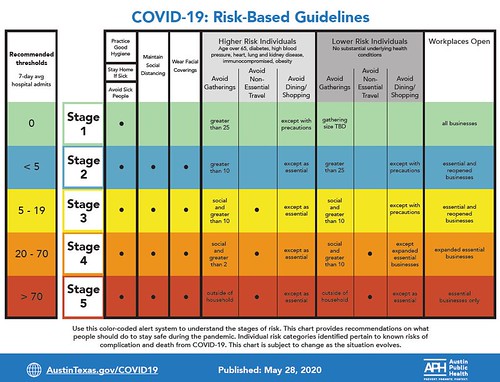
The COVID-19 risk guidelines in Austin, Texas present a design dilemma and a case of the blues (and more on that anon, see if you can spot what I mean). They also started with a political handicap when they were unveiled a few months ago. These are local city and county guidelines, drawn up by the Austin Public Health department, that were always likely to be ignored and run roughshod over by Texas's governor who was early in hailing The Grand Reopening of Texas, and has steadfastly proclaimed Positivity in the face of all contrary evidence.

Covid-19 risk guidelines Austin Texas May 28 2020

The earlier color-coded threat level Homeland Security Advisory System in the US has also been handicapped since its inception. While some critics focus on its bureaucratic unwieldiness, what irks me most is a catastrophic user interface and design failure. The failure, as you'll note, continues into the present.

The reason is that, in order to have green be the colour for the "all-clear" threat level, the natural spectrum of light, as normally seen in rainbows, has been altered in the Homeland Security scheme. Thus ice cool blue has been promoted to "guarded" whereas tropical green has been demoted to "low".

homeland security advisory systemrainbow

A bureaucrat or marketing person's intelligent design is at odds with evolution, physics and reality. Blame Osama bin Laden perhaps, but any number of people in the US government signed off on this mishap. Further, we are still living in this era of Recent Non-Specific General Threats almost two decades later.

The messaging and visual branding in the covid guidelines suffers from the very same flaw with the inversion of the colors of the rainbow spectrum. You can almost hear the designer's brain ticking: let's start with a traffic light metaphor, Red-Yellow-Green. But wait, they want 5 levels, let's add in orange and blue. Oh no, what about green? Argh, I give up, let's just invert green and blue. Mixed metaphor much?

Covid-19 risk guidelines Austin Texas May 28 2020rainbow over san francisco bay

Everytime I look at these charts, I suffer cognitive dissonance, there's something not quite right. I don't have to be color blind to be confused; I get a case of the misplaced blues. Could it be so hard, I ask myself? When I bought some paint to go after Tom Sawyer, things seemed easy, I ordered my 5 cans of paint and got a nice rainbow spectrum:

rainbow spectrum of colors

When I looked at my bookshelf at my stack of Unesco General History of Africa books, I noticed that there was a similar confusion if you organized things chronologically. I suspect the editors of that wonderful series weren't visually inclined but, in mitigation, they weren't dealing with a global pandemic and coming up with an urgent public health intervention. Still, the learning exhibited in that series stands the test of time. Even if later scholars have access to more material these days, those historical tomes were a real benefit for humanity. It was certainly wise to have the red volume be Africa under Colonial Domination. The blood of colonial era lingers on the ground. Alfred Adu-Boahen's opus of historical scholarship stared with clarity at the heart of darkness and eschewed Africans as scenery in the race to Fashoda.

But back to our covidious guidelines and rules and regulation... Once you move beyond the blue in green, as it were, a further problem is with naming and comprehension. If you use numbers for different phases, you have to consider the order. Do increasing numbers mean an easing of restrictions or an intensification of the lockdown? Are you considering opening or closing? In Austin, it looks as if Stage 1 is the all clear whereas Stage 5 is the fullblown lockdown stage, but I could see the reverse making sense too. Leaving aside the blues, where do epidemiologists stand on endianness and indeed on numerology?

Mind you, an interesting thing to note is that the misplaced blues is not a universal design failure. The Texas Medical Association coronavirus risk assessment of activities is at least in line with the rainbow spectrum. Different designers, most likely working down the hall from each other, came up with different solutions. No wonder humanity is afflicted with version hell and the Tower and Babel.

coronavirus risk assessment activities

The designers behind Harvard Global Health Institute's Global Epidemics site went with the Rule of Four instead, with the graphics for their Key Metrics for Covid Suppression. There is still the notion of the rainbow, but to avoid the case of the misplaced blues while fitting in with the traffic light metaphor, they added orange but decided that the blues could wait.

the path to zero

The British government in April was considering The traffic light exit strategy to free the UK from lockdown. A new economics paper suggested "a red-amber-green solution to safely ease us out of coronavirus restriction". That would be The traffic-light route to ending the economic lockdown by Gerard Lyons and Paul Ormerod (April 5 2020). It was noted at the time that this academic had sway in the past with Dominic Cummings so Mister Johnson was likely to pick up on this metaphor.

A few weeks later would read Coronavirus: 'Traffic light' system to lift lockdown in Wales
Ending lockdown could be in phases,"like a traffic light in reverse". There would be a move from red - some "careful and controlled" relaxation - to green, which would be "much more like the lives we had before the crisis hit". The amber zone would see more restrictions lifted and, if the virus is not re-emerging, Wales could then move to the green zone.

The UK would unveil its covid alert system in June rollowing the traffic light metaphor - the blues of the worst excess mortality were seeping in

uk covid alert levels system in June 2020

By July we were reading Coronavirus: Quarantine scrapped for arrivals from 'low risk' countries to England, a constrained reopening was in prospect
Last weekend the government said a traffic light system would be introduced, with countries classified as green, amber or red, depending on the prevalence of coronavirus... the Join Biosecurity Centre – which was set up to coordinate the government’s response to the pandemic – will be categorizing countries with a “traffic light” system.

Each country will be rated green, amber, or red. This will depend on the prevalence of coronavirus, the trajectory of the disease, and the center’s assessment of the data’s reliability. The quarantine will only apply to those countries rated red.

The UK Government Traffic-Light Quarantine System was said to be red amber and green.

rainbow installation at The Contemporary Austin

Chile launched its five step coronavirus prevention program to gradually reopen the country. They didn't bring in color to the mix, it was steps and numbers.

Seven Santiago neighbourhoods will transfer to Step 2 — they will be allowed to leave their houses freely on weekdays, with local shops allowed to reopen. The quarantine remains in place on weekends and holidays, along with a nighttime curfew every day.

La Araucanía joins fellow southern regions Los Ríos and Aysén in Step 4 of the prevention program. Here, rates of infection are significantly lower than other parts of the country. Restaurants, cafés, shops and cinemas can reopen with up to 25% capacity, while bars, clubs and gyms remain shut and the curfew stays in place.

If you were lucky enough to take advantage of lower interest rates caused by the downturn and attempt to refinance your mortgage, you would have faced the hard sell and the kind of mixed messages that ensue whenever traffic light meets rainbow, we always seem to get a case of the misplaced blues.

misplaced-blues-in-refinancing-look-to-the-rainbow

California's governor Gavin Newsom is hip to this game

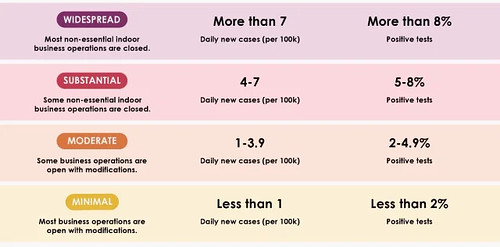
The governor said that the new four tier color-coded system would match a color to each of the four tiers with purple representing the highest “widespread” risk level for a county with more than seven new cases per 100,000 residents and more than 8 percent positivity rate. Red will represent “substantial” risk, while orange represents “moderate” risk and yellow the lowest level, “minimal” risk, with those lower levels being determined by reduced numbers in case and positivity rates.

“We don’t put up green because we don’t believe that there’s a green light that says just go back to the way things were or back to the pre-pandemic mindset”

california pandemic color coded system

The shiny Silicon Valley solution eschews the misplaced blues using purple instead, deftly forgoes green to flee the traffic light metaphor, and embraces the rule of four in pointing to simplicity for its color-coded county guidelines

Througout this pandemic, there has been a lot of mixed signals and confusion in the messages that the public has been inundated with. This inconsistent messaging goes against the best practices of public health messaging. The public is necessarily conflicted: stay home except when you shouldn't, wear a mask although you don't need to says the governor or the sherrif. Bleach and disinfectant is first presidentially recommended, and then immediately reviled and universaly ridiculed. This is the stuff of confusion, and I won't get into the stranger turns of hydroxychloroquine, or indeed the numerous cases of drinking of hand sanitizer - that last was a bridge too far for me, to mix my metaphors.

Colors abound in the discourse, yet the only consistent message is that red is bad, the hot zone or the torrid zone of infection. Heat is also at work; hot is bad, cool is good. And if some states go with colors, some with phases, some with steps, and yet others go with levels or stages. And when it comes to numbers, some go with high numbers while others prefer low numbers as the warning. Numbers are probably better than colors but again everyting is up for debate. Is higher better or worse?

One interesting thing is that we don't hear about black much in the messaging. We don't get black or white. The implied binary choices are too stark. Life or death, Stop or go. Perhaps it is because binary choices have an immediacy that force us to reflect on mortality. Three or more states is best, there are shades of gray in this business - these shades imply some degree of human flexibility and agency. Designers reached with intent into their toolkit and came up with traffic lights, with the rule of four, and always remember, as a best practice, if five or more states are needed, we should heed the actual rainbow.

Graphic designers are having a tough time achieving clarity during this coronavirus pandemic. There's no easy living when you have mixed metaphors in a covidious time.

rainbow installation

Mixed Metaphors


Traffic lights
Full circle rainbows
Prevention steps
Priority zones
Stage guidelines
Lockdown levels
Threat areas
Risk tiers
Confused warnings
The misplaced blues

mixed metaphors - covid guidelines meet the rainbow

Mixed Metaphors, a playlist


A soundtrack for this note, here's hoping we can find the blues or some black gold of the sun somewhere over the rainbow. (spotify version)

A ball of confusion is perhaps a good description for the novel coronavirus

See also: Colors, a playlist (spotify version)

This note is part of a series: In a covidious time.


File under: , , , , , , , , , , , , , , , , , , ,