Showing posts with label markets. Show all posts

Tuesday, October 27, 2020

Wishful Thinking

It is always a relief to believe what is pleasant, but it is more important to believe what is true.

— Hilaire Belloc, The Silence of the Sea
It's your day by Glen

The Sound of Anticipation


I guess I anticipated that the private sector would have engaged and helped develop it for the clinical side.

— Robert Redfield, director of the CDC Congressional testimony (March 12 2020)

I keep coming back to this statement delivered, with a straight face, by Doctor Redfield in response to a rather sympathetic congressional audience. I assume that the congressmen and women's eyebrows arched violently at this verbal eruption. My eyebrows certainly assumed McDonalds' golden arch proportions when I read that soundbite.

Most American politicians only throw softballs - the business about scrutiny and oversight of the executive is mostly a fiction, and even the lawyers among them barely cross examine at the best of times. Even if you wing it and come unprepared, you should be able to dodge their inquiries. And yet this is the answer that a friendly congressman's pitch elicited: "I guess I anticipated that the private sector would have engaged..."

Slightly related: The Ayn Rand Institute bootstrapped its way to a PPP Loan of at least $350K. The institute's leadership had clearly done a close reading of their eponymous subject's The Virtue of Selfishness

In the hearings, there was not much more urgency, the outlines of the botched US federal response were already clear six weeks into the coronavirus pandemic. The main outrage in early March 2020 was that CDC did not have the testing capacity, nor indeed did it look as if there was a plan to increase it. This, of course, in stark comparison to the war footing that China, Taiwan, Vietnam and other countries had taken. And so, for example, the Democratic congresswomen were complaining that passengers on cruise ships were not being notified that they might have been exposed to the fast spreading clumps of viral RNA even weeks after exposure and so might have been unwittingly contributing to superspreading events.

If the leader of the public health response was freely signalling his belief that it was all a matter for private sector engagment, we were clearly in troubled waters. This seemed to be a foundational sin: the United States's public health response to our covidious predicament was flawed at conception.
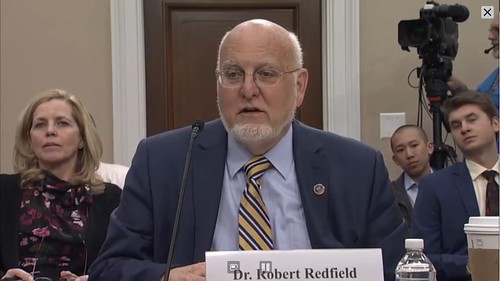
Robert Redfield I guess I anticipated that the private sector would have engaged

Then I read the delicious sentence in the Financial Times that "Dr Anthony Fauci – the infectious disease expert and now household name – is widely known to loathe Redfield, and vice versa." I am up to 25 stanzas imploring Dear Kindly Doctor Fauci to step in and sort things out, but perhaps he might have had reason for his assumed assessment of Dr Redfield. With hindsight, when you watch the footage of Fauci and Redfield testifying while seated next to each other, you note that Redfield calls Fauci, Tony, whereas it is always "Doctor Redfield" in the other direction. Not to digress further, but one wonders if sharp-elbowed bureaucratic infighting is part of the reason for the dysfunction we have witnessed. Reading that CDC testing guidelines were relaxed only when the good Doctor Fauci was in surgery is of a piece with this pattern of neglect.

Still, one shouldn't personalize things since I am using "Redfield" as a shorthand for a kind of evidence-free, faith-based ideological thinking. It's a marker for a blindspot of sorts, an Anglosphere take on magical realism. Others have followed this line of thinking

Here were two men wondering aloud why reality had failed to conform to their ideology. Where was the private sector, exactly, during these eight weeks? How odd that these companies, whose only responsibility is to their shareholders, had failed to make up for the incompetence of this administration.

Redfield seems to have been selected to run the CDC not only because he was a prominent virologist, which made him appear qualified for the job, but also because of his hard-line politics, which made him qualified to serve in this Republican administration. Even at the time of his appointment, a few experts tried to warn the administration that, as concerning as his dodgy politics were, his complete lack of experience in public health administration was even more disturbing. His politics, as it turns out, matter much more than his expertise when it comes to making a vital agency function.

The adherents of this kind wishful thinking will always observe in a crisis that "the private sector was too slow". They are forever singing the Dazz Band's chorus: "do I hear the sound of anticipation?" in advance of the second wave.

The next day, Congresswoman Katie Porter had had enough and brought out the whiteboard while questioning Robert Redfield and eventually got him to commit to free coronavirus testing. Her basic point was that the good doctor had ample authority in the context of a public health emergency to actually regulate the health care system. But it took relentless questioning, and she had to frame it like a game of The Price is Right to get him to admit that it might be a touch difficult for an uninsured American to pay the then-estimated $1,331 out-of-pocket cost of a coronavirus test, and that perhaps this might be an impediment to the WHO's injunction to "test, test, test" in light of a highly contagious disease to which humanity had no immunity.
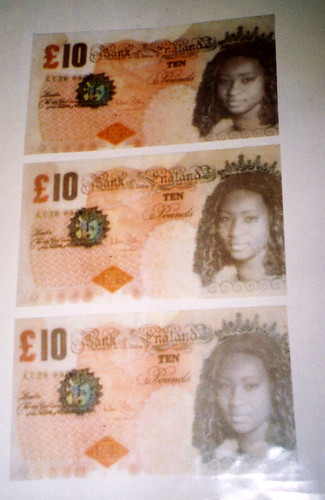
Queen Portia

Note: that it would take until September 1st for the full implications of actually exercising that regulatory authority to start to show. All of a sudden, we heard that the CDC could impose a moratorium on evictions, that it was well within its capacity to do so. There was no explanation on why it had taken more than 6 months to make that determination, and, as for all those lives that had been upended in the interim, the families put on the street, those made unemployed or forced to return to work in unsafe Smithfield plants for fear of the bread line, oh well c'est la vie. A blind man could see the need for even these half measures, as the Godfather of soul sang. Or perhaps, we can turn to Upton Sinclair

"It is difficult to get a man to understand something, when his salary depends upon his not understanding it."
John Kenneth Galbraith was less cynical but no less piercing in outlining the workings of wishful thinking when he cast his eye on The Great Crash of 1929:
By affirming solemnly that prosperity will continue, it is believed that one can help insure that prosperity will in fact continue. Especially among businessmen the faith in the efficiency of such incantation is very great.

As with public health so with the economy. I've previously pointed to the figure of Alan Greenspan whose lifelong herculean efforts to tilt the playing field in the economy towards the rich were shown up to be similarly catastrophic in fomenting a modern Depression. Even his mea culpa has proven to be ephemeral

"I made a mistake in presuming that the self-interests of organisations, specifically banks and others, were such that they were best capable of protecting their own shareholders and their equity in the firms"

Ha ha ha ha ha ha. Pardon my visceral reaction. GTFOHWTBS

It was a strategic retreat however, in light of the Great Recession and the housing bubble. Still, the rehabilitation campaign for this disastrous legacy was immediately launched and, more importantly, there was no restitution or move to address the fundamental inequality that Greenspan advocated and, indeed, enabled. The great cheerleader of unrestrained capitalism had set the system in place and the rigged game continues apace.

There is, of course, a difference between the theory and the practice of free markets. Charicatures of Adam Smith notwitstanding, Bagehot's caveats are always ignored as inconveniences. As I wrote at the outset of the pandemic:

We'll be hearing a lot about the "lend freely" aspect of Bagehot's premise in the coming bailouts. We'll conveniently hear less about the "at a high rate" or the "solvent merchants" qualifiers. But those are the rules for banks foremost, and for businesses writ large.

When it comes to bailouts for labor, moral hazard suddenly leaps to the front of the political arguments. The language is of handouts and welfare. Means testing inevitably raises its head. Social insurance has always needed better PR if not crises of power (Bismarck, FDR, Bevan)

A difficulty for the rest of us is determining whether the Redfield-Greenspan outlook was a sincere belief or a convenient cover story. It's a puzzle: are they in on the con or merely naive? Are they a mark or is it part of the long con? Should we consider them like the character played by Robert Redford in The Sting, actors in double and triple crosses? I do not mean to suggest Robert Redfield should be played by the Sundance Kid when the tales are told by Hollywood, but it's quite the ambiguous adventure.

Perhaps it doesn't matter, because the end result is the same grift, it's a shell game nonetheless, and one should protect oneself accordingly. We should fight the good fight against the soi-disant abstract magic of the market, even as one expresses one's outrage.

The pessimistic view is that we are dealing with gremlins, per Ezra Pound's Hugh Selwyn Mauberly

usury age-old and age-thick
and liars in public places.

The optimistic viewpoint is more charitable albeit that it is is a matter of routine greed. We can turn again to John Kenneth Galbraith for insight

The modern conservative is engaged in one of man's oldest exercises in moral philosophy; that is, the search for a superior moral justification for selfishness.
Returning to Belloc's thought about wishful thinking, we can hear its rhyme with Francis Bacon's aphorism:
Hope is a good breakfast, but it is a bad supper.

In any case, the die is cast, the pursuit of herd immunity was the chosen tactic and we are all paying the cost in flesh and blood. 'Tis quite the pity that, in this pandemic, wishful thinking has lead the public health intervention.

"I guess I anticipated that the private sector would have engaged and helped develop it for the [insert topic here]" should be the epitaph of the wishful thinkers.
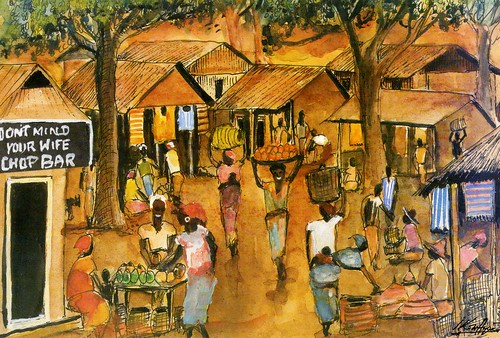
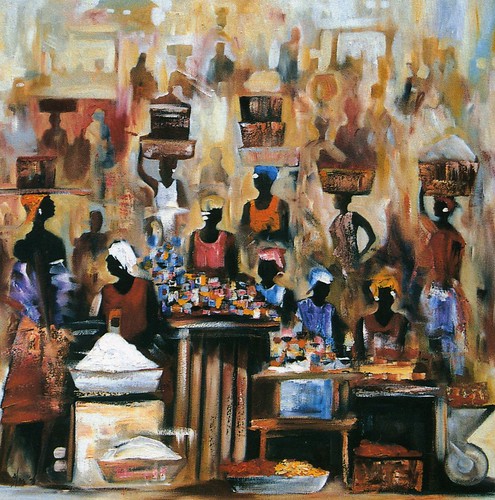
don't mind your wife chop bar at the local market

Wishful Thinking


Wishful thinking has been revealed as the bottom line
Their font of magical realism in a covidious time
An age-old shell game full of mystical narratives
The rhetoric of pocket book common sense and tough love
Merely masked the underlying impunity and strife

Force majeure, they vouchsafed bailouts for finance
But look, all of a sudden, central bankers turn to doves
Then the quick turn, post-haste, to restore the balance
We started hearing of moral hazard and hard choices.

For businessmen with hard noses, it's called strategic default
For your ordinary Joe, it's eviction and the bread line
Rent is due, sucker, it's your fault, not mine
Public health can wait, let's have a grand reopening
Never mind The Mosquito Principle or social living

Individual choice will save us, communal thinking is in the tank
Pull yourself up by your bootstraps, there's always the food bank
Governments can socialize the losses, of course, for the bosses
Meanwhile you're on your own, the workers can pay the cost
There's the incantation of free enterprise almost to the point of rapture
When the abiding principle is really that of regulatory capture

Crush the unions, we worship at the altar of the free market
Still, the world is watching, the crisis is having a clarifying effect
It's proving hard to deny the phantom thread of greed
When our human infrastructure is shown to be in dire need
Everything must change, this is school of hard knocks
Essential workers and labor are shown to be in the dock
The spokesmen of capital momentarily in a state of shock
Revealingly, the operative phrase is "human capital stock".


by his grace

Soundtrack for this note


Let's have a soundtrack for this worldview. What to call it though? Regulatory Capture is argumentatative as well as being a mouthful. Free Markets doesn't get to my intent and Lightweight Regulation reeks of irony. It's not quite Social Darwinism and I already have a Manifest Destiny and a Shell Games playlist. Arggh let's go with Wishful Thinking. In the context of the US and UK responses to our covidious predicament, it clearly fits the bill.

Wishful Thinking, a playlist


The sounds of magical realism in the human marketplace. (spotify version)

Further Reading


Amitav Ghosh's excellent Ibis trilogy spends some time musing about the traders of the East India Company and the Opium Wars in River of Smoke and especially in Flood of Fire. Indeed it ought to continue further just for the sheer exuberance of the linguistic invention. Why stop at three novels?

The logical endpoint of free market thinking is the hypocrisy of empire.

I realised this was the inaugural moment in the wars of what you might call Free Trade Imperialism. These merchants were the first generation of people for whom Adam Smith’s ideas were like a religion. They really thought they were laws of nature

"The profit motive has always existed, nowhere more so than in China and India, but Adam Smith created the idea that the economy is separate from human society and driven by its own internal forces. For the merchants, the market was not subject to any ethical constraints. Nobody in America [today] would suggest that Colombia has a right to push drugs in their country. But this was exactly what the Free Trade Fundamentalists were saying back then." In this, opium was uniquely suited to Smith’s purposes. “The whole point about capitalism is to try to persuade people to buy things that they don’t need," Ghosh argues. "It necessarily began with addictive substances. Tobacco, rum, tea, opium."

And the band played on...

This note is part of a series: In a covidious time

File under: , , , , , , , , , , , , , , , , , , ,

Wednesday, September 05, 2007

Conundrum 65: Taxi Driver Braking Style

The burning issue that has been exercising my mind for the past few hours is the way in which taxi drivers apply brakes to their cars. Thus I give you another entry as part of an occasional series, briefly noted...

So. Why do taxi drivers brake the way they do? What accounts for their peculiar relationship with their car's braking system? Why is that taxi drivers never want to idle their cars? And so forth...

zebras and kitsch


When a cab driver sees a red light, she will do one of two things:
  1. Accelerate and simply speed through the light - daring oncoming traffic in a game of chicken.
    This behaviour is almost de rigeur if you want to obtain a taxicab medallion - an initiation rite of sorts. When your car is branded as a taxi, it is a signifier, almost a warning signal of recklessness to other drivers, and you can trade on this reputation to bully through most intersections. Such are the fringe benefits of every profession.
  2. Slow to a stop at the light if it is obvious that one can't beat the light.
    In this scenario, you'll almost see the subliminal scowl on the driver's face in the mirror and the accompanying sound of disgust under their breath.
It is the manner in which taxi drivers slow to a stop that is the source of today's conundrum.

A taxi driver never simply slows down to a stop like other drivers. There's an eccentricity to the gradual manner in which they apply their brakes. It's a little hard to describe exactly how they brake but it is different enough that I always notice it; let's simply posit for our purposes a Brake Eccentricity Index ™ and assign taxi drivers the maximum value, 10, on an admittedly arbitrary 10 point scale. Still, why do they brake in such an unnatural fashion?

Theory 1: Maximize the fare


I should be a little bit more precise about this, namely that I've mostly observed eccentric braking styles in cities that have metered fares for taxis. Of course correlation is not causation but I've always thought that it was the fact that meter fares are lower when the taxi is idle than when it is moving that drove taxi drivers to this behaviour.

The notion here is that by keeping the taxi moving for as long as possible you will reap fiscal rewards. Amortized over the length of a typical shift, perhaps you can sneak in an extra hour of fares at the higher, mobile rate. If you consider driving a taxi as a purely revenue maximization enterprise then the optimal economic strategy is all about minimizing engine idle time and maximizing the amount of time the car is moving. The braking style then is simply a matter of arbitrage; 5-10% extra revenue will be nothing to sneeze at (handwaving at the exact amount).

One piece of the puzzle however is that I sometimes observe as much even in countries where taxi rides are not metered transactions. What gives?

Some control experiments: presumably there should be increased eccentricity in braking style the larger the difference between moving and idle fares. Drivers in cities with greater idle premiums would exhibit a higher brake eccentricity. Anecdotally New York and Boston are more prone to the phenomenon than San Francisco.

The web being what it is, an armchair economist such as myself can validate such intuition...

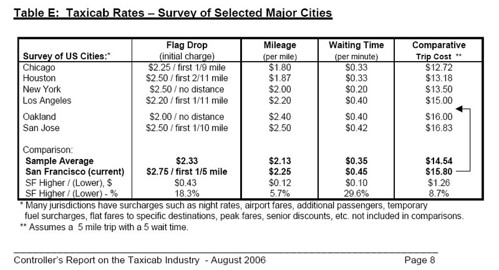
Consider this table taken from the San Francisco Taxicab Industry Report 2006 via the invaluable Taxi Library site. It is a survey of rates charged in various US cities.

taxicab rates 2006


We'll codify a proxy for our braking eccentricity quotient as the ratio of mileage rate to waiting time rate. In New York, this ratio is 10 (mileage rate per mile is $2.00 and waiting time per minute is $0.20). In San Francisco, the ratio is 5 (mileage rate per mile is $2.25 and waiting time per minute is $0.45). This would confirm the greater propensity of New York cabbies to work the brakes and even assign them 10 on our admittedly arbitrary index.

Out of interest, we have the following results: Chicago at 5.45, Houston at 5.67, Los Angeles at 5.5, Oakland at 6, San Jose at 5.95. In my experience, Oakland taxi drivers are more eccentric than San Francisco cabbies so this seems to be about right. The rate structure of fares provides serious incentives to taxi drivers to do everything possible to keep in motion, it is no wonder that they are irritated at having to wait, idle time literally robs them of revenue.

Theory 2a: Minimize fuel consumption and/or 2b. minimize wear on the car's brakes


Part of the utility function that a taxi driver has to account for is the impact of fuel consumption. With conventional internal combustion engines, the fuel that is used when the engine is idle is pure waste, hence it makes sense to minimize fuel consumption as part of the profit maximization function.

Wear and tear on the brakes is also something drivers need to worry about; perhaps it is indeed easier on the brakes to slow down the way they do. No one tells you that when you learn how to drive so this might well be a trade secret of sorts.

This last theory is counterbalanced by the frantic way brakes are applied when the driver misjudges and almost causes an accident (all too frequently judging by the statistics of road accidents involving taxis). Frequent near misses and even accidents are almost a cost of doing this kind of business and in those cases, brakes are manhandled. So a question for auto engineers, what is the best way to apply brakes? Incidentally I wonder if there is any research on the incidence of heart attacks amongst taxi drivers, but I digress...

Some control experiments:
  • hybrid cars are slowly being adopted into taxis fleets, these are cars in which the cost of idling has essentially been eliminated. Minimizing fuel consumption in one's Prius is thus a matter of running for as long as possible on electricity rather than on the conventional gasoline engine. Presumably Prius taxi drivers would not be as prone to brake eccentricity and the new technology might provide an insight into the relative importance of the fuel consumption factor. One should monitor the situation as hybrid adoption rates increase.
  • rising petrol prices should increase the fuel consumption premium so there should be increased eccentricity when we have higher prices. Metered fares after all aren't indexed to petrol prices and are only updated episodically. Anecdotally again, I've been noticing more braking shenanigans during the Bush years with the concomitant high oil prices.
With this in mind, perhaps we can add some additional dampening factors to our braking eccentricity index. I welcome your mathematical input.

la paz


Exegesis


The obvious thing to resolve this conundrum is to simply ask taxi drivers why indeed they brake the way they do. The thing is that whenever I've observed this behaviour, I've typically been annoyed because I tend to lean towards the first theory, namely that the driver is engaged in an attempt to wring an extra dollar or so out of my inconsiderable wallet. With that at the back of my mind, it will come off adversarial to ask the driver about this, no matter how academic the concern is. Also you might change the behaviour merely by asking and make the driver self-conscious. Moreover, there's always something more pressing to talk about: politics, the economy, real estate, cars, relationships etc. In any case, small things like taxi driver braking styles are appropriate fodder for blog entries. I hope I've made a plausible economic case of cabbies being rational economic actors but of course I may be missing the plot. Perhaps others can come up with better analyses. The floor is yours...

On Metering and Automation


Now you might well wonder why indeed I'm spending time and virtual ink on this matter. Well it is in aid of a book of toli. The low end theory posits that one should temper the human factor to encourage adoption. Thus I've been digging around matters of human factors and automation. The obvious case study of the human factor in technology adoption is with taxis and the introduction of metered fares. A little digression and that's all she wrote.

The idea of meters, of standard fares introduced through regulation, meshes with an attempt to eliminate the vagaries of human discretion and bargaining around the negotiation of payment for rides. Prior to their introduction, one was at the mercy of one's skill and knowledge of prevailing rates when discussing fees with cab drivers, and often one would be at a considerable disadvantage in the conversation. The drive towards standardization and automation was almost inevitable in many communities; electronic meters were the technical solution to the legal and cultural problem. By metering you could reduce the amount of price discrimination that taxi drivers could do and gain some amount of consumer satisfaction at not having to bear the mental transaction costs.

Recently also there has been the introduction of GPS-driven radio dispatch into the taxi business in. One virtue is that this might prevent certain dispatchers from rewarding their favourites with the best jobs. I know that in the Boston area, Haitian cab drivers would always curse the often 'native' dispatchers, claiming that they wouldn't give them (the immigrants) jobs even if they were closer to the customers. Presumably technology in the form of location-aware optimization algorithms could add a measure of impartiality to the dispatching process along (potentially) with some extra efficiency. Of course as with all things in which the human factor applies this is not the end of the story. Wherever there is human discretion we will see the usual social and cultural cues and biases assert themselves in one form or another. For one, it all depends on what is coded and who gets to make the decision.

Indeed New York city taxi drivers will be going on strike against GPS devices in coming days:
The Taxi Workers Alliance opposes the installation of high-tech touch-screen video systems that will allow passengers to watch television, make credit-card payments and — using a global-positioning device that tracks the cab - follow their ride on an electronic map.

Some drivers have said that the global-positioning devices and the automated trip recording system are an invasion of privacy, and that the use of credit cards would diminish drivers' incomes, given the card transaction fees.

They also say they will take in less money because the system requires drivers to log on before each fare, and they object to the television noise and the heat from the monitors.
This last case is interesting in the bundling of two technologies, electronic payment systems and location aware devices. In both arenas, the proponents highlight the benefits in terms of consumer convenience: additional payment options and additional information (map data) that can empower the rider in the transaction with the driver. For example, a tourist, able to see a realtime map of their journey, will now be more liable to ask "Why the hell are you going in this roundabout way to my hotel?" and reduce the unscrupulousness of drivers.

Detractors similarly highlight the effects of payments and transaction costs. By introducing credit cards into the billing systems, the authorities are passing on increased costs to drivers, a tax of sorts. A slight digression here: the taxi profession has typically been a cash-is-king affair - hence for example its appeal for the informal sector often the domain of transients and immigrants etc. (e.g. for an extreme case of 'informality' you can read James Ellroy's novels on the appeal of taxi ranks for the Mafia).

Both sides of the debate conflate things. Who really wants to watch television in a cab? That is surely a byword for yet more advertising. And yet that is what Mayor Bloomberg is touting even as the agenda of the authorities is plainly to exert additional control on the profession. On the one hand, the argument about privacy that the drivers advance is probably not the core objection, it is rather the issue of control, about losing discretion in the way they do business and the burden of additional transaction costs (which can even be mental costs).

A few centuries ago, the Quakers brought sanity to the systems of measurement with their reputation for probity in the standards of weights they provided. Eventually, social norms and mores were codified in laws, regulations and sometimes in technological standards. It is interesting that we are seeing lawmakers seeking to impose technological standards to achieve social ends. As we have seen in the case of braking style, there will still be behavioural attempts to game the system — that is the realm of the human factor. In the low end theory framework, the best you can hope for is to temper these things.

This year in Accra, the Accra Metropolitan Authority introduced medallions for taxi cabs and even imposed a dress code on taxi drivers (although from what I understand, the dress code is not that widely adopted). The introduction incidentally lead to an immediate decrease in the typical crime methods where criminals would use cabs for their robberies. By getting control of licensing, the AMA has managed to better understand the scope of the taxi market, the public also can better identify taxis and further norms can be codified. One wonders whether metered fares will be the next regulation to be adopted in Ghana. As anyone would tell you, a large part of the experience of using public transit in Ghana is the bargaining that one must do. Taxi drivers will quote exorbitant fares to those they perceive as well-heeled or unaware of the prevailing rates - and you don't even need to be an obroni to feel cheated at times. Metered fares would have undoubted benefits in reducing this kind of price discrimination and the associated transaction costs but might also remove social and cultural lubricants, those aspects of conversation and market traditions. I wonder if this is a trade-off that should be made. What say you?

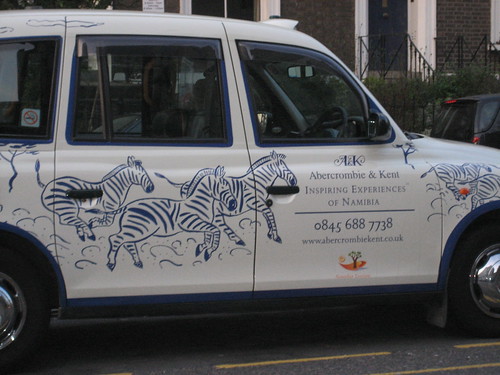
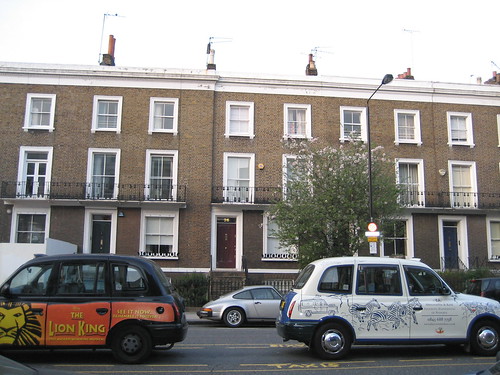
I'll close with a further digression... You might have seen me point to this Lion King decorated taxi a couple of weeks ago. The Wife caught it parked next to the zebras and kitsch taxi displayed above. I quite like the serendipity of the photos and the varying images of Africa expressed in taxicabs.

Lion Kings and Zebras and Kitsch, Viewing Africa in London


Abercrombie & Kent are merchants of "Inspiring Experiences of Namibia" hence the zebras crossing they use to advertise their escapist travel services. The Lion King of course is pure Disney nostalgia. Such are the types and faces we use on our taxis about Africa that mysterious land. The fantasy of Brand Africa.

A Taxi Driver Soundtrack


A playlist for this note

  • Loose Ends - Slow Down
    Apropos braking, we'll start our playlist with Slow Down, the brilliant showpiece of Loose Ends' Zagora album. Classic 80s soul music, eminently danceable and with an infectious chorus. It is often paired with the lead single Stay A Little While Child and the titles are fitting for the laidback theme of the band.
  • The La Drivers Union Por Por Group - Trotro Tour Of Ghana

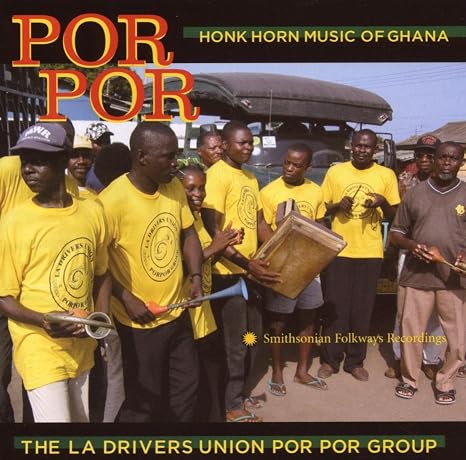
    The La Drivers Union Por Por Group - Por Por: Honk Horn Music of Ghana

    We'll continue with some music by taxi drivers, some honk horn music from Ghana. It's unlike almost anything you've heard, simply consisting of the horns and drums that you might here on the streets as these drivers vie for your trade and seek to attract your attention. This horn group has a 50 year history amongst other things, wielding their honk horns against the colonial regime. They continue to make music from the most unlikely of instuments.

    I quite like 'Driver, Take Me, The Train Has Left Me Behind' and the Kpanlogo Por Por Medley but perhaps it is "Trotro Drivers, We Love You So" that is the best song on the album. You can listen to the slightly more conventional yet still exuberant Trotro Tour of Ghana here.


File under: , , , , , , , , , , , , , , , ,