Showing posts with label regulation. Show all posts

Tuesday, June 10, 2025

Default Deny

Default deny is a very simple policy
Easily defended on grounds of complexity
What with the ease of implementation, even if cruel
With the golden excuse, we were just following the rules

Insurance companies often take refuge in it, it's a frequent addiction
Imposing on their customers by default, as it were, this untoward friction
Cynical, in their time of loss when they need rapid compensation
They instead offer up the burden of these inconvenient fictions

In the full knowledge that many won't bother and simply drop it
Their bean counters salivating in the back office thinking: profit
Mind you they're quick to pretend that the end result was not intended
And that it is perfectly normal to shy away from services rendered

Even if the sheer outrage is hard to countenance
It speaks to the perils of living with your fellow man
It's the injustice of it, all those years you duly paid those premiums due
Then it turns out that, all along, they were taking you for a bloody fool

Hence the importance of norms, rules and regulations and enforcement
But also the stick of tort, laws, oversight and, ultimately, punishment
The constant need to redress the wrong and put them on notice
To do the right thing by default and resist the temptation

And shame too has been known to work its charm
Applying the fear of god to prevent such harm
Brand damage remains a powerful tool for compliance
Eternal vigilance being the price of soul insurance

II. Coda


Default deny is also well known in networking technology
Firewalls, those gatekeepers, often turn to this strategy
Out of the box it gets you up and running very quickly
It's the low hanging fruit, good enough, the poor man's security
Protection from without but, sadly, it doesn't cover every layer
'Tis quite the pity, you still need to guard against bad actors
The real world is complicated, it's merely the start of a fight
Trust in Allah, goes the proverb, but always tie up your camel at night


Order. Do not thrown refuse dumb here

Default Deny, a playlist


A soundtrack for this note (spotify version) ...

Timing is everything
Observers are worried

File under: , , , , , , , , , , , , , , , , , , ,

Writing log: September 18, 2022

Monday, February 07, 2022

The Corruption Tango (Part 4 The World's Lawyer)

Part 4 of The Corruption Tango (see previously)

IV. The World's Lawyer


My dear uncle, of blessed memory, used to work at the World Bank
He had a seat at the table, he'd risen to a high rank

With world movers and shakers, many said to be covered in glory
From his vantage point, up close and personal, he saw the backstory

Of many of the headlines that we would later read in the daily news
He was intimately familiar with the ways in which due process was abused

The haste with which the bounds of propriety
   would be promptly set aside
And the board's directors would say the magic words: let's override

It often happened to coincide happily
   with what the American president wants
The fig leaves of accountability
   that were forsaken in light of such demands

A lawyer, he rose in the profession
   to become the bank's top legal counsel
Jokingly, he referred to his job as the restraint of the world's scoundrels

For even though he constantly sided "with the ninety nine percent"
His very salary and position placed him firmly in the one percent

He saw through those demanding structural adjustment and reforms
Shifting the blame to Third World cultural traditions and lax norms

For much of the impetus came from these selfsame First World rogues
Who would emphasize whatever fine words happened to be in vogue

The hubris of people in glass houses and all that
He chose his moments to bring up inconvenient facts

What with his work on matters of compliance in the banking sector
Conversations with him were always revelatory chapters

He was quite jaded, if not cynical, about human fallibility
Hard-boiled even, such are the wages of observing venality

I imagine it was like shooting the breeze with a vice cop
He'd seen it all, try as I could, there was nothing that could shock

The media accounts always focus on
   the weak country and the bribe taker
Scapegoats: the low trust culture, and the willingly suborned insider

Thus it was written, that huhudious drama of the cease and desist
Almost always turned out in practice to amount to a mere slap on the wrist

It makes you wonder who is writing the script
About these scandals and dirty politics

While there would later be an almanac of political corruption
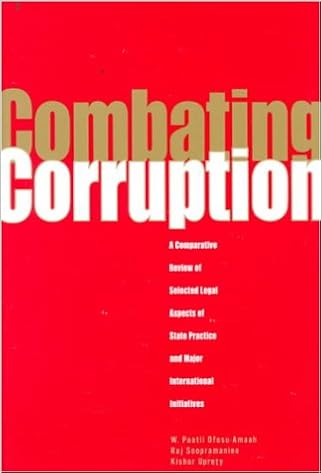
His contribution was to write the book on combating corruption

Human beings were not too far removed from the garden of Eden
When it became second nature for some to deceive and scheme

Lying for money is akin to original sin
Envy, greed, all these can pave the way to embezzling

There's always the other side to these affairs and imbroglios
Recall the old song, it takes two to do the corruption tango

combatting corruption

The Corruption Tango: A Playlist


A soundtrack for this note. (spotify version)

The Corruption Tango


A dance in four movements.
  1. A Touch of Sleaze
  2. Cease and Desist
  3. The Temptation of Black Gold
  4. The World's Lawyer
I nominate this internal displacement for The Things Fall Apart series. It's a family tradition to call out Fallen Angels.

File under: , , , , , , , , , , , , , , , , , , , ,

Writing log: Concept: July 7, 2005; March 11, 2021

Saturday, February 05, 2022

The Corruption Tango (Part 3 The Temptation of Black Gold)

Part 3 of The Corruption Tango (see previously)

III. The Temptation of Black Gold


Meanwhile, this century has seen a number of elections in Nigeria
Our West African brethren, branded poster child for chaos and disorder

And the conventional wisdom from, say, The Economist was hardly honorable
Sample headline: Nigeria's elections - Big men, big fraud and big trouble

Home of the hustle, the country is continually in the headlines
Tales of shenanigans galore and the entrenched climate of the 419

You'll read things like "rotten at the core", fodder for scoundrels
But doesn't that also describe the options backdating scandal?

Western media hardly covers the good news in the darkest continent
Would that they would apply the same scrutiny to shell games on their end

I actually think it's miraculous for such a large country to keep moving
And even take more than baby steps after decades of misrule and killing

Everyone wants things to move fast,
   corruption is surely a tax on the common man
But every complex ecosystem has parasites,
   that shouldn't be hard to understand

So there will always be the temptation of black gold
It's human nature, a golden target will never get old

Then there are stories like "Saudi prince received arms cash"
That focus on the recipient, the venal prince with the stash

And not on the British multinational arms company
That so happily disbursed those fistfuls of golden money

Observers are worried, how doth the little crocodile?
It seems as if many prefer to affect denial

There seems to be something rather structural at hand
For perverse incentives, seem to be part of the plan

It doesn't seem to matter that the shadow looms of the regulator
The threat of enforcement actions and severe sanctions hardly matter

High profile companies are unbothered
   by the specter of the compliance officer
Ignored, and written off, with a touch of sleaze
   and the workings of the human factor

Or, more formally, the temptations are an inherent part of the process
In this light, bribery is viewed as part of the cost of doing business

There are two sides to this social disease, it just goes to show
That it takes two to do the corruption tango

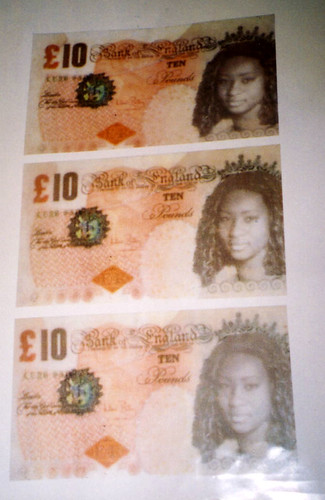
Queen Portia

Black Gold, a playlist


A soundtrack for this note(spotify version)

See also: The Corruption Tango: A Playlist

The Corruption Tango


A dance in four movements.
  1. A Touch of Sleaze
  2. Cease and Desist
  3. The Temptation of Black Gold
  4. The World's Lawyer
I nominate this internal displacement for The Things Fall Apart series under the banner of Fallen Angels.

Next: Part 4 The World's Lawyer

File under: , , , , , , , , , , , , , , , , , , , ,

Writing log. Concept: July 7, 2005; March 10, 2021

Thursday, February 03, 2022

The Corruption Tango (Part 2 Cease and Desist)

Part 2 of The Corruption Tango

II. Cease and Desist


I was piqued by a little commented-upon story the other day
Well it was a while ago, a little illustration of the games people play

It happened in the shadow of a tragedy you might have heard in the news
It concerned the dealings of a company that rhymes with Baker Hughes

Baker Hughes then being the world's third-largest oilfield services company
You'd no doubt hear its name in the same breath as other high flying somebodies

Like the more notorious Chevron, Exxon, or say Haliburton
Oil and gas services icons and so forth, etcetera, anon

The company's slogan they extol, I must say, is quite endearing:
Core values of integrity, teamwork, performance and learning

Indeed Baker Hughes completed 100 years of corporate history in 2007
It's a wonderful company, Texas-raised, Katrina relief, volunteer heaven

It couldn't have been good to be front and center in the New York Times
Luckily for them, a couple of fallen towers had changed the headlines

The following passage has to be one of my favourite illustrations
Of the corruption tango's reach, and enduring vexations

In an action that was filed on September 12, 2001,
And received little attention at the time, (imagine that?)
Baker Hughes agreed to a cease-and-desist order
Issued by the Securities and Exchange Commision, which said that
It had (repeatedly) violated the Corrupt Practices Act
By bribing an official in Indonesia.

That cease-and-desist order appeared to have had little impact
On the company's behavior, (they stayed on the wrong track)
The S.E.C. action filed Wednesday indicated
It said the payments in Kazakhstan and Angola
Went on from 1998 to 2003, while those to an agent
Involved in securing business in Russia
And Uzbekistan went on from 1998 to 2004, and payments in Indonesia
Went on from 2000 to 2003. Payments in Nigeria
Were made from 2001 to 2005, the S.E.C. said.

In 2003, the company initiated an investigation,
But, the S.E.C. said, it did not uncover some of the violations,
Which allowed them to continue. (End of digression)

Now we shouldn't tar the company with a broad brush for the sins of bad apples
As we surely know that there are rogue elements in the wild, at any level

We need to tread carefully with allegations of insider trading
The bezzle takes a plethora of forms, not least self dealing

It's a matter of concern that culture can undermine the sinews
Far be it to attack the company that rhymes with Baker Hughes

There is a serious commitment to governance, audit, ethics and the environment
I need not say more, there are vast quantities of material on their web site

And, of course, all companies are made out of people in reality
And there are only people behaving, and sometimes, behaving badly

Go back to the founders, Howard Hughes senior's name adds color to the dance
James Ellroy made American Tabloid pulp out of the sleaze of the son

Heck I know some of those characters, the company's storied alumni include Red Adair
Good old John Wayne depicted him in a great b-movie as a prized hellfighter

So distinguished is the composition of its board, it isn't funny
I guess it's plainly obvious that Big Oil attracts Big Money

Check the resumes: Big Banks, Big Real Estate, and Big Property
Curriculum vitae: Imperial Tobacco, Big Insurance, Big Industry

Big Politics, former U.S. Ambassadors to Israel, Syria, the Pentagon
Big Men, Generals and Comptrollers of the U.S. Army, Federal Credit Unions

Needless to say the lineup of shareholders and executives are storied
How then could they possibly be out of compliance with Sarbanes-Oxley?

With that kind of oversight, no one should ever question their integrity
I only mention the story to highlight the interplay, the weakness of humanity

The logic of capitalism: the perverse incentives for those in the know
It is no secret, after all, that it takes two to do the corruption tango


J. Kofi Aryee dance

Cease and Desist: A Playlist


A soundtrack for this note (spotify version)
See also: The Corruption Tango: A Playlist

The Corruption Tango


A dance in four movements.
  1. A Touch of Sleaze
  2. Cease and Desist
  3. The Temptation of Black Gold
  4. The World's Lawyer
I nominate this internal displacement for The Things Fall Apart series under the banner of Fallen Angels.

Next: Part 3 The Temptation of Black Gold

File under: , , , , , , , , , , , , , , , , , , , ,

Writing log: Concept: July 7, 2005; March 9, 2021

Tuesday, February 01, 2022

The Corruption Tango

A dance in four movements.

I. A Touch of Sleaze


I know, I know, an oil company bribing in Kazakhstan,
Angola, Indonesia, Nigeria, Russia and Uzbekistan?

Captain Obvious, who would have thought it? Why bother, very passé
Or, alternatively for the more world weary, isn't that so blasé?

It's the very definition of oil barons everywhere in the wild west
That's how robber barons and monopolists amass their treasure chests

So nineteenth century, so railroad tycoon, so captain of industry
So very Portuguese explorer, so very East India Company

And truth be told, it's really no big thing,
A bit of imperialism or monopolistic trading

To make a such a fetish out of a few bribing actions
In a world of rampant stock market manipulation

Where we celebrate ruthless and unscrupulous business practices
On a frequency and scale worthy of a swaggering industrialist

It's not like rubber farming in Liberia by way of the Dunlop family
It's not like a banana republic run by the United Fruit Company

It's a small thing, just a temporary lapse in ethics
That found ordinary Joes caught looting in a crisis

The post-facto rationalization of age old greed is termed mercantilism
Humbug, as Marx might have remarked, it's the thin veneer of capitalism

Fortune favors the bold, the lure of black gold makes brave men take chances
Well... yes and no. Bear with me if you will, as I invite you to a dance.

We aren't talking of eccentric moguls in wonky health
Using exploitative strategies to amass wealth

Profit making for those with an aversion to shame
Pure pricing power for winners of the great game

Rapacious, these highway bandits, to the third degree
The simple secret of their success is a touch of sleaze

There will be blood, if not exploitation, by these canny merchants
There's always a shortcut when you encounter Never Never Man

The preferred tactic of this nouveau aristocracy
Best exemplified by Rockefeller and Carnegie

Is to scrub reputations with overdue philanthropy
Extravagant gestures, museums and public libraries

Serenely unrepentant in his lifetime was the colossus named Rhodes
Even since, the legacy scrubbing has taken on colleges and scholarships

So manifest was his destiny - his confession of faith doth nakedly appall
That centuries later, the cries continue to ring out that Rhodes must Fall

The biographers can argue about his complicated legacy, of course
But unlike Alfred Nobel's example, there was no buyer's remorse

Fallen angels like him and King Leopold
   practiced the conqueror's catechism
What many forget is that, during their lifetimes,
   they faced the charge of racism

But these are merely the opening steps,
   as when the dancers gather for the show
The intimate legacies of men,
   it takes two to do the corruption tango

dance by wiz

The Corruption Tango: A Playlist


A soundtrack for this note. (spotify version)

The Corruption Tango


A dance in four movements.
  1. A Touch of Sleaze
  2. Cease and Desist
  3. The Temptation of Black Gold
  4. The World's Lawyer
I nominate this internal displacement for The Things Fall Apart series under the banner of Fallen Angels.

Next: Part 2: Cease and Desist

File under: , , , , , , , , , , , , , , , , , , , ,

Writing log. Concept: July 7, 2005; March 8, 2021

Monday, September 21, 2020

Rules and Regulations

There are passports, and then there are passports. Keeping on top of our covidious dilemma requires locking down and, as with all thing bureaucratic, where there are regulations there will inevitably always be loopholes. The fine print is an iron-cast existence proof of any law.

Consider the passport. So you want to add regulations on visitors from a particular country. Let's take a wild example, the USA (a fantasy I know, everyone wants US tourist dollars, or to come to America's great land; per Mr Trump, they'll even pay to build a wall around it). Anyway, let's assume a ban on the US as a thought experiment, indulge me if you will.

Recall that the index cases that imported COVID-19 to Ghana and Burkina Faso were diplomats and businessmen who skirted what screening procedures had been hastily established at the start of the outbreak. Now you may counter, temperature screening doesn't work, asymptomatic transmission etc. Still: the VIP lounge gap, or its equivalent, will exist in some form, and certainly did in those instances, my compatriots are paying the price.

What more people carrying diplomatic passports? Forget the bluster of a trade war, sanctions and what have you, a large part of the current US-China dispute involves the quarantine procedures China would like US diplomats to follow. The State Department and the CIA aren't used to having to follow plebian rules. Quarantine? Rules are made to be broken. There are procedures, and then there are procedures.

ziploc display tsa state college airport 2007

Or take the military, let's say, for whatever godforsaken reason, your country has a security arrangment with the United States (Cold War legacy, the new Great Game, Africom entanglements, what have you). That means bases, compounds, black sites etc. Troop rotations willy-nilly. Japan, South Korea and Djibouti really don't want US military visitors at this point; they are covidious vectors and will do grievous damage to whatever protocols you have established for your own populace. You don't have to have watched M.A.S.H. or read Catch-22 to know how hard it is to keep soldiers from fraternizing - military discipline is not quite compatible with social distancing. The quotes from soldiers and their families about life in South Korea are replete with complaints about restrictions: "they wear masks here", "you can't go anywhere", "they take these things really seriously"... The Germans are quite furious at that soldier who broke quarantine to bar hop and spread the viral love. I am fairly certain that the infection rates among the US military approaches that of the more traditionally vulnerable populations. There are soldiers, and then there are soldiers.

The clear alternative to all this military industrial complex business, as I've previously suggested, is to embrace the glorious visions of The New Warfare.

zip-loc display state college airport 2007

"Ghana demands that on arrival you go into a 14-day quarantine in a hotel monitored by the security services." Many in the Ghanaian diaspora are complying and returning home. Inquiring minds want to know if US diplomats are subject to the same requirements. Is the VIP lounge at Kotoka International Airport still operational?

Even if you have the best regulations, you will depend on the human factor, and the practices of those who have to implement them. Australia's resurgent outbreak - apart from the disastrous meatpacking plant and food pipeline processing outbreaks, has also been partly blamed on the free market, and the privatization imperative. In Victoria unlike in other regions, they had outsourced the company that was providing security for the quarantine hotels that had been set up. A few slips in the procedures by the security guards, a little laxity in casting a blind eye to the guests, or even, as has been piquantly suggested by the tabloids, a romantic, or more properly a lustful assignation, and weeks later, a cool 5 million are having to go into severe lockdown. There are regulations, and then there are regulations.

Spain is trying to get the UK to reverse its hasty restrictions and not tar its lucrative tourist islands with the broad brush of the Catalonia outbreak. The argument is that the islands are safer than mainland Spain and even the UK. I'm sympathetic but, well, these are the breaks. There are restrictions and then there are restrictions.

the novel coronavirus SARS-CoV-2

Saudi Arabia, for whatever reason, didn't cancel the 2020 Hajj but instead severely limited numbers in the face of the pandemic. Only 10,000 pilgrims were allowed and "the only foreigners allowed to attend are those who reside in the kingdom". Ergo, there was a quota and some gatekeepers got to decide who were the lucky people who get to participate in this potential superspreading event.

I read all the reports that I could and didn't see any mention of a lottery to help this decision, instead I read considerable griping about those who got selected, even as the cover story was that it would be primarily health care workers who got the nod. The Hajj is a religious obligation and the many who didn't make it on their assigned year may be rueing this gap in their future. There are pilgrims and there are those who get to watch the pilgrims.

The CDC belatedly declared that it could block evictions as it wouldn't do to force people onto the street during a pandemic but, again, the details matter as with any rules or regulations:

Some judges say the order, which was announced on Sept. 1, prevents landlords from even beginning an eviction case, which can take months to play out. Some say a case can proceed, but must freeze at the point where a tenant would be removed — usually under the watchful eye of a sheriff or constable. Other judges have allowed cases to move forward against tenants who insist they should be protected, and at least one judge, in North Carolina, has raised questions about whether the C.D.C.’s order is even constitutional.

The uneven treatment means where tenants stand depends on where they live.

Or consider the matter of Covid certificates. Back in July, we read the story about Big Business in Bangladesh

The Bangladeshi authorities have arrested the owner of a hospital who they said had sold migrant workers thousands of certificates showing a negative result on coronavirus tests, when in fact many tests were never performed...

There is a huge market for these certificates among migrant workers from Bangladesh hungry to get back to work in Europe, doing jobs like stocking grocery stores, bussing tables in restaurants or selling bottled water on the streets. Many Bangladeshi workers have recently flown to Italy, where they said that employers required such certificates before allowing them to go back to work.

As the saying goes, trust in Allah but always tie up your camel at night.

One reason that the US response to our covidious predicament has been bad is the confusion from leadership about rules. Donald Trump is allergic to any rules, impunity runs through his veins, along with vanity and hurt pride, and we are all paying the price.

"People need a bit more than a suggestion to look after their own health,” said Dr. Mackay, who has been working with Australian officials on their pandemic response. "They need guidelines, they need rules — and they need to be enforced."

The enforcement part of it is key, when you are demanding shared sacrifice, the notion that there is impunity can be very damaging. Leona Helmsley gained notoriety for quipping "only the little people pay taxes", Martha Stewart claims to this day that she "didn't cheat the little people". Dominic Cummings is presently reviled primarily for disdaining the rules that he drew up while others complied at great cost. This is the terrain I've explored, at length, of shell games and shame cultures:

The forcing function of shame can be a great moderator. Hypocrisy observed and widely broadcast is the essential mechanism. A prime example from 2,000 years ago: "He that is without sin among you, let him first cast a stone at her".
A hypocrite

All this to say that, where there is rule making, there will be grey areas and all that follows. There will be corruption, there will be lobbyists greasing palms, there will be gremlins, and there will be parasites, as in any complex ecosystem. Gird your loins my friends, and watch the covidious fine print.


Note: the one unalloyed covidious dividend is the relaxation of the rules on liquids during travel, call it the hand sanitizer loophole to the homeland security theater. I'll close by singing a paean In Praise of Loopholes

Rules and Regulations, a playlist


As ever, a soundtrack to this note. (spotify version)


See also: The Ziploc Factor


This note is part of a series: In a covidious time.


File under: , , , , , , , , , , , , ,

Saturday, July 11, 2020

Top Public Health Interventions

A list of the top public health interventions in history...

  • Sewer pipes (Mesopotamia 4000 BC)
  • Soap (for washing hands circa 2800 BC)
  • Emperor Shennong of China mandating drinking boiled tea (2737 BC)
  • Mosquito nets (from Cleopatra's time through present)
  • Vaccination (Jenner 1796, Pasteur 1880)
  • Pasteurization (Pasteur 1864)
  • Antibiotics (pace Fleming's penicillin 1928 onward)
  • Existence of unions (1827 onward)
  • Child labor laws (starting with the Cotton Factories Regulation Act of 1819 in England to present)
  • Birth control pills (Djerassi 1951, and Pincus and Rock producing Enovid, the first birth control pill approved in 1957)
  • Tobacco control (1952 to present, from the 1964 US Surgeon General report through the Tobacco Control Act of 2009)
  • Seat belts (1955 to present, the crucial milestone was 1966 with the National Traffic and Motor Vehicle Safety Act in the USA)
  • Occupational safety regulations (kicked into high gear in the US with Occupational Safety and Health Act of 1970)
  • Water fluoridation (widespread after 1945)
  • Iodized salt (1924 onward)
  • Ban on use of lead in gasoline (regulation starting 1973 - banned in US with Clean Air act in 1996)
  • Antiretrovirals, especially in African countries to manage HIV (1996 onward)
  • Board certification for doctors (1917 onward)
  • FDA approval for food and medicine (onset with Food and Drug Act in USA 1906, effective after 1938's Food, Drug, and Cosmetic Act )
  • Helmets (although a 1600 BC invention, their public health application came in sports after 1896 for American football and transportation circa 1914 with the motorcycle helmet)
  • Gun control (in most countries almost immediately after its invention circa 1000 AD with Yemen and the USA as modern day outliers)
  • Alcohol control (an ongoing and uneasy spectrum of regulations even to the extent of prohibition with religion even weighing in)
  • Oral rehydration therapy (1940s, popularized with ORS sachets especially after the refugees successfully treated during cholera epidemic of cholera after the Bangladeshi Liberation War)
  • Facial masks and shields (briefly after the influenza pandemic of 1918, in East Asia after the SARS pandemic of 2003, in China, Taiwan, South Korea, Vietnam, Mongolia, Japan and the Czech Republic memorably immediately after the start of the novel coronavirus SARS-CoV-2 pandemic January-April 2020, and the rest of the world circa March - June 2020, with notable American exceptionalism - in most enlightened states in the US. The N95 respiratory mask, conceived in 1992, remains a milestone although cloth masks have long had their uses. Whither my Texas neighbors you may ask? The neighbor who was overheard just a month ago, after The Grand Reopening of Texas, shouting "There is no virus" remains under the relentless grip of the Positivity of The Governors even after their July 2020 pivot. My best guess is that it will take 9 months, or perhaps personal experience, for the aversion to evidence and public health to penetrate consciousness. On the other hand, norms can change quickly, as evidenced in other countries, but I won't hold out hope for the year 2020 in the USA at large, I think it's a Vision 2021 project despite the rising body count)

This became a collaborative list with crucial additions from friends and The Wife, whose pointed comment about the birth control pill prompted me to add It's a Man's Man's Man's World by James Brown to the playlist I was conjuring for this list. Indeed oral contraceptives have probably positively affected the greatest numbers of humans lives outside of soap and sewers.

A twitter follower also challenged me that it was Emperor Shennong's courtiers, not the Emperor himself, who mandated boiling tea - that the Emperor just preferred his tea boiled. This again speaks to the Princpal-Agent relationship, and posits that there is a difference between the wishes of the Emperor and those surrounding him. The suggestion is that "Who will boil me this tea?" is the antecedent to "Who will rid me of this meddlesome priest?". I dodged the question as is my wont because, in any case, it was fortuitous that boiling water, with its side effect of killing germs and other beastly organisms, became an integral part of humanity's public health arsenal.

There was some controversy about my inclusion of child labor and the existence of unions, enough that I was even moved to play Devil's advocate

Think about it, would we have Dickens without child labour? What paradise have we lost when the youth of Bangladesh, or Ghana are no longer doing shifts in the textile factory, or planting yams and pineapples in the hills of Aburi? Our modern day Oliver Twists and Little Annie's no longer have the hard knock life, coddled as they are with this modernity, they have school not farms, and they are constantly demanding fondleslabs of mobile entertainment.

Of course, it was facetious to posit a world without Dickens, there was more than enough outrage in 19th century England and the world for Charles Dickens to get novelistic material. The little street urchins and cannon fodder for the worst excesses of capitalism might make the headlines but the the vast majority of capitalism's operation is a mundane grind, a rigged shell game on a tilted playing field - pick your metaphor. Call them the underlying conditions and risk factors that favour capital over labour. The notion of "the weekend", far from being divinely prescribed as days of rest, was in actuality a hard fought victory of labor and trade unions, as were occupational safety regulations. Social welfare and the advances in communal living have had considerable impact beyond the economic sphere and have public health effects.

Looking over the list, the human species has gotten away with much faulty biology and superstition. I suppose that belief in unseen things is what makes the Gospel of Germs such a hard sell that it requires constant marketing and reinforcement. Hilaire Belloc would satirize late 19th century popular conceptions of The Microbe in The Bad Child's Book of Beasts and More Beasts (For Worse Children). Things are not much changed in 2020 than in 1897.

The Microbe by Hilaire Belloc

The Microbe is so very small
You cannot make him out at all,
But many sanguine people hope
To see him through a microscope.
His jointed tongue that lies beneath
A hundred curious rows of teeth;
His seven tufted tails with lots
Of lovely pink and purple spots
.
The Microbe by Hilaire Belloc 2

On each of which a pattern stands,
Composed of forty separate bands;
His eyebrows of a tender green;
All these have never yet been seen -
But Scientist, who ought to know,
Assure us that they must be so...
Oh! let us never, never doubt
What nobody is sure about.

It is interesting that the tiny clumps of viral RNA that are driving our current covidious predicament fit much the same description.

the novel coronavirus SARS-CoV-2

The inverse list is also interesting, and we have a great candidate in Thomas Midgley for the most catastrophic intervention. Midgley invented both leaded petrol, and the CFCs (chlorinated fluorocarbon) used in refrigerators. The collateral damage, and body count, of these two inventions are world historic. Still, knowledge about their effects on the environment was not well known in his lifetime, unlike the inventors of gunpowder or the nuclear bomb. Midgley didn't have an Alfred Nobel come-to-Jesus moment and continued tinkering until his death.

I think we have real time candidates for the negative list either with neglect or by wilful policy decision making. It's slightly morbid to follow the implications of that thought because it gets to valuing abstraction over of flesh and blood. What is the value of a human life? And who gets to coldly decide that on the golf course or hastily fortified bunker?

Back to Basics


Covid-19 is a funny disease as my doctor uncles and aunts put it. It's forcing humanity to go back to basics and causing us all to change our way of life. If you take a look at the coronavirus superspreading timeline, you quickly get a sense of the activities that are now to be avoided, they involve crowds, and places with poor ventilation and sanitation, and where we sing or chant. We basically shouldn't touch or breathe on each other. And these are hard lessons to teach and follow, as I've found even after months of self isolation. The 7 and 9 year olds in my household are not the only ones that need constant reminders about the best practices for survival, frequently washing hands is not obvious despite our best efforts to make it a habit. It's hard to be a good neighbor when you can't do small talk and even conversations over the fence are fraught and wary episodes.

All communal gatherings have the potential for risky distribution of disease even as they might give comfort and social and economic utility. Paradoxically, we need to draw on social living for comfort and resilience, yet in our present, it is social distancing and enforced absence and the foregoing of our rituals and traditions that is our best chance of survival.

We are all in this together and it pays to learn the lessons of The Mosquito Principle, for these clumps of viral RNA, like our close and longstanding companions, mosquitos, don't discriminate. While we wait for a vaccine or effective treatment for Covid-19, our mantra has got to be: stay home if at all possible, maintain social distancing, and wash hands with soap frequently, wear masks when outside and perhaps even indoors when there is poor ventilation or if in the company of others beyond one's core living unit.

Optional: pray.

For faith healing is always an option; epidemiologists will forever be fighting a rearguard action against the placebo effect of faith. The other alternative is the very human hope that you will be saved, a deus ex machina is always a possibility - vaccines do get developed. Indeed this wishful thinking is firmly embedded in American mythology and culture.

And yesterday was the day of our cinema heroes
Riding to the rescue at the last possible moment
The day of the man in the white hat or the man on the white horse
Or, the man who always came to save America at the last moment

Someone always came to save America at the last moment
Especially in B-movies

B-movie by Gil Scott-Heron

In lieu of herd immunity, researchers at the Center for Disease Control (CDC), or perhaps the Surgeon General, would do well to issue the following public warning:

Nostalgia can be a fatal disease.

Observers are worried

chief zaachi physical and spiritual center

A Public Health Playlist


As always, a soundtrack for this note. (spotify version)

Suffice to say that I prefer public health interventions to faith healing, as always there is the fine print: your mileage may vary

File under: , , , , , , , , , , , , , , , , , ,

Wednesday, September 05, 2007

Conundrum 65: Taxi Driver Braking Style

The burning issue that has been exercising my mind for the past few hours is the way in which taxi drivers apply brakes to their cars. Thus I give you another entry as part of an occasional series, briefly noted...

So. Why do taxi drivers brake the way they do? What accounts for their peculiar relationship with their car's braking system? Why is that taxi drivers never want to idle their cars? And so forth...

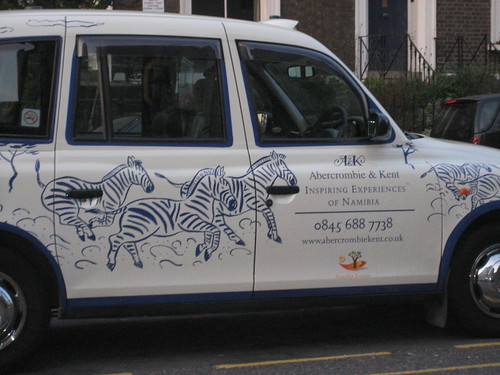
zebras and kitsch


When a cab driver sees a red light, she will do one of two things:
  1. Accelerate and simply speed through the light - daring oncoming traffic in a game of chicken.
    This behaviour is almost de rigeur if you want to obtain a taxicab medallion - an initiation rite of sorts. When your car is branded as a taxi, it is a signifier, almost a warning signal of recklessness to other drivers, and you can trade on this reputation to bully through most intersections. Such are the fringe benefits of every profession.
  2. Slow to a stop at the light if it is obvious that one can't beat the light.
    In this scenario, you'll almost see the subliminal scowl on the driver's face in the mirror and the accompanying sound of disgust under their breath.
It is the manner in which taxi drivers slow to a stop that is the source of today's conundrum.

A taxi driver never simply slows down to a stop like other drivers. There's an eccentricity to the gradual manner in which they apply their brakes. It's a little hard to describe exactly how they brake but it is different enough that I always notice it; let's simply posit for our purposes a Brake Eccentricity Index ™ and assign taxi drivers the maximum value, 10, on an admittedly arbitrary 10 point scale. Still, why do they brake in such an unnatural fashion?

Theory 1: Maximize the fare


I should be a little bit more precise about this, namely that I've mostly observed eccentric braking styles in cities that have metered fares for taxis. Of course correlation is not causation but I've always thought that it was the fact that meter fares are lower when the taxi is idle than when it is moving that drove taxi drivers to this behaviour.

The notion here is that by keeping the taxi moving for as long as possible you will reap fiscal rewards. Amortized over the length of a typical shift, perhaps you can sneak in an extra hour of fares at the higher, mobile rate. If you consider driving a taxi as a purely revenue maximization enterprise then the optimal economic strategy is all about minimizing engine idle time and maximizing the amount of time the car is moving. The braking style then is simply a matter of arbitrage; 5-10% extra revenue will be nothing to sneeze at (handwaving at the exact amount).

One piece of the puzzle however is that I sometimes observe as much even in countries where taxi rides are not metered transactions. What gives?

Some control experiments: presumably there should be increased eccentricity in braking style the larger the difference between moving and idle fares. Drivers in cities with greater idle premiums would exhibit a higher brake eccentricity. Anecdotally New York and Boston are more prone to the phenomenon than San Francisco.

The web being what it is, an armchair economist such as myself can validate such intuition...

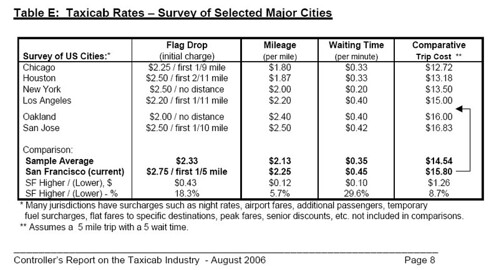
Consider this table taken from the San Francisco Taxicab Industry Report 2006 via the invaluable Taxi Library site. It is a survey of rates charged in various US cities.

taxicab rates 2006


We'll codify a proxy for our braking eccentricity quotient as the ratio of mileage rate to waiting time rate. In New York, this ratio is 10 (mileage rate per mile is $2.00 and waiting time per minute is $0.20). In San Francisco, the ratio is 5 (mileage rate per mile is $2.25 and waiting time per minute is $0.45). This would confirm the greater propensity of New York cabbies to work the brakes and even assign them 10 on our admittedly arbitrary index.

Out of interest, we have the following results: Chicago at 5.45, Houston at 5.67, Los Angeles at 5.5, Oakland at 6, San Jose at 5.95. In my experience, Oakland taxi drivers are more eccentric than San Francisco cabbies so this seems to be about right. The rate structure of fares provides serious incentives to taxi drivers to do everything possible to keep in motion, it is no wonder that they are irritated at having to wait, idle time literally robs them of revenue.

Theory 2a: Minimize fuel consumption and/or 2b. minimize wear on the car's brakes


Part of the utility function that a taxi driver has to account for is the impact of fuel consumption. With conventional internal combustion engines, the fuel that is used when the engine is idle is pure waste, hence it makes sense to minimize fuel consumption as part of the profit maximization function.

Wear and tear on the brakes is also something drivers need to worry about; perhaps it is indeed easier on the brakes to slow down the way they do. No one tells you that when you learn how to drive so this might well be a trade secret of sorts.

This last theory is counterbalanced by the frantic way brakes are applied when the driver misjudges and almost causes an accident (all too frequently judging by the statistics of road accidents involving taxis). Frequent near misses and even accidents are almost a cost of doing this kind of business and in those cases, brakes are manhandled. So a question for auto engineers, what is the best way to apply brakes? Incidentally I wonder if there is any research on the incidence of heart attacks amongst taxi drivers, but I digress...

Some control experiments:
  • hybrid cars are slowly being adopted into taxis fleets, these are cars in which the cost of idling has essentially been eliminated. Minimizing fuel consumption in one's Prius is thus a matter of running for as long as possible on electricity rather than on the conventional gasoline engine. Presumably Prius taxi drivers would not be as prone to brake eccentricity and the new technology might provide an insight into the relative importance of the fuel consumption factor. One should monitor the situation as hybrid adoption rates increase.
  • rising petrol prices should increase the fuel consumption premium so there should be increased eccentricity when we have higher prices. Metered fares after all aren't indexed to petrol prices and are only updated episodically. Anecdotally again, I've been noticing more braking shenanigans during the Bush years with the concomitant high oil prices.
With this in mind, perhaps we can add some additional dampening factors to our braking eccentricity index. I welcome your mathematical input.

la paz


Exegesis


The obvious thing to resolve this conundrum is to simply ask taxi drivers why indeed they brake the way they do. The thing is that whenever I've observed this behaviour, I've typically been annoyed because I tend to lean towards the first theory, namely that the driver is engaged in an attempt to wring an extra dollar or so out of my inconsiderable wallet. With that at the back of my mind, it will come off adversarial to ask the driver about this, no matter how academic the concern is. Also you might change the behaviour merely by asking and make the driver self-conscious. Moreover, there's always something more pressing to talk about: politics, the economy, real estate, cars, relationships etc. In any case, small things like taxi driver braking styles are appropriate fodder for blog entries. I hope I've made a plausible economic case of cabbies being rational economic actors but of course I may be missing the plot. Perhaps others can come up with better analyses. The floor is yours...

On Metering and Automation


Now you might well wonder why indeed I'm spending time and virtual ink on this matter. Well it is in aid of a book of toli. The low end theory posits that one should temper the human factor to encourage adoption. Thus I've been digging around matters of human factors and automation. The obvious case study of the human factor in technology adoption is with taxis and the introduction of metered fares. A little digression and that's all she wrote.

The idea of meters, of standard fares introduced through regulation, meshes with an attempt to eliminate the vagaries of human discretion and bargaining around the negotiation of payment for rides. Prior to their introduction, one was at the mercy of one's skill and knowledge of prevailing rates when discussing fees with cab drivers, and often one would be at a considerable disadvantage in the conversation. The drive towards standardization and automation was almost inevitable in many communities; electronic meters were the technical solution to the legal and cultural problem. By metering you could reduce the amount of price discrimination that taxi drivers could do and gain some amount of consumer satisfaction at not having to bear the mental transaction costs.

Recently also there has been the introduction of GPS-driven radio dispatch into the taxi business in. One virtue is that this might prevent certain dispatchers from rewarding their favourites with the best jobs. I know that in the Boston area, Haitian cab drivers would always curse the often 'native' dispatchers, claiming that they wouldn't give them (the immigrants) jobs even if they were closer to the customers. Presumably technology in the form of location-aware optimization algorithms could add a measure of impartiality to the dispatching process along (potentially) with some extra efficiency. Of course as with all things in which the human factor applies this is not the end of the story. Wherever there is human discretion we will see the usual social and cultural cues and biases assert themselves in one form or another. For one, it all depends on what is coded and who gets to make the decision.

Indeed New York city taxi drivers will be going on strike against GPS devices in coming days:
The Taxi Workers Alliance opposes the installation of high-tech touch-screen video systems that will allow passengers to watch television, make credit-card payments and — using a global-positioning device that tracks the cab - follow their ride on an electronic map.

Some drivers have said that the global-positioning devices and the automated trip recording system are an invasion of privacy, and that the use of credit cards would diminish drivers' incomes, given the card transaction fees.

They also say they will take in less money because the system requires drivers to log on before each fare, and they object to the television noise and the heat from the monitors.
This last case is interesting in the bundling of two technologies, electronic payment systems and location aware devices. In both arenas, the proponents highlight the benefits in terms of consumer convenience: additional payment options and additional information (map data) that can empower the rider in the transaction with the driver. For example, a tourist, able to see a realtime map of their journey, will now be more liable to ask "Why the hell are you going in this roundabout way to my hotel?" and reduce the unscrupulousness of drivers.

Detractors similarly highlight the effects of payments and transaction costs. By introducing credit cards into the billing systems, the authorities are passing on increased costs to drivers, a tax of sorts. A slight digression here: the taxi profession has typically been a cash-is-king affair - hence for example its appeal for the informal sector often the domain of transients and immigrants etc. (e.g. for an extreme case of 'informality' you can read James Ellroy's novels on the appeal of taxi ranks for the Mafia).

Both sides of the debate conflate things. Who really wants to watch television in a cab? That is surely a byword for yet more advertising. And yet that is what Mayor Bloomberg is touting even as the agenda of the authorities is plainly to exert additional control on the profession. On the one hand, the argument about privacy that the drivers advance is probably not the core objection, it is rather the issue of control, about losing discretion in the way they do business and the burden of additional transaction costs (which can even be mental costs).

A few centuries ago, the Quakers brought sanity to the systems of measurement with their reputation for probity in the standards of weights they provided. Eventually, social norms and mores were codified in laws, regulations and sometimes in technological standards. It is interesting that we are seeing lawmakers seeking to impose technological standards to achieve social ends. As we have seen in the case of braking style, there will still be behavioural attempts to game the system — that is the realm of the human factor. In the low end theory framework, the best you can hope for is to temper these things.

This year in Accra, the Accra Metropolitan Authority introduced medallions for taxi cabs and even imposed a dress code on taxi drivers (although from what I understand, the dress code is not that widely adopted). The introduction incidentally lead to an immediate decrease in the typical crime methods where criminals would use cabs for their robberies. By getting control of licensing, the AMA has managed to better understand the scope of the taxi market, the public also can better identify taxis and further norms can be codified. One wonders whether metered fares will be the next regulation to be adopted in Ghana. As anyone would tell you, a large part of the experience of using public transit in Ghana is the bargaining that one must do. Taxi drivers will quote exorbitant fares to those they perceive as well-heeled or unaware of the prevailing rates - and you don't even need to be an obroni to feel cheated at times. Metered fares would have undoubted benefits in reducing this kind of price discrimination and the associated transaction costs but might also remove social and cultural lubricants, those aspects of conversation and market traditions. I wonder if this is a trade-off that should be made. What say you?

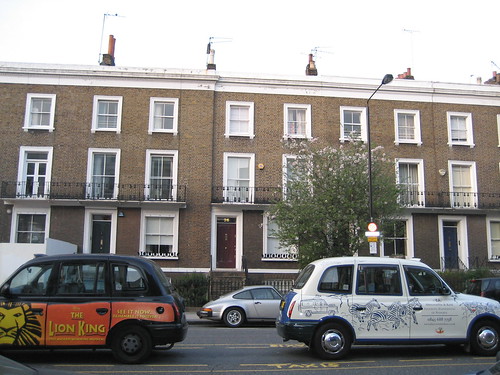
I'll close with a further digression... You might have seen me point to this Lion King decorated taxi a couple of weeks ago. The Wife caught it parked next to the zebras and kitsch taxi displayed above. I quite like the serendipity of the photos and the varying images of Africa expressed in taxicabs.

Lion Kings and Zebras and Kitsch, Viewing Africa in London


Abercrombie & Kent are merchants of "Inspiring Experiences of Namibia" hence the zebras crossing they use to advertise their escapist travel services. The Lion King of course is pure Disney nostalgia. Such are the types and faces we use on our taxis about Africa that mysterious land. The fantasy of Brand Africa.

A Taxi Driver Soundtrack


A playlist for this note

  • Loose Ends - Slow Down
    Apropos braking, we'll start our playlist with Slow Down, the brilliant showpiece of Loose Ends' Zagora album. Classic 80s soul music, eminently danceable and with an infectious chorus. It is often paired with the lead single Stay A Little While Child and the titles are fitting for the laidback theme of the band.
  • The La Drivers Union Por Por Group - Trotro Tour Of Ghana
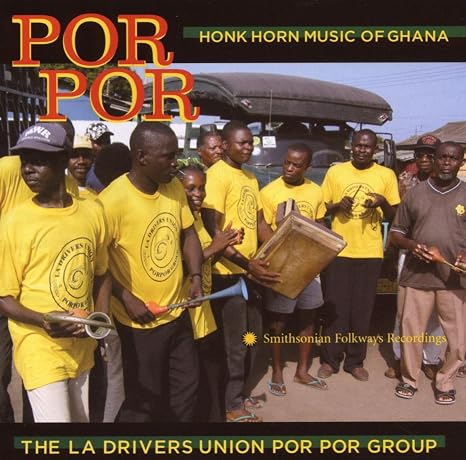
    The La Drivers Union Por Por Group - Por Por: Honk Horn Music of Ghana

    We'll continue with some music by taxi drivers, some honk horn music from Ghana. It's unlike almost anything you've heard, simply consisting of the horns and drums that you might here on the streets as these drivers vie for your trade and seek to attract your attention. This horn group has a 50 year history amongst other things, wielding their honk horns against the colonial regime. They continue to make music from the most unlikely of instuments.

    I quite like 'Driver, Take Me, The Train Has Left Me Behind' and the Kpanlogo Por Por Medley but perhaps it is "Trotro Drivers, We Love You So" that is the best song on the album. You can listen to the slightly more conventional yet still exuberant Trotro Tour of Ghana here.


File under: , , , , , , , , , , , , , , , ,