Showing posts with label theft. Show all posts

Tuesday, September 26, 2023

Tracking Package

Grainy video clip, Nest cam, low resolution
Slight angle from your front window, fishbowl vision
Poor lighting as befitted the early hour, 4 a.m.
After bringing in the new year, he was walking down the street
A double-take, a package at the door, who'd have thought it?

A brief check, took a look around, no one around to witness
But still, precaution, eyes darting, quick, pull up the hoodie
He shuffled in at an angle, eyes turned away
Made a beeline for the door, only a minor course correction
Then, grab and lift. Bulky, a little heavier than expected
What to call it? Booty or bounty? Practiced operator
He walked away furtively. Happy New Year, sucker.

A thief in the night, a liminal shadow, this interloper
Fittingly, in this covidious time, he was not a mask wearer
He duly seized the opportunity to perform the crime
Leaving only this digital trace, the notification
Discovered the next day. And the sense of violation

Grand larceny, you wonder: what was in the package?
Think. You rack your brain, did you order anything?
Stocking up for the lockdown, or was it a gift?
Amazon? UPS? Who even delivers on New Year's Eve?
Maybe your aunt sent a care package from your parents
She just returned from home and asked if you'd received it
That would be something else, what mortification
Oh well, to my nocturnal visitor, compliments of the season


snake at the door

Tracking Package, a playlist


A soundtrack for this note. (spotify version)

This note is part of a series: In a covidious time.


File under: , , , , , ,

Writing log: January 1, 2022

Friday, March 07, 2008

Lunchtime Heist

Something didn't look right. There he was on his hands and knees in the corner next to the ATM ten feet inside the burger joint. It gave you a little pause but you thought you'd proceed regardless. Someone at the front table was muttering something to him, the sounds lost amidst his chewing. Your bag got stuck in the doorway and, by the time you got unstuck, he had gotten up, turned around and was now facing you as you entered. 2:15 was later than normal for you, the upside was that you had missed the lunchtime rush: the place was a little empty.

For whatever reason you looked him up and down and took in the rest slowly. It didn't feel right. A gray hat haphazardly lay atop his head. A jacket: not quite a technician's jacket, nor even a UPS jacket, more like a fashion piece. You looked downwards as he stepped towards you. His hand brought up a bag from behind, he was gripping it tightly. You'd seen the money bags that the couriers use - this was the financial district after all, you see the couriers all over downtown San Francisco. This wasn't a regular bag. Puzzling.

And of course there was the sheepish grin that he was sporting. That definitely looked out of place. No gun that you could see... Still you dismissed your impulse to tackle him. "Whatever, you're imagining things." You walked past him towards the counter. He nodded imperceptibly as you crossed - still smiling you noted, and began to walk out.

As you made your way to the front counter, you continued to put it all together. "Must be missing something. Didn't look like a technician, nor a armored car courier... Surely he won't walk out of here just like that. Wasn't holding a gun, but could he? Why the smile? Anyway let me order."

Just in case, you tried to fix his features in your memory, late forties, brown hair beginning to gray, white guy, looked a little like Chevy Chase. You wondered if you'd make a good witness.

"May I take your order please."
"The special. No drinks... Hmm..."

You figured you should vocalize something about your disquiet. "Umm ... The guy..", you gesture. "Umm, the ATM.. the machine. Umm"

You turned and looked back to the front of the restaurant and noticed that the guy had indeed walked out. Oh well. Then the clincher: the ATM didn't quite look right. You turn towards the server and begin again: "Umm... The guy..."

Someone appeared by your side, impatient and loudly put the words out there:

"You know that someone just robbed your ATM machine."

That's it, that's what didn't look right. The bottom half of the ATM had swung out into the lane. The cheek of it, he even left the door open. You gesture. The newcomer repeated his words:

"You know that someone just robbed your ATM machine."

The woman taking your order was a little perplexed at first - perhaps it was the language barrier. She was also a little annoyed. The two men in front of her were departing from her script. You remained tongue-tied but Citizen Alert proceeded to spew out the details. Eventually, as he got no response, he asked, "Call the manager." She gestured to the manager and the other servers and grunted a name. Then:

"May I help who's next?"

You never quite liked that awkward formulation, surely she could have said "whoever's next" but the grammar pedant in you, let alone the intrigued potential crime witness, decided to step aside. Your order would be ready in a few minutes.

"Next."

You shuffled to the side and turned to look again at the front of the restaurant. Those now entering the restaurant all raised their eyebrows as they passed the evidently-open ATM. An alarming sight you assumed. You'd never seen the inside of an ATM before - well perhaps on the way out. A few diners started pointing towards the ATM but on the whole, there there was a lot of apathy in this joint. Perhaps it was the time of day, perhaps everyone needed a siesta. Or maybe it was just the nature of the place. Lee's is a tad above a McDonalds but it isn't quite a gourmet Barneys. Well you get what you pay for. You decided to take things in.

The manager eventually sauntered out from behind the counter and walked towards the front, chatting all the time on his cell phone. The newcomer accosted him, as did a few others: amplifying and explaining their consternation. The manager didn't seem impressed and continued his phone conversation. Minutes passed and a little group formed around the ATM bending down and examining it. One guy kept saying "ATM machine" and this again bothered you: you thought "machine" was redundant given the acronym. Eventually someone decided to call the police.

Your order arrived, you picked it up, thanked the server and walked over to the gathering at the front. You wanted to get a look at the ATM. Well, who knew?

You wondered how the robber managed to open the ATM and how long he'd been fiddling with it. Did he have a key or tools?

You heard someone say "He must have been a technician."

At that you smiled and shook your head. You said to no one in particular, "He just walked out with a bag of money and left the ATM open! Come on now."

You wondered how many other joints the robber would be targeting. It was a pretty brazen heist but it worked. The managers would be like the present one - unconcerned since the ATM had nothing to do with them. The clientèle would likely be as lethargic as today's version and, well, no one would be a hero. Indeed you were one of the few people who noticed anything anomalous or could have even attempted to stop it. Of course you didn't, proving the point.

You wrote your name and number on a sheet of paper and gave it to the manager in case the police cared - you didn't have time to hang around for them. Four or five others claimed to have gotten a good look at the guy and they all looked excited about their brush with notoriety. As you reached the office a few blocks away you started to hear the sirens.

You've been hibernating for the past few months; perhaps you too have been behaving like everyone in the restaurant: quiet and simply minding your own business. You need to get back into things, find your voice again. Don't let others just walk all over you and snatch your soul. Come on now.

You passed by the joint the next day and noticed that the ATM was no longer there. You kicked yourself for not having photographed the open ATM. You went to another lunch place. The sign was still outside however: ATM inside.

Soundtrack for this note


Nas - Thief's Theme File under: , , , , , , ,

Wednesday, July 11, 2007

Of No Fixed Abode

My initial response to the 2005 London bombings was in the vein of whimsy: London's got soul, a trilogy celebrating the place, my favourite town. I then considered a case of identity theft last year to kick off the present Things Fall Apart series. After the news of the past few days, I can now give you the second part of a trilogy focused on the people. This time a look at my "fourth man": the fifth bomber, a man of no fixed abode. Some notes ripped from the headlines, a few musings and some poetry...


"Thought to be Bukhari": A Paper Trail


You lived with him
You stole his name...

They trained you well
Your name is cursed...

No one knows the identity of this man who performed the identity theft.

Identity Theft

Identity:
[Redacted] 32, from West London. A Ghanaian, his real name is thought to be Bukhari. Said to have abandoned his bomb at Little Wormwood Scrubs after losing his nerve. Represented by Stephen Kamlish, QC.

21/7: the trial, January 16, 2007

Motivation:
Mr Kamlish, representing [redacted], said to Mr Ibrahim: "You wanted to do a copycat of 7/7 - four bombs on 7/7, four bombs two weeks later on 21/7. That was your plan.

"We say your 21/7 bombs were to be bigger and better in your twisted thinking than that of 7/7.

"Four real bombs on the Tube and one block of flats, a tower, destroyed, going up in a ball of flames. That was your plan, wasn't it?"

Man 'planned tower block blast', March 22 2007

During the trial the man I called cursed continued to be referred to by his alias and that inevitable suffix, "of no fixed abode".

Tricksters, gremlins and parasites; who is which?
Mr Kamlish said his client - who the jury was told was really called Sumailia Abubakhari - was "used and abused" by Mr Ibrahim who was a "cowardly, manipulative schemer".

21/7 suspect 'saved tower block', April 17 2007

On Tuesday, he took to the witness box for the first time and told the court his real name was in fact Sumaila Abubakhari and that he is 28 - not 34. Wearing a crisp white shirt, dark blue tie and grey suit, [redacted] said he came to the UK in December 2003 using a passport in someone else's name and applied for the Army. He said he did not consider what countries he might be sent to on active service.

Ghanaian suicide bomber 'wanted to join Army', April 17 2007
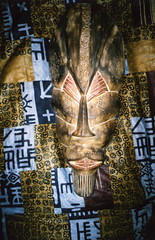
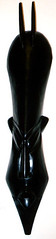
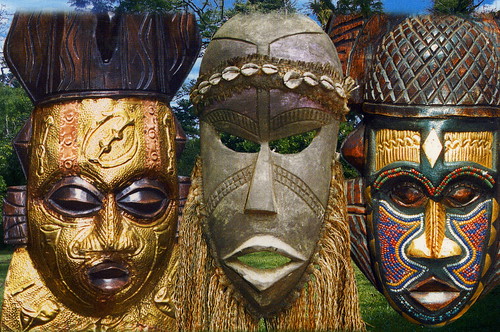
Aburi mask - strange days


Muddied waters:
A terror suspect dismantled a bomb and saved the lives of people living in a tower block, his lawyers have claimed...

Prosecuters say he was the fifth bomber who allegedly lost his nerve at the last minute.

But Stephen Kamlish QC, defending, said his client had ditched his bomb - made of hydrogen peroxide and chapatti flour - at Little Wormwood Scrubs after "making it safe".

Woolwich Crown Court heard claims he also dismantled a booby-trapped sideboard at a "bomb factory" allegedly set up by a co-defendant in Curtis House, New Southgate, north London.

Mr Kamlish said: "He's not asking for any applause, but if he hadn't have done it and it was a bomb that actually worked ... he was in fact responsible - potentially - for saving the block and all the people in it."

Mr Kamlish said his client - who the jury heard was really called Sumailia Abubakhari - was "used and abused" by Ibrahim, a "cowardly manipulative schemer".

The barrister told the jury that [redacted] had been under intense pressure, and was even threatened by another defendant, since deciding to "break ranks".

He described his client as a "decent" and "somewhat childlike, sometimes naive" man.

'Not Asking For Applause', Sky News, April 17 2007

A theatrical man, he makes good copy with his African emotions; consider the headlines generated in under an hour a few months ago:
masks aburi


A compromised man:
Anthony Jennings QC, defending Hussain Osman, accused Mr [redacted] of crying when he told police about his supposedly dead father.

Mr [Redacted] has since admitted that his father is still alive.

"You were doing exactly what you were trying to do to this jury, which is pull the wool over their eyes by starting to cry when you were lying," said Mr Jennings.

The barrister went on to accuse Mr [redacted] of being a "self-confessed liar", a "fraudster", and a "sly and devious liar".

Mr [Redacted] denied lying, saying: "I was remembering the time as I'm staring death in my face and you're telling me not to cry?"

21/7 suspect 'is a devious liar', BBC, April 17 2007

Bukhari or Abubakari?
The prosecution says his real name might be Sumaila Abubakari but his nationality is unclear.

'Bomb plot' trial, BBC, April 17 2007
Bukhari or the other moniker Abubakari are Muslim names typically found in West Africa (from Northern Ghana, Nigeria to Sierra Leone). In Ghana at least, the north is much poorer and less developed than the rest of the country. Northern muslims tend to settle in the zongos (slums). Regardless of nationality, the experience of these dwellers is much like that in the slums of Nima, rough and hardscrabble lives. As an often itinerant people, they are deliberately opaque and insular. This served them well in their dealings with the colonials and beyond but this opacity gives rise to much uncertainty as in the present case. We simply don't know what the nationality is.
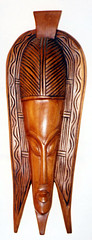
masks-aburi-thin


Emotional:
Mr [Redacted], who is said by the prosecution to have lost his nerve and dumped his device, has said he was not a "fanatic".

He told the court he left the device he was given in a west London park as he "just wanted to get rid of it".

He said Mr Ibrahim had told him the devices would "not hurt anyone".

He told the jury: "It didn't make sense to me. I didn't know whether this was hoax or real or anything to do with terrorists.

"But I didn't want anything where the police got involved in it.

"I thought: 'I don't want to listen no more. I have heard enough. I just don't want to have anything to do with it." ...


At one point, Mr [redacted] needed several minutes to compose himself in the witness box.

He broke down after telling the court of how Mr Ibrahim demonstrated the rucksack device on the morning of 21 July 2005 - two weeks after suicide bombers struck in London on 7 July 2005.

"He started to explain for the first time as if he has been talking to me before," Mr [redacted] told the court.

"I was waiting for him to tell me if this was a suicide bombing or not.

"This was my belief, that this was going to be a suicide bombing because it just happened two weeks ago."

He told the court: "I wanted to live. I wanted to have a good life. I wanted to support my family. It is just something that I have never thought of in my life."

21/7 accused breaks down in court


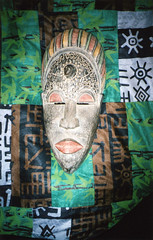
aburi mask


Lies and Truths:
But he agreed with Mr Sweeney's description that he had lied to police on an "epic" scale, including not telling them his real name, religion or background, about buying the peroxide or what he did after the "attacks" had failed.

He said: "It is unbelievable when I look back at these lies...I lied about the whole day of July 21."

Mr Sweeney said: "You lied through your teeth as to who the bombers were."

[Redacted] replied: "Yes I did. I did not want to associate myself with them after realising what they had put me through."

[Redacted] denied lying to cover up his own guilt, maintaining that he was initially manipulated by co-defendant Muktar Said Ibrahim to follow the story that the attacks were meant only to be a hoax but realised once the trial had started that he had to tell the truth.

21/7 suspect 'lied on epic scale' April 27, 2007

Assessment
The jury deliberating the cases of the alleged July 21 bomb plotters was today discharged after failing to reach a verdict on the final two defendants.

The decision by the trial judge, Mr Justice Fulford QC, came during the eighth day of deliberations by the jury at Woolwich crown court in south-east London.

He asked prosecutors to decide by tomorrow whether they want to seek a retrial for [redacted].

Jurors fail to reach verdicts on two 21/7 defendants, Guardian, July 10, 2007
The jury was discharged yesterday after failing to reach a decision on two other defendants, [redacted], both of whom deny conspiracy to murder.

[Redacted], 34, of no fixed address, ... will face a retrial, prosecutors said today.

Four July 21 plotters jailed for life, The Guardian, July 11, 2007

A Redacted Note


It has been known since September 2005 that the man I called cursed, a man of "no fixed abode" and now "thought to be Bukhari" was not the man his identity papers claimed, yet in the proceedings of the trial and the journalistic coverage, he is continually referred to with his stolen name. Perhaps this is as it should be, the slow workings of the law and the wheels of justice, an administrative decision. Yet each mention of the name is an open wound for a family in Ghana and London, a reminder about the continuing trauma in their lives. We are all collateral damage, the walking wounded of these interesting times.

I'll note in passing that the western journalistic tic of attaching an age and provenance to every name leads to the stilted formulations of the copy we have seen. Indeed these details detract from the heart of the matter and obscure rather than enlighten the complexities of this very human story. As we have seen, the name, age and nationality are still undetermined and the reporting has been wrong throughout. The only certainty is that he is "of no fixed abode". If we do have to name, place and date in tangible words, I suggest in this case that we stick to the following:
"[redacted], undetermined age, unclear nationality, of no fixed abode"
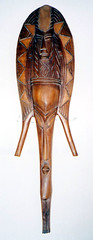
aburi mask dark


Reflection


A few more leading indicators to round off our notes:
Al-Qaeda has responded to the U.S. intelligence focus on young Arab men as potential risks, he says, by recruiting "jihadists with different backgrounds. I am convinced the next major attack against the United States may well be conducted by people with Asian or African faces, not the ones that many Americans are alert to."

George Tenet: Tenet Details Efforts to Justify Invading Iraq, April 28, 2007
No country is immune from these things, consider this clipping from last summer:
Two Nigerians, whose identities were not disclosed at press time, have become victims of the exchange of artillery fire between Israeli authorities and Hezbollah forces in Lebanon.

Two Nigerians Confirmed Killed in Lebanon bombings, July 24, 2006
The footsoldiers of The Great Game know no boundaries, indeed their variety is a historical commonplace.
So when I watched the recent protests in Kyrgyzstan, I thought not to the recent people-power outings in Ukraine and Georgia or even to the collective courage that led to the fall of the Berlin Wall (not pope-inspired by the way). Rather I thought back to Christmas 1990 sitting in Nancy, France, watching images from Bucharest alongside a true-believer socialist as his worldview finally succumbed to that ineffable and unrelenting pull of gravity.

It is no comfort to have learnt, as I did a few years later, that there were Ghanaians who died fighting for that reptilian man, Nicolae Ceausescu, alongside his Securitate during the Romanian overthrow of that macabre communist regime. I thought about the kind of world in which someone would send young Ghanaian men to train in interrogation techniques in far-flung places like Cuba, East Germany and Romania to come back and oppress their people.

I thought about what it meant for a young man to find himself in that position, in a foreign land, dodging bullets and shooting at people, in their own country mind you, trying to overthrow a rotten regime. I thought about how miserable and brutish their lives must have been to have undergone that kind of journey. And what about their peers who did come back from their various schools of grist to wreck havoc on their compatriots? I'm sure that some of these trained killers are among those who carry out weekly armed robberies in our towns.

Strange Bedfellows and the Journalistic Impulse
Perusing these notes, the obvious questions remain unanswered. Depending on where you stand, the actors range from convenient scapegoats like John Walker Lindh, to the convinced and morally convicted ciphers such as Richard Reid, to the more ambiguous cases like that of the man I call cursed. There is perhaps a full spectrum of responses: from moral courage, through the mistaken and misguided indiscretions of youth, to moral midgetry. That is the terrain of fallen angels.

As with all things about the human factor and the theatre of our existence, our fall from grace perhaps renders this melancholy mystery unknowable. One cannot but stare at the trainwreck when it comes. But how does one equip oneself to face the abyss? Where does one buy soul insurance? In a dark time, perhaps social living is the best.

masks maame


"Of No Fixed Abode"


Identity theft
Open wounds

Fallen angels
Damaged goods

Brutish living
Scarred consciences

Devious schemers
Lost nerves

Enemy combatants
Collateral damage

Modern travelers
Prison shelters

Stolen verdicts
Jury deadlocks

Bomb factories
Moral blinders

Hostile lives
Fractured dislocations

Cultural interplay
Social living

The aliases of exiled souls
Alienated, "of no fixed abode"

Soundtrack for this note


Of No Fixed Abode, a playlist
  • Antibalas - Indictment
    An angry afro-beat meditation with dissonant horns that presents a bill of goods, if not some articles of impeachment, on our current situation. The song is also a humourous indictment of all those rogues in a musical court of law. One wished everyone expressed their grievances in music or words. The cover art is prescient about the flight of that man "thought to be Bukhari", the confusion and urgency are the same, as is the mistaken resort to violence. It is the mask of a man of no name, of indeterminate age, of unclear nationality and of no fixed abode. The only missing thing is the discarded, bomb-laden rucksack.

    Antibalas - Indictment
  • Prince - Reflection
    A simple song: light drums and an acoustic guitar that sticks in your head and gets you singing along before you know it. The melody is wistful and, befits the title, reflective. We're reminiscing about innocence lost, the good old days when decisions were without consequence and life itself was carefree. Not everyone has that luxury but we can all empathize with that sentiment
    Sometimes I just want to sit out on the stoop, play my guitar just watch all the cars go by
  • Angie Stone - Soul Insurance
    Her warm voice endears as does the music; Angie assures you that she has got your back. Soul assurance. Soul insurance. Where do I sign up for mahogany soul?


Update August 29, 2007

The following passage should give much pause for those sympathetic to this man "thought to be Bukhari"
He said that Mr Omar had offered a bed to a mentally ill African refugee, took in a homeless Indian man and paid visits to people in hospital. He never heard Mr Omar speak out in support of any act of terrorism. Mr Dixon said: "He was against the Iraq war, but... he said nothing radical." Mr Dixon became an unwitting helper of the alleged conspirators when he accompanied Mr [Redacted] on a trip to buy dozens of litres of hydrogen peroxide, the chemical that formed the key ingredient of the rucksack bombs.

Witness was unwitting helper with 21/7 purchase
So not only did [redacted] use people unwittingly to help buy bombmaking equipment but, if my reading is correct, he also stole the identity of that "mentally ill African refugee" who his accomplice had taken in. No one has connected these particular dots but I would lay even odds that said refugee was indeed the man who woke up to learn that the police were calling him a bomber. That would certainly round out the circle of infamy of tricksters using anyone who falls into their orbit. One wonders if there really are any more shades of gray to this story.

Next: Ode to Betty Brown

File under: , , , , , , , , , , , , , , , , , , , , ,

Sunday, June 03, 2007

A Plagiarism in Plaid

To the Editors (Daily Telegraph)
Date: Jun 3, 2007 5:29 AM
Subject: A plagiarism in plaid?


I noted with interest that Liz Hunt's recent opinion piece — Immigrants have bags of ambition (June 2, 2007) — was a nice reworking of my April 13, 2007 essay, Bags and Stamps, published on my blog, Koranteng's Toli.

While I appreciate that this means that I have readers in high places, the norm when remixing on the web is to include a link to the originating source of the material.

I'll assume that this was a minor oversight on her part and, for what it's worth, she adds a little colour, her personal perspective and indeed some original reporting - not a bad remix - she certainly channeled my words and ideas quite effectively.

Still one wonders about these things... A cursory examination reveals wholesale, shall we say, lifting of said words and ideas.

It is also ironic since the essay was ostensibly about the ecstasy of influence, as Jonathan Lethem would have it, and concerned itself with a high profile appropriation, if not plagiarism, by Marc Jacobs of Louis Vuitton fame of the notion of "Ghana must go bags" as used in the work of Ghanaian artist Senam Okudzeto. That the Ghanaian writer who connected these dots together is himself (inadvertently we'll assume) written out of the conversation is quite something to behold.

"Out of Africa always something new", wrote Pliny The Elder. There must have been a second part to his observation: "Things to be used but not acknowledged".

A further twist, this essay is part of my ongoing Things Fall Apart series which I am hoping to publish as a book - I am quaint that way. It had been suggested to me to send it to the New Yorker or similar. It now appears that I have a nice postscript for the essay, if not a further essay topic, one addressing the lines between journalism and blogging and the influences and overlap thereof.

I am unclear whether Liz's piece was published in the newspaper or only online. If the former, presumably there are well known procedures for corrections of editing errors, errors of omission or indeed (and God forbid) errors of commission - that is the domain of so-called intellectual property, copyrights and such.

If the latter, I'd appreciate a link.

The internet being what it is, I am glad to have the option of commenting directly on the piece in question through The Telegraph's website and 'having my say' in that forum. I'll demur for the moment and intend to publish my query on my website. Perhaps your response or indeed that of your reporter can occur on my grounds.

Still, the currency of the web is the link, I don't think it is too much to ask for a link. It simply adds to the conversation.

Best regards.

Koranteng Ofosu-Amaah

P.S. For further fodder, I took a few minutes to provide a little juxtaposition of the two articles, nothing exhaustive but illustrative I hope - a link in other words - and here I hesitate to reuse a title I had suggested in my original essay:

Click here — Bags and Stamps: a plagiarism in plaid
As a study in contrast, consider this sampling and judge for yourself:

Koranteng Liz Hunt
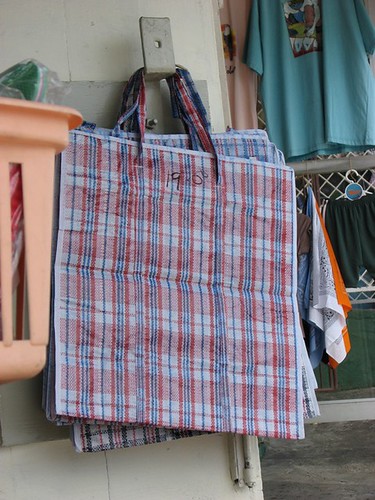
In Ghana and most of West Africa we call it the "Ghana must go" bag. Last year Sokari Ekine revealed her own bag woman tendancies and opened the discussion - she's a connaisseur. In response, Georgia Popplewell noted that "in Trinidad I've heard those bags called Guyanese Samsonite". We learnt that in Germany, per contra, they are known as "Tuekenkoffer" or Turkish suitcase. In Boston I've heard them referenced as Chinatown totes, and called Bangladeshi bags in England, presumably after the 1970s influx of Bangladeshi immigrants. In Ghana, it is known as the "Ghana must go" bag; in Germany it is "Tuekenkoffer" or the Turkish suitcase; in America, the "Chinatown tote"; in Guyana as "Guyanese Samsonite" and elsewhere as the "Bangladeshi Bag"


Do note that the author completely misses Georgia's nuance by transposing Trinidad to Guyana. The point is that the naming is done by the natives - looking down onto the teeming masses of refugee or downtrodden immigrant Others. Thus Nigerians named the bags Ghana must go, Germans named it Türkenkoffer, and so forth. Thus this is not a simple copying and pasting, there was reordering and some conscious editing done in the article, and perhaps the immigrants coalesced into one indistinguishable mass. This is of a piece with the general disdain for said immigrants that the rest of the author's commentary indicates. We can also skip over how Boston becomes America in the coining of "Chinatown tote". The rest of the article I'll suggest is equally enlightening.

bags and stamps a plagiarism in plaid


Soundtrack for this note


I normally offer playlists to accompany my writing, in this case we'll go with Abbey Lincoln, she has been on my mind lately.
Abbey Lincoln - Throw it Away
From her extraordinary 1995 album A Turtle's Dream, the lyrics are inspirational and I hope she'll forgive me for reproducing them here with attribution.
One day I found these magic words
in a magic book:


Throw it away. Throw it away
Give your love, live your life
each and every day,
and keep your hand wide open.
Let the sun shine through,
'cause you can never lose a thing
if it belongs to you


[Update June 5, 2007 3:31PM PST]


My inbox, the comments and clickstream on my website all tell an interesting tale. The global audience of modern travellers and sedate web surfers who frequent this joint have sprung into action, mice and keyboards at the ready. Even some who normally remain dark matter have sent head nods of recognition if not sympathy or empathy (and links of course - this is the web). It's comforting to know that I'm part of such a community.

Sokari who started this global conversation is suitably outraged, as is Georgia, and presumably that prolific fellow named Anonymous. Sattva helpfully pointed out that even the typos were faithfully reproduced in the Daily Telegraph - the Türkenkoffer Tragedy as it were. The Telegraph columnist has no idea about the depth of fortitude of the interlocutors she dismissed - bags of ambition is the least of it.

It's been a day or so since a Telegraph editor read my query and I, like many, have been slightly expectant as to their response. I know also of at least one outraged toli reader who deigned to comment on Sunday on the Telegraph's website - annoyed that I hadn't immediately published this note on my blog on Saturday. That comment has not been published and indeed, as I write, the article's web page is unchanged since Saturday.

The initial silence from the Telegraph's offices, like all silences, can at once be seen as eloquent and troubling. Eloquent in suggesting that one's concern was deemed trivial or not worthy of a response and all that implies. Troubling because of what the cynical might proffer as the worst reading of the matter. If someone could be so reckless as to brazenly and casually pass off others' words as their own, one inevitably wonders just how long such things have been going on. We have seen recent high-profile examples of such effrontery in journalism.

Such actions would also show a certain contempt, for editors and audience alike. As an editor, I would worry about the compromise of a publication's reputation and want to proceed carefully. Allegations of sloppiness and/or misconduct are serious, and reflect on people's careers and livelihoods, not to mention the bottom line of the organizations that relate to them. This is the tangled web of The Reporter and The Editors. I place my faith in The Editors in this instance.

One theme I've been considering in this series is 'who is writing the script?' and I've even suggested a word to cover the behaviour I've observed: huhudious. I trust instead that Telegraph editors are simply not wanting to rush to judgement. Let's hope they will be thoughtful in their eventual and considered response.

I do appreciate that The Reporter advanced the story - indeed she adds one important and original nugget: the name and background of the putative Chinese manufacturer of our Ghana must go bags. Another potential addition is the model name and price of the Louis Vuitton plaid appropriation - although that last could be figured out by following the links I sourced in my original essay. These are the kinds of things I would undoubtedly have followed up on as a professional. With The Reporter's kind permission, I will include these points (after quite scrupulous fact-checking of course, and with attribution) when I do finally submit my article to editors for publication in a magazine or book.

Liz Hunt, at the prompting of The Editors, has kindly replied to my query and I've linked our email exchange below:
Click here — Liz Hunt - Plagiarism Exchange
It's a very creative defense, the most revealing phrase being "how our researcher came to your blog". Thus she cannot but acknowledge that I was a crucial source of her story - the damning spelling mistakes, let alone the juxtapositions that a few minutes revealed, don't offer a leg to stand on. A friend had posited an underling factor in this business, but who knows about these things; she can best inform us. Anyway you can judge her motivations and thought process for yourself. Her response is unedited as she requested.

I do wonder about her use of the word "refute" and whether she has since taken a peek at my blog, because most wouldn't dare brazen this out. But maybe it is that in my culture I have a different appreciation of shame. Still I'll acknowledge the protestations of "good faith" - although the evidence is lacking in my opinion. I do believe in the golden rule but I'll admit I have no words for her.

In the meantime, I wait patiently for the response of The Editors. They are the ones I addressed my note to, and they are well versed in honour and the calculus of damage limitation. There is enough going on in my life that I won't go out of my way to press the issue. I thought I'd enjoined in a beautiful conversation, but a gift bestowed with open heart seems besmirched by notoriety. I will say that this episode leaves a sour taste - quite tangible in real life, that not even Abbey Lincoln's sultry and bittersweet exhortation can cover. Blogging shall be fitful at best for the next few weeks. I will in parting add a couple of stanzas to my original poem
Bags and stamps

Modern travellers
Packing our bags
Seeking out stamps
The mementos of exiled souls

Ghana must go versus Louis Vuitton
Observing a hustler tradition
Enjoining a global conversation

The Reporter and The Editors
Immigrants and their ambition
Plaid bags and plagiarism

A Busy Person's Guide to the Curious Case of Liz Hunt, Plagiarism and The Daily Telegraph


A couple of links for the busy observer...

[Update June 15 2007]


So. Twelve days later... As we continue to wait for The Daily Telegraph editors to weigh in on matters of plagiarism, I thought I'd lighten the mood a little and follow up with some of the visual responses I've received to the Bags and Stamps essay and to this note.

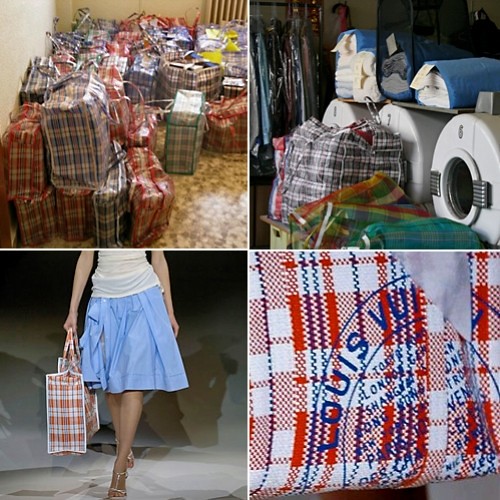
The first came from Elia, whose visual sense is more acute than mine and came up with this great collage which makes the point more effectively than I had. My spanish is non-existent, but a Babelfish translation indicates that a very kind label had been launched towards this joint; a head nod back in your direction, Elia.

plaid bag collage Ghana must go Louis Vuitton


Guyanese Samsonite Musings


Georgia, our Trinidadian informant on the "Guyanese Samsonite" business, took the following photo in a market in Scarborough, Tobago. She was also threatening to follow a lead and head out in the pouring rain to photograph a woman she had passed a day earlier, sans camera, who sported one of these bags that featured a flowery addition to our plaid stylings. Please don't risk your health on my account, it's just a bag!

Tobago plaid bag, Guyanese Samsonite by Georgia Popplewell


While on the Guyanese Samsonite angle, one wonders when that name was bestowed on the bags. I wonder if these are the same bags that not just the Guyanese, but also the Trinidadians and the Jamaicans, were carrying in the 1940s and 1950s when that immigration wave happened, and Britain was welcoming them for their cheap labour. Their struggles were what the famed Trinidadian writer, Samuel Selvon, lovingly chronicled in The Lonely Londoners which also has piercing insights on African immigrants at that time.

The cover art indicates slightly different luggage:

the lonely londoners by Sam Selvon


The literary evidence points to similar bags of exigency as when a family suddenly appears and handbags an Trinadadian immigrant at Waterloo station. Described in Selvon's pitch perfect voicing of Caribbean patois:
A old woman who look like she would dead any minute come out of a carriage, carrying a cardboard box and a paperbag. When she get out the train she stand up there on the platform as if she confuse. Then after she a young girl come, carrying a flourbag filled up with things. Then a young man wearing a widebrim hat and a jacket falling below the knees. Then a little boy and a little girl, then another old woman, tottering so much a guard had was to help she get out of the train.

"Oh Jesus Christ," Tolroy say, "what is this at all?"
"Tolroy," the first woman say, "you don't know your own mother?"

Tolroy hug his mother like a man in a daze, then he say:

"But what Tanty Bessy doing here, Ma? and Agnes and Lewis and the two children?"
"All of we come, Tolroy," Ma say.
The goodwill for those Caribbean immigrants was beginning to run out by the time he published his novel and he catches the flavour of that historical moment in the paperbags, flourbags and indeed in that stylized prose.

Staying on the Caribbean theme, and with another stylist, one wonders whether our plaid bags were similarly depicted by Patrick Chamoiseau in the mythical slums of Martinique or whether his urban griot, Solibo Magnifique, would have spontaneously declaimed any odes to them as he walked through those grand markets. The cover art you'll see is again ambiguous.

Appropriation a l'Africaine


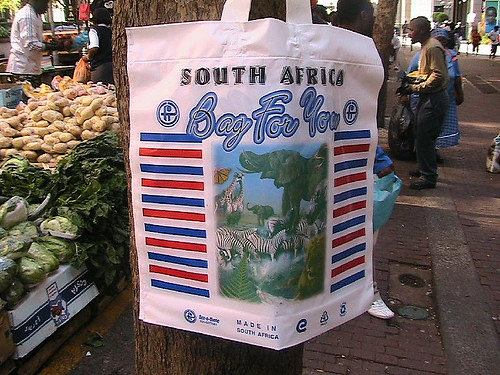
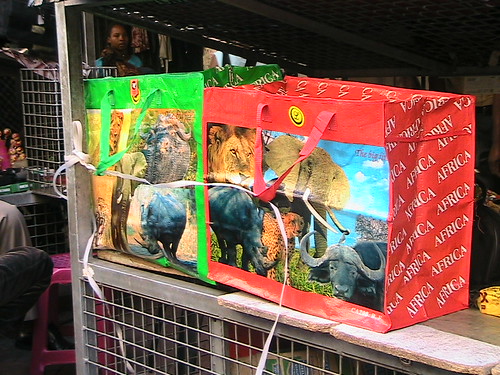
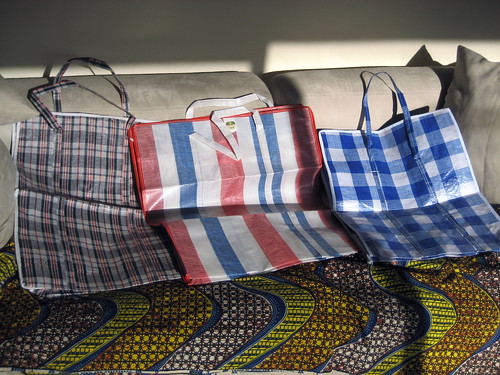
Sokari mentioned that the trend in South Africa was to rebrand the plaid bags "with shiny maps of Africa, elephants, soap powder and all sorts". The idea is to badge them with Made in South Africa labels. I quite agree, why should the Chinese have all the fun, and profit, even on these cheap goods? The Wife called this the Fubu effect, reinvention and appropriation. Sokari kindly sent along these photos that make the point quite effectively.

sokari south africa utility bags


Forget your garden-variety shoppers with heavy loads to pick up, I trust even the tourists will be picking them up, I certainly would. She adds: "photos were taken in April in the Jeppe Street / Bree street areas of downtown Joburg. I have a blue version of the red one which cost me 10 rands". They come in "blue, red and green and large, medium and small". A great knockoff with a little profit to boot.

sokari south africa utility bags


Still, as with book covers and types and faces, these too present a certain image of Africa: zebras, elephants, safaris etc. While certainly more colourful, fun and perhaps "authentically African", the more arresting images to my mind are those of the marketplaces in which they are found, and the context in which they are used. The streets of downtown Johannesburg and the activity therein draw me in, as do the marginalia of the Tobago concoction. Those marketplaces are as much a part of Brand Africa or Brand Caribbean as the fashionable and camera-ready versions.

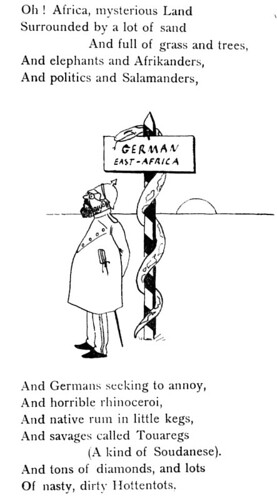
I'm reminded of what Hilaire Belloc wrote in The Modern Traveller
Oh! Africa, mysterious Land
Surrounded by a lot of sand
And full of grass and trees,
And elephants and Afrikanders,
And politics and Salamanders
Oh! Africa, mysterious Land - the modern traveller


As long promised, that 1898 tome will be addressed in a coming installment of our meandering series, it is indeed an invigorating antidote to the later Heart of Darkness...

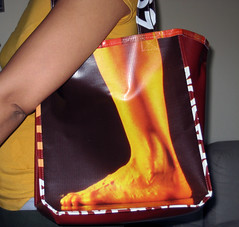
Finally, and in a different direction, I ran across the work of Bay Area artist, Jenny Hurth, this past weekend at an art fair in Berkeley.

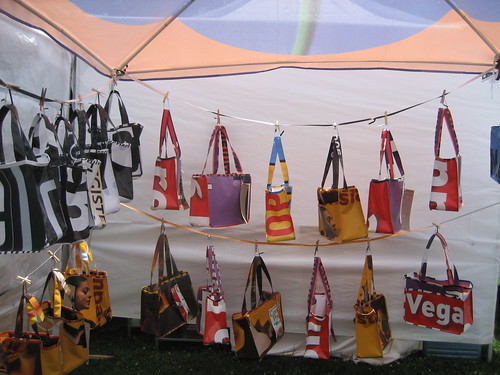
arm and a leg - Jenny Hurth


Another bag lady, she makes her bags from recycled banners from trade shows and conferences - essentially the garbage that these marketing events and ceremonies engender.

jenny hurth bags


I think the notion of recycling is quite apt, and works well in terms of encapsulating historical memory and rescuing it in a tangible, utilitarian, and, in some instances, fashionable repository. I'll try to connect her with Senam, they should have much to talk about.

[Update June 21, 2007]

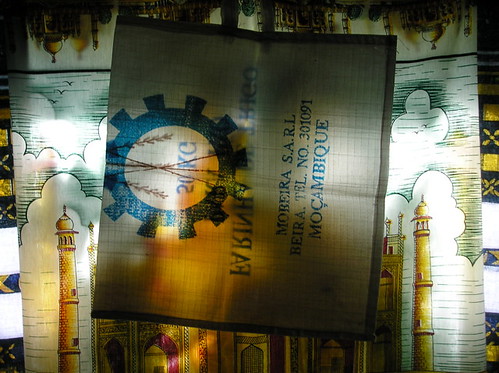
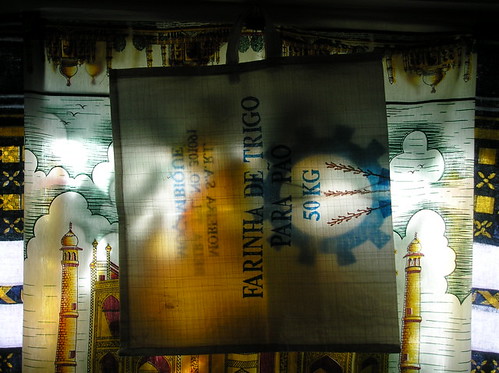
My good friend Nate, riffs on our "South African Street Merchant Bags" and considers containers in one big boxy multicoloured metaphor. He also sends along a bag "bought in Vilankulos, Mozambique. It's a re-sewn flour sack." Dig the back lighting.

mozambique flour sack nate


He adds as an aside:
Reminds me of how flour companies in the US used to use sacks that had floral patterns printed on, once they realized farm wives were using the soft cotton material to sew dresses out of. I think Williams-Sonoma now sells "flour-sack" kitchen towels, designed to mimic the better properties of towels made from actual flour sacks.
mozambique flour sack nate


I too have batakaris from the north of Ghana made from flour sacks. They feel more comfortable than the ones made with more conventional materials and lining. As we have seen, their utility too goes beyond flour and general market duty, and spans the world, from Mozambique to Trinidad, to Ghana, England and Middle America. This reinvention is only fitting: Humanity knows no boudaries.

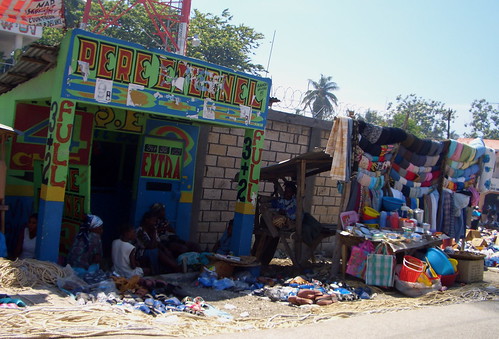
Connecting dots further, I'll simply point to this image from a slideshow in Hanna Rose Shell and Vanessa Bertozi's wonderful documentary Secondhand (Pepe) about the history of used clothing and immigration - and more on said documentary later. Simply note the presence of our Ghana must go bags in the midst of the bend down markets in Haiti where the cast-offs of the First World are bartered and reinvented in the comfort of the Haitian landscape.


Credit: Vanessa Bertozi (licence)


Perhaps others can provide their plagiarisms in plaid, I'll be your bag man, collecting your visions. I'm quite easy to contact and will happily link if need be — that business about attribution on the web... Links do cost so little.

[Update July 1, 2007]

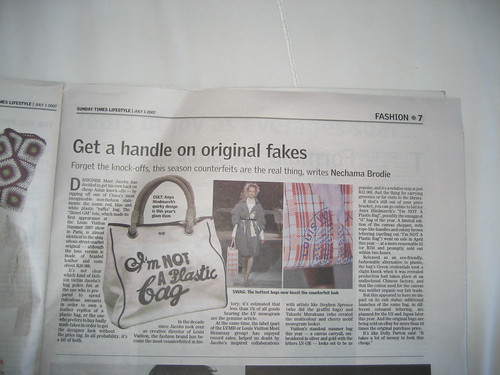
The Wife, while conducting research in an unseasonably chilly South Africa, points out a piece she came across in this week's Sunday Times at Johannesburg airport, Get a handle on original fakes. It's a bit of a late pass on Marc Jacob's expensive appropriation, or rather his plagiarism in plaid but it is a good example of how one would expect journalists to cover the story,


Nechama Brodie has written a sharp and insightful piece with a reflective perspective and original reporting. Further, she contributes a few more terms to our bag vocabulary. Apparently in South Africa, they are known as "raffia" bags or as the "Street GM" which meshes well with Nate's "South African Street Merchant Bags" characterization. Interestingly there is no trauma involved in the naming, these are generic names. One wonders whether the large influx of Zimbabwean immigrants fleeing the bleak desperation of that rogue called Mugabe in recent times will change that perception. From what I understand, South Africans are beginning to resent the refugees in their lands and, curiously enough, brand them generically as "Nigerians". Will be soon be hearing cries of "Nigeria must go" as the natives start resenting the immigrant upstarts? Or is it rather the case that Zimbabwean's, with their rich tradition of Ndebele textiles, have not had to resort to our bags of exigency as they flee into political and economic exile? Perhaps they use baskets as they take flight? Inquiring minds want to know.

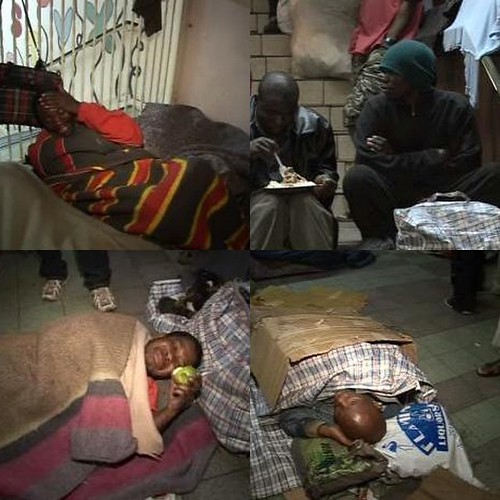
Grandiose Parlor points us to some videographic evidence, an AFP news report on Zimbabweans fleeing the brutality and economic deprivation that is the lot of those living under the thumb of that rogue.

Zimbabwean refugees in South Africa


It is difficult to watch these kind of images and see proud people sleeping rough in churches in the cold South African winter. How does one handle the rogues that cause these things? It is no comfort to notice the presence of our Ghana must go bags by acting as literal comforters for a few that choose a blanket of soul made of our plaid polypropylene bags. I'll wager we'll soon be hearing "Zimbabweans must go" (Zim must go?) before too long.

Returning to lighter thoughts and perhaps to rogues previously discussed, I do like Brodie's poetic title. "Get a handle on original fakes" could very well be the best strategy to apply to our smug and admitted plagiarist at the Daily Telegraph.

Our dear Liz Hunt isn't even saying "I smoked but I didn't inhale", like Mr Clinton famously did about his youthful indiscretions with marijuana. No, that would be too easy. Rather it's a case of
"I smoked, but it was for a good cause. And incidentally I resent you accusing me of smoking as much weed as I did smoke."
Oh well hubris springs eternal, the celebrity got to her head; a diluted sense of noblesse oblige... We shall take our time formulating the appropriate response.

ghana must go mission


Bags and Stamps - the photo set

File under: , , , , , , , , , , , , , , , , , , , , , , , , , , , , , , , ,