Showing posts with label globalization. Show all posts

Wednesday, July 11, 2007

Of No Fixed Abode

My initial response to the 2005 London bombings was in the vein of whimsy: London's got soul, a trilogy celebrating the place, my favourite town. I then considered a case of identity theft last year to kick off the present Things Fall Apart series. After the news of the past few days, I can now give you the second part of a trilogy focused on the people. This time a look at my "fourth man": the fifth bomber, a man of no fixed abode. Some notes ripped from the headlines, a few musings and some poetry...


"Thought to be Bukhari": A Paper Trail


You lived with him
You stole his name...

They trained you well
Your name is cursed...

No one knows the identity of this man who performed the identity theft.

Identity Theft

Identity:
[Redacted] 32, from West London. A Ghanaian, his real name is thought to be Bukhari. Said to have abandoned his bomb at Little Wormwood Scrubs after losing his nerve. Represented by Stephen Kamlish, QC.

21/7: the trial, January 16, 2007

Motivation:
Mr Kamlish, representing [redacted], said to Mr Ibrahim: "You wanted to do a copycat of 7/7 - four bombs on 7/7, four bombs two weeks later on 21/7. That was your plan.

"We say your 21/7 bombs were to be bigger and better in your twisted thinking than that of 7/7.

"Four real bombs on the Tube and one block of flats, a tower, destroyed, going up in a ball of flames. That was your plan, wasn't it?"

Man 'planned tower block blast', March 22 2007

During the trial the man I called cursed continued to be referred to by his alias and that inevitable suffix, "of no fixed abode".

Tricksters, gremlins and parasites; who is which?
Mr Kamlish said his client - who the jury was told was really called Sumailia Abubakhari - was "used and abused" by Mr Ibrahim who was a "cowardly, manipulative schemer".

21/7 suspect 'saved tower block', April 17 2007

On Tuesday, he took to the witness box for the first time and told the court his real name was in fact Sumaila Abubakhari and that he is 28 - not 34. Wearing a crisp white shirt, dark blue tie and grey suit, [redacted] said he came to the UK in December 2003 using a passport in someone else's name and applied for the Army. He said he did not consider what countries he might be sent to on active service.

Ghanaian suicide bomber 'wanted to join Army', April 17 2007
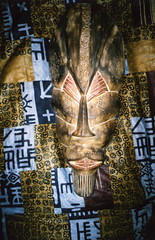
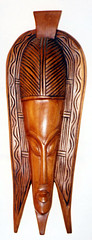
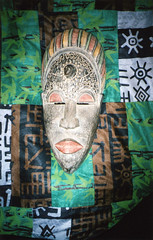
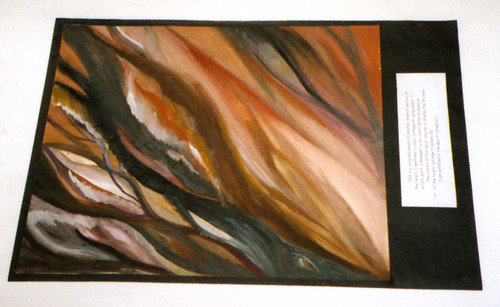
Aburi mask - strange days


Muddied waters:
A terror suspect dismantled a bomb and saved the lives of people living in a tower block, his lawyers have claimed...

Prosecuters say he was the fifth bomber who allegedly lost his nerve at the last minute.

But Stephen Kamlish QC, defending, said his client had ditched his bomb - made of hydrogen peroxide and chapatti flour - at Little Wormwood Scrubs after "making it safe".

Woolwich Crown Court heard claims he also dismantled a booby-trapped sideboard at a "bomb factory" allegedly set up by a co-defendant in Curtis House, New Southgate, north London.

Mr Kamlish said: "He's not asking for any applause, but if he hadn't have done it and it was a bomb that actually worked ... he was in fact responsible - potentially - for saving the block and all the people in it."

Mr Kamlish said his client - who the jury heard was really called Sumailia Abubakhari - was "used and abused" by Ibrahim, a "cowardly manipulative schemer".

The barrister told the jury that [redacted] had been under intense pressure, and was even threatened by another defendant, since deciding to "break ranks".

He described his client as a "decent" and "somewhat childlike, sometimes naive" man.

'Not Asking For Applause', Sky News, April 17 2007

A theatrical man, he makes good copy with his African emotions; consider the headlines generated in under an hour a few months ago:
masks aburi


A compromised man:
Anthony Jennings QC, defending Hussain Osman, accused Mr [redacted] of crying when he told police about his supposedly dead father.

Mr [Redacted] has since admitted that his father is still alive.

"You were doing exactly what you were trying to do to this jury, which is pull the wool over their eyes by starting to cry when you were lying," said Mr Jennings.

The barrister went on to accuse Mr [redacted] of being a "self-confessed liar", a "fraudster", and a "sly and devious liar".

Mr [Redacted] denied lying, saying: "I was remembering the time as I'm staring death in my face and you're telling me not to cry?"

21/7 suspect 'is a devious liar', BBC, April 17 2007

Bukhari or Abubakari?
The prosecution says his real name might be Sumaila Abubakari but his nationality is unclear.

'Bomb plot' trial, BBC, April 17 2007
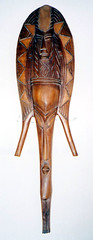
Bukhari or the other moniker Abubakari are Muslim names typically found in West Africa (from Northern Ghana, Nigeria to Sierra Leone). In Ghana at least, the north is much poorer and less developed than the rest of the country. Northern muslims tend to settle in the zongos (slums). Regardless of nationality, the experience of these dwellers is much like that in the slums of Nima, rough and hardscrabble lives. As an often itinerant people, they are deliberately opaque and insular. This served them well in their dealings with the colonials and beyond but this opacity gives rise to much uncertainty as in the present case. We simply don't know what the nationality is.
masks-aburi-thin


Emotional:
Mr [Redacted], who is said by the prosecution to have lost his nerve and dumped his device, has said he was not a "fanatic".

He told the court he left the device he was given in a west London park as he "just wanted to get rid of it".

He said Mr Ibrahim had told him the devices would "not hurt anyone".

He told the jury: "It didn't make sense to me. I didn't know whether this was hoax or real or anything to do with terrorists.

"But I didn't want anything where the police got involved in it.

"I thought: 'I don't want to listen no more. I have heard enough. I just don't want to have anything to do with it." ...


At one point, Mr [redacted] needed several minutes to compose himself in the witness box.

He broke down after telling the court of how Mr Ibrahim demonstrated the rucksack device on the morning of 21 July 2005 - two weeks after suicide bombers struck in London on 7 July 2005.

"He started to explain for the first time as if he has been talking to me before," Mr [redacted] told the court.

"I was waiting for him to tell me if this was a suicide bombing or not.

"This was my belief, that this was going to be a suicide bombing because it just happened two weeks ago."

He told the court: "I wanted to live. I wanted to have a good life. I wanted to support my family. It is just something that I have never thought of in my life."

21/7 accused breaks down in court


aburi mask


Lies and Truths:
But he agreed with Mr Sweeney's description that he had lied to police on an "epic" scale, including not telling them his real name, religion or background, about buying the peroxide or what he did after the "attacks" had failed.

He said: "It is unbelievable when I look back at these lies...I lied about the whole day of July 21."

Mr Sweeney said: "You lied through your teeth as to who the bombers were."

[Redacted] replied: "Yes I did. I did not want to associate myself with them after realising what they had put me through."

[Redacted] denied lying to cover up his own guilt, maintaining that he was initially manipulated by co-defendant Muktar Said Ibrahim to follow the story that the attacks were meant only to be a hoax but realised once the trial had started that he had to tell the truth.

21/7 suspect 'lied on epic scale' April 27, 2007

Assessment
The jury deliberating the cases of the alleged July 21 bomb plotters was today discharged after failing to reach a verdict on the final two defendants.

The decision by the trial judge, Mr Justice Fulford QC, came during the eighth day of deliberations by the jury at Woolwich crown court in south-east London.

He asked prosecutors to decide by tomorrow whether they want to seek a retrial for [redacted].

Jurors fail to reach verdicts on two 21/7 defendants, Guardian, July 10, 2007
The jury was discharged yesterday after failing to reach a decision on two other defendants, [redacted], both of whom deny conspiracy to murder.

[Redacted], 34, of no fixed address, ... will face a retrial, prosecutors said today.

Four July 21 plotters jailed for life, The Guardian, July 11, 2007

A Redacted Note


It has been known since September 2005 that the man I called cursed, a man of "no fixed abode" and now "thought to be Bukhari" was not the man his identity papers claimed, yet in the proceedings of the trial and the journalistic coverage, he is continually referred to with his stolen name. Perhaps this is as it should be, the slow workings of the law and the wheels of justice, an administrative decision. Yet each mention of the name is an open wound for a family in Ghana and London, a reminder about the continuing trauma in their lives. We are all collateral damage, the walking wounded of these interesting times.

I'll note in passing that the western journalistic tic of attaching an age and provenance to every name leads to the stilted formulations of the copy we have seen. Indeed these details detract from the heart of the matter and obscure rather than enlighten the complexities of this very human story. As we have seen, the name, age and nationality are still undetermined and the reporting has been wrong throughout. The only certainty is that he is "of no fixed abode". If we do have to name, place and date in tangible words, I suggest in this case that we stick to the following:
"[redacted], undetermined age, unclear nationality, of no fixed abode"
aburi mask dark


Reflection


A few more leading indicators to round off our notes:
Al-Qaeda has responded to the U.S. intelligence focus on young Arab men as potential risks, he says, by recruiting "jihadists with different backgrounds. I am convinced the next major attack against the United States may well be conducted by people with Asian or African faces, not the ones that many Americans are alert to."

George Tenet: Tenet Details Efforts to Justify Invading Iraq, April 28, 2007
No country is immune from these things, consider this clipping from last summer:
Two Nigerians, whose identities were not disclosed at press time, have become victims of the exchange of artillery fire between Israeli authorities and Hezbollah forces in Lebanon.

Two Nigerians Confirmed Killed in Lebanon bombings, July 24, 2006
The footsoldiers of The Great Game know no boundaries, indeed their variety is a historical commonplace.
So when I watched the recent protests in Kyrgyzstan, I thought not to the recent people-power outings in Ukraine and Georgia or even to the collective courage that led to the fall of the Berlin Wall (not pope-inspired by the way). Rather I thought back to Christmas 1990 sitting in Nancy, France, watching images from Bucharest alongside a true-believer socialist as his worldview finally succumbed to that ineffable and unrelenting pull of gravity.

It is no comfort to have learnt, as I did a few years later, that there were Ghanaians who died fighting for that reptilian man, Nicolae Ceausescu, alongside his Securitate during the Romanian overthrow of that macabre communist regime. I thought about the kind of world in which someone would send young Ghanaian men to train in interrogation techniques in far-flung places like Cuba, East Germany and Romania to come back and oppress their people.

I thought about what it meant for a young man to find himself in that position, in a foreign land, dodging bullets and shooting at people, in their own country mind you, trying to overthrow a rotten regime. I thought about how miserable and brutish their lives must have been to have undergone that kind of journey. And what about their peers who did come back from their various schools of grist to wreck havoc on their compatriots? I'm sure that some of these trained killers are among those who carry out weekly armed robberies in our towns.

Strange Bedfellows and the Journalistic Impulse
Perusing these notes, the obvious questions remain unanswered. Depending on where you stand, the actors range from convenient scapegoats like John Walker Lindh, to the convinced and morally convicted ciphers such as Richard Reid, to the more ambiguous cases like that of the man I call cursed. There is perhaps a full spectrum of responses: from moral courage, through the mistaken and misguided indiscretions of youth, to moral midgetry. That is the terrain of fallen angels.

As with all things about the human factor and the theatre of our existence, our fall from grace perhaps renders this melancholy mystery unknowable. One cannot but stare at the trainwreck when it comes. But how does one equip oneself to face the abyss? Where does one buy soul insurance? In a dark time, perhaps social living is the best.
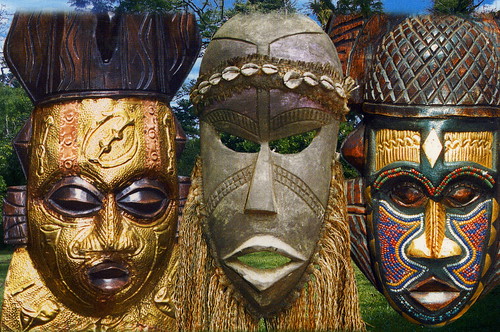
masks maame


"Of No Fixed Abode"


Identity theft
Open wounds

Fallen angels
Damaged goods

Brutish living
Scarred consciences

Devious schemers
Lost nerves

Enemy combatants
Collateral damage

Modern travelers
Prison shelters

Stolen verdicts
Jury deadlocks

Bomb factories
Moral blinders

Hostile lives
Fractured dislocations

Cultural interplay
Social living

The aliases of exiled souls
Alienated, "of no fixed abode"

Soundtrack for this note


Of No Fixed Abode, a playlist
  • Antibalas - Indictment
    An angry afro-beat meditation with dissonant horns that presents a bill of goods, if not some articles of impeachment, on our current situation. The song is also a humourous indictment of all those rogues in a musical court of law. One wished everyone expressed their grievances in music or words. The cover art is prescient about the flight of that man "thought to be Bukhari", the confusion and urgency are the same, as is the mistaken resort to violence. It is the mask of a man of no name, of indeterminate age, of unclear nationality and of no fixed abode. The only missing thing is the discarded, bomb-laden rucksack.

    Antibalas - Indictment
  • Prince - Reflection
    A simple song: light drums and an acoustic guitar that sticks in your head and gets you singing along before you know it. The melody is wistful and, befits the title, reflective. We're reminiscing about innocence lost, the good old days when decisions were without consequence and life itself was carefree. Not everyone has that luxury but we can all empathize with that sentiment
    Sometimes I just want to sit out on the stoop, play my guitar just watch all the cars go by
  • Angie Stone - Soul Insurance
    Her warm voice endears as does the music; Angie assures you that she has got your back. Soul assurance. Soul insurance. Where do I sign up for mahogany soul?


Update August 29, 2007

The following passage should give much pause for those sympathetic to this man "thought to be Bukhari"
He said that Mr Omar had offered a bed to a mentally ill African refugee, took in a homeless Indian man and paid visits to people in hospital. He never heard Mr Omar speak out in support of any act of terrorism. Mr Dixon said: "He was against the Iraq war, but... he said nothing radical." Mr Dixon became an unwitting helper of the alleged conspirators when he accompanied Mr [Redacted] on a trip to buy dozens of litres of hydrogen peroxide, the chemical that formed the key ingredient of the rucksack bombs.

Witness was unwitting helper with 21/7 purchase
So not only did [redacted] use people unwittingly to help buy bombmaking equipment but, if my reading is correct, he also stole the identity of that "mentally ill African refugee" who his accomplice had taken in. No one has connected these particular dots but I would lay even odds that said refugee was indeed the man who woke up to learn that the police were calling him a bomber. That would certainly round out the circle of infamy of tricksters using anyone who falls into their orbit. One wonders if there really are any more shades of gray to this story.

Next: Ode to Betty Brown

File under: , , , , , , , , , , , , , , , , , , , , ,

Wednesday, May 09, 2007

Briefly Noted

Deadlines are looming and it's also travel season, hence toli must be brief. Here then are some notes on the run...

I. Imperfect Analogies

Item: Before a certain column was published last Friday, a note I wrote used to be the top result for searches for IBM layoffs. I always worried that my musings might attract attention of The Authorities; thankfully, with Cringely taking the hyperbolical lead, they are now firmly (and hopefully permanently) under the radar... It's been almost two years and perhaps I should revisit the France IBM Connection. Back then, I predicted that despite the malaise in France, the French would re-elect the right after Chirac stepped down. Dig: Nicholas Sarkozy was elected president over the weekend in an election that saw record participation. French democracy is proving remarkably healthy. Although ostensibly elected on a mandate for reform, it is interesting that the old guard was the demographic group that voted for him en masse and put him over the top. In a similar vein I will not (cannot?) comment on rumours that IBM is about to decimate the ranks of its global services group and reform that business. One has to tread carefully in this lean corporate world, job (in)security and all that. I never answered the question later put to me: if IBM is France, who was it that was burning cars in the banlieues and would they survive? Implicit also was the issue of whether and how the French establishment would address the wider challenge, modernity and sundry taboos, or in the case of IBM, how it would deal with the web. My analogy was never perfect and I remain at a loss for answers on both fronts. Still, to mix a few sayings:
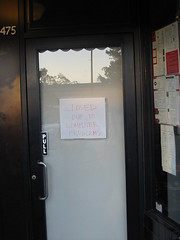
The stakes are high. Observers are worried. Closed due to computer problems.
closed due to computer problems

II. Special Treatment


Delta Airways recently (December 2006) began direct flights to Accra from JFK and Baltimore. By all accounts this has been a very successful endeavour for them. Their three weekly flights are fully booked. Clearly they are servicing pent-up demand. Ever since Ghana Airways went out of business, KLM and British Airways had been reaping the wages of monopoly pricing. It's not simply that Ghanaians are homesick or that we are now able to flex our economic muscles. The Nigerians, and others seeking convenient access to West Africa, are also patronizing these flights.

There is a little twist that I observed over the weekend. Delta has done their research well and paid attention to their market. They know all too well that Africans love luggage, what with Ghana must go bags and such, and will seek to haggle over the amount of luggage that they can check in and carry on board. Further, our crowds in airports are often unruly as fellow travelers will attest. Our relationship to authority and order was perhaps poorly served by having rogues rule us for a few decades.

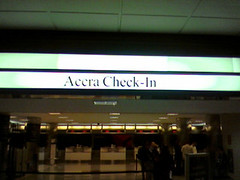
Accra check-in

Thus I noted that there is a separate check-in area for travelers to Accra in the Delta terminal in New York. As I passed it on my way to San Francisco, I overheard a couple in the regular check-in area pointing and asking "What country is Accra in?" The reply: "I don't know, I don't envy them however". I looked over at the long line that was forming, the numerous bags spilling over, and heard the clamour arising from the check-in counters. The airline staff looked a little harried, and well, world-weary. Crowd control is a difficult thing especially when you are dealing with a culture that is all about conversation and the banter of marketplaces. Keep in mind that Kweku Ananse, the cunning and scheming spider, is Ghana's great cultural and literary gift to the world. They must have heard every story in the book, along with sundry inducements for bending of the rules on all forms of luggage, excess and otherwise. I was a little sad at first at our segregation, and embarrassed at being singled-out for cattle-herding. I thought it over for a while, rationalizing rather than wringing my hands, and then smiled: we have our own section, how many others can say that? Our people are being given the special treatment.

Accra check-in
Step right up
Baby steps, baby steps.

III. Triumph of the Penguin


A sidenote: a custom version of Redhat Linux is the operating system running the in-flight entertainment system on Delta flights. This was evident from the scrolling screen messages that we observed as the air hostesses had to repeatedly reboot the system so that the other side of the plane could get their 40 channels of satellite tv. It's heartening to see the spread of Linus' little penguin even if it is only visible when there are problems - the brief flashes of startup screens. The Pentium chip grew into the public's consciousness after its flaws with floating point calculations were exposed. Paradoxically Intel never looked back once it dealt with the initial fallout of that episode. Similarly, folks continue to photograph blue screens of death in machines running Windows say in ATM machines and the like. Again that is an ironic triumph, a display of the spread of Microsoft's software into areas that were formerly the lucrative province of others. As we observe the spread of Linux as core and ubiquitous infrastructure it is good that it is similarly an iconic brand. Infrastructure is normally invisible and only appreciated when things fall apart. In this respect, I should say:

I love infrastructure.
I love glitches.
Infrastructure

IV. Dark Brown


When I wrote my piece on Cultural Sensitivity in Technology, I alluded to a number of incidents involving glitches with Microsoft Word's dictionary or thesaurus. I never managed to track down a good reference to add before it was published. A few weeks ago however the perfect example came up, it concerned the colour dark brown. The headline read:

Offensive couch label traced to China

Toronto. Doris Moore was shocked when her new couch was delivered to her home with a label that used a racial slur to describe the dark brown shade of the upholstery.

The situation was even more alarming for Moore because it was her 7-year-old daughter who pointed out "n----- brown" on the tag.

The rest of the story is a tangled web especially apt these days as we all mind our P's and Q's and hold mock funerals.

It's a wonderful and layered example of the ramifications of small things. The fingerpointing that results in this globalized world of ours is also very interesting. Who is to blame? Is it the manufacturer of the software that translated 'dark brown' in Chinese to the n-word in English? Or is it the supplier of the upholstry that used said software? Or is it rather the furniture store that sold the couch? Who is ultimately responsible for making sure that such things don't occur? Who, if anyone, should apologize? Or are such things what we should expect, the logical endpoint of globalization?

So what do we have here? A simple glitch in the continuum of cultural sensitivity resulted in innocence lost all around the world. The Chinese companies are embarrassed and worried that they will lose business - they are furiously updating all their software, the furniture store is worried about being sued, the mother learned that you can't protect your kids from that thing known as race, the 7 year old learned what a complex world we live in, a world of words that hurt and can even kill.

I was also tickled by the huhudious claim of the Indian store owner that "I've been here (Canada) since 1972 and I never knew the meaning of this word". That is indeed as brazen as it gets.

The remaining absurdity lies in the visiting "friends over from St. Lucia" who "wouldn't sit on the couch." I wish I could meet said friends, they push this toli into sublime territory.

portia portfolio sunflower seed

A Brown Playlist


A soundtrack for this note, some music celebrating the darker shade... Liner notes to follow.

File under: , , , , , , , , , , , , , , , ,

Friday, April 13, 2007

Bags and Stamps

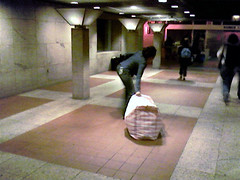
Let's talk about bags if you please. Bags are in the news these days. I don't mean San Francisco's ban on plastic shopping bags. Rather I'm thinking about this type of bag. In Ghana and most of West Africa we call it the "Ghana must go" bag.

ghana must go bag

Alternatively in Ghana, and humourously, they are called "Efiewura Sua Me", literally "help me carry my bag". Indeed there's always someone at the bus or train station who needs help moving such bags. (And yes, I did help that young lady after taking a surreptitious snap with my dodgy cell phone. Chivalry isn't dead even at midnight at the bus terminal).

Last year Sokari Ekine revealed her own bag woman tendencies and opened the discussion - she's a connaisseur. In response, Georgia Popplewell noted that "in Trinidad I’ve heard those bags called Guyanese Samsonite". We learned that in Germany, per contra, they are known as "Tuekenkoffer" or Turkish suitcase. In Boston I've heard them referenced as Chinatown totes, and called Bangladeshi bags in England, presumably after the 1970s influx of Bangladeshi immigrants.

The "Ghana must go" designation resulted from the various expulsions of immigrants that Ghana and Nigeria engaged in between the 1960s and 1980s. Many were only able to pack their belongings in such bags before fleeing, expelled with barely hours or days notice. Thus Ghana must go is ironic at best, and has mocking overtones at worst.

During the Rawlings Chain lean years in the 1980s when it wasn't simply a matter of returning immigrants and the whole country was facing political and economic difficulties (Revolution! Ghana), they were simply called "refugee bags". We were all refugees then.

In any case, the trend in naming is clear, these utility bags designate immigrants, refugees, or those down on their luck. They are emblems of hardship, relative poverty and exigency. I'll argue here that they are object lessons about the fluidity of ideas.

Pattern Matching


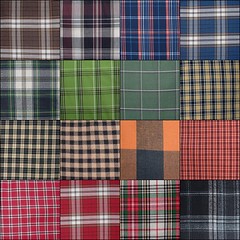
Let's first discuss the pattern. The majority of these bags are produced in China and it is fitting, given the interesting history of the pattern that covers them.


from: c r i s


The plaid pattern is thought to originate in the Taklamakan area in Xinjiang Uyghur in China perhaps between 100-700BC and certainly by the 3rd century. The Scots have the most famous claim to it however. The Falkirk tartan in 1707 is thought to be the Scottish debut of the tartan, the rich tradition of the Scottish plaid kilt that various families and clans adopted (this pdf shows a visual timeline of tartan). The Scottish colours are typically rich shades of red and green and only occasionally is the main colour white as in the bags.

The word plaid means a blanket, from the Gaelic plaide. In North America people use it interchangeably for tartans. The etymology of the word tartan is itself in dispute. The French word tiretaine (an amount of material), and the Spanish word tartana (a fine quality cloth) are the main contenders.

Now of course tartans were adopted wherever the British empire cast its wings. Bagpipes and kilts can be found from Ireland through Sierra Leone to India. I need only point you to this piece about tartans and turbans which lovingly traces their legacy in the Indian subcontinent and beyond. Amongst other things Ennis notes that Sikhs in Scotland have even commissioned family tartans; the headline for that episode reads: Singh Adds Spice To The History of Tartan. So: spice, the silk road and the Highlands.

Typically plaids have been woven textiles, used for clothing or decoration. The little plaid skirt evokes many associations. Like all patterns used in visual design, plaid has been applied to all manner of objects. Which brings me back to bags...

Bag Lady


Senam Okudzeto - Ghana must go


The Ghanaian artist Senam Okudzeto has very personal knowledge of the history of "Ghana must go" and has incorporated its iconography into her work. If you look at the fragments of her recent exhibitions, you'll be exposed to a history of dislocation, of fractured, sudden enforced exile.

The question she raises is one of historical memory. Our plaid bags are the physical proof of the way in which the boundaries that meant nothing in our pre-colonial past now loom large in Africa. Indeed their name stems from the 1983 Expulsion Order giving illegal immigrants 14 days to leave Nigeria. But more broadly the bags refer to repeated upheavals in our lands and sub-Saharan Africa knows upheaval all too well. Still, there's a sort of existential defiance in her reclaiming these objects of loss. Divisions are embodied in the cheap, practical and functional bags.

There is considerable wit in her work although it is always combined with a wistful displacement. Note the slogan, Capitalism and Schizophrenia, and some of the quotes she highlights: "deception is fundamental to the system".

Resilience


Plastic bags then. Plastics are the great innovation of the past century and a half and well they are sources of alienation and comfort, pollution and practicality. The famous scene from The Graduate comes to mind
"I want to say one word to you. Just one word."
"Yes, sir."
"Are you listening?"
"Yes, I am."
"Plastics."
If you are confronted with packing up your entire possessions in a hurry for fear of your safety, a Ghana must go bag will undoubtedly be a source of comfort. If you're trying to pack tins of corned beef and sardines, rice and sundry spare parts along with the clothes your relatives back in Ghana lack, you will gravitate towards the Ghana must go bag. At such times, volume and weight is everything. Ghana must go bags are about the most practical and lightweight luggage that exists.

Plastic, rugged and functional, you can even wrap them with tape to ensure additional sturdiness so that they don't split when they are manhandled by underpaid bag handlers. You can place all sorts of foodstuffs in them: smoked fish, yams, meat and spices. And heck they are distinctive: plaid, woven and plastic. As such, they are fixtures in many routes serving the developing world.

I can remember the scene at JFK airport waiting in line for a Ghana Airways flight, watching a market woman and the fifteen young men who would be taking the trip with her wares - all in huge fully packed Ghana must go bags. They had brought a big truck to the airport and were blocking the entrance causing a stir as their cargo was unloaded. This was even after 9/11 but she wasn't minding the Homeland Security folks that approached. Mama Trader wasn't travelling herself but had come to supervise the dispatching of her consignment of goods home. She made it clear that she wasn't planning for any of her workers to pay any excess luggage fees. I'm almost positive they didn't; she must have had a 'business arrangement' with the airline (or at least those manning the counter). Incidentally Ghana Airways went out of business shortly thereafter. Moving right along...

Fashioning Bags


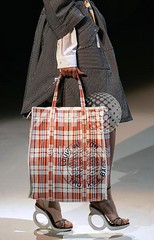
I wrote the foregoing to connect a few dots raised by a recent stir in Ghanaian newspapers. The headline read: Louis Vuitton sells "Ghana Must Go".

The images of models bounding down the catwalk at Marc Jacob's 2007 collection for Louis Vuitton raised the ire of a few commentators. An example:


The expensive shoes the model was wearing, indeed her entire outfit, stand in sharp contrast to the utility bag she was wielding. A typical review of the show mentions
a funny cheap checked shopping bag that carried a big, passport-style Louis Vuitton stamp...

the collection was a complex refraction of the many inspirational sparks that go into the work here: pieces synthesized to project the simultaneous multinational appeal this brand must maintain
The language of the style section is too clever by half but they captured the incongruousness and appeal of the image. A complex refraction indeed. A close look at a full slideshow of Marc Jacobs' creations shows that the bags of our tale were a leitmotif of the collection.

This is nothing new in fashion; slumming is a trope in the rarefied heights of haute couture. In recent years we have seen much appropriation of the sort and things like service uniforms (UPS, McDonald's etc.) have gained a fashion quotient. This is run of the mill piracy and the kind of tongue-in-cheek sentiment we applaud our designers for.

The author of the article was incensed that Ghanaians hadn't capitalized on the Ghana must go iconography and that others were now about to make hay out of a designer bag frenzy.
Having an idea stolen can be more difficult to deal with especially when the other party makes a bigger name and money off the idea than what it was originally worth...
A tempest in a tea pot in short.

Of course I could have pointed out that a proud Ghanaian artist was blazing these trails long before Marc Jacobs got there. Indeed there is an element of theft in this episode. If you look at Senam's work, you'll also see that she focuses on the passport stamp along with the Ghana must go bag. She highlighted not just the bag, the few personal mementos, photos and such, but also the passport stamp. Those who didn't have the requisite stamp on their residency papers or passports were the ones who were forced into upheaval with only these bags to carry their belongings into the unknown. Thus issues of legitimacy and exile are part of the questions she poses in her ongoing series.

In many ways, Jacobs's shtick was only a high-profile plagiarism. I expect Senam would be tickled by the nexus of commercialization and piracy that she likely provoked. The Akan proverb, humanity knows no boundaries, is one she would have been steeped in. Not to mention that the plaid pattern comes and goes used by all and sundry. The Wife notes incidentally that plaid is in this season in all the fashion magazines and stores. It was inevitable that others would latch on to it.

In any case, what claim does Ghana have to Ghana must go? Shouldn't the Nigerians, who ironically coined the term, have first cuts of any royalties? Heck these bags aren't even produced in Ghana, we are mere buyers and users. Our Chinese friends manufacture them using their native pattern. And, as we have seen, our local name for the bags is not widely known outside of West Africa. We're not the only refugees, immigrants or attendees of the school of hard knocks.

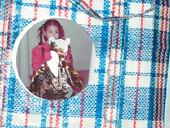
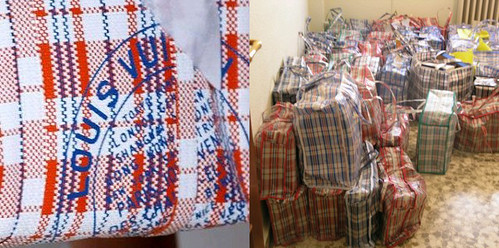
Still like Marc Jacobs, and in the spirit of Senam, I thought a juxtaposition would be appropriate and, rather than link to the original images, I thought I'd perform a creative theft with the following image. The title should be evident:
Ghana must go versus Louis Vuitton
ghana must go vrs louis vuitton
Bags and Stamps: a plagiarism in plaid
So to recap, a Ghanaian, by way of France and England, living in the USA, creates a collage starting with an image of Chinese-produced plastic utility bags taken by a Nigerian living in Spain - a 'theft' of the "Ghana must go" imagery, born of the interlocking episodes of reciprocal deportation and sundry exile between their two homelands, both former British colonies. The plaid pattern on said bags is originally Chinese although it is most celebrated in Scottish fabrics, and the subject of English schoolboy fantasies. Said pattern was transmitted in recent centuries over the corners of the British empire and is rightly part of Indian and especially Sikh heritage.

The symbolism of the bags is the signal subject of the work of a American-Ghanaian artist who grew up in Ghana, Nigeria and the UK (yes I should have mentioned Senam's Nigerian connection - isn't that a complication? And doesn't that explain the resonance of the Ghana must go iconography in her boundary-straddling life? Not to mention her focus on the passport stamp of approval. Sidenote: this modern traveller now has a very sensible Swiss connection, whither neutrality?)

This image is juxtaposed with a recent appropriation by an American fashion designer working for an France-based luxury company whose ironic contribution is to place a seal on the bag, contrasting the pennies on the dollar cost of the bag with a logo that is renowned for its deleterious effects on even the fattest wallets - a logo, moreover, that is often counterfeited by Chinese manufacturers in a global shadow economy of knockoffs that are sold all over the world. The significance of the logo or stamp of approval is iconic in expressing authenticity, legitimacy and belonging, demarcating the boundaries separating countries at once, and luxury status symbols delineating the rich from the poor.

Incidentally this note was prompted by a posting by an Indian American, who is arguably more Ghanaian in sensibility than me from his few years in Ghana, said posting focused on the celebration of National Tartan Day by Scottish Americans and its implications for the Desi community and diaspora.

The mind reels.

I have just booked a trip to England. My ostensible purpose is to get a stamp in my passport that will keep my notional residency in Her Majesty's lands legitimate. I am hedging my bets against this American episode; the stamp is my soul insurance if you will. Refugees all, we in Africa are no strangers to dislocation, in many ways it is our close friend. As the song goes, wherever I lay my hat, that's my home.
Modern travellers
Packing our bags
Seeking out stamps
The mementos of exiled souls

Bags: A Playlist


As usual, some music for the exiled soul...
  • De La Soul - Shopping Bags (She got from you)
    The percussion on this song, a stark array of milk bottles, proves that the boys still have it, appropriating whatever beat is expedient to get the message across.
  • Freestyle Fellowship - Inner City Boundaries
    The inner city griots expound
    Who is that surrounding me?
    Enemy enemy you crossed the wrong boundary
    Wicked witness wizardry
    Disappear from here and end up in a tree
    Crossed the wrong boundary
  • Milt Jackson - Bags' Groove
    Milt Jackson's nickname was Bags. He is most famous as a pillar of the Modern Jazz Quartet, Django being only one of their numerous standards. Bags' Groove is a heavyweight encounter with Miles Davis, Sonny Rollins, Thelonious Monk, Horace Silver, Percy Heath and Kenny Clarke. He played his vibes and the rest is history.
  • Milt Jackson and John Coltrane - Bags & Trane
    Bags and Trane is a more delicate affair, the two great soloists respected each other and are all empathy. I think Milt comes off better than Coltrane, much as Sonny Rollins came off fiercer in his Tenor Madness conversation with Trane.
  • Bob Marley - Exodus
    Movement of Jah people. 'Nuff said.
  • The NPG - The Exodus has begun
    A Prince album in all but name, the title track is sprawling like Bootsy and George would have done it. Oh identity.
  • Digable Planet - Nickel Bags
    Their reunion in 2005, after 10 years apart brought such joy. (I still have a review in the draft pile). Let's hope they head back to the studio. I want some more nickel bags of funk.
  • Herbie Hancock - Three Bags Full
    Herbie Hancock's contribution to this playlist is from the aptly titled Takin' Off album, an affair featuring Freddie Hubbard and Dexter Gordon mind you. This is hard bop at its best. Most airlines only allow two bags but when you fly Air Herbie, you get extra allowances for your baggage, and a bigger plane.
  • Erykah Badu - Bag Lady
    I'll end with the bag lady herself. Ms Badu's Ghanaian heritage is only obliquely referenced these days, if at all; Texas claims her. Still, her musical iconoclasm is plainly mid-Atlantic, her sensibility is that of one who knows no boundaries, a musical refugee in her creative prime. This was the lead single from her last soulful album, the title of course: Worldwide Underground.

A parting question: I wonder if this note could pass as a Things Fall Apart affair. Would it be a case of social living, a comfort suite or rather that rough beast? What say you dear reader?

[Update June 5, 2007]

See also: A plagiarism in plaid

Bags and Stamps - the photo set

File under: , , , , , , , , , , , , , , , , , , , , , , , , , , , , , ,

Thursday, July 13, 2006

World Cup Radio Toli

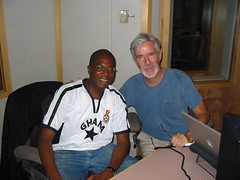
I tried to keep away, believe me... Last night, right after the movers departed with our possessions, I donned my Stephen Appiah shirt and headed to the WGBH studios to make an appearance on Radio Open Source to dispense some toli on the World Cup and sports as a leading indicator. You can download the podcast to listen if you care. It was my last Bostonian hurrah with Christopher Lydon, Chelsea Merz and crew, a show packed with both erudition and down home punditry. On the phone were Robert Lipsyte, Stacy-Marie Ishmael, Patrick Belton and John Ralston Saul - cosmpolitans and sports lovers all.

Chris's pitch for the show was simple

What is this comprehensive "globalization" of sports stars, money, victory all about?

What is the story unfolding in this World Cup summer of empires falling and rising — empires of money and fashion as well as of national pride and prestige?

These were some notes I sent him over the weekend, my talking points, if you like, about possible directions for the topic: sports as leading indicator and sports as globalization off the top of my head.

On Sports as a Leading Indicator

You'd have to talk about the French team and its composition.

Zidane as the street gladiator. 17 of the 23 players are minorities. Cosmopolitans?

You'd also have to talk about how they are looked at by their countrymen... With love by most, but ambivalence or outright hostility by some (e.g. Jean Marie Le Pen).

You'd have to talk about the changing nature of the game and how everyone plays in Europe. The Brazilians have made almost one billion dollars selling their players to European teams. The Africans too, and these days many of the African teams were playing a very European game with only flashes of their previous freer flowing style.

What about identity and allegiances? I've pondered it recently.

Brazil, Argentina and Old Europe as the Great Powers; South Korea's showing in the last World Cup. Australia doing better than the US this time.

Rupert Murdoch built his empire on sports: Sky satellites... Fox Sports World and elsewhere as the expression of his parochial interests. The problem with the coverage: all highlights, all sensational, all superficial, all triumph over adversity, missing the subtext. Compare to Fox News.

Connect to the entirely ridiculous coverage by ESPN/ABC. Less said on that. I watched it all on Univision. This bit by Jeff Klein of the New York Times covers it all: The Sins of American Sportscasting.

Dana Blankenhorn too wrote about The Greatest Game Ever Played

Americans still have no clue about the World Cup, or of soccer in general.

The U.S. announcers are horrible. They talk about everything but the game in front of them. They repeat the back-story endlessly. They assume the ending and look two games ahead. They talk about other shows to be on the next day or the next week.

Tony Karon, whose coverage was excellent, had piped in earlier with How to Watch the World Cup.

I have a pretty good idea where Osama bin Laden will be on June 14 -- and June 19, and again on June 23. Not his exact location, but it's a safe bet he'll be in front of a TV tuned in to Saudi Arabia's World Cup soccer matches with, respectively, Tunisia, Ukraine, and Spain.

Sporting Blues


You'd have to talk about America's place in sports. Great Power? Things Fall Apart? Decline and Fall? I don't know but small things add up. You need some joie de vivre and the sports headlines should be providing comfort.

It was not a good 4th of July... No McEnroe, no Connors, no Agassi, no Sampras or Roddick, no Venus, no Serena, no Lindsay Davenport winning at Wimbledon. Instead a Swiss guy and a Spaniard are providing the excitement. And what about that tall Chinese woman who made the quarter finals and gave Clujsters the fits, Li Na? What about feet binding? The Chinese are coming...

Nathan's hot dog eating competition was won by Kobayashi again, a small Japanese guy out-ate red-blooded Americans. Hot dogs for God's sake.

If you watched the world cup on Independence Day you would have seen Italy against Germany (weren't they part of the original Axis of Evil back in the World War?).

The US team had been knocked out by Ghana, and it was the "Nigerian" player who bumped the guy and gave away the crucial penalty. Where is Ghana on the map again? And Ghana beat the Czechs, the number 2 team?

If you read the news, the front page of the New York Times showed a baby faced soldier in chains accused of rape and murder of a 15 year old girl and her family in Iraq, echoes of Abu Ghraib, erustication. He was wearing a black Johnny Cash shirt and looked vaguely gothic and troubled.

If you went to the movies you would have to make sure you didn't see An Inconvenient Truth, The Road to Guantanamo Bay or Army of Shadows as you got your Superman Returns tickets.

Things like that put a damper on the fireworks...

On the other hand, it is silly season, just a few bad apples. In other news, the Israelis are using American tanks to blow up Palestinian bridges and power stations...

Realpolitik


You'd have to talk about Italy winning with deadly efficiency. You'd also have to mention the corruption back home in their football league.

Sports is big business, the global brand.

You'd have to talk about Fifa and the International Olympic Commision, bureaucracies created by English and Frenchmen but now totally their own thing. Who was that Spaniard at the IOC with his corrupt ways?

You could talk about how tribal identities are forged when you watch sports.

Sports bind the US more even than religion since there is that Church/State separation business.

The Germans started buying flags once again since their team did so well this time.

Gamesmanship: Portugal's diving cynicism and the head butts in the Netherlands match.

Togo and Cote d'Ivoire have been on the brink of a civil war but were quiescent for the past few months since their teams made it to the cup. What will the future bring?

In Ghana there is considerable nationalism now based on the way the team played. We came to win and did well. The nation fully expected that the cup would come back with the boys. Ghana flags are flying everywhere these days. Will this feeling be capitalized on in the economic sphere?

me Chris Lydon

Afterthoughts


Yannick Noah, the great French tennis player, was French when he won but was characteristically "of Cameroonian descent" when he lost. Similarly, the coverage of Zidane, and the urge to "understand" his actions, focuses on his Algerian immigrant upbringing. Wayne Rooney, who similarly lost his cool and shoved Ronaldo to be sent off must comes from the same immigrant school of hard knocks I suppose, as does Luis Figo whose head butt was unprovoked. Right?

Silvio Berlusconi's political career was supercharged by his ownership of a football club. How he would have loved to bask in the triumph of the Azzurris, the colour and slogan of his political party if he were still Prime Minister. Instead he was indicted for fraud days before the final.

I don't quite buy the argument that Americans only care about "their" sports (NFL, baseball, Nascar etc.) and will always remain indifferent to football and the World Cup. If there is one thing that America understands, it is attention and the impact of large numbers. Branding is the signal contribution America has made to the world. That is why there is a "World Series" in baseball even though much of the world doesn't play that game. Hence the excitement of a truly global game like football, one that literally is the lingua franca of the entire world, will permeate consciousness and attract participation. Soccer children will become the next generation's soccer moms and dads and will want to see their heroes make it on the global stage. Join the queue.

Wolves and Emperors


During the show, I tried to handwave a little about this notion of sports as a leading indicator, mixing my metaphors as is my custom, and I should explain what I was getting at. Poetically I started with the focus on small things like the current poor performance of the US in sports. Someone had brought up the Duke of Wellington in the conversation, but I rather harkened to The Boy Who Cried Wolf in that folktale as a leading indicator of perils that faced his community... To relate that to another folktale, the message in these leading indicators is often that The Emperor has no clothes. And I'd hazard that we are currently living in an imperial moment. The difference between the reception of the boy who cried wolf and the devastating impact of the boy who pointed out the emperor's hubris was that the words were said at a parade. Thus it is at social events or gatherings that we reflect on the zeitgeist and see things in their true light. Sporting events like our ceremonies and our public holidays are the grand events when communities come together. Politicians can't control the zeitgeist, nor can big businesses really control the human drama of sporting events. Still they can try, and I can recall Mr Bush delivering turkeys to the troops one recent Thanksgiving. I'm not so sure that there has been much comfort in this silly season of our discontent however. But perhaps one shouldn't make too much of these things.

In any case, head nods are due to my fellow panelists and to the Open Source crew who conjure up news feverishly every day, Chelsea, David, Brendan, Robin and the rest. The conversation continues apace.

File under: , , , , , , , , , , , , , , , ,

Tuesday, May 23, 2006

The Books of Nima

A note I've been meaning to write for perhaps 6 months to "Sir Sky", the author of The Sea and the Bells; a conversation about Nima, a neighbourhood of the mind.

Part 9 of the Things Fall Apart series, this time an entry under the banner of Social Living...

I was looking over your shoulder during your year in Ghana, perusing your travelogue that I came across in a case of web serendipity (the Ghana tag at Technorati, in case you're wondering). When I first read you, and learned that you were going to be staying in Nima, I was apprehensive. Yours would not be the typical volunteer or expat experience; you weren't destined to have the servants, the driver and car, or the air-conditioned office. I don't know if you knew what you were getting yourself into, that you'd be going local and doing the slum housing thing and worse. As an Accra boy, albeit transplanted to Cambridge, I know all about the school of hard knocks called Nima. It looms large in the Ghanaian consciousness, even if there are many worse places these days as you know. It's very far from ideal as an introduction to a visitor.

ghana postcards


The fact that you were willing to give of yourself to us was very generous, and I don't know if Ghana fully reciprocated the generosity... The years from 1982 to 1988 broke the back of the Ghanaian people, and ever since, we've been struggling to recover from scarcity and arbitrariness. Thus we demand a lot of outsiders and of anyone who's been abroad. This is changing, and our current quiet stability is restoring our confidence in parts; still, not everyone has read that script, and the neediness can wear you down. For what it's worth, you're not the only one labelled oburoni; my mid-Atlantic self gets that designation every now and then when I'm home.

I was tempted at many stages to jump in: to suggest creature comforts or avenues that would have made things less wrenching for you. But as is the norm on this web, I remained dark matter, absorbing your energy. Still in mitigation of the head nods I omitted to send your way, I think your experience is all the more richer for being yours alone. Like your country's peacekeepers, you are one of Canada's great exports, and after your experience in Ghana, you'll breeze through anything back home.

You lived through countless lights out and experienced the wasted time spent dealing with simple things like water, food and transportation. And of course, there were those untrustworthy and maddeningly inconsistent people... It's the simple fruits of poverty; we lack infrastructure, physical and otherwise.

You had the daily struggle in that library without resources, where you taught the adult literary classes and wrangled to teach those neighbourhood children. The ironies and absurdities about that task are worthy of a novel and hopefully you'll write one.

Osu library was the scene of some of my fondest memories of my childhood. It was well stocked and the librarians cared and worried about you. No one could ever tear me away from it, even at closing time. It was where I learned that books and ideas are important, where the parental challenges were investigated and puzzled over. Those books were a long winding road, to be read with care as their nuggets would reveal themselves, or the inconsistencies of an argument would appear in relief in the reading light. My greatest heartache about Ghana today is that very few children are getting the same opportunity. True, our lingua franca these days might be radio, television or this internet thing, but really, how many Ghanaians are participating in this conversational web? If only I could hear those missing voices... The notion that so few in my country can bury their heads in books on weekday afternoons or on a lazy Saturday morning at the library is cause for much distress. And don't get me started about what's happened to the Legon university bookstore. Must everything be utilitarian? Is a country without whimsy worth worrying about?

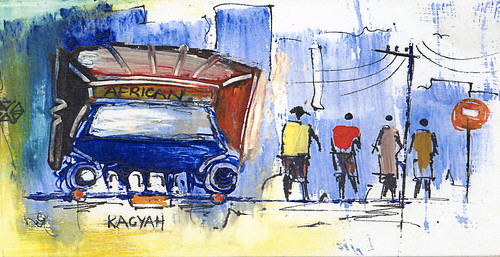
African by Kagyah


I think the emotional violence could have been avoided, and, certainly the physical violence should have been avoided. My heart leaped at such times, but still I kept silent and read on. Nima is such an insular place, it is very wary of outsiders as you probably found. In the past it was where rural migrants came to partake of the Accra dream in the Gold Coast. Thus it has always been messy, and developed in fits and starts as befits the residence of those who live on the fringe.

Even today, two shacks away from the homes of proud middle-class schoolteachers you'll find the "Nima boys", selling 'wee', guns or worse, right under the Kanda highway and close to the police station. The boys can always be counted on to roust any political opposition come election time, and their hard knocks usually come for cheap. True, the stereotypes of Nima boys as uncouth, brash, vicious, and ill-educated are extreme, but they carry a kernel of truth about a small minority that lingers even in the relative prosperity of the moment. Across is a chop bar serving the best banku and fetri in town; Auntie Maggie's spot is packed during the day and there's nice fresh tilapia at night, shantytown chic as it were. Just around the corner is a drinking spot with people playing oware or dominoes and downing bottles of Star beer and Guinness in the early evening. Nowadays there are the occasional interruptions when they'll whip out the latest mobile phone ostentatiously: "talking loud and saying nothing".

But you saw all that and more, you saw how people "disciplined children" and how they meddled in each other's business — or not. As you found out, that "it takes a village to raise a child" business isn't happening much in the slums of Nima; too often it is the garden-variety anomie and indifference of urban life, something that wouldn't be out of place in any big city. I saw the same mix in Soweto a decade ago, although that was more upscale at the time, and well, Inman Square is what it is. It is true that given a few decades of development, Nima could become the Catford of Accra, and, believe it or not, it is much better today than it was in the sixties and seventies, but perhaps that progress is cold comfort for the struggles you faced.

I dug your observations on the press and on street life of Accra. Your look at the street cleaning exercises that took place earlier in the year was priceless. In the year 2006, they're finally worried about rubbish and overflowing gutters! And only for two weekends. Ah yes, that culture of maintenance that was so evident in your encounters with us. Perhaps you too have the journalistic impulse. And that water shortage in certain parts of town, Accra is straining at the seams; I was in Ghana at the time and noted as much, although we had water in our neighbourhood. You picked up on our tro-tro wisdom, our folktales, and the languid way in which we view the world. You even taught me that proverb from Northern Ghana:
"Trust God implicitly but always tie your camel up at night."
I don't know if that's where Ronald Reagan got his "trust but verify" shtick, but it's close. Still, Kweku Ananse's cunning and laziness can be a curse; living by your wits, hustling in short, is no substitute for the prosaic work of development, although it can be quite enjoyable.

I suspect that a lot of Ghana has rubbed off on you; we can be quite infectious (and not just in matters of public health). Do be careful that you don't break out into pidgin when you're back home interviewing for a job; our deconstruction of the English language has its own musical logic, and not everyone is ready for it.
Take care-oh.
And you saw the other side too, the havens of those expats who saw Ghana as a holiday, who kept to themselves and didn't engage with the country and its people. Hell they might as well have been living in Eden; your garden was good old Nima. Well at least you got to know us intimately; that has to count for something. We claim you as our soul sister, and will keep your heart hostage in our town.

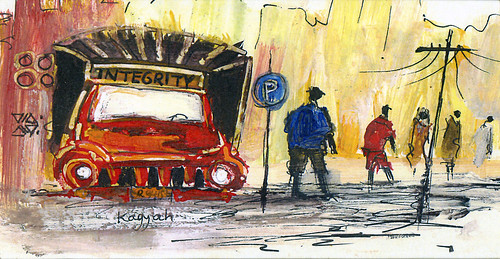
Integrity by Kagyah


You even reported on the beginnings of the cholera outbreak that I encountered last Christmas. When my father began to warn me about taking precautions if I decided to eat out in town, I nodded my head knowingly; for a time you were my favourite Ghanaian newspaper.

And of course there were those malarial episodes, the fevers, the Larium dreams and those hallucinations. How much energy was dissipated in those sweaty nights and days? Those mosquitos, and their cargo of plasmodium falciparum; they are a poverty tax. We may throw our herbal medicine and "bitters" at them, but that is after the fact, to deal with the symptoms. The full panoply of mosquito nets, sprays and lotions counts for nought if you don't deal with sewers and the ever-present pools of stagnant water, or if parents will use their children's nets. And we all know about drug resistance: Darwin's evolution is intelligent design. Still, as they say, mosquitos don't discriminate. Not in Ghana, not on the island of Reunion, and certainly not in Cambridge. We're all singing the West Nile Blues these days. Some call it globalization; I know it as the Mosquito Principle.

You may only have lived in Nima for a while but you got the full Ghanaian experience, unvarnished and cacophonous; three centuries taking place simultaneously in those twisted back alleys. I'll admit to a sense of wistfulness in seeing my country anew through your eyes, and I want to hear more of your thoughts going forward as you carry Ghana in you. I hope we don't weigh too heavily on you. I wish I had been there on the ground; it's hard to be living vicariously through a Canadian woman.

As you'd expect, it's very painful for me as a proud Ghanaian that, almost 50 years after independence, we are still relying, nay depending on you, to teach us how to read, or even to school us about the importance of a book. To read, for God's sake. Hundreds of years after our chiefs started sending their children to Europe to learn these things and we haven't internalized the lessons... But then it works in the other direction, the West relies on people like me to make sense of its world - the technology world in my case. And your southern neighbour, that United States of Anomie, can be a similar school of hard knocks, and not just for lowly immigrants; you don't need to visit New Orleans to get the daily evidence. Still, I wish the cultural interplay was more balanced, that we could each walk tall, rather than smile sheepishly as we do and say, "Only in Ghana" or "That's how it is in Ghana". As if we can't do anything about it. As if it doesn't have to be this way.

You quoted Anthony Hopkins playing C.S. Lewis in Shadowlands:
"Experience is a brutal teacher. But you learn. My God, you learn."
I'll suggest in response, our poet Kwesi Brew's book, African Panorama, and I'll quote one of his elegiac poems. You should recognize the subject matter.

The Slums of Nima


Three neighbours met,
And after a hurried, "I give you rest"
The two young men stood aside for the old man
to pass and then picked their way
in the opposite direction towards the alley on the left.
They were thieves who robbed with violence
But still they stood aside for the old man
And he thanked them.

In a bereaved world questions and comments
Fall on unhearing ears.
Only silence, understanding and
Belonging can put
A blind man's stick in the hands
Of a searcher in that night.

The crumbling walls have leaned
On their chests for decades!
The toll of breathing has shredded
Their lungs, and their eyes are sore
With the smoke of the wicker lamps.
And now we all stand at the edge
Of an abyss
Afraid to plunge headlong, or
Return to the dark of the night with them!
kwesi brew


Ghanaians are natural storytellers. We are cultural interpreters and urban griots; not for us Anglo-Saxon brevity. Even as we consider Kwesi Brew's abyss, or that heart of darkness, you'll hear the musical laughs and see our urge to understand. We want to change the perspective and open things up through observation and humour. As he wrote in another poem, and I won't give the punchline away, things must be sweet for Ghanaians:
How else could they laugh
Like they do when they should weep;
Remembering the voiceless days of the past.
It is quite poetic that you arranged for your class to travel outside Accra - to the beach no less, and even managed to get them that helicopter ride over the city. We are all so caught up in our black boxes, strangers in our own country. It is eye-opening to glimpse those different perspectives, and you too were being a cultural interpreter, making people see themselves anew. It was a small victory in your ongoing journey.

I really hope you don't take your journal down as you threatened recently. The pearls of experience therein are too rich to be simply discarded in the dustbin of the lost web. Allow Google to stumble over your throwaway experiments - they provide comfort even for an audience of one. I dug a lot of the writing (without a doubt, you're on the road to many books). The sound of a voice trying to make sense of an unfamiliar, frustrating yet endearing environment, the large and the small observations, all these things make for a historical document done in best tradition of the web style. The Sea and the Bells, at least that year's version, is a great snapshot of Ghana in the years 2005-2006, a personal introduction to be sure, but it constitutes a compendium of small things to be duly celebrated.

As you might guess, my preferred response to Things Fall Apart is small things: short cuts and bite-sized conversations that engage in the marketplace of ideas. I know you only as "Sir Sky" and the conversation has been one-sided until now. Consider this my opening gambit, my "so what's your name?" approach. I hope you like my brand of small talk; it's known as toli.

Dig: I'm sending some books to the Osu library. I hope it's still there and that someone will receive them. I can only hope that people are still reading. I've been carrying them all these years but never did anything about them; they make a glorious floorscraper. They'll be delivered in your name, and inscribed with the word Nima.

A belated head nod to you.

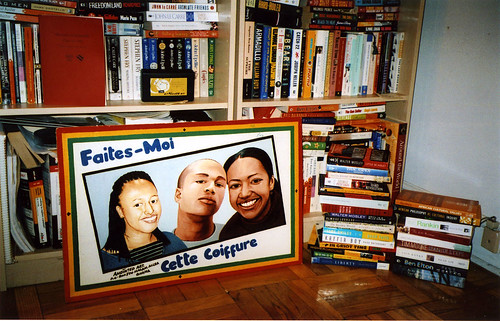
barbershop portrait and books


Next: Dilemmas.

See also: Poetry as Cultural Memory

File under: , , , , , , , , , , , , , , , , , , , , , , , , , , , ,