Showing posts with label commerce. Show all posts

Thursday, September 14, 2017

Functional Defenestration

It’s almost been a Friedman unit since I published anything in this joint so, with due deference to that old standby public service pamphlet, What everyone should know about blog depression, and a head nod to Bertrand Russell's note In Praise of Idleness, here goes some throat-clearing toli.

I. Defanging Satire (or Editorial Genuflections in the Internet Age)
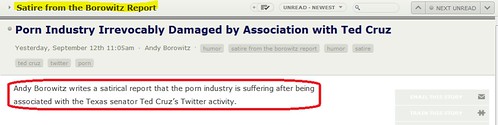

Defanging satire in the age of the internet (New Yorker edition)

A highly paid editor at The New Yorker is now intervening to neuter the bite of Andy Borowitz's normally savage satire. The first injury came a few months ago with the retitling of the column and RSS feed from "The Borowitz Report" to "Satire from The Borowitz Report" as if to say “we must protect you from being a moron in a hurry”. Then the lasting, almost fatal, wound was the recent move to change the contents of the feed summary, which used to be the first few sentences of the article, to instead actively bash you over the head with a spoiler warning that each article is "a satirical report". Apparently the reader needs to be informed upfront that they are about to read a humorous article and protected from the dire possibility of being spoofed.

In other words, even for the most potent source of written content (and the New Yorker proclaims itself to have "the best writing anywhere"), it now of paramount importance to maintain its listing as a Google News "source" (and now with Facebook's Zuckerberg apparently faking concern about clickbait and fake news and the like, the audience needs to be coddled). The bean counters (and search engine optimizers) have run the numbers and, on the evidence, it is clear that telegraphing an article's intentions, and blunting its impact is worth the downside risk and what, I rather think, is grievous damage to art.

Up until a few months ago, the feed summary would have been the following (a pithy defenestrationof age-old hypocrisy)

WASHINGTON (The Borowitz Report) — The pornography industry has likely suffered permanent damage as a result of its unfortunate association with the Texas senator Ted Cruz, industry sources said on Tuesday.

It is soul-deadening to contemplate the considerable effort expended to actively sabotage noble hatchet jobs.

The only concession to art is that the editor didn't additionally prepend "Satire" to article titles as I noticed smaller publications starting to do routinely 12 or so years when Google News started being a dominant source of web traffic.

And here Dear Reader, as I wrote the foregoing sentence and began winding up to a thoroughgoing rant, I realized that I had been down this path before. Indeed I left a community (Blogcritics) back when its writing guidelines started to ask that writers explicitly tag their work and the site started messing with titles. The injunction then was that we needed to telegraph and prefix "Satire" to titles '(if you "make things up" or "bend the truth" notably to make a point, or for comedic effect)'.

Searching through the archives, I even found a cri de cœur written on the topic, Husbanding the Blogcritics Commons, a jeremiad-in-vain as it soon became a case of This Boring Headline Is Written for Google.

It is a disappointing development a decade later, that ostensibly powerful media outlets have thoroughly succumbed, even as one cannot deny their economic logic, pace Buzzfeed. And yet I remain a maximalist on the issue.

The story, I suppose, is about capitalism in the internet age. Per Jeff Hammerbacher by way of Allen Ginsberg, it is a case of "The best minds of my generation are thinking about how to make people click ads". Per contra, we could harken back to Slim Charles's folk wisdom from The Wire: "Game's the same, just got more fierce."

The existential question posed is how do we weigh the competing demands of popularity (as expressed by the Google News imperative) against whimsy (as expressed in satire). Sacrificing whimsy at the altar of attention is not a price worth paying, and I am yet to be convinced otherwise. Needless to say, I dissent.

II. Attention Mongering

Apropos attention, for a good decade, say right up to the Charlie Hebdo massacre, and much to my consternation, a note I had hastily written On the importance of biting satire was regularly the top search result on Google about satire. It has since found its proper obscurity, but my unexpected Googlejuice in the interim meant that the occasional student writing a term paper on “why satire matters”, “significance of satire”, “importance of satire” etc. would start mining this blog.

The early web was a great equalizer, one in which my rants occasionally trumped the combined insights of Jonathan Swift, Will Self and the like, hell even the encyclopedic Wikipedia was lagging in the Anglophone internet. Even as Jon Stewart and company started a revival of the satiric tradition in America, the clicks kept coming my way.

I don't know if I ultimately managed to convince 15 readers of the paramount importance of savage satire as opposed to the milder form that Americans favor, but I feel my ultimate insight is worth restating:

I like my satire savage. It should be vicious, biting and deeply heartfelt. The targets should feel a sharp wound. The whimsical and comic artefacts of the best satirists are side-benefits; their purpose is really to serve as social barometers and canaries in the mineshafts of our communities.

III. On Satire

Satire is a sort of glass wherein beholders do generally discover everybody's face but their own; which is the chief reason for that kind reception it meets with in the world, and that that so few are offended with it. But, if it should happen otherwise, the danger is not great; and I have learned from long experience never to apprehend mischief from those understandings I have been able to provoke: for anger and fury, though they add strength to the sinews of the body, yet are found to relax those of the mind, and to render all its efforts feeble and impotent.

Jonathan Swift - The Battle of the Books
Satire is an art form that thrives best on a certain instability and tension in its creator. The satirist is always holding him or herself between two poles of great attraction. On the one side there is the flight into outright cynicism, anomie and amorality; on the other there is the equal and countervailing pressure towards objective truth, religion and morality.

Will Self - Junk Mail
[Will] Self sees himself paradoxically both as a moral satirist and as a social rebel who is more interested in shocking his middle-class readers than in reforming them. "What excites me," he has said, "is to disturb the reader's fundamental assumptions. I want to make them feel that certain categories within which they are used to perceiving the world are unstable"

— Gillian Glover, as quoted in Brian Finney's The Sweet Smell of Excess: Will Self’s Fiction, Bataille and Transgression.
Of all the gifts of the pen perhaps the most fraught with danger is that which resolves itself into satire. It is indeed difficult to distinguish between cynicism and satire, perhaps the former is born of disappointment perhaps the latter is born of humour. Let it remain so and it cannot be called debased, let it become cold and let it die.

— Patrick Braybrooke writing on Hilaire Belloc as Essayist in Some Thoughts On Hilaire Belloc

Instability fundamentally disturbs markets which is why even the threat of boycotts so unmans even the most cynical modern corporations. The reverse of the coin however is that whimsy, that most valuable human concern, and its close counterpart satire thrive as disturbances to the mundanity of life. Reconciling whimsy in all its messiness to the demands of hard-nosed capitalism remains a struggle and yet struggle we must. For better or worse, we must humanize capitalism.

IV. Orphaned Thoughts

I once spent forty minutes on a subway sitting opposite a group of engineers and salespeople that worked at Functional Fenestration. They were attending a conference in Oakland about window hardware and automation, of all things. I was fascinated with their technical argot, the intricacies of the actuators, track and carriage systems and door automation that they were discussing. I marveled at the engineering arcana, and the fact that the windows and doors that we take for granted could have such complexity. Their deconstruction of the merits of some of their competitor's offerings and their strategizing about how to market the new feature of whatever widget they had just come up with (a slide handler if I remember correctly) drew me in. The intensity of the back and forth between the marketers and the technical folks reminded me of a comedy of manners of sorts, office politics writ large. Hypnotized as I was by the language and the context, I immediately imagined a novel or short story, something in the vein of Colson Whitehead's The Intuitionist and the title came unbidden, Functional Defenestration.

Most ideas are destined to be half-formed and ultimately, I never got beyond the few pages scribbled in my Moleskine, a meditation about a man unmoored by capitalism. The first sentence remains:

Man, it was hard to compete against those guys at Functional Fenestration, they were intense.
Run with it.

Soundtrack for this note

A playlist for those tilting at windmills.

File under: , , , , , , , , , , , , , , , , , , , ,

Thursday, July 13, 2006

World Cup Radio Toli

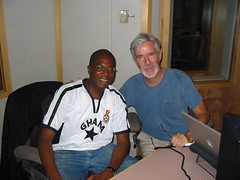
I tried to keep away, believe me... Last night, right after the movers departed with our possessions, I donned my Stephen Appiah shirt and headed to the WGBH studios to make an appearance on Radio Open Source to dispense some toli on the World Cup and sports as a leading indicator. You can download the podcast to listen if you care. It was my last Bostonian hurrah with Christopher Lydon, Chelsea Merz and crew, a show packed with both erudition and down home punditry. On the phone were Robert Lipsyte, Stacy-Marie Ishmael, Patrick Belton and John Ralston Saul - cosmpolitans and sports lovers all.

Chris's pitch for the show was simple

What is this comprehensive "globalization" of sports stars, money, victory all about?

What is the story unfolding in this World Cup summer of empires falling and rising — empires of money and fashion as well as of national pride and prestige?

These were some notes I sent him over the weekend, my talking points, if you like, about possible directions for the topic: sports as leading indicator and sports as globalization off the top of my head.

On Sports as a Leading Indicator

You'd have to talk about the French team and its composition.

Zidane as the street gladiator. 17 of the 23 players are minorities. Cosmopolitans?

You'd also have to talk about how they are looked at by their countrymen... With love by most, but ambivalence or outright hostility by some (e.g. Jean Marie Le Pen).

You'd have to talk about the changing nature of the game and how everyone plays in Europe. The Brazilians have made almost one billion dollars selling their players to European teams. The Africans too, and these days many of the African teams were playing a very European game with only flashes of their previous freer flowing style.

What about identity and allegiances? I've pondered it recently.

Brazil, Argentina and Old Europe as the Great Powers; South Korea's showing in the last World Cup. Australia doing better than the US this time.

Rupert Murdoch built his empire on sports: Sky satellites... Fox Sports World and elsewhere as the expression of his parochial interests. The problem with the coverage: all highlights, all sensational, all superficial, all triumph over adversity, missing the subtext. Compare to Fox News.

Connect to the entirely ridiculous coverage by ESPN/ABC. Less said on that. I watched it all on Univision. This bit by Jeff Klein of the New York Times covers it all: The Sins of American Sportscasting.

Dana Blankenhorn too wrote about The Greatest Game Ever Played

Americans still have no clue about the World Cup, or of soccer in general.

The U.S. announcers are horrible. They talk about everything but the game in front of them. They repeat the back-story endlessly. They assume the ending and look two games ahead. They talk about other shows to be on the next day or the next week.

Tony Karon, whose coverage was excellent, had piped in earlier with How to Watch the World Cup.

I have a pretty good idea where Osama bin Laden will be on June 14 -- and June 19, and again on June 23. Not his exact location, but it's a safe bet he'll be in front of a TV tuned in to Saudi Arabia's World Cup soccer matches with, respectively, Tunisia, Ukraine, and Spain.

Sporting Blues


You'd have to talk about America's place in sports. Great Power? Things Fall Apart? Decline and Fall? I don't know but small things add up. You need some joie de vivre and the sports headlines should be providing comfort.

It was not a good 4th of July... No McEnroe, no Connors, no Agassi, no Sampras or Roddick, no Venus, no Serena, no Lindsay Davenport winning at Wimbledon. Instead a Swiss guy and a Spaniard are providing the excitement. And what about that tall Chinese woman who made the quarter finals and gave Clujsters the fits, Li Na? What about feet binding? The Chinese are coming...

Nathan's hot dog eating competition was won by Kobayashi again, a small Japanese guy out-ate red-blooded Americans. Hot dogs for God's sake.

If you watched the world cup on Independence Day you would have seen Italy against Germany (weren't they part of the original Axis of Evil back in the World War?).

The US team had been knocked out by Ghana, and it was the "Nigerian" player who bumped the guy and gave away the crucial penalty. Where is Ghana on the map again? And Ghana beat the Czechs, the number 2 team?

If you read the news, the front page of the New York Times showed a baby faced soldier in chains accused of rape and murder of a 15 year old girl and her family in Iraq, echoes of Abu Ghraib, erustication. He was wearing a black Johnny Cash shirt and looked vaguely gothic and troubled.

If you went to the movies you would have to make sure you didn't see An Inconvenient Truth, The Road to Guantanamo Bay or Army of Shadows as you got your Superman Returns tickets.

Things like that put a damper on the fireworks...

On the other hand, it is silly season, just a few bad apples. In other news, the Israelis are using American tanks to blow up Palestinian bridges and power stations...

Realpolitik


You'd have to talk about Italy winning with deadly efficiency. You'd also have to mention the corruption back home in their football league.

Sports is big business, the global brand.

You'd have to talk about Fifa and the International Olympic Commision, bureaucracies created by English and Frenchmen but now totally their own thing. Who was that Spaniard at the IOC with his corrupt ways?

You could talk about how tribal identities are forged when you watch sports.

Sports bind the US more even than religion since there is that Church/State separation business.

The Germans started buying flags once again since their team did so well this time.

Gamesmanship: Portugal's diving cynicism and the head butts in the Netherlands match.

Togo and Cote d'Ivoire have been on the brink of a civil war but were quiescent for the past few months since their teams made it to the cup. What will the future bring?

In Ghana there is considerable nationalism now based on the way the team played. We came to win and did well. The nation fully expected that the cup would come back with the boys. Ghana flags are flying everywhere these days. Will this feeling be capitalized on in the economic sphere?

me Chris Lydon

Afterthoughts


Yannick Noah, the great French tennis player, was French when he won but was characteristically "of Cameroonian descent" when he lost. Similarly, the coverage of Zidane, and the urge to "understand" his actions, focuses on his Algerian immigrant upbringing. Wayne Rooney, who similarly lost his cool and shoved Ronaldo to be sent off must comes from the same immigrant school of hard knocks I suppose, as does Luis Figo whose head butt was unprovoked. Right?

Silvio Berlusconi's political career was supercharged by his ownership of a football club. How he would have loved to bask in the triumph of the Azzurris, the colour and slogan of his political party if he were still Prime Minister. Instead he was indicted for fraud days before the final.

I don't quite buy the argument that Americans only care about "their" sports (NFL, baseball, Nascar etc.) and will always remain indifferent to football and the World Cup. If there is one thing that America understands, it is attention and the impact of large numbers. Branding is the signal contribution America has made to the world. That is why there is a "World Series" in baseball even though much of the world doesn't play that game. Hence the excitement of a truly global game like football, one that literally is the lingua franca of the entire world, will permeate consciousness and attract participation. Soccer children will become the next generation's soccer moms and dads and will want to see their heroes make it on the global stage. Join the queue.

Wolves and Emperors


During the show, I tried to handwave a little about this notion of sports as a leading indicator, mixing my metaphors as is my custom, and I should explain what I was getting at. Poetically I started with the focus on small things like the current poor performance of the US in sports. Someone had brought up the Duke of Wellington in the conversation, but I rather harkened to The Boy Who Cried Wolf in that folktale as a leading indicator of perils that faced his community... To relate that to another folktale, the message in these leading indicators is often that The Emperor has no clothes. And I'd hazard that we are currently living in an imperial moment. The difference between the reception of the boy who cried wolf and the devastating impact of the boy who pointed out the emperor's hubris was that the words were said at a parade. Thus it is at social events or gatherings that we reflect on the zeitgeist and see things in their true light. Sporting events like our ceremonies and our public holidays are the grand events when communities come together. Politicians can't control the zeitgeist, nor can big businesses really control the human drama of sporting events. Still they can try, and I can recall Mr Bush delivering turkeys to the troops one recent Thanksgiving. I'm not so sure that there has been much comfort in this silly season of our discontent however. But perhaps one shouldn't make too much of these things.

In any case, head nods are due to my fellow panelists and to the Open Source crew who conjure up news feverishly every day, Chelsea, David, Brendan, Robin and the rest. The conversation continues apace.

File under: , , , , , , , , , , , , , , , ,

Thursday, June 08, 2006

Husbanding the Blogcritics Commons

A open note to those who run the Blogcritics community.

First a question: what is wrong with these headlines?

Satire: Partition - A New Solution For Iraq

Satire: Attack of the Killer Immigrants

Satire: How to Write Good

Satire: No Mexicans, Get Congress On The Job!

Satire: Take Cover, There's a Kennedy at the Wheel!
In your mad rush to "professionalize" the Blogcritics community and "drive traffic" to the site, you are losing the plot.

I have been fairly inactive in the community but I have a few comments on the editorial changes that have been made in our joint.

First what's the deal with not allowing product links in the body of the text... The link is the only currency of the web. If someone goes to the effort to punctuate a point, to explain with hypertext instead of footnotes, that should be celebrated. Instead it's a matter of style. Well we have our style. It's the web style. You don't need a print style to become "an official Google News and My Yahoo! source", those folks are coming to you. Fetishizing search engine reach and arbitrage for attention in the current manner gives cause for concern. That style is not the native web style. You should know better.

Which leads me to my second point, what's the deal with the titles? Why that big Satire prefix? Even the New York Times, and that lady is all about style guides, wouldn't label Calvin Trillin's wit and wisdom as "Satire:". That goes under Opinion or Op-Art or something.

And good titles are important to be sure... it's always worth spending a few minutes getting a good title but then you spoil it all with that nasty prefix. It then becomes a case of This Boring Headline Is Written for Google or shall we say Snooze Headlines

The days of the catchy newspaper headlines full of wit and style and the occasional double entendre are fading to blah as a growing number of news outlets are bowing to the 'bots. Search-engine 'bots, that is, designed to scour online newspapers, magazines, and TV news headlines worldwide to rank and list news items for the likes of Google and Yahoo.

News organizations have been rewriting or distilling the traditional eye-catching headlines with more subdued, logical ones for software to catch. One California newspaper recently renamed some of its sections to make them easier for 'bots to find: "Real Estate" became "Homes"; "Scene" became "Lifestyles"; and the dining out section became a bland "Taste/Food." Ironically, search engines often rework their algorithms to avoid self-serving manipulation by news outlets.

I have been on a tear in recent months with lots of material that could well have featured on Blogcritics. After I'd written each piece, I'd first worry that the title I'd chosen would be changed. If I got over that threshold, I would then compose the draft and prepare to hit submit. Out of habit, I'd check the Blogcritics front page and without fail would see another one of those "Satire:" posts on the site and lose heart. To the extent that I've "lost traffic" in the interim that is a shame. But my writing is about changing the perspective and I can't buy into the primacy of traffic and the disembodiment of my writing. Thus I've been conducting a quiet boycott for the past few months.

I suppose if Jonathan Swift had submitted "A Modest Proposal for preventing the children of poor people in Ireland from being a burthen to their parents or country, and for making them beneficial to the public", you would have jumped in to make it more palatable. I can just see the title after it passes through the Blogcritics satirical filter

Satire: Irish Babies have nutritional value and should be eaten.
Why have titles like these?
Satire: How to Become an Onion Ring Connoisseur

Satire: A Deep Man Running for President

Satire: Q & A With the Bookologist
I haven't read the above articles, but really, why mess with the onion rings or the bookologist?

In your current policy you seem to be conforming to the worst stereotypes of Americans as overly earnest people and the notion that it takes "Old World" decadence to appreciate irony and satire. That hogwash about Puritans, Salem and such. At the very least fix the labeling of satire, categories are there for that, don't telegraph your intentions. Part of the shock of the best satire, the savage satire that I love, is that there is a sting of recognition and discomfort. We don't need to be protected from such things.

I dug the notion of the Blogcritics tagline, that "sinister cabal of superior bloggers on music, books, film, popular culture, technology, and politics". That sounds very much like that well-known English word, toli. More broadly, I make a living worrying about community software, hence I can see the classic warning signs of community drift and not just because I am currently drifting afloat in the brackish Blogcritics tide.

The Blogcritics commons is important, it's a community full of people bursting with ideas and wielding their keyboards irreverently. We are the unwashed masses that the energy of the web has unleashed. I love engaging with editors but it strikes me that in trying to tame that horseless carriage, you might neuter it into bland conformity. Consider me part of the dark matter of said community, I'm surfacing for a brief moment to simply say "pay attention to the commons and don't lose your soul". You may claim it's editorial necessity, at the risk of being perceived as deliberately provocative, I'll say it's just the commercial imperative. It appears that it's all about gaming search engines for attention as evidenced in the breathless tomes I read in the Blogcritics mailing list, "the traffic! the traffic!" echoes of that crazy baldhead known as Kurtz. Like that sign I saw on the subway in Boston read:

Buy something, you stupid consumer.
Needless to say I dissent.

The founding mythology of the Ewes, the Ghanaian tribe, my mother's people, is that they were chafing under the reign of an overbearing chief who was restricting them in countless little ways. They aired their complaints in the normal manner in town meetings but were roundly ignored over the years. They made their preparations over months, gathered up their children and belongings, and one night they snuck out through a hole they had secretly dug in the thick walls of the town (a precursor to those walled garden things). They walked backwards so that their tracks in the dust would confuse those who were sure to follow in hot pursuit come morning. It was a long journey until they found their promised land but it was worth it. That is why they don't have chiefs any longer, of if they do tolerate one, why everyone sits on stools at the same level in village meetings.

I am not so sure that clans as a means for social organization is effective - witness the degenerate case of Somalia, but it seems to work for the Ewes. Still they sometimes look longingly at the Akans, my paternal people, with a lump in their throat at their riches and prestige - you may have heard of the Ashantis. Still, things also work in the reverse direction, some of the other tribes look at their entrepreneurial spirit and fearlessness with a touch of wistfulness at the vibrancy that has been lost. And to pursue the analogy further, better financed and more "efficient" or organized sites may garner more traffic but they have far less soul and character. I wonder if you realize the depth of fortitude in your community and how important it is to husband its evolution. From another context, this was my take:

It is in small insignificant items that the tribal instinct is articulated.

Pagerank is not the reason we contribute to Blogcritics despite what you seem to think... Being "official Google News sources" is beside the point. Our irreverent and informed voices are the point.

In any case I've ranted enough, some editor will wordsmith this piece I suppose and make it fit the "official" style guide. I hope I picked a reasonable title, husbanding the commons sounds about right to me, but feel free to prepend some byline that fits the prevailing style (Rant, Nitpick, Satire or something) or maybe this:

Satire: Tempest In Teapot About Title Terminology and Traffic Tendencies
or perhaps:
Satire: Boston Blowhard Boldly Blows Bile on Bubbly Blogcritics Behemoth

With some tongue in cheek, you can consider this note as my raised hand at the village meeting in the blog commons; I've been making my own preparations. I do like the sinister cabal idea and wouldn't want to start walking backwards. Just recently I asked myself

"Must everything be utilitarian? Is a country without whimsy worth worrying about?".

Suffice to say that I'm wondering about Blogcritics in the same vein and those carnival things are looking more attractive. I miss the whimsy in our commons. So please, less of the breathless posturing, leaderboards and such... chill a little on the traffic obsession, and above all don't mess with the satire.

aburi

This is the second part of the Boycott Day Trinity: The Son

[Update] This piece is crossposted at Blogcritics although not under the "Satire:" category that I submitted it in; it got the "Opinion" label. The saga of its publication and the discussion that it is raising has given me ample material and incentive to complete a follow-up piece, something I have been procrastinating about for over a year now. The title of said piece is as relevant now as when it was conceived: The Dark Matter of Communities. Somehow it will write itself between world cup matches and an intense day job.

File under: , , , , , , , , , , , , , , , , , , , , , , , , , , , , ,

Tuesday, February 14, 2006

Wiz's Flowers

Floral Arrangement by Wiz - 1998 (Wisdom Kudowor)


The painting is titled Floral Arrangement. The artist is Wiz, or Wisdom Kudowor, one of Ghana's most famous living artists (another profile). As his reputation has grown, he no longer comes cheap (e.g. you're likely to read "please contact us for the price"). Our parents are lucky to have known him when he was down-and-out and managed to snag a few originals. Even back in 1998, when I started trying to buy a few paintings, Wiz's creations were far beyond my budget. He has a great eye and a distinctive style. We are luckly to be able to peruse online galleries to sample some of his work. These days it's increasingly abstract and there's less of the curvaceous eye candy of yore.

I recently read Jo Ellen Fair's article on The Creation of Valentine's Day in Accra, Ghana. It's a fair piece although it doesn't get much beyond a sketch of an argument about "globalization + nascent middle-class + commercial imperative = Valentine's Day". One wishes she dug deeper into the cultural underpinnings and was a bit more historical. Still one shouldn't complain, she has pointed out a phenomenon that has taken place in the past 15 years. I certainly can't remember Valentine's Day being a big deal growing up. From all accounts, these days the streets of Accra are a confusion of red on the 14th of February and the hype leading up to the day is even more pervasive than in the commercial West. I guess we all want to belong to the global village. The women in Wiz's Floral Arrangement, with their flowing and sheer decorations struck me as in tune with the spirit of the moment.

Soundtrack for this joint

  • Wayne Shorter - Wild Flower Lyrical saxophone and hard bop from one of jazz's great artists and composers off his masterpiece album, Speak No Evil
File under: , , , , , , ,

Sunday, August 01, 2004

On the loss of smooth mint gel

A year ago, I was driven to hoard up tubes of "Tarter Control Crest Smooth Mint Gel". It seemed that some bean counter had decided to withdraw that particular flavour of toothpaste. This was very much like the famous Seinfeld Sponge episode:

When the apparatus became scarce and, ultimately unavailable, many sponge devotees were outraged. Legend has it that they were driven to hoard the devices as Jerry Seinfeld's pal Elaine did on the TV show. In fact, Elaine weighed the "sponge-worthiness" of potential lovers to determine whether sleeping with them was worth giving up one of her coveted sponges.
In any case, I was only able to find a few tubes and I've since run out. I had been noticing in the prior year or so that it was becoming difficult to find that particular flavour but I thought that this was just the normal variations in supply. And then came the abrupt withdrawal: it simply disappeared off the shelves.

Now I had settled on "smooth mint gel" as the best toothpaste after due consideration I don't go in for the tingly stuff, or the baking soda and had moved beyond Colgate and Close-Up before settling on this version of Crest. It's not that I share the American obession with teeth. During my childhood, I even used to use the traditional chewing stick (see here and here) - chewing sticks work fine by the way, and I still use some occasionally when I can find them in african food stores (sidenote: the last African food store in Boston closed down earlier in the year so I don't have any convenient access to my favourite foods these days).

In any case, consider this my effort to force a comeback of my tried and trusted brand.

I don't care for pastes, stripes, baking soda, "minty" as opposed to mint, or even newfangled cinnamon-flavoured pastes; I want my smooth mint gel back, damn it.

Then I read in the Post a long piece on the explosion of new oral care products this explains why they've discontinued old brands and now are marketing all these fancy flavours.

More For the Mouth
Open Wider, the Oral-Care Explosion Has Just Begun

Manufacturers seem to have decided that the fastest way to your wallet is through your oral cavity. They're out to invent a better mouth trap, and in drugstore after supermarket after convenience shop, shelves overflow with the results. The flood of new pastes, gels, sprays, strips, brushes, flosses, washes, pills, picks and you-name-it, each guaranteed to whiten, brighten, sweeten or protect, has now become a deluge. To walk down the toothpaste aisle at the drugstore today is to behold a marketing executive's dreams.

Take toothpaste. In a much simpler time, Americans made do with a handful of products, choosing from among Colgate's invisible shield, wonder-where-the-yellow-went Pepsodent and a small number of competitors -- when they weren't using tooth powder or plain baking soda and water. Then came fluoride and flavors and exotic gels and the occasional speckled paste. In 1999 alone, companies added 49 new toothpastes to the existing array of tubes.

If that was the flood, here's the deluge: So far this year, the number of new toothpastes -- meaning new brands, flavors, functions or packaging -- is a jaw-dropping 96. And that's just a microcosm of what's happening in the entire oral care category.

The mouth has become a gaping profit center that every consumer-goods giant is chasing.

None of this would be happening without the enthusiasm of consumers, of course. Aging baby boomers are especially eager to snap up anything that will allow them to hold on to their beauty and youth. But there's a bit of a debate in the oral care fraternity about which came first: consumer demand or marketing muscle. Diane Dietz, general manager for oral care products for Procter & Gamble, said the dramatic changes in the industry stem from "people's obsession with really trying to have a great smile -- a perfect smile." Companies like P&G, she said, are filling that burgeoning need.

On the other hand, people couldn't have developed that desire out of thin air, said Gary Price, chief executive of the Dental Trade Alliance, an Alexandria trade group. "Somebody had to tell them that they didn't want yellow teeth," he said.

Whatever the genesis of the oral care explosion, it's clear now that companies and consumers are bound up in an escalating match of development and demand that will likely last for years to come, with constant pushing and purchasing of whatever is new, new, new.

Whiter as Better

It's hard to overestimate the impact that one subset, teeth whitening, has had on the entire oral care industry. In the late 1990s, whitening became a phenomenon of professional dental care. With dentists filling fewer cavities thanks to the wide use of fluoride in water, doctors' offices began looking more to cosmetic treatments, and they found the profits irresistible.

It also began to get out that Hollywood stars weren't all born with those perfect white teeth we've admired in the pages of InStyle magazine, and the dental professional was only too happy to take the credit -- and offer average consumers a way to the same blinding smiles.

This was way beyond braces. Whitening meant $400 treatments with patients enduring hours of bitter-tasting peroxide gel in a molded plastic tooth guard stuck to their teeth. But some -- the vain, the affluent -- were eager to sign up.

Consumer products giants couldn't help but notice.

"A couple of really smart companies said, 'You, too, can have really beautiful teeth,' " said Szynal of Oral-B, and an at-home industry was born. Crest launched its Whitestrips treatment first, in 2001, and even at $30 to $40 the product flew out of stores. Colgate followed with Simply White brush-on gel, at a lower price, and even more people jumped on the trend. To have so much activity and excitement in the oral care aisle was a revelation, and the category quickly became a marketing extravaganza.

"As we saw some, particularly larger, companies get into the consumer side of this, they started using marketing techniques that they have with other products," said Price of the Dental Trade Alliance. That meant huge media campaigns. In 2001, P&G alone spent $45 million educating consumers about at-home whiteners, according to Euromonitor.

Once the genie was out of the bottle, whitening became the function every product had to have. Toothpaste, toothbrushes and even chewing gum promised brighter, whiter pearls in your mouth. And Hollywood helped again, this time in the form of reality television shows such as "Extreme Makeover" that showed, sometimes graphically, what can be done to make a smile perfect.

Such shows have pumped up professional services for cosmetic dentistry, too, but the spillover has pushed sales of convenience whitening products to more than $500 million -- from nothing just a few years ago.

Next, Breath Strips

Whitening products weren't the only oral care category to get the attention of shoppers. In late 2001, Listerine PocketPaks brought a totally new method of breath freshening to a business that had become mundane. After all, it wasn't enough to have white teeth, you had to have fresh breath, too.

Listerine's small blue, paper-thin strips came in cute little plastic dispenser packages that didn't get sticky in your purse, dissolved on the tongue instantly and ignited sales immediately. Consumers adopted the breath-strip habit quickly, and more flavors of PocketPaks followed.

But Listerine didn't have this innovation to itself for long. By 2003, other consumer products companies, and even private-label manufacturers, were in the breath-strip business too. That's the nature of oral care right now: It's considered such a hot category that as soon as one company develops something novel, the rest of the pack piles on. Being first to the breath-strip business was a benefit to Listerine, of course, which sold $166 million worth of PocketPaks last year, according to Euromonitor. But innovation doesn't always offer the help that companies hope. It has hardly helped the manual toothbrush business, for example.

As electric toothbrushes became increasingly popular in the late 1990s, makers of manual toothbrushes dusted off their own R&D departments and introduced a whole new array of angles, bristles and functions to compete. But these souped-up brushes, which are priced higher than old-style low-tech models, began hitting the market around the same time that cheaper, battery-operated electric toothbrushes came out for as low as $4 and $5 apiece. Given the choice between a manual toothbrush and a power brush for just a dollar or two more, many consumers chose the motor over the newfangled manual styles.

The result has been a steady erosion in sales of manual toothbrushes: They were off 10 percent last year alone. Euromonitor predicts sales of manual toothbrushes will fall an additional 24 percent by 2008.

Chasing Innovation

But as consumers switch to electric toothbrushes, find new ways to whiten their choppers and worry more about their breath, consumer products giants are dreaming up the next miracle mouth cures. The latest ideas tend to revolve around flavor, portability, ease of use and funky packaging.

"It's a really fun time," said P&G product manager Dietz. "We're limited only by our own creativity."

Dietz said Crest's newest toothpaste launch, Whitening Expressions, was the result of a delayed flight that left Dietz and the company's head of oral care research and development, Shekhar Mitra, stuck in an airport for hours. They started talking about how boring toothpaste flavors are. "We said, it's mint, mint and more mint," Dietz recalled. "We came up with the idea of doing a flavor line."

If toothpaste tasted really good, the two managers figured, then maybe people would brush longer, which gave both the R&D and the marketing departments at P&G an outline for action. The new toothpaste line came out last fall in three flavors: cinnamon, fresh citrus and herbal mint -- unusual in the world of mass-market toothpaste, though somewhat familiar to users of all-natural toothpaste products such as Tom's of Maine.

One of the great advantages of marketing oral care products is that they are aimed at hygiene activities that most people know they should be doing better, or more often. Any product that helps people achieve those goals with less work and more enthusiasm is ripe for marketing.

Oral-B has just brought out a textured tooth wipe, packaged individually, that slides like a glove onto one finger and can be swiped across the teeth without water. It's designed for a between-brushing cleanup, which the company's Web site touts as the perfect solution for the office, on a date or when you've just spotted someone cute across the room. Likewise, Oral-B's latest electronic innovation is the Hummingbird, a flossing tool that Szynal said makes flossing more convenient and less messy.

"It's just about giving people the tools to do what they know they should be doing," Szynal said. "People are looking for easier ways to take care of their teeth so they don't have to feel guilty."

That also explains the growing trend of piling multiple functions onto one product. Putting whitening agents in regular toothpaste got the ball rolling, but now there is a tube of Aquafresh toothpaste with a dental-floss dispenser built right into the cap. And coming soon is Colgate Max Fresh toothpaste, which has strips of breath freshener in the paste.

The company previewed the product in an earnings statement earlier this month, explaining that "the breath strips dissolve instantly upon brushing, releasing an extra rush of breath freshening power."

Flourish or Perish

With so many new products arriving on shelves, companies have the challenge of breaking through all the noise in the drugstore or supermarket aisle. For their part, retailers are putting increasing pressure on manufacturers to get results fast or get out.

"You've got to not only have a great idea, you have to execute great, too," said Vierhile of Productscan Online. "The amount of time retailers are giving these products has shrunk."

That's pushing marketing executives to be more creative. Part of the solution, said P&G's Dietz, is knowing the target consumer for a particular product intimately and understanding what that person wants and likes. Whitening Expressions, with its novel flavors, was aimed at buyers who pay close attention to "experiences" -- people who open a shampoo to smell it before purchasing it, she said. But the research didn't end there.

"We know what TV shows they're watching, what magazines they're reading, where they're prone to be receptive to this message," Dietz said. "Since they are experiential and sense-oriented, we devised a program with [specialty retailer] Yankee Candle. It's not some mass message."

But in the mass market, Whitening Expressions also tapped into an "experience" theme by putting scratch-and-sniff patches on its toothpaste boxes and in magazine ads, so consumers could get a whiff of the flavors.

Pity the smaller companies that don't have the money for scratch-and-sniff technology.

"We have two big behemoths, Colgate and Procter & Gamble, outspending us 10 to one and having a 70 market share between them," said Bruce Tetreault, product manager for Arm & Hammer oral care products for Church & Dwight Inc. "Truly, for the smaller guys, it's finding an niche and owning it. Whereas for Crest and Colgate, it's 'we have a lot of money, let's blast out our products.' "

Arm & Hammer has focused on its unique baking soda ingredient and heritage, and has carefully reserved its R&D money for innovations that it can back up with science as well as marketing dollars. In February, the company launched its Enamel Care toothpaste with liquid calcium and publicized results of studies that show the product actually remineralizes the surface of teeth, making them smoother and glossier.

"We need that kind of breakthrough news, we need that technology there, because we know we can't outspend or out-shout Crest and Colgate," Tetreault said.

A Focus on Health

There is some concern that consumers are getting confused by all the new products and claims in the oral care business, which may account for the softened sales of the past year. Even those steeped in the dental industry confess to sometimes feeling a little overwhelmed by all the choices.

"I went into Rite Aid, I went down the aisle and I said, 'God, I don't want anything that sparkles, I don't want anything that fizzes in my mouth -- where is the regular stuff?' " said Price of the industry's trade group. "Maybe the market is saturated."

But manufacturers say a lot more can be done. They are especially interested in recent research that has shown a connection between poor oral health and potentially devastating systemic health problems such as heart disease, diabetes and even premature birth.

"This is getting pretty basic -- that if you don't clean up your mouth, you might make yourself sick," Price said. "It's just dawning on people that this is really important. We'd forgotten that 150 years ago an abscessed tooth could kill you."

That's an easy message for marketers to sell, too. Szynal of Oral-B said health will be the next push in the oral care business. "At Oral-B we are going beyond whitening and going to 'whole mouth' health," she said.

Industry experts say another obvious frontier is to use the newly energized oral hygiene and beauty regimen as a way to deliver medications. The mouth makes a promising delivery method for medicines and nutritional additives because it has so many capillaries and veins close to the skin, potentially allowing for the easy absorption of helpful substances into the bloodstream. It's a wide-open avenue for innovation in the coming years, experts say.

And oral care products are appealing vehicles for medication for another reason: Consumers are motivated to use them because doing so makes a difference in how they look. People may not be inclined to eat food with healthful additives, or even supplements that make grand promises, because they can't really see a benefit in the short term.

"You're using a different scale to measure," said Ken Milligan, principal of science and technology for Health Strategy Consulting, a Providence-based nutrition consulting firm. "For many of the neutraceuticals, you're using a longevity time frame -- you won't know you did it right until you're at the end, until you get sick or don't. But you know if you're getting uglier."

And if you don't know, the marketing people will be sure to tell you.
Indeed.

See also: The New Formula and The Scrunge Era

File under: , , , , , , , , , , , , , , , , ,