toli: n. 1. A juicy piece of news. 2. The latest word or gossip. 3. The talk of the town, typically a salacious or risque tale of intrigue, corruption or foolishness. (Ga language, Ghana, West Africa)
There is an art to being a great leader
We rightfully celebrate those few examples that we have
Many books and tomes have been written
There is also an art to being a bad leader
These last proliferated throughout history
Indeed, bad seeds are plainly in the majority
Still, despite the appeal of cautionary tales,
Far fewer tales are told about bad leaders
Heroes over zeroes, humanity prefers redemption stories
Ever the optimists, we celebrate triumphs rather than failure
Perverse incentives carried over from our antecedents in the savanna
The pathology of groups outlined in crass social behavior
Paradoxically, we reward bad leaders in equal measure as good leaders
Some contend it's even worse in the modern corporation
Namely, that we reward bad managers out of routine dysfunction
Call it the Peter Principle or what have you, they tend to fail upwards
Borne on the deep seated human need to be appreciated
Monkey dey work, baboon dey chop
The fear of being shunned
To be laughed at for being mistaken or ridiculous
The importance of grooming, the appeal of approval ratings
Fragility, we accommodate rogues for fear of shame
Ignorance is bliss, we blindly obey the rules
And stay quiet, lest our competence be impugned
The banality and burden of following the orders
The ever looming specter of the conqueror
Striving simians we are, not far removed from the savanna
It's one thing to avert the eye and go for benign neglect
It's another when the chairman of the board is affected
I recall that when Saddam Hussein invaded Kuwait
A furious response was simply not up for debate
With Kuwaiti elites, whether oligarchs or royal family, over a barrel
These major stockholders, the world over, were in mortal peril
Forget matters of sovereignty, it didn't need to be said
That it wouldn't be good for business, let alone US interests
Even today, western media, who would not normally exercise restraint about strangers
Suddenly become coy and sensitive about their coverage, and hew to their better angels
As India became a new epicenter, they initially started showing makeshift crematoriums
And the telegenic, albeit burning, funeral pyres; the utter collapse and dysfunction
But the tone quickly changed, even as things were getting worse
The reality is that Indians hold the power of the purse
It really comes down, in these things, to who pays the piper
Who has the loudest voice when it comes to the diaspora
For when, say, Google's CEO's close and extended family is affected,
You'd best believe there'll be outrage, and an almighty scramble
Suddenly those who would never otherwise spare a thought
Are seen to be urging solidarity for this catastrophe
And so I've been thinking about the power of the lobby
I wonder who, in extremis, would ever be coming for me
I have long studied the successful ones even if I disapprove of their sleaze
The Israeli, the Saudi and those others; smooth operators, well versed at advocacy
For when my countrymen were stranded in Libya, Lebanon, or what have you
Or even those unfortunate souls who were being trained by Nicolae Ceaușescu
When calamity struck, the lesson they quickly learned was rather sobering
Namely that not a scintilla of help was on the way, no one was coming
In the past, to hold a Ghana passport was to be a down-on-your-luck kind of person
Radioactive really, the kind of thing that attracts the worst sort of attention
The immigration agent would break out a broad smile as you made your arrival
Your ovaries or gonads, foreseeing their inspection, would start to shrivel
We always wished for a different passport, Liechtenstein, or, say, Luxembourg
Let's be frank here, of a Luxembourgian held for hostage, I have never heard
But it stands to reason, there is something quite apt, even if it's inequitable
To read a headline: "White contractors airlifted to safety before local Black people"
There is a great sorting hat at work, perhaps the gods have always played favorites
But it is rather tiresome for those of us who have to content ourselves with miseries
"The fellow with the fufu usually moves over to the man with the soup,
Never the other way around", goes that saying, and well known Nigerian truth
And so as I write my own stories, I realize that I too need a posse
That I need to build bridges, and help those on the lower rungs than me
In this liminal life in the glue layer, making connections is what matters
The head nod of appreciation, building up the lobby for my fellow travelers
The public expression of grief can be confounding especially when rituals combine with politics and the performance of power. At such times, perception is all.
The institutions that have staying power in human history are well practised at the spectacle of ritual tributes. The Catholic Church, and as we are currently seeing, the British monarchy, are experts in this realm, putting on a finely-tuned display with the pomp and pageantry of a well oiled machine.
Africans understand well the importance of funeral ceremonies, death being our close companion. Effusive outpourings are to be expected, furrowed brows and florid rhetoric - albeit with a sober countenance, in celebration of the departed. During our lost decades, even the rogues who were busy feeding on the carcasses of our body politic, and who, in the main, weren't the most gifted of wordsmiths, could be counted on to give a felicitous toast and ritual tribute. Solidarity matters and we were treated to the keen expression of shock and sorrow.
Their counterparts of today may be more sensible but are equally eloquent and performative, it goes with the territory. Observe well the statements of condolences - and acts, upon the death of the good Queen Elizabeth II.
The Soviet Union didn't last a century and their leadership transitions were sometimes fraught affairs but the Communist Party well understood the necessity of ritual tributes. Their populace and their clients duly performed. Shock and sorrow was expected, shock and sorrow was delivered.
News of the death of President Yuri Andropov was received in Africa with shock and sorrow as expressed in the various measures taken by African leaders in memory of the Soviet leader.
In Nigeria a delegation led by the Chief of Staff, Supreme Headquarters, Brigadier Tunde Idiagbon, and including the Chief of Air Staff, Air Vice Marshall Ibrahim Alfa and the Minister of External Affairs, Dr Ibrahim Gambari, were in Moscow to attend the funeral.
Ghana: Three days of national mourning were declared during which Flt-Lt. J.J. Rawlings, Chairman of the Provisional National Defence Council signed the book of condolence at the Soviet Embassy.
Earlier during a visit to Upper Volta, Flt-Lt. Rawlings had sent a message of condolence to the Soviet leadership noting that "the frailty of individual destinies should provide the world with fraternal solidarity that goes beyond ideological inclinations"
Benin: An extraordinary meeting of the Political Bureau of the sole party was convened followed by a declaration of three days national mourning. President Kerekou then sent a message of condolence to the Soviet leadership describing Andropov as "a worthy pursuer of Lenin's works."
Ethiopia: Addis Ababa radio reported Mengistu Haile Mariam's departure for Moscow and announced that flags would be flown at half mast in Ethiopia for three days.
Zimbabwe: Harare radio reported that Prime Minister Robert Mugabe was at the airport to see off President Canaan Banana and the Foreign Minister, Witness Mangwende to Moscow. Two days of national mourning were also declared as a further mark of the solidarity.
Guinea: The Prime Minister, Lansana Beavogui, delivered to the Soviet Ambassador a message of condolence from the people, party and President of Guinea describing Andropov as a man of peace. The Prime Minister was also in Moscow for the funeral.
Liberia: The Liberian leader General Doe sent a message of condolence describing Andropov as a staunch fighter for world peace
Congo: A statement issued by the Party's central committee declared two days of national mourning. President Sassou-Nguesso sent a message of condolence to the Soviet leadership describing the USSR as the rampart of peace, harmony, world co-operation and the progress of humanity."
Mozambique: President Machel was in Moscow to attend the funeral Earlier in his message of condolence to the Soviet leaders broadcast by Maputo Radio, Machel said Andropov had "wisely used his intelligence and serenity at a time when the aggressiveness of imperialism increasingly showed itself as a permanent menace against humanity's liberation."
Angola: Luanda radio reported the signing by President dos Santos of the book of condolence at the Soviet embassy and his description of Andropov as "a statesman and distinguished leader of the CPSU and a staunch fighter for peace, liberty and socialism."
Upper Volta: According to Ouagadougou Radio, there was a message from the Upper Volta leader, Capt. Sankara, saying that the loss of "this illustrious freedom fighter should further strengthen our revolutionary faith and vigilance."
...
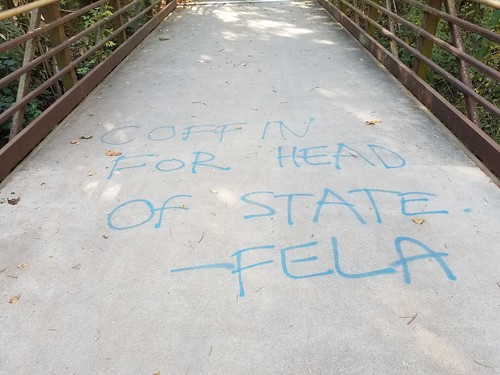
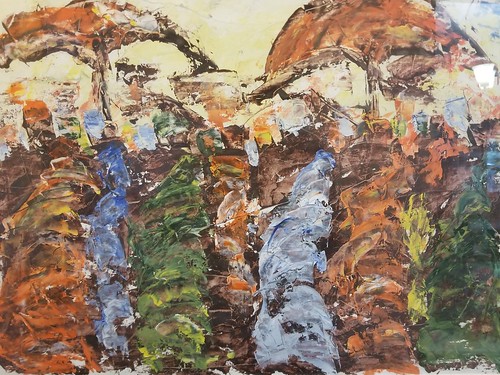
(On election day 2020, this was the graffiti we came across on our walk. On the same trail we saw "Trump is the virus" and other unprintables by the same artist. I guess it was cathartic for them).
I would normally be moved to a poem, the language in the above passage is tempting; the music to be found in the homilies of strongmen and the men in khaki. Also, as a time capsule of cold war perceptions from the south, much could be drawn out. Still, one is conflicted. Circa 1984 the Soviet Union and General Secretary Andropov were not supporting the apartheid regime as Reagan and Thatcher were, indeed they were actively on the side of many African liberation movements. Still it's hard to resist commenting on the expressions of grief from say Comrade Mengistu, who was then Chairman of the Organisation of African Unity (OAU), or the erstwhile Master Sergent (and then Doctor and General) Doe, the blood altogether blinds me.
Bread and circuses are not merely confined to monarchies. But this is a time of worldwide mourning and sober reflection, let's not pursue the thread...
I like to think of good King Solomon as a claims adjuster
Whose renown came from the application of force majeure clauses
For the essence of his intervention in the famed custody dispute was none other
Than that how one reacts to sudden adversity determines whether we should get applause
It was Ananse the Spider who clean absconded with the pot of wisdom
When the tale of the lost stories became part of humanity's curriculum
Solomon's later strategic insight lay in the soul insurance he dispensed:
When the snake is in the house, there's no need to discuss the matter at length
Later, one can satisfy those with delicate sensibilities
Who would rudely cite due process, chapter and verse
But in the heat of the moment, borne of necessity
None can argue, decisive measures are of the essence
It is no wonder that a central banker,
In extremis, acts first to protect the rich
Ignore the cover story that the world was falling,
And all that business about systemic risk
Like a mother who instinctively gathers her brood
Hastening to escape a fire or avalanche
There's no time for observing the rules
Forget regulations, this is soul insurance
If I recall, it was the Sage of Omaha,
Warren Buffett, who once said
"Only when the tide goes out do you discover
Who's been swimming naked"
And Walter Bagehot in Lombard Street, it was that noted,
"Every great crisis reveals the excessive speculations
Of many houses which no one before suspected",
An altogether astute observation
We saw during the Great Recession,
Rules set aside, as if they were no longer in vogue
The haste with which the political system
Rushed to indemnify so many financial rogues
Scoundrels whose vulture capitalist behavior
Fomented wholesale casino Ponzi misdeeds
Not for nothing, many still made shocking profits,
Not the least of which the great vampire squid
Call it sharpening the contradictions
As the actions are often shown to be crude
These fugitive glimpses of the real world
And of those who were swimming in the nude
Oh the celebration at the outset, of the hordes, the brave essential workers
Yet some others formed bettingpools on who would survive of their number
It was made fairly clear that if you worked in a meatpacking plant
You were an afterthought, for they only made to protect the banks
But back to our song of Solomon
And our erstwhile soul insurance agent
Who negotiated the terms and conditions
The policies and society's cost payments
Without shame we'll never reach herd immunity
Nay, for this policy there's no buyer's remorse
This pandemic is a signal moment of clarity
It's time to invoke the force majeure clause
The volunteers carried litter sticks and plastic bags
They were out in force and seemed in rude health
One of them climbed down into the creek to pick up the trash
I thanked them, for I'd thought of cleaning the trail up myself
But always forgot, on our weekend walks, to bring a bag
To spend one's Saturday afternoon doing garbage collection
Is quite the antidote to our ongoing social isolation
And what do you know, just two weeks later
We passed, on the bridge, a couple of teenagers
With fishing poles at the ready dangling over the bridge
Lines dipping into this selfsame creek in search of fish
We thought back to those altruistic weekend warriors
Who tended the fabric of our commons in quiet sacrifice
I daresay, social living is the best. Quality of life.
...
Perhaps it was the pandemic, and the phobia it elicited,
That caused me to stop frequenting places I normally visited
I succumbed somewhat to the caution of hygiene theater
The fear of fomites, the call for action of the gospel of germs
Like everyone, I wiped things religiously citing public health
A little overkill, wouldn't you think, for an airborne disease?
What it meant was that I'd stopped taking up those park seats
Turns out that there was also the small matter of comfort
For it's not very appealing when you lack lumbar support
Everything came into place when I noticed the new wooden slat
That added an extra cushion for when the weary traveler sat
Parks and Recs had budget, it seems; they fixed the bench, it was nice
Even without the green paint, it made all the difference. Quality of life.
...
Don't call it a love letter, for it was merely appreciative
And kind, of this unknown neighbor to take the initiative
To pen, with loops and hearts adorning her I's, this grace note
"Hello Friend, I love your flowers!" was what she wrote
"You take very good care of the plants you share space with,
They look very happy!" Must be an expert on these things but who knows?
The letter concluded, "I wish that your love and care for each other grows"
Like the old man who lives in the park, she likes seeing me on my hands and knees
Slowly weeding and making a living home out front for the honeybees
The monarch butterflies and even hummingbird moths are all well served
Now that, with my seed infusion, I appear to have created a nature preserve
Surely, dear wife, you can't be jealous of such gracious folk?
Knowing full well this pandemic garden got its start for want of a bolt
You do know there's no alienation of affection, we can't have marital strife
The flower garden is a covidious dividend, isn't it? Quality of life.
For most of history, it has been left to sovereign nations
To raise concern about the plight of refugees
But it was Matthew, from his gospel writer's station,
Who best reported on how to treat the least of these
The laments of note throughout history have been of the great migrations
The tales of exodus, grit, and survival that prevail in our mythmaking
Think back, if you will, to the great origin stories that take pride of place
Much less, however, is made about the fate of the internally displaced
This semantic framing glosses over the very real trauma for those others
How can it be left to insurance actuaries and international lawyers
To assess the level of pain of a wound, even psychic, in human beings?
A temporary inconvenience is their prized, arbitrary reading of things
For every action, there is an equal and opposite reaction
Goes the third proposition of Newtonian physics
On the human scale, and in the realm of human affairs,
The notion is couched as blowback that damns the spirit
A word to the wise, discard social living at your peril
The mosquito principle teaches that man can be feral Buyer beware, take heed of the treatment meted out to the least of us
First they came for others, but you may well be the next one deemed treasonous
There is no worse feeling than alienation, it leaves the most bitter residue
To walk among people who actively celebrate the hurt inflicted on you
Wrath and ignorance, the mob brings out the worst aspects of our culture
As goes the proverb, try not to die when you are surrounded by vultures
A marshmallow test of sorts is posed in humanity's curriculum
About the interplay in society to gain equilibrium
Whether to exercise restraint or give in to insatiable appetites
The message from your leader: a duty of care, tolerance, and equal rights
...
No man is an island, entire of itself; every man is a piece of the continent, a part of the main. If a clod be washed away by the sea, Europe is the less, as well as if a promontory were, as well as if a manor of thy friend's or of thine own were: any man's death diminishes me, because I am involved in mankind, and therefore never send to know for whom the bells tolls; it tolls for thee.
Why? (Am I Treated So Bad) by Staples Singers
Martin Luther King's last words to Pops form the chorus of this march on the freedom highway. Mavis and family and angelic yet gritty as the song demands.
I'm conflicted about how to place this internal displacement, originally conceived for a covidious series as it could well fall under the banner of Social Living, do let me know what works better.
It's uncanny when you first recognize a kindred spirit
When you find yourself in conversation with a long lost friend
Beholding that ineffable nous that immediately speaks to you
A substance and outlook that, you realize, tints your customary lens
For what is familiar to you, what you've long known as normalcy
Is not the same for others, rare are the cases of deep empathy
You wrote the tale of the lost stories in an attempt to find yourself
For it's not often that you recognize yourself on the book shelves
It's bracing to read them as they take you into their worlds, these writers
With their finely detailed narratives, it's the underlying story that matters
What with the shared love of limpid language and angular storytelling
We are children of Ananse, with words as music, lovers of social living
I have my tribe, masked in words, with whom I'm in episodic conversation
Members of my cohort who give me comfort with their singular discursions
Blood brothers and sisters, most of them badged as modern travelers
I don't need their likes or plaudits, their very presence is enough
Humorous anecdotes and elliptical notions thrown in for good measure
Unafraid to take our time and tell stories and let them take us where they may
There are distinctions for sure, I'm not one for some of their enthusiasms
Even when I disagree, I have a deep and specific connection with their artistic impulses
The long tail of community, kindred souls who risk and dare
We are normally dark matter, but clarifying with the stories we share
Each pushing our way towards the moment when you see your face in the mirror
But even with our undoubted self confidence, it can be the shock of the familiar
In a life of mixed metaphors: the middle passage and the torrid zone
I'd rather not face the challenge of humanity's curriculum alone
At once stranded mid-Atlantic, dislocation is our ultimate subject
A head nod to my fellow travelers engaging in the normalcy project
The Friends playlist would normally be my first port of call, but this note seems to require something a bit more angular and evocative. Taken mostly from Massive Attack and Portishead who frankly won the 90s and finishing with the incomparable Stevie Wonder taking flight. (spotify version)
I woke up to music just the other morning and I can safely say
That the most exhilarating nine minutes of recent memory
Was when The Seven Year Old and I took out our white handkerchief
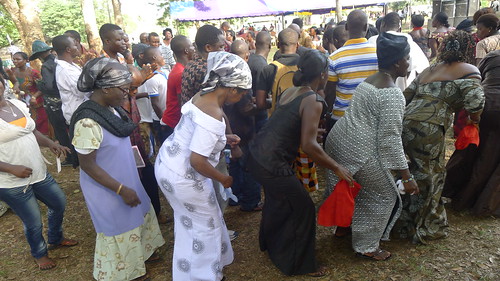
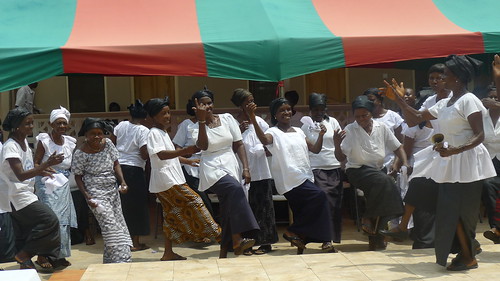
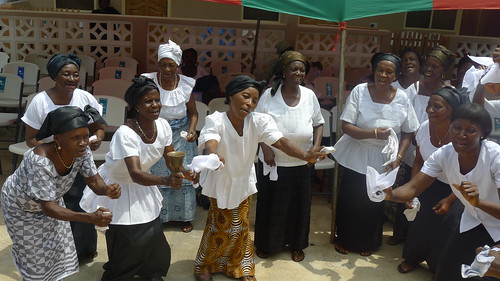
And comfort blanket, respectively, and got down to our song and dance circle
Call it the musical antidote to the previous day's zoom funeral
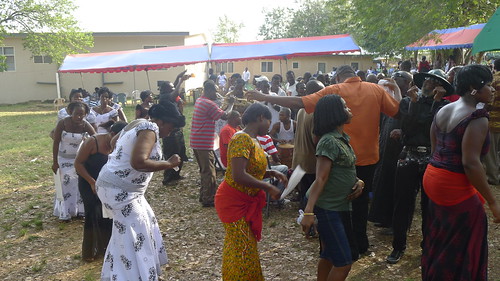
Even as I was paying penance in this ongoing season of grief Borborbor dances and other Abutia clan traditions soothe as remedies
Then I recalled the moment after we had lost Daa, when my Auntie
Briefly sublimated her pain and sorrow and lost herself in the dance
A few seconds of pleasure in fond remembrance of her mother
In a covidious time we live with the fear of the superspreader
The web gave a glimpse of African ceremonies of yore
This was the music of the Gods, what paradise have we lost?
...
Gee kindly Doctor Fauci
As a boy, I used to enjoy choir practice
That is, until my voice cracked
And hormones made my intentions mixed
These days, however, the danger is stacked
Singing in mixed choirs has been decidedly nixed
Until this pandemic's ended, we are well and truly stuck
I must say, it's been causing quite the commotion
Dogs and their walkers appreciate the distraction
From the stultifying sameness of the urban jungle
I wonder if I could even grow a pineapple
The thing is I really don't know what I'm doing
Gee only trained me as an unpaid laborer in her garden
An able body and willing mind to be put to work digging and weeding
There was never any hope of green thumbs,
call it low (or realistic) expectations
But something must have rubbed off it seems
Perhaps it was tacit knowledge or beginner's luck
For when I happened to throw down some seeds,
Things started to grow and, with water, they stuck
So now there's a profusion of flowers in the front yard
Monarch butterflies and bees flit around unconcernedly
Every day a new variant blooms, flourishing like a wild card
One never knows what today's delight will be, for nature works mysteriously
The only constant appears to be change - and delight, that is
I'm not quite reconciled to have become a naturalist
It's been quite the covidious dividend,
much less than 100 dollars I've spent
The rest is my time and labor. Luck be the lady,
I love this pandemic garden
The boy picked up a dandelion
Carefree as was his wont
But when it came to blowing it out
He was stymied by the face mask
No matter how hard that he huffed and he puffed
The fabric mesh that covered his mouth held fast
The mask against aerosols and other viral vectors
Did its duty of protection against childhood leisure
Thus whimsy was victimized by material culture
Revealing the extent of the plague's infrastructure
We were getting a truer measure of the pandemic's cost
Even as we asked, what paradise have we lost?
...
We passed our neighbor on our daily walk
But where we would usually stop and talk
We contented ourselves with a head nod and gave her a wide berth
Such are the rituals that are disappearing from this earth
Now alienation becomes common courtesy and a duty of care
The temporarary inconvenience of distancing as social welfare
That the breath of life carries tainted droplets is another irony
Anecdotal testimony abounds of the myriad covidious casualties
Biology imposes penalties and we weigh its shadow's burden
Deprived of touch and community, so many are truly hurting
This new normalcy, fraught and enforced, only exhausts
We are left pondering, what paradise have we lost?
The First Law of Grief, conservation, is, at first glance, confounding
That while cathartic, the public expression of grief favors forgetting
This is the quantity theory of grief that the ancients have observed
Namely, that it is in the nature of grief that it is preserved
A fundamental property of the substance is internal displacement
An external observer disturbs the soul, preventing reliable measurement
The observer effect is ineffable, never judge the outward appearance
Nay, the solitude of private grief destroys society's moral balance
That pain, unacknowledged, is a burden cannot be denied
Social beasts, the inside might not be as strong as the outside
Sometimes extreme measures are called for, even extraordinary rendition
It is only in retrospect that the workings of grief achieve recognition
The Second Law of Grief, irreversibility, is much disputed
For the texture of grief is intangible and cannot be computed
Most social sciences assume agency, hence the notion is frequently challenged
Practitioners believe in the efficacy of solace, thinking that it can be managed
It's an article of faith in all religions that the cure is consolation Memorials and laughter are often proffered as emotional vaccination
The counselor's handy prescription for the spirit's rhythm of loss
Assuages the survivor's misgivings, yet we all one day will pay the cost
Some advanced the notion of stages,
Finite, and with an eventual equilibrium
These stages were posited as stepping stones,
Or rest stops, on the pathway to resolution
There were many doctrinal disputes about the magic number
Conclaves and conferences were held, more than I can remember
Was it the five heartbeats or, rather, the seven steps to heaven?
Out of the tower of Babel, came a dozen steps of mourning
Expedience and practicality reared its head contra the theorists
There's no pride of place to be the chief mourner in the funeral notice Regret is everything, only belatedly can you enjoin in the communal numbness
Weary sons and daughters left wounded at the loved one's erasure, and the absence
Unlike thermodynamics, the Third Law of Grief concerns sorrow
The essential conceit is that no one is promised tomorrow
It is an inverse, this constant, and, rather than absolute zero,
The arc of grief, experiments confirm, instead approaches a plateau
The formal statement posits an upper bound, renewed anew
The paradox is that this physical limit is unapproachable
Whatever the perspective, whether raised heights or depths unfathomable,
You may think that you are done, but grief is never done with you
Applied grief, in practice, presents a serious dilemma
The theory holds that there are ways to move on and recover
Military training courses may try to inure their recruits from future trauma
But stress has a thousand fathers, while grief bears the affliction of a single mother
Unlike shame, for which some cultures have herd immunity,
There is no cure as yet, there is no remission for grief
Highly contagious, it's a social disease that simply cannot be prevented,
The only treatment is time, a balm with only minor palliative relief
The late discovery of the calculus of grief was a sorry chapter
Contra the skeptic's credo, its proponents got caught up in the rapture
The assumption of the golden rule has been that for every act of emotional kindness
Society will repay the bearer in full, and with no small amount of additional interest
Ivory tower professors, however, got into the mix, and designed a commodity market
But the flaw in the trading strategy's conception should have been readily apparent
Recall the First Law, markets can remain irrational longer than you can stay solvent
The Apocrypha suggest a Fourth Law of Grief which I'll briefly explore
Malcontents required an additional dimension, and preferred the Rule of Four
If you probe deeply, these quantum theories, simply stated, are plainly mislabeled
The putative reason is that grief's insubstantiality is the source of much frustration
Like its cousin, nostalgia, grief can be a fatal affliction
When in the throes of it, patients are frequently disabled
The impairment presents as a nervous condition, as they say, observers are worried
Yet the demands of capital mean that the working reality is barely acknowledged
In most companies, the nature of the loss is judged by the closeness of connection
Always check the fine print of the bereavement policy lest you suffer a resource action
All houses are grief houses, it all depends on one's time frame
The long view of humanity, let alone biology, enforces this hard rule
The tale of the lost stories, we're all marks in a shell game
The hard knocks will come surely, some learned the lesson early in school
In the world of the bereaved, the ritual is king
The comforting routines that are shared with kith and kin
A facade of normalcy is said to protect a house of pain
Guilt leads the way, but grief always leaves a residue of shame
Social interplay imposes complexity, we were left to understand
Previous certainties dissolved, like everything, they were written in sand
Our freedom is ephemeral, and this is the chief reason:
In the land of the living, we are never far from grief season
The natural impulse is to seek out unease when stricken
To find comfort in the unseemly, and embrace discomfiting
But the pangs afflict further, and run up against respectability
When, in your pain, you’re accused of disturbing tranquility
The burden of the done thing enforces the miserable
Teaching a lifelong caution against the public spectacle
The laws of grief, in their fullness, verge on the obscene
The fear of flailing even when you want to scream
I give you African Ceremonies, my photographic examination of some of the ties that bind us in Africa and the diaspora...
Back in 2006, I gathered some photos I'd taken into a slide show about African ceremonies. It was intended as a companion piece to an article I was writing about building software to support communities and how to highlight the periodic social events that all communities require - said article has sadly remained dark matter. Well that's my cover story, another theory is that I had 15 minutes to procrastinate...
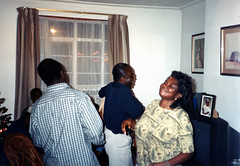
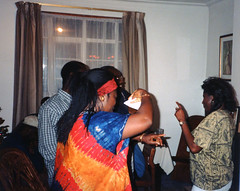
A curious few who happened onto the photos asked for a little narration to underline what I was getting at, and to explain some of what was taking place, the traditional weddings were intriguing it seems. There was also a withering comment about why I labeled it "African" rather than the more specific "Ghanaian" - but I'll dodge that one now as I did back then. I was vaguely hoping to start a trend and was hopeful that others from the continent or diaspora would add their own visions of their own ceremonies. I was early on the web and, for the longest time, if you searched for Ghana weddings, my happy day would have been your top search result (sidenote: a lazy Ghanaian journalist once did that search and used one of our photos to illustrate a story about sham Green card marriages which almost gave my poor mother a heart attack as she opened her newspaper one morning to see her son and daughter-in-law in glorious print and juxtaposed infamy - I really must dig up that paper from my archives).
I am well aware of the types and faces that we traditionally see of Africa. I've been pleased, in the years since, to see Africans adopt Flickr, Instagram, and what have you. As internet penetration advanced, and especially with the adoption of mobile phones, we are all putting out our own images and telling our own stories. Here comes everybody, as a prescient Clay Shirky intoned.
There is a tension however about putting one's family snaps out there, I am mindful of privacy concerns that may arise and have taken down promptly whenever alerted. I've found though that my loved ones have actually appreciated my amateur social historian impulses and the value of a simple link. Even when I've recorded painful interludes and genuine grief, the memories of our rituals and traditions have been the social capital and comfort that we draw on to go forward.
Then the pandemic intervened and, in this covidious interlude, I've had further time to pair all those images with a very special piece of music, a stunning version of Better Days Ahead by Gil Scott-Heron, recorded Live at the Fox Theatre Boulder Colorado in 1979, I believe - hat tip to Kalamu.
Herewith then an attempt to turn my amateur snaps into a "photo essay", a personal tour of African ceremonies...
African Ceremonies (Better Days Ahead by Gil Scott-Heron)
I also give you the linked video for viewing and listening pleasure. My liner notes follow below. At the very least, the music should be your blanket of soul. I found the juxtaposition of the images and the song moving for, even as I contemplated how things have fallen apart, I could harken back to these mementos of togetherness. It is no article of faith to expect that there will be better days ahead even as we ask: what paradise have we lost?
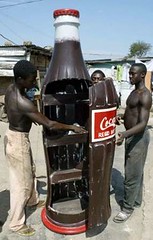
People like Angela Fisher and Carol Beckwith make coffee table fodder out of photography books like African Ceremonies and Africa Adorned. Those books are visually wonderful and they deserve all the acclaim (and money) they get. To my eyes however, their approach is a little too stylized; there's a loss of social and cultural context, and a sense of titillation. They omit the Coke bottles or cans, the white plastic chairs, the satellite dishes in the background or the goat-herders with the cellphones.
"Move that away", you almost hear them demand as they take the "authentic" photos. The end result is based purely on an aesthetic sense (albeit a very acute sense) and a view from the outside-in. Still I'm grateful that someone is documenting these affairs; so much of Africa's past has been ephemeral and lost in oral tradition. But the result is otherworldly and, I hesitate to bring up the word, exotic...
You don't need to point to the nativist stylings of Leni Riefenstahl whose penance for the Third Reich propaganda was a retreat to the most "traditional" Africa and a celebration of the Nuba of Sudan. It's a very different feel from the photos of African photographers like Seydou Keita or Malick Sidibe which are full of knowing wit that comes from breathing in life in the society.
This is also true if you monitor contemporary photos about Africa. The aesthetic of many of the photos in the Images of Africa pool at Flickr is quite different from that of those taken by "the locals" even if said locals have begun posting to that and other forums. This is understandable, holiday pictures of a safari, of wildlife, or of those who put on performances for your benefit will obviously be far different from the kinds of things you notice if you were involved in the occasion. Still as more Africans add to the collective pools, things are changing. The aesthetic of the more professional local photographers, say the "African Futurist" or say Blackwize is as vibrant as can be. I'm not a visual person, but whenever I've ventured into Instagram and such, I've never been disappointed. You can get a keen sense of the modernity and normalcy in their visions.
Tradition
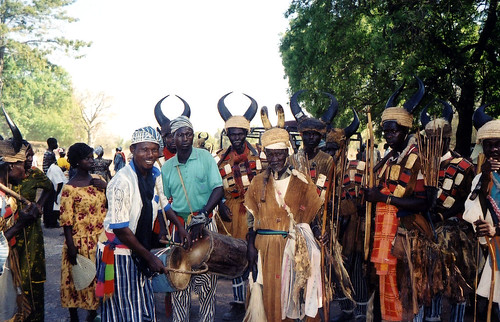
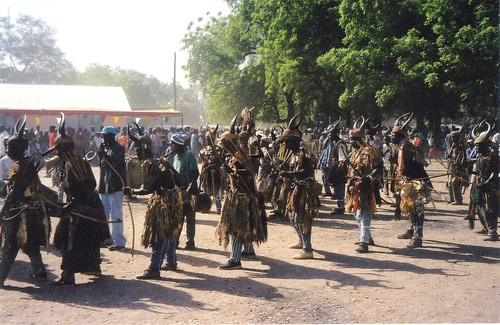
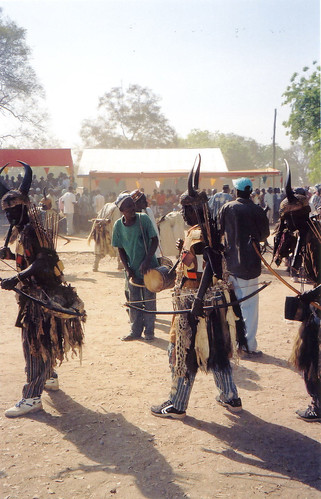
Take a ceremony like this, from Sandema in Northern Ghana (of which I'll later share a quite harrowing story).
The setting is the Feok Festival of the Builsa people where they re-enact the story of how their ancestors fought off the slave raiders. If you're ever in Ghana in December and can make it up north, you'll definitely enjoy the occasion: the elaborate choreography and exuberance of the warriors showing off their forebear's proudest moment.
Note if you will the Adidas and Nike trainers - how inauthentic, right? Angela Fisher would surely make them get some real hunter shoes, savanna grass and antelope hides or what have you before taking her photos.
One of the backstories to the photos is that these guys are all ex-policemen despite their posturing as "traditional" warriors. These days they settle scores with AK-47s instead of the cudgels and shepherd's crooks they carry here. Capturing them on the one day of the year when they ostensibly forgo their hair-trigger militia tendencies misses half the story. In many ways, they are seen by the rest of the country as a lost cause, almost akin to the Somali warlords - i.e. people to be mostly ignored or, at best, bought off to keep quiet. A quite dangerous state of affairs, but that's another story...
Pageantry
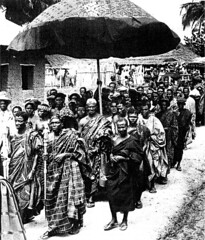
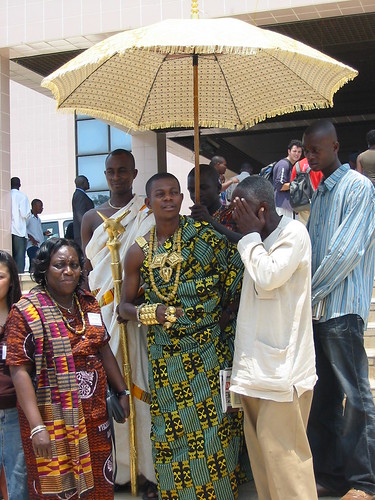
We do like our chiefs and the pageantry that comes with durbar rallies. Throughout our history we have put them on a pedestal or palanquin.
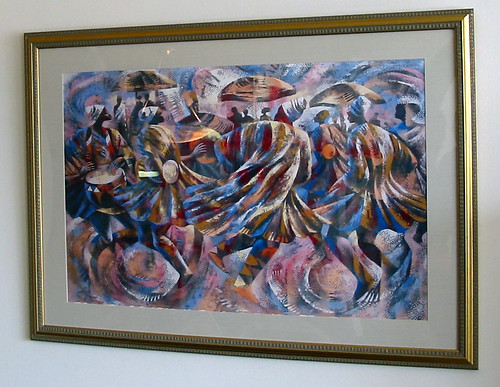
Durbars and the ceremonial umbrellas that accompany them are a recurring motif in our art.
While I like these glamourous and photogenic ceremonies, they are fairly infrequent. The majority of my experience of ceremonies has been of the more personal variety, and not quite so dramatic: births, engagements, weddings and funerals... Ceremonies are rites of passages and have importance in our communities given the impermanence and fragility of life in our part of the world.
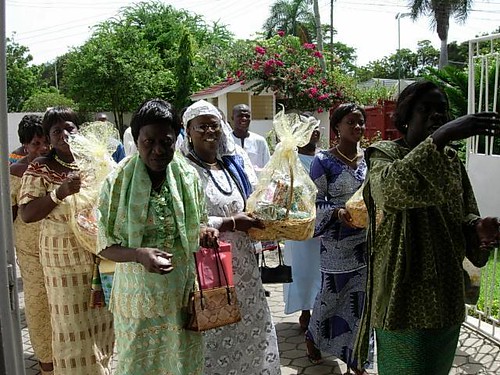
Let's start with an engagement ceremony - or "knocking" as we call it in Ghana. In our traditions this is where the two families ostensibly meet for the first time.
The man's family goes bearing gifts to the woman's family to "knock" on the door, introduce themselves, declare intentions and ask for woman's hand on behalf of their son. Basically it's the traditional wedding.
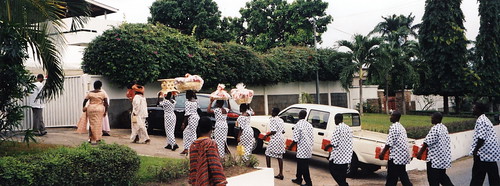
Sometimes for the more showy, you can hire carriers, a band or people - color-coordinated of course, to carry the gifts your side is bringing to the table and to come and sing praises. On the whole though it's an opportunity for the families to get to know each other. Depending on the tradition, attendance by the couple is optional, this is all about the two families becoming one.
More often though, you carry them yourself.
In the Ga tradition, the groom's family arrives at the gate of the bride's father's residence and "knocks" requesting entry. Typically you offer a nominal payment of 100 cedis (about $10) for entry.
You're making an entrance. In some traditions, there is a big to-do about the entrance. They won't let you in, pretend no one is there. Or the reception is grudging, "who are you people?". But it's all a theatrical pose.
I know that in some traditions they bring out multiple ladies from the house and theatrically ask that you identify the desired, to see how well you know her. We come bearing gifts whether Schnaaps, cloth, jewelry, suitcases and cash. Gifts are symbolic although there is much ado about the list - e.g. approx 100 cedis ($10) to enter the gate, a suitcase for the woman's belongings, pieces of cloth, a ceremonial white bible, a few crates of drink, a stool etc.
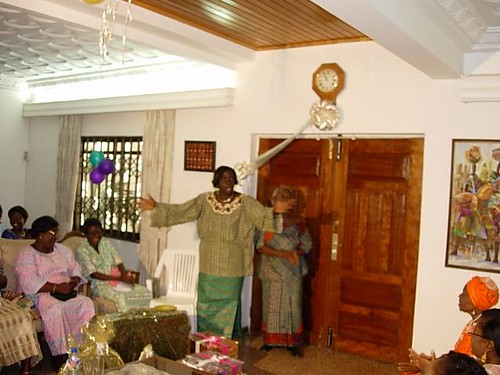
We have spokesmen, or Okyeames, recounting the praises of the participants, using very ornate and flowery language. "Our son has spotted a beautiful rose in a garden." Knocking ceremonies, are mostly run by women, and indeed are for women, attendance by the men in optional.
One last thing: this was also the point at which one would openly discuss the lineage and antecedants of the couple - e.g. in the past this was the moment at which we checked with the family elders to prevent inbreeding.
Sometimes you get priests running things - with Ghana's new Christianity, you get a lot of prayer interludes. Occasionally it's silent prayer but often the exhortations are quite intense - and lengthy.
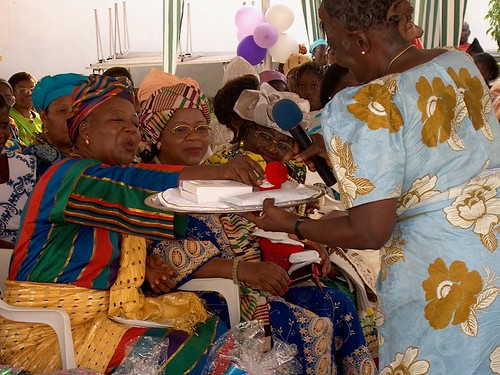
There's lots of fuss about the little things, the white bible, the ring, the cloth, the cakes, the little envelopes stuffed with cash bribes for members of the family,
the suitcases (sometimes a brand of suitcase is specified).
The people who come bring a lot of energy to the gathering. You may not see them often during the year but they want to affirm their membership in your community (I realize I'm writing here with software engineer's terminology, but you can sue me, my life informs my work).
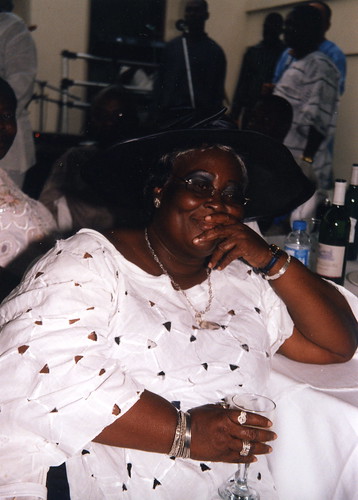
Some come with glint of mischief in their eye, or maybe a sense of the cantankerous.
and perhaps pearls of experience
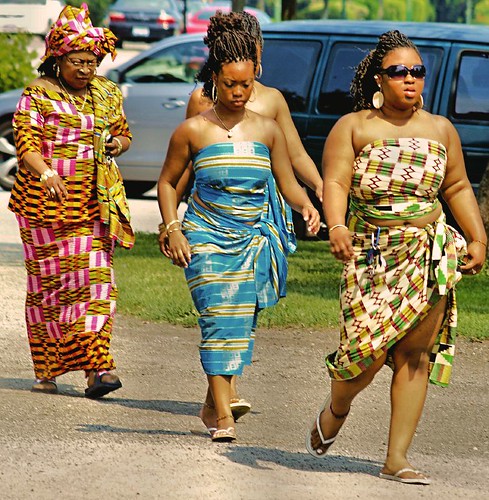
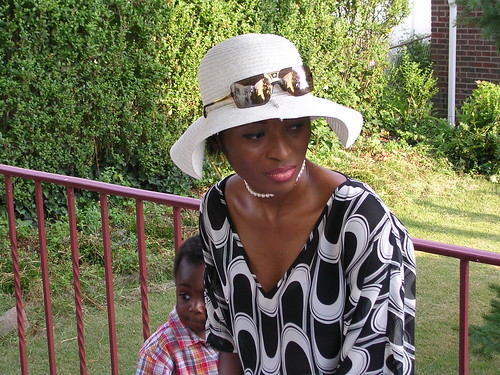
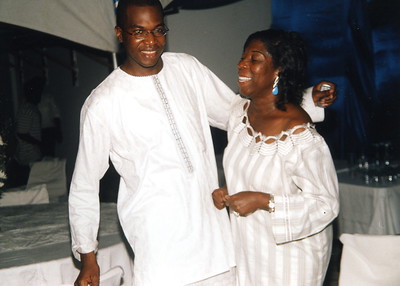
We all make an effort to dress up for the occasion.
Our seamstresses are kept busy
Lace style and pageantry is in order
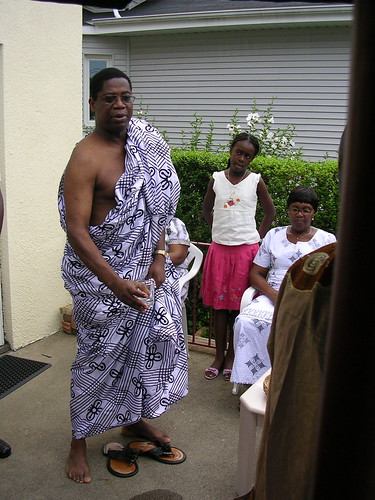
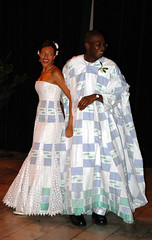
As are the kente stylings.
Funeral Minded
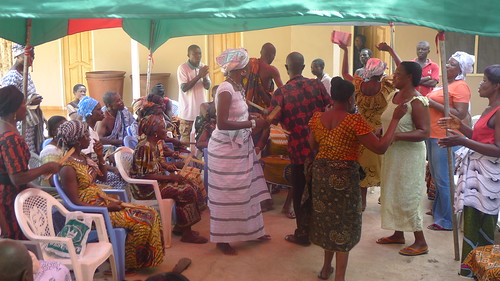
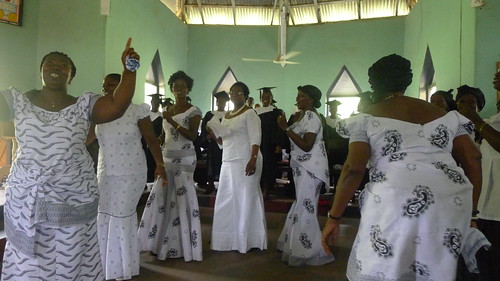
The iconography of funerals I've attended rhymes with that of engagments. Even in our moments of grief, tradition demands surety. Consider an Abutia clan funeral ceremony that takes place the day after the burial. The clan visits the bereaved family bringing gifts to commiserate, bring comfort, and share in the community's loss.
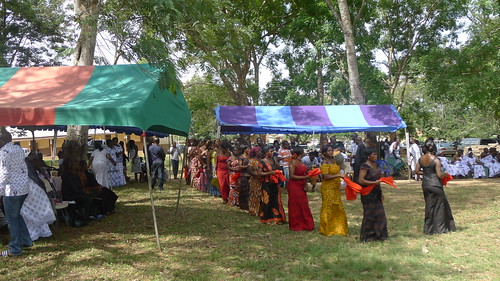
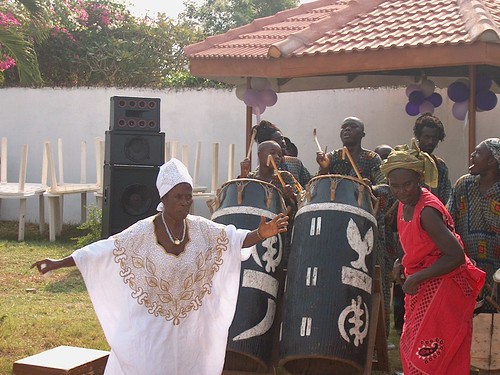
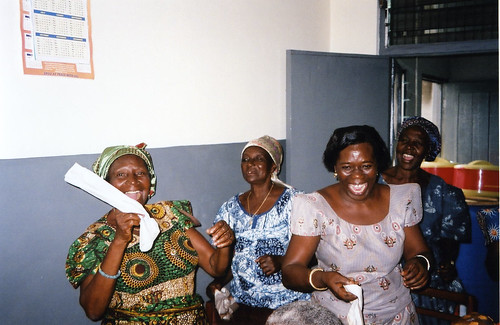
It was a painful moment for all of us, we had lost Da but you can see the exact second when my Aunt's grief was sublimated and she lost herself in the dance, in fond remembrance of her mother.
You're always surprised about who is most involved in the event. The dark matter of communities surfaces at such times. These social events are about participation and identification. Formalisms like invitations are a little much in Ghanaian traditions. If you hear that so-and-so has a baby or is getting married, it is your obligation to show up. You can imagine the uncertainty this causes. If you're organizing such an event, you should probably double your expectations about attendance. Like the South East Asians, it becomes a numbers game.
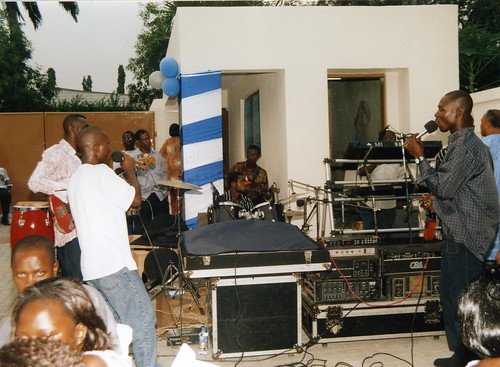
During our years under military rule the only outlet we had were these ceremonies, and once democracy returned and a middle class began to reassert itself, there has been a burgeoning industry of event planners. We believe in textiles, food and such.
Members of the family and close friends would wear the same print.
It is well known that the Ga have made an industry, and art, out of their coffins, and well entrepreneurial spirit flourishes where there is a need.
We also mark the anniversary of the death as the 1 year and 10 year dates are important in our traditions. Our lost ones live through us and we remember and celebrate their legacy. These celebrations of life happen not just in Ghana but in New York, New Jersey or London.
Outdoorings
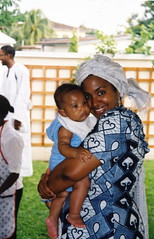
At the other end of the circle of life are outdoorings, the naming ceremony for newborns. These are traditionally held on the morning of the 8th day of life.
The Okyeame pours libation and formally presents the newest member of the family.
The colours are typically blue and white.
the children look on and learn
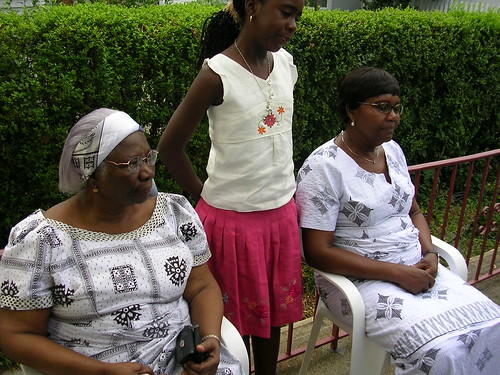
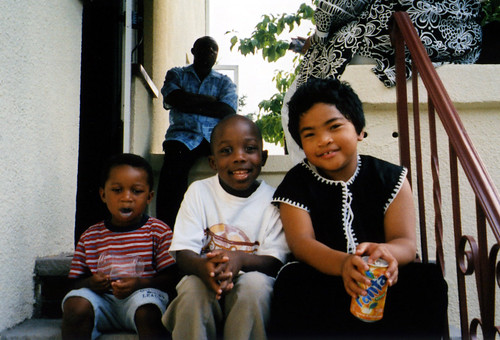
The grandmothers are beside themselves. They like to see that things are done properly.
We forget the daily grind of life in the diaspora
and embrace a certain aesthetic of ease on these occasions
Ceremonies qua Ceremonies
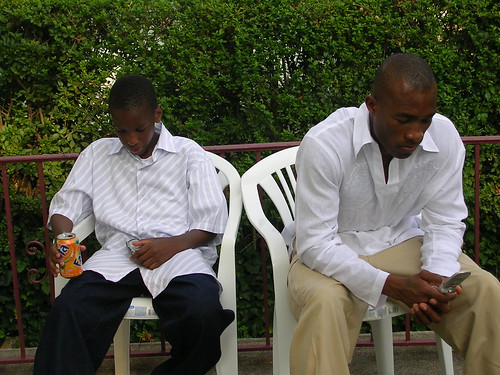
Mobile phones are de rigeur these days
The food is always something else, we like to throw a spread...
I normally make a nuisance of myself in the kitchen
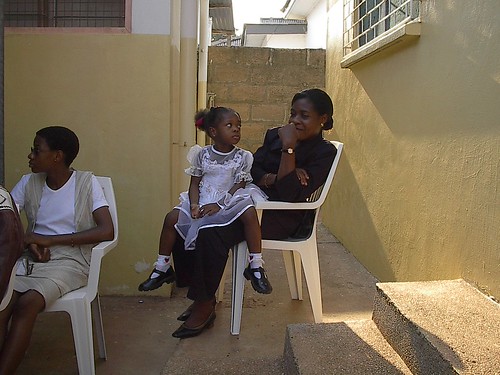
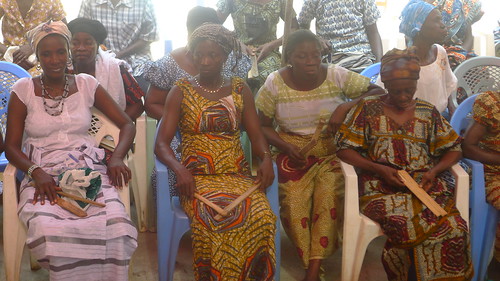
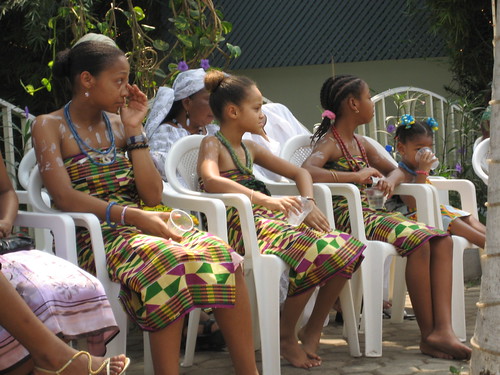
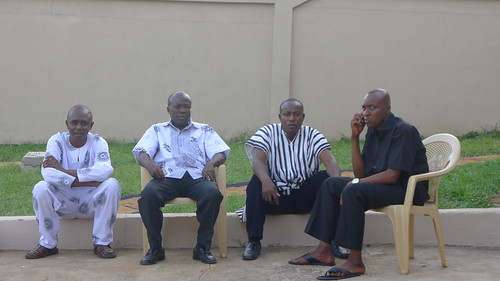
It's all about the chairs however...
lots of chairs
We spend lots of time in the heat, under canopies
plastic chairs, sunlight and waiting for tardy drinks
A surprising amount of time is spent simply waiting