Showing posts with label marketing. Show all posts

Monday, April 01, 2024

The Body Wash Situation

Now it's come to this, an inglorious chapter
Did they really have to go this far, I wonder?
Some things in life are just so disconcerting
Now I'm facing the body wash situation

You see, somebody's been messing with my shower
The signs were unpromising just a few weeks earlier
I'd noticed on the bottle that ominous portent of terror
Yes indeed, brightly highlighted, it read: New Formula

Uh oh, I thought, I wonder how this will go over
The Wife, you see - bless her, is a delicate flower
Woe is me, her nose for scents is simply without equal
Would this new formula repeat the earlier debacle?

Twenty years was a good run for a product, it's indubitable
I guess the new formula striking once again was inevitable
Back then, I’d being forced into exile with the demise of Oil of Olay
Their "new and improved" body wash was a clear fail - plain as day

I'd investigated, and found that they'd changed their formula
   Because of the price of soybeans
Call it a supply chain adjustment,
   Late stage capitalism messing with my shower routine

At length, I'd then settled on Aveeno
"Unscented and fragrance free"
And what's this they're now touting?
The new formula is "Sulfate free"

I suppose I should rejoice, going by their advertising material
Their chemists have plainly gone to great lengths for this sequel
So I tried the new bottle out....
   It's okay on the skin but clearly different
But, as you know, we live in community, I'm not the only constituent...

Yep, it only took a week for The Wife to start to complain
"There's a new smell in the house, it's giving me a migraine"
The writing was on the wall, marital strife beckoned, what a disaster
And now I'm creeping, scouring pharmacies, searching for the old formula

You can see where I'm going with this, the roots of my dilemma
They messed with a good thing and came up with the new formula
Now I'm stuck with bar soap. The Wife made me cancel my subscription!
Until I find an acceptable replacement, I'm facing the body wash situation


The New Formula strikes again

— Figure 1: old formula (left), new formula (right)


II.

Now I played it for laughs, but this situation is deadly serious
I'm also an organic chemist at heart and hence quite curious
Can't a man have a shower in peace? Such is my predicament
I resolved to get to the bottom of things and check out the ingredients

From a visual inspection, I couldn't detect a change in color
The change is in the olfactory realm, something about the odor
To the touch, the cream feels just a little bit thicker
And perhaps, I'd hazard, it lingers on the skin longer

Turns out, from the label, that the old formula was "Made in Canada"
Hmm, how damnable, the new formula is "Made in America"
I don't know, I think I prefer the work of the Canucks
Because this American formulation, quite frankly, sucks

I see what they did there: they took the more expensive seeds out
And tried to mask the change by claiming they're taking sulfates out
I've been down this road before, I almost want to scream and shout
I'm not inclined, at this stage, to give them the benefit of the doubt

Gone are the citric acid, coriander fruit, and cardamomum seed oil
Replaced by, who's ever heard of, Pelargonium Graveolens Flower Oil
Stick to core competency, I mean talk about missing ingredients
Bean counters and boffins inflicting on us this kind of deviance

They've now turned to the hard sell. On this, the evidence bears me out:
"91% agreed this product gently cleansed their skin without drying it out"
Are they imposing a global formula change using leftovers and by-products?
Or, Dear Reader, do I need to move to Canada to find my beloved product?

What gives? What's wrong with a little sodium laureth sulfate?
Why do I need to switch to, of all things, ethylene brassylate?
Is there nothing sacred anymore? Call it buyer's remorse
I mean The Wife is now actively contemplating divorce

Some things should be sacrosanct but they'd rather whitewash
For god's sake, why are they messing with a man's body wash?
I'm rather minded to call it The Aveeno Debacle
Frankly Johnson & Johnson, this is unacceptable

And so I leave you stewing, with a mix of anger and frustration
Driving around town with the kids in search of the old formulation
"The customer is always right" is the quintessential American fiction
Steel yourself and gird your loins for when you face your own body wash situation


the body wash situation aveeno body wash old vrs new formula

— Figure 2: list of differences in the ingredients.
old formula (left), new formula (right)


The Body Wash Situation, a playlist


A contentious soundtrack for this note (spotify version) Bonus beats: You've turned my whold world around by Barry White


The New Formula strikes again

— Figure 3: ingredient list and marketing hard sell
old formula (left), new formula (right)


Please bring back the old formula Aveeno Johnson & Johnson
With this unseemly change, I'm unmanned, I really can't cope
It no longer passes the wife test, this is a desperate call to action
Please bring back the old formula... and save me from bar soap

...

[Update]

Six weeks later and things are no better, I really can't cope
The Wife threw out the various substitutes I tried out, she said nope
Even the brand that bore her middle name, sensitive skin and all was a no go
Leaving me to bask in that time-tested but low frills efficiency: bar soap


More beats in this time of mourning: I can't go for that by Hall & Oates and Come Back by Keith Sweat

...

See previously on this curio of late stage capitalism: And for more on the domestic front,

Needless to say, I dissent.

(Oh, look at the date. Ducks)

File under: , , , , , , , , , , , , , , , , , ,

Writing log: February 16, 2024

Thursday, September 10, 2020

Mixed Metaphors

The COVID-19 risk guidelines in Austin, Texas present a design dilemma and a case of the blues (and more on that anon, see if you can spot what I mean). They also started with a political handicap when they were unveiled a few months ago. These are local city and county guidelines, drawn up by the Austin Public Health department, that were always likely to be ignored and run roughshod over by Texas's governor who was early in hailing The Grand Reopening of Texas, and has steadfastly proclaimed Positivity in the face of all contrary evidence.

Covid-19 risk guidelines Austin Texas May 28 2020

The earlier color-coded threat level Homeland Security Advisory System in the US has also been handicapped since its inception. While some critics focus on its bureaucratic unwieldiness, what irks me most is a catastrophic user interface and design failure. The failure, as you'll note, continues into the present.

The reason is that, in order to have green be the colour for the "all-clear" threat level, the natural spectrum of light, as normally seen in rainbows, has been altered in the Homeland Security scheme. Thus ice cool blue has been promoted to "guarded" whereas tropical green has been demoted to "low".

homeland security advisory systemrainbow

A bureaucrat or marketing person's intelligent design is at odds with evolution, physics and reality. Blame Osama bin Laden perhaps, but any number of people in the US government signed off on this mishap. Further, we are still living in this era of Recent Non-Specific General Threats almost two decades later.

The messaging and visual branding in the covid guidelines suffers from the very same flaw with the inversion of the colors of the rainbow spectrum. You can almost hear the designer's brain ticking: let's start with a traffic light metaphor, Red-Yellow-Green. But wait, they want 5 levels, let's add in orange and blue. Oh no, what about green? Argh, I give up, let's just invert green and blue. Mixed metaphor much?

Covid-19 risk guidelines Austin Texas May 28 2020rainbow over san francisco bay

Everytime I look at these charts, I suffer cognitive dissonance, there's something not quite right. I don't have to be color blind to be confused; I get a case of the misplaced blues. Could it be so hard, I ask myself? When I bought some paint to go after Tom Sawyer, things seemed easy, I ordered my 5 cans of paint and got a nice rainbow spectrum:

rainbow spectrum of colors

When I looked at my bookshelf at my stack of Unesco General History of Africa books, I noticed that there was a similar confusion if you organized things chronologically. I suspect the editors of that wonderful series weren't visually inclined but, in mitigation, they weren't dealing with a global pandemic and coming up with an urgent public health intervention. Still, the learning exhibited in that series stands the test of time. Even if later scholars have access to more material these days, those historical tomes were a real benefit for humanity. It was certainly wise to have the red volume be Africa under Colonial Domination. The blood of colonial era lingers on the ground. Alfred Adu-Boahen's opus of historical scholarship stared with clarity at the heart of darkness and eschewed Africans as scenery in the race to Fashoda.

But back to our covidious guidelines and rules and regulation... Once you move beyond the blue in green, as it were, a further problem is with naming and comprehension. If you use numbers for different phases, you have to consider the order. Do increasing numbers mean an easing of restrictions or an intensification of the lockdown? Are you considering opening or closing? In Austin, it looks as if Stage 1 is the all clear whereas Stage 5 is the fullblown lockdown stage, but I could see the reverse making sense too. Leaving aside the blues, where do epidemiologists stand on endianness and indeed on numerology?

Mind you, an interesting thing to note is that the misplaced blues is not a universal design failure. The Texas Medical Association coronavirus risk assessment of activities is at least in line with the rainbow spectrum. Different designers, most likely working down the hall from each other, came up with different solutions. No wonder humanity is afflicted with version hell and the Tower and Babel.

coronavirus risk assessment activities

The designers behind Harvard Global Health Institute's Global Epidemics site went with the Rule of Four instead, with the graphics for their Key Metrics for Covid Suppression. There is still the notion of the rainbow, but to avoid the case of the misplaced blues while fitting in with the traffic light metaphor, they added orange but decided that the blues could wait.

the path to zero

The British government in April was considering The traffic light exit strategy to free the UK from lockdown. A new economics paper suggested "a red-amber-green solution to safely ease us out of coronavirus restriction". That would be The traffic-light route to ending the economic lockdown by Gerard Lyons and Paul Ormerod (April 5 2020). It was noted at the time that this academic had sway in the past with Dominic Cummings so Mister Johnson was likely to pick up on this metaphor.

A few weeks later would read Coronavirus: 'Traffic light' system to lift lockdown in Wales
Ending lockdown could be in phases,"like a traffic light in reverse". There would be a move from red - some "careful and controlled" relaxation - to green, which would be "much more like the lives we had before the crisis hit". The amber zone would see more restrictions lifted and, if the virus is not re-emerging, Wales could then move to the green zone.

The UK would unveil its covid alert system in June rollowing the traffic light metaphor - the blues of the worst excess mortality were seeping in

uk covid alert levels system in June 2020

By July we were reading Coronavirus: Quarantine scrapped for arrivals from 'low risk' countries to England, a constrained reopening was in prospect
Last weekend the government said a traffic light system would be introduced, with countries classified as green, amber or red, depending on the prevalence of coronavirus... the Join Biosecurity Centre – which was set up to coordinate the government’s response to the pandemic – will be categorizing countries with a “traffic light” system.

Each country will be rated green, amber, or red. This will depend on the prevalence of coronavirus, the trajectory of the disease, and the center’s assessment of the data’s reliability. The quarantine will only apply to those countries rated red.

The UK Government Traffic-Light Quarantine System was said to be red amber and green.

rainbow installation at The Contemporary Austin

Chile launched its five step coronavirus prevention program to gradually reopen the country. They didn't bring in color to the mix, it was steps and numbers.

Seven Santiago neighbourhoods will transfer to Step 2 — they will be allowed to leave their houses freely on weekdays, with local shops allowed to reopen. The quarantine remains in place on weekends and holidays, along with a nighttime curfew every day.

La Araucanía joins fellow southern regions Los Ríos and Aysén in Step 4 of the prevention program. Here, rates of infection are significantly lower than other parts of the country. Restaurants, cafés, shops and cinemas can reopen with up to 25% capacity, while bars, clubs and gyms remain shut and the curfew stays in place.

If you were lucky enough to take advantage of lower interest rates caused by the downturn and attempt to refinance your mortgage, you would have faced the hard sell and the kind of mixed messages that ensue whenever traffic light meets rainbow, we always seem to get a case of the misplaced blues.

misplaced-blues-in-refinancing-look-to-the-rainbow

California's governor Gavin Newsom is hip to this game

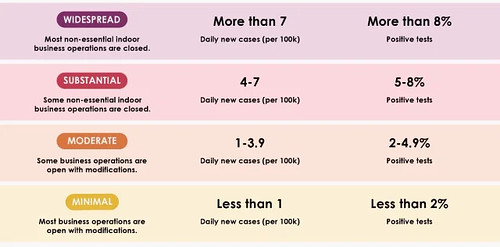
The governor said that the new four tier color-coded system would match a color to each of the four tiers with purple representing the highest “widespread” risk level for a county with more than seven new cases per 100,000 residents and more than 8 percent positivity rate. Red will represent “substantial” risk, while orange represents “moderate” risk and yellow the lowest level, “minimal” risk, with those lower levels being determined by reduced numbers in case and positivity rates.

“We don’t put up green because we don’t believe that there’s a green light that says just go back to the way things were or back to the pre-pandemic mindset”

california pandemic color coded system

The shiny Silicon Valley solution eschews the misplaced blues using purple instead, deftly forgoes green to flee the traffic light metaphor, and embraces the rule of four in pointing to simplicity for its color-coded county guidelines

Througout this pandemic, there has been a lot of mixed signals and confusion in the messages that the public has been inundated with. This inconsistent messaging goes against the best practices of public health messaging. The public is necessarily conflicted: stay home except when you shouldn't, wear a mask although you don't need to says the governor or the sherrif. Bleach and disinfectant is first presidentially recommended, and then immediately reviled and universaly ridiculed. This is the stuff of confusion, and I won't get into the stranger turns of hydroxychloroquine, or indeed the numerous cases of drinking of hand sanitizer - that last was a bridge too far for me, to mix my metaphors.

Colors abound in the discourse, yet the only consistent message is that red is bad, the hot zone or the torrid zone of infection. Heat is also at work; hot is bad, cool is good. And if some states go with colors, some with phases, some with steps, and yet others go with levels or stages. And when it comes to numbers, some go with high numbers while others prefer low numbers as the warning. Numbers are probably better than colors but again everyting is up for debate. Is higher better or worse?

One interesting thing is that we don't hear about black much in the messaging. We don't get black or white. The implied binary choices are too stark. Life or death, Stop or go. Perhaps it is because binary choices have an immediacy that force us to reflect on mortality. Three or more states is best, there are shades of gray in this business - these shades imply some degree of human flexibility and agency. Designers reached with intent into their toolkit and came up with traffic lights, with the rule of four, and always remember, as a best practice, if five or more states are needed, we should heed the actual rainbow.

Graphic designers are having a tough time achieving clarity during this coronavirus pandemic. There's no easy living when you have mixed metaphors in a covidious time.

rainbow installation

Mixed Metaphors


Traffic lights
Full circle rainbows
Prevention steps
Priority zones
Stage guidelines
Lockdown levels
Threat areas
Risk tiers
Confused warnings
The misplaced blues

mixed metaphors - covid guidelines meet the rainbow

Mixed Metaphors, a playlist


A soundtrack for this note, here's hoping we can find the blues or some black gold of the sun somewhere over the rainbow. (spotify version)

A ball of confusion is perhaps a good description for the novel coronavirus

See also: Colors, a playlist (spotify version)

This note is part of a series: In a covidious time.


File under: , , , , , , , , , , , , , , , , , , ,

Thursday, September 14, 2017

Functional Defenestration

It’s almost been a Friedman unit since I published anything in this joint so, with due deference to that old standby public service pamphlet, What everyone should know about blog depression, and a head nod to Bertrand Russell's note In Praise of Idleness, here goes some throat-clearing toli.

I. Defanging Satire (or Editorial Genuflections in the Internet Age)


Defanging satire in the age of the internet (New Yorker edition)

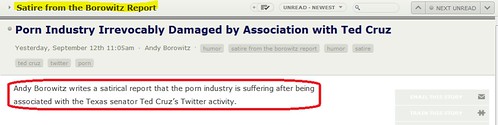
A highly paid editor at The New Yorker is now intervening to neuter the bite of Andy Borowitz's normally savage satire. The first injury came a few months ago with the retitling of the column and RSS feed from "The Borowitz Report" to "Satire from The Borowitz Report" as if to say “we must protect you from being a moron in a hurry”. Then the lasting, almost fatal, wound was the recent move to change the contents of the feed summary, which used to be the first few sentences of the article, to instead actively bash you over the head with a spoiler warning that each article is "a satirical report". Apparently the reader needs to be informed upfront that they are about to read a humorous article and protected from the dire possibility of being spoofed.

In other words, even for the most potent source of written content (and the New Yorker proclaims itself to have "the best writing anywhere"), it now of paramount importance to maintain its listing as a Google News "source" (and now with Facebook's Zuckerberg apparently faking concern about clickbait and fake news and the like, the audience needs to be coddled). The bean counters (and search engine optimizers) have run the numbers and, on the evidence, it is clear that telegraphing an article's intentions, and blunting its impact is worth the downside risk and what, I rather think, is grievous damage to art.

Up until a few months ago, the feed summary would have been the following (a pithy defenestrationof age-old hypocrisy)

WASHINGTON (The Borowitz Report) — The pornography industry has likely suffered permanent damage as a result of its unfortunate association with the Texas senator Ted Cruz, industry sources said on Tuesday.

It is soul-deadening to contemplate the considerable effort expended to actively sabotage noble hatchet jobs.

The only concession to art is that the editor didn't additionally prepend "Satire" to article titles as I noticed smaller publications starting to do routinely 12 or so years when Google News started being a dominant source of web traffic.

And here Dear Reader, as I wrote the foregoing sentence and began winding up to a thoroughgoing rant, I realized that I had been down this path before. Indeed I left a community (Blogcritics) back when its writing guidelines started to ask that writers explicitly tag their work and the site started messing with titles. The injunction then was that we needed to telegraph and prefix "Satire" to titles '(if you "make things up" or "bend the truth" notably to make a point, or for comedic effect)'.

Searching through the archives, I even found a cri de cœur written on the topic, Husbanding the Blogcritics Commons, a jeremiad-in-vain as it soon became a case of This Boring Headline Is Written for Google.

It is a disappointing development a decade later, that ostensibly powerful media outlets have thoroughly succumbed, even as one cannot deny their economic logic, pace Buzzfeed. And yet I remain a maximalist on the issue.

The story, I suppose, is about capitalism in the internet age. Per Jeff Hammerbacher by way of Allen Ginsberg, it is a case of "The best minds of my generation are thinking about how to make people click ads". Per contra, we could harken back to Slim Charles's folk wisdom from The Wire: "Game's the same, just got more fierce."

The existential question posed is how do we weigh the competing demands of popularity (as expressed by the Google News imperative) against whimsy (as expressed in satire). Sacrificing whimsy at the altar of attention is not a price worth paying, and I am yet to be convinced otherwise. Needless to say, I dissent.

II. Attention Mongering

Apropos attention, for a good decade, say right up to the Charlie Hebdo massacre, and much to my consternation, a note I had hastily written On the importance of biting satire was regularly the top search result on Google about satire. It has since found its proper obscurity, but my unexpected Googlejuice in the interim meant that the occasional student writing a term paper on “why satire matters”, “significance of satire”, “importance of satire” etc. would start mining this blog.

The early web was a great equalizer, one in which my rants occasionally trumped the combined insights of Jonathan Swift, Will Self and the like, hell even the encyclopedic Wikipedia was lagging in the Anglophone internet. Even as Jon Stewart and company started a revival of the satiric tradition in America, the clicks kept coming my way.

I don't know if I ultimately managed to convince 15 readers of the paramount importance of savage satire as opposed to the milder form that Americans favor, but I feel my ultimate insight is worth restating:

I like my satire savage. It should be vicious, biting and deeply heartfelt. The targets should feel a sharp wound. The whimsical and comic artefacts of the best satirists are side-benefits; their purpose is really to serve as social barometers and canaries in the mineshafts of our communities.

III. On Satire

Satire is a sort of glass wherein beholders do generally discover everybody's face but their own; which is the chief reason for that kind reception it meets with in the world, and that that so few are offended with it. But, if it should happen otherwise, the danger is not great; and I have learned from long experience never to apprehend mischief from those understandings I have been able to provoke: for anger and fury, though they add strength to the sinews of the body, yet are found to relax those of the mind, and to render all its efforts feeble and impotent.

— Jonathan Swift - The Battle of the Books
Satire is an art form that thrives best on a certain instability and tension in its creator. The satirist is always holding him or herself between two poles of great attraction. On the one side there is the flight into outright cynicism, anomie and amorality; on the other there is the equal and countervailing pressure towards objective truth, religion and morality.

— Will Self - Junk Mail
[Will] Self sees himself paradoxically both as a moral satirist and as a social rebel who is more interested in shocking his middle-class readers than in reforming them. "What excites me," he has said, "is to disturb the reader's fundamental assumptions. I want to make them feel that certain categories within which they are used to perceiving the world are unstable"

— Gillian Glover, as quoted in Brian Finney's The Sweet Smell of Excess: Will Self’s Fiction, Bataille and Transgression.
Of all the gifts of the pen perhaps the most fraught with danger is that which resolves itself into satire. It is indeed difficult to distinguish between cynicism and satire, perhaps the former is born of disappointment perhaps the latter is born of humour. Let it remain so and it cannot be called debased, let it become cold and let it die.

— Patrick Braybrooke writing on Hilaire Belloc as Essayist in Some Thoughts On Hilaire Belloc

Instability fundamentally disturbs markets which is why even the threat of boycotts so unmans even the most cynical modern corporations. The reverse of the coin however is that whimsy, that most valuable human concern, and its close counterpart satire thrive as disturbances to the mundanity of life. Reconciling whimsy in all its messiness to the demands of hard-nosed capitalism remains a struggle and yet struggle we must. For better or worse, we must humanize capitalism.

IV. Orphaned Thoughts

I once spent forty minutes on a subway sitting opposite a group of engineers and salespeople that worked at Functional Fenestration. They were attending a conference in Oakland about window hardware and automation, of all things. I was fascinated with their technical argot, the intricacies of the actuators, track and carriage systems and door automation that they were discussing. I marveled at the engineering arcana, and the fact that the windows and doors that we take for granted could have such complexity. Their deconstruction of the merits of some of their competitor's offerings and their strategizing about how to market the new feature of whatever widget they had just come up with (a slide handler if I remember correctly) drew me in. The intensity of the back and forth between the marketers and the technical folks reminded me of a comedy of manners of sorts, office politics writ large. Hypnotized as I was by the language and the context, I immediately imagined a novel or short story, something in the vein of Colson Whitehead's The Intuitionist and the title came unbidden, Functional Defenestration.

Most ideas are destined to be half-formed and ultimately, I never got beyond the few pages scribbled in my Moleskine, a meditation about a man unmoored by capitalism. The first sentence remains:

Man, it was hard to compete against those guys at Functional Fenestration, they were intense.
Run with it.

Soundtrack for this note

A playlist for those tilting at windmills.

File under: , , , , , , , , , , , , , , , , , , , ,

Monday, March 04, 2013

New and Improved

Another case of the new formula, another case of a company juicing the books: the diaper wipes that we had settled on for The Daughter got the New and Improved! treatment last week (the exclamation mark is the usual signifier of duplicity). It's the now customary scenario: a company decides to wring out surplus value by squeezing every ounce out of its means of production, typical latter day capitalism at work.

Working in an industry that is perpetually focused on the new and shiny, I probably shouldn't begrudge innovation in a mature market, and what is more fundamental than diaper wipes after all. Furthermore The Wife suggested I should censor this particular rant - perhaps wanting me to elevate the discourse and not fall into a parental blogging rut. I had even planned initially to use the title of this piece to dissect exactly why the recent redesign of Delicious left me in literal despair, but, well, my muckraking instincts for economic malarkey would not be denied. I'm knee deep in it, so diaper wipes toli it is...

I note:

  1. The number of wipes per box is reduced, 64 rather than 70
  2. The formulation is changed - the material is different and the liquid the wipes are soaked in is different. Presumably cheaper ingredients are being used all around.
  3. The price per box remains the same.
  4. Profit!
Counteracting this, my investigations reveal that the size of each individual wipe is slightly increased now a 17.7 by 17.7 cm square as opposed to a 17.7 by 17.2 rectangle. Thus an individual wipe might feel slightly more substantial in your hand. Such are the fringe benefits.

I won't repeat my usual analysis of the costs of all the raw materials (although I was intrigued by some of the substituted chemicals) - I'll give them the benefit of the doubt that the research and development costs of this process tweak is neutral in that regard.

Doing the math however, even if the same raw material for the tissue was being used, they have managed to get a 6 percent decrease in their costs. This combined with a 8.5 percent decrease in the units per box (their revenues are assuredly tied to the total number of units moved) is the icing on the cake, or should I say, the fruit at the bottom.

And the only thing they had to do was change the packaging. The New Formula is marketed as "New and Improved"!, ostensibly "thicker, more absorbent" and the new box has been given a makeover - green graphics evoking the forest plundered in the manufacturing process, marketing copy about how it is good for the environment, bio-degradable, hypo-allergenic etc.

mother and son by e. bonsu

Impressionable Youth


Most egregious is that the new diaper wipes have a stenciled design of what looks like little Winnie the Poohs to make it more exciting for both the adult wipers and the toddler wipees. The owners of A.A. Milne's copyright (or is it Disney) must be smiling at both the licensing opportunity and inspired product placement, eyeballs are everything and the younger and more impressionable the better.

Some surfer of the conventional wisdom says you have to do something 10,000 times (or is 10,000 hours) before you become a pro. Diapers are in most cases a 2 to 4 year part of a parent's life thus one might approach that virtuosity. Incidentally the diaper companies quite ludicrously say that you should expect to change 10 diapers a day (it is obviously in their interest to encourage inflation in diaper changing rates). Crunching numbers as is my wont, in addition to the economic bonanza gained by the process tweak, there are all those ad impressions that can be monetized, marketed to the highest bidder.

The brand is called Seventh Generation, they must be in Seventh Heaven at this turn of events. Really, think about the impressions here. The best minds of my generation are trying to figure out how to get users to click on ads and here we have literal evidence of bottom power. Various science fiction novels and films have emphasized the permanent advertising that is in our near future. The tissues given to economy passengers on some airlines have advertisements on them; much has been made about catering to captive audiences in toilet stalls and the like. The future has long intruded in the most routine encounters, intimacy and privacy be damned.

I expect that my love for Winnie the Pooh, Peter Rabbit and Kwaku Ananse will remain undiminished, but surely one might wonder about a potential backlash. I expect however such things have been taken into account, brand managers are watching social media for signs of reaction to the rebranding. Indeed my company even markets software for this purpose.

Maker's Mark was pilloried recently for planning to dilute the alcohol content of its bourbon and other products; the company reacted by reversing its decision. Fiddling with the formula is a fine art and perilous especially with food and drink (New Coke and horse meat notwithstanding). They should really have just gone with strategy of smaller containers like the orange juice producers. For other types of product the sky seems to be the limit in this respect. Inertia being what it is, most people won't change their practice even if they notice the difference.

We are all jaded customers, used to being nickled and dimed and singing the inflation calypso - this is par for the course in this Great Recession. Anyway, I noticed and wrote it up for what its worth.

A New and Improved Playlist


A soundtrack for this note as is my custom

File under: , , , , , , , , , , , , , , , , , , , ,

Friday, March 12, 2010

Juicing the Books

My greatest acknowledged vice, according to two of the women most dear to me, is that I drink too much fruit juice. Rather than dwell on this marital and maternal complaint over what is surely a most benign addiction (compare the problems of keeping a fridge full of orange, pineapple and mango juice to alcoholism, the perils of nicotine, drugs, sex, or say dodging bill collectors due to gambling debts with loan sharks and their ilk), I thought that acknowledging it upfront would help explain how I worked myself into a state of righteous indignation over the following article. Well partially at least.

Tropicana Orange Juice Raising Prices

PepsiCo said it was shrinking its most popular size by about 8 percent, while maintaining its price, and raising the price on another size starting in May.

The 64-ounce container of orange juice will drop to 59 ounces. The suggested retail price will remain at $3.59. [snip]

Food and beverage makers react to changing ingredient costs by raising prices, changing products sizes or both. It is a way to protect their profit margins, and in the case of shrinking packages, offer less to shoppers so they can still buy products without having to pay more money at once.

Now far be it for me to complain about my suppliers raising prices. It's not a case of hell hath no fury like a juice lover squeezed. I do understand, after all, that the Florida winter damaged crops this year and that there's supply and demand and all that. Like Bubbles in The Wire, I accept what a working man has to do to make a living. It's all in the game right? No, what got to me was the disingenousness of the thing. That last line in the article is a prima facie lie, an attempt to disguise a price increase with weasel words. Well I started feeling like Bodie: the game is rigged.

You may recall me discoursing on The New Formula - the propensity of companies to tweak processes and often worsen their products in furtherance of the bottom line, a pathological hallmark of latter-day capitalism. I even had a case study showing how spikes in the prices of soybeans directly led to me losing out on my trusty Oil of Olay body wash as, first, the oil maleation process was removed and then, when there was nothing to be tweaked in the manufacturing process, soybeans were removed and the product was relaunched and relabeled "new and improved". Such is life right? Make lemonade when life gives you lemons.

But that was tinkering with process, now they're even messing with my lemonade. With commodities like juice, one would think that there is only so much you can do to process to wring out efficiencies. You can only pay the illegal immigrant labour force so little to harvest, even they need basic food and shelter after all. The gains from fertilizer are diminishing and runoff issues are quite literal. Even the politics of it are confusing; banana republics are expensive these days. Ecuador's going mildly 'socialist' to the dismay of old fashioned Texas businessmen. In all seriousness, the economics of modern day agriculture are fairly well studied and there's precious little slack.

pineapple

No. It's the package shrinking that gets me. The Tropicana deception, as I called it, this juicing of the books is only the latest in an interesting trend of manufacturers increasing prices but retaining the same size packaging. Bottles or containers are made more convex, given revamped designs to fill the same physical dimensions, the spouts are shaped to pour out more than previously. Throughout the sticker price remains constant in order to fool the indiscriminate consumer into thinking that they are receiving the same product.

This orange deception is the result of literal bean counting in the spirit of airline companies in the 1990s that literally started saving peanuts (reducing the number of peanuts per package distributed in flight - and these days you're lucky to even get any complimentary snacks). We're being nickeled and dimed to death. The sole concession to honesty is in the small print of the labels on supermarket shelves - the per unit price that generations of consumers had to fight for. Regulations that are often meaningless in the marketplace.

Consider liquid detergent in this vein. There is a fine interplay of fluid dynamics between the design of the spouts of modern liquid detergent bottles and the viscosity of the liquid they contain. And this is an engineering and marketing decision, when you pour, sometimes things come out faster than you expect. At other times, it is rather that you have to be quite lithe of hand to steady the bottle as you try to stop pouring - call the result excess runoff if you will to keep with the fertilizer analogue. It's a minor irritation to be sure but the net effect is to make you use more of the product than you expected, a cynical nod towards planned obsolescence. And I've experimented you know, I follow these things closely - for a couple of years I even kept a collection of old bottles of Ivory, Palmolive, Tide and the like. Results? Well each brand tweaked their bottle design and consumer convenience was never in mind.

But let's broaden the perspective here on this mania for manipulation, this drive to extract surplus value. We see this in strategies adopted in modern agriculture - or should I rather say agribusiness: piling on the fertilizer, force feeding animals substances that should alarm even the most jaded, corn everywhere, herding in crowded cages, top-ups with antibiotics when expedient and so forth. No wonder modern farms or say your local meat rendering plant are desolate places. But this imperative has broad applicability. Airline travel is now seen in its true light - convenient perhaps, but an exercise in stress and physical discomfort. The space in economy class of ye regular airline is now so circumscribed as to be cattle tested. The logic indeed is that we're only cattle. "Buy something you stupid consumer" as that poster goes.

But I can understand the perverse incentives. I know that there is a push at the end of each quarter to close deals and I've felt it wherever I've worked no matter how low up the totem pole I might rest. You don't need studies of companies manipulating earnings to consistently beat expectations to know what all this means. When we read about Lehman Brothers doing the Repo 105 dance, it is much the same attitude towards truth in advertising at work. The current encomiums to "do more with less" have their counterpart as we have seen, "sell less for more" is Pepsi's slogan. As someone who owns stock I can understand the profit imperative, as a consumer however, I know it will come back to bite me and in this case, it will bite me in the form of a 59 ounce juice container lovingly designed to fill much the same shelf space as its 64 ounce predecessor.

It's all a shell game and there are now so few scales left to fall from my eyes. I am now eagerly awaiting the new juice containers in May to add to my collection of deceptive latter day capitalist artifacts - an archive of products engineered for the express purpose of juicing the books.

Soundtrack For This Note


Anyone have any further examples of these newfangled "advances" in packaging?

Disclaimer: I should note that of late I've been mostly buying a brand of juice that is often sourced from South America (typically Brazil) rather than juice from Florida or California - I wonder if I'll return to Tropicana or Minute Maid after this fiasco - can't they have the nerve to simply increase the price? And while digressing, I should also again note that I've started to see pineapple juice from Ghana making it to the supermarket shelves in these California climes. I do applaud the wonders of distribution in this modern age. It's the packaging and advertising that gets me down. Deception innit?

File under: , , , , , , , , , , , , , , , , , , ,

Thursday, June 08, 2006

Husbanding the Blogcritics Commons

A open note to those who run the Blogcritics community.

First a question: what is wrong with these headlines?

Satire: Partition - A New Solution For Iraq

Satire: Attack of the Killer Immigrants

Satire: How to Write Good

Satire: No Mexicans, Get Congress On The Job!

Satire: Take Cover, There's a Kennedy at the Wheel!
In your mad rush to "professionalize" the Blogcritics community and "drive traffic" to the site, you are losing the plot.

I have been fairly inactive in the community but I have a few comments on the editorial changes that have been made in our joint.

First what's the deal with not allowing product links in the body of the text... The link is the only currency of the web. If someone goes to the effort to punctuate a point, to explain with hypertext instead of footnotes, that should be celebrated. Instead it's a matter of style. Well we have our style. It's the web style. You don't need a print style to become "an official Google News and My Yahoo! source", those folks are coming to you. Fetishizing search engine reach and arbitrage for attention in the current manner gives cause for concern. That style is not the native web style. You should know better.

Which leads me to my second point, what's the deal with the titles? Why that big Satire prefix? Even the New York Times, and that lady is all about style guides, wouldn't label Calvin Trillin's wit and wisdom as "Satire:". That goes under Opinion or Op-Art or something.

And good titles are important to be sure... it's always worth spending a few minutes getting a good title but then you spoil it all with that nasty prefix. It then becomes a case of This Boring Headline Is Written for Google or shall we say Snooze Headlines

The days of the catchy newspaper headlines full of wit and style and the occasional double entendre are fading to blah as a growing number of news outlets are bowing to the 'bots. Search-engine 'bots, that is, designed to scour online newspapers, magazines, and TV news headlines worldwide to rank and list news items for the likes of Google and Yahoo.

News organizations have been rewriting or distilling the traditional eye-catching headlines with more subdued, logical ones for software to catch. One California newspaper recently renamed some of its sections to make them easier for 'bots to find: "Real Estate" became "Homes"; "Scene" became "Lifestyles"; and the dining out section became a bland "Taste/Food." Ironically, search engines often rework their algorithms to avoid self-serving manipulation by news outlets.

I have been on a tear in recent months with lots of material that could well have featured on Blogcritics. After I'd written each piece, I'd first worry that the title I'd chosen would be changed. If I got over that threshold, I would then compose the draft and prepare to hit submit. Out of habit, I'd check the Blogcritics front page and without fail would see another one of those "Satire:" posts on the site and lose heart. To the extent that I've "lost traffic" in the interim that is a shame. But my writing is about changing the perspective and I can't buy into the primacy of traffic and the disembodiment of my writing. Thus I've been conducting a quiet boycott for the past few months.

I suppose if Jonathan Swift had submitted "A Modest Proposal for preventing the children of poor people in Ireland from being a burthen to their parents or country, and for making them beneficial to the public", you would have jumped in to make it more palatable. I can just see the title after it passes through the Blogcritics satirical filter

Satire: Irish Babies have nutritional value and should be eaten.
Why have titles like these?
Satire: How to Become an Onion Ring Connoisseur

Satire: A Deep Man Running for President

Satire: Q & A With the Bookologist
I haven't read the above articles, but really, why mess with the onion rings or the bookologist?

In your current policy you seem to be conforming to the worst stereotypes of Americans as overly earnest people and the notion that it takes "Old World" decadence to appreciate irony and satire. That hogwash about Puritans, Salem and such. At the very least fix the labeling of satire, categories are there for that, don't telegraph your intentions. Part of the shock of the best satire, the savage satire that I love, is that there is a sting of recognition and discomfort. We don't need to be protected from such things.

I dug the notion of the Blogcritics tagline, that "sinister cabal of superior bloggers on music, books, film, popular culture, technology, and politics". That sounds very much like that well-known English word, toli. More broadly, I make a living worrying about community software, hence I can see the classic warning signs of community drift and not just because I am currently drifting afloat in the brackish Blogcritics tide.

The Blogcritics commons is important, it's a community full of people bursting with ideas and wielding their keyboards irreverently. We are the unwashed masses that the energy of the web has unleashed. I love engaging with editors but it strikes me that in trying to tame that horseless carriage, you might neuter it into bland conformity. Consider me part of the dark matter of said community, I'm surfacing for a brief moment to simply say "pay attention to the commons and don't lose your soul". You may claim it's editorial necessity, at the risk of being perceived as deliberately provocative, I'll say it's just the commercial imperative. It appears that it's all about gaming search engines for attention as evidenced in the breathless tomes I read in the Blogcritics mailing list, "the traffic! the traffic!" echoes of that crazy baldhead known as Kurtz. Like that sign I saw on the subway in Boston read:

Buy something, you stupid consumer.
Needless to say I dissent.

The founding mythology of the Ewes, the Ghanaian tribe, my mother's people, is that they were chafing under the reign of an overbearing chief who was restricting them in countless little ways. They aired their complaints in the normal manner in town meetings but were roundly ignored over the years. They made their preparations over months, gathered up their children and belongings, and one night they snuck out through a hole they had secretly dug in the thick walls of the town (a precursor to those walled garden things). They walked backwards so that their tracks in the dust would confuse those who were sure to follow in hot pursuit come morning. It was a long journey until they found their promised land but it was worth it. That is why they don't have chiefs any longer, of if they do tolerate one, why everyone sits on stools at the same level in village meetings.

I am not so sure that clans as a means for social organization is effective - witness the degenerate case of Somalia, but it seems to work for the Ewes. Still they sometimes look longingly at the Akans, my paternal people, with a lump in their throat at their riches and prestige - you may have heard of the Ashantis. Still, things also work in the reverse direction, some of the other tribes look at their entrepreneurial spirit and fearlessness with a touch of wistfulness at the vibrancy that has been lost. And to pursue the analogy further, better financed and more "efficient" or organized sites may garner more traffic but they have far less soul and character. I wonder if you realize the depth of fortitude in your community and how important it is to husband its evolution. From another context, this was my take:

It is in small insignificant items that the tribal instinct is articulated.

Pagerank is not the reason we contribute to Blogcritics despite what you seem to think... Being "official Google News sources" is beside the point. Our irreverent and informed voices are the point.

In any case I've ranted enough, some editor will wordsmith this piece I suppose and make it fit the "official" style guide. I hope I picked a reasonable title, husbanding the commons sounds about right to me, but feel free to prepend some byline that fits the prevailing style (Rant, Nitpick, Satire or something) or maybe this:

Satire: Tempest In Teapot About Title Terminology and Traffic Tendencies
or perhaps:
Satire: Boston Blowhard Boldly Blows Bile on Bubbly Blogcritics Behemoth

With some tongue in cheek, you can consider this note as my raised hand at the village meeting in the blog commons; I've been making my own preparations. I do like the sinister cabal idea and wouldn't want to start walking backwards. Just recently I asked myself

"Must everything be utilitarian? Is a country without whimsy worth worrying about?".

Suffice to say that I'm wondering about Blogcritics in the same vein and those carnival things are looking more attractive. I miss the whimsy in our commons. So please, less of the breathless posturing, leaderboards and such... chill a little on the traffic obsession, and above all don't mess with the satire.

aburi

This is the second part of the Boycott Day Trinity: The Son

[Update] This piece is crossposted at Blogcritics although not under the "Satire:" category that I submitted it in; it got the "Opinion" label. The saga of its publication and the discussion that it is raising has given me ample material and incentive to complete a follow-up piece, something I have been procrastinating about for over a year now. The title of said piece is as relevant now as when it was conceived: The Dark Matter of Communities. Somehow it will write itself between world cup matches and an intense day job.

File under: , , , , , , , , , , , , , , , , , , , , , , , , , , , , ,

Sunday, August 07, 2005

The New Formula

Some more fodder for a pet topic of mine, the new formula.

What gets my juices flowing is thinking about why it is that Crest no longer makes Smooth Mint Gel replacing it with a multitude of junk bundled with Scope mouthwash! I spend hours thinking about why so many companies these days are tinkering with the formula of their products, worsening things just slightly (but calling the result new and improved) and testing the waters to figure out just how cheap they can make things before it has an noticeable impact on the bottom line. Is that just run-of-the-mill capitalism at work or are we at a historical moment?
A year later I've come to grips with the loss of Smooth Mint Gel (although apparently a few toli readers are as peeved as me on the matter) but I continue to see the wider pursuit of the new formula as inexorable even if I am deeply skeptical. Some recent exhibits...

Pantene Pro-V


Pantene Pro-V conditioner has been given the "new and improved" treatment. It was rebranded and relaunched this spring. Now Pantene is marketed at women and it's not one of the things I use myself but I bought a bottle or two a while back as an attempt to make the apartment more congenial to certain parties. As someone with sensitive skin and hair, The Girlfriend Fiancee immediately pointed out the change.
"I don't know what they've done but it's much worse."
Sensible woman, she hoarded up a few bottles of the old formula that she could still find in shops that hadn't worked through their old inventory. As a historian, she made her prediction:
"Trust me, women are very sensitive to these things, it's not going to work."
She remarked a few months later that Pantene has been struggling. I didn't quite believe her at the time but then I've noticed of late when I pass through CVS or Walgreens that there are fire sales on the new conditioner. Pantene seems to be the only brand that is requiring constant discounts in order to move the product. Did a significant proportion of their clientele notice the change and switch to different products? I wonder if this is like the New Coke debacle albeit less publicized? So ladies, do you use Pantene these days? Did you notice this change and are you bothered? Should we be selling Procter & Gamble stock?

Oil of Olay body wash


Exhibit 2 in our "fiddling with what works" indictment is Oil of Olay sensitive skin body wash, something I settled on 6 years ago moving upmarket from bar soap into yuppiehood.

This one hit me just a couple of weeks ago and I want to nip it in the bud. As I reached up to pick up a replacement I noticed that there were 3 versions on the shelf. Hmmm...
  1. Olay Complete Body Wash Sensitive Skin Unscented
    the old faithful
  2. New Olay Complete Body Wash Sensitive Unscented
    Really?
  3. New and Improved Olay Complete Body Wash Sensitive Skin Unscented Moisture
    This comes with a promotional package with some additional goodies to help the introduction.
At first I thought that this was just your garden-variety marketing subterfuge. First they dropped the "skin" in the "new" version, then in the "new and improved" version, the "skin" returned but now it is a matter of "Unscented Moisture".

What, I ask, is the difference between "Unscented" and "Unscented Moisture"?

Well consumer that I am, I tried all 3 and plainly put the "new" and the "new and improved" versions are worse - the latter version is horrible. Indeed I'm considering returning to plain old soap once I've worked my way through the extra bottles of the original formula that I promptly bought.

Luckily my local Walgreens still has to work through its old inventory and it it looks like the new formula hasn't been launched at the online shops (although I've never bought toiletries online).

If you were journalistically inclined and consulted the labels and the listed active ingredients, you would notice that they have been slowly reducing the amount of soybean oil, presumably replacing it with something cheaper. The labeling of such products is mostly a matter of obfuscation but still I noted that in the "new" version it is no longer "Maleated Soybean Oil", it's just "Soybean Oil". Per Google, maleation is the chemical process of forming a maleate, which is an ester or a salt of maleic acid. So perhaps a step in the manufacturing process was eliminated in the intermediate version. It turns out that in the "new and improved" version there is no trace of soybean oil, maleated or not.

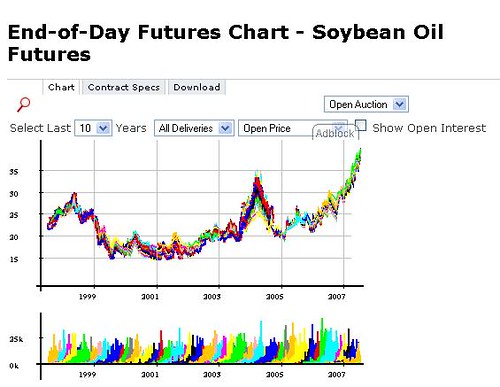
Now as an armchair economist I wanted to test out this theory. I went to look at the charts for the price of soybean oil futures to see if there was any pattern I could discern that could account for the slash and burn of my body wash. The price of soybean, like many commodities has been slowly trending up over the past 5 years, I assume due to the ripple effect of higher transportation costs - everything comes back to oil again. However there must have been a huge shock to the system because in 2004 the price more than doubled in barely 6 months from about $16 to $35 per whatever the unit used in these contracts before returning to around $20 by year end. In 2005 the price has been trending higher to $25. Now I don't know what the lead time is for developing a new formula, but my current theory is that a bean counter decided that the volatility in the soybean oil market could no longer be countenanced and hence there was an imperative to tinker with the formula.

soybean prices 1997 - 2007

As a sidenote, why is it called Oil of Olay in the USA and Oil of Ulay everywhere else in the world? Is there some trademark dispute going on?

Now this is not to say that what we have is the be and end all of capitalism. I have an uncle who works at Dupont who has spent the best part of the past 25 years developing new compounds. Far be it from me to suggest that the world stand still. We have seen how advances in materials like titanium and graphite have changed the game of tennis and cycling to take just a few obvious applications of technological advances.

Belt-tightening sometimes needs to happen but companies often go too far. The crew on a recent United flight informed us that there would no longer be blankets distributed on their flights. Presumably by cutting on the laundry bill some jobs could be saved. But how about this assault on batteries?
The budget airline Ryanair today took its no-frills approach to new heights by banning its staff from charging their mobile phones at work.

In justifying a move likely to underline its Scrooge-like image, Europe's largest discount airline said it did not believe using a mobile phone charger at work was acceptable.
I work in an industry that wouldn't survive if we weren't marketing the new formula daily. Most users would argue that a lot of software could do with some new formula treatment.

But why can't they leave well enough alone? Why do they want to mess with my shower?

I would also mention the Phisoderm debacle, but that episode was too painful and I've managed (at length) to find a replacement. In any case, I should be all set for the next 6 months of showers, but Oil of Olay, I beg. Stop the nonsense.

Have you noticed any products going through the new formula treatment lately? Are they any better?

A Musical coda


The New Formula is the name of the 1992 album by Today. The thing though is that this, their sophomore album, was not as fulfilling or indeed as successful as their self-titled debut.

today

Producer Gene Griffen had broken up with Teddy Riley, who was the secret ingredient of the New Jack Swing movement and previous producer. Thus a whole cast of new producers was brought in including Dr Freeze fresh off his Bell Biv Devoe heroics. I suppose it's a decent album but I think the titles of the songs tell the ironic tale and quite apropos the advisability of messing with the formula. Stick to your core competency guys.

Oil of Olay are you listening? Don't you leave me. Why you get funky on me? Tell me why.

See also: Why the Red Delicious No Longer Is for a discussion about the taste of apples. An apple may look red and succulent, but it shouldn't look the same 6 months after it has been harvested.

File under: , , , , , , , , , , , , , , , , , , , ,