So last night, right around 11:30pm, a big power surge rippled through your mid-Cambridge neighbourhood.
Your first thought as the lights went out and computer sessions abruptly ended was that Acts of God, the tsunamis of this world or, in this case, the inept dealings of NStar, the now-deregulated electricity company, with the overwhelming complexity of their power grid, are particularly apt reminders of the importance of perspective in human life.
Because after all, why exactly were you trying to get work done at midnight connecting to the corporate network and trying to figure out the remote access passwords to servers on which you were planning to test your newly-written software for the next few hours. Wouldn't it have been better to be sleeping or simply chatting with your loved ones? You are still living like a "just-out-of-college" engineer, burning the midnight oil, rather than someone 10 years on with attendant responsibilities and perspective on things. There's wisdom in the complaints from your parents, numerous aunts and especially your grandmother about why you haven't sorted your life out, bought a house or gotten married. What were you really trying to achieve?
You even start reconsidering your curmudgeonly, Luddite tendencies and re-evaluate anew the reason you haven't gotten a mobile phone even as you expound at length on cutting edge software. It would have been fun to be able to talk to The Girlfriend. After all she had just turned in the PhD dissertation this afternoon, a 5 year labour of love, blood, sweat and tears whose genesis you've been an integral part of whether through editing, printing, technical support or all those long conversations. Hours earlier she had set off to catch a plane to deliver a paper at a conference at Bryn Mawr. You don't even know if she made it. It would have been good to simply shoot the breeze and think about the grand vistas and opportunities that lie ahead of both of you. You'd at least have wanted to tell her again how proud you were and those other things.
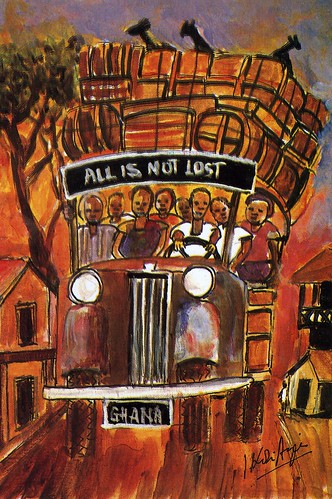
The few things that you lean on in this mini disaster recovery period are all battery-powered: your laptop, your organizer, and the watch you use to figure out the time. You wish everything in your life had a backup battery-powered system. Living in the US, where power and infrastructure is so reliable, blackouts, or Lights Out, as they call it in Ghana, are memorable events. You remind yourself to get the UPS system that you put on your wishlist 6 years ago and also to invest in APC because even though the dollar has gone to hell these days, there's a vast developing world out there where their products would be in demand.
Some would say that Lights Out is no big deal, indeed it has been the daily bread of your Ghanaian experience. It is only in the West, where infrastructure problems were solved in this past century, that such things are memorable. Lights Out has been a singularly rare phenomenon in your 23 years in Europe and America. Still this is the second time in a few months that the Cambridge electrical system has failed so dramatically. You say to yourself that the US is becoming a Third World country.
It's a reminder though, of the things you take for granted. Almost everything you use requires a good electrical supply. No TV for narcotic effect. No internet for conversational fulfillment or information dissemination, and certainly no wi-fi nodes to point your laptop at to continue your work. Incipient thoughts about continued work are now definitively delusional. There's also no power to the fridge, you note when you fetch yourself a drink. You wonder about the economic costs of unreliable power in the developing world: the whole paraphernalia of additional surge protectors, power stabilizers, the noisy diesel generators that punctuate the sounds of any African town, the mass of broken electronic equipment, the mountains of spoilt food. That is a heavy price people pay daily, the wages of poverty as it were.
The flashlight that you remembered to place in that closet is your best friend. The fact that this is only the fifth time you've had to resort to stumbling around to bring it out says a lot. You remember the smell of kerosene lamps that were fodder for nostalgia every time you went to your mother's village as a child. These days, back home, they use rechargeable lanterns although the quality of the fluorescent light is harsher. Your Uncle Senyo fondly recalls that his myopia stems from his illicit nightly reading of books huddled under the covers with the glow of kerosene lamps during his childhood in the village of Abutia in the 1950s. Thoughts of fire hazards never cross the minds of the young.
Everything seems to require electricity these days, including your bedside alarm clock from which the lovely tones of the BBC that normally put you to sleep would radiate. You wonder why you didn't pick up that Grundig Wave Boy shortwave radio you saw advertised in the back of the New Yorker or that legendary Sony ICF-310, the gold standard of radios past. Battery powered portable radios forever changed humanity in this past century. They have impacted far more lives than even TV or this Internet thing you evangelize daily.
That's when the neighbours who've been prime material for your studies in urban anomie recover their humanity. We all gather and knock at each other's door trying to figure out what's going on, if everyone is ok, who has spare batteries or flashlights. You envy those who have the Maglites rather you scrawny plastic piece-of-junk flashlight. Another item for your Amazon wish list.
20 minutes later, the power is restored to parts of the neighbourhood. Of course when this happens, you realize that, since your apartment complex is an old building, things will be a little complicated. There are no circuit breakers to be tripped, and indeed it isn't a simple matter of replacing all those blown fuses. Fully a third of the apartments simply have no power. There's a larger electrical problem to be dealt with in coming days. Before you go to bed you position your flashlight up on top of your fruit bowl to get enough light to change the fuses. One of them didn't blow but better be safe than sorry. You replace them both. You notice you only have 3 more fuses. You might dream of circuit breakers tonight. You remember that you have the MP3 player somewhere on which you've carefully assembled a playlist called, La Freak (or African music nirvana). When you find it in the corner, you decide to press the shuffle button and instead let shuffle serendipity be tonight's lullaby.
When you wake up a few hours later. You think about the configuration of your day and how you're going to make things work, whether the electricians of NStar are going to come around or if the building superintendent, the ever elusive Charlie, will handle everything. You suspect it will be much like the 2 foot wide hole in your bathroom ceiling that took weeks to deal with a few years ago. Don't fool yourself, you'll have to make the call for an electrician yourself. Hmmm. 411 or Yahoo Local? Decisions, decisions.
Still that is only a vague complication. You decide that well, you'll to go to the office, where there's power and phone (although you remember that the bean-counting accountant types of Corporate America really did send that email around a few months back asking you to validate that you really needed your office phone since in your high-tech instant messaging life, it isn't used as much these days). You might need to let the electricians into your apartment if Charlie doesn't handle things today. True the 69 bus makes it only a 15 minutes door-to-door exercise between work and home but public transport is what we know in America. You've bravely resisted the American necessity of cars for 15 years, but as you sigh, you suspect that a cell phone, car and a better house will have to bought in the next year. Alan Greenspan and US economy are going love you. You feel ambivalent about giving comfort to John Snow or Dubya.
Then it strikes you, it's Tax Day today and as usual, things have been left to the last minute. Well you'll just have to make it work somehow. Never mind those fires you're trying to put out at work.
Still though, you think back to that moment last night, when you and your neighbours simultaneously said "Oh shit" when someone asked, "What about Frances?". Indeed, what about Frances, that remarkable 96 year old woman who lives on her own on the 5th floor? She can barely walk down the stairs at the best of times and the immediate fear is that she is now trying to make her way down in the dark. A delegation is dispatched full of concern to check on her. Thankfully she was fine through all of this, although she had stumbled and bumped her hip as she poked around looking for her flashlight. She had just about found it and had been on the verge of attempting to step out to talk to the neighbours with her microsteps.
You all count your good fortune that no ambulance had to be dispatched. You wouldn't want to be the neighbours explaining to news anchors on the News at 11 why the old lady died on your building's stairs.
In any case, this is the kind of thing Frances lives for: six neighbours at her doorstep bearing flashlights and warm smiles. She even wants to invite us in to her apartment although we demur. Still as we stand at the door and begin to exchange pleasantries at our good fortune and Lights Out of yore, everyone hushes as she starts recounting how life was growing up in the early part of the last century: her childhood during the years of the Great War (she muttered something about the Kaiser that you didn't quite catch), teenage life in the roaring twenties in Massachusetts, and then the complications and frustrations of a young adult living through the Great Depression. You all just let her talk for the next twenty minutes. She expounds on how this country is going to hell, how she doesn't like what Bush is doing to Social Security. And the theory from that article on the dollar that she was reading from the recent publication of the Federal Reserve of Boston where she spent a good 40 years of her life. God help you Dubya, an aroused 96-year old woman is not someone you want to cross.
Seeing a mind so lucid on a frame so wizened is invigorating. You start thinking that you should start working out again; your health insurance program even offers keep-fit incentives. This software life of yours hunched in front of screens is unnatural. She talks about her two sisters who have died recently in their nineties and how she misses them. She wishes the light was back on, she wanted everyone to see the poem that her niece's 11 year old son had penned for her. You remember it however. She had been clutching it in her bony hands and had read it to you when you encountered her on the stairs last week on one of her half-hour daily trips down those stairs to see the mail man. The boy was a talented writer and the way he described the quality of the snow that was falling in the yards of his native Connecticut where he grew up was inspired. You had told her as much and that the sky was limit for the boy. She had beamed in appreciation, a proud grand-aunt.
As she reminds us about her niece, someone offers a cell phone to make a call to her. Frances says: "Oh no I wouldn't want to use yours, she'll think something is wrong. Let me use my own phone". We all troop into the apartment in search of the phone, 7 flashlights beaming all around in orchestral harmony, and then say our goodbyes as she talks to her niece and explains this night's excitement. You make a mental note to yourself about the cell phone again. What about that T-Mobile family package The Girlfriend keeps talking about? Hint-hint: family. Do you really want to cough up the money for that Treo they have since you love your trusty Handspring Visor Pro and don't want to carry another gadget in your pocket? $500 is a lot even with incentives and rebates. Well think about that tomorrow.
As you all step out into the corridor and prepare to see whose apartment now has light, arrangements are made to check up on her in the morning. This has been the glorious moment when you all discovered that you indeed had a community - one you weren't even aware of. That's when first names were exchanged. That's when people's professions were revealed. Little did you know that the man who's been living right across from your apartment was actually a very interesting Geography professor, who's knows all about Africa. You always had him down as an Unabomber type. That's when the virtues of small talk paid off. You chuckle about the fact that 4 months after your last missive about her, and, as is her wont, Frances still misheard your name, Koranteng is still Frank to her. "Goodnight Frank", she had said as you took your leave.
The time is 6am on the clock at the top right of your laptop's screen. The early morning light that you so love is appearing and you can even hear the birds chirping in the background. They weren't as troubled as you that it snowed in Boston even on April 12th and that you regretted not having your wool cap to cover your head. They've seen it all before. The tree outside your window that is the cause of your annual allergies has barely begun to flower. You can't wait for the heat and the comfort of its bloom and attendant pollen. You also anticipate the sweet, sickly smell of rotten food that will slowly emanate up from the garbage bins that are under the living room windows in this your bachelor pad, the smell that The Girlfriend so often remonstrates you for when she annually threatens to dump you for your infuriating inertia.
Sure you could move and change is indeed inevitable. Still, you've enjoyed this Cantabrigian interlude. Between the Harvard Years and this past decade of professional work, you've spent almost half of your life here. You've become a true mid-Atlantic type.
As the gauge on your laptop's battery power slowly dwindles and hits 5%, you write:
There are unexpected benefits to Lights Out.
Best to shut down the laptop now though, maybe you'll post these notes to that blog of yours - the one that people of late have been allusively insinuating is taking so much of your time. When you get to the office there's bound to be electricity, phones and all those other accoutrements. There are obvious creature comforts in working for Big Blue. Remember to pack the TurboTax cd and all your tax materials. Don't forget the wool cap; the Boston spring is illusory. You wonder when the first bus 69 leaves and where the bus schedule is. Time for a shower, you've got a big day ahead of you.
Lights Out.
See also:
Frank and Frances (or 500 Steps)
File under: Cambridge, toli, life, writing, whimsy, Lotus, IBM, aging, electricity, development, Ghana, Africa, Small Things, fun, drama, Frances