Showing posts with label internet. Show all posts

Tuesday, February 02, 2010

Black Sheep

Every feel unwanted? Ever feel like a pariah? What if your country starts disappearing from the global zeitgeist? When, I wonder, did Ghana start to fade from view? All right, let's get concrete here. Try this on your iPod Touch or iPhone (I was given a first generation iPod touch - now running iPhone OS 3.1.2 - a while back as a kind of consolation prize when my job seemed in doubt - but I shouldn't digress about the pathologies of corporate America). Anyway, where was I? Yes, take your i-something, open the Contacts App, create a new contact and add a new address. Alternatively just try to edit an existing address. Now try to change the country field to Ghana. Note, if you will, the result: Ghana is not in the list of countries. Search under "Africa (Western)" and you'll see nary a trace of Ghana. Heck, look through the entire list of countries and realize that we didn't make the cut. Ghana is not a country in the eyes of Apple.
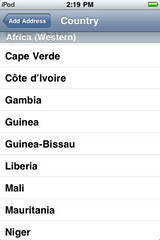
ipod touch country list bug: Ghana must go

I came across this issue over Christmas when I was home and trying to enter new addresses in this, my conflicted glorified organizer thingimijig. It's just a bug of course, and presumably if I complain loudly enough or write up a bug report against Apple, it will get fixed. Whoever wrote the Contacts app is certainly not trying to whitewash Ghana from history. They just don't have many Ghanaians using iPhones, nor indeed testing the feature hence the omission slipped through the cracks, embarrassing as it may be. Moreover I've been on the other side of the fence, producing software that at times has been seized upon for subtle local insensitivity. I've even written in the past about the cultural difficulties that any piece of technology can elicit so I won't be calling for boycotts or apologia.

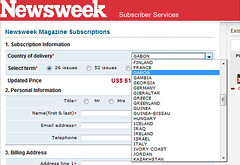
But wait, there's more. It seems that Ghana has been disappearing left, right and center from dropdowns and country selection boxes all over the web. I keep coming across this kind of ethnic cleansing in my browsing. Who decided that Ghana must go? It is one thing to be a literal exiled soul, a man of many countries but no home, but it's adding insult to injury to be cast into virtual exile. What gives? Why are form widgets all of a sudden slimming down and discarding Ghana? Why are even these fleeting elements of identity, that pleasing sight of Ghana nestled in between Germany and Gibraltar, being denied me and my countrymen. For example, in the past week I've been trying to buy gift subscriptions to some magazines for my uncles (Economist, Newsweek, New Yorker) and noticed that the online payment processors that these websites use simply don't feature Ghana in the list... go take a look: Gabon, Gambia, Georgia, Germany, Gibraltar. Where did Ghana go?
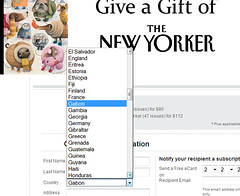
new yorker country list bug

newsweek country list bug

economist country list bug

I opened an investigation into this onset of web deportations but, first, let me tell a story...

My routine, ever since 1998, has been to spend my Christmas vacation in Ghana. As a fairly dutiful engineer son this means that 24 hours or so of my vacation is spent on tech support. I either bring new computers or coax the parental unit's setup into shape. They've tended to use Windows as their operating system so, as a matter of course, I would install or renew the subscription to Norton anti-virus or some software firewall or other, paying penance to the insecurity of the Microsoft ecosystem. Since 2005 however, I have been unable to renew the subscription with Symantec from Ghana. It's the usual thing, any credit card transaction from a Ghanaian or Nigerian IP address would fail silently with only a cryptic error message. I had a US billing address and yet my transaction would keep getting denied.

After repeated instances of this, I eventually worked out that the payment processor that Symantec uses had declared Ghana a nation non grata. Thus for the past 5 years, I would renew the subscription when I returned to the United States, or by using the corporate VPN (back when I was actually foolish enough to take a work computer with me on vacation) in effect pretending to be in the USA. Sidenote: the other alternative that most Ghanaians take is to simply install bootleg software or some open source or more wallet-friendly package (virtually no one actually pays Microsoft or other vendors for their wares).

Containers: cybercafe

Ghanaians have great difficulty using credit cards, PayPal, Google Checkout and the like. If we take ecommerce as one component of modern global citizenship then we are illegal aliens of sorts, and our participation is marginal at best. While remittances are a major part of our economy, we continue to pay a heavy price in all our financial transactions. Banks, wire transfer and check cashing joints salivate at the profits they make on our backs and yet the kind of routine monetary transactions that any idiot with a credit card can do in the West is a pipe dream.

The major reason of course is that a large amount of 419 scams, advance-fee schemes and outright frauds seem to emanate from our virtual lands. Payment processors tend to filter with a broad brush and their geolocation heuristics often tar almost all IP ranges from Ghana. The same story goes with spam filtering and some ISPs are known to ban entire countries arbitrarily as mitigation measure (I've seen this applied to countries like Russia, China, Korea). I have lots of Nigerian friends and their emails are often consigned to the spam folder even in GMail whose spam filtering capabilities seem to be the most discriminating. I can recall a member of the security services in Ghana quipping that two thirds of the 419 scams in the world could be stopped if police could simply round up everybody at Busy Internet and other internet cafes in Accra at the right hour. Thankfully that broad brush hasn't been applied - think of the rule of law, false positives, and Minority Report a priori censorship. Still, the actions of an unruly minority are making life difficult for us all.
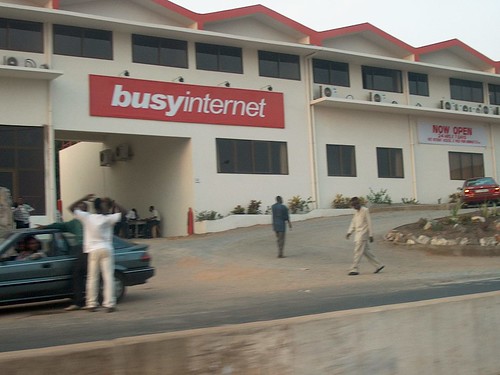
Busy Internet

What is most galling now is that even our Nigerian brethren in e-criminality are on the list of countries in the above 4 cases. We have the workings of a different bug. With tongue firmly in cheek, I would say that Ghana is uniquely blacklisted. If you live in America, you expect that you won't see North Korea, Iran, Cuba or the like in your commercial browsing since sanctions and embargos pertain. Why would Ghana be in such august company?

One hypothesis, for the websites at least, is that the bug is at the level of the payment processor: Entrust, or Visa, MasterCard etc. Or perhaps our unreliable postal system is at fault. Another alternative is simply that there is a canned type of widget that is being used around the web. I know how these things work: most programmers cut and paste code when they are developing their sites, I know I do that often enough. A cursory inspection shows that the Condé Nast sites are using the jQuery toolkit, a potential source of the bug, but it could be any of the other popular toolkits, Dojo, YUI, Scriptaculous etc. These are pre-canned form widgets and one can envision that a popular tutorial site or user interface toolkit has the bug and has been widely copied.

But, what about the bug in Apple's iPhone Contacts app, one wonders? That seems like an outlier unless it too was written as a web app using much the same widgets. Does anyone have any theories on the matter?

I won't get into how Orbitz and Expedia have now followed the lead of Travelocity in removing Accra from the list of places you can book travel to - this, even though major airlines like Delta, KLM and British Airways fly there. I know that my small country doesn't warrant much attention, I know my place. But this is different, all I want to do is enter some addresses in my organizer or send my uncles some magazines. Magazines that are ostensibly a dying business won't even let me send my hard earned money to them. Someone help me, I feel like a black sheep.

File under: , , , , , , , , , , , , , , ,

Sunday, May 08, 2005

On The Significance of Social Software

danah boyd posts the abstract of a paper she's writing on The Significance of Social Software for public criticism.

In this paper, I will explore the contributions of social software. I will argue that there have been notable technological advancements, but that their significance stems from the rapid iteration of development in ongoing tango with massive user participation. In other words, the advances of social software are neither cleanly social nor technological, but a product of both.

Social software represents a new generation of social technology development - a generation that is dependent on moving beyond the laboratory and into mass culture. Its manifestations are already staggering - ABC declared 2004 the Year of the Blog as blogging challenged everything from political discourse to identity production. Social networking services in the hundreds have motivated millions of people worldwide to construct and negotiate profiles and grapple directly with the social awkwardness of being more public than one thought. By allowing people to easily stumble upon the work of others, media sharing services have prompted new ways of organizing information and playing with the intention of producing media. These advancements complicate critical theoretical ideas about the nature of the public(s), the role of relationships in sharing, and the collective desire to organize information.

Flash in the pan or novel?


This certainly sounds like a paper that should generate much discussion and I can't wait to weigh in with my keyboard in dissecting it. I was reflecting on much the same question a couple of months ago in People, Processes and Things
The terms that have been used about software that aids collaboration have all been unsatisfactory. They have been mostly opaque terms (groupware, knowledge management etc) overloaded and hyped by marketing teams. Correspondingly also, lots of software in this area has been unsatisfactory even if very useful for some groups whether it's mailing lists, usenet. The flight to a quality term like "social software" that people like Clay Shirky have spurred in recent years is an exercise to escape the stigma of the reigning software. I heartily endorse that effort but when I pass the hungry salesmen in the corridor that are trying to sell software for my company, I know that that effort will be in vain. If it's between their year-end bonuses and calling something "social software", you know what's going to win. Thus I predict that our vocabulary for software that supports groups, organizations and communities will continue to be contaminated.
There is more than mere terminology here as danah points out; there is also the question of whether the newer sofware applications and the insight gained in developing them are significant.

From my standpoint, the only difference in the emergent software is that much of it is web-native and can leverage the delightful surprises and scale of the web platform (which thankfully has remained relatively open). Previously this type of software was typically on vertically-integrated platforms (e.g. Lotus Notes, Groove etc). Now if you lived in the ecosystems of those platforms, you would know that you can (in some cases) get much of the immediacy of the web. As an example, Notes has always had hyperlinks of a sort, there are database links, view links and doc links. Ray Ozzie even invoked Lotus Notes' hyperlinking fundamentals in a bid to save the browser from the Eolas lawsuit. The problem with Notes hyperlinks was that they weren't simple URIs - even if you could indeed copy and paste them in Notes; they were only useful in Notes clients. The ubiquity of the web could not be leveraged in other tools. I couldn't jot down the URI to a particular teamroom on a napkin or paste it in an instant messaging window to share. On the whole nobody cares what kinds of clients you use with web-native software.

Sociological Insight


When considering social software, you have to bring in the sociologists and hence I'd point to some older case studies to consider in this arena regarding the nature of the communities that the software in question is supposed to serve.
  • Wellman, Boase and Chen: The Networked Nature of Community Online and Offline
    Communities started changing from groups to networks well before the advent of the Internet. Initially, people believed that industrialization and bureaucratization would dissolve community groups and leave only isolated, alienated individuals. Then scholars discovered that communities continued, but more as sparsely-knit, spatially dispersed social networks rather than as densely-knit, village-like local groups....

    Given the movement from the local and densely knit to the far flung and sparsely knit ... it is useful to define community as networks of interpersonal ties that provide sociability, support, information, a sense of belonging and social identity.
  • Koku and Wellman: Scholarly Networks as Learning Communities: The case of TechNet
    "There's a shift from small groups to diffuse, variegated social networks. Boundaries are permeable, interactions are with diverse others, linkages switch between multiple networks, hierarchies are flatter and more recursive.... transient, virtual organizations.. work relations spill over nominal work group boundaries... even connecting to outside organizations"
The insight of such quotes is about the fluidity of the communities in this modern life of ours. They presage a notion of social networks with sometimes implicit rather than explicit webs of relationships. The kind of thinking required for networks needs to be flexible in order to deal with the diffuseness of our evolving patterns of discovery and social interaction. Handwaving a little, it is like the kind of shift in thinking that we have gone through in the move from desktop productivity applications (like the traditional office suites) to web applications that need to keep the network abstraction and usage patterns in mind.

On Metrics


I'd also throw in some Usage Statistics from Groove Networks but the details from that report seems to have vanished into the cyber ether although the summary is important in what it displays about how people actually use the software (as opposed to how the people who wrote the software thought it would be used). With appropriate metrics, those in the community can get measures of health (since as we know sometimes a group is it's own worst enemy - e.g. the kind of collaborative moderation on Slashdot). The metrics can also help those who are developing the community software.

Right now the server logs at del.icio.us, Flickr and Furl are among the most valuable pieces of property in the internet. Certainly for anyone interested in social software, the kind of insight that Joshua Schachter is gaining from his logs would be invaluable.

But this goes beyond research, potentially this is something that can be translated into features of genuine use by glue layer people or perhaps that can be monetized in some fashion (e.g. through advertising supported services). If you want to be intelligent in your design of social software, sometimes you need to go straight to the source and simply ask the users (e.g. the proliferation of "Report Spam" buttons in web mail clients). Enlist the users and get them to feed you their usage patterns (e.g. the Alexa toolbar). It's no wonder that Google is trying to do the same with the launch of its web accelerator.

Cross-posted at the Inside Lotus weblog.

File under: , , , , , , , , , , , , , ,

Tuesday, August 10, 2004

In appreciation of Telepocalypse

Martin Geddes writes about the end-to-end principle and telecom issues on his Telepocalypse blog. Other than say Andrew Odlyzko on the history of telecommunications, David Isenberg as the great popularizer of the Stupid Network, Bob Frankston, David Reed, Scott Bradner who one might term, the intellectual braintrust, or perhaps the folks who lurk on the end-to-end interest mailing list, diving deep in the bowels of TCP/IP, I don't know anyone who has more fully internalized the lessons of the end-to-end principle.

Unlike some of the others I've cited, his is a less academic but more pragmatic take - a practitionner's view from ground level, as it were. More to the point his writing is so lucid and the analysis so trenchant that I encourage everyone I know to simply 'follow him around', read everything he writes and revise their business plans, investments etc accordingly. Read all his opinion pieces and come back buzzing with insight at the opportunities and pitfalls in this wonderfull networked world we live in. Take for example this post about the intersection of the content industries with telecom: Internet didn't kill the video star

Money arrives in the video entertainment business in two buckets. The customers directly pay for content that satisfies their desire for televisual narcosis. And advertisers pay to insert marketing messages to suggestible semi-hypnotized viewers. That’s all.

Now, let’s look at the economics in more detail. You can only increase the amount people pay directly by extending the duration and intensity of their narcosis. The scope for improvement is baselined by the current depth of their TV trance. Before multi-channel cable and satellite, you couldn’t get a good fix on four or so terrestial channels. But given some non-stop movies, sport and cartoons, and you were off. Hence the cable and satellite TV companies made a bucket load satisfying an unmet need.

A TV channel is essentially a bundled product, in the classic marketing sense. TiVo enables you to create your own bundle. [...] But the incremental improvement from TiVo is relatively small. Why? Because if you didn’t like the bundle you were just watching, you can easily switch to another one. And they’re conveniently labelled for you to make an instant judgement on how likely you are to want that new bundle. The substitute product for TiVo is the raw remote control handset.

Think of it this way. Terrestial TV is like a nice cup of tea. Multi-channel TV is cocaine. Video-on-demand is methamphetamine. TiVo is just washing your meth down with a stiff espresso.
And the ensuing analysis is equally perceptive. A daily read for sure... I'll be writing more about the end-to-end principle in coming weeks but thought you should know where I get my source material from.

File under: , , , , , , , ,