Frisson de Folksonomie
Oh, look at the date. It's been a while, hasn't it? Indulge me if you will in part 6 of the Things Fall Apart series. A slight detour perhaps, or rather a journey into the heart of dar- ... technology, and matrimony.
A Social Bookmarking Affair
Catharsis — Seduction — Intimacy — Play — Reconciliation
Cherrelle's Affair
Journal — Music
Catharsis
I have a crush. There, I finally said it. I feel better already. I'm confessing that I have a serious case of folksonomic titillation. I can no longer stand this conflicted life... The pastor counseled us before marriage that these things are best dealt with in the open. So Dear Wife, I must confess a previously secret admiration.
The object of my affection is meryn. More precisely my belle-de-jour is del.icio.us/meryn. Even more accurate is that I'm jonesing for the set of tags at del.icio.us/meryn. I get a frisson de folksonomie every time I look at her assets, those tags of hers.
Seduction
Stay! Don't you walk out that door. Please stay... Let me explain... Oh... Where should I start in discussing this social bookmarking affair of ours? Of mine, I mean. It's so hard to know how to talk about these things... I know that you think that I must be used to it since I spent those years in France, but believe me, affairs are not my kind of thing. It never crossed my mind, it's just... Well maybe I should start at the beginning... I know you have questions... It hurts... but please... please, let me tell the story my way...
We first met about a year ago at the bar of a hotel called del.icio.us, regulars don't use those two periodic seperators in the official name. As you might know I've been spending some time at that joint since... well, I think it was September 2004. My first bookmark was called Writing Well on the Web, I disagreed with that piece (keep everything brief?). Anyway, del.icio.us isn't a bad joint as social bookmarking hotels go, a little minimalist on the eyes but it's getting quite crowded these days and of late you hear a lot of yahoos. She, on the other hand, started frequenting the bar sometime in the dark days of winter 2004, you know, after that election...
I can remember the exact day we met. I had written something on People, Processes and Things in the morning and, after giving it the day to simmer, settled down after work to bookmark the post with the benefit of a few hours reflection. After the act, I noticed that a certain meryn had been quicker on the tag to my own musings, and with nice tags to boot (communication, association, collaboration, interaction, facilitation and mediation were the words she used). Interesting, I thought, not quite how I would have tagged it, but you know, different strokes for different folks.
The name vaguely rang a bell, perhaps I had overhead it in one of those community software dives I sometimes frequent. Or was it some network economics something or other? Oh well, I thought nothing of it.
Later on I noticed some intertwingling and bookmarking consonance. She seemed to have picked up some of the same links as me, or was it the other way round? But I didn't care. It was just an occasional flirtation with groupthink, nothing serious you know. No serendipity really. No one made any moves.
Things really got going started just days before I proposed to you. Uh-huh. I had been writing about the importance of syntax in technology adoption. I had even posited "cognitive impedance" as the theme of that article. What a mouthful. That day, I beat her to the tag, I had learned my lesson about delayed gratification. Yet when I came home that evening... That's right, you were away at a conference, remember? Bryn Mawr or something. Anyway, there I was, home alone, eating a TV dinner of kelewele and promiscuously surfing the web. I'm a habitual browser... Anyway...
There it was! A coup de foudre.
By her simple act of tagging, I saw a new way to conceptualize my material.
Yes! She walked right past me wearing a tag named "comprehension".
"Aha", I said. "That's what I had been writing about. The word I had been circling around, the conceptual truth I had been avoiding. Oh, what a tag."
Sure, she was also wearing a perfumed tag named "adoption" and shoes designed by a tag named "rejection", but who cares? I could no longer deny it.
Comprehension was the basis of my attraction.
And so it came to pass, things moved quickly from there on. It's quite a blur really... By June, I was using that term in my discourse. In barely three months I had internalized one of her goods.
Thus I'm confessing that every month or so, I secretly fire up the browser to look at her, to see if I can mine some more of her glorious tags.
They look so... well... how to put it? ... I just love... her... classification scheme... Her tags all end in "tion". There's a "je ne sais quoi" to her categorization... Great, great tags, they are...She... She puts words to concepts I had been thinking about but couldn't articulate... Such tags. All 319 of them, I've counted. Their contours are so... delicious.
Now I don't know why this happened. I can't say that I haven't been happy at home, I am verbose myself and have 1,266 tags of my own. Why aren't I satisfied? After all, those folks working on Dogear point out to me as an outlier with a gigantic folksonomic vocabulary.
Our marriage is still young... I feel I can tell you these things. I know you'll understand.
As it is, I've worked out that meryn and I now have 28 tags in common, I've adopted six of them after our monthly encounters.
Don't get me wrong. The links are fine to be sure, but it's rather that the tags give me the chills - I mean, it's that I look at them. I seek release in her folksonomy.
Intimacy
Mind you, I haven't acted on the attraction... Well that's not exactly true... I did succumb late last year and added meryn to the subscriptions in my del.icio.us inbox. It's such a useful feature; being able to subscribe to the bookmarks of others to see the ebb and flow of their ongoing reading. You can see the books I read, the photos I take and the music I listen to. Why not the bookmarks?
Don't look at me that way. Please... I'm not alone. There's nothing wrong with me! I saw that Jason Kottke was thanking his del.icio.us inbox just the other day. It's just data, says Sam Ruby. We're all wired together in a web of data say Adam Bosworth and Ray Ozzie. Let atomic feeds bind us together.
Of course like any episode of R Kelly's Trapped In The Closet, there are a few complications to my story. It's not quite the midget hiding under the kitchen sink, or Rosie, the nosy neighbour, who comes knocking on the door with a spatula on hand. Remember that wonderful musical moment we shared? You remember, don't you? You and I. Ahh. Remember how hard we laughed when that man Kelly delicately crooned the word "Spa-tula"? That was great wasn't it? How we laughed. That boy's lost his mind... Ha... Okay, Okay, I'll continue.
Anyway, I don't know how to put this, but no doubt you'll find out so I might as well tell you now. At the beginning of this year I found out that behind meryn is a man. His name is Meryn, Dutch I believe, an economist or some social scientist or other, with an affinity for things technological. I suspect he used to read me in the past but I was relegated to dinosaur status when I took that blogging hiatus to get married to you.
Now to tell the truth I had suspected as much. That she was a man, I mean, Most of the early adopters in the software world are men for some reason. You know, boys with toys. Let's face it, we make things difficult for women in technology. Such a shame really... Still he seems like a reasonable guy. All true man, heck he recently announced reaching the milestone of 1,000 bookmarks in del.icio.us.
Pssh... The size of her... I mean, the size of his bookmark collection doesn't matter to me. My interest was purely folksonomic. It was all about the tags. I was rather bent on mining her, I mean his, conceptual framework. This isn't Brokeback Mountain, it's more like Pimp My Tag. Sacré bleu. I can just see the case before the judge, "She only loves me for my tags, not my bookmarks". These social bookmarking feelings are so confusing sometimes.
Baby... Honey. Don't walk out of this room. Stay. Let me finish...
Where was I? Ah yes, two can play this game. I know that some people like me for my bookmarks. Then there are others who like me for my tags (size matters apparently and with a long tag list, there is evidence of my roving mind - you know too the stereotype about black men, that we have large... vocabularies). Still others like me for my occasionally jaundiced comments on said bookmarks. Well in meryn's case, it was all about the tags. I want to recapture the feeling of that first time. Their aggregation, consolidation, combination, interoperation, participation...
There have been others of course, I must admit... Don't throw that. Please... That won't help anything... Okay sure, I'll come clean. Yes, there've been other attractions in this social bookmarking world. At work for example, there's Mr Feinberg, but you know Jonathan after all, he even came to our wedding. I don't like him for his tags, it's more the bookmarks, he tends to dig up stimulating stuff about programming in the trenches. Then there's Carol on mass amateurization, Andy on collaboration, Tessa on glue. Outside there's Ethan on Africa and serial entrepreneurship, David and others too. I even occasionally snatch a peek at Coté's good enough tag and I'm flirting with The Governor's declarative living meme but haven't bitten that apple yet. I'm a prime example of that perhaps.
But here's the thing, all of those have been affairs of the bookmark not of the tag. Rather, I'm curious about how we name things. I want to internalize the concepts. The heart of the matter for me has always been the tag.
Play
Okay, Okay. I'll start over... What? You want me to explain? Explain what? Don't turn this around on me...Okay... I'll bite, I'll be a man about this... Whatever... I'll tag this social bookmarking thing. I'll break it down for you. I don't want to get all software engineer on you but you know I can do this. I've thought about it quite a bit, I've got a lot of tags you know... All right, here goes...
In social software, there are "people", there are "places", and there are "things". Oh some say that there are also "processes" and of course those exist, but let's stick to the fun stuff. Oh, you like the Rule of Four? Okay, whatever... it's just that processes are so... what's that new tag? enterprisey... Anyway, the "things" and the "places" are the shared context in a community. The places are like homes or land, things we feel proprietary about. The people however are where the action is found. We like to chat, we like to form groups, basically we're social beasts.
That man Metcalfe has a law which says that the value is all about the people. I think he means that communication is key. That man Reed has a law which claims the value is all about group forming - all those tribes and clans we like to form and the comfort and entertainment they provide us. The man Odlyzko says those two are overselling things (pdf) but even he says that the network has great value and it's quite considerable in the aggregate. Needless to say, there's money to be minted in software that aids collaboration or serves communities.
With social bookmarking, the "things" are
- The bookmark
the URI that we use to remember the site (identification of resources) - The web page that you see
that's the representation (and I've even got a pitch about that) - The metadata
That's the data about the data. It's the eternal headache. Things like- the title of the page
- any comments you have
- those newfangled tags you can use to remember the site
- how you might rate it
- what you were doing when you encountered the page
- who referred you to the page etc.
It's quite simple really, you merrily go around your surfing way and decide you'd like to remember a site. You click on a button, or right click, perhaps you select some text, and then you get shown a basic form, you enter some information and then most of those things are saved. That's the way of all social software: you gather the data, you explore the data, you search the data and you interact with people and exchange messages. The data could be anything at all; we have examples from music, films, books, food, places, lists etc. In this case it's bookmarks. The best social software will try to make it relatively painless to do the mundane things like entering and managing data and easy to do the more fun things like exploring and communicating. It may intrude a little in directing you around and suggesting new avenues but then everyone needs a little handholding from time to time.
I've hung out at 3 of these joints. What? You I think I am afraid to commit? That I have a split personality? Whatever.
- Furl - which allows you to save a copy of the page along with everything else. I started out here because of said feature.
- del.icio.us - well everyone likes Joshua Schachter's baby - it's lightweight, sweet and has most of the mindshare if not the users.
- Dogear - It's very nice on the eyes. I use it to keep up with the IBM tribe and monitor things inside that Big Blue firewall. Plus they keep adding all the features I request and fixing the obscure corner cases I detect, thus I have a little hand in it. That pitch is about "social bookmarking for the enterprise". I hope it graduates from research to product, it certainly deserves to.
All right then, you wanted tags, I'll give you tags.
Language
Furl and Dogear are good names. You can use them as verbs. "I dogeared that page". "I furled that site". Indeed that's what the word dogear is used for in common language. Jonathan was suitably chuffed when I started using that felicitous phrase. You can't use delicious as a verb but it remains a powerful brand. It's rather like calling a "country" a "homeland" - hard to argue with, indeed one must love it, you're "treasonous" if you criticize it...
Identity and Security
Furl and del.icio.us care only that you have a valid email address. Dogear makes you use your real life identity or whatever your corporate directory would require. Obviously this can be changed and like the others, it can simply run off a user name or email address. Which leads us to...
Memorability
Ideally you can choose a handle or at least a persona to use in the service. With a name as long as mine, a nickname is far preferable. Of course this means that there's always going to be a land grab when it comes to names. It's much like when I signed up for 16 different free email accounts to hedge my bets in those glorious dot com days of yore.
Adoption
All these applications give you freebies; you don't need to login to get benefits from the system. You can browse bookmarks, tags and users and see what's current or popular. These social bookmarking hotels are like tobacco companies or drug dealers, they make sure you get a free taste before they hook you. Great capitalists they are. In economics they call this lowering the barriers to entry, I tag the concept as adoption, impedance and lubrication. The sociologists believe that this notion of lurking is important in all our communities. We may be social beasts but we're often shy and inarticulate and that's fine - well most of us are shy. Because one can behave relatively anonymously with these applications, at the very least, the service can monetize our eyeballs with advertising.
Notification
You can subscribe to feeds for almost every page that you might encounter in these applications. This allows you to peruse later at your leisure. Notification and alerts are good ways to stimulate your interest. One feature that I haven't seen is a simple indication when new links have been suggested for you or if there are new subscribers to your links.
Navigation
These are web applications hence interaction is all about hyperlinks and forms which are the currency of the web. Thus there lots of links, and they follow the hyperlink imperative to allow you to pivot around and navigate the site. The front pages feature recent links, popular links, popular tags, link clusters, random tags, links to your personalized view etc. Presumably if group features are implemented, they will also have prominent links.
Search
Search becomes more important as you gather lots of bookmarks or tags and navigation becomes more difficult; also sometimes it's the title or comment that you entered that was what you remember. That human brain is a weird one.
Latency
del.icio.us and dogear use a simple textbox for entering the list of tags and they throw in some auto-completion to make entering tags easier. The suggestions can also be sorted by relevance or popularity. You can also get frequency counts. They both seem to be moving towards adding in-line editing so that all you need to do is click to edit. Metadata is generally annoying hence the lower the latency, the more likely you'll enter and manage it. This again is to promote immediacy in the interaction.
Usability and Interaction
Furl is the worst of the three in one significant respect; the way it handles multiple tags is problematic for verbose people like me who use lots of tags. The proof is that I have half the number of tags in Furl than in the others even though I've been using it for longer. I can't count the number of times have I written to their technical support asking them for just a few tweaks to their system. Take a look at their dialog for saving a new bookmark.
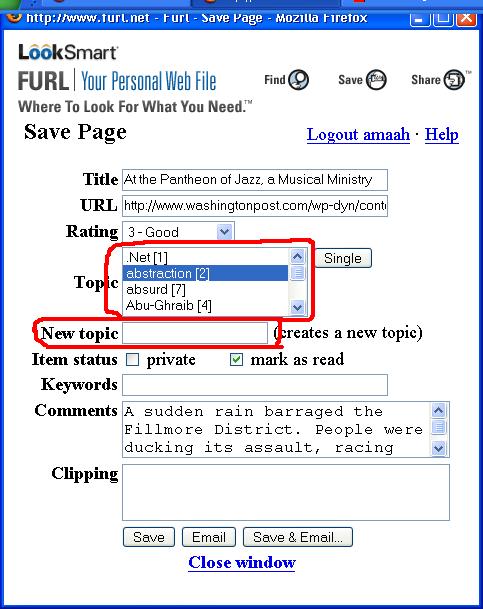
It's a little cluttered as it's trying to gather a fair amount of information. I'd like wider text boxes for the title and URI - a wider dialog in general would be good.
Note that the select box only displays 4 tags at a time. This doesn't scale if you have more than 50 or so tags, let alone if you have several hundred. You simply can't scroll quickly through that many tags and pause to do that shift-click business.
Then they've deliberately made the "New topic" textbox small, implying that only one new topic can be created. This is not so; you can create multiple tags if you type them in separated by a semi-colon. This last fact is still not documented anywhere in their user interface, let alone their help. Indeed I learned of this hidden feature in passing on the delicious-discuss mailing list. It's as if Furl wants to actively discourage proliferation of tags.
Yeah, yeah. I know I could write my own interface and that those glue layer people at Freshblog have lots of bookmarklets and interfaces that let you post to Furl and del.icio.us simultaneously. But that's social bookmarking polygamy, who wants that?
On the other hand, Furl can collect far more metadata in that dialog than the others allowing you to separate your comments from article clippings. It even goes beyond the call of duty by inspecting the meta tags on the page, referrer pages and any HTTP headers from the page snapshot it saves.
Data and Storage
This last feature though, saving the web page along with the link and associated metadata, is probably what is giving the Furl folk their biggest headache. Plainly put, their storage needs are several orders of magnitude greater than the others. The vision of providing personalized snapshots of the web makes them face issues that are akin to what the Internet Archive and search engines face. One mitigating factor is that most users don't check their personal copies often since most links will continue to work. Further web pages are fairly small compared to the photos in Flickr or the videos in YouTube or Google Video.
Scaling
Thus scale is a great concern, first in terms of the number of users, the amount of data that the applications need to handle and the number of tags that are used. This affects the backend and the performance of the application but also the user interface. If you have huge numbers of tags the interface can get overwhelming thus you need to filter out the little used tags. Tag bundles in del.icio.us are an interesting way to manage this, you can group tags into bundles to help with filtering. Also with increasing scale, search becomes more important, that's why Google is popular in the web and likely why Yahoo bought del.icio.us.
Comprehension
Ah that glorious concept... In the social bookmarking setting, it's the matter of the syntax used for tags. Dogear and del.icio.us use spaces as separators, as does Flickr in the photo arena. Furl uses semi colons and All Consuming (books, music, food) uses commas.
Then there's the treatment of multiple words, the first two use quotes around them since the space character is not a separator character.
Then there's case sensitivity, Furl seems to treat "Technology" and "technology" as different tags which would be a problem most of the time I believe. I can just hear Jonathan tell me that 'dogear is case-preserving, but case-insensitive; it remembers that you tagged with "foo", but a click on "Foo" will find your bookmark'.
Then there are the perennial issue of "special characters". Tags have their own web pages and consequently each have their own URIs. As you know, there are restrictions to the characters that you can use in URIs (even though there are those newfangled things called Internationalized Resource Identifiers, IRIs, that might help). These difficulties however might mean that areas of the world that use characters that are outside the set normally allowed in URIs might have more problems and will likely see slower adoption. Combine this with the dissonance over separator characters and you get confusion. The Gruesome Twosome of Computer Science (Structured Data and Character Encoding) strike again.
Recommendation
The remedy that some of these applications have implemented is to display related tags to suggest alternatives. You can put a nice cluster of suggestions that might interest the user. Recommendation systems are a pet topic of mine and it has been interesting to see the various ways in which the applications try to direct you towards interesting things whether people, links or tags.
Discovery and Exploration
Dogear has a very nice interface for exploring subscriptions and the networks that can arise among users. Furl and del.icio.us only concentrate on your subscriptions; it would be interesting however to also see those who subscribe to you. Further one can imagine lots of social network analysis tooling applied to the corpus of data to discover and suggest latent and implicit communities of interest.
Privacy
The 'social' in social bookmarking is a little at odds with selfish uses of bookmarking. Thus these applications encourage sharing and only grudgingly added the feature of private bookmarks. Now I'm a promiscuous bookmarker myself, I've never used private bookmarks but I can see that if I'm researching for a patent, I might not want others to see those links I'm gathering on a particular subject. Still it appears that most people don't use private bookmarks although, when available, a small minority do make use of it. All subscriptions are public by default in the spirit of openness yet perhaps one could make a case for limiting the visibility of subscriptions in the same way as bookmarks. The same applies to user profiles, you can pick and choose what aspects about yourself you expose. Bookmarks are not as sensitive as things like photos hence the concern for privacy is less pronounced. Eventually if the group features mature in this area there will likely be a movement beyond the public/private dichotomy to things like friends, family, and named interest groups. Selective disclosure perhaps.
Visualization
I'm only human. I like to slice and dice what I see to explore and discern patterns. One of the most important interfaces in social bookmarking is the page for a given uri. This is constantly being tweaked and designers have a hard task. They are trying to show the users who saved the link, the tags that were used, the titles and the history for that link while throwing in things like recommendations. del.icio.us recently had a makeover that is not entirely satisfactory. The idea they had was to split the screen into well-defined areas concentrating on comments and tags and use the length of the page to show the history.
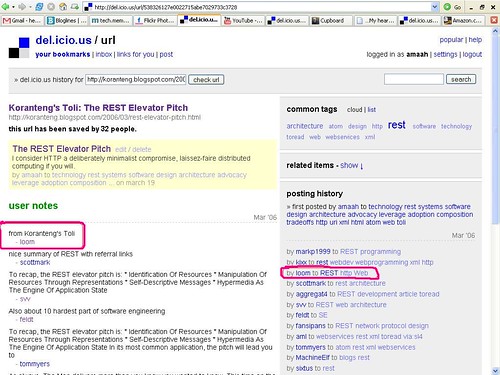
The bad thing is that they've split up the metadata for each posting except for the initial post (or if you've saved that bookmark, your own entry on the bookmark). They've removed the tags from the user notes for all other entries. Also they no longer show what title each person used. You remember Ruby's Postulate don't you? You know Sam Ruby's postulate that
The accuracy of metadata is inversely proportional to the square of the distance between the data and the metadata.Here del.icio.us has succumbed to variant of that rule. The value of the metadata is reduced by being separated from the data. And indeed here there is also fragmentation of the metadata. I'd prefer to see everything in context. There's enough space to show the tags used alongside the user name, comments and title.
There's also those tag clouds, aren't they glorious?

Evolution
You want to see how tags vary over time and the frequency of activity but also if people are bothered enough to change the title when they entered. These are valuable things to know and indeed every such act should be celebrated.
Take the history of an article I wrote about On Gmail and DHTML architecture again. It was always DOM scripting to me but after 15 months, people had started tagging it as web2.0, webOS and bleach. You know: bleach, Bleached Unobtrusive DOM Scripting (BUDS). Fancy that, someone just came up with a snappy acronym and now people start lecturing you about things that you used to do, talking about "all you need is a bleach call" and everything will be better. Remember that Prince sang, "Put The Right Letters Together And Make A Better Day".
In visualizing the evolution over tags over time, I can imagine sparklines or perhaps another application of History Flow beyond the wikis that it was developed for. Or throw in some clustering and perhaps there could be a treemap. And perhaps there should be some animation written to dynamically show the evolution of tags. Moving images have always worked their magic.
Presence
You could probably make a case for making the names of users in pages active so that you can check their online status. Remember back when I was working on the person tag to integrate Sametime into K-station and WebSphere Portal? Yeah, it's the same idea, these days you throw in some microformat buzzword, decorate the name with an hCard something or other, throw in a contextual menu and voila, "people-enabled collaboration". Add some chat, screen sharing, profile viewing etc and you're all set. For bonus points, you can scope presence to the place, not just who's online but who's online and looking at this tag and throw in scoping to members of the current user's groups. Allow others to plug in their instant messaging systems and customize the contextual menu that is brought up and you're done. The rest is left as exercise for the eavesdropper but I'd note in passing Prior Art™ for anyone considering patenting such things.
Classification and Aggregation
Dogear has the concept of inside and outside, being able to scope a link to figure out if it is "inside" or outside the firewall. del.icio.us automatically classifies certain types of links such mp3s. You can imagine that you could present a different interface depending on what is represented by the link. If it's music, you might offer a nice link to sample the music, or buy the cd. This then gets into the issue of aggregation. In general, this argues for a generic and pluggable link classifier for other applications that want to embed these social bookmarking environments as components. Simply define the semantics of a special system tag and off you go. This arguably will allow for better-targeted user interfaces but we should also dwell on the commercial possibilities. As the Pet Shop Boys sang in Opportunities:
I've Got The BrainsQuel frisson de folksonomie. No wonder this stuff is hot.
You've Got The Looks
Let's Make Lot Of Money
You've Got The Brawn
I've Got The Brains
Let's Make Lot Of Money
Group Forming
del.icio.us allows you to suggest links to others using a special for:username tag. Dogear lets you comment on an entry. Furl builds in emailing of links thus fulfilling Zawinkski's Law. You're able to see people's names or identities and browse their links and tags. All of these gestures are ways to enable communities to form, conversations to begin and communication to flow. The photography and music sites do a much better job in the area of group forming but that is only because the content is intrinsically more interesting, bookmarks are not quite as amenable to groups, still there is much room for innovation. These services don't seem to allow you to easily discover see how many links or tags you have in common with someone. That's a feature that should be one click away. Flickr has group pools of photos with different levels of access public, private by invitation etc. Last.fm gives you shoutboxes on almost every page allowing you to comment as well as a journal. All of these leverage the tribal instinct and human propensity for orgiastic connection.
Metrics
We all seem to like statistics and there are many metrics that are interesting in this land: when things were first posted, how many people have bookmarked the same thing, who is most active, who discovers the most influential links, which tag is most popular etc. I'd like to be able to see the number of tags a user has. For example in Library Thing you'll see things like this
Tag info: The tag "current" is used 153 times by 42 usersSome of these however come to seen as popularity contests and therein lies the seed to a problem.
Attention, Arbitrage and Exploitation
The paradox of social bookmarking is that it provides considerable externalities to an ostensibly selfish endeavour. Since many of us use different computers during the day, it makes sense to have our bookmarks in the network cloud so that we don't have to deal with synchronization. These externalities mean that, like all social software, social bookmarking is prime for targeting by parasites. Arbitrage in inevitable in this environment since attention is important and a scarce commodity. Thus the mortgage and insurance tags will always get gamed by succubuses with commercial concerns and who can blame them since advertising pays. Reportedly the most expensive AdWords at Google are concerned with asbestos and mortgage refinancing and it stands to reason, we're all parasites. In my case, I hope I'm just a benign gnat on meryn's tags.
Moderation
All communities eventually need to add some filtering and moderation to keep the parasites at bay or at a tolerable level. That Clay Shirky keeps harping on the unbearable irksomeness of groups to the extent that he's trying to invent a pattern language for fighting group pathologies. That Christopher Allen thinks it's basically about the emotional amplification of text. Who knows? In any case, you'll eventually have to support flagging people as anti-social or detecting overly abusive behaviour or instituting the occasional calming periods. As group features come on board, there'll be more of an emphasis on moderation. I can also imagine a "Safe Tag"© or "Safe Bookmark"® mode just as with all search engines, something based on fuzzy notions of "community standards". Oh well, c'est la vie, it is a wild wide web.
Reconciliation
I could go on of course. But anyway all this is just beating around the bush, you understand this stuff now don't you? I've given you a folksonomy of social bookmarking off the top of my head. What more could you want?
Which reminds me, you aren't entirely blameless yourself. I've seen you seduced by the wiles of the social bookmarking scene. I saw you looking over my shoulder, spying on me as I bookmarked away these past years, saving urls to send to you on demand. And then I pointed you to Jon Udell's screencast on del.icio.us and it all clicked, that moving image thing again. You got all social scientist on me, "This could be very useful for my research". I saw you on Furl. I saw you on Flickr, I saw you on All Consuming. I saw you on 43 Things.
For you the attraction wasn't really the bookmark but rather the ability to save a copy of the page. So you can stash away things from when you're inside the campus network. I think that's why you're on Furl right? Anyway, I like that feature too, it comes in handy when lawyers or the Scientologists force people to remove their thoughts from the web. Anyway, now we're even. Don't hate me for my tags. You made me spill my guts and it turns out that you're just as selfish as me and you play the social bookmarking scene too.
I know you want to call me a social software slut but try to understand. Collaboration software has been my Lotus life, don't take that away from me. To paraphrase James Bond in Thunderball,
"You don't think I enjoyed what I did those evenings, do you? What I did was for Queen and metadata!"Or like Dragnet, it's "Just the tags, Ma'am." That's right. That's what I'm saying.
Well anyway, with all that said, the reason I came forward today and confessed all this was that I took a big step yesterday, I feel a little guilty. Hmm... Yes I was seduced by that thing we call "integration on the glass". That's what they call it these days: it takes just one line of javascript in a webpage to bring those tags to life on a browser screen. So I put up a webpage last night. It displays my tags side by side with meryn's.
Now I promise I'll only look at the page once a month to check out that tag cloud of hers/his. I've worked out that even if more tags aren't added I have a good 25 years in which to assimilate that folksonomy.
I know we can work through this trying time. Come here, give me a hug. Sing with me.
"Spa-tu-laaaaa".P.S. Cheers, meryn. I mean, "Cheers, Meryn".
[Ducks to avoid thrown cup of coffee]
Journal
Wait. Why are you laughing? After I've told you everything... I've come clean and you're standing there laughing at me. What's that behind your back? A book? What book? What's the title? It's about an affair? A social bookmarking affair? No... Oh. It's about Africa? And England? Let's see... Oh yeah, The Heart of the Matter by Graham Greene. I remember that. Good book. It's all about how things fall apart and come together again. Good choice. I'll tag it with "fiction, observation, insight, Africa, intimacy, perception, re-reading, things fall apart" in my All Consuming account. Yeah... I agree, it's a great book by a great writer. Graham Greene believed in personal triumphs and tragedies on a bite-sized scale. I fully agree, bite-sized is all one could hope for in the 20th century. He didn't get the Nobel Prize but he's quite the conflicted conscience of that bloodthirsty century, and memorable too in his own way. I wonder who's writing today's equivalent.

Music
You're turning on the stereo, plugging in your iPod... Hmmm. It would stand to reason that the soundtrack for this affair would be Cherrelle's 1990 album by that name.

The best albums that Jam and Lewis produced (that is Jimmy Jam and Terry Lewis) were not necessarily the Janet Jackson ones, much as I loved Control and Rhythm Nation. The trio of albums that best defined their great take on the Minneapolis Sound were Alexander O'Neal's Hearsay, New Edition's Heartbreak, and the album I'll highlight here, Cherrelle's Affair. Each of these albums were concept albums: a party, the perils of fame, and an affair, respectively. The music however was all soul.
Cherrelle sings about the love affair she had with Randy Ran who was one of the musicians in the Flyte Tyme stable, a frequent collaborator over the years. It was a tumultuous affair and the album consequently runs the gamut of emotions; the song titles tell the tale. There was excitement, fun and ultimately heartbreak and you are privy to the various stages of the relationship. There's the irresistible seduction of Pick Me Up
If You Really Want My LoveMusically the arrangement is quite spare, a few drums, a funky bass and the occasional keyboards, the emphasis is on the soulful side of things. Then there's the conspiratorial imperative of Discreet with the driving drums sounding the alarm as in the temptation, vulnerability and exuberance of Looks Aren't Everything, the blistering album opener. The title track, Affair, is classic industrial funk, better than the contemporaneous tracks Janet was gifted by that production duo. Imagine the sentiment of Janet's Nasty doubled if you will. It is driven by a righteous anger in the chorus
Just Pick Me Up...
Be A Man And Make The First Move Towards Me
If I Say Yes, Don't Worry I'll Do All The Rest
"What Do You Call This Thing We Had?The couple of tracks that are ligher weight such as What More Can I Do For You are still fun grooves on the dancefloor.
Are You My Woman? Are You My Man?
I Don't Need Commitment,
I Don't Need A Man To Tell Me How To Feel"
The ballads on the b-side, however, showcase some of the most heartfelt singing I've had the pleasure to hear. She sings of things she's lived through. Interestingly enough Randy Ran co-produces the most tumultuous trio of songs. Crazy is plaintive, the desperation and longing underlined with an amazing vocal performance. It's the kind of thing that tickles your sensibility. This is the Quiet Storm that Smokey Robinson sang about. At the end she dwells on the very real friendship that was at the core of the relationship, there's real pathos in My Friend and when the horns come in during the bridge you can't help but be moved. In Lucky she sings
I Dreamed All My Life For Mr. RightWhen she bemoans that "Love has turned his back on me", Randy Ran's keyboards punctuate the feeling. Oh to have been a fly on the wall of that recording session. This is a slow burner with jazz inflections which distills raw emotion.
But Mr. Wrong Always Seems To Come Along
Someday I'll Be As Lucky As The Next Girl
Some Way I Know Love Will Fill My Heart
Everything I Miss At Home is the heart of the album and she continues her musical conversation with Alexander O'Neal in this glorious duet. This follows the earlier Saturday Love, I Didn't Mean To Turn You On, and Never Knew Love (Like This). He also appears on Keep It Inside another heartbreak featured on this album. These two wonderful soul singers were the Marvin Gaye and Tammy Terrell of the Eighties. They had a chemistry together, hearing them sing the line "Home Is Where The Heart Is Baby" gives me the chills to the day.
The reprise of Home is two instrumental minutes of soulful bliss to close out the album, floating pianos, lush keyboards, subtle bass, atmospherics etc. The kind of thing that Jam and Lewis always threw in to let you know that these were real thinking musicians who had paid all their dues in church and in long nights of performances and jam sessions. Thus the album ends wistfully in a contemplative mood. It is surely fitting that Graham Greene also wrote that wonderful novel called The End of the Affair. I find that simply sublime, perhaps because I too aspire to manufacture serendipity on this web.

Next in part 7: Angola.
File under: whimsy, social-software, collaboration, satire, technology, serendipity, storytelling, social, bookmarking, folksonomy, affair, review, software, communities, design, networks, dogear, furl, del.icio.us, writing, music, obsession, imagination, soul, Cherrelle, literature, Graham Greene, essay, Things Fall Apart, toli