Showing posts with label naming. Show all posts

Sunday, November 07, 2021

Clinical Dwarfs

The lineup of Zimbabwe's football team includes Divine, Talent, Teenage and Knowledge. Marvelous is a substitute, and their coach is Sunday.
The Ewe and Akan of Ghana have great names too, full of vim and wonder. Names are said to give protection and delight in our traditions. See for yourself, I recorded a transcript of the climax of Saturday's Premier League match of WAFA versus Ebusua Dwarfs at Sogakope Stadium...

Match Highlights


Thy Will Be Done passes the ball to Your Cause Is Just who dribbles past No Adversity
And, this is inspired, he then sets up Troubles May Follow You who gets ready to shoot
Oh! foiled at the last minute by God Is Good. Goodness, that was a missed opportunity.
Jealous, on the other side is screaming, he was wide open facing an empty goal

Still, a wonderful last minute tackle there by God Is Good, world class
He had run back from just past the halfway line, streaming like a tornado
What? A full sixty yards down the pitch to save the day, the pocket dynamo
Anyway, Peace recovers calmly and gathers Chastity for the counterattack

Correction, it was rather Charity. They do look alike those two midfielders
Charity lifts his head, spots Love making a run and, with the outside of the foot,
Unleashes a devastating through ball, it simply cuts through WAFA's defence
Runs right past Wisdom and the straining brothers, Shadrach, Meshach and Abednego

Love collects with one touch on the sideline, beautifully done, what skill
He then lobs it diagonally, lofts it with a wicked swerve across the area
The half volley (was it?) finds the running Sword unmarked on the penalty spot
Sword's diving header is in the back of the net before anyone can react

Strange was helpless there, there was absolutely nothing he could do
Stranded on his goal line. That was brilliant, end to end stuff.
Just twenty seconds on from trouble and it's a goal. And what a goal.
A clinical finish. The game is on with just a quarter hour to go.

The captain, Wisdom, is furious and bellows at his teammates to not lose faith
WAFA must now seek an equalizer. Oh well, live by the sword, die by the Sword.


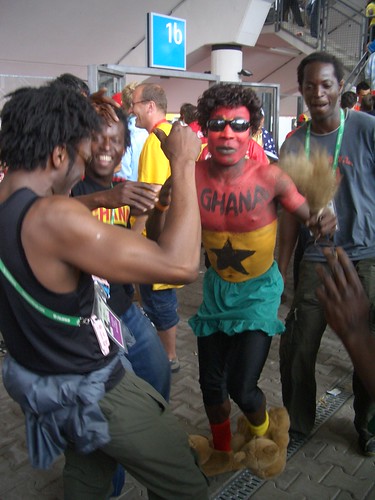
ghana celebration

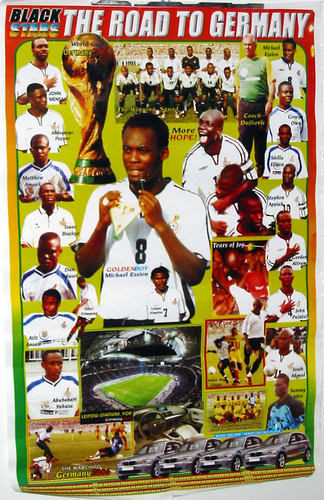
ghana road to germany 2006

ghana celebration

Soundtrack for this note


The above was just an excuse to highlight one of my favorite songs, Dynamos vs. Tornados by Zimbabwe's Real Sounds. The sounds of the football match commentary rendered against the background of an infectious soukous groove never gets old. It's quite unlike anything I'd ever heard, striking in its inventiveness. The bonhomie and cameraderie of our sports. What paradise have we lost?

ghana celebration

...

Timing is everything
Observers are worried

File under: , , , , , , , , , , , , , , ,

Writing log. Concept: June 28, 2019; Written: March 28, 2021

Friday, December 04, 2009

66 Ways to Franco

It was the kind of thing that you found yourself doing in the middle of the night, musing on an idle question born of two of your concerns: musical obsession and software anthropology. Counting the ways to Franco was an excursion into the realm of metadata, matters of syntax, and a contemplation of the hive mind of the web. The initial insomniac impulse was to create a playlist; your search, however, found a surprising 38 variants of the name in your library and you couldn't locate the song that had triggered your nocturnal foraging.

You remembered that at the beginning of the year you only had a couple of his albums in your collection but the music blogs of this world wide web had sprang to life and you'd steadily filled the gaps while reading them. In this golden age of music distribution, all one needs is a vague memory and an internet connection to fulfill one's aural titillation. Let's see, a cursory glance shows that the mp3 collection now stands at 25,494 songs, 186 GB, or 99 days of non-stop music - probably a third of which was acquired over the past year. Now you do still spend a lot on your musical vices, but you can imagine that it is highly unlikely that $8,500 (at iTunes or Amazon pricing) would have left your insubstantial wallet during this Great Recession. No, your collection grew by osmosis. Moving on...

Your count was akin to last year's discussion about the bewildering number of ways people mangle song and artist names. That led to the sight of those Top 100 ways to write Guns N' Roses – Knockin' on Heaven's Door. What a strange glimpse of the musical Tower of Babel we now have. Take a lexical curio like Guns N' Roses (call it typographical eccentricity), add a few apostrophes and you'll realize that the children of Mr Special Character and Mrs Structured Data are blessed ones. This is the minutiae that software people - and that unwashed sub-clan, the database denizens, have to deal with on a regular basis. Whole businesses have been founded on making sense of such messy data. Information retrieval is the general term of art, and metadata, well, metadata is the data about data. It's one of the hard problems in your line of work.

So what do we have then? Through a set of historical accidents over the past decade - notably the piecemeal standardization of ID tags in the mp3 file format, the mp3 file format itself, the rapid adoption of internet led by the web, improvements in storage technologies, the development of new portable music players and the decentralized mass digitization and distribution of music, we can behold the glorious results of a democratic exercise of mass data entry. During this time, millions of ordinary people took to their computers and ripped their cd collections. Millions more downloaded and shared this great social bounty. True, the more prudent laggards waited until there was commercial affirmation and legally sanctioned avenues for their digital music. Throughout, however, this mountain of music had to be labeled.

The inevitable curators came along fairly early on in this process - the online databases, GraceNote and then Freedb, to help automate things and identify the cd once you loaded it on the computer. Their altruism however didn't stem the tide of data entry (someone after all had to have entered it once and we all know how that goes). Offerings like MusicBrainz have emerged in recent years as repositories of high quality music metadata, ostensibly on a mission to bring accuracy and fingerprinting to digital music. The commercial services too now loom large as major distribution points, but they too license their listings from some of these databases, and it shows: errors everywhere. More puzzling is that the record companies haven't been of much help, they too don't pay attention to the details of the names of the artists they supposedly promote, nor indeed the titles of the songs. They, like iTunes and Amazon stores, aren't perfect at information hygiene. You see typos and plain wrong labeling of music. You don't have to take the word of an opinioniated metadata curmudgeon, the proof is in the existence of a vibrant ecosystem of tag editing software, free and even commercial. Imagine that, people pay for a product to help them label their music.

Given that even the big boys don't label their music accurately, it has been a true free-for-all and that's not even taking into account the trend of the past couple of years of digitizing (and sharing) all the lost vinyl. I'll only note that the amount of African music that is being rediscovered is frankly startling. The labour of love of those who find and clean dusty grooves, scan album covers, digitize and share their musical memories is a true surplus for society.

It turns out that all these musical curators and aggregators have only been partially successful. It really is a problem with the human factor. When you have humans doing data entry you'll have errors. When you have on order of millions doing data entry, you'll have large numbers of errors. These glitches appeal to me, truth be told. People label things to remember them and the patterns they use are worthy artifacts. The variants, I'll suggest, are emblematic of both folk memory and the mass creation of semi-structured data. If I could, I'd write an ode to the mp3 tag. In the meantime, I set about to count the ways to Franco.

Last.fm was my weapon of choice - a music recommendation system with attitude. For one, they have been gathering data from all and sundry for years now - they call it audio scrobbling. They gather data about what people listen to, crunch away, and make contextual recommendations. They deal with huge amounts of data and the attendant complexity. One early strategy to work around the inadequacies of ID tags in mp3s was to simply escape from their confines and allow users to tag artists, songs and albums on the website and watch the free-form folksonomie emerge. Web-savvy as they are they organized these musical objects each with its url and wiki page. People like to discuss songs, albums and artists. Few algorithms can handle the notion that Orchestra Baobab recorded two albums in 1975 under the Orchestre Bawobab moniker. You need a human intervention to account for this kind of peculiarity. And so they did. It's a simple application of collective wisdom: watch what users do and organize around it. They can even offer radio stations based on tags. At a certain point also, they tried a fingerprinting technique that would process their users' libraries to allow them to normalize the metadata associated with a piece of music. Taking this further, they can simply ask and allow people to correct spellings or suggest alternatives for artists that performed under different incarnations. Once a critical mass is reached you can automatically apply this feedback to tend to this garden of metadata. This is the business of web scale identifiers.
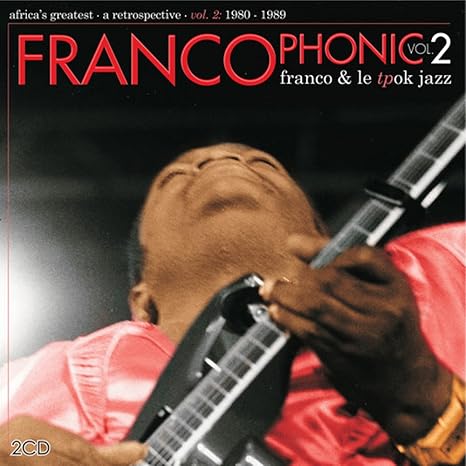
Franco


And so we come to Franco. Not the fascist Spanish dictator, whose despicable legacy is still paradoxically a touchstone for some American neocons. No. For most Africans, Franco is all you need to say to signify great, pulsing guitar-driven music, rumba, soukous, social commentary and old time good fun. All these are the elements of Franco. It's all the same good, liquid music and great memories of excursions on the dancefloor, a long career spanning four decades. It's been twenty years since François Luambo Makiadi passed away, time enough to count.

And so I counted:

There are at least 66 ways to get to Franco.

I must admit looking at the list gave me pause. How do people remember a musician? How do we remember a piece of music? Only about 9,000 users of last fm seem to listen to Franco and yet here we find world class variety. He appears in 66 different guises to the world if you exclude the 3 obvious mistaggings and misspellings. The labelers in a pool of 1.5 million Guns N' Roses listeners could only mangle that band's spelling 56 ways. What was so special about Franco, I wondered, as I looked at the list? The obvious answer is that much of his music is not available commercially in digital form. Instead, a lot of his listeners are typing up the records and cassettes.

Capitalization concerns surface immediately. Some people like ALL CAPS, others are lower case freaks. That is par for the course in a world where search engines basically ignore case. (Sidenote: looking at the top search trends of the year, it appears that users use lower case in search engines, few bother these days with "Britney Spears" when "britney spears" will do. In this age of mobile phones, it seems that the shift key is being used less). Sidenote: we won't digress onto Camel Case discussions at this stage.

Most people think of Franco as synonymous with the band he founded: OK Jazz. But how do people deal with the abbreviation? How does one spell OK? Is it rather "Ok" or "O.K."? Opinions are varied. The OK Jazz band was so named because they began as the house band in the OK Bar in Leopoldville (now Kinshasa). It should be simple then: Franco & OK Jazz say - assuming you go with no dots.

Matter of punctuation however open up a can of worms; we stray onto typographical concerns, with pronounced eccentricity in the choice of separators. For delimiters, we see dots, semi-colons, slashes, commas and hyphens.

People have different conventions for conjunctions: it's a case of ampersands (&) for the many and fully spelled out for the few.

We have the language issue, the band was named in French so we'd expect "et", but some labelers are English-speakers hence we get a few instances of "and", "with" and "featuring" showing up. Incidentally the folks in the forums at MusicBrainz will regale you with tales about the epic wars over the conventions for dealing with the word "featuring". Briefly, some people spell it out, others contract to "feat" or "feat." - with the punctuation, or even further to "ft.". Suffice to say that it was much like the egg-cracking debate in Gulliver's Travels.

Lest you think that punctuation doesn't matter, let me interject the following anecdote. Tony! Toni! Toné! were named as such in their debut album, "Who?". In later albums, they were called Tony Toni Toné - with the exclamation points removed. Which is the more accurate name for the band I ask? Could you spin a story from the missing exclamation points? Well I'll engage in mindless speculation on this typographical mystery - stay with me. It's obvious: they changed record label and lost the rights to their name (much like The Jackson 5 had to become The Jacksons when they left Motown). They were shrewd in their negotiations and the price they paid was the removal of the exclamation points. The transformation was from 3 ejaculations (those 3 exclamation marks) to a sedate sentence, perhaps indicating a newfound maturity. Truth be told, the music was better without the exclamation histrionics yet it clearly is the same band. For what it's worth, Last fm and Amazon all normalize the name without the exclamation point. Anyway, I won't pursue this tall tale further. Back to Franco and OK Jazz...

The OK Jazz band was an orchestra with a shifting cast - in Congo and much of Africa after the second world war, there was a great flowering of such orchestras as proving grounds and incubators - so you have some renderings going with Orchestre OK Jazz. Again native language comes into play, for the English it's orchestra instead of the French orchestre.

Then there are the nicknames and honorifics. Simply put, Africans love titles. OK Jazz acquired the "Tout Puissant" prefix (almighty, literally all powerful). Franco acquired the appellation, "Grand Maître" (Grandmaster). Add in the grammatical concerns and you expand the choices; is it "le tout puissant" or "son tout puissant", ergo is it "the almighty" or "his almighty"? Le Grand Maître Franco & le T.P.O.K. Jazz perhaps? Franco Luambo Makiadi & OK Jazz? Sometimes also, Franco's full name is spelled out as if to underlie the vastness of his catalog. And when doing this, the name order varies.

At its most extravagant you'd get something like Le Grand Maitre Franco Luambo Makiadi & Le Tout Puissant Orchestre OK Jazz.

Even then, would you contract to TPOK Jazz? Or T.P. OK Jazz? Or T.P. O.K. Jazz? The plot thickens.

With such a long career, there was inevitably a shifting of focus; on some albums it was the band that was the lead, on others it was Franco who took the spotlight, and at other times other members took center stage (Sam Mangwana, Vicky, Taby Ley Rochereau and so forth). The names varied accordingly. It was all Franco, and it was all good, if you don't mind my saying. Trust me, pick almost anything he recorded and you'll be a happy camper.

But to get to my point. The music I'd been looking for at the midnight hour was the following album:
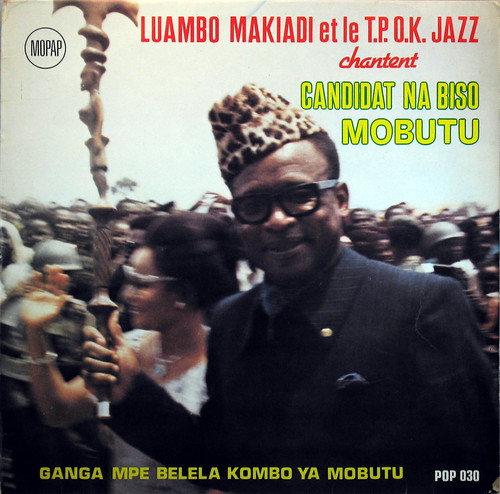
Franco et le T.P. OK Jazz sing for Mobutu


Over his career, there were a number of occasions where Franco had to pay obeisance to his patron, that murderous dictatorial rogue, Mobutu, kleptocrat without equal. The music on those few albums were not the best that he produced in his illustrious career. True, the tracks were danceable but they weren't ecstatic as usual. Some have even detected elements of irony in some of the songs - subversive dog-whistles that undercut the dictator's purpose and propaganda. I imagine some Africanist historian writing the definitive study of this phenomenon, perhaps something titled Musical Resistance in Dictatorial Times in 20th Century Congo: Rumba as Social Subversion. Interestingly enough, as you can see, the word Franco doesn't appear on the billing of the album, it is just plain old Luambo Makiadi. Twenty five years after its release, I couldn't find Candidat Na Biso Mobutu when I searched my iTunes and Winamp libraries for Franco's music, and it figures: he didn't need the dictator's bloodstains attached to his musical name. Franco was a smart man, he knew all about branding. He is sorely missed.

File under: , , , , , , , , , , , , ,

Friday, February 17, 2006

Version Hell

In the beginning we called it "CoolCodename". But that was then... That was before fate stepped in. A one-act play...

[Demosthenes is lying on his chaise longue, eating grapes, he appears to have been in this state of lassitude for a long time. Ctesiphon enters stage right in a hurry, he appears dishevelled.]

Demosthenes: [between munches] So what's bothering you, Ctesiphon? Software got you down?

Ctesiphon: The software's no problem, it's the naming thing. Those Gods are capricious beasts.

Demosthenes: [puzzled look]

Ctesiphon: I mean its the version thing. It's the fact that there is no longer an XYZ 2.5, it's now ABC 2.5.

[he continues, gesticulating wildly]

Did you know that the ABC 2.5.1 stream into which I've checked in 8 bugs was renamed on Wednesday to be the ABC 2.6 stream?

Demosthenes: Slow down a little, let me get it straight. There's a 2.5.1?

Ctesiphon: Slow down? Demo, 2.5 was last month's story, it's all 2.5.1 these days. And 2.6 of course. Yes. Well...

[slowly now, pausing to collect himself]

The ABC 2.5.1 project was renamed to ABC 2.6 after people like myself had been checking things into it for weeks. Ergo, post-facto crapulum.

Demosthenes: Hmmm. Ipso facto absurdum.

Ctesiphon: Greek not Latin, where's your classics, you anachronistic orator. This means that I have to recreate all my activities and redo the check-ins into whatever project is now supposed to be ABC 2.5.1.

Demosthenes: But I heard from the Oracle that the latest thing was XYZ 2.5, I mean JKL 2.5.

Ctesiphon: Rebranding they call it, that's the thing with Delphic Oracles... [pauses] Then they pretend that we were always calling it ABC 2.5 and not XYZ 2.5 and that we were always calling it JKL 2.5 and not CoolCodename. But that's a seperate issue. Don't get me started.

[he starts pacing up and down the stage, suggest crackling thunder in the background as he enumerates each point]

What gets me steamed is that

  1. They only told us now (Friday night) that the ABC 2.5.1 stream is open for submissions, and
  2. All submissions are due by Sunday, and
  3. The ABC 2.5.1 stream is now the ABC 2.6 stream, and
  4. The place to check in the ABC 2.5.1 fix is the old XYZ 2.5 stream which was not renamed to ABC 2.5.1
  5. And... oh forget it, who knows what the ABC stream is for....
Thus when I check in for ABC 2.5.1, I have to remember not to use the streams I had created, named ABC 2.5.1, but rather the old stream called XYZ 2.5. Reductio ad absurdum.

Demosthenes: [After winking at the audience] But I just read this week's scrolls, it was all about 2.6. What's going on, Ctsey?

[Ctesiphon becomes manic as he replies, perhaps his toga starts coming loose]

Ctesiphon: Which 2.6, I ask? Which 2.6, Demo? Let's not mention that we are going to have a new release of XYZ. They only tell you later. As you know XYZ 2.6 is based on CoolCodename, I mean JKL 2.5, but they'll be wanting some of the fixes from ABC 2.5.1.

[louder]

So this Saturday, after I finish merging my work into ABC 2.5.1 in the old XYZ 2.5 streams, I'll have to find the new streams for JKL 2.6, whatever they are named, because they won't do automatic merges. Then I have to diff the 2.5.1 code against the JKL 2.6 base (I mean the XYZ 2.6 base) and take only those changes that are in ABC 2.5.1 and hand-merge them.

[Even louder and faster]

But of course, they made some security fixes for that Trojan issue in JKL and so the security model has changed because the SMB market you aren't guaranteed to be using DBO instead it's XBO or SBO. And of course, there is no machine to test any of this stuff whether ABC, XYZ or JKL. Come to think of it, I've only ever tested my patch on a old build of ABC 2.5 that was using DBO, I never tested with...

Demosthenes: All right, all right... [winking again at audience then patting Ctesiphon on the back]

You better get some sleep, sounds like you've got a busy weekend ahead of you.

Ctesiphon: That Sisyphus had it good, the boulder always rolled down the same hill.

[Demosthenes walks him out stage right. Comes back alone, pours himself a goblet of wine, sips it and sighs... looks straight at the audience.]

Demosthenes: That's the thing about managing engineers, you've got to tolerate all this background noise. [Picks up a grape and sits down]

[Curtain falls.]

Note: the foregoing is a work of fiction, any resemblance to actual persons or products is entirely coincidental. Your mileage may vary. Always fasten your seatbelts when on a chariot. Objects in the mirror may be closer than they appear. Do not drink and drive.

Further reading

Soundtrack for this dialogue

Playwright's Note


A number of people have been reading themselves or their products into my little tale of version whiplash and confusion and I've even been asked to decode ABCs and JKLs. I rather thought the point was that the three letter acronyms didn't matter and indeed will change without notice until something sticks in the market place (ESB, SOA etc)

I will admit that almost all the lines of dialog sounded vaguely familiar to some, "verbatim" was what a friend said. But really, it's just fiction...

Still one might well construct a parallel universe in which CoolCodename might be "Portal" or "Workplace". Lotus Workplace (LWP) might become IBM Workplace and then might morph into Workplace Collaboration Services (WCS) for a while. Product managers might get the idea to attack the SMB market and turn a "lightweight" WCS into a CoolCodename-d PortalX which might in turn become Workplace Services Express (WSE) and then you might need to get version so-and-so out for... Well you get the picture.

It's all Greek to me.

See also: Version Hell Revisited

File under: , , , , , , , , , ,

Wednesday, June 15, 2005

Calling Things By Their Names

So I heard that sanity has returned to these parts. [1]

Our marketing folks are now going to call Lotus QuickPlace, QuickPlace instead of whatever bland and insipid name that had been previously mandated. IBM Lotus Team-Workplace-something or-the-other?

Similarly Sametime will now be called Sametime instead of "IBM Lotus Instant Messaging and Web Conferencing". For a while the Lotus in that designation had been deprecated.

This probably portends that our marketing teams now better understand how to sell the Lotus portfolio. A few years ago, the perception from the trenches where I live was that there was a rush away from the land of Lotus simply because (in my estimation) it wasn't understood or didn't mesh well with the compensation structure of our sales teams. Presumably we've adjusted and now understand what these products are capable of instead of dismissing them out of hand.

Now when belts tighten in the IT industry (and right now, it is a deep retrenchment), people fall back on things that work, whether it is the glue, spackle or wrenches that I keep referencing. And much in the Lotus portfolio works even if it isn't pretty sometimes. And it works especially in the SMB space that is in the Long Tail of software. See our recent acquisitions of more Glue Layer People or even my recent hand-waving thoughts on Lotus Notes:

"For those unfamiliar with Notes/Domino, my handwaving elevator pitch is that it is a platform essentially based on the fundamental insight that a huge class of applications can be built based on just a few compositional building blocks: Forms, Views and a standard file format, the note in Notes terms. The brouhahas made about messaging, security, directory services, and all that paraphernalia that marketing people throw about when they pitch the platform to you are all syntactic sugar around the core competency of Forms and Views and the client and server processes that can manage them. A whole cottage industry of business partners are doing very fine thank you building custom and evolvable applications for businesses, small and large, everywhere. The fact that email can be construed as a forms application is just a side benefit and detracts from the real focus of the platform. This is much misunderstood by people whose only encounter with Notes is as a Mail client. It's really just a forms and view app for people and processes. Incidentally this same platform is most likely what is funding my current work and much of the IBM Software Group, even as resources are spent on other "sanctioned" and more "strategic" approaches. C'est la vie."

So that's the good news.

The not so good news:

Coincidentally the [redacted] domain was removed from the internal dns without notice sometime in the last 2 weeks. I was wondering for a few days why I coudn't couldn't post to [redacted product] or vnc into my development servers from home. I thought it was a temporary flaw and added temporary entries to my hosts file. Of course I eventually realized that nothing in the internal [redacted] hierarchy would ever resolve again that this was part of the reason why [redacted product] moved away from [redacted domain]to its current location at [redacted new location]

Some of us who had to jump through hoops to get static ip addresses like [redacted] were a little disgruntled for a good 15 minutes. Mr Feinberg even brought Godwin's law into the mix albeit with a smiley at the end of that invocation.

I guess it was approriate that the hard drive for that twilight zone machine died 2 days later. Cosmic justice or Sign of the times. These are strange days...

Now this was probably just a case of run-of-the-mill miscommunication, but let's remember that simple things like naming bring out the tribal instinct in people with sometimes shocking reactions... A lot of goodwill could well be lost.

Take for example the time 5 years ago when it was not announced that Lotus Development Corporation had been deincorporated and a good 7,000 people suddenly received payslips from the IBM corporation saying that they had received only their thousand or so dollars year-to-date (and it was mid-year). Indeed it was only months later, after prompting by an atypically tough question in an Lotus all hands meeting and seeing the quite hurt and vociferous articulation of pent-up feeling that the question belied that this was acknowledged in a subsequent prickly corporate message. Perhaps we were being babies (after all we were still getting paid), why should we care about trivial things like the name on our paycheck? I didn't attend said meeting but I caught the fallout since I just became "reverse-mentor" to [redacted executive] and had to explain why such things would matter to us "[redacted] folks"...

The identity of a community is to be found in the most unlikely of things. The things that draw people together to form a cohesive whole are not the explicit things that one thinks, it's not a kind of warlike territoriality or dedication to some mission statement or other, it is rather in small insignificant items that the tribal instinct is articulated.
People will rally round the most surprising items (Elian Gonzalez, OJ Simpson, Teri Schiavo) and they quickly become litmus tests. Think of some of the most intractable political conflicts (say Serbia/Croatia/Bosnia or and here I hesitate, I wonder who else will have an Israel/Palestine category on Blogcentral) and wonder whether the political, religious or economic arguments were really the cause of the conflict or if there weren't instead some more mundane hurt feelings that then blossomed into what we have seen and subsequently rationalized by opportunist political or religious hacks.

Or take this example form my part of the woods: for the past 9 years, Northern Ghana has been in turmoil because of an argument at a market stall over a chicken or guinea fowl (the historians will have to figure this out at some point). Two ethnic groups, the Dagbons and the Kokonbas who have lived peacefully together for centuries are now in open dispute. Many, many lives have been lost, and a huge amount of money, goodwill, diplomacy, cajoling and outright bribing has had to to done to try to cool things down and to get that part of the country to begin to contribute again to the rest of the community. This in a place that can ill afford such distractions. Now in my analogy, the guinea fowl is the stand-in for the name or for a dns entry.

All this to say that when nurturing communities, it is best to keep such sensitivities in mind and call things by their names. If not all those Sensational Fruity Delights might come home to roost.

Things come home to roost


Editors note: I posted this piece on May 18 on my internal blog but now that the information is no longer a rumour but has received confirmation, I decided to remove the embargo since it speaks to the tribal instinct in communities, something that interests me as an anthropologist of social software

File under: , , , , , , , , , , , , , , , , , , , , , , , , , , , ,