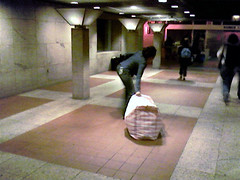
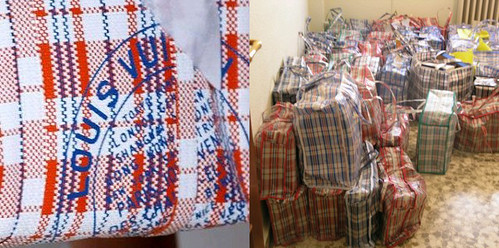
Let's talk about bags if you please. Bags are in the news these days. I don't mean San Francisco's ban on plastic shopping bags. Rather I'm thinking about this type of bag. In Ghana and most of West Africa we call it the "Ghana must go" bag.
Alternatively in Ghana, and humourously, they are called "Efiewura Sua Me", literally "help me carry my bag". Indeed there's always someone at the bus or train station who needs help moving such bags. (And yes, I did help that young lady after taking a surreptitious snap with my dodgy cell phone. Chivalry isn't dead even at midnight at the bus terminal).
Last year Sokari Ekine revealed her own
bag woman tendencies and opened the discussion - she's a connaisseur. In response,
Georgia Popplewell noted that "in Trinidad I’ve heard those bags called Guyanese Samsonite". We learned that in Germany, per contra, they are known as "
Tuekenkoffer" or Turkish suitcase. In Boston I've heard them referenced as Chinatown totes, and called Bangladeshi bags in England, presumably after the 1970s influx of Bangladeshi immigrants.
The "Ghana must go" designation resulted from the various expulsions of immigrants that Ghana and Nigeria engaged in between the 1960s and 1980s. Many were only able to pack their belongings in such bags before fleeing, expelled with barely hours or days notice. Thus Ghana must go is ironic at best, and has mocking overtones at worst.
During the Rawlings Chain lean years in the 1980s when it wasn't simply a matter of returning immigrants and the whole country was facing political and economic difficulties (Revolution! Ghana), they were simply called "refugee bags". We were all refugees then.
In any case, the trend in naming is clear, these utility bags designate immigrants, refugees, or those down on their luck. They are emblems of hardship, relative poverty and exigency. I'll argue here that they are object lessons about the fluidity of ideas.
Pattern Matching
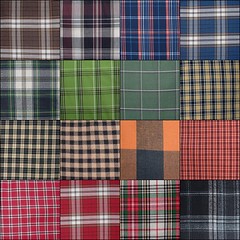
Let's first discuss the pattern. The majority of these bags are produced in China and it is fitting, given the interesting history of the pattern that covers them.
The plaid pattern is thought to originate in the Taklamakan area in Xinjiang Uyghur in China perhaps between 100-700BC and certainly by the 3rd century. The
Scots have the most famous claim to it however. The
Falkirk tartan in 1707 is thought to be the Scottish debut of the tartan, the rich tradition of the Scottish plaid kilt that various families and clans adopted (this
pdf shows a visual timeline of tartan). The Scottish colours are typically rich shades of red and green and only occasionally is the main colour white as in the bags.
The word plaid means a blanket, from the Gaelic plaide. In North America people use it interchangeably for
tartans. The etymology of the word tartan is itself in dispute. The French word tiretaine (an amount of material), and the Spanish word tartana (a fine quality cloth) are the main contenders.
Now of course tartans were adopted wherever the British empire cast its wings. Bagpipes and kilts can be found from Ireland through Sierra Leone to India. I need only point you to this piece about
tartans and turbans which lovingly traces their legacy in the Indian subcontinent and beyond. Amongst other things Ennis notes that Sikhs in Scotland have even commissioned family tartans; the headline for that episode reads:
Singh Adds Spice To The History of Tartan. So: spice, the silk road and the Highlands.
Typically
plaids have been woven textiles, used for clothing or decoration. The little plaid skirt evokes many associations. Like all patterns used in visual design, plaid has been applied to
all manner of objects. Which brings me back to bags...
Bag Lady
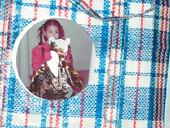
The Ghanaian artist
Senam Okudzeto has very personal knowledge of the history of "Ghana must go" and has incorporated its iconography into her work. If you look at the fragments of
her recent exhibitions, you'll be exposed to a
history of dislocation, of fractured, sudden enforced exile.
The question she raises is one of historical memory. Our plaid bags are the physical proof of the way in which the boundaries that meant nothing in our pre-colonial past now loom large in Africa. Indeed their name stems from the 1983 Expulsion Order giving illegal immigrants 14 days to leave Nigeria. But more broadly the bags refer to repeated upheavals in our lands and sub-Saharan Africa knows upheaval all too well. Still, there's a sort of existential defiance in her reclaiming these objects of loss. Divisions are embodied in the cheap, practical and functional bags.
There is considerable wit in her work although it is always combined with a wistful displacement. Note the slogan, Capitalism and Schizophrenia, and some of the quotes she highlights: "deception is fundamental to the system".
Resilience
Plastic bags then. Plastics are the great innovation of the past century and a half and well they are sources of alienation and comfort, pollution and practicality. The famous scene from
The Graduate comes to mind
"I want to say one word to you. Just one word."
"Yes, sir."
"Are you listening?"
"Yes, I am."
"Plastics."
If you are confronted with packing up your entire possessions in a hurry for fear of your safety, a Ghana must go bag will undoubtedly be a source of comfort. If you're trying to pack tins of corned beef and sardines, rice and sundry spare parts along with the clothes your relatives back in Ghana lack, you will gravitate towards the Ghana must go bag. At such times, volume and weight is everything. Ghana must go bags are about the most practical and lightweight luggage that exists.
Plastic, rugged and functional, you can even wrap them with tape to ensure additional sturdiness so that they don't split when they are manhandled by underpaid bag handlers. You can place all sorts of foodstuffs in them: smoked fish, yams, meat and spices. And heck they are distinctive: plaid, woven and plastic. As such, they are fixtures in many routes serving the developing world.
I can remember the scene at JFK airport waiting in line for a Ghana Airways flight, watching a market woman and the fifteen young men who would be taking the trip with her wares - all in huge fully packed Ghana must go bags. They had brought a big truck to the airport and were blocking the entrance causing a stir as their cargo was unloaded. This was even after 9/11 but she wasn't minding the Homeland Security folks that approached. Mama Trader wasn't travelling herself but had come to supervise the dispatching of her consignment of goods home. She made it clear that she wasn't planning for any of her workers to pay any excess luggage fees. I'm almost positive they didn't; she must have had a 'business arrangement' with the airline (or at least those manning the counter). Incidentally Ghana Airways went out of business shortly thereafter. Moving right along...
Fashioning Bags
I wrote the foregoing to connect a few dots raised by a recent stir in Ghanaian newspapers. The headline read:
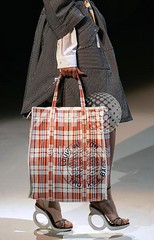
Louis Vuitton sells "Ghana Must Go".
The images of models bounding down the catwalk at Marc Jacob's 2007 collection for Louis Vuitton raised the ire of a few commentators. An example:
The expensive shoes the model was wearing, indeed her entire outfit, stand in sharp contrast to the utility bag she was wielding. A
typical review of the show mentions
a funny cheap checked shopping bag that carried a big, passport-style Louis Vuitton stamp...
the collection was a complex refraction of the many inspirational sparks that go into the work here: pieces synthesized to project the simultaneous multinational appeal this brand must maintain
The language of the style section is too clever by half but they captured the incongruousness and appeal of the image. A complex refraction indeed. A close look at a
full slideshow of Marc Jacobs' creations shows that the bags of our tale were a leitmotif of the collection.
This is nothing new in fashion; slumming is a trope in the rarefied heights of haute couture. In recent years we have seen much appropriation of the sort and things like service uniforms (UPS, McDonald's etc.) have gained a fashion quotient. This is run of the mill piracy and the kind of tongue-in-cheek sentiment we applaud our designers for.
The author of the article was incensed that Ghanaians hadn't capitalized on the Ghana must go iconography and that others were now about to make hay out of a designer bag frenzy.
Having an idea stolen can be more difficult to deal with especially when the other party makes a bigger name and money off the idea than what it was originally worth...
A tempest in a tea pot in short.
Of course I could have pointed out that a proud Ghanaian artist was blazing these trails long before Marc Jacobs got there. Indeed there is an element of theft in this episode. If you look at Senam's work, you'll also see that she focuses on the passport stamp along with the Ghana must go bag. She highlighted not just the bag, the few personal mementos, photos and such, but also the passport stamp. Those who didn't have the requisite stamp on their residency papers or passports were the ones who were forced into upheaval with only these bags to carry their belongings into the unknown. Thus issues of legitimacy and exile are part of the questions she poses in her ongoing series.
In many ways, Jacobs's shtick was only a high-profile plagiarism. I expect Senam would be tickled by the nexus of commercialization and piracy that she likely provoked. The
Akan proverb, humanity knows no boundaries, is one she would have been steeped in. Not to mention that the plaid pattern comes and goes used by all and sundry. The Wife notes incidentally that plaid is
in this season in all the fashion magazines and stores. It was inevitable that others would latch on to it.
In any case, what claim does Ghana have to Ghana must go? Shouldn't the Nigerians, who ironically coined the term, have first cuts of any royalties? Heck these bags aren't even produced in Ghana, we are mere buyers and users. Our Chinese friends manufacture them using their native pattern. And, as we have seen, our local name for the bags is not widely known outside of West Africa. We're not the only refugees, immigrants or attendees of the school of hard knocks.
Still like Marc Jacobs, and in the spirit of Senam, I thought a juxtaposition would be appropriate and, rather than link to the original images, I thought I'd perform a
creative theft with the following image. The title should be evident:
Ghana must go versus Louis Vuitton
Bags and Stamps: a plagiarism in plaid
So to recap, a Ghanaian, by way of France and England, living in the USA, creates a collage starting with an image of Chinese-produced plastic utility bags taken by a Nigerian living in Spain - a 'theft' of the "Ghana must go" imagery, born of the interlocking episodes of reciprocal deportation and sundry exile between their two homelands, both former British colonies. The plaid pattern on said bags is originally Chinese although it is most celebrated in Scottish fabrics, and the subject of English schoolboy fantasies. Said pattern was transmitted in recent centuries over the corners of the British empire and is rightly part of Indian and especially Sikh heritage.
The symbolism of the bags is the signal subject of the work of a American-Ghanaian artist who grew up in Ghana, Nigeria and the UK (yes I should have mentioned Senam's Nigerian connection - isn't that a complication? And doesn't that explain the resonance of the Ghana must go iconography in her boundary-straddling life? Not to mention her focus on the passport stamp of approval. Sidenote: this modern traveller now has a very sensible Swiss connection, whither neutrality?)
This image is juxtaposed with a recent appropriation by an American fashion designer working for an France-based luxury company whose ironic contribution is to place a seal on the bag, contrasting the pennies on the dollar cost of the bag with a logo that is renowned for its deleterious effects on even the fattest wallets - a logo, moreover, that is often counterfeited by Chinese manufacturers in a global shadow economy of knockoffs that are sold all over the world. The significance of the logo or stamp of approval is iconic in expressing authenticity, legitimacy and belonging, demarcating the boundaries separating countries at once, and luxury status symbols delineating the rich from the poor.
Incidentally this note was prompted by a posting by an Indian American, who is arguably more Ghanaian in sensibility than me from his few years in Ghana, said posting focused on the celebration of National Tartan Day by Scottish Americans and its implications for the Desi community and diaspora.
The mind reels.
I have just booked a trip to England. My ostensible purpose is to get a stamp in
my passport that will keep my notional residency in Her Majesty's lands legitimate. I am hedging my bets against this American episode; the stamp is my soul insurance if you will. Refugees all, we in Africa are no strangers to dislocation, in many ways it is our close friend. As the song goes, wherever I lay my hat, that's my home.
Modern travellers
Packing our bags
Seeking out stamps
The mementos of exiled souls
As usual,
some music for the exiled soul...
- De La Soul - Shopping Bags (She got from you)
The percussion on this song, a stark array of milk bottles, proves that the boys still have it, appropriating whatever beat is expedient to get the message across.
- Freestyle Fellowship - Inner City Boundaries
The inner city griots expound
Who is that surrounding me?
Enemy enemy you crossed the wrong boundary
Wicked witness wizardry
Disappear from here and end up in a tree
Crossed the wrong boundary
- Milt Jackson - Bags' Groove
Milt Jackson's nickname was Bags. He is most famous as a pillar of the Modern Jazz Quartet, Django being only one of their numerous standards. Bags' Groove is a heavyweight encounter with Miles Davis, Sonny Rollins, Thelonious Monk, Horace Silver, Percy Heath and Kenny Clarke. He played his vibes and the rest is history.
- Milt Jackson and John Coltrane - Bags & Trane
Bags and Trane is a more delicate affair, the two great soloists respected each other and are all empathy. I think Milt comes off better than Coltrane, much as Sonny Rollins came off fiercer in his Tenor Madness conversation with Trane.
- Bob Marley - Exodus
Movement of Jah people. 'Nuff said.
- The NPG - The Exodus has begun
A Prince album in all but name, the title track is sprawling like Bootsy and George would have done it. Oh identity.
- Digable Planet - Nickel Bags
Their reunion in 2005, after 10 years apart brought such joy. (I still have a review in the draft pile). Let's hope they head back to the studio. I want some more nickel bags of funk.
- Herbie Hancock - Three Bags Full
Herbie Hancock's contribution to this playlist is from the aptly titled Takin' Off album, an affair featuring Freddie Hubbard and Dexter Gordon mind you. This is hard bop at its best. Most airlines only allow two bags but when you fly Air Herbie, you get extra allowances for your baggage, and a bigger plane.
- Erykah Badu - Bag Lady
I'll end with the bag lady herself. Ms Badu's Ghanaian heritage is only obliquely referenced these days, if at all; Texas claims her. Still, her musical iconoclasm is plainly mid-Atlantic, her sensibility is that of one who knows no boundaries, a musical refugee in her creative prime. This was the lead single from her last soulful album, the title of course: Worldwide Underground.
A parting question: I wonder if this note could pass as a
Things Fall Apart affair. Would it be a case of social living, a comfort suite or rather that rough beast? What say you dear reader?
[Update June 5, 2007]
See also:
A plagiarism in plaid
Bags and Stamps - the photo set
File under: bags, plaid, art, culture, globalization, fashion, immigration, exile, memory, Ghana, Nigeria, Africa, authenticity, design, history, collage, identity, loss, China, India, Scotland, commercialization, boundaries, plagiarism, theft, appropriation, naming, Ghana Must Go, Things Fall Apart, Social Living, toli