Heart of Darkness
Part 5 of the Things Fall Apart series - in which we head down the river...
Mr Metaphor
Once he found his voice, the man the world would know as Joseph Conrad would be at once compelling and infuriating. He had travelled widely in the British merchant navy, observing the colonial enterprise from a seaman's perspective. It took a while for him to settle into the style of storytelling that would win him renown but, once he found his voice, he was prolific. He tended to mix personal meditations and psychological portraits with a broad brush of metaphors (pun intended). Late in his writing life, this latter aspect would lead to his work losing his earlier audience. Still the works he produced when he was on form endure to this day.
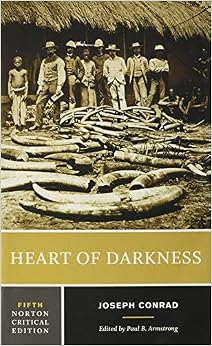
Heart of Darkness is a slender novel, it is short, sweet, muddled and, as befits the title, murky. It's the story of a journey and at barely 100 pages in my edition, you can read it in a couple of hours. For almost a century, this has been the novel that people have used to characterize Africa. Indeed Chinua Achebe's Things Fall Apart has taken almost half a century to surpass its influence. Short of safaris, wild animals, poverty, famine and warfare, popular notions of Africa have not been of normalcy (of say skyscrapers, markets and factories) but have rather been informed by Conrad's visions.

I've long been interested in the creative spark, in finding out what sets an artist off. In this respect, Heart of Darkness looms large in its influence. The Norton critical edition augments it with more scholarship than almost anyone can absorb. Even as you read my ruminations, secondary school children the world over are writing papers on its themes. A cottage industry of Cliff Notes exegesis has obviously blossomed on its fertile ground. Beyond interpretation however, it is worth pointing out a few works that seem to draw from its premise.
But first, what of Conrad's own creative spark? Well Conrad wrote the novel at the turn of the century 8 years after making his trip to Congo in the 1890s. Thus he was writing at a remove from his experience. Yet there is immediacy in the story, it isn't merely a mythical journey. Conrad wrote at a time when the "Congo Issue" was being raised in the press - namely the quite vigourous campaign against the egregious human rights violations that King Leopold's men had been perpertrating for decades in his personal fiefdom of the Congo. Perhaps the headlines of the time prompted Conrad to put to paper some of what he had seen.
The plot, as it is, is stark: the unreliable narrator, Marlow, recounts his experience heading down the Congo river to encounter the agent, Kurtz, who one learns is a larger than life character who has become unhinged. The atmospheric journey is the point of the novel. You are led into an environment that is meant to be impenetrable and alien. Darkness prevails both physical and metaphorical. The fascination mounts about Kurtz who is variously described as "a prodigy", "a remarkable person, he gets more ivory than all the others", a "universal genius".

The writing is hallucinatory, Conrad has a talent for repetition and incantatory description. Some characterize Heart of Darkness as a meditation on man's capacity for evil, that is, as a psychological jumping point for examining the eternal human story. Others perceive it as an indictment of the rapacity of King Leopold's excesses - a legacy which still haunts Congo today. If there wasn't quite a cyncism about the colonial enterprise in the novel, it could still be read as an illustration of the costs of the effort. One problem with the purely psychological reading however is that those who are affected are rough sketches at best. In the biblical tale, Cain and Abel were brothers and started out as equals, in Kurtz's Congo however, the victims are the proverbial wretched of the earth and are worth only cursory descriptions.
It is a truism that when you're building empires, rules don't apply. This covers a spectrum that ranges from noblesse oblige through exceptionalism and, in Conrad's time, to Social Darwinist Alley. Idées fixes abounded in the attitudes towards the "savage people" that were being colonized. Euphemisms reigned supreme and a missionary zeal to uplift the conquered peoples prevailed. Throughout history, such encounters proved catastrophic for those on the losing side. To the winners however come the obvious material spoils and the fringe benefits of superiority complexes.
It is no surprise then that "Mr Kurtz lacked restraint in the gratification of his various lusts". The whispers along the river are that he is considered some sort of "Superior Being". The shock to reader however is the extent of the moral decay and corruption. It queered the self image of the whole enterprise. We read graphic evidence of how low people can sink when unmoored from any checks and balances. The enduring image of the tale is of the ghastly decorations, the decapitated human skulls staked to the ground that surround Kurtz's house. Bromides of an uplifting mission are harder to countenance in light of such scenes.
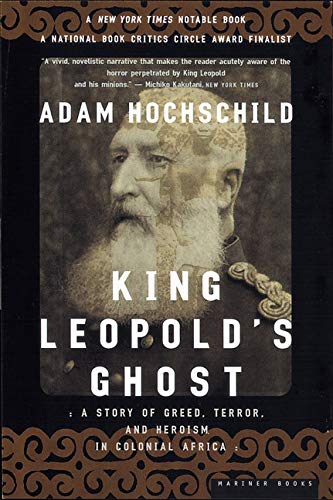
The metaphorical Heart of Darkness that Conrad wrote about is something rooted in the unparalleled brutality perpetrated on the Congo. Adam Hochschild spent some time in King Leopold's Ghost situating the novel in its proper historical context. Kurtz is based on historical figures and perhaps people that Conrad himself met during his four month expedition. The reality of Congo's colonial past was indeed conscription, forced marches (your basic slave labour) and summary amputations all in service of ivory, rubber and the good King Leopold. It is estimated that 10 million died under this regime.
Hochschild points out any number of men who could have served as prototypes for Kurtz including Captain Léon Rom who famously kept a collection of severed African heads around his garden. Sentences like the last one are part of the power of the shock of that episode. If Conrad's novelistic indictment helped stem such outrages, Heart of Darkness would have served its purpose.
Near the end of the tale, Marlow finds Kurtz's "masterpiece" writings which are dryly titled "Suppression of Savage Customs" - the scrawled inscription on them is "Kill the brutes". This little detail should resonate for readers of Things Fall Apart, the report written by the colonial administrator in Achebe's story has a very similar title.
Burnt-Out Cases
Graham Greene almost satirized Conrad in his 1960 novel A Burnt-Out Case. A man heads to a leper colony in Congo where he is diagnosed as a burnt-out case; he seeks solace in helping the lepers in the institution. Greene takes Conrad's tale but adds nuance - the vivid imagery, Conrad's impenetrable darkness, is substituted by the shades of grey that were Greene's natural inclination. This is one of Greene's strongest novels, one that is sometimes (and wrongly I believe) counted as one of his "Catholic" novels. It is the same framework however: Africa as the place people come to for redemption or escape. The difference here is that the jaundiced viewpoint of the twentieth century informs Greene's treatment of the Heart of Darkness. He acknowledges upfront that "this Congo is a region of the mind".
The language also is instructive and it is interesting to see the progression. Writing 60 years after Conrad's novel, we've moved from Heart of Darkness to Burnt-Out Cases. This is undoubtedly progress. I suspect that burn-out, or perhaps its counterpart, things fall apart, is more tractable than heart of darkness. With occasional breaks and maintenance the human animal can keep going, indeed, if you throw in a change of perspective, we can go from strength to strength.

Chinua Achebe has said that he wrote Things Fall Apart as a response to Heart of Darkness and other books in that vein, novels he felt that at best short-changed Africa and at worst were viscerally objectionable. I love literary spats and Achebe got himself in the midst of a great one. In quite plain language, he noted that "Joseph Conrad was a thoroughgoing racist" amongst other weighty charges in his famous 1977 polemic An Image of Africa: Racism in Conrad's Heart of Darkness. In that lecture he laid into the sacred cow of Heart of Darkness, finding all manner of things awful in the novel. He conflates Marlow and Conrad, argues against the language, the setting and the entire story.
It continues to enervate him to this day as Caryl Phillips found out in a 2003 interview, The case against Conrad:
"Africa as setting and backdrop, which eliminates the African as human factor. Africa as a metaphysical battlefield devoid of all recognisable humanity, into which the wandering European enters at his peril."This is "arrogance", "perversity" and worse in Achebe's eyes.
The thing is that Conrad is too easy a target. You can open the novel at almost any page and find something objectionable. For example:
We had enlisted some of these chaps on the way for a crew. Fine fellows - cannibals - in their place. They were men one could work with, and I am grateful to them. And after all, they did not eat each other before my face: they had brought along a provision of hippo-meat which went rotten, and made the mystery of the wilderness stink in my nostrils. Phoo! I can sniff it now.There is a gruesome humour in these attitudes but even if you think it is despicable, or that the author had a pernicious intent, it is humour nevertheless.
While Achebe strikes home on some of his points, I think his novelistic output is a better counterpoint and response to Conrad. The deep-seated resentment of the colonial enterprise and its concomittant disdain and exploitation of Africa drove Achebe to write his own tales and to change the perspective. This impetus led to a blossoming of modern African literature. Why exercise oneself about this novel? It is true that travel writing seems to have a disproportionate influence in the world. I'll note in passing how Robert Kaplan's The Coming Anarchy seized Bill Clinton and Madelaine Albright's imagination and informed their response to Rwanda and the former Yugoslavia in the 1990s. I'll confess that I quite like Conrad's tale, it's a great achievement and obviously much more than mere "travel writing". It certainly doesn't bother me; I'm writing my own stories of Africa.
For an example of a more telling critique and one that I think is far more powerful, we can turn to Vladimir Nabokov who famously dismissed Conrad (and Ernest Hemingway mind you) as "writers of books for boys":
I cannot abide Conrad's souvenir-shop style, bottled ships and shell necklaces of romanticist cliches. In neither of those two writers can I find anything that I would care to have written myself. In mentality and emotion, they are hopelessly juvenile.That is the more insightful and damning critique, in just a few words Nabokov stabs Conrad's work in its heart - and its style and substance is found wanting.
Things Fall Apart brought to the fore different ways of writing about Africa that broadened the context beyond standard tropes and travel pieces and put Africans at the center of the narrative. At the same time, who's to say that Africans are better writers on Africa? V.S. Naipaul and Graham Greene stand as masterly writers about the continent whose works display the same rich textures and emotional fortitude. More recently William Boyd's A Good Man in Africa or Brazzaville Beach stand up to much contemporary African literature - indeed I claim him as an African rather than an English writer, and not just because he was born in Ghana. Moving outside the continent, Madison Smartt Bell has just completed the definitive fictional works on Haiti - who knew that Toussaint L'Ouverture would be reincarnated from a home office in Baltimore, Maryland?

Black Mischief
Jerome Weidman wrote the following on Evelyn Waugh's Black Mischief.
To achieve greatness... satire must be rooted not only in a genuine love for the object being satirized but also in an awareness of the object's relation to the entire human condition, regardless of race, color, creed, or geographyHe was shrewdly anticipating what would be an almost politically correct response to Waugh's musings by many critics and pointing out a way to deflect those charges. The novel is not as savage a satire as Vile Bodies or A Handful of Dust, but it remains one of his funniest novels, brimming with great set pieces and a sustained wit that powers the narrative. There are no sacred cows and everyone is thoroughly lampooned.
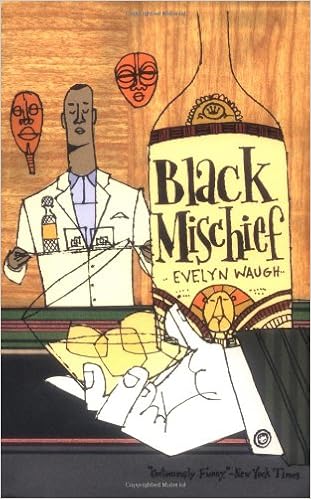
Broke and after running into more jams than one can count, a young Basil Seal flees Britain for Azania, a barely-fictionalized Zanzibar. Waugh provides a picture-perfect rendering of colonial administration in the 1930s. This is a portrait of decrepitude, of second-chance has-beens reinventing themselves in faraway lands as overlords, of the casual racism and solipsism of the colonists, of intrigues between the English, French and the German who worry about their spheres of influence and the profit imperative. The Emperor Seth, who had been Basil's contemporary at Oxford, aims to come back and modernize the country. The two eventually combine to implement the various absurd reforms which have no practicality or relevance to his "subjects". The portrait of the English in foreign lands is never pretty, let alone when they occupy positions of power and Waugh delights in showing them at their worst. After all, only in colonial times could a ne'er-do-well leave his country and promptly become an Imperial Minister. There are even animal rights ladies who have come to do something about the treatment of the livestock on the island completely glossing over the mindless treatment meted out to the locals, the Azanians who mind the livestock.
Waugh follows Conrad's motif, the journey into the dark, impenetrable Other but he takes a keen satirist's eye and wrecks gleeful havoc along the way. As an author, Waugh is completely unsentimental about human relations and motivations. It isn't contempt for his characters but rather a recognition that in life much occurs that is unfair and absurd. Laughter is the coping mechanism for his keenly felt outrage. Unlike Conrad however, he is an equal opportunity satirist, the "locals" are given as nuanced a portrait as the "colonists" and they are similarly doomed and knowingly characterized. I would add this extremely funny and bittersweet novel to Greene's as the best artistic take on Heart of Darkness.
Abdulrazak Gurnah's great novel By the Sea presents a perfect reversal of this idea. Quite simply, it inverts Black Mischief and Heart of Darkness. In this case it's an old Arab trader who arrives from Zanzibar at Heathrow airport and eventually finds himself in a guest house in coastal England while his immigration case is considered. At length he is joined by a young man, a fellow countryman. It is only in a sedate bed-and-breakfast that the two protagonists can resolve issues that their families had back on their island. The novel concerns itself with their tangled history.
England in the novel is the place of escape and refuge. Here it is literal exile, the one is an asylum seeker. The meat of the story however is in the implications of their former lives in Zanzibar. Gurnah has said "Places don’t live just where they are, they live within you". This sentiment points to all writers' urge to project and in his novel, Zanzibar is projected onto East Sussex to a quite sublime effect.
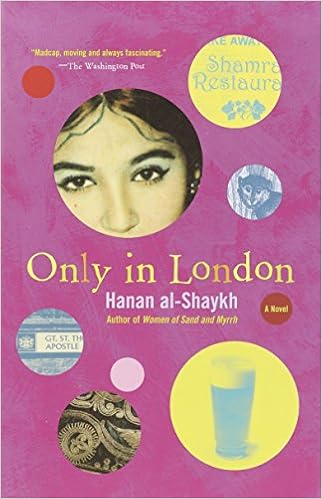
Less successful artistically is Only in London by Hanan Al-Shaykh which is also in this vein of using the West as a stepping stone for purely local concerns - Al-Shaykh is Lebanese. It's a fun read, a ribald comedy with a mass of stereotypes, four strangers who head to London and their misadventures. It's nothing too weighty; it features an Iraqi divorcée contemplating an arranged marriage, a high-class Moroccan prostitute, an English connaisseur of Arabic art, a young gay Lebanese man (and a smuggled monkey). What is instructive however is to read some of the reviews by western critics. Many are upset that London is not a character in the novel, in their eyes the story could have been set anywhere. And that's the point I suppose; for Al-Shaykh, London is indeed a mere backdrop, the heart of the city is barely scratched. The characters don't step out beyond say Harrods or other predictable landmarks. The English characters are the proverbial Other and barely drawn. As a Londoner, I couldn't recognize the soul of the city yet, as someone who has read much fiction about Africa, I could recognize the trend: London as Conrad's river Congo and those chattering savages on the banks of the river Thames, a cacophony to be ignored. Only in London is thus an ironic title, for that alone, the novel is worth reading.
Apocalypse Now
"I love the smell of napalm in the morning" is the line that everyone remembers from Apocalypse Now and Robert Duvall's improvisation is fitting for the most famous adaptation of Conrad's tale. Francis Ford Coppola's epic movie bursts with more ideas and quotable nuggets than one can handle. It is more than a war movie, indeed Coppola has quipped: "The film wasn't about Vietnam, it was Vietnam". The haze of the journey and the futility of war is illustrated at length. The cynicism of the Vietnam enterprise is exposed in all its dubious glory. The image of Marlon Brando's Kurtz when we meet him is as disturbing as one would expect and his final monologue as unnerving and hallucinatory as Conrad would have wanted.
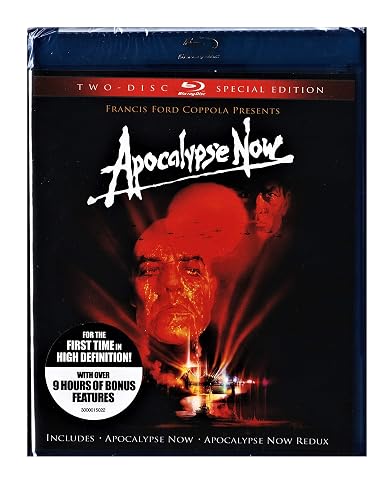
It is said that Francis Ford Coppola almost lost his mind during the filming as depicted in his wife's documentary Hearts of Darkness: A Filmmaker's Apocalypse. His leading man suffered a heart attack, his Kurtz arrived massively overweight (Brando as prima donna), his other actors were out of control. There was hubris (filming without a complete script), it was over budget, the weather didn't help etc. It's a mess as befits the title, but we all love it and it is firmly embedded in the pop culture of the world.
The scene of the helicopters sweeping into into action is iconic. Like Oddball's Sherman tanks in Kelly's Heroes, they head into war with Wagner's Valkyries playing. It is fascist in the extreme but very exciting cinema. War is glamourous and such scenes have their own perverse logic. In the film, Kurtz's book bears the inscription "Drop the bomb, exterminate them all". Ironically, despite being conceived as an anti-war film, Apocalypse Now is motivational fodder and a sort of war pornography for soldiers as evidenced in Anthony Swofford's Jarhead and its recent film treatment.
Still, I keep waiting for the definitive Vietnamese or Cambodian response to Apocalypse Now and its ilk, the Full Metal Jackets of the world. For it must surely come, in whatever medium. It can't sit well to be considered a mere backdrop, let alone a playground for Agent Orange and worse.
"The horror! The horror!" are Kurtz's famous last words in Conrad's work. When Marlow returns home however, he reports a white lie to Kurtz's fiancée, and perhaps to the reader, namely that
"The last word he pronounced - was your name."Africa has seen much that can lead to the heart of darkness. From Sierra Leone and Liberia to Rwanda, and perhaps the current slow burn in Sudan, there is much that is hallucinatory. True, such scenes aren't the complete picture but they are an integral aspect of our outlook and one that bears meditating on. Writers, musicians and all artists inform our received notions about the continent. They are griots urging us beyond journalistic copy. Whenever I finish reading Heart of Darkness or any of the works that have followed its path, my response is to return to questions that I ponder daily:
What is the cement of African society? And how can it be strengthened?See also in part 4: Chinua Achebe's voices inside Things Fall Apart.
Next in part 6: Frisson de Folksonomie
File under: Africa, literature, perception, image, Joseph Conrad, Heart Of Darkness, Chinua Achebe, culture, film, Imperialism, Evelyn Waugh, satire, Graham Greene, Abdulrazak Gurnah, Congo, Zanzibar, art, review, essay, Things Fall Apart, toli