Monday, April 06, 2015

To Make The Road Fearful

Prosecutor: Mr Witness, what did Reflection tell you about who shot Superman?

The transcripts of the Special Court for Sierra Leone, commonly called the Charles Taylor Trial, were a fascinating and disturbing glimpse into the conduct of a very dirty war. Nihilism was the trademark of most of the civil war's protagonists. The trial records feature not just garden-variety graft and basic criminality (the 'crime' part of war crimes), but mostly hallucinatory bloodlust and premeditated savagery (indiscriminate killings, routinized rape, summary amputations, forced drugs, cannibalism, etc.). War is hell; civil wars are hell; the descent of Liberia and Sierra Leone was an uncommon hell.

Still if you read the transcripts as I did in real time through the daily updates, you would have been confronted with a grand and unique body of literature, a mix of Kafka, Beckett, and plain Gothic horror presented in bureaucratic form. Truly, everything is in there.

For most observers, it was the child soldier narratives that were the most upsetting - overwhelming testaments to innocence lost and unconscionable cynicism, if not evil. For me, it was the observations of daily life during the wider Dante-esque free-for-all that resonated most. Additionally, there was a wealth of stories and conspiratorial detail to attract those afflicted with the journalistic impulse.

The setting was legal, with built-in confrontation and dramatic tension: Defense versus Prosecution moderated by The Court. There was the examination of Witnesses and Victims while Defendants looked on defiantly, denying everything, all of this shaped by the stylized conventions and terms of art of international law. The chaotic events described were mostly awful and occurred episodically over fourteen years, with protagonists from over a dozen countries, and affected millions of people; it was an international disaster through and through.

There was poverty and illiteracy on display - those already-poor countries became poorer still - and, indeed, could no longer even be called 'developing', during those wartime years. The language barriers were many, often obscuring comprehension during the trial - the creole and pidgin, and the many local languages of Liberia, Sierra Leone (Krio, Mende etc), Guinea and Cote d'Ivoire contending with the English, French and Dutch of The Hague to create a legal Babel of interpretation. The heavy accents essentially leap off the transcript pages. There were heaps of military jargon to further confuse things - for, although unconventionally fought, this was a bloody military war. And there would be smidgens of pop culture references, the warlords and their recruits (or rather prey) were young and enamored with football, reggae, hip hop and action movies (Stallone and Schwarzenegger would turn out to be big influences).

There were also fatally compromised actors in this drama. Many witnesses and defendants had considerable blood on their hands, a sizable number would often be lying through their teeth or, at best, furiously seeking to diminish their responsibility. And worse, many potentially valuable witnesses had come to bloody ends. Oftentimes the only remaining witnesses of crucial events would be lower level protagonists, say the drivers who drove the warlords to their nefarious meetings, or the radio operators who would arrange communications. Witnesses were often still traumatized about their experiences.

The concept itself of a Special Court and its legitimacy kept being brought up. Why was the trial focusing on events in Sierra Leone? What about all the atrocities in next door Liberia? Why confine prosecution to those "who bear the greatest responsibility" while allowing many murderers impunity? What about the truth and reconciliation committees that had been set up in those countries? What about the motley cast of foreigners involved, from Ukrainian and South African mercenaries, ex-CIA agents, through Al Qaeda types seeking blood diamonds from Lebanese and Belgian jewelers, Russian arms dealers, to meddling rogues and financiers like Blaise Campaoré and He of the Little Green Book, Colonel Gaddafi? There was enough culpability to go around. Despite all these difficulties, the lawyers had to tease out a grand narrative among the mountains of evidence, demonstrate a chain of custody, and establish clear findings of fact among the details. A challenging mess in short.

So. The Charles Taylor trial wasn't easy to digest but it had legal, journalistic and historical merit, not to mention an unexpected literary benefit. And it is this last aspect that transfixed me and kept me reading rather than grieving and despairing of humanity. It turns out that there's a certain poetry in these mundane transcripts, a kind of found art in the minutiae of these annals of cruelty. Where else would you find a more perfect sentence?

Prosecutor: Mr Witness, what did Reflection tell you about who shot Superman?

No fiction could equal this notion of Law and Order meeting The Last Philosophers in a comic book trial. Frankly I was hooked; I can't praise that sentence highly enough. Everything about it compels you to read or listen on. The text, the sub-text, the über-text, the text qua text! The formality of address is merely the beginning (Mr Witness). The testimony sought by the authority figure, The Prosecutor, is the second hand memories of The Witness about what someone named Reflection (Reflection!) confessed about the implied assault on (or death of) someone named Superman. Who is this person named Reflection? What was his relation to Superman? Why, to start with, does the prosecutor care about Superman? And, pray tell, did Superman die of the attack?

II. Conflict Readings
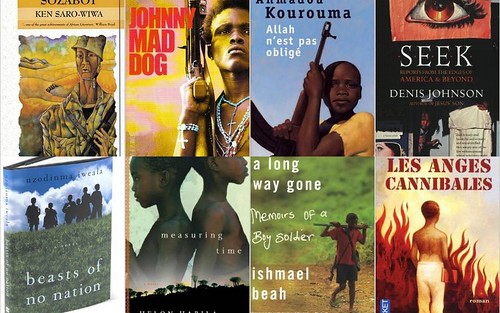

The child soldier narrative in African literature

Some of our best writers have tackled the war, warlord, and child soldier narratives in African literature. The pinnacle of the genre of course is Ken Saro Wiwa's Sozaboy which deals with the Biafra conflict. There are also great works that focus specifically on the Liberia and Sierra Leonean imbroglio. Ahmadou Kourouma's masterpiece Allah n'est pas obligé is the best of the contemporary novels, a stunning achievement full of coiled menace and casual cruelty. Denis Johnson's reporting in Seek is hallucinatory; in particular, the reporting on Prince Johnson's torture and execution of the erstwhile Master Sergent, and then President, Samuel Doe, and the piece on Charles Taylor's Small Boy Units are unmatched in their immediacy (that phrase, Small Boy Units, being another grotesque, yet inspired, coinage). He sought out extremes and was unmanned by what he found. Emmanuel Dongala's Johnny Chien Méchant is simply scary - there's a fine English translation, Johnny Mad Dog. Helon Habila's Measuring Time treats the theme in a measured manner (it is a mere subplot of his grand novel) while Iweala's Beasts of no nation revels in surface style and linguistic gymnastics. Jean-Claude Derey's Les Anges Cannibales is a beastly mix of journalism turned novel and Léonora Miano's Les aubes écarlates stands out in its depiction of the dark episodes. Dealing with the militias in Congo-Brazzaville, Alain Mabanckou opted for restraint in Les Petits-Fils Nègres de Vercingétorix. Ishmael Beah's memoir, A Long Way Gone, by necessity of the form, can't take as much novelistic license, hence it is a more sober, if still harrowing, affair.

The unbearable reality these works address speaks for itself; the attending book covers merely highlight the distressing story. Journalists are typically the first to write about such things - although, often, their writings, being in the service of 'news', aim for the dispassionate rather than the urgent. When the writers have turned to fiction, the worlds they created were uniformly haunting; when they have drawn on their experiences, the reader yearns to escape their suffocating worlds. And it is this unreal reality they confront that we read at length in these trial transcripts of the Special Court. In contrast, we dare not turn away.

III. Naming Conventions

Let's start with the names, a mixture of military directness, macabre grimness and sheer horror. One can only find death and desolation in Operation No Living Thing or Operation Spare No Soul. And consider the cynical precision of Operation Stop Elections which introduced, and institutionalized, the alarming spectacle of random amputations as shock and awe. But what of Operation No Monkey, or the obvious invitation to marauding looting embodied in Operation Pay Yourself?

And what about the names of the wicked? Consider a few of the huhudious nicknames and noms de guerre: Jungle, Black Jesus, Savage, Crazy, Red Goat, Rocky, Rambo (there were many Rambos in the conflict - the one that that first caught my attention was the fearsome RUF Rambo), Zigzag Marzah, General 50, General 245, Five Five, General Dry Pepper (not to be confused with Dried Pepper), Captain Blood, Leather Boot, Gullit (lots of football nicknames as it turns out), Dawn-Dawn, Waco-Waco (there's joy in repetition), Butterfly, KGB, Zino, Black Diamond, the notorious Adama Cut Hand, The Devil, The Killer, Scare the Baby, Monkey Brown and groups such as the "Black Gaddafa", the Black Guards and the West Side Boys. And yes of course the aforementioned Reflection and Superman. To think that General Butt Naked didn't even figure in the trial (his murdering ways were confined to Liberia).

The mere names of the characters and the setting would be enough to summon a play by way of Ionesco. They need not be doing anything out of the ordinary to garner attention (imagine Scare the Baby discussing with Butterfly where to take Superman and Red Goat for dinner) let alone when those now questioning them are constrained with legalese ("my learned colleague", "I submit to you", further and better particulars etc). Adding the very surreal subject matter of this raging civil war serves to surface all the incongruity of a heightened theater of the absurd. Naming alone can drive the narrative.

A poignant counterpoint to these names of awful men and women is to consider their victims. It is truly sobering to read the listings of victims painstakingly compiled by the commissions and courts.

A._ (Female) age 13 - 1991 in Pujehun - Assaulted and raped.
F._ (Male) - 1998 in Bombali - Forcibly conscripted.
F._ (Female) age 12 - 1999 in Western Area - Abducted and detained. Raped.
G._ (Female) - 1995 in Moyamba - Forced to labour and sexually enslaved. Assaulted.
F.A (Female) age 10 - 1995 in Kono - Sexually enslaved. Tortured.
F.A (Female) age 16 - Forced to labour. Assaulted, tortured and raped.
A.B (Female) age 57 - 1997 in Port Loko - Displaced, extorted and property looted. Forced to labour. Assaulted and raped.
Charles, Bockarie (Male) age 53 - Displaced. Limb amputated.
Charles, Eyaja (Male) - 1998 in Kaiyamba, Moyamba - Tortured. Killed.
[ snip... lengthy and distressing listings of victims ]
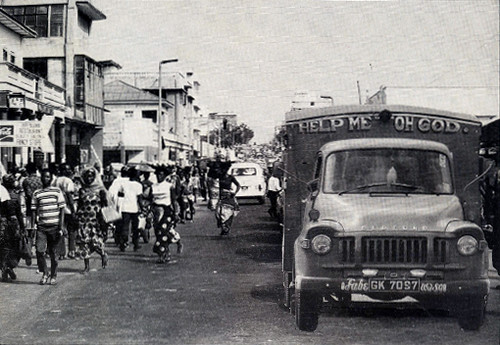
help me o lord talking drums july 1985

The undeniable villain is Mosquito, Sam Bockarie, a man who wrecked bloody havoc and inspired so much fear for so long. He is cited as "a Battlefield Commander of lethal prowess and a deviant of unknown quantity... [who] committed human rights abuses with total abandon". Even more than the RUF's leader Foday Sankoh, and the ostensible target of the trial, Charles Taylor, his specter haunted the proceedings. Like the mosquitoes he was named after, he was not afraid of blood and indeed sought it out and seemed to relish vicious warfare and unrestrained cruelty. Sidenote: Bockarie suffered a very convenient death once it became clear that his ultimate boss, Charles Taylor, would be facing legal troubles.

Prosecutor: Just pause, Mr Witness. First you talk - once you spoke about the Master, that Master came. Who did you refer to when you said Master?

Witness: Sam Bockarie. I had said it once or twice here in this Court that we used to call Sam Bockarie Master, so any time I use Master I will be referring to Sam Bockarie. Then Father, we used to call Charles Taylor the Father. So at times - I am still used to calling him that way, that's why.
A lot of effort is spent on identity issues, naming is a fluid thing and prosecutors always have to double check what names are being used and when.
Witness: Later on, some of my friends called me Uprising.
The names are what witnesses hold on to in order to make sense of things.
Witness: Well, yes, like I recall CO Big Darling, one who was called Big Darling. And there was another called CO Nyamator and there was another with a nickname called CO After the War. So those were the kind of names they had. There was also another called Rebel Baby, CO Rebel Baby.

The Liberians were often the first to resort to nicknames for whatever reason.

Witness: Well, CO Lion was a Liberian vanguard and they were the ones who came to help train us in Sierra Leone to fight the war.
Context is everything.
Prosecutor:So, Mr Witness, just so we're clear, who were you with at that time?

Witness: I was with RUF Rambo at that time to attack Hastings and Jui.

Prosecutor: What other commanders were with RUF Rambo?

Witness: Rambo Red Goat, Crazy and others

Suffice to say that this parade of absurd names often diverts attention from some of the more consequential actors (such as Eddie Kaneh, Mike Lamin, Issa Sesay or Ibrahim Bah) and colors our perception of the acts that took place. And yes, for the record, Reflection was a radio operator for Benjamin Yeaten, Charles Taylor's right hand man. And Dennis Mingo (alias Superman) was a bad man: 'one of the foremost perpetrators of abduction-related crimes against children, including forced recruitment and forced drugging'.

IV. To Make the Road Fearful

should there be chaos in our beloved country

The word "fearful" has a heavy burden in the history of the conflicts in Liberia and Sierra Leone. It was the adjective of choice for Charles Taylor and his acolytes for describing a crucial element of their wartime strategy. It is read entirely too often in the transcripts, a mournful thread running through the narratives that emerge. It is always uttered as an explicit invitation to murder and terrorism - with civilians as the frequent targets.

Taylor told one group of RUF soldiers, the "Black Gaddafa", that their mission was to "sabotage the movement of the enemy in Sierra Leone" by setting up ambushes and making areas 'fearful'. The witness said that Taylor and Sankoh ordered the troops to attack SLA and ULIMO forces, as well as capture civilians.

These injunctions would be taken to heart and the accounts of the subsequent misdeeds are often rendered in the most matter-of-fact terms.

Prosecutor: Was this attack only by the RUF or there were others involved?

Witness: the AFRC guys were involved

Prosecutor: Like who?

Witness: Gullit, Bazzy, Hon. Adams, Savage and other commanders

Prosecutor: Who were they all taking orders from?

Witness: Superman

Prosecutor: What happened during the attack?

Witness: We attacked Kono and we took over the town. We started looting and some of the commanders captured girls and made them their wives while some of us were burning houses

Prosecutor: Do you recall how many houses were burnt?

Witness: No I can't remember the figure

Prosecutor: Was there any particular reason you will select a house to burn?

Witness: Yes, one of the reasons was because there specific houses where Kamajors were based and some people pointed at house where people were supporting Kamajors

Prosecutor: Do you know if there were people inside the houses that were burnt?

Witness: Yes. When we set the houses on fire, we will hear the people inside screaming and when the house is burnt, we will see their skulls and bones.

And so with clinical precision, we get to the heart of the matter: blood and sin. Also note the hand of Superman.

Prosecutor: Did you take part in the Bumpeh attack?

Witness: Yes

Prosecutor: Were there opposing forces in Bumpeh when you got there?

Witness: No other forces were there so we attacked the civilians

Prosecutor: So what was done to the civilians there?

Witness: We asked them to leave the town. Some of them resisted, so we opened fire on them, we decapitated some and put their heads on the checkpoint.

Prosecutor: Why would you put the heads on the checkpoint?

Witness: To make the road fearful.

Prosecutor: Why would the RUF attack civilians in Motema and Bumpeh?

Witness: Because ECOMOG were advancing and we wanted to make the place fearful.

Prosecutor: Did RUF have any philosophy about treatment of civilians?

Witness: Well when civilians were based in the communities, they will take information in and out and so if we wanted to base there, we will get the civilians out of the town.

Prosecutor: Did you have any sense in the RUF about civilians?

Witness: We used to say civilians did not have blood

Prosecutor: What did you mean?

Witness: They were not as important as we were

Prosecutor: Did you see any difference in the way the AFRC treated civilians?

Witness: I did not see any great difference except the time we divided along the Freetown highway. We treated civilians in the same way

Prosecutor: Who led the attack on Tombodu?

Witness: Savage

Prosecutor: Do you know what happened during that attack?

Witness: Yes. Savage went there and did mass killings. They had a big valley there where he placed all the civilians. Superman and I went to Tombodu. Savage went and showed us the valley and Superman did not take any action.

Prosecutor: Can you describe the valley?

Witness: It was an old diamond pit.

Prosecutor: When your friends came back with girls from Motema, can you say the ages of the girls they came with?

Witness: Some were 14, some 20 etc. Some of them were in Koidu town with us and some at the Combat Camp. We even had one Michaela who was very small, about 14, who was with one of my friends.

Sexual abuse was pervasive:

Prosecutor: I need to go back to the attack on Makeni, what if anything happened to civilians there?

Witness: Most of the civilians, everybody got married. Whoever saw a woman will take her, some people looted.

Prosecutor: What do you mean by everyone got married?

Witness: We captured girls and made them our wives, we captured SBUs (Small Boy Units), gave them guns and got some civilians to work at our houses.

Prosecutor: What do you mean when you say they made them their wives?

Witness: They took them home, they slept with them

Prosecutor: What do you mean they sleep with them?

Prosecutor: We are all matured people here, so I can't go beyond that, but when you say you have sex with someone

Prosecutor: Who had sex with who?

Witness: The RUF had sex with the girls

Prosecutor: Was anything taken from Makeni?

Witness: At the first instance yes. The first two weeks, people looted and later Issa said he was Temne and those were his people, so he started killing people who looted.

Prosecutor: I think this will be a convenient point to stop.

I second the prosecutor's call to stop, if only briefly, because in reading we can only sink into despair when you consider some of the more infamous cases such as Adama Cut Hand, a girl "in charge of the small boys group that was known as Cut Hand Group" who wore a necklace of human hands and carried decapitated heads of village chiefs. A vision that wouldn't be out of place in Joseph Conrad's opus.

V. Not A Civilian Thing

Let's put aside our sticks knives guns and arrows... no truth to reports on radio gold that there is tension

Charles Taylor and Foday Sankoh had very clear ideas about what making places fearful entailed. It is important to remember that much of this infrastructure of terror was planned, and that many of the participants were mere instruments of their will.

Witness: We had a message that was from Foday Sankoh through CO Mohamed for all the stations which were at the front line to go and run Operation Stop Elections, to go into those towns where the elections were to be conducted and to cause panic there so that the people will not conduct the elections.

Prosecutor: What do you mean by to go cause panic there?

Witness: To go and shoot in the places so the people will be afraid; they will run away and the elections will not be actualized.

Prosecutor: Do you know where Sankoh was when he issued this instruction?

Witness: he was in Ivory Coast.

The testimony from compromised characters was always revealing in how they sought to downplay their own roles amidst the mayhem that surrounded them. The case of a close collaborator like Moses Blah, who had been there at the start and would become Charles Taylor's Vice President, is an interesting case in point. From his testimony, it would appear that matters of blood never reached him despite his proximity: he was merely political and had clean hands. Sadly prosecutors didn't question him about his motivations, these lawyers kept to their brief to prove the their limited case against his boss and didn't explore the historical or novelistic context. One has to read between the lines for psychological insight. On the other hand, Blah was prepared to spill the beans about others, or rather talk about the bread and butter of wartime atrocities:

[Moses] Blah recounted a few occasions when punishments were carried out against soldiers, but said only Taylor had the authority to order punishments. Blah was not allowed to investigate members of Taylor's special forces. Blah testified about complaints that the commander of the Executive Mansion Guard abused civilians at checkpoints. Blah further testified that he had seen the head of the Marine Unit eating roasted human hands. In addition, Blah said he heard of an incident where the head of the Marine Unit ate the intestines of a farmer cooked together with the man's cassava harvest. Blah said he was reluctant to complain to Taylor about these incidents because they would be considered an attack on the Executive Mansion Guard unit. Blah recalled Yeaten's involvement in atrocities, and stated that Yeaten never faced punishment.

According to Blah, in 1991 Sankoh complained to him that the NPFL soldiers were committing atrocities in Sierra Leone, including raping women, killing civilians, and looting. According to Blah, Sankoh discussed this problem with Taylor. After this meeting, Taylor complained to Blah about Sankoh and said:

"When you talk about a guerrilla war there's destruction and this is the type of thing - and this type of thing must happen if you are fighting a war. You are not eating bread and butter, you are fighting."

- Taylor's Former Vice-president Describes Training, Arms Deliveries and Atrocities, Claims Cannibalism was Required to Join Taylor's Presidential Guard

The bread and butter, as it were, of this war was making the road fearful, causing panic, and destabilizing people and places.

Prosecutor: What was this Operation No Monkey?

Witness: I was there when Benjamin Yeaten instructed Zigzag Marzah and other fighters to go to Belle Forest and destabilize all the civilians that were in the forest and anybody who refused should be killed and no monkey should even stand in front of them. That was why they named the operation Operation No Monkey. No monkey can stay in that forest. Everybody should move from that forest to come to the safer area, because the LURD fighters were trying to get into Belle Forest to come to Bomi Hills and attack Monrovia and indeed they used the route. Zigzag Marzah went there and did the operation in Belle Forest.

Others would express the same sentiment, although less quotably than Charles Taylor.

"I want the whole world and the Sierra Leone people to know that there is no war without atrocities" - the RUF's Francis Momoh Musah in a statement to the TRC on 2 May 2003

Or consider Gullit and Five Five during a meeting where the infamous amputation strategy was formulated, cynically, and out of frustration.

"When we started cutting hands, hardly a day BBC would not talk about us"

"For any war there must be an atrocity for the outside world to know there is something wrong in the place"

Some would say that these were post-hoc rationalizations for unrestrained savagery, and this is explored at length in well researched appendices in the truth commissions and in the trial documents: Amputations in the Sierra Leone Conflict.

There was little difference between Operation No Monkey and Operation Spare no Soul, these were all merciless affairs.

Witness: Well, I can recall at that time when they said Abacha had died, Sani Abacha. So it was during that time - I can recall that operation because at that time people were happy, the RUF soldiers were, the commanders, everybody was happy at that time.

Prosecutor: And do you recall exactly what happened during that period?

Witness: Well, it was that time - because that time when Abacha died was the time that that mission was arranged, because the Spare No Soul mission, Sam Bockarie said because Abacha had died and he was one of the big men for ECOMOG and that he was dead the soldiers would be weakened, everybody would be discouraged, so if they undertook any operation at that time they would be able to chase the ECOMOG out and they would be able to regain their positions because they were sad at that time and that would weaken them. That was why the mission was called Operation Spare No Soul and they were not to capture soldiers - they were not to capture ECOMOG soldiers and take them to him in Buedu. Spare No Soul meant that anybody who saw any of them, they should kill those soldiers. Any soldier they saw was to be killed. They were not to take any soldier to him in Buedu.

Prosecutor: And do you recall what happened during the course of this operation?

Witness: Yes, Komba Gbundema reported that they killed many civilians and ECOMOG soldiers too during this operation.

Prosecutor: When you say Alice Pyne told you this, how did she tell you?

Witness: Well, she came on and said they went on a mission and said that was how things happened, that they killed many civilians and they said - and she said anybody who saw them, that person was a dead person. And anybody they saw too, that person was a dead person.

If - Komba Gbundema's group, that is the RUF fighters, if they spared any - if they wanted to for example spare the civilian, that civilian's hand would be amputated. That would be the only way they would spare that civilian.

The horrible acts had a gruesome soundtrack

Witness: What I listened to I heard them saying, "People were daring. Man den get mind o way den wan kot pipul den an, den day say, 'Pull yu han pan di war. Pull yu foot pan di war'."

Prosecutor: When you say, "Pull yu han pan di war. Pull yu foot pan di war", do you know what that translates to in English?

Witness: Well I don't know if you want me to speak English directly, but what I understood by that as I said yesterday because the people whose hands were amputated were civilians, it was the RUF fighters who amputated civilians' hands and their feet and whenever they wanted to do this action that was what they told the civilians, the expression I just said in Krio, which meant that they were not to be involved in the war. They were not to have anything to do with the war. It was not the business of a civilian...

Judge Doherty: Yes, please. Mr Interpreter, please interpret those words which the witness has used.

The Interpreter "Pull yu han pan di war", your Honours, is translated "Take your hand off the war". "Pull yu foot pan di war" is translated "Take your foot off the war".

Such behavior is the signal and iconic legacy of Charles Taylor and Foday Sankoh.

Witness: Well, from what I understood, the Kamajors, like they called them, they were the Civil Defense Forces. I did not know that they had gone to any particular training base to be trained as combatants, or as soldiers. So we took them to be civilians who had guns, they had cutlasses, fighting against the RUF. Because they were calling them civilians, they were telling them that the civilians should take their hands off the war and to take their foot off the war, it was not a civilian thing.

Prosecutor: You said the RUF was using this expression. Who were they using it to?

Witness: Any of those civilians whom they captured when they were amputating his hand or foot.

But let us catch up with Superman a few months after the so-called Fitti-Fatta mission failed

Prosecutor: And exactly what was Superman instructed to do?

Witness: Well, Sam Bockarie told Superman that he should set one or two examples on civilians so that will instill fear in the other civilians and they will not be leaking information to the ECOMOG soldiers.

Prosecutor: How was Superman supposed to set examples - an example on civilians?

Witness: Well, he was to kill either one or two or to amputate some of their hands and to tell them to take their hands off the war...

Prosecutor: Do you know whether these instructions were carried out by Superman?

Witness: Yes, after two or three days I heard it over the SLBS radio that around the Kono axis rebels were cutting off civilians' hands and they were killing civilians.

Prosecutor: Is that all that you learnt about what happened?

Witness: After that, I enquired in the station, I went there, and it was not long after that that Sam Bockarie went there and he called Komba Gbundema to be sure that was what had occurred in the place. And Sam Bockarie told Komba Gbundema that that was enough, he said because as long as the whole world had heard about the killings and the amputations let that be enough, let it stop there.

Sometimes "fearful" is rendered as "fearsome", but the result is always the same:

Witness: ...before Issa left he said we were guerrillas and anywhere a guerrilla was you should make the area fearsome. In the RUF when we talk about making the area fearsome it is a word that carries different meanings. It means we should burn down houses, destroy other properties, killing and construct road blockades and destroy bridges. That would help in making the area fearsome. That was the instruction he gave.

In many respects the evidence against Charles Taylor was overwhelming, but his attorneys would argue that it was always second hand hearsay - after all people like Mosquito were dead and could not be cross-examined. Still, the extent of his ambition and hunger for power are brought to light in all the testimony.

Prosecutor: Did Sam Bockarie indicate to you in his discussions with Mr Taylor if there was any discussion about how the attack should be carried out in order to free Sankoh?

Witness: Yes, he said they discussed it. After he had shown those places to him they discussed that we should run that mission to ensure that we free Foday Sankoh and others and on the operation we should ensure that the ammunition is not wasted. We should make the operation fearful than all the other operations that we had undertaken because we want to make sure that we take Freetown and hold on to power.

VI. No Longer Human Beings

in peace and harmony protect our nation

The pathology was widespread and it was all a few could do to simply bear witness:

Prosecutor: Who was Zigzag Marzah?

Witness: He too was a fighter in Liberia under Charles Taylor's government.

Prosecutor: How did you know that he was a fighter in Liberia under Charles Taylor's government?

Witness: Well I used to hear his name, but I never knew him. That was the first day I knew him.

Prosecutor: When you say you used to hear his name, what did you hear about his name?

Witness: Well, I used to hear people saying that he ate human beings, that he did not - he was not hesitant, he would kill human beings and he would eat human beings, and from that time I kept that name at the back of my mind. So when I heard that he was to come and indeed I saw him, I asked - I said, "Where is the man?", and he was pointed out to me and I looked at him, I stared at him, to know what sort of human being he was to be doing things like those. So, that was how I knew him.

Betrayals were commonplace and it turns out that Superman, a man who made his wartime reputation for abducting youngsters and training them to be Small Boy Units was killed by those he thought were friends.

Prosecutor: Mr Witness, what did Reflection tell you about who shot Superman?

The answer is that joint criminal enterprises are often unstable affairs.

In 2002 when the war intensified in Liberia, 2002 to 2003, when I used to go and fight and come back and sit down with him, he used to tell me, "Son, you are really trying for us, but we regret the death of your boss. People misled us to kill Superman." He told me that people told them that they used to see Superman at the American embassy. That was why they killed him, but he regretted. I had nothing to say. I just sat down and smiled. Yes, Benjamin Yeaten himself told me that he regretted why he killed Superman
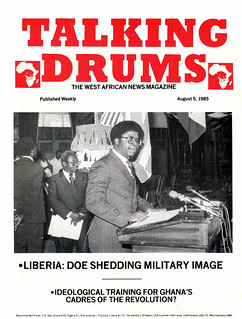
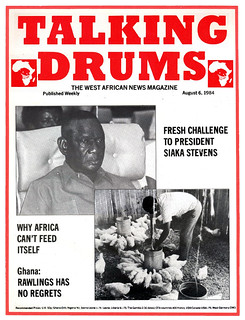
talking drums 1985-08-05 Liberia Doe shedding military imagetalking drums 1984-08-06 Challenge to Siaka Stevens - Rawlings has no regrets

One of the participants in Superman's death was the aforementioned Zigzag Marzah, head of Charles Taylor's accurately named Death Squad, and his cross-examination is hair-raising. That he is still walking around as a free man is one of the great injustices of the world. The headlines and summaries (e.g. Zigzag Marzah Says Taylor Ordered Cannibalism; Defense Works to Discredit his Testimony) simply do not do justice to the harrowing depths of the actual text. It should be read in full:

Defense: So you're talking about when the NPFL entered Liberia. Are you saying that at that stage Charles Taylor ordered you to eat Krahns?

Witness (Zigzag Marzah): I told you yes, yes. Any activity against which you did not take action was appreciated by him. What Doe did by taking our own people, not just Doe, Charles Julu, he himself went as far as eating some of the Nimbalian children from school campuses. When he kills them they would butcher them in the street. Like AK Pa [phon], he did that there so many times.

Defense: Now according to you at the time that the NPFL entered Liberia you were under the command of Prince Johnson who didn't allow this kind of thing. So help me please, who was it who told you to eat Krahns?

Zigzag Marzah: Thank you very much. Prince Johnson did not go far enough in the war. We were in Tiaplay when Charles Taylor wanted - his Specials Forces wanted to kill him and he ran away from us. But when he came to encourage us mostly Nimbalians to join his forces, that whatever Doe did to your people you should revenge and carry out the same act and what they did to us was what we did to them. We hadn't any sea port or container to put the children there or this or that rather than to go and fight against them and destroy them.

Judge Doherty: Pause, Mr Witness. The question is who told you to eat Krahns? Please answer that question.

Zigzag Marzah: I said yes sir, yes sir. I said Charles Taylor.

Defense: Very well. And did Charles Taylor order you to eat people in Sierra Leone as well?

Zigzag Marzah: Yes, sir, to set example for the forces to be afraid.

Defense: So help me, where in Sierra Leone did you eat people?

Zigzag Marzah: It happened when we were disarming the ECOMOG by his directive. He said that those Nigerians were disturbing the south eastern region, when we captured them we should eat them. Even the UN, when we were disarming them he said he didn't want any of those white people to pass through Freetown to go, so when we get them we can use them as pork.

Defense: Port or pork?

Zigzag Marzah: Pork. Pork to eat. Pig. Food.

Defense: So Charles Taylor told you you could eat Nigerians and white people as pork?

Zigzag Marzah: The Nigerian - the Nigerians and the UN. He said the remaining Africans which will pass with them through Buedu, he will turn them over to the international communities, but the others, like the Nigerians and some other people, we should kill them and do anything we want to do with them and that was what we were supposed to do with them is what I am telling you.

Defense: So, Mr Marzah, Charles Taylor ordered you to eat Nigerians --

Zigzag Marzah: Yes.

Defense: -- and white UN officials. How did he give you that order? Was it in person or was it over the radio or what?

Zigzag Marzah: It was not over radio. When Mosquito went for the first time when ECOMOG were deployed and he gave the instruction for us to go and disarm the ECOMOG he said he hasn't got any room. Even when there is no food guerrillas live by their fellow human beings, so we should live by them when had there was no food. So that was how we were living by them, by eating them. There he is sitting down.

Defense: How many UN soldiers or ECOMOG soldiers did you eat?

Zigzag Marzah: Thank you very much. The ECOMOG soldiers, the Nigerian troops, we eat a few, but not many. But many were executed, about 68. Those who were captured were executed. And the UN troops, the whites, after we had taken them to Vahun to Benjamin Yeaten's base Benjamin Yeaten himself executed about --

Defense: No, no, let's forget about executions --

Zigzag Marzah: Wait. Wait now. You can't eat them alive. You can't eat human beings alive. You have to execute them before you eat them, right.

Defense: Right. And did you cook them as well?

Zigzag Marzah: Yes, I participated. You think if my senior commander does something I will deviate from it?

Defense: So help me, please, just how do you prepare a human being for a pot?

Zigzag Marzah: I am sorry there's no way to demonstrate here because we are sitting.

Defense: Just describe it to us?

Zigzag Marzah: Okay. The way we do it, the way you're standing, sometimes we lay you down, slit your throat and butcher you and take out your skin, your flesh, throw your head away, your intestines, your flesh, we take it and put it in a pot and cook it and eat it. The way you're standing, you cannot stay like that and we eat you. We would kill you first and take those parts that are not good for us and this your palm, your two palms, we would put them together and clean inside your intestine and wrap it around, because it's not correct. It's a hard bone. Charles Taylor knows that. That's how we eat them.

Defense: And did you have a preference for white people, Nigerians or Krahns, which ones taste the best?

Zigzag Marzah: Yes, I have likeness for them, but there was no alternative to do it my own way. There was no was no alternative to do it your own way. As long as it was Charles Taylor who gave instruction and you did anything your own way you would be surely executed. If I'm lying, the remaining UN troops, the Africans that passed through --

Judge Doherty: Mr Witness, pause. You have deviated from the answer.

Defense: Now I mean that wasn't the only instant where you ate human flesh. You also ate Superman's heart, didn't you?

Zigzag Marzah: Yes, by the directive and a ceremony in Ben's yard by the time we turned over his hand to Charles Taylor.

Defense: And did Charles Taylor tell you as well to eat Superman's heart?

Zigzag Marzah: Yes, yes.

Defense: Where were you when he told you to do that?

Zigzag Marzah: Ask he himself. I can --

Judge Doherty: Mr Witness, I've told you before, no facetious replies.

Defense: Where were you when Charles Taylor told you to eat Superman's heart?

Zigzag Marzah: When after he had passed the instruction, because in his security meeting he said whatever instruction comes from Ben should be executed, whatever instruction came from Ben should be executed. Whoever does not go by Ben's instruction would be dealt with. So when we killed the men - the man and he said we should take out the heart and Charles Taylor said we should eat the heart and take the hand to him. So in my presence Ben and I entered at the back of his yard. He went inside in Charles Taylor's house and turned Superman's hand over to him and from there he gave us $200 each, went into his car and bought - he went and bought the ingredients to cook the man's heart with. That's how I believed that that was his instruction.

Defense: So it wasn't Charles Taylor who actually told you, it was Benjamin Yeaten?

Zigzag Marzah: It was Charles Taylor. It was Charles Taylor. It was Charles Taylor. Listen to my explanation.

Defense: So help me one final time because we're running out of time. Where were you when Charles Taylor gave you the instruction to eat Superman's heart?

Zigzag Marzah: At that time we had already executed Superman. We were in Monrovia with the man's heart and the arm.

Judge Doherty: Mr Witness, listen to the question. The question is about a place. Where were you? Where?

Zigzag Marzah: Okay, we were in Monrovia. In Monrovia. In Monrovia.

Defense: Where in Monrovia was it that Charles Taylor stood in front of you and said, "Zigzag, I want you not only to cut off his hand but to also eat his heart". Where were you when Taylor said that to you?

Prosecutor: Objection, your Honour. As stated the question assumes facts that the witness has not testified to.

Judge Doherty: You're being overly precise, Mr Griffiths. You're assuming that the person was in front of him, et cetera.

Defense: Was there ever a time when you stood in front of Charles Taylor physically like now and he said to you, "Zigzag, I want you to go out and eat a human being" or a part of a human being?

Zigzag Marzah: Apart from Superman?

Defense: Anyone. Anybody?

Zigzag Marzah: Okay, thank you.

Defense: Whether he be white --

Zigzag Marzah: Thank you, I understand. It happened twice when Gbarnga fell. I stood physically before Charles Taylor at the time Robin White was interviewing him. They were standing beside a jeep and he was telling the man that he was in his yard. That is the time he telephoned the Death Squad for me to carry out that execution. Anywhere there are human beings, you should eat them. They are no longer human beings. I was not in position to eat them raw, rather than to cook them with pepper and salt and fix some barbecue with them. It was from Gbarnga.

Defense: Would that be a convenient point, your Honour?

Judge Doherty: Indeed, Mr Griffiths. We will take the normal mid-morning adjournment.

The above remarkable exchange is the purest theater that real life can offer. There is drama, humour, horror, absurdity and tragedy at once. If we started out wondering who shot Superman, we are now beyond the gruesome mechanics of the deed, and deep into the aftermath, discussing not just Superman's death but also his dismemberment and consumption. Consider the defense attorney's barely disguised incredulity at the allegations of cannibalism and his dogged persistence in trying to discredit the witness and prove that his client had not given direct orders as alleged. He presses the point repeatedly: "Where were you when Charles Taylor told you to eat Superman's heart?" Consider the gusto and argumentative posture of the witness, a remorseless serial killer who also happens to be very charismatic - he gives great copy is what journalists would say, and polite to a fault (he prefaces almost all his answers with thank you very much). Zigzag Marzah is a courteous zombie by definition, and one who performs his master's demands without question. Add the Judge's interjections, and the Prosecution's objections, and let's not forget the witness diving eagerly into the discussion about the mechanics of dressing and eating humans, the willingness to demonstrate and regale the audience with recipes of pork, salt, pepper, and barbeque techniques. It is a quite remarkable performance.

Zigzag Marzah would carry on in his testimony to insist that he was just following the laws of his "poro society" and engaging in killing and cannibalism with its leader Charles Taylor - recounting several other instances when they had shared meals of human hearts or 'livers' as they would call them. Delivering Superman's hand in person to Charles Taylor was not a sufficiently final outcome, his heart also needed to be consumed. Thus a very perverse tradition of secret societies came to be wartime normalcy.

Every emotion is heightened in the transcript leading to the realization by all at the end of the exchange that everyone has been tainted by what they have heard. If the witness's victims were indeed "no longer human beings" (Charles Taylor's explicit justification for the indignities inflicted on them at, and after, death), then how are we we to classify him, the perpetrator? What did the aptly named Reflection think about witnessing these gruesome deeds? And what about everyone in that courtroom debating the issue? And what about us, the later readers of these transcripts? Well, we were all victims.

VII. The Bitterness of War
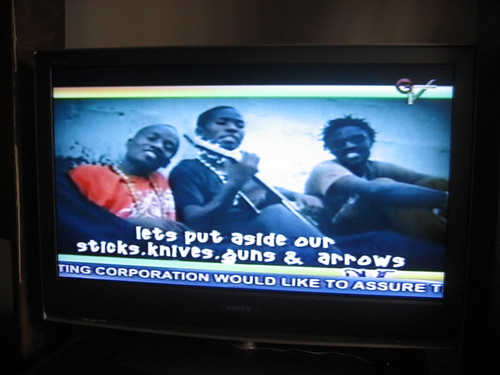

let's put aside our sticks, knives, guns and arrows

I've previously discussed the dilemmas faced by my mother and her colleagues working at the BBC's African service in how they dealt with the various warlords in the Liberian and Sierra Leonean civil wars. Were they giving these colorful and ever-quotable miscreants too much oxygen and exposure for their nefarious deeds? Were their stories "news" or was the simple act of acknowledging them making "news"? For the warlords would suspend hostilities without fail when 1700 GMT came around and the first edition of the Focus on Africa bulletin would start. They would get on their satellite phones and call the studio to see if they could get on air to discuss their dirty war. There was considerable discomfort and even guilt in the halls of Bush House.

Witness: Well, we heard that Charles Taylor and his rebels were fighting in Liberia. Then at one time we heard over the radio that he was saying that they were using Sierra Leone as an ECOMOG base to launch attacks in Liberia, so Sierra Leone will face the bitterness of war one day.

Prosecutor: Now, again, Mr Witness, when you heard this BBC programme who did you know was Charles Taylor?

Witness: Well, we heard that he was the rebel leader for the NPFL who entered into Liberia.

Witness: We heard that they were fighting in Liberia. We also heard that Taylor said they were using Sierra Leone as an ECOMOG base and so Sierra Leone will taste the bitterness of war.

Prosecutor: And when you heard this programme on the radio how did you know that it was Charles Taylor talking?

Witness: Well, he himself, when he was being interviewed, when Robin White was interviewing him, we heard his name.

Prosecutor: And Robin White, who was Robin White?

Witness: Well, Robin White was a BBC reporter that we knew about.

There was more than enough prima facie evidence of misdeeds to convict Charles Taylor, yet it was the blood diamond angle pursued by prosecutors that was the highest profile strand to the case - the glamour of Naomi Campbell proved irresistible. There is lots in the testimony about the mechanics of abductions and forced labor in mines with considerable details of the mining operations, the two pile system and the casual cruelty towards the slave labour workforce. There is a long chain of evidence leading ultimately to the trading of mayonnaise jars of diamonds in exchange for arms and ammunition.

The destructive use of child soldiers loaded with drugs and forced under compulsion of death to do awful deeds is also highlighted at length. We are in the presence of malevolence.

Defense: And how old was this child?

Witness: One year, some months. Close to two years.

Defense: You were at Superman Ground with a child of a year and a few months old and you gave your child to Sebatu, yes?

Witness: Yes

Defense: And in one of your interviews with the Office of the Prosecutor you told them that that child was essentially killed in what you said was a sacrifice ritual by Sam Bockarie, yes?

Witness: Yes

Defense: Was the child killed in 1998?

Witness: 1999

Defense: Do you know what month your child was killed in 1999?

Witness: In March...

Defense: And from the time when your child was killed by Sam Bockarie up until disarmament you have told us that you facilitated radio communication at certain times between Buedu and Superman, yes?

Witness: Yes

Defense: You were conveying messages from the same Sam Bockarie, who killed your child, to Superman, yes?

Witness: Yes

Defense: Did you ask how it came to be that he killed your child?

Witness: I did not ask, but I knew. And the person who was sent to bring the child said so. Issa Sesay too said so, that that was happened to my child. And when I saw my sister she also explained to me that that was what had transpired.

Defense: What exactly did Sam Bockarie do to your child? What do you mean by "sacrifice ritual"?

Witness: I don't want to explain further than that.

Judge: Pause, Mr Anyah. Madam Witness, you have been asked a question and you said you did not want to explain further. Why do you not want to explain further? Madam Witness, would you like a break or would you like somebody from WVS to assist you?

Witness: starts crying. Witness, however, says she is fine and will continue.

Defense: Madam Witness, you told the Prosecution not long ago this month, the month of June 2008, that Sam Bockarie killed your child in a sacrifice ritual. What does sacrifice ritual mean, Madam Witness?

Witness: He sacrificed him for power. They did not kill him. They buried him alive. From the person who did that are the person whom they sent, he told me...

There is no time to pause on the distressing stories during the cross examination, the defense simply presses on, and the topic turns from sacrifice ritual to herbalists and juju.

Defense: You spoke about some herbalists, seven of them you said, Liberians, that were sent to Sam Bockarie, yes?

Witness: Yes.

Defense: Were they just seven, or were they more than seven?

Witness: There were more than seven, but those who were heading the herbalists, those who were doing the job, were seven...

Defense: And at some point Sam Bockarie sent those herbalists to join you and Superman, is that correct?

Witness: Yes, we went and collected them.

Defense: And what was the purpose of having these herbalists?

Witness: I think I have said that before. They came to mark our bodies, like the other soldiers who were in the RUF, as a protective measure for - so that when they attack, bullets will not pierce them.

Defense: And indeed, this morning you added that the herbalists were sent by Charles Taylor, correct?

Witness: Yes.

Defense: And if what this woman says is true, then it means that the President of Liberia was sending the RUF herbalists to protect them with I think you said juju, yes?

Witness: Yes.

Defense: While fighting war, yes?

Witness: That was what he told me.

Defense: And juju is what?

Judge Sebutinde: Mr Interpreter, who is the "he"?

The Interpreter: Your Honours, it is not actually clear in the witness's answer. In Krio we do not have any distinction between a he and a she. She just said, "That was what he told me."

Judge Sebutinde: Was she talking about a herbalist, or a Gbandi woman?

The Interpreter: Well, I do not know in her answer. That is the train that is continuing.

Judge Doherty: Please clarify the point.

Defense: The person who told you Charles Taylor sent this herbalist was the Gbandi woman, correct?

Witness: Yes.

Defense: And to put my question again, if what she says is true then it would mean that the President of Liberia at the time, Charles Taylor, in 1998 was sending over herbalists to use juju, the phrase that you used, to protect RUF fighters from bullets, correct?

Witness: I said that was what the herbalist woman told me.

The discussion, which sets out on the issue of the belief system that would send herbalists to protect members of a militia from bullets, takes an unexpected turn into matters of interpretation and syntax and dives into languages that do not differentiate gender. Dialog worthy of Beckett (or perhaps Stoppard if you are that way inclined).

There are many close calls with death, especially harrowing whenever Chucky Taylor, Charles Taylor's sociopathic son was involved. Thankfully a few lived to tell the tale.

Defense: During the course of the day, one of your captures while feeding you manages to drop the metal spoon in the pit, you and your colleague manage to break the metal spoon in half and cut your bonds?

Witness: Yes.

Defense: So this is the third time you are escaping?

Witness: No the second time

Defense: How did you manage to escape so many times?

Witness: Human instinct

Defense: Why weren't you executed?

Witness: It was a blessing I had.

Note here how the witness deflects the continued skepticism of the defense attorney who tries to raise issues of credibility. This undercurrent of dramatic tension raises the stakes throughout the proceedings.

Witness: Except when you are telling me now but Sesay Musa told me that his brother was the ambassador and he was a late man.

Judge: What do you mean by he was a late man?

Witness: He said he was dead

Sometimes the testimony devolves into absurd minutiae, consider this argument about the price of pizza in Monrovia (the defense is trying to challenge a witness's credibility, implying he was paid to lie).

Defense: You could eat a lot in Ganta for 25 US dollars, couldn't you?

Witness: One piece of pizza is more than $25 in Liberia.

Defense: US dollars for one piece of pizza?

Witness: US dollars, yes.

Defense: Hang on.

Witness: Yes, yes, pizza, yes.

Defense: Hang on. Wait for me to finish the question before you start interrupting and laughing. Are you seriously telling this Court that a piece of pizza in Ganta costs more than $25 US?

Witness: In Monrovia, not in Ganta. Monrovia. Monrovia. Yes, in Monrovia. And I can locate the areas to you for you to make a background investigation.

Defense: So it would cost more than the rent of one of your motorbikes for a whole day just to eat a piece of pizza?

Witness: When you bring me to Monrovia I would have to eat, eat good food, yes, but from the money I get from my motorbikes I cannot take that to go and buy pizza, but in Ganta I eat what I eat, but at any time I come to Monrovia when - I eat what I want to eat because like I'm here, they brought me here, when you bring me here you have to feed me. What I want to eat is what I ask for, it's what I eat.

Sometimes there are moments of levity although they are quickly challenged.

Defense: If you look at that document in the middle of the page, paragraph 2 says: "Subsistence allowance. Witness: was brought under the protection of the Court on 20 August 2006. To date he has been paid a total of 13,122,800 leones."

What is amusing you about that?

Witness: Nothing made me to laugh about that. It is just my usual habit. I am not laughing. I am chuckling.

If the defense would challenge many of the witnesses, in all too many cases it would be inhuman to question the overwhelming evidence that was being presented against their clients and so the summaries would end: "the Defense had no questions for this witness".

Ultimately, the rebel commander ordered a boy no more than 13 years-old to cut off the witness's arms. After his arms were amputated, the witness testified that "Rambo" arrived at the village, and he was angry with the rebels for killing some civilians and amputating the limbs of others. The witness reported that Rambo gave him money and told him to endure the pain, because that was what God had ordained. The witness testified that before the amputation he was a petty trader, but that since 1999, when this incident happened, his only source of income has been begging.

The Defense had no questions for this witness.

VIII. Reflection


reflection

The machinery of the law works slowly and despite my stance of permanent outrage, I've often thought that this slowness, this bureaucracy, was a good thing. It is an antidote to rushed judgement and an aid to careful reflection on tort and damage - collateral and intended. I expect that lawyers are still interrogating Slobodan Miloševic in whatever part of hell he is - his five years facing trial at the International Criminal Tribunal for the former Yugoslavia were clearly not enough. Similarly, Charles Taylor's comfortable jail library ought to consist solely of these trial transcripts.

And yet the trial setting can be a little unsatisfactory for the historian or cultural observer whose intent is to plumb the depths of a tragedy for psychological insight. Memory is difficult - the recollection of often traumatic events can lack coherence. Defense lawyers can seize on the smallest inconsistencies to raise doubt. Prosecutors have to show certain facts as they lay out their case and oftentimes, they stick to a limited brief. The distinction between what can be proved and what actually happened is a sharp one. We have to balance our desire for a full accounting against the right of defendants to have a fair and public hearing and what can be proven in a court of law.

I've focused mainly on one thread in reading these transcripts, the cautionary aspect (with occasional diversions into the absurd journeys that language can take one on). And it is this notion of caution that keeps me at night whenever I've seen the signposts of political violence raised in my own country, Ghana. It leads me to be a scold of sorts and to engage in jeremiads. It is worth emphasizing that it didn't take much for things to fall apart in Liberia and Sierra Leone. It took just a few well-connected rogues with a willingness to do their worst. Charles Taylor, Foday Sankoh and company numbered in the dozens when they started their campaign of confidence artistry, terror and conquest. Their sheer bloody-minded will, a will that went beyond any animating ideology, found fertile ground in the intrinsic cracks in Liberian and Sierra Leonean society and caused a thoroughgoing disaster whose after-effects still reverberate decades later (think of the response to the current Ebola outbreaks).

There are many more lenses through which to view the violent conflicts outlined here. An equally fruitful reading would focus on the rogues gallery jostling for the loot and influence - an international cast of Liberian and Sierra Leonean warlords, Guinean adventurers, Gambian, Ivorians and Burkinabe meddlers, Senegalese, Israelis, Libyans, Syrians, Lebanese, Saudis or, more broadly, 'the Arabs' as the locals called them, Belgian diamond traders, Bulgarian financiers, Slovenian weapons smugglers, Italian mafioso, psychopahic teenagers with identity issues, ex-CIA officers, Australian mining companies, Swiss bankers, US rubber (and robber) barrons, quiet American country preachers such as Pat Robertson and Jesse Jackson, and even the ostensible good guys, the Nigerians and Ghanaians who formed the bulk of the ECOMOG regional peacekeeping force but whose senior officers often took the freelance war profiteer route. As in Angola, this conflict did not happen in a vacuum. The evidence is there for the careful reader.

By and large, the prosecutors efforts to gain convictions for the wider strands of this joint criminal enterprise were frustrated. On the other hand, unlike the Indonesia depicted in The Act of Killing, not everyone is walking around with impunity years later. There has been some measure of justice in the proceedings even beyond the convictions of a few like Charles Taylor. True, many others have escaped accountability, but, certainly, no one is celebrating their wartime acts and appalling behavior, the perpetrators have been chastened. And if the palliative of truth and reconciliation commissions and international trials is not an effective cure for the damage inflicted, it is cathartic and, at the very least, a step in the right direction.

As Theodore Roethke put it in his celebrated poem:

In a dark time, the eye begins to see

Our novelists have found fertile ground in the soil of this conflict but their creative works needn't stand alone. The stories leap out of the pages and therein lies the enduring legacy of the Special Court on Sierra Leone. I find comfort in the shadows of these trial transcripts. The stories they outline cast a light on modern Africa, unvarnished and denuded of any imputed childlike innocence. While we set about strengthening the cement of our society, let us have no illusions about our frailty. As we pursue the mundane work of development, let us be vigilant in safeguarding our bite-sized triumphs for, ultimately, the game of the rough beast is about who is writing the script. And so I'll write my own script.

Soundtrack for this note (listen)

Index

Previously in Part I: Close Encounters

Next in Part III: Enter Doctor Simbo


See also: Naming Conventions

File under: , , , , , , , , , , , , , , , , , , , , , , , ,

Tuesday, March 17, 2015

Doctor Simbo

Prosecutor: And who was Doctor Simbo?

The working title was Close Encounters Of The Murderous Kind and the first entry of the planned series was in that vein but, once encountered, I felt that he deserved the eponymous treatment, let me know how it fits...

I. Close Encounters

Prosecutor: And who was Doctor Simbo?

Witness: He was a Ghanaian.

I first met him in the court transcripts and, within minutes, he evoked the same mixture of horror and recognition that Mr Hyde must have surely raised to Doctor Jekyll. Although I suspected that the name Simbo was a pseudonym, I had no reason to doubt the witness's notion that he was a doctor, nor indeed that he was a Ghanaian. And this last, I suppose, was what first alarmed me, his countryman. His appearance was a mere footnote to an overlong trial, the fugitive glimpse of the man, revealed during a fishing expedition by a prosecutor who really should have stuck to the wealth of stronger material at hand. But I appreciated the strategic ambition of that servant of the International Criminal Court, immersed as she was in all that murky talk of warlords; for there he was outlined in those few furtive paragraphs. Really! What was he doing there in that lugubrious free-for-all? What was he doing there amongst that gruesome lot, knee deep in their ruthless bloodlust? How did he come to be embraced by them, the most notorious proponents of summary amputations, surrounded by the most hallucinatory child soldiers we have seen. Hell, those guys even put the Lord's Resistance Army to shame. I had to reassess things even as I remembered all their victims. But I held on to the witness's statement: his name was Doctor Simbo, and he was a Ghanaian.

There are many who think that God watches over Ghanaians, keeping us from the brink whenever full blown disaster beckons. By contrast our Nigerian brethren seem to laugh at brinks and disdain cliffs. We congratulate ourselves that somehow we've avoided the kind of mess that is fodder for cautionary tales about Africa. It's a kind of faint praise really: things could be worse, things could have been much worse. I dissent from this kind of talk even as I recognize its power, for I obsess rather with how much better things should have been, how much better things should be now, and indeed how much better things should be going forward. But well, that's the claim, your mileage might vary.

The canonical example is the providential rain that fell one June night in 1982 that prevented the bodies of the three judges and a retired army officer that Flight Lieutenant Jerry Rawlings's junta had ordered murdered from being burnt beyond recognition. It was the dry, hot season and it hadn't rained in weeks. The death squad had set out, list in hand, supplied with curfew passes, operational permits and a Fiat jeep pickup obtained from the Head of State's wife's front yard (we have our Lady Macbeths too). The houses had been pointed out to them previously. They rounded up their prey from their homes and family, ostensibly for questioning (we were months into arbitrary military rule), or, more cruelly, to assist an ailing colleague. They drove their victims to the Bundase Military Range near Dawhenya and the Shai hills, sat them on concrete blocks, shot them, poured petrol on their corpses, and set them on fire.

Their disappearance was not supposed to be acknowledged. The country was rather meant to join the company of those with a community of 'disappeared'. The intent was terror, striking at the core of the Ghanaian establishment that was quietly opposing the "31st December revolution", a settling of scores for past slights, and, well, this was only meant to be a beginning. Breast-feeding mothers be damned, the revolution was moving too slowly. "Let the blood flow" was the refrain that was still echoing in the Castle, and Kojo Tsikata, Alolga Akata-Pore, and Jerry Rawlings were not afraid of other people's blood. A good culling, or more classically perhaps, a decimation was warranted.

The rain intervened and the bloodbath, the planned reign of Robespierran terror, was stillborn. A cattle herder came across the partially-burnt and maggot-infested bodies in the morning and the foul murders were discovered and investigated. Cold comfort as it is to the families of those slaughtered that day, the potential death toll of the planned campaign and, well, the course of Ghana's history was changed. Initially we were told that the murders were to be blamed on counter-revolutionary saboteurs who had "adopted the tactics of terrorists by the kidnapping and murder of innocent citizens in order to create an atmosphere of fear and panic among the population and to use this an an opportunity for further action". The contingency scripts had been readied and the complaisant Western media outlets played their part. Quickly however, the investigators unraveled things and it was found that the junta itself was responsible.

I shall skip over the inadequacies of the investigation, the performance of the regime's Attorney General, and the ensuing murder trial (held in one of those Public Tribunals that had been created to mete out rapid revolutionary justice). Those public servants did their best under the circumstances (after all, it's hard to point the finger at your boss or, indeed, the Head of State Security). I'll also gloss over the curious fact that the Leader of the Revolution felt the need to be Priest Confessor to his fallen comrade-in-arms, interrogating and tape-recording even as as the latter faced the firing squad a year later (presumably the need to secure an exoneration trumped all process and he obviously ducked out of the way just before the bullets started flying). Reading what we do have in the public record is disquieting; the casual tenor of the talk of these so-called radicals, their intrigues and their attitude towards blood, honor and betrayal. Personalized and vicious politics was our lot and clearly we had fallen on evil times. The revolution eats its own, I suppose, and I'd rather concentrate on its collateral damage.

The revulsion at the depravity of the PNDC reverberates to this day - amnesty provisions in the 1992 constitution notwithstanding. We had a glimpse of the abyss. We learned who was popping champagne on that rainy night. We learned in unchallenged court testimony about the dry run murders that had taken place earlier in the Volta Region. We learned about the various "special operations" that the Security Adviser to the PNDC and Head of Security had commissioned. We learned about the lists that had been drawn up in the previous months by these conspiratorial people who had conquered Ghana. We learned about the hundreds of people who were being coldly discussed at night while the rest of country was facing a curfew.

Closer to my home, the dinner table talk has occasionally drifted onto who else was on those lists of 'enemies of the revolution' targeted for liquidation in those heady days. People's positions in these lists are discussed stoically; visitors unaccustomed to such topics either shiver or laugh nervously as we talk. I should explain that my family history is replete with close calls with the wages of political violence in Ghana. From facing internal exile to being born in the shadow of death row, through an infancy of political prison and harassment, and a childhood of coup d'états, mere discussions of thugs and death squads are nothing new to me, or indeed to my family. We mask our heightened sensitivity to the wounds and wasted time with a kind of gallows humour. We always end by thanking the rain.

In the grand realm of things, the violence that military rule wrought in Ghana was not outlandish - albeit appalling, traumatic, and unnecessary of course. Our truth and reconciliation commission puts the death toll at 'only' a few thousand - open wounds on the scale of, say, a September 11th. Moreover the bulk of the killing and maiming took place spasmodically over the course of 20 years. Even at peak of the brutality (the frenzy of Rawlings coups), we can't really compare our lot to Chile, El Salvador or Argentina say, and, certainly, we got off lightly compared to other African imbroglios. Like many other African countries we had our lost decades after our bright post-independence starts. A couple of million Ghanaians went into exile - the bulk in the 1970s and 1980s, the rest embraced a culture of silence and quiet resistance. Simply put, we waited them out. Not for us civil war and fratricidal conflict. One of our great poets rather noted that we embraced the "mettle of invisibility", and developed our distinct philosophy of survival.

In any case, half of the country was born after democracy returned in 1992 and has no memory, or experience, of military junta rule. There have been hard times economically and otherwise since, but nothing compared to the deprivation of the 1980s. The larger economy has essentially grown every year since 1991 and, even when things have stalled, as presently, our political landscape has grown freer. There have been flashpoints, political violence and thuggery for sure, but we haven't had all out and widespread savagery. So yes, we had our close encounters, but Ghana didn't become Sri Lanka or Cambodia during the 80s, we didn't experience the scale of looting of our patrimony that Nigeria epitomizes, and we also didn't become the bloodied Kenya of early 2007 as repeatedly threatened during the 2008 elections. Such are the small mercies we live with.

I recounted the foregoing to set the stage for Doctor Simbo whose story I intend to unravel over the next few weeks, and I will raise the stakes here in light of what his very existence meant, because it seems that Ghana has been spared far worse: we're lucky that Ghana didn't become Liberia or Sierra Leone in upheaval. (Sidenote: I've previously discussed some of the larger forces that were arrayed in Ghana's recent political history, strange bedfellows ruled the roost in the 1980s. I've even worried about Ghanaian involvement and collateral damage in the 2005 London terrorist bombings).

Little did I know, however, that there were countrymen desperate enough to countenance the internecine civil war route. And let's put as plainly as can be: in the annals of iconic savagery, Charles Taylor's Liberian militias and Foday Sankoh's RUF of Sierra Leone are second to none, their stories are cautionary tales that should never be forgotten nor indeed emulated. So what was Doctor Simbo doing there with them? And as the prosecutor asked: who was Doctor Simbo? My belief in even the weakest kind of Ghanaian exceptionalism was shaken to the core as I read, and I still shiver when I think to the witness's answer: he was a Ghanaian.

See also

Some contemporaneous commentary:
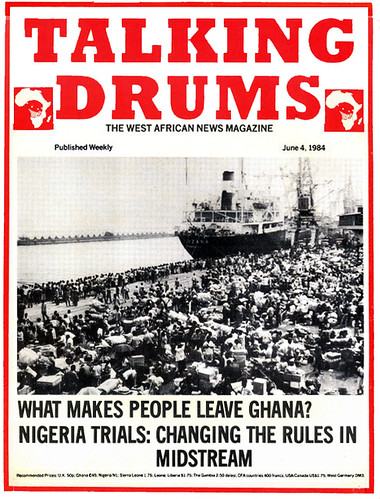
  • But The Melody Lingers On from Talking Drums magazine, September 1983.
    The question sadly remains unanswered: "When is an action of a member of the PNDC an individual matter and when is it a matter for the Council?"
  • Politicians, Politics and Policies in Ghana by Emmanuel Hansen.
    Some of the clearest analysis of the time can be found in this book review from October 1984.

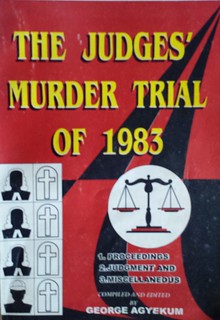
The Judges' Murder Trial of 1983 by George Agyekum

Soundtrack for this note

Next in Part II: To Make the Road Fearful
In which we read about dark matters at the Special Court


See also: Truth and Reconciliation


File under: , , , , , , , , , , , , , , , , ,

Wednesday, December 10, 2014

Render / Rendition

I've been thinking about the verb render and its euphemistic use by 'intelligence' folks. Ionesco loved such words intended to obscure.

Render, when used in the context of extraordinary rendition, seemingly refers to the "provide to" sense of the verb.

I'm sure however that the "melt down" or "process carcass in order to extract protein" sense of render was the intended variant.

The same people that brought us the phrase terminate with extreme prejudice speak softly of extraordinary rendition and coercive techniques.

It turns out the extraordinary modifier to rendition was an exaggeration, for the actual policy was rather ordinary once the gloves came off

I'm impressed by the techniques suffix to "coercive interrogation techniques". It provides the weasel veneer of bureaucratic justification.

The gloves came off metaphor is of a piece with the reluctant avenger, cold warrior and cowboy rhetoric. Also the fighter pilot iconography.

As Gil Scott-Heron pointed out the metaphor is always "The man in the white hat", it's never "He died with his pants on". The B-movie Theory

They used techniques, after all, this wasn't done without thought. Techniques for God's sake. They had memos, they had a mandate. Techniques

They rendered enemy combatants. The analysts were security professionals, the lawyers wrote briefs, memos, and provided sober legal counsel

From the president on, everyone always meant well. We should never forget the pervasive fear of those times. We should never forget they say.

I'm confounded by Diane Feinstein's phrase in the Senate Committee's torture report: "the impulse to consider the use of every possible tool"

Render / Rendition

Render
Rendition
Techniques
Extraction
Intelligence
Determination
Coercive
Interrogation
"Color-coded threat"
"Stress position"

Agency
Authorization
Bureaucratic
Justification
"Pervasive fear"
Suffocation
"Every possible tool"
Mutilation
Truth
Fiction

Program
Detention
Committee
Conclusion
Values
Expectation
Evidence
Destruction
Executive
Classification

Concern
Abdication
Duress
Oppression
Detainee
Sanction
Mission
Completion
Indefinite
Incarceration

Reviews
Recommendation
Secrecy
Investigation
Findings
Decision
Medical
Precision
Battlefield
Condition

Field manual
Operation
Contractor
Delegation
Homeland
Representation
Unreleased
Section
"Enhanced"
[ Redaction ]

Wall
Collision
Sleep
Deprivation
Rectal!
Hydration?
Pain
Contortion
Linguistic
Distortion

Study
Revision
Wartime
Alienation
Constraints
Compulsion
Restraints
Revulsion
Enforcement
Intimidation

Outsourced
Situation
Professional
Affectation
Permanent
Condition
Blood
Repulsion
Sin
Confession

Delayed
Publication
Damage
Mitigation
Sullied
Reputation
Outrage
Attention
Necessity
Neglection

Statute
Limitation
Geneva
Convention
Liability
Litigation
Missing
Compensation
Accountability?
Desertion

Blustery
Pontification
Misleading
Compilation
Success?
Inflation
Platitudes
Comprehension
Ludicrous
Prevarication

Security
Protection
Treaties
Obligation
Counsel
Dissimulation
Impulse
Misdirection
Damning
Distraction

Extensive
Preparation
Confinement
Contraction
Liquid
Nutrition
Programmatic
Starvation
Behavior
Modification

Goodwill
Dissipation
Diplomacy
Complication
Reckless
Accommodation
Pride
Restriction
Shame
Inflection

Patriotic
Intention
Tenuous
Salvation
Absence
Redemption
Erasure
Restoration
Judicious
Diversion

Harmful
Friction
Living
Invention
Mournful
Adjudication
Dangerous
Subversion
Poverty
Imagination

Rhetorical
Congratulation
Obscene
Citation
Wicked
Implication
Doubtful
Mediation
Ignored
Submission

Imperial
Contention
Oblivious
Reaction
Systematic
Protestation
Ridicule
Reception
Artful
Omission

Inquiry
Condemnation
Worldwide
Suggestion
Reluctant
Identification
Faded
Admiration
Ongoing
Asphyxiation

Covert
Dispensation
Robust
Accumulation
Intentional
Concision
Captured
Regulation
Oversight?
Illusion

Implacable
Opposition
Sensible
Supervision
Remarkable
Dilution
Income
Distribution
Unearned
Remuneration

Ruthless
Organization
Policy
Gestation
Unwarranted
Invasion
Conflict
Adoption
Contemptuous
Communication

Western
Machination
Solipsistic
Absorption
Fragile
Adaptation
Cultural
Variation
Toothless
Negation

Rights
Suspension
Deleterious
Temptation
Funding
Indignation
Needless
Accusation
Pointless
Recrimination

Ordinary
Exaggeration
Unfortunate
Improvisation
Admitted
Deception
Managed
Perception
Mythical
Affirmation

Dishonorable
Introduction
Dungeon
Provision
Insomnia
Hallucination
Unbearable
Tradition
Uncivilized
Nation

Increasing
Frustration
Aggressive
Competition
Consistent
Anticipation
Unsanitary
Migration
Cold
Calculation

Forced
Digestion
Useless
Petition
Dismal
Donation
Media
Fixation
Footnote
Generation

Coffin-sized
Configuration
Water
Application
Simple
Combination
Damage
Deracination
Worthless
Information

Misguided
Collaboration
Crusade
Confrontation
Intellectual
Immiseration
Spurious
Distinction
Soulless
Association

Energetic
Manipulation
Democracy
Promotion?
Disappointing
Corruption
Misplaced
Compassion
Deferred
Conversation

Duty
Dereliction
Integrity
Renunciation
Scatological
Fascination
Childish
Obsession
Ignored
Objection

Youthful
Indiscretion
Mean
Regression
Sanctimonious
Suppression
Unmerited
Acclamation
Failed
Inhibition

Celebrity
Contribution
Suppository
Imposition
Prisoner
Supposition
Presidential
Prohibition
Poisoned
Succession

Formal
Deposition
Norm
Violation
Dubious
Potion
Patrimony
Dissipation
Naysayer
Vindication

Posture
Prostration
Sexual
Lubrication
Fitful
Ingestion
Religious
Desecration
Humanity
Constriction

Internee
Evaluation
Light
Attenuation
Restricted
Motion
Nasal
Irrigation
Liminal
Libation

Interpreter
Translation
Adverse
Selection
Bounty
Concession
Changing
Definition
Circumstantial
Conviction

Moral
Dimension
Topical
Digression
Selective
Indirection
Rogue
Procession
Warning
Obliteration

External
Location
Allied
Accession
Righteous
Recognition
Fatal
Indecision
Justice
Elision

Frustrated
Ambition
Clipped
Diction
Intense
Articulation
Procedure
Resurrection
Intentional
Vivisection

Arrogant
Arrogation
Perilous
Peregrination
Alarming
Imputation
Disputed
Observation
Choice
Abortion

Presumptuous
Appropriation
Amateur
Pronunciation
Illegible
Illustration
Execrable
Assumption
Waste
Elimination

Singular
Possession
Inevitable
Progression
Perfidious
Corporation
Currency
Devaluation
Greater
Recession

Multiple
Quotation
Target
Consultation
Civility
Vacation
Supreme
Toleration
Broken
Union

Limb
Extension
Faltering
Respiration
Exemplary
Pretension
Appearance
Abolition
Existential
Reversion

Choreographed
Transition
Saline
Infusion
Fluid
Intoxication
Psychologist
Intervention
Biological
Experimentation

Mental
Perversion
Panicked
Retrogression
Hunger
Humiliation
Extreme
Affliction
Grace
Castration

Deliberate
Obfuscation
Diffuse
Suspicion
Warrantless
Intrusion
Abuse
Adoration
Retinal
Dilation

Feigned
Concentration
Advice
Exclusion
Constant
Invocation
Imagined
Exception
Probity
Remission

Necessary
Interception
Fantasy
Creation
Stolen
Tribulation
Marginal
Implementation
Decency
Immigration

Extremity
Subtraction
Cavity
Insertion
Wound
Insemination
Artificial
Distinction
Probable
Extinction

Casual
Exploration
Depraved
Sensation
Particular
Illumination
Expected
Humiliation
Soul
Ruination

Stylistic
Innovation
Freelance
Rumination
Advanced
Automation
Telling
Indication
Resultant
Concussion

Drone
Explosion
Village
Commotion
Newspaper
Mention
Perfunctory
Expression
Population
Reduction

Latest
Edition
Perfidious
Caption
Final
Option
Ceremonial
Presentation
Complaisant
Facilitation

Background
Attribution
Sought
Cooperation
Site
Relocation
Distributed
Participation
Impotent
Injunction

Thoughtless
Instruction
Rule
Diffusion
Nebulous
Compartmentalization
Threat
Emission
Press
Domestication

Unpopular
Opinion
Cost
Trillion
Predicted
Contradiction
Peaceful
Liberation
Continuing
Education

Masculinity
Aggression
Adrenaline
Animation
Sad
Disposition
Estrogen
Disruption
Required
Reflection

Pervasive
Vandalization
Tactical
Generalization
Retrospective
Admission
Profound
Ossification
Importance
Cognition

Sinister
Specialization
Family
Co-option
Suborn
Deliberation
Hostage
Negotiation
Self
Preservation

Conscious
Simulation
Appropriate
Coordination
Surprising
Satisfaction
Activity
Customization
Influence
Conservation

Profit
Augmentation
Homogeneous
Composition
Resistance
Transformation
Tribal
Authentication
Ideological
Indoctrination

Ethical
Evolution
Arduous
Navigation
Conduct
Demonstration
Murderous
Standardization
Noxious
Revolution

Lost
Congregation
Principle
Minimization
Controversial
Interpretation
Philosophical
Question
Stolen
Election

Power
Centralization
Historical
Abstraction
Honesty
Aversion
Preferred
Version
Tissue
Rejection

Cowering
Caution
Shrieks
Exhaustion
Injury
Infliction
Wilful
Inaction
Derived
Fragmentation

Camp
Administration
Poetry
Confiscation
Literature
Munition
Human bodies
Ammunition?
Privilege
Revocation

Intolerable
Provocation
Impertinent
Recrimination
Cult-like
Indoctrination
No
Reconsideration
Cultural
Projection

Cell
Utilization
Anxiety
Elevation
Electrical
Stimulation
Genital
Incapacitation
Inspired
Abomination

Dishonest
Acquisition
Scandalous
Faction
Violent
Suction
Disgust
Urination
Legacy
Despoliation

Overseas
Destabilization
Blowback
Saturation
Foreign
Legion
Mercenary
Season
Bleeding
Lesion

Hidden
Installation
Policy
Persecution
Vindictive
Perpetration
Agony
Segregation
Criminal
Explanation

Rented
Mansion
Newfound
Vision
Rumored
Allegation
Implied
Sterilization
Potential
Circumcision

Mindless
Tabulation
Unusual
Exposition
Rapid
Transportation
Hubris
Enervation
Gutter
Gravitation

Legal
Abrogation
Effective
Cancellation
Inadequate
Transmission
Territorial
Expansion
Conscience
Evacuation

Claustrophobia
Congestion
Sensory
Encapsulation
Outlaw
Contagion
Inviolable
Constitution?
American
Predation

Advanced
Intuition
Pastoral
Repudiation
Exploited
Division
Troubled
Intersection
Embarrassing
Erection

Prolonged
Discussion
Mounting
Discrimination
Avoiding
Circumspection
Fuel
Ignition
Internal
Combustion

Chest
Compression
Air
Circulation
Flow
Obstruction
Ingredient
Addition
Drug
Addiction

Mislaid
Cushion
Welts
Contusion
Desired
Solution
Coarse
Confection
Quick
Execution

Lengthy
Seclusion
Organ
Occlusion
Lawsuit
Preclusion
Punishment
Recursion
Debarment
Prevention

Deployment
Rotation
Cynical
Politicization
Rationale
Implosion
Widespread
Derision
Nostalgia
Fashion

Belief
Proposition
Efficient
Collection
Course
Correction
Wink
Connotation
Dead
Complexion

Stentorian
Declaration
Proffered
Recompensation
Generational
Declension
Ingredient
Alteration
Abhorrent
Mutation

Forced
Constipation
Rape
Insinuation
Ceaseless
Vibration
Ominous
Intimation
Functional
Defenestration

Tooth
Excision
Surgical
Incision
Heat
Convection
Post-mortem
Dissection
Post modern
Explication

Blind
Devotion
Proof
Confirmation
Fact
Verification
Lacking
Substantiation
Invented
Corroboration

Message
Synchronization
Brand
Appreciation
Sublime
Persuasion
Enchanted
Population
Cattle
Appellation

Dogs
Domination
Slaps
Profusion
Hoods
Reclusion
Handcuffs
Ablution
Pacifist
Delusion

Sovereignty
Immunization
Amnesty
Vaccination
Stench
Consecration
Impunity
Desecration
Grief
Consolation

Suspect
Motivation
Vicious
Direction
Self-serving
Narration
Impossible
Reconciliation
Odious
Foundation

Immoral
Consideration
Deceitful
Conception
Repeated
Subjection
Physical
Deterioration
Disappearing
Documentation

In sober rooms, and without compunction,
With their white collars and red scribes,
They rejected a mere police action.

The resolved solution of their tribe:
Wounded flesh, revenge their intention.

Standing orders and compromised sources,
An own goal, these never-repudiated wars.
A course, instead, of military prosecutions,
Lies, and brutal interrogations.

Disgrace
Nepotism
Briefs
Criticisms
Wars
Terrorisms
Memos
Legalisms
Freedoms
Euphemisms

...

I've written about the game of the rough beast and I continue to wonder at its bureaucratic infrastructure. Who is writing the script?

For whatever reason, perhaps a keen sense of outrage, I've felt compelled to devise over a hundred variations on my initial scheme. Such is my asylum:

Wordplay as balm for disgust
Language as defense mechanism
Wit as refuge from despair
Poetry as exorcism

I'll follow the Via Negativa convention and tag the above under poems & poem-like things.

Sidenote: Twitter is a dangerous medium. In its immediacy, it takes just one fugitive thought about ostensibly serious-minded folks, and before you know it fifteen forty-five seventy minutes have passed.

File under: , , , , , , , , , , , , , , , , , , ,

Tuesday, October 21, 2014

Patterns of Exchange

A few weeks ago, a Liberian man passing through Accra, Ghana for a few days on his way to a medical conference in Nairobi, Kenya started feeling unwell and feverish. He called the WHO in Nairobi and informed them he wasn't well, suspecting Ebola. The WHO contact in Nairobi called my aunt, a doctor who works for the WHO in Ghana. My aunt hastily organized an Ebola response team and ambulance and dispatched it to the hotel where he was staying. The doctors and ambulance arrived at the hotel equipped with masks, hazmat suits and protective equipment only to discover that the man had gone to the mall! The doctors then managed to contact him at the mall and eventually conveyed him to the isolation unit at the hospital where he was tested for Ebola. The tests eventually come back negative but he remained in quarantine for the full 21 days until the all clear was given.

This, of course, was the height of irresponsibility. The man clearly knew enough given his symptoms to seek medical advice and to contact the WHO in a different country. But I can't believe that he then decided to leave his hotel room to go to a shopping mall. Ghana certainly dodged a bullet, we are lucky that he didn't have Ebola. Indeed given the traffic between Liberia and Ghana, we have been lucky that Ebola hasn't made its way to the country yet. Based on air traffic patterns, Ghana has been modeled as the most likely country to experience Ebola importation. We have seen the effect of a single infection in the most developed countries, and the contrast in countries with poor public health infrastructure.

My aunt had just returned from a harrowing five week tour of duty helping run the WHO Ebola response in Liberia. The thing she emphasized most about her experience was just how easy it was to inadvertently get infected. The example she cites was someone simply dropping something at the end of the 19th of the 20 steps one has to go through when removing one's protective equipment and bending down to pick it up, thereby getting infected. The Spanish nurse who caught Ebola while attending to two Ebola patients in Madrid believes she might have inadvertently touched her face while disposing of an infected glove.

Upon her return to Ghana from Liberia, the WHO wanted to send her to manage the separate outbreak of Ebola in Congo. She demurred, deciding instead to help set up the UN regional Ebola response center in Accra. I wonder, however, whether she will also decline to go to Uganda to deal with the recent outbreak of the Marburg virus there if asked. Everyone in the family is hoping she stays in Ghana, we certainly need her expertise dealing with the ongoing cholera epidemic that has been plaguing our country.


Containers: Eddie's African Grocery

II. Borders and Boundaries

Item: Thomas Eric Duncan (the Liberian man who died of Ebola in Texas) was a refugee in a camp in Danane in Cote d'Ivoire for a few years after the start of the Liberian civil war launched by Charles Taylor.

One of the success stories so far about the present crisis has been the prevention of the spread of Ebola from Liberia and Guinea to neighboring Côte d'Ivoire. The obvious response is that the borders between the countries were eventually closed. It is worth asking however why there was no transmission before the border closures and, well, there is a political angle to explore.

Nimba county in Liberia used to be a source of mercenaries employed by disaffected supporters of the deposed (and disgraced) ex-President Laurent Gbagbo to destabilize Côte d'Ivoire. In the aftermath of the Liberian civil war, there were lots of ex-combatants searching for employment and, for some, the way of the gun was a lucrative comfort. Ivorian president, Alassane Ouattara, had no tolerance for such things: instability is bad for business and Ivory Coast is all about business. He cracked down with a carrot (tempting the opposition back into the political process - and declining to prosecute most of their misdeeds), and the stick (the Liberia-Côte d'Ivoire border is now one of the most impregnable borders in West Africa). Even before the Ebola outbreak, the effect of this policy on cross-border interchange (and trade) has been severe. One wonders when normalcy will return.

Item: Thomas Eric Duncan would later migrate to Ghana where refugee life was more congenial (and the language and cultural barriers less pronounced). The photos of him that were used by the media, showing him dressed in green attire, were taken at a wedding he attended in Ghana a few years ago.

The Buduburam Refugee Settlement in Ghana was set up to host Liberian refugees in 1990. It was always intended to be a temporary camp but events had a way of imposing permanence and it quickly grew into a sprawling city. The Liberian civil war officially came to an end in 2003 after a few false starts, especially the chimera 1997 elections 'won' at the barrel of a gun by Charles Taylor (campaign slogan: "He killed my ma, he killed my pa, I'll vote for him"). The UNHCR began winding down operations there in 2007 although many NGOs of all stripes continue to advocate for camp residents. Authorities in Ghana have never been keen about the camp and throughout its existence have repeated calls to shut it down. Popular prejudices in Ghana attribute a lot of the rising urban crime to Liberians (and the perennial scapegoated Nigerians). Many Liberians have indeed returned to rebuild their country but the ties they forged in Ghana have endured.


H.B. Duncan Enterprises Containers: Motors and electrical shop

While Ghanaians were refugees in the rest of Africa in the 1980s (after all that is where the notion of Ghana must go came from), there has been relative stability since, and Ghana became a destination for political and economic refugees (for Liberians and Sierra Leoneans throughout their civil wars, for Ivoriens during their conflicts in 2002, 2005 and contested elections, and even for Sudanese in 2005, for the Togolese in a couple of spasms after Eyadema's demise and subsequent elections, for Nigerians whenever their economy has sputtered). By and large, we have opened our doors during crises perhaps because we aren't that far removed from crisis.

I read somewhere (UNHCR perhaps?) that the average length of stay in a refugee camp was 18 years. I couldn't quite bring myself to believe this statistic - that's basically a whole generation. I thought that if the figure was accurate, it only meant that the never-ending Palestinian experience was skewing the numbers of these protracted situations. But then I considered my own family experience, and remembered that it was 18 years after we fled Ghana's 1982 coup regime that my mother returned to live there. Of course our exile in France and England wasn't anything like a refugee camp but the point remains that upheaval can have generational effects. I have now, after all, spent most of my life outside Ghana. Collateral damage as cultural exchange, I suppose.


talking drums 1984-06-04 what makes people leave Ghana - nigeria trials changing the rules in midstream

III. Markets are conversations

The World Bank periodically publishes studies about regional integration, (see De-fragmenting Africa as an example). As befits a bank, it is mostly concerned about "removing barriers to trade". The point is well taken and many studies now focus on transportation. Working roads and railways would indeed be good things; these days infrastructure development is all the rage (sidenote: some of us remember donor nations telling us in the 1980s and 1990s that our economies could not sustain even dual carriage motorways). Of course more and better roads are not the only obstacles to overcome.

Surface transport in West Africa is very expensive compared with the rest of Africa and the developing world. The causes are cartelization and restrictive regulation of the trucking industry. High freight charges do not reflect high transport costs so much as high trucking profits that can be traced to the lack of competition in the industry. Trucking industry profit margins in West Africa were found to be on the order of 80 percent, compared with 20–60 percent in southern Africa.

Surface transport in West Africa is also very slow compared with the rest of Africa and the developing world, because of frequent delays associated with administrative processes.

- Ecowas’s Infrastructure a regional perspective

In 2003, one of my cousins started a factory in Accra processing kaolin (soft white clay), wholesaling for the multinationals like Unilever. I had thought in the years since that he would try to go upmarket and add higher value processing so that he wasn't merely selling raw material. He certainly has maker aptitude (a chemical engineer by training) and I've seen some of the ingenious centrifuges he and his partners have designed for use in the factory. Still, working without the precision machinery that German engineering easily affords, he has added new products to the initial portfolio: calcium carbonate from oyster shells, gypsum for fertilizers and so forth. One can see a path of incremental growth on this foundation. Government industrial policy is supposed to foster such development.

Somehow instead, he has made it into the trucking industry and now supplies heavy duty trucks and mining equipment, a sideangle that has become very lucrative. There is a gold rush again in Ghana (the former Gold Coast) with lots of Chinese and Indian prospectors competing with the local Galamsey (there's also a current scramble for offshore oil with Cote d'Ivoire gearing up to join Ghana's recent operations). There is perhaps a precedent here, not necessarily in the scramble for Black Gold, but rather in the move to transportation from an initial focus on trade. A lot of the big Nigerian trading family fortunes were consolidated in the last century by moves into the trucking industry. They initially started as pure traders (mostly agricultural) but then quickly found that it was more lucrative to be in the trucking business. Margins of 80 percent are nothing to sneeze at in any economic venture. Thus there are huge incentives to prevent things like rail and better highways that all agree are key to increased regional integration.

Beyond the petty corruption that keeps things stuck at the border (informal payments and delays), there is also Big Money that adds inertia to tariff policy and regulatory processes. This is the additional context (whose parochial concerns are hurt by increased regional integration) that is missing when you read through the admittedly interesting research notes such as Removing Barriers to Trade between Ghana and Nigeria.

Both countries account for about 61 percent of population and 68 percent of GDP in ECOWAS...

Beyond trade, substantial migration flows between both countries have existed for a long time. Recent estimates put the number of Ghanaian emigrants in Nigeria at 125,000 (IOM 2009), which represent 13 percent of Ghanaians living outside Ghana, and the number of Nigerians living in Ghana at more than 50,000...

Ghanaian manufacturers believe the key barriers to increasing trade with Nigeria include substantial informal payments and delays — regardless of whether documentation is complete — transit charges, and requirements for product registration...

The [ECOWAS] protocols also establish the right of citizens with a valid travel document and health certificate to stay for up to 90 days in another ECOWAS member state before being formally required to apply for residency... Such application should be automatically granted. The revised ECOWAS treaty of 1993... stipulates that ECOWAS citizens should be treated identically to national citizens in establishing and running a business.

- Removing Barriers to Trade between Ghana and Nigeria Strengthening Regional Integration by Implementing ECOWAS Commitments
beads and necklaces ghana containers 2000

There is a notional vision of open borders, common currencies and even political union embodied in Ecowas and in the wider African Union. In general, the Francophone countries in ECOWAS have been more integrated but even they have been subject to things falling apart periodically. Ghana and Nigeria have historical ties and ought to have every incentive to strengthen them. The concern is that there are many regional integration processes that are currently being disrupted by the Ebola outbreak. Let's hope that the cultural ties are resilient enough to survive the challenge and quickly rebuild.

West Africa is the part of Africa with the strongest market traditions. I'd argue that the accompanying social engagement is what Africans have to teach the rest of the world and that conversational banter is often lost in the modern world. Trade and markets are not the only lens through which to view patterns of exchange.

Item: when a BBC journalist asked a Sierra Leonean how he prepared for the three-day nationwide Ebola lockdown that took place in September. The reply was "I have bought enough credit on my mobile phone".

Social living is the best.

Soundtrack for this note

File under: , , , , , , , , , , , , , , , , , ,

Monday, October 13, 2014

Trend-surfing Alacrity

For years I've resisted writing anything about Liberia or Sierra Leone. Too painful, too raw, too soon. The pen keeps calling however...

I figured Liberia and Sierra Leone deserved a couple of decades of peace and quiet but, as they say, 'Tings deh happen. Expect some toli.

I saw Rev. Jesse Jackson today with the Texas Ebola victim's family. Really? Some of us remember his history with Charles Taylor during Liberia's descent.

The Country Preacher ought to steer clear of anything related to Liberia and Sierra Leone. It's unseemly.

Suggested reading regarding Jesse Jackson, Pat Robertson (Pat Robertson!) and Charles Taylor: The Quiet American by Graham Greene

Was it Stalin who talked of useful idiots? They always seem to materialize before and during wars.

Consider a taxonomy of useful idiots: the ignorant, those who should know better, the reflexively-tribal, and the professional opportunists.

Servants to power, we are all striving simians on the savannah at heart, looking to Alpha authority.

Apologists for war (think Iraq, think War on Terror) and apologists for unfettered capitalism have had a rough start to this century

Most useful idiots lie low when things go awry. That, paradoxically, is the only time they are of any interest.

Only posterity is unkind to the man of conventional wisdom, and all posterity does is bury him in a blanket of neglect - John Kenneth Galbraith

Professional opportunists are singular gremlins in human society and deserve close study. Sadly, we simply shake our heads at the spectacle

The professional opportunist knows no shame and depends on our short attention span. Hey! Look over there...

I looked.

Most professional opportunists escape scrutiny and scorn because there's always a core of past competence that one can point to.

The notion of shame has become a vestigial sentiment in many Western countries; some call it a casualty of modernity. I dissent.

Coming from a shame society, it's hard to watch bad behavior tolerated with benign neglect, or even rewarded.

My mother emphasized the necessity of permanent outrage. Will I be able to convey that to the children I'm raising in America?

I know my place in America (at the intersection of Tenuous St and Hired Immigrant Worker Alley) and accordingly keep a low profile.

Also civility.

Let's posit a corollary to the quantity theory of insanity. Perhaps a coefficient of opportunism? Argh, forget it: rusty mathematics.

Just because a lizard nods its head doesn't mean it's happy - Ghanaian proverb

observers are worried

Observers are worried

I'm reposting these (slightly annotated) twentysomething thoughts on opportunism here for archiving purposes. With a little distance, I realize that this product of few fevered minutes of short form writing essentially revisits a theme I'd previously covered. Timing is everything I suppose.


[Update: November 2021]

See A Taxonomy of Useful Idiots for a more considered take

File under: , , , , , , , , , , , ,

Thursday, August 21, 2014

The Ziploc Factor

The most attractive aspect of patents is their expiration. Built-in expiration, that "limited times" proposition, is similarly the appealing aspect of the Faustian pact one makes for copyright. In that vein, I would venture that one of the best things to have happened since the start of this century is the expiration of the patent for the ziploc. If you frequent the same supermarkets as I do, you would have noticed the ascendance of the ziploc form factor over the past decade. At first the spread was likely due to increased licensing in anticipation of the expiration of said patent, then, of course, once the crucial patent expired, the flood gates opened and generics came into play, to the extent that these days I can barely find regular plastic bags in store aisles. Permit me to present another item as part of an occasional series on bags, this time a brief cultural history of the ziploc, a foray into the grooves of technology and hardball business. Plastic bags I say, locks, knots, zippers, all have been changed. Ladies and gentlemen, consider the ziploc factor.

zip-loc display tsa state college airport 2007

I. Radical Transparency

The ziploc resealable plastic bag, sometimes called zip top, zip lock, one zip, slide lock, snap bag, zip-loc (if inclined towards hyphens) or zip snap depending on the brand or technology underpinning you lean towards, crossed the chasm of cultural inevitability in the summer of 2006 when liquids were banned on many flights due to a case of pure bureaucratic terror - call it a liquidity crisis in the skies if you will, for we were living in a era of recent non-specific general threats. Homeland Security restrictions made themselves felt, and within days the nascent ubiquity of ziploc bags could no longer be denied - indeed they were officially mandated. Air travel, already a ludicrously fraught endeavor after September 11 2001, now gained a set of extra contortions that have spoiled things for all who can't afford their private jet - and for all intents and purposes that is everyone. The ziploc was the palliative.

zip-loc TSA poster

The British were the first to impose restrictions since the ostensible liquid bomb plot had British airports as their target, but it was the TSA list of permitted and prohibited items that really soured things:

All liquids, gels and aerosols must be placed in a single, quart-size, zip-top, clear plastic bag. Gallon size bags or bags that are not zip-top such as fold-over sandwich bags are not allowed. Each traveler can use only one, quart-size, zip-top, clear plastic bag.

Early versions of the TSA list mentioned zip lock although later versions now mention zip-top - as we shall see this little-noticed change in nomenclature is significant in our history, but let's not get ahead of ourselves at this stage. We'll also skip over the size restrictions for the time being and concentrate on the specification of the bag which is a technology prescription backed with the coercive powers of American law enforcement: "clear" for transparency and ease of observation if not confiscation, and ziploc for ease of opening and sealing. The snappy slogan is "Bag and zip for a short trip" and undoubtedly some poor sod had to come up with a breezy mnemonic for the public education campaign on the new requirements:

3-1-1 for carry-ons (3 ounce bottles, 1 ziploc bag, 1 bag)

The equivalent British poster from the BAA doesn't have the same marketing flair (but who can compete with American salesmanship?) and gets the essential point across: the requirement is simply "a transparent, resealable bag". In practice of course, this boils down to a ziploc bag. The Brits sensibly don't refer to a brand in the BAA rules

Customers may take with them in their cabin bag limited quantities of liquids, gels and aerosols, including travel-size toiletries such as shampoo, suntan lotion, creams, toothpaste, hair gel and hair spray. Containers holding liquids must not exceed three American ounces or 90ml.

zip-loc BAA poster


Liquid containers must be carried in a separate clear plastic zip-top bag that does not exceed 20 cm x 20 cm or 8 inches x 8 inches or quart size. Items must fit in the bag comfortably and the bag must be completely closed.

The earliest revision of the British policy noted:

Only one bag per passenger is allowed. The bag must be clear and re-sealable, such as 'ziplock' bags or bags with pressable seals. Larger bags or bags that are not sealable, such as fold-over sandwich bags are not allowed
The ziploc regulation is one that requires constant reinforcement and it gives rise to frequently inventive exposition by TSA officialdom. Thus if you were to pass the TSA stand at State College airport, Pennsylvania, some time ago you might have spotted the following three-dimensional illustration of permitted and banned items.

zip-loc display state college airport 2007


The three bulging Hefty One-Zip bags were meant to augment the above 3-1-1 poster. Presumably the security attendants got tired of having to explain the cryptic 3-1-1 propositions and opted instead to show graphically to the traveling public the sorts of items that were and were not permitted.

Again note the type of ziploc bag that was used, it is more properly called a zip top. Recently at JFK airport, there was an information officer prowling the unsurprisingly long lines at the TSA whose sole purpose was to dispense Hefty One Zip bags. I don't want to suggest cronyism in the choice of brand of plastic bag but it was interesting to me that each time I've observed such actions, the brand of bag being proffered was a Hefty bag; there really must be a marketing effort at work.

II. Deformation and Displacement

The Hefty One Zip bag has a zip handle at its top, a satisfying target to clasp as you close - a moveable stub, in short, to enforce the close action. The most widely used ziploc bag on the other hand - made not coincidentally by Ziploc, simply has those pleated, interlocking grooves. By most reckonings, the Hefty variant is the gold standard of the form yet, in many ways, the broader Hefty versus Ziploc story is a reversal of the Coke versus Pepsi narrative. Indeed the owners of the Ziploc brand seems to have chosen the better name - ziploc has become the generic term for plastic, resealable bags, and as far as adoption goes, the 'worse' technology appears to have triumphed in the marketplace. What lies behind the workings of the ziploc factor? To find the answer, we need to undertake a minor diversion into the realm of patent histrionics...

ziploc sliding clasp fastener

The essential ziploc innovation is US Patent 4262395 Sliding clasp fastening means. Filed in 1979, it was published in 1981. It refers to mating strips, coupling heads and sundry means of fastening through a sliding motion. Like most innovations, it didn't come in a vacuum; its inventors stood on the shoulders of giants. It builds on the work of the slide fastener, patent 4004327, filed in 1975, Japan. In the US, a further improvement was submitted in 1990 by Hefty, Patent 5007143 - Rolling action zipper profile and zipper thereof.

Broadly speaking, these devices take the notion of the zipper and apply it to plastic bags. If you read, you'll dive into a world of pairs of flexible plastic strips, reclosable interlocking male and female elements, extrusions and welding. In the US, since the 1980s, these ziploc patents stood their owners (ultimately controlled by Hefty) in good stead, and they were embodied in the marketplace as the Hefty One Zip bag which reigned supreme as the dominant resealable bag. There was, and continues to be, a hefty premium for a Hefty bag. There is a price to pay in order to get the satisfaction of that sliding, often purple, clasp fastener. The purple nub, standing out as it does atop the closing plastic strips at the top of the bag, gives a good closure indication and symbolizes the fulcrum of a conventional economic monopoly.

The chinks in Hefty's armor, the ziploc factor, as it were, came in two forms. The first weakness was in the name. The most serious competitor was the Slide Lock bag, later renamed Slide-Loc (since lock was a generic term), then still later renamed Ziploc. Simply put, ziploc is the better name for the resealable bag. The zip in the Ziploc name references the gold standard of the zipper (and the Hefty competitor), and the lock aspect identifies the sealing function of the bag.

ziploc rolling action zipper


The second chink built on the insight of the plain meaning of Slideloc/Ziploc name, namely that simply sliding an interlocking groove was good enough to produce a lock; you literally did not need a zip (or zip handle) to form a lock. True, the kind of seal that you get from snapping and sliding a groove in a plastic bag is not as tight as if you applied the pressure of a zip fastener, However, you can get a tighter seal if you increase the number of grooves that formed the lock. The pragmatic solution embodied in most ziploc bags that don't use zip handles is to simply add more grooves.

Slideloc/Ziploc versions of the bags started to get wide distribution in the late 1990s as the 20 year limit on the patents on the basic technology was coming up. This being American capitalism, of course, everything would get resolved in the courts (after the lawyers took their cut). Hefty, after issuing various cease-and-desist notices to the companies that were intruding on its turf, eventually filed a lawsuit based on the later 1990 patent.

The lawsuit, Pactiv (formally Tenneco) v. S.C. Johnson & Son and KCL Corporation was decided in November 2000 and found that ziploc slider bags didn't infringe on the relevant patent. It was a simple complaint:

The manufacturer of Hefty One Zip reclosable plastic storage bags, claims that the Slide-Loc reclosable plastic storage bag, manufactured by defendant KCL Corporation for defendant S.J. Johnson & Son, Inc., infringes U.S. Patent No. 5,007,143
The case turned on a matter of overreach, if a zipper handle is the core innovation of a process and a design omits that essential element, how can one claim that one's so-called intellectual property is being copied?
The fundamental difference between the '143 patent and the Slide-Loc in this regard, essentially ignored by Pactiv's experts, is that the '143 patent describes closing by a rolling action, whereas the Slide-Loc closes by deformation and displacement, with incidental rolling taking place at the very end of the process. The fact that some incidental rotation occurs does not alter the fact that the Slide-Loc closes in a very different manner than the '143 patent describes.
ziploc slide fastener

Deformation and displacement was thus the technical loophole that ushered in the era of ubiquity of the ziploc. By side-stepping the necessity of the zip handle, competitors could avoid the encumbrance of the Hefty patent monopoly. The long inhibited competition in the recloseable bags could proceed and the floodgates opened. Eagle-eyed billionaire investors sensed blood in the water long before the verdict was issued and, in 1999, you might have noted that Huntsman Packaging Corporation acquired KCL Corporation, the Indiana-based manufacturer of reclosable polyethylene bags that was subject to the lawsuit. The press release touted its "patented and proprietary technology in zipper and slider closures" and development of "patented slider technologies for both vertical and horizontal 'form-fill-seal' bagging processes".

Huntsman is of course the largest private chemical company in the US. Jon Huntsman Jr, billionaire heir to his father's fortune would go on to have presidential ambitions in 2012 - although the Republican Party ultimately wanted more red meat and less timidity. S.C Johnson & Son of course make everything from Windex, Pledge to Raid and are a veritable marketplace of consumer products. Hefty (originally owned by Mobil) is now owned by Reynolds Consumer products. I lay these items out to give a sense of the stakes involved in our ziploc contest. We have oil companies facing off against chemical companies and multinationals spun off from heavy extractive industries (oil, aluminium etc.) engaged in an ongoing battle.

The mythology of these brands is instructive
American ingenuity mixed with a bit of elbow grease. Reynolds Wrap foil was invented after aluminum was no longer needed for military use... Hefty waste bags were first developed with excess material from an early plastics innovator, creating another household essential.

The rest as they say is history, marketing and execution. The big boys jumped in, you can see any number of patents by Proctor and Gamble, Glad and the like that tackle the general notion of flexible storage bags. One wonders why Velcro which specializes in touch fasteners didn't get into the act (brand dilution perhaps?)... There were also those who saw the business opportunity in marketing ziplocs as part of the packaging machinery that all manufactures use. We have specialized companies like Zip-pak, Mini-grip and GT Zip that target industrial clients.

The engineering questions were difficult ones: how to efficiently evacuate air from a bag (an important worry if perishables were to be stored in them), how to create a tight enough seal, how to track the alignment and integrity of the seal, how to tweak the manufacturing process so that the marginal cost of adding a ziploc to one's bag is negligible. There were also usability questions, what kind of closure indicator to use? How, indeed does one indicate closure? It is obvious, if a zip handle is present, to determine with a quick glance if a bag is fully closed or not; not quite so with a plain ziploc. Is an audible signal appropriate? Is paying attention to the satisfying snap sound a good approach? As evidenced by the resilience of the Snap and Seal brand I keep encountering, that is an approach that is succeeding. There's also an arms race on ziplocs, some tout double zips, sometimes there are three seals. On the most recent ziploc I purchased, I see no less that 7 interlocking grooves. Like razor blades, more grooves are thought to be better.

III. War of the Fasteners: Knots, Rubber Bands, Ziplocs and Twisties

Ziplocs (mostly without handles) have been widely licensed and have found their way into the list of household essentials. In this era of liquid threats, it is a good thing to have some ziploc bags on hand when you travel by air. Articles abound about the applications: ziploc your stuff at airport security, Camera Zip-lock to protect in wet, dusty environments, multi-port laparoscopic surgical access devices, urn for ashes and so forth.


war of the fasteners: knots, rubber bands, ziplocs and twisties

The burgeoning ziploc tag at Delicious and the ziploc images at Flickr show how far these interlocking rib and groove bags have penetrated our cultural consciousness.

The convenience of ziplocs and their reassuring snap as their interlocking grooves are conjoined has changed the nature of the fasteners we use for our containers. We are spoiled with a wide variety of touch fasteners, from interlocking rib-type seal to plastic, paper, or clad-wire ties and on. Rubber bands have never quite worked as fasteners, we use them in to shift gears and such but we not generally as bag fasteners. Where once we used knots, in recent times we have graduated to twisties and to those little jagged plastic clips that we use to close bags of bread - sidenote: is there a better name for those nubs? Bibs or chokers perhaps?

Twisties, of course, are another great innovation in the vein of the ziploc but even they have their limitations: they are separate objects and often get separated from the bags they are meant to close. Thus there is almost always a little cognitive pause as you search for the little twistie ribbon on the kitchen counter or dining room table. Where exactly did you put it? It is always underneath. How much time is wasted in the search for the twistie? Is this inefficiency the driver of the faster adoption of the ziploc. Some baggies also attempted to prescribe a way to better preserve their contents, asking you to fold over the plastic before applying the twistie.

zip lock usage


The ziploc brooks none of these limitations. Like its zipper grandfather, the ziploc has the virtue of remaining part and parcel of the container - thus there is nothing to lose. Thus although we can read about epic battles such as that of Twist-Ties vs. Plastic Clips: Tiny Titans Battle for the Bakery Aisle, I'd hazard that the ziploc will be ultimate victor.

One downside of the ziploc and that other magical innovation, Velcro, is that the knowledge of knots and crosses that humans have passed down since time immemorial is now being lost. Only sailors, sadomasochists, magicians have the need for training in knots. One should perhaps add special forces grabbing enemy combatants for erustication to the coterie of knot aficionados - and even in the accounts of extraordinary rendition that we do have, the norm is for plastic hand-cuffs - or metallic if the gloves come off and stress positions are emphasized. Other than shoe laces then, the modern man has no more need for learning the time-tested art of knots - and no, tying up the boot of your car with your weekend haul from Ikea doesn't count - I should know, I was quite hopeless a few weekends ago.

Before concluding we should return to the liquid terror that prompted the ziploc's ascendance. When exactly will we get to the end of that pesky liquid ban? There have been many false sightings on that front since 2006 and everyone keeps hoping for a revision (see for example: EU to ease airport liquids rule in security revamp) but it is hard to see sanity returning, it is George W. Bush's most durable legacy. I imagine Al Qaeda or ISIS types periodically seeing these reports and saying "Why don't we send around a few emails around mentioning liquids, bombs and planes?". Our friendly NSA will duly notify the security establishment and the security tax that the entire world faces will continue. I fear the ziploc will be mandated long after my lifetime.

In an age of radical transparency it is all about the ziploc factor. Whether it is food packaging or cosmetics, all hail the ziploc. I wonder, Dear Reader, where you stand in the Hefty versus Ziploc contest, and what uses you put your ziplocs to? Deformation and displacement, young man, deformation and displacement.

The Ziploc Factor

Soundtrack for this note

  • Pete Rock & C.L. Smooth (ft. Grand Puba) - Skinz
    Better yet you could pass me a ziploc A bag of boom, and a 40 then some boot knock
    I've always loved this fragment of Grand Puba's celebrated verse in this 1993 ode to prophylactics, Skinz - a song about the importance of contraception in which they hilariously explore options from aluminium foil to ziploc bags before returning to plain old condoms - Catholics beware.
  • Prince - Ripopgodazippa
    Every stripper's favorite track, sexy funk that appropriately enough featured in that cult b-movie, Showgirls. The sound of the zipper

Obligatory disclaimer

In my line of work, software, expiration is typically seen as the only attractive aspect of patents.

There's a patent officially filed under my name filed from my last few months at IBM. It seemed then, as it seems now, like much ado about nothing (a tweak to the kind of auto-suggestion that you see every time you search) but I suppose technology companies like to build up defensive portfolios of patents, weaponry that they can lob over the wall when convenient. I plead guilty that I succumbed that one time. In contrast, one of the more interesting ideas I came up with back then was rather treated as an "invention disclosure" to be kept in IBM's back pocket, and was never filed with the patent office. I hope someone builds it.

File under: , , , , , , , , , , , , , , , ,

Wednesday, July 09, 2014

Could have been / Should have been

We've been at the part of the World Cup, ever since the group stage ended, where many of the spectators have been muttering the "could have been / should have been" mantra. Fans don't need prompting from sensationalist reporting about implosions, denigration of the coach's strategy, team cohesiveness, slips of concentration or the vagaries of the drama of the game. Us football fans simply know. We could see for ourselves and feel it in our bones. We know what could have been, we know what should have been.

Every team had its chances - unlike in other world cups, this has been a wide open competition. Read the reports in zonal marking and you won't see much onesidedness. Even where there were clear gaps in class vis-a-vis their opponents (say Honduras or Australia), the teams in question had opportunities. The Socceroos were thrilling and gave palpitations because of their athleticism and Cahill's finishing ability. Those who pooh-poohed the Iranians' defensive-mindedness will admit that when they finally broke out they were potent. The Ivoriens will wonder how they let the Greeks back in with minutes to go. The Mexicans, Chileans and the Colombians will know that they will never have collapsed like the Brazilian hosts did today... It could have been, it should have been.


All is not lost


Closer to home, Ghanaians are ruing the missed opportunities and thinking about how they were the only team to really frighten the Germans. Even more-so than in 2010, when we could taste the semi-finals and beyond, Ghanaians were expecting to return with silverware - Group of Death be damned. Those seven minutes when Ghana had Germany on the run and could even had piled on and added a couple of goals to their lead will be an enduring memory. It could have been, it should have been.

I still feel that Sulley Muntari getting his second yellow card during that game hence missing the crucial midfield battle against the Portuguese was the turning point, but even then Ghana had its chances against Portugal as we did in every game that we played. It could have been, it should have been.

I think to the sense of predatory anticipation every time Costa Rica's Joel Campbell touched the ball. I wonder why it took Wayne Rooney 75 minutes to realize that he had to come back to make deeper runs to shrug off his man-to-man marker - something that took James Rodriguez 25 minutes in Columbia's toughest match. Why didn't his manager simply signal from the bench since his star was being anonymous. The Hodgson Puzzle perhaps, and there have been many other puzzles this time. It could have been, it should have been.

I think to the fluency of the passing when teams really gelled. Colombia, The Netherlands and others. And Ghana. And Ghana... The 4 man game that Asamoah Gyan, Andre Ayew, Kwadwo Asamoah and Sulley Muntari sometimes offered was thrilling. I recall Kwadwo Asamoah's brilliant crosses and that last ditch tackle at the end of the Germany match. Turns out that that was not enough. It could have been, it should have been.

Soundtrack for this note

Abbey Lincoln - Should've Been (listen here)

One of my favorites from A Turtle's Dream. I still miss her desperately.

It's the sound of sorry
Looking yonder with regret
Sorry 'cause of what you got
And what you didn't get

Could've been another song
Would've been a sing along
Could've been, would've been
Should've been

File under: , , , , , , , , , ,

Saturday, June 14, 2014

Deferred Maintenance

Deferred maintenance is a norm where I come from; we tend to demur on the necessary until we are confronted by the looming or, more frequently, the actual, catastrophe. Indeed, quoth my mother, "if you are seen painting your house, people will stop by and ask if you have a funeral". That's just the way things work. Still I was struck by the following photos which depict the Jamestown Mantse palace in Accra; the first dilapidated in 2001:

Jamestown Mantse Palace 2001


and vaguely restored in 2010 (restored enough that it features on calendars these days).

Jamestown mantse palace 2010


There's a comment to be made about what the former photo says about the institution of chieftaincy among the Ga. One can't imagine the Ashantis ever letting Manhyia Palace fall into similar disrepair but that is by the by...

There is a wider cultural point, I suppose; there are opportunity costs for maintenance, moreover, it is hard work, and unsexy at that. Some cultures simply have norms that emphasize mundane processes and others where the constraints of societal life drive different behaviours. Inertia is an essential part of the dark matter of communities. What interests me most is exactly how a society moves towards cultivating the maintenance ethic.

In the software profession, we often talk about "technical debt", acknowledging its almost inevitable presence as well as the inertial forces that contribute to its growth. Just recently, I was burning the midnight oil and paying for design and architectural decisions postponed for a couple of years. It was painful to deal with, but with hindsight, plainly unavoidable. My sleep-deprived self was conscious enough to bemoan my plight. It takes maturity and discipline to instill this ethic.

In Ghana, sadly, the escape valve for a surprising amount of deferred maintenance is often that some benevolent foreign entity can be called upon to fund a restoration. One wishes that the impetus was internal. There is certainly plenty of shovel-ready work to be done in development.

restored houses elmina

That said, I see 'normalcy' taking root in many places. Indeed the rise of the insurance industry can be said to be a marker in that respect. Restoration and maintenance does take place (occasionally) and must be celebrated whenever it happens. Welcome signs on the streets of Jamestown and Elmina.

Soundtrack to the note


As usual, a playlist: Restoration

Sidenote: before parenthood intervened, I used to tend to this virtual joint more often, consider this note some throat-clearing, some deferred maintenance on the blogospheric writing front. It's the World Cup season and I am bound to summon up the creative juices as in times past. Some readings from the archives: Ghana vrs USA and some Dilemmas.

File under: , , , , , , , , , ,