Thursday, April 01, 2010

The Codes of Martial Music

Earlier, the officers threatened to kill the PM if his supporters continued street protests in his defence...

National radio interrupted its programmes to play military music, which correspondent say is code for a coup.

— Guinea-Bissau army head 'seized', April 1 2010


After a day of gunfire, explosions and nonstop military music on the radio in Niger’s capital, Niamey, the whereabouts of the president, Mamadou Tandja, remained unknown...

As of Thursday evening, the government had made no announcement about its status, even as martial music continued on the radio. A wrestling program replaced the evening news broadcast on state television. The streets were deserted and shops shut early.

— Palace in Niger Is Attacked by Soldiers, February 18, 2010


Bands of soldiers ransacked the homes of several ministers and gunshots rang out, residents reported. The junior officers were apparently tightening their grip on strategic buildings, with their supporters ensconced in the national broadcasting headquarters across the street from the American Embassy. There were no immediate reports of casualties.

The national radio station blared martial music. Many shops across the city were closed, though street vendors continued to sell mangoes, bananas and pineapples.

— Confusion After Guinea Coup Attempt, December 24, 2008

I have many memories of the two coups I lived through in Ghana in 1979 and 1981-82. Like many of my compatriots, I have chosen not to dwell on them and instead have noted simply that we are very discriminating in what we choose to remember and forget. The safe detail that lingers, however, is of the martial music that consumed the radio, and then the TV, airwaves in the ensuing days. We were treated to waves after waves of martial music on Ghana Broadcasting Corporation (GBC) that were only occasionally interrupted by the rantings of someone who claimed he was coming to protect us. Suffice to say that I have a visceral reaction to military strongmen and their rhetoric - I am blinded by the accompanying blood.

More interesting perhaps is that I have a deep appreciation of the codes and nuances of martial music. My first response to the news of any coup is to wonder whether this time-tested ritual, the playing of military music, had been followed. And then my curiosity and propensity for musical obsession takes the best of me: I ask around about the exact pieces of music that were played. When I do manage to get the nitty-gritty details, it is almost always disappointing: in the main, a few olde English paeans to blood-lust. The Francophone coups tended to run with more folksy arrangements and the North African had a rather elusive quality - the Arab influence perhaps. The martial music of our coups all had this alien, otherworldly aura - as if to remind the listener that the military in Africa were one of the most ruinous of our colonial inheritances.

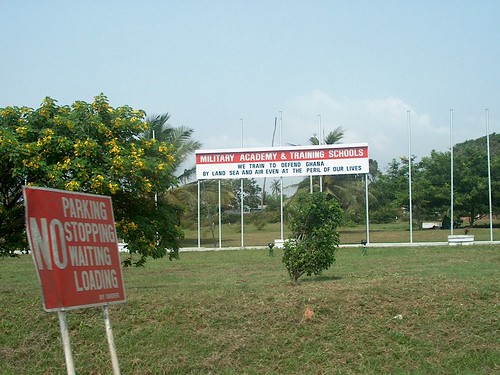
military - we train to defend ghana by land, sea and even at the peril of our lives

I am left to wondering why in this day of of digital music and ipods, the savvy aspiring military junta couldn't come up with a more inspiring playlist. And in the context of Africa, didn't our warriors of old have fearsome praise songs written for their exploits? Couldn't some talking drums have the same effect? why not a "Made in Africa" soundtrack? But perhaps this is missing the point; martial music in the context of a coup is simply a code, a social signifier, and the disrupted programming an intimation of an enduring, if disastrous, tradition. The journalistic descriptions are always about 'blaring military music'. In contrast, in my memory, the dissonance is not really about volume but rather about unfamiliarity and annoyance: the horns were especially grating coming through the modest speakers of the portable radios we gathered around. The irritation was that you couldn't avoid this music even as your favourite news broadcast was preempted. The screeching horns resonated with the tinny sounds of your Grundig Waveboy and made for a rather somber nuisance.

Coups in the past century mostly seemed to follow the same blueprint and martial music was no mere footnote, I'd even wager that they were a critical ingredient. But have there been innovations one wonders, global guerrilla adaptations of the noisome strategy? Reading closely the above news reports, what is one to make about the detail of the 'wrestling program' that preempted regular programming after Niger's coup month's ago? Was it a case of l'appel de l'arènes. And was the continued selling of "mangoes, bananas and pineapples" in the streets after the Guinea coup a flourish of journalistic colour or merely a blasé signifier about the prospects of that grim lot.

I have friends who study the history of coups and military-civilian relations and who will wax poetic on when exactly it was that the airport became a necessary target for a nascent military junta. In Francophone Africa you always had to worry about a flight of French paratroopers swooping in to restore the current client dictator. Not so with coups in Anglophone or Portuguese Africa. Technology also changes things, these days a successful putsch in a healthy media market requires that you deal with those pesky communication networks and pay a threatening visit to mobile phone operators so that your opposition can't organize countering maneuvers.

During the struggle over the abolition of the monarchy in Nepal a few years ago, the reactionary forces tried to shut down the cell phone networks. They managed — for a day, and the enduring damage was done to their cause. The monarchy is no more. Aspiring military juntas should take note that one messes with the mobile phone networks at one's peril. The communication imperative is keenly felt. Even in the bloody aftermath of Iran's last election, the authorities didn't dare take the drastic step of shutting down the mobile networks. The day I read that headline, I'll know that they are done for.

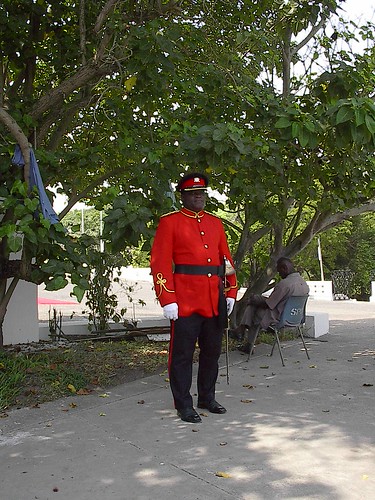
Presidential Guard

Africa will be in the news a lot this year, and not simply for uplifting reasons like the World Cup in South Africa. It doesn't matter that many African countries will be celebrating 50 years of independence, brace yourself for some dismaying headlines even if natural disasters don't dominate. A major part of the narrative is going to be about coups and military/civilian relations. Throughout, it will be about how civil society fights against encroachments on the democratic gains made since the 1990s. Watch for slippages and authoritarian thuggishness on freedom of speech, watch for arbitrariness and vendettas resurfacing, watch for soi-disant democrats averting their eyes to due process. Consider Gbagbo dissolving the government in Cote d'Ivoire - and crucially the electoral commission. Take a look at Sudan in coming weeks for example. Muse on what Mugabe will come up with in Zimbabwe this year. Worry about why North Korea arms shipments are headed to Congo-Brazzaville. Observing the twists and turns in the African story can be very trying.

What are the necessary and sufficient conditions for a coup to succeed in 2010? What is needed in this modern age of citizen journalists, the internet, a web of global voices, cheap digital cameras, Twitter, Facebook, Ushahidi, ridiculously simple group forming and ubiquitous mobile phones and such? Is it enough to capture the radio and TV station as in the past? Should you even bother to threaten the newspapers? Surely the gadfly editors will be watching which way the wind is blowing with alternate headlines at the ready. Do you need to secure the army barracks or just the airport and the country's borders? What about a show of force? Send some tanks into the street? Should one surround the American, British, French and now Chinese embassy - the Chinese are big in Africa these days? In Guinea-Bissau today, soldiers were sent to surround the United Nations compound. Remember that some of the first targets of the Rwandan genocide were the Belgian UN blue helmeted peacekeepers. Or is the current fashion of targeting cabinet meetings the most expedient?

I suspect that the key feature in all this is playing martial music on the radio or TV. The dismal tones of the ironic playlists of authoritarians are symbolic laments of sorts. A dosage of aural intimations of the prospect of bloody streets, these military anthems are set to fierce drums and harsher horns. The lyrics, if any, are a celebration of fisticuffs, eviscerations and strategic disembowelments. Such are the codes of martial music.

A few more nuggets of note:
  • During the 2008 coup in Mauritania, "the first indications of a military coup came as state radio and television were taken off the air amid reports of unusual troop movements in Nouakchott". Note if you will that there was no mention of martial music and that the authors of this coup are still standing. Serious (if bloody) men that they are.
  • During the 2009 coup in Madagascar, there were no reports of martial music on the radio. Perhaps this is because the major beneficiary of the coup, Andry Rajoelina was then "a 34-year-old former disc-jockey". In constrast, there were suggestions about the army targeting the mobile phone networks. Everyone has gone on to condemn the Madagascar coup but Rajoelina is still sitting pretty a year on, his was a 21st century coup: he knew all about the playlist. Threaten the cell phones for sure, monitor Twitter, but don't mess with the radio programming.

I continue to ask, can't they get a better playlist? And dear readers, what constitutes a good martial music playlist? What tunes would you pick for your coup d'état? And what of this here musical theory of coups? Does it adequately model the gracenotes of African coups?

Soundtrack for this note


File under: , , , , , , , , , , , , ,

Sunday, March 21, 2010

The Polyrhythmic Temptations of Erykah Badu

"What good do your words do when they can't understand you?"

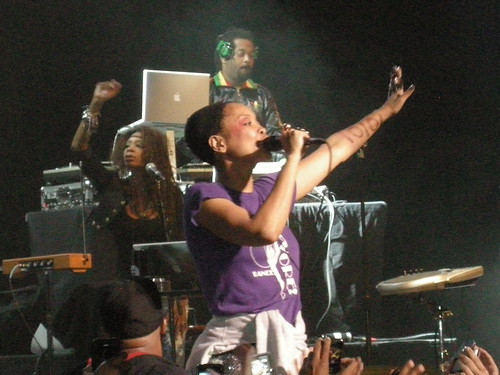
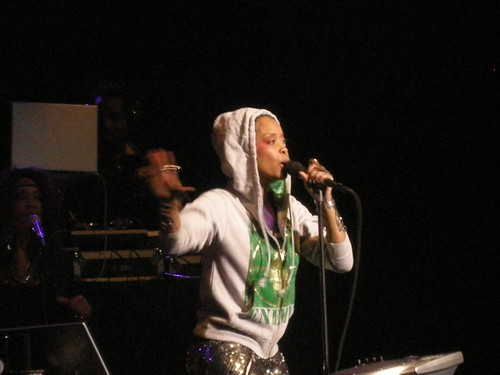
The above chorus seemed to have rhetorical heft midway through Erykah Badu's recent concert at the Fox theater in Oakland. You see, she seemed about to escape the song form, en route to dissolving into a polyrhythmic ether of sorts. Just when lift-off appeared inevitable however, hip-hop brought her back to earth, then, after a short tribute to Michael Jackson, the soul returned. Standing in the audience nodding my head as I observed the proceedings, I started thinking about the relationship between artist and audience. What happens when your muse takes you off the beaten path? What concessions, if any, should one make on the one hand, and, on the other, how much should you, the audience, indulge the performer? Because it was a close run thing you know.

erykah badu finale

This polyrhythmic temptation, this polyphonic inclination, has taken up much of her last two albums. Indeed during the last two concerts I'd seen of her, there was no attempt made to coddle the audience. During the earlier one, in support of Worldwide Underground, she was in the throes of a liquid type of electronic soul music and had began drinking from the polyrhythmic fountain. During the last one - in 2008 in support of New Amerykah Part 1 - polyrhythms possessed her completely. To compound the musical dissonance further in this latter instance, she had made the mistake of following The Roots onstage - a frequently lethal decision on the best of days, and definitively so if the audience isn't ready to be a guinea pig for one's new directions. I enjoyed myself - to my ear it sounded much like a Funkadelic affair, a beautiful mess in short, but I'm not sure that everyone felt the same. For example, The Wife had some words later on - and she wasn't cooing. This past February's concert was fun and more audience friendly (the band was gearing up for the big push in support of her new album). She has pulled back, it would seem; one still wonders however.

Let it first be stated that I dig Erykah Badu, that on the strength of Baduizm and especially Mama's Gun, I will follow her to the musical ends of the earth and beyond. As we wait for the new album to be released in short order, the question most of her audience is asking is whether she will reign in the demons that she wears on her sleeves. Musically also, we're asking whether she'll submit to a sonic conception that is more recognizably song-like and whether melody and old fashioned soul singing will feature. The snarky will ask how long can a soul singer be post-song. The music these days is all riffs, beats, polyrhythms. Blame the sampler (that new accoutrement that has been accompanying her of late), blame Jay Electronica perhaps for a carnal and musical temptation. At times she seems consumed with sonic tics and mannerisms reminiscent of Michael Jackson after 1993. It's no doubt very exciting in the studio but rendered live, it can be challenging.

When someone like Giles Peterson hails her as the Nina Simone of our time, I think to myself, hey, I too am an aficionado of Sun-Ra and believe that the creator has a master plan, but which Nina Simone is he refering to? Does he mean the outsized musical talent or is he alluding to the late era eccentricity and mannered diva stylings? When Sly Stone is invoked, is it apropos her recent funk excursions or... well, let's leave the Sly comparison alone.

erykah badu vibe

Erykah Badu is self referential in the extreme and takes these kinds of cultural perceptions in her stride; she's all about multiple identities and musical schizophrenia. From Lowdown Loretta Brown to her other personas, she's a Kool Keith of sorts, presenting a hyperlinked conundrum asking you to stare at the performance while grooving with her. She demands attention and makes clear she will only do what she wants. It's the kind of creative freedom that few other artists have. It's also part of her mystique. In concert, she sheds skins, and is continually reincarnated. Costumes morph repeatedly as if to underlie that you can't pin her down, you shouldn't even try. To harken to the cautionary lyric that opened this note, I'll only add that there's a fine line between being elusive and being unapproachable. I was minded to call in Stevie Wonder and ask him to sing Have A Talk With God to her.

Let's not go too far and damn her with faint praise, Erykah Badu after all is a student of the great performers, and will jab and feint with the best of them. She remains very successful commercially even though the singles that are released now bear little relation to what you get when you buy the album. In the last album, Honey and The Healer, her tribute to J Dilla, were just about the only songs that moved the crowd and that were heard on the radio. Fair enough you may say, 'radio suckers never play me' is a refrain from Public Enemy on. She always makes sure to throw in a club banger, a unique video and moves units as the say. Who's to argue, right?

The earlier overt homages were to songsmiths: Roy Ayers, Chaka Khan, Midnight Star. These days however it appears that songs don't interest her, rather it is grooves, riffs, beats in short. She takes scraps of rhythm, drum and bass and forms sonic collages. The last two albums have been full of dense polyrhythms, loop backs, staccato effects, overlays and, crucially, very little concessions to the song form or indeed her audience.

Orchestre Poly-Rythmo de Cotonou The Vodoun Effect

I'm no musicologist but as an African I know all too well about polyrhythmic conceptions. The Congolese with their sebene (and the Ivoriens of late) have long prospered on these changes in their music but their inclinations are rather ecstatic. It's about the dance, the audience is constantly in mind, not so with our analog girl in a digital world. The closest analog to Erykah Badu's current game is the vodoun effect of T.P Orchestre Poly-Rhythmo de Cotonou. Think Benin. Think musical voodoo. It's the same aesthetic: funk underneath, musical mysticism, dense polyrhythms, polyphony and frequent changes. It's meant to be hypnotic at its best, I can only hope she reaches these heights as she continues to experiment. And if not, someone should hip her to Poly-Rhythmo.

A typical concert moment will have her holding up her hand, stopping the band just as they've built up a groove. "Hold up. Wait a minute." It's a tic if overused and you sometimes wonder if she can give it to you straight.

erykah badu wait a minute

When performing I Want You, it is almost a dissolve into liquid incorporality but then she pulls back and gets it together as if she has returned from a spell. There are commercial repercussions to how she handles these polyrhythmic temptations. Erykah Badu is by most measures the most popular soul singer of her generation (I'll skip her elder Sade in this comparison and ignore Amy Winehouse and Alicia Keys - call them pop). The soul crowd simply appreciates the voice and the songcraft. The hip hop crowd love her because she has genuine love for that aesthetic. She also happens to make rappers lose their minds such is her aural and sonic seduction. The bohemian are drawn to her mystical stick. All should be good if she holds it together.

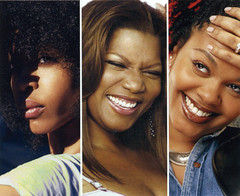
erykah badu queen latifah jill scott 2005

I can recall fondly a joint tour with Jill Scott and Queen Latifah in 2005 when they appeared all-conquering in friendly competition. It is instructive to see how her contemporaries have dealt with fame. Jill crossed over into acting where her evident warmth is welcomed - her music hasn't been as strong since, but there are mutterings that she's hungry to get back on top - viz the forthcoming album and tour with Maxwell. Latifah? Well she's escaped music entirely - I was given the hard sell over Christmas about a Queen Latifah perfume.

I know I shouldn't, but I'm going to compare her to Amel Larrieux if only to contrast their live performances. Amel will joke that she is 'the queen of long endings' and I believe that this is an interesting way of dealing with having to sing the crowd favourites. She'll sing most of the song straight up and then go an excursion at the end and no one can tell where the song will wind up. This strategy allows the song to be different every time, depending on the mood of the band, the vibe of the crowd and so forth. Erykah's heart doesn't seem into her back catalog, she's experimental from the get go, the song doesn't interest her, it's more a mood that she's searching for and she'll add layers and rhythms. The result is that the audience doesn't get even the benefit of being moored to familiar ground.

erykah badu points

The new album, Return of the Ankh, is about to be released in few days. I suspect that the first singles won't sound anything like the rest of the album much in keeping with her modus operandi. Erykah Badu continues to be tempted by polyrhythms, this is not a temporary flirtation. Let's hope that she manages to navigate the tension between her muse's direction and the commercial imperative.

Erykah Badu at the Fox Theater Oakland, Friday 19 February 2010

Opening Act: Goapele

Goapele opened the show with a short set mostly of old favourites. She also introduced a slow and moody new blues: Tears on my pillow, capped off with a lovely organ solo. Oakland gave her love.

Here's my illicit footage of Goapele performing Closer.

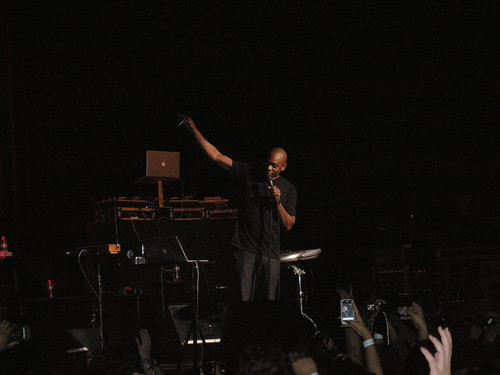
Dave Chappelle showed up, drawing a great cheer, to introduce the main event.

dave chappelle

Setlist
  • 20 feet tall (from the new album, psychadelia itself)
  • The Healer
  • Me
  • My People
  • On and On
  • & On
  • Appletree - done as an electronic boogie joint
  • Michael Jackson medley finishing with Off the Wall
  • I Want You
  • Didn't you know
  • Love of my life
  • Hip-hop interlude:
    • Friends by Whodini
    • Lodi dodi by Slick Rick and Doug E. Fresh
  • Large Professor interlude showcase for the dj
  • Bump it
  • Back in the Day (Puff)
  • Muddy Waters sounding joint
  • Other Side Of The Game
  • Soldier
  • Next Lifetime
  • Orange moon (snippet)
  • Tyrone
  • Bag Lady

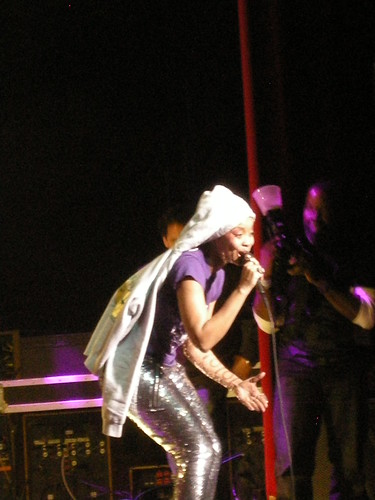
Obligatory blurry photos: Erykah Badu Live

File under: , , , , , , , , , , , ,

Friday, March 12, 2010

Juicing the Books

My greatest acknowledged vice, according to two of the women most dear to me, is that I drink too much fruit juice. Rather than dwell on this marital and maternal complaint over what is surely a most benign addiction (compare the problems of keeping a fridge full of orange, pineapple and mango juice to alcoholism, the perils of nicotine, drugs, sex, or say dodging bill collectors due to gambling debts with loan sharks and their ilk), I thought that acknowledging it upfront would help explain how I worked myself into a state of righteous indignation over the following article. Well partially at least.

Tropicana Orange Juice Raising Prices

PepsiCo said it was shrinking its most popular size by about 8 percent, while maintaining its price, and raising the price on another size starting in May.

The 64-ounce container of orange juice will drop to 59 ounces. The suggested retail price will remain at $3.59. [snip]

Food and beverage makers react to changing ingredient costs by raising prices, changing products sizes or both. It is a way to protect their profit margins, and in the case of shrinking packages, offer less to shoppers so they can still buy products without having to pay more money at once.

Now far be it for me to complain about my suppliers raising prices. It's not a case of hell hath no fury like a juice lover squeezed. I do understand, after all, that the Florida winter damaged crops this year and that there's supply and demand and all that. Like Bubbles in The Wire, I accept what a working man has to do to make a living. It's all in the game right? No, what got to me was the disingenousness of the thing. That last line in the article is a prima facie lie, an attempt to disguise a price increase with weasel words. Well I started feeling like Bodie: the game is rigged.

You may recall me discoursing on The New Formula - the propensity of companies to tweak processes and often worsen their products in furtherance of the bottom line, a pathological hallmark of latter-day capitalism. I even had a case study showing how spikes in the prices of soybeans directly led to me losing out on my trusty Oil of Olay body wash as, first, the oil maleation process was removed and then, when there was nothing to be tweaked in the manufacturing process, soybeans were removed and the product was relaunched and relabeled "new and improved". Such is life right? Make lemonade when life gives you lemons.

But that was tinkering with process, now they're even messing with my lemonade. With commodities like juice, one would think that there is only so much you can do to process to wring out efficiencies. You can only pay the illegal immigrant labour force so little to harvest, even they need basic food and shelter after all. The gains from fertilizer are diminishing and runoff issues are quite literal. Even the politics of it are confusing; banana republics are expensive these days. Ecuador's going mildly 'socialist' to the dismay of old fashioned Texas businessmen. In all seriousness, the economics of modern day agriculture are fairly well studied and there's precious little slack.

pineapple

No. It's the package shrinking that gets me. The Tropicana deception, as I called it, this juicing of the books is only the latest in an interesting trend of manufacturers increasing prices but retaining the same size packaging. Bottles or containers are made more convex, given revamped designs to fill the same physical dimensions, the spouts are shaped to pour out more than previously. Throughout the sticker price remains constant in order to fool the indiscriminate consumer into thinking that they are receiving the same product.

This orange deception is the result of literal bean counting in the spirit of airline companies in the 1990s that literally started saving peanuts (reducing the number of peanuts per package distributed in flight - and these days you're lucky to even get any complimentary snacks). We're being nickeled and dimed to death. The sole concession to honesty is in the small print of the labels on supermarket shelves - the per unit price that generations of consumers had to fight for. Regulations that are often meaningless in the marketplace.

Consider liquid detergent in this vein. There is a fine interplay of fluid dynamics between the design of the spouts of modern liquid detergent bottles and the viscosity of the liquid they contain. And this is an engineering and marketing decision, when you pour, sometimes things come out faster than you expect. At other times, it is rather that you have to be quite lithe of hand to steady the bottle as you try to stop pouring - call the result excess runoff if you will to keep with the fertilizer analogue. It's a minor irritation to be sure but the net effect is to make you use more of the product than you expected, a cynical nod towards planned obsolescence. And I've experimented you know, I follow these things closely - for a couple of years I even kept a collection of old bottles of Ivory, Palmolive, Tide and the like. Results? Well each brand tweaked their bottle design and consumer convenience was never in mind.

But let's broaden the perspective here on this mania for manipulation, this drive to extract surplus value. We see this in strategies adopted in modern agriculture - or should I rather say agribusiness: piling on the fertilizer, force feeding animals substances that should alarm even the most jaded, corn everywhere, herding in crowded cages, top-ups with antibiotics when expedient and so forth. No wonder modern farms or say your local meat rendering plant are desolate places. But this imperative has broad applicability. Airline travel is now seen in its true light - convenient perhaps, but an exercise in stress and physical discomfort. The space in economy class of ye regular airline is now so circumscribed as to be cattle tested. The logic indeed is that we're only cattle. "Buy something you stupid consumer" as that poster goes.

But I can understand the perverse incentives. I know that there is a push at the end of each quarter to close deals and I've felt it wherever I've worked no matter how low up the totem pole I might rest. You don't need studies of companies manipulating earnings to consistently beat expectations to know what all this means. When we read about Lehman Brothers doing the Repo 105 dance, it is much the same attitude towards truth in advertising at work. The current encomiums to "do more with less" have their counterpart as we have seen, "sell less for more" is Pepsi's slogan. As someone who owns stock I can understand the profit imperative, as a consumer however, I know it will come back to bite me and in this case, it will bite me in the form of a 59 ounce juice container lovingly designed to fill much the same shelf space as its 64 ounce predecessor.

It's all a shell game and there are now so few scales left to fall from my eyes. I am now eagerly awaiting the new juice containers in May to add to my collection of deceptive latter day capitalist artifacts - an archive of products engineered for the express purpose of juicing the books.

Soundtrack For This Note


Anyone have any further examples of these newfangled "advances" in packaging?

Disclaimer: I should note that of late I've been mostly buying a brand of juice that is often sourced from South America (typically Brazil) rather than juice from Florida or California - I wonder if I'll return to Tropicana or Minute Maid after this fiasco - can't they have the nerve to simply increase the price? And while digressing, I should also again note that I've started to see pineapple juice from Ghana making it to the supermarket shelves in these California climes. I do applaud the wonders of distribution in this modern age. It's the packaging and advertising that gets me down. Deception innit?

File under: , , , , , , , , , , , , , , , , , , ,

Saturday, March 06, 2010

A Kenkey Bounty

Happiness is finding kenkey in Oakland - and not just something purporting to be kenkey, but good kenkey. You hadn't realized how much you'd been missing kenkey in your life so you beamed when you saw those corn husks wrapped around those broken pieces of your heart. Call it a restorative. And then to cap it off you notice some good puna yam at the door of the store, "From Ghana", she assures you. Hey it's Ghana's independence day and what better way to celebrate. Your basket was quickly filled with the basics: kenkey, yam, sardines, tilapia, plantains, okro, palm oil, fufu powder, and the old faithful, gari. You had come perilously close to disaster but had remembered that piece of advice that they announce as the plane takes off from Kotoka International Airport: "A Ghanaian immigrant should never run out of gari"; it's like losing your soul.

One of the problems with being an immigrant is getting food from home, a problem exacerbated especially if, like me, your culinary tastes were locked in place by age 8 or thereabouts. Physical displacement can be tolerable - a cosmopolitan disposition helps, but culinary dislocation goes beyond the realm of physical to a certain level of metaphysical angst. Like nostalgia, it's almost a social disease. As that wise man said, "home is where the kelewele is".

kenkey bounty

I see it as a quality of life issue. Moreover I have a very specific notion of (my culinary) home. I could eat plantain every day (and often do) - and have been known to base my housing decisions on its availability. So the first thing to investigate when in a new town is where the "African" shop is and if my staples can be obtained. My kelewele has to be styled like Auntie Becky's in North Labone - and I've been known to come to virtual fisticuffs with other exiled souls who have the nerve to argue that it was rather 'the woman from Labone junction' who made the best kelewele in town. Good grief. Well, less said on that, I shouldn't blame you if you haven't been exposed to that slice of heavenly taste.

Fruits: mangoes, bananas and pineapples preferably from Aburi and its environs - I am a failed pineapple farmer - and more on that later. Fruits however can be substituted. Banku and kenkey are irreplaceable. When it comes to kenkey, it's Ga kenkey that is essential. I could of course learn how to make kenkey but I always demur, safe in the knowledge that I'll never reach the heights of some of the good kenkey houses in Osu or Jamestown. I believe in division of labour. Sidenote: to avert the inevitable Ga versus Fante kenkey critiques, I'll admit that Fante kenkey off the road from Cape Coast is quite the thing. Tell Mama Akos Esi (or rather, her grand-daughter who tends to skip school to mind the stand) that I sent you.

mama akos esi fante kenkey

There's probably a longer feature to be written about the "African shop" abroad that caters groceries, phone cards and serves as community bulletin board to the diasporic cohort. My experience in France is perhaps coloured by the relative lack of authentic African food stuffs where we lived; the substitutes helped but weren't sufficient and French cuisine leaves me completely indifferent to this day. In London in the 80s it was first Charlie's in St John's Wood that catered to our tastes - although Charlie's English reserve and hefty prices were a bit hard to take. Then, as the immigration wave crested, we started to see competition as Africa immigrants opened their own shops - the couple of Afro-Carribbean shops in Cricklewood made my day. Later, Ghanaians and Nigerians took over many parts of South London so that Deptford on a Saturday could be well be Kaneshie market. In New York and New Jersey, there were of course the Korean shops that were early entrants but again Ghanaians and Nigerians have now caught up and compete in the culinary marketplace with groceries and now restaurants. Boston was touch and go - the Ghana shop that I frequented moved a number of times - and even burnt down at one point. Still, I was never too far from plantain, yam, gari and kenkey. And the world was good. Slowly and surely the African culinary colonization is taking place and these days many supermarkets cater to our diaspora. Would that this trend continue.

Downtown Oakland has the Lucky Oriental Mart which, despite its title, is comprehensive in its purveyance of all manner of African and Carribean food. God bless the Filipino owners whose knowledge of our plants and foods is a thing to behold. The only gap in their coverage had been a regular supply of decent kenkey - now resolved. I do hope these soul sisters make it to the continent one day; on this Independence day, they captured my heart with a few balls of kenkey. A small thing perhaps, but I am duly sated. From here on, I only have a few fantasies to fulfill: some chichinga or grilled Guinea fowl - well a man can dream can't he? Everyone needs a taste of Africa.

File under: , , , , , , , , , ,

Tuesday, February 02, 2010

Black Sheep

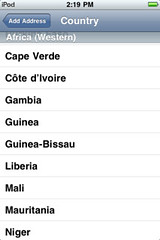
Every feel unwanted? Ever feel like a pariah? What if your country starts disappearing from the global zeitgeist? When, I wonder, did Ghana start to fade from view? All right, let's get concrete here. Try this on your iPod Touch or iPhone (I was given a first generation iPod touch - now running iPhone OS 3.1.2 - a while back as a kind of consolation prize when my job seemed in doubt - but I shouldn't digress about the pathologies of corporate America). Anyway, where was I? Yes, take your i-something, open the Contacts App, create a new contact and add a new address. Alternatively just try to edit an existing address. Now try to change the country field to Ghana. Note, if you will, the result: Ghana is not in the list of countries. Search under "Africa (Western)" and you'll see nary a trace of Ghana. Heck, look through the entire list of countries and realize that we didn't make the cut. Ghana is not a country in the eyes of Apple.

ipod touch country list bug: Ghana must go

I came across this issue over Christmas when I was home and trying to enter new addresses in this, my conflicted glorified organizer thingimijig. It's just a bug of course, and presumably if I complain loudly enough or write up a bug report against Apple, it will get fixed. Whoever wrote the Contacts app is certainly not trying to whitewash Ghana from history. They just don't have many Ghanaians using iPhones, nor indeed testing the feature hence the omission slipped through the cracks, embarrassing as it may be. Moreover I've been on the other side of the fence, producing software that at times has been seized upon for subtle local insensitivity. I've even written in the past about the cultural difficulties that any piece of technology can elicit so I won't be calling for boycotts or apologia.

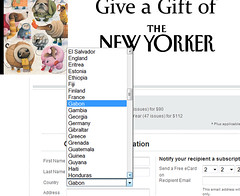
But wait, there's more. It seems that Ghana has been disappearing left, right and center from dropdowns and country selection boxes all over the web. I keep coming across this kind of ethnic cleansing in my browsing. Who decided that Ghana must go? It is one thing to be a literal exiled soul, a man of many countries but no home, but it's adding insult to injury to be cast into virtual exile. What gives? Why are form widgets all of a sudden slimming down and discarding Ghana? Why are even these fleeting elements of identity, that pleasing sight of Ghana nestled in between Germany and Gibraltar, being denied me and my countrymen. For example, in the past week I've been trying to buy gift subscriptions to some magazines for my uncles (Economist, Newsweek, New Yorker) and noticed that the online payment processors that these websites use simply don't feature Ghana in the list... go take a look: Gabon, Gambia, Georgia, Germany, Gibraltar. Where did Ghana go?

new yorker country list bug

newsweek country list bug

economist country list bug

I opened an investigation into this onset of web deportations but, first, let me tell a story...

My routine, ever since 1998, has been to spend my Christmas vacation in Ghana. As a fairly dutiful engineer son this means that 24 hours or so of my vacation is spent on tech support. I either bring new computers or coax the parental unit's setup into shape. They've tended to use Windows as their operating system so, as a matter of course, I would install or renew the subscription to Norton anti-virus or some software firewall or other, paying penance to the insecurity of the Microsoft ecosystem. Since 2005 however, I have been unable to renew the subscription with Symantec from Ghana. It's the usual thing, any credit card transaction from a Ghanaian or Nigerian IP address would fail silently with only a cryptic error message. I had a US billing address and yet my transaction would keep getting denied.

After repeated instances of this, I eventually worked out that the payment processor that Symantec uses had declared Ghana a nation non grata. Thus for the past 5 years, I would renew the subscription when I returned to the United States, or by using the corporate VPN (back when I was actually foolish enough to take a work computer with me on vacation) in effect pretending to be in the USA. Sidenote: the other alternative that most Ghanaians take is to simply install bootleg software or some open source or more wallet-friendly package (virtually no one actually pays Microsoft or other vendors for their wares).

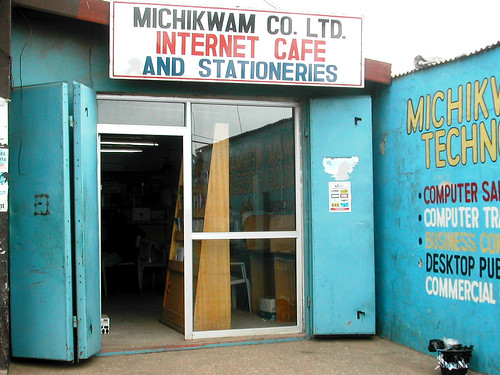
Containers: cybercafe

Ghanaians have great difficulty using credit cards, PayPal, Google Checkout and the like. If we take ecommerce as one component of modern global citizenship then we are illegal aliens of sorts, and our participation is marginal at best. While remittances are a major part of our economy, we continue to pay a heavy price in all our financial transactions. Banks, wire transfer and check cashing joints salivate at the profits they make on our backs and yet the kind of routine monetary transactions that any idiot with a credit card can do in the West is a pipe dream.

The major reason of course is that a large amount of 419 scams, advance-fee schemes and outright frauds seem to emanate from our virtual lands. Payment processors tend to filter with a broad brush and their geolocation heuristics often tar almost all IP ranges from Ghana. The same story goes with spam filtering and some ISPs are known to ban entire countries arbitrarily as mitigation measure (I've seen this applied to countries like Russia, China, Korea). I have lots of Nigerian friends and their emails are often consigned to the spam folder even in GMail whose spam filtering capabilities seem to be the most discriminating. I can recall a member of the security services in Ghana quipping that two thirds of the 419 scams in the world could be stopped if police could simply round up everybody at Busy Internet and other internet cafes in Accra at the right hour. Thankfully that broad brush hasn't been applied - think of the rule of law, false positives, and Minority Report a priori censorship. Still, the actions of an unruly minority are making life difficult for us all.

Busy Internet

What is most galling now is that even our Nigerian brethren in e-criminality are on the list of countries in the above 4 cases. We have the workings of a different bug. With tongue firmly in cheek, I would say that Ghana is uniquely blacklisted. If you live in America, you expect that you won't see North Korea, Iran, Cuba or the like in your commercial browsing since sanctions and embargos pertain. Why would Ghana be in such august company?

One hypothesis, for the websites at least, is that the bug is at the level of the payment processor: Entrust, or Visa, MasterCard etc. Or perhaps our unreliable postal system is at fault. Another alternative is simply that there is a canned type of widget that is being used around the web. I know how these things work: most programmers cut and paste code when they are developing their sites, I know I do that often enough. A cursory inspection shows that the Condé Nast sites are using the jQuery toolkit, a potential source of the bug, but it could be any of the other popular toolkits, Dojo, YUI, Scriptaculous etc. These are pre-canned form widgets and one can envision that a popular tutorial site or user interface toolkit has the bug and has been widely copied.

But, what about the bug in Apple's iPhone Contacts app, one wonders? That seems like an outlier unless it too was written as a web app using much the same widgets. Does anyone have any theories on the matter?

I won't get into how Orbitz and Expedia have now followed the lead of Travelocity in removing Accra from the list of places you can book travel to - this, even though major airlines like Delta, KLM and British Airways fly there. I know that my small country doesn't warrant much attention, I know my place. But this is different, all I want to do is enter some addresses in my organizer or send my uncles some magazines. Magazines that are ostensibly a dying business won't even let me send my hard earned money to them. Someone help me, I feel like a black sheep.

File under: , , , , , , , , , , , , , , ,

Thursday, January 14, 2010

Best of 2009

Everybody likes lists so here's a list of things that moved me in 2009. I didn't blog much (a mere 5 posts - I was quite shaken) but I did leave quite a wide digital trail by compulsively tracking my consumption of various cultural artifacts - especially as I tend to make time to write mini-reviews. A cursory summary of my year: 50 books, 120 movies (blame Netflix), 10 concerts and 1 play. I remain an omnivorous consumer of the web and additionally bookmarked or shared up to 680 articles and blogposts (blame the 1099 feeds I subscribe to Google Reader) - each of these was the occasion of some pithy commentary and tags, your basic frisson de folksonomie.

Books


I read mostly novels last year and eschewed non-fiction since I haven't yet become American in my reading preferences. There was some poetry especially near the end; mostly web-based after I got interested in how poets are using the web.

Entertainments


Entertainments tend to get short shrift, dismissed as they are as guilty pleasures, yet there is something to be said to bask in the glow of literary entertainments. With hindsight, I prefer Graham Greene's self-described 'entertainments' to his serious pieces. I've resolved to increase the quotient of entertainments in my reading.

  • Zuleika Dobson by Max Beerbohm
    A delightful entertainment and sublime take on a bygone era at Oxford. Compare to the best campus novels like those of Kingsley Amis and David Lodge or even more scabrous affairs like Porterhouse Blue. Satire and vicious cultural observation. Some of the dialog from the upper class twits reminded me of his Edwardian contemporary, Saki. For example,
    Are you fond of peasants? My tenantry are delightful creatures, and there is not one of them who remembers the bringing of the news of the battle of Waterloo.
    How to describe an effete English Lord in 2 sentences.
  • Comment Cuisiner Son Mari Ă€ L'Africaine by Calixthe Beyala
    A novel in the form of a cookbook. A cookbook in the form of a novel. A fable in the form of a tasty barbecue. A romance spiced with flair. A delightful confection through and through, cooked with verve. A sensual read, it is also a thoroughly modern affair set in the milieu of low income housing in Paris. She was early in documenting immigrant life and prescient about the travails of exiled souls.
  • The Charlie Mortdecai trilogy by Kyril Bonfiglioli
    The three Charlie Mordecai novels, Don't Point that Thing at Me, After You with the Pistol, and Something Nasty in the Woodshed have the highest concentration of effortless wit, zingers and cultural affectation I've encountered in a long while. Who knew that the intrigues of a disreputable coward, art snob and seasoned thief would be so entertaining? The increasingly intricate plots are almost incidental - verging at times on spoofs of James Coburn spy capers which were themselves spoofs, the towering pleasures are in the asides. I want to have cocktails with Mordecai.
    My life-long study of the art of warfare has taught me that running away is certainly the most cost-effective type of fighting. It doesn't win many battles but it saves you a lot of troops. Ask any Italian general if you can catch him out of his hairnet. Or, indeed, if you can catch him at all.

    — Kyril Bonfiglioli - After You with the Pistol, page 74
  • The Parker novels by Richard Stark
    Donald Westlake sadly passed away late in 2008, his alter-ego's productions are the gold standard of hard-boiled noir, spare and stripped down tales of amorality and professional crime. Luckily many are being reissued these days. The Mourner, The Score and The Seventh were last year's comfort suites for me, variations on a heist with a relentless force of nature at the helm. Also revelatory was Darwin Cooke's graphic novel resurrecting Richard Stark's Parker: The Hunter. Revenge has never been better.

Masters of Storytelling


There's nothing like letting go and putting your faith in one of these craftsmen of the tale:
  • Verre Cassé by Alain Mabanckou
    I read a lot of Mabanckou last year and an appreciation piece is sorely overdue. He is one of the best living African writers and yet few focus on him perhaps because he writes in French. Let's hope that the new translations that have began appearing remedy the situation - Broken Glass seems to be getting some buzz. Short of that, I'll become his shill. His latest, Mémoires De Porc-épic, was also magisterial.
  • Moses Ascending by Samuel Selvon
    After discovering the many pleasures of Zee Edgell last year I resolved to read more Caribbean literature and, after plowing through Selected Poems by Derek Walcott, I went back to that other master of Caribbean letters, Samuel Selvon, catching up on his great creation in 1970s England. A novel packed with hilarious observations about immigrants, poor whites, Pakistanis, black power, sexual mores, the relationship with authority figures, and throughout the resilient hustle of the Caribbean immigrant.
  • The Dragon Can't Dance by Earl Lovelace
    Call it a masquerade or rather a prose calypso. Wonderful social commentary on Trinidad, straight from the slum hills overlooking Port of Spain.
  • The Friends of Eddie Coyle by George V. Higgins
    Beautiful writing, haunting characters and an unerring ear for the nuances of language. The film adaptation is a classic of tragic noir, Robert Mitchum was never better.
  • To Each His Own by Leonardo Sciascia
    A sardonic lament on the corruption of the mafia. He cut out all the fat in the narrative and the result is so restrained as to be unbearable. It lingered in my mind the whole year and resonated as I watched Gomorrah. What is to be done when this malevolent thing can blight an entire society? The follow-up, The Day of the Owl is, if anything, more menacing.

Urban Dread


  • Man Gone Down by Michael Thomas
    This one hit too close to home mainly because I know one of the barely fictionalized protagonists. Observations on race, identity and cultural anomie from the viewpoint of Boston black Americans close enough to the ivory towers to make their continuing travails and periodic falls from grace more heartrending and frustrating. An elegy for the modern strays of the world.

    Also in the same vein of urban dread, The Scholar: A West Side Story by Courttia Newland with its inner city London setting and The Turnaround by George Pelecanos who continues to mine the streets of the Washington DC area.

Heartwarming


I Do Not Come to You by Chance by Adaobi Tricia Nwaubani

Young African writers are in ascendance these days. This wistful and funny study of world of the 419 scam was the best and most heartening of the lot. I never quite got to Sarah Ladipo Manyika's In Dependence or my friend Nii Ayikwei Parkes's Tail of the Blue Bird so those will have to be part of the 2010 contingent.

Theatre


The Cutting Ball's production of Ionesco's The Bald Soprano was a tonic, what with its great translation and interpretive gusto, but then you know that I love all things Ionesco.

Movies


  • In The Loop
    The best film of the year. The best adaptation of the year. The most fun of the year. A satire of the build up to the Iraq war, it hit harder than all the war movies. The Alistair Campbell character is larger than life but the entire cast shines.
  • Goodbye Solo
    Ramin Bahrani is fast becoming my favourite director; he manages to get so much out of his actors. I'm fairly sure I've been driven by a taxi driver with the same spirit as Solo (wonderfully played by Souleymane Sy Savane) in Boston. They caught the magic with this gripping meditation on life and family ties. The previous year's Chop Shop was gritty and heart-breaking.
  • Killer of Sheep
    Talking about strays of the world, how about a portrait of working class life in 1970s Los Angeles. Charles Burnett's masterpiece only received a theatrical release after 30 years. I can still hear Dinah Washington's This Bitter Earth play in the background of a hot apartment in the summertime.
  • Sin Nombre
    The most uncanny love story meets road movie meets Latin American gang life. Mesmerizing.
  • Gomorrah
    No wonder the writer, Roberto Saviano, now needs police protection; Matteo Garrone's adaptation brings stark visuals to a relentless milieu of social corruption and violence.
  • District 9
    I hope Neill Blomkamp never gets budgets ala James Cameron, his scrappy aesthetic and expedient innovations are fine by me.
  • Nuts in May, Abigail's Party
    Happy-Go-Lucky also was my top film of 2008 hence I went on a Mike Leigh spree and revisited many of his early television pieces. Fun all around.
  • Life and Nothing But
    The aftermath of the first world war is a great backdrop for a meditation on loss and love. Another Tavernier-Noiret collaboration.
  • Mapp & Lucia (series one)
    I have long loved E.F. Benson's Mapp & Lucia series, its celebration of beastly manners are economical marvels of observation. The television series didn't disappoint.

Music


I have a series called The Lost Reviews in the works so I'll simply note the high points.

And then there were the passings. Michael Jackson's death left a hole in my heart. The concert film was no consolation and the tributes barely salved the soul; the thrill is gone. Add to that the recent passings of Willie Mitchell and Teddy Pendergrass and what is a soul lover to do. Rest in peace.

Late Pass:

Kutiman's Thru You was the most creative album of the year, all the more impressive since Youtube was his orchestra and jam band. Dig it.

On to 2010. My mantra: focus and produce.

File under: , , , , , , , , , ,

Monday, December 14, 2009

Africa 1989

It struck me that we haven't heard many African voices in all the recent reminiscing about the year 1989. Anniversaries abounded. From Tienanmen Square, through the Soviet withdrawal from Afghanistan, to the fall of the Berlin Wall, we've had retrospectives on these momentous happenings. 1989 evokes loaded images, especially poignant amongst these being the transformations in Eastern Europe and beyond that affected the whole world. The year is a convenient stand-in for epochal change, Cold Wars fizzling and so forth. 1989 was similarly epochal in Africa even if our headlines were filed in the inside pages of our collective newsprint. Africans weren't mere onlookers and enjoined in the global conversation of those heady days.

I then came across some fragmentary notes I had on the year in Africa, notes I'd written when I was in a more jaundiced mood - they verged on the bleak. Writing today, however, I am more sanguine about that year, and hopeful, even as I look back. I can point to many items that genuinely warm the heart. You have to take the long view when it comes to Africa, and perhaps this accounts for the dissonance one feels about our past. Perhaps you'll be able to detect the keys in which different parts of the following were written.

I. The Reign of Locusts


Item:
Although political transformation in the 90s proved to be of variable intensity and longevity, often turned out to be new wine in old bottles, the change on the continent has been lasting. The incidence of military coups has dropped so far as to become negligible and there is an indisputable increase in functional democracies. In 1989 only three countries in Africa could claim to have democratic governments.

— Akwe Amosu musing on Democracy in Sub-Saharan Africa: Trends and Transitions (pdf) in 2007
Dig:
I've often wondered what it was like to attend, say, an OAU meeting circa 1989. That must surely have been a rogues gallery sans pareil. Could you shake hands with everyone in that room and look at yourself in the mirror the next day? For that matter, could you sleep that night? And what did the small talk of the nifty fifty sound like? Scratch that, what exactly was their big talk? Inquiring minds want to know.

— Excellent Discussions

Having looked at Africa in 1966 (when innocence was lost) and written about the promise of Ghana in 1969, the faint glimpses of hope in 1992, and the pre-millennial tension of Africa 1999, and with an evident itch to scratch, I thought I'd give the toli take on continent in 1989. The 1970s and 1980s have been termed The Lost Decades in much of Africa — almost as if a plague of locusts had the run of the continent. We should tentatively file these notes under the banner of fallen angels.

crocodile

Let's start with this: Robert Mugabe of Zimbabwe would likely have been the golden boy at the OAU meeting in 1989.

With 20 years hindsight, it is hard to believe that Zimbabwe was the example that the rest of Africa was being lectured about to emulate by the donors. Its vibrant economy, well managed agricultural sector, deep focus on educational achievement, and its democracy seemed without equal. Where its neighbours were basket cases, Zimbabwe appeared to be moving forward, it was the "success story". Mugabe's "egalitarian socialism" was being studied by Western cognoscenti. A stereotypical halo of smugness would surround my Zimbabwean friends of the time (side note: my Sierra Leonean comperes exuded similar confidence). Suffice to say that things can go wrong or right in a hurry.

He of The Little Green Book, Colonel Muammar Gaddafi, would have been a few years removed from the US bombing attacks that aimed to kill him, and a year removed from the reaction over the skies of Lockerbie. A French jet would suffer a similar fate in September 1989 when a bomb would kill all 170 people on board as it flew over the Sahara. There were even more potent, and certainly uncontested, acts, however, in his interaction with the West: the Provisional IRA was in full murderous effect in 1989, equipped with significant supplies of his explosive Semtex and sundry weapons; it would rotate members for training in the Libyan desert. As I recall, public transportation in London was an exercise in bomb threat delays followed on occasion by actual locomotion. The implications for West Africa of He of The Little Green Book's unmoored rage would be far more bloody I am sad to say. He was just about to unleash Charles Taylor and Foday Sankoh from nearby camps in his grand project of revolutionary agitation, and more on Liberia and Sierra Leone anon.

I won't bore you with by enumerating the long list of dictators that ruled and the havoc they caused, it makes for dismal reading (3 democracies out of near 50 countries remember). From "Comrade" Siad Barre in Somalia to Master Sergent Doe in Liberia and Sergent Eyadema in Togo, it was repression as usual. Most significant, perhaps, in this dreary military vein was that Omar al-Bashir came to power in Sudan in a coup on 30 June 1989. His regime brooked no opposition and promptly took Sudan's civil war into high gear. The legacy of Lost Boys and such ensued. Civil wars are never pretty and Sudan's was long and ugly.

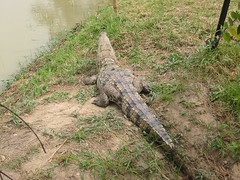
crocodiles emerge at paga pond

Structural Adjustments


For what it's worth, in my native Ghana, Flight Lieutenant Rawlings's PNDC was typically authoritarian throughout 1989 as our Truth and Reconciliation commission has outlined. Apparently it was no contradiction for a supposed Marxist to be implementing the unpopular IMF Structural Adjustment Program, he was an early adopter on this front. General Ibrahim Babangida of Nigeria was of the same mind, and followed suit with the IMF and the World Bank. Expediency trumps everything if the preservation of power at all costs is the overt motive. Popularity or economic sense in policy doesn't matter much when you have a military regime, your populace will have to cope with whatever you dictate. It is the very definition of dictatorship. Structural Adjustment, then, was the great agenda in Africa, and many countries were being put through the wringer its paces. I'll note in passing that the term "Washington Consensus" was coined in 1989 at the very height of authoritarian rule in Africa. The Cold War bred strange bedfellows but none so ironic as the combination of mild-mannered Western financial technocrats and African dictators.

The inevitable backlash was felt from civil society, large enough to have necessitated a bit of rebranding and message massaging. In 1989, we started to hear about "structural adjustment with a human face" and its counterpart "sustainable growth with equity". This revelatory exercise in linguistics only betrayed the apparent irony that inhumanity had been the prevailing concern, with equity as an afterthought. In fairness, the legacy of these programs is mixed: the economies of most African countries did need reform after all. What is beyond question, however, is that the success stories that were being touted in 1989 were nothing of the sort, most of the gains were chimeric. Ask any Ghanaian if the 80s were good years if you want to hear a hearty guffaw. Would that the development aid cohort had their current restraint in those years, their swagger was hard to take. Some of us have long memories...

Francophone Africa presented a perfect picture of client states. Smooth operators like Omar Bongo (President of Gabon) and Houphouët-Boigny (President of Côte d'Ivoire) mixed the requisite post colonial trappings at home with the luxurious core of sleazy quasi-corporate patronage of the French political class. Call it equal opportunity looting or mere cronyism, enabled by Mitterrand and the revolving board of Elf-Aquitaine and others. France regrets those good old days. Who wouldn't, I wonder?
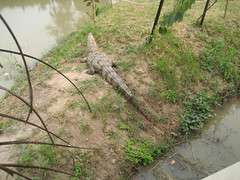
crocodile

Mobutu of Zaire was in full flight, an unchallenged dictator systematically breaking down the social fabric of his country while breaking world records in kleptocracy. Interestingly enough, by 1989 he was a little fed up with some of the shenanigans that some of the other African rogues leaders were getting up to. These parvenus were beginning to spoil the game for everyone. In mitigation, and in a rare act of regional statesmanship, he even helped broker a peace deal (promptly broken) in Angola. Now Mobutu was not one to do anything without a pecuniary motive hence inquiring minds are wondering what he was promised for his efforts. We'll no doubt have to wait until the State Department declassifies records in 2014 for the answer. Accordingly, I've already scheduled my FOIA request in Google Calendar.

It is worth dwelling on the Angolan case. Jonas Savimbi broke the barely 2 month old ceasefire, the fruit of years of negotiations, and resumed the civil war in Angola. Master of the huhudious, Savimbi declared:

"The Angolan people, to their infinite sorrow, accept that the war has restarted."
That, without any doubt, has to be the quote of the year 1989. He was the one who decided to break the peace, he didn't ask anyone, he presented the Angolan people with war as a fait accompli. He was to deepen their infinite sorrow for another 13 years.

Human Right's Watch began their Africa Watch in 1989 in their world report with a look at the Angolan case. Again it is instructive:

This refusal to criticize rebel abuses stems from the Bush administration's unwavering support of UNITA and its leader, Jonas Savimbi. For 14 years UNITA has been seeking to topple Angola's post-independence government in a war that to date has resulted in the deaths of over 100,000 people, most of them civilians. The U.S. policy of funding UNITA, first initiated by President Reagan in late 1985, has if anything been solidified under President Bush. Even before President Bush took office, he wrote to Savimbi assuring him that "all appropriate and effective assistance" would continue. Then, in 1989, to compensate for the loss of South African military and economic assistance to UNITA, the Bush administration increased the level of U.S. covert aid for Savimbi to close to $50 million. Although termed "covert," U.S. assistance is widely characterized as an "open secret." Savimbi himself made a public statement in June that Congress had renewed his aid, and was also quoted in Jeune Afrique magazine as saying that he had received $35 million in funding from the Central Intelligence Agency. Characterizing the aid as "covert," however, helps minimize Congressional and public scrutiny.

The lesson of Angola is that Africa was never innocent.

The corollary perhaps is that marauding phenomena like Jonas Savimbi did not operate in a vacuum. Proxy wars were a legacy of the Cold War, and Africa was a bloody battleground. Africans paid a heavy price. Enough.

paga crocodile eats chicken

II. The Great Awakening


The global conversation in 1989 was all about democracy. Mali led the way in Africa. Their president, Moussa Traoré, was your garden variety military ruler: no ideology to speak of save for the unvarnished exercise of power. With Mali being a poor landlocked country, he must have figured that he would have free reign. There would be no strategic interest for the Americans or the Soviet Union, the colonial power, France, had bigger and more lucrative fish to fry, and neighbouring countries only cared if refugees started streaming over the border. Everything seemed perfect and the years passed. 1989 must have been a rude awakening (1990 would be a nightmare, and 1991 would be the end). The Malian body politic and social compact reacted to his rule as if to an emetic. Malians were simply fed up with military rule and the attendant violence and arbitrariness. Slowly and systematically from 1988 on, they organized themselves to take back their country. It was a truly impressive sight throughout 1989. No external motivation was needed, a society simply decided to change its direction and moved.

Historians ask the same question about Leipzig in 1989. Why did people lose their fear? From the trade unions, to the students, the teachers, the lawyers and other professionals, all the way to the farmers, the consensus was that multi-party democracy was the way forward. Newspapers appeared without approval and served as forums for discussion over the shape of democracy to come. It wasn't unanimous, and the process had its twists and turns but the atmosphere changed. Those sensible Malians lost their fear and brought about lasting change. The proviso, with this being Africa, was that there would be needless deaths along the way (a massacre of 300 protesters in 1991 being the final straw). The miracle in Mali is how we now call it. Mali was the first to turn the tide to genuine democracy in the 90s, an impressive beacon for the rest of the continent.
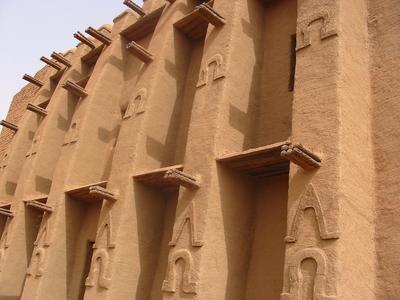
Malian Architecture

Ghana's version of 1989 was in a minor key and actually started over the course of a few weeks in 1987. It was a series of public lectures by a history professor, Alfred Adu-Boahen, on a sober topic: The Ghanaian Sphinx. Reflections on the Contemporary History of Ghana, 1972-1987. It is hard to believe that there was a time when such comparatively mild criticism would have condemned you to harassment, jail or worse, but that was the case at the height of the reign of Flight Lieutenant Rawlings' junta. Arbitrariness, and a malign and heavy hand were the weapons of choice. The only forms of resistance in the eighties were exile on the one hand, or the culture of silence on the other. Said culture of silence was attacked head on during these lectures and the spell was decisively broken.

The metaphor of the Ghanaian Sphinx - that puzzling acquiescence to authority and silence in the face of privation and worse, was outlined and a solution was proposed. It was a simple formula: plain speaking about the history of Ghana since independence and calling things by their name with lucidity. His argument made a difference and the atmosphere in the country changed. The fight for democracy was enjoined and much of Adu Boahen's blueprint has been followed over the years. If only there had been more such profiles in courage. Would that more had stood up and been counted.

The immediate and major difficulty in this effort was that political parties were not allowed in Ghana. 8 years of military rule had cowed the opposition. To the extent that there was any politics in the country it was to be found in social groups without any agenda. Ghanaians vied to compete to be secretary of football supporters' associations, book appreciation clubs or bible study groups. Even the Danquah lectures were framed as simply educational lectures. It would require considerable reorientation to force the issue. Still a conversation was started and Ghanaians began to organize themselves. Indeed in 1990, a Movement for Freedom and Justice was formed to pressure for change and a return to civilian rule. The first fruits of this pressure was with the news media. The Catholic Standard resumed publication (religion being the major (only) growth industry in the country). More crucially, a few independent newspapers were allowed to come into existence, the Ghanaian Chronicle the most significant among them. Over a next decade, these newspapers and then the new FM radio stations that started broadcasting would prove crucial in securing democratic gains - monitoring elections being one of their essential contributions.
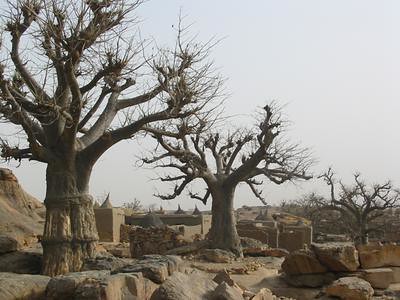
Dogon Hillside

Another history professor, Laurent Gbagbo, was speaking up in Côte d'Ivoire against President Houphouët-Boigny whose recently completed basilica, Our Lady of Peace of Yamoussoukro, was the largest church in the world. By then he had been in power almost as long as Castro and Kim Il Sung of North Korea. The sly fox was nothing if not resilient and hanged on to power until his death a few years later. With hindsight, it would have been better if Gbagbo had been successful in his efforts in 1989 (or for that matter in the 70s when Houphouët first put him in jail). He was a very different (read compromised) man when he would come into power in 2000. The damage was done to the social fabric of Côte d'Ivoire during the lackluster years of the 1990s when each leader in the political class outdid themselves in demagoguery and never failed to disappoint their compatriots.

Algerians turned out in masses and overwhelmingly approved a new constitution at the start of 1989 to pave the way to multi-party politics. The generals seemed to go along with the decision but would have second thoughts about democracy at the culmination of the process in 1992 when it appeared that Islamist parties were poised for victory. A murderous civil war then ensued. In 1989 however things were looking up. In most of Africa, there seemed to be a great awakening and signs of life.

The strongmen in Africa fought these encroachments on their freedoms like all powerful men are wont to do: tooth and nail. It was the eternal dynamic of the confronted authoritarian: delay, ignore, suborn, bribe when expedient, divide and conquer and that old standby, the demonstration of violence. After 1989 there would be less room for maneuver and many had to tone down their outrages against human rights and democracy. The result was that the 1990s would see a spate of elections. True, in many countries, it was only lip service that was being paid in these elections, hence the frequent resort to of vote rigging; in other countries, however, there would be genuine transitions. 1989 gave impetus to these nascent movements.

baobab by kagyah

III. A South African Detour


A conventional reading of South Africa in 1989 would run with the Great Man theory, namely that the secret negotiations that had began with an imprisoned Nelson Mandela in 1988 continued throughout the year and would culminate in his release in 1990. All this would understate the complications on the ground and the considerable effort expended to rid the country of apartheid.

There was continued internal pressure by the banned ANC, persistent strikes by the trade unions and general defiance in the townships. There were significant external pressures, whether through economic sanctions or consumer boycotts, that forced the divesting of holdings of South African enterprises and a shunning of exports. Military, diplomatic and cultural pressures weighed on the regime.
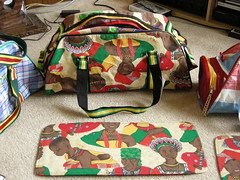
jo bag: ghana must go in South Africa

There was a lot of geopolitics involved and some point to the crucial impact of the battle of Cuito Carnival the previous year in Angola where South Africans and their proxy army, Jonas Savimbi's UNITA movement, were forced to a stalemate by the MPLA and their Cuban reinforcements. After much diplomatic untangling of the situation, the Cubans went home, South Africa agreed to Namibian independence, and Angola's MPLA agreed to a truce with UNITA. You can read Chester Crocker's self serving memoir, High Noon in Southern Africa, for the naive account of what transpired... The irony of the book's title and indeed the outlook it betrays will be tackled later. Sam Nujoma would lead Namibia to independence in 1990 after what had been long hard-fought war. South Africa would begin to stop meddling in its neighbour's affairs.

In 1989, the world learned that hit teams of South African police were assassinating people "in Swaziland, Lesotho, Mozambique, Zimbabwe and Britain, as well as inside South Africa". All opponents of the apartheid regime were fair game. The moral opprobrium against P.W. Botha's would weigh on his successor De Klerk. The optics were not in their favour. The rest of Africa made their thoughts clear. The ANC proposed, and the OAU adopted its Harare Declaration on August 21 1989

We recognise the reality that permanent peace and stability in Southern Africa can only be achieved when the system of apartheid in South Africa has been liquidated and South Africa transformed into a united, democratic and non-racial country. We therefore reiterate that all the necessary measures should be adopted now, to bring a speedy end to the apartheid system, in the interest of all the people of Southern Africa, our continent and the world at large.
Note, if you will, how the same story was reported in the New York Times: "South Africa Rebel Blueprint Backed by Regional Leaders".

The spin in the paper of record reflected the prevailing conventional wisdom in the USA. We must never forget that Ronald Reagan, George Bush the first, Margaret Thatcher and their bagmen, still saw themselves as allies of the apartheid regime. To their dying day, they should be tarred with their association, nay commission, with some of the most awful lot in history. There were many misadventures and much blood spilled in the Great Games of the Cold War; the support by these governments for apartheid is unambiguously egregious.

jo bag: ghana must go in South Africa

And it bears reminding that the struggle for liberation of South Africa was still a close run thing - note the headlines from that same day: "New Wave Of Arrests In S. Africa; Apartheid Resisters Go Into Hiding"

Leaders of a three-week-old campaign to defy apartheid restrictions began going into hiding today to elude a new wave of arrests by South African police as the government of acting President Frederik de Klerk intensified its crackdown on activities aimed at disrupting next month's segregated elections for Parliament.

The Cape Province turmoil has been viewed as a campaign against elections for the tricameral Parliament, in which Coloreds and Indians have separate-and mostly powerless-chambers. South Africa's 23 million blacks have no representation in Parliament.

The police crackdown on dissent appears to be the government's response to criticism by the far-right Conservative Party that de Klerk has gone "soft" on security, especially after the announcement that the acting president will travel to Zambia next Monday to meet with President Kenneth Kaunda, Africa's leading patron of the exiled African National Congress, which is South Africa's most powerful anti-apartheid resistance group.

Still the sensible folks prevailed:
We believe that a conjuncture of circumstances exists which, if there is a demonstrable readiness on the part of the Pretoria regime to engage in negotiations genuinely and seriously, could create the possibility to end apartheid through negotiations. Such an eventuality would be an expression of the long-standing preference of the people of South Africa to arrive at a political settlement.
That thankfully came to pass. The ANC won the 1994 elections.

At the end of the year, the General Assembly of the UN adopted its Declaration on Apartheid and Its Destructive Consequences in Southern Africa (pdf). Again this was over the strenuous objections of Bush and Thatcher. Lest we forget.

IV. Decentralization


In many arenas in 1989, Africans were beginning to route around central governments. The Big Men still mattered but civil society looked to assert itself. Change was in the air and decentralization was the result. The caveat as ever would be that the institutions took some time to follow the lead of the people; it is the African way it appears. A few years later, Yassin El-Ayouty would write "the world has completely changed since 1989; the OAU has not, since 1963" (The Organization of African Unity After Thirty Years). As someone who rails against stodgy institutions, I am heartened by the decentralization that continues to take place throughout Africa, it keeps leaders on notice.

Where the Organization of African Unity was barely more than a club for the "big men" first of African independence and then of cold war politics, with a gentleman’s agreement not to interfere in each others affairs, the African Union is a institution whose statutes affirm the importance of substance, of accountability, of human rights, and the obligation to uphold those rights not only at home but in your neighbor’s back yard too. Undoubtedly in practice, these aspirational standards are often not met and the development of these institutions is a work in progress; but the challenge is no longer the lack of standards but enforcement.

— Akwe Amosu - Democracy in Sub-Saharan Africa: Trends and Transitions (pdf)

In the field of health care and public policy, The Bamako Initiative was beginning to bear fruits. Again, starting from Mali, we got concerted efforts in health care and population issues. The emphasis was on decentralization and getting local communities involved in decision making that affected them. The strategy would inform later efforts at poverty reduction.

The most useful document I've found to evaluate Africa in 1989 is a long-term perspective study by the World Bank: From crisis to sustainable growth - sub Saharan Africa (pdf). It is comprehensive and fodder for historians, social scientists and mere bloggers.

Decentralization has been essential in bringing about change in Africa and often times it hasn't been a matter of conscious policy. It turns out that things like cell phones and FM radios are the great equalizers for democracy and help move beyond social communication to the political and economic realm. We should all search for more in that vein.

V. Enter The Gremlin


He could have been a mere footnote, but it wasn't to be. He was a mere anecdote for me on Boxing Day of 1989. Annoyed as I was that my mother had worked on the holiday, she deflected my irritation by mentioning this man who had called up the BBC and told her that he had invaded Liberia. That was most people's introduction to Charles Taylor and his unique brand of malevolence. It was bemused entertainment for a journalist but he gave such good copy, a fluent mixture of hubris and cold calculation. He was going to "bring the bitterness of war to Liberia", launch a revolution throughout Africa, and overthrow Master Sergent Doe.

From the first 10 men who joined him from Libyan camps to all the subsequent marauding armies that came into play, Charles Taylor has destabilized no less than eight countries. The casualties and the brutality was impressive. The callousness was biblical, the innovations of small boys units in warfare absolutely diabolical, and the savagery simply unmatched. Much as I wish to dwell on democratic change that 1989 presaged, I have to admit that Charles Taylor and the civil wars that he fomented since 1989 loom large throughout Africa. He may sit these days on trial in The Hague but he casts a dismal and influential shadow. Liberia and Sierra Leone suffered the most in the bloody free-for-alls; Cote d'Ivoire vacillates and many others are picking up the pieces twenty years later. The events of the past year in Guinea can even be read as further aftershocks of the Charles Taylor earthquake.

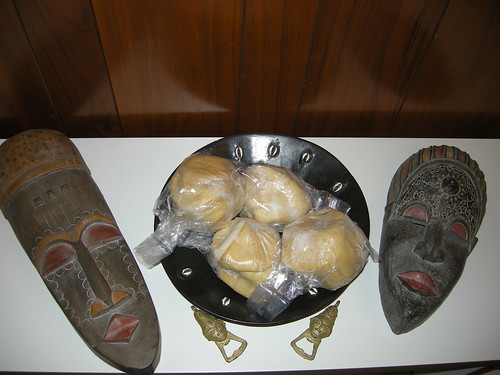
Aburi mask - strange days

Blood and sin was Charles Taylor's unique contribution to Africa.

The pervasiveness and intensity of looting, pillage, and plunder by the leaders and the rank and file, the lack of a stable and systematically organized structure of command and control among the armed bands, the criminal misuse of children, the employment of strategies of confidence artistry, the opportunistic use of a variety of cultural symbols, the orchestration of a state of anarchy as the normal environment of operation are all constitutive of the behavior of gangsters who use terror as their ultimate instruments of control. This mode of control draws from the worse aspects of an array of cultures ranging from the culture of urban gangsters and small town confidence artists of western society, and the area boys and swindlers of West African cities to marauding murderers.

— Amos Sawyer - Violent Conflicts And Governance Challenges In West Africa: The Case Of The Mano River Basin Area (pdf)
It is a dubious legacy, and it all started in 1989.

VI. A Year in Music


There was lots of politics on the agenda in 1989, and lots of dancing too. A playlist for your listening pleasure

What were your memories of Africa in 1989?

File under: , , , , , , , , , , , , , , , , ,