Monday, April 08, 2013

The Ways of the Porcupine

Notes on reading the novels of Alain Mabanckou.

I. Restraint


A writer who shows restraint on a topic that is prime for exuberant fireworks is a rarity. When that topic is the dislocation of a civil war, you start to wonder. When the writer is known for splendid wordsmithing atmospherics, you take notice at the muted tone you encounter. As you read and can palpably feel the wrenching of the conflicts that the Republic of Congo (Congo-Brazzaville that is) was subjected to, you are even more surprised by the self-effacing prose. As you observe the contrast between the close and personal observations - the subtlety in short of the text, and the groundswell of manic viciousness that sweeps a country, you ask yourself if he can keep it up. When the voices of the female characters are realized so poignantly, you scratch your head thinking back to the author's reputation for shrewd depictions of male worlds. What do we have here, you ask yourself? All is not quite what it seems.

When you are branded a young lion, it takes restraint to not growl. When you have been feted as a stylistic innovator, it takes restraint to write within the margins. And so I came to read Alain Mabanckou's Les Petits-Fils Nègres de Vercingétorix. And so I was drawn deep into his world. I had previously read his debut novel, Bleu Blanc Rouge (1998), a bravura work for sure (and more on that anon) and had already placed him in the vanguard of modern African literature. Reading Les Petits-Fils Nègres de Vercingétorix simply marked him as a singular talent tout court. I was plainly impressed by his remarkable restraint. Would that more African writers follow his lead; too often we aim for the epic when the delicate touch would be just as ambitious.

There is a certain virus that afflicts human societies that's ostensibly to do with identity - sometimes it's couched as nationalism, sometimes as tribalism, oftentimes it's plain jingoism. Demagogues feed on it, and sadly many politicians find it hard to resist. It's a seminal disease whose symptoms at its worst involve people who had previously been living alongside each other erupting into murderous violence. The last century was a particularly bloodthirsty exemplar of this. The former Yugoslavia was a notoriously teachable moment about the endurance of such tribalism (Europeans don't seem to like the word for whatever reason). Africans of course are not immune to this disease; indeed, some often paint the continent as a great incubator of vicious innovation in this sphere. In the politics of Congo-Brazzaville of the last thirty years, militias were its expression. Whether it was those favoured by Denis Sassou Nguesso or some of the other rogues that the country had the misfortune to be afflicted with, militias wrought havoc with gruesome efficiency.

Les Petits-fils negres de Vercingetorix


The most interesting question to the reader in me is the form that the artistic response to such events takes. How does one write about topics as loaded as what we now brand as ethnic cleansing? And what kind of literature emerges in the wake of these uncivil wars? Surveying the scene - since similar tragedies have been plentiful in Africa, the literature, on the whole, has aimed for the epic. Sometimes the emphasis has been on the absurdity of the goings-on, other times writers have gone for sober reflection, always, however, the stories come out epic. Think of Ahmadou Kourouma's Allah n'est pas obligé, think of Emmanuel Dongala's Johnny, Chien Méchant, and, less successfully, Uzodinma Iweala's Beasts of No Nation in recent times as takes on the warlordism and child soldiering. On the other hand, I'd advance as paragons of epic sobriety Helon Habila's Measuring Time, Yvonne Vera's The Stone Virgins and, on Biafra, Chimamanda Ngozi Adichie's Half of a Yellow Sun. Standing essentially alone, Alain Mabanckou's strategy is restraint.
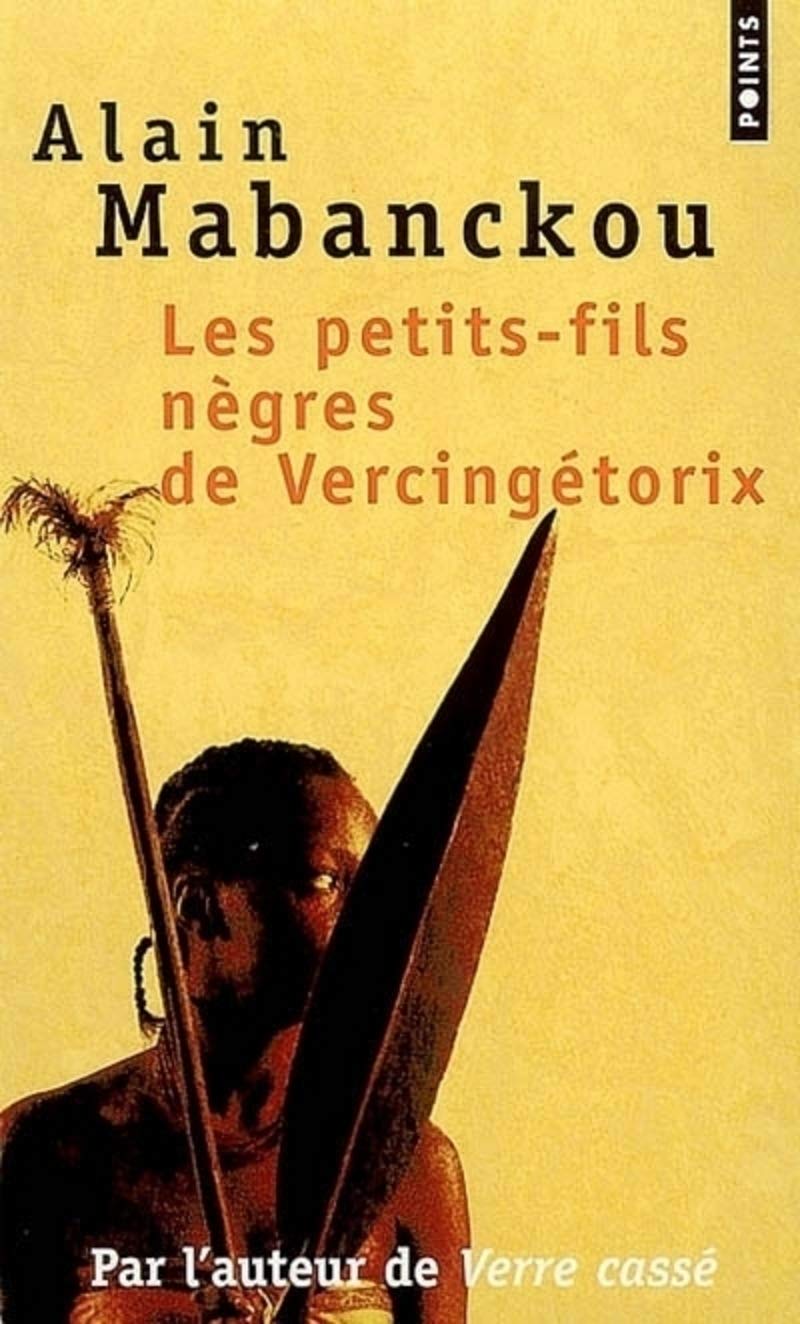
Les Petits-fils negres de Vercingetorix


Perhaps the most telling choice he makes is to do with the question of form. Les Petits-Fils Nègres de Vercingétorix is an episodic novel, written in the form of notebooks that a woman is writing to try and make sense of a life that has been upturned. It is about a barely disguised Congo-Brazzaville - a country placed into upheaval by militias and a North/South divide that affects families even to the extent of turning a man against his wife and even his own daughter. The inspired choice of diaries is at once a constraint - it almost obliviates grand storytelling and a kind of epic sweep - and a release, the narrower focus brings a intimate immediacy to the fore. The form allows for ellipses and the gaps are always telling, for when do we have the time and discipline to return to one's notebook? What is left unsaid can be inferred without much work on the reader's part, and, sometimes, the implications are so ominous that you wish that he had inserted a scene to salve the tension you feel.

Here is an African writer eschewing nativism and metaphorical excess a la Ben Okri. There is no fat, there is nothing to trim in the narrative. He doesn't traffic in arch constructions and just gives a story plainly told. The emphasis is on small scale journeys. Restraint in the form then serves to accentuate the dislocation that occurs.

It is a deeply felt book, I'd hazard even that it is the most personal of his books and it is the one in which he discarded the customary humourous mask he proffers. It is also the least 'literary' of his works which it makes it more satisfying to my mind - as he has been embraced by the academy, his novels have taken on more academic concerns. The novel considers what family and friendship mean when ethnicity becomes paramount and driven by parochial concerns. The lens is focused on two families that have crossed the ethnic divide and the repercussions they face as politicians ratchet up tensions. Perhaps the tale is best expressed by considering the two covers of the different editions: the one focusing on a woman and the other on a military parade. The latter, with the military in their shiny uniforms, perhaps representing the dissipation of so much of the continent's promise and energy. The cruelty of the militias that form is unrelenting and ugly and weighs on everyone.

It is fascinating that Mabanckou manages to give entire histories of these cruel militias and the men who used them as shock troops within the constraints of the novel's framework. You wouldn't expect that kind of pointillist historiography from mere diaries. It's as if Anne Frank's limited perspective from her Amsterdam hiding place grows to encompass the entire sweep of the world war. You don't notice it at first because there isn't an omniscient narrator at work, but all the players in Congo's madness are indelibly sketched, and vividly so. They could have been caricatures but instead are characterized with economical writing and steady accumulation of close observation.

I marvel at the power of this elegiac novel. Reading it, we learn that, with restraint, the tales of displacement that are part of the African story can be written with such delicate reflection. How does a seemingly clear-eyed society rend itself so thoroughly? And what are the costs to family and friendships? Restraint, indeed, is what that sterile modern phrase 'ethnic cleansing' deserves. Such is the way of the porcupine.

II. Empathy


All that glitters is not bleu, blanc, rouge. That, in brief, was the message of Bleu-Blanc-Rouge, my introduction to the writings of the man I'll call the porcupine. And what a debut this 1998 novel was. I can't praise it highly enough, for it contains multitudes within it. Read it as a novel about yearning, read it as a novel about immigration, revel in the fond portrait of Congo - wrinkles and all, enjoy the comic set pieces, and laugh, above all, laugh. In all these ways, you will encounter a very assured writer who found his voice early on. In many ways, it is a testament to the anglophone myopia in African literature that this wonderful book is only now seeing a translation into English as Blue White Red.
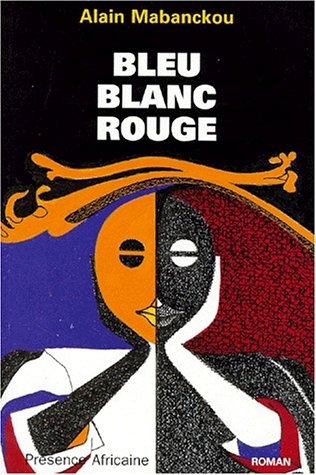
Alain Mabanckou Bleu Blanc Rouge


Bleu Blanc Rouge of course refers to the French flag; its embodiment in Parisian streets serves as a stand-in for the promised land (at least for those growing up in francophone Africa). Ostensibly then, there is this loving pull to leave one's land and head to streets paved with gold. "Abroad" is a message repeatedly hammered home to young Africans, and, along with its counterpart "The City", it has been one of the irresistible forces in post-colonial Africa. Our literature has followed accordingly, and the best treatments have always stemmed from authors who have great empathy.

The story of the African diaspora in France has universal echoes and, much like the story of any diaspora amidst their erstwhile colonizers, has built-in drama and comedy (the tension of exile, nostalgic longing and the process of adaptation to the funny ways of the locals etc.). The stories of Africans in England, Spain and Portugal touch on all these areas. Still I relate what Mabanckou does in Bleu Blanc Rouge most closely to what Samuel Selvon did in writing a great comic novel with sharp edges about the Caribbean diaspora in The Lonely Londoners, and with similar humour. Beyond that, Mabanckou appears to do what Krzysztof Kieslowski's Three Colors trilogy does in a different medium, illuminate an entire society. He is not content to simply concentrate on what happens once you leave your homeland, he intends to fully explore the life you were leading in said homeland. Indeed he captures so many textures you'd suspect him of being a seasoned anthropologist.

Structurally and thematically we can read the novel in three broad sections.
  • Bleu - the blues of aspiration. Why is the lure of going abroad so strong even when there isn't political exigency driving things?
  • Blanc - the color of snow and the cold life abroad with the Caucasian natives. The hustle of immigrant life is examined.
  • Rouge - the red of conflict and disappointment, in this case dealing with the quiet return home and even deportation.
The young narrator, although ostensibly middle class, has given up on his studies and is making do in his own desultory way. Presumably it is a measure of the futility he sees of getting highly educated only to join the ranks of the hordes of graduate unemployed on the lookout for patronage in a country where cronyism is how things run.

He is inevitably drawn to those who affect to be gentlemen of leisure. What makes the novel indelible is its portrait of the culture that we know as La Sape. The first part of the book might well be the most complete account of the rise of the sapeurs of Congo. La Societé des Ambianceurs et des Personnes Élégantes (La Sape) is the star of the novel.
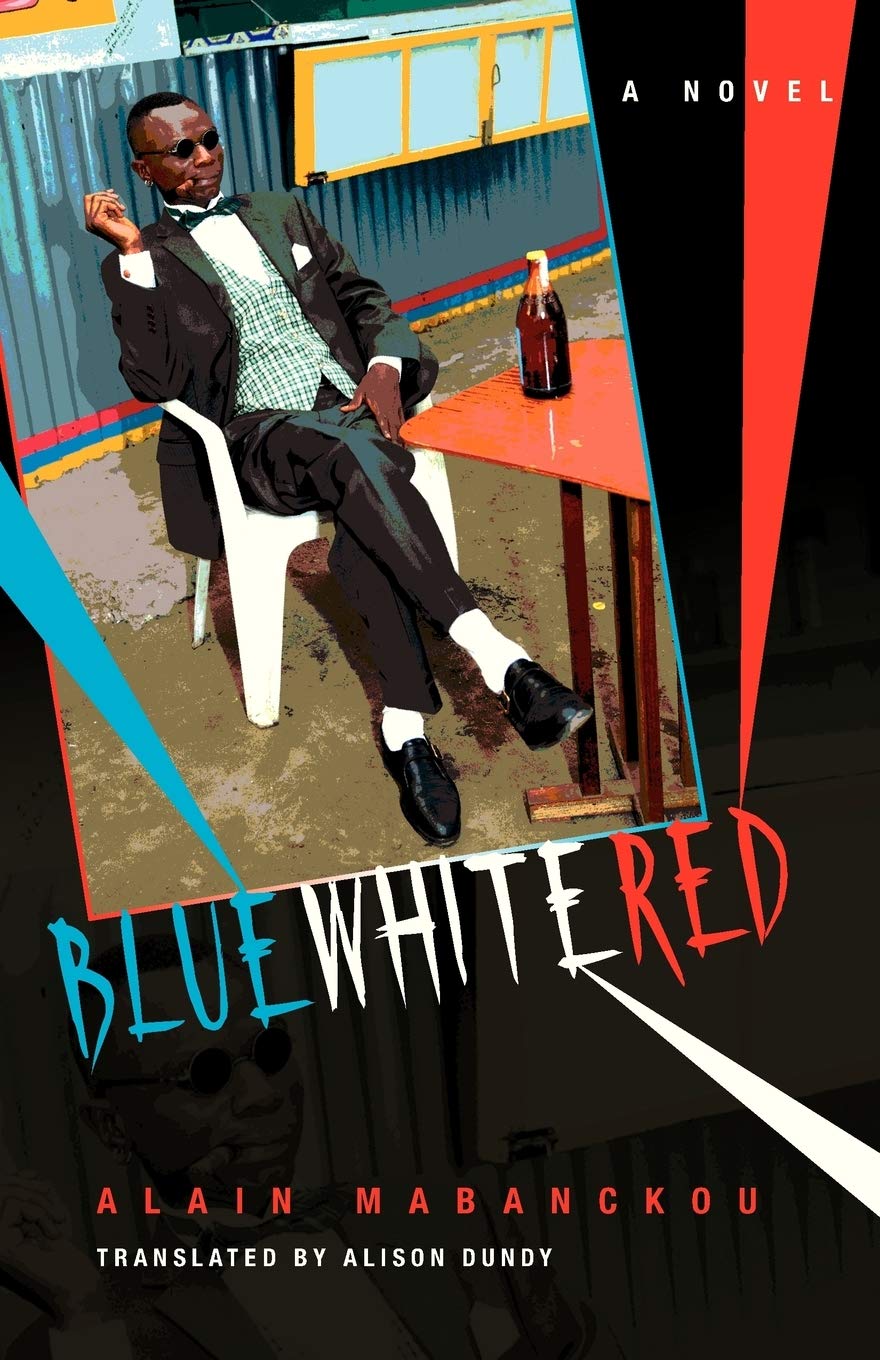
Alain Mabanckou Blue White Red


Mabanckou grew up among these iconoclasts. Their sartorial choices were a brazen reaction against the Authenticité campaign that Mobutu had embarked on next door (a campaign echoed initially by Sassou Nguessou close to home). At the same time in their lifestyle, they had taken to heart the dictator's more direct edict: Débrouillez vous. He describes with considerable humour (and without judgment) their seeming cult of materialism, their love of designer labels, of style over substance perhaps, their playful way with language and their dedication to living by their wits.

He regales us with fond descriptions of the origins of the sapeurs, he is especially acute about the difference between the sapeurs of Brazzaville and Kinshasa. We learn about those who lived that life, and their effect on those who grew up among them. The sapeur lore is recounted: the exuberance of their competitions, the mixture of hubris and bravado at work in their core... The set pieces that punctuate the book are a comic delight.

The seduction is quite real and embodied in the character of Moki - Charles Moki, who looms larger than life throughout the novel. Moki, one of those 'Aristocrates' and the most legendary of the 'Parisiens', might be considered the king of those sapeurs. They return from Paris with bags of designer clothes that they sell and exchange, spread money around town, flaunt their peacock wares, and tell tall tales about their life abroad.

There is an acute analysis of their descriptions of the promised land. The appeal of going abroad to Paris or Bruxelles lies in the perception of gold-lined streets in Babylon. A running joke in Marguerite Abouet's Aya de Youpougon series is of the man who is always promising to take you to Paris. In her works, the response is always skeptical yet the comic hyperbole used by those who come back about how things are easy abroad (as rendered by Mabanckou) will wear down even the most skeptical. And so we head abroad.

Paris proves to be a rude awakening. The narrator finds that Moki in Paris is a quite different man and, more generally, that life in Paris is quite different (read difficult) from what he had been led to believe. The contrast between the relative ease of life back home in Congo (even in poverty) and the squalid lives that many immigrants lead is something to behold.

Like Calixthe Beyala whose Le Petit Prince de Belleville paved the way (translated as Loukoum), Mabanckou depicts the reality that immigrants find hustling in Paris. Whether it is living illegally in vacant housing, sleeping in shifts on the floor of a squat, working multiple menial jobs and in the case of many sapeurs, getting embroiled in check fraud and any manner of illegality. The hardships are many and pressure of this fraught existence can weigh on you.
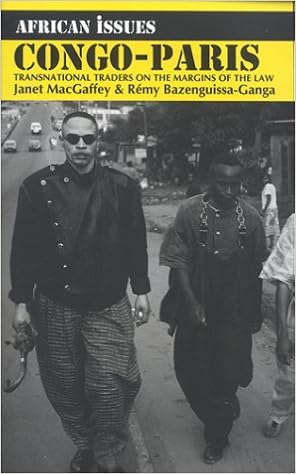
Congo Paris


Consider a sociological text like Congo-Paris: Transnational Traders on the Margins of the Law - a book that The Wife assigns in one of her African history classes. As an academic study of some of the same characters, it covers the same terrain exploring these men doing the gruntwork of globalization and capitalism. And yet I would hazard that far more insight, and indeed fun, would be gained by seeing things through Mabanckou's lens.

A Squatter's Tale by Ike Oguine is in the same vein, dealing with Nigerians who make it to the Bay Area in the US. A similar mix of bemusement and understanding suffuses the narrative. In another medium Alain Gomis's film L'Afrance tackles how one oversight can lead one to fall through bureaucratic cracks into the illegal immigrant category. With Mabanckou, however, one doesn't get the sense of a didactic point being made. The question of values is certainly on the agenda and one might well read this novel as a cautionary tale, but he wouldn't push you in that direction. The reason is his evident empathy for his characters and his ability to find humour even in the disillusionment about what one finds abroad: the drab immigrant life, the hustling for identity papers, the shadow life, the turn to crime etc. Indeed, when things go awry in the inevitable third act the authorial voice remains equanimous. The fall from grace is as entertaining as the rest of the novel.

If Mabanckou was not the first of the growing number of Immigrant Narratives in Contemporary France, he was certainly among the most assured and definitive. He revels in close observation and has a perfect ear for dialog. One finds in him a writer comfortable in his storytelling and deeply empathetic to his characters. One expects nothing less of a porcupine.

III. Provocation


African Psycho is a provocation. Try reading it in public, or leave it on your bus or subway seat, and observe the response of your fellow commuters. The title is pure agent-provocateur evoking, with a clin d'oeuil, Bret Easton Ellis. Everything about it demands attention, from the title, to the plot, the style of the prose and the inspired language. The English translation of African Psycho is serviceable although to my ear it doesn't capture the playful tone nor indeed the fireworks that Alain Mabanckou delivers in this novel.

African Psycho


The edition I have has a cover that showcases the madcap energy of the writing. The covers of other editions emphasize the youth aspect rather than the emotion. Mabanckou drops zingers every so often as if to keep you unbalanced throughout your reading. There is hardly a page without sentences make you gasp at their audacity or laugh at the goings-on.

The plot, such as it is, is detailed nonchalantly. It is the story of a street kid, an orphan sent from foster family to foster family. Self esteem is not on the agenda. He thinks he's ugly with repeated complaints about his 'tete rectangulaire'. A loser prone to self delusion, he is what you'd call minable in French. Full of resentment if not anger and poor as hell, he knows his shantytown well. Unlike many in the slums who seem to be getting on with life, he is a teeming mass of grievances. Looking out to 'le pays d'en face' across the river, there is resentment about the other Congo - Kinshasa, which is bigger and more famous than Congo-Brazaville, heck they even send their prostitutes over here. Our man's gripes echo the blind spots of Patrick Bateman's character in American Psycho although his are more legitimate than the latter's ludicrous obsession with labels, style and crass materialism.

The conceit of the novel is that he aspires to be a serial killer. You'll therefore note the explicit harkening to the themes of Dostoyevsky's Crime and Punishment or even Camus' L'étranger. Unlike those antecedents, the protagonist is all aspiration. He couldn't kill a mouse if he set himself up for it. He'd make elaborate plans and find repeated excuses for why the mouse escaped this time. It's rather like one of Donald Westlake's Dortmunder entertainments. It's as if he initially decided to draw you in with the titillation of the setup but changed his mind, and rather settled to entertain you with a comic meditation on inept aspiration. After all death is far too frequent in African life and literature. The vibrant and showy language also reminds me of Dany Laferrière's Comment faire l'amour avec un nègre sans se fatiguer. Literary young lions provoking readers and critics alike before getting down to business.

The porcupine, like the hedgehog in Isaiah Berlin's retelling, knows one one big thing. In that vein, it is plain that Alain Mabanckou cannot tell a bad story no matter how light the premise. He is blessed as a storyteller in much the same way that Evelyn Waugh had an unerring ear for satire. Like Waugh he also had quite prodigious early works (read Bleu Blanc Rouge as his Decline and Fall if you will). Oftentimes, however, to gain literary renown one must aim to be a fox. One never knows what critics or indeed the market will reward.

I have a pet theory that African Psycho was a throat clearing exercise, something he wanted to get out out his system before really stretching his shoulders and demonstrating his versatility beyond 'mere storytelling'. If my reading of the chronology is correct, he would next get a new publisher and start teaching literature in the US, gaining further insight into how to carve his place in the literary world. The provocative fireworks of African Psycho should then be seen as a transition or even a stepping stone. As such it has been a success, indeed, everything published since has been untouchable.

IV. Deception


Well perhaps deception is too strong a word especially since the confounding of expectations was welcome. Call it sleight of hand and a very studied and knowing affair, Verre Cassé - now available in translation as Broken Glass, is a literary hall of mirrors, the titular broken shards of glass reflecting fabulous visions at the reader.

At first Mabanckou approaches you with what seems to be a grotesque sort of Arabian Nights - or perhaps we should refer to some of the bawdier tales spun by Chaucer's travelers in The Canterbury Tales. The nightly revelry takes place at a bar and, as you settle down for the latest story, the regulars compete to add outré twists as if to ask can you top this one. From sordid tales about cuckoldry to pissing contests, he literally leaves you in the merde.

Verre Casse


About halfway through however, you you realize that Mabanckou is actually more interested in his narrator than in the baroque folktales spun nightly by the bar regulars. It's the David Lodge sensibility, lovingly, ever so lovingly, dragged into the gutter. Lodge's The British Museum is Falling Down is the best model for what is at work. One could read the latter as a straight comic novel, but the real pleasure and the playfulness comes when you realize that it embeds parodies of some of the most august authors. Lodge's tome spins pitch perfect voicings of everyone from James Joyce, through Franz Kafka to Virginia Woolf and Joseph Conrad.

Verre Cassé is similarly full of wordplay and literary allusions dropped as the bar tales are told with the studied effort of seasoned drunkard. You'll find puns about Autumn of the Patriarch (Gabriel Garcia Marquez), The Old Man and the Medal (Ferdinand Oyono) and even Camara Laye's L'Enfant Noir. There are no sacred cows; these influences are deployed, probed and deconstructed fluidly. The reader can bask in the oral tradition of storytelling like that of Chamoiseau in the vein of Solibo Magnifique.
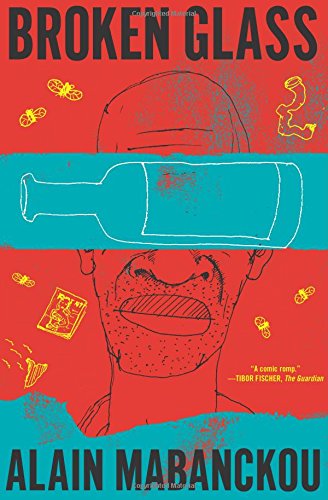


You learn that your narrator host is someone whose head is full of literature - a stand-in for the author perhaps, who at this point had come to be teaching French literature in the US. He's drawn you in with humourous observations and is such good company that you'll want to drink at the same bar and, dare I say, read the same books. He had found the formula in this novel and the critical acclaim and major prizes started flowing his way.

The old wives' tale is that the porcupine's quills can be thrown at advancing predators and form the ultimate defensive weapons. The reality is that the prickly exterior is best adapted for camouflage. In the dark recesses of our minds, we know to crouch instinctively when the porcupine gathers himself in a ball. Most of the time however we don't notice him, hidden as he is in the foliage. Such wry deception, you see, is the way of the porcupine.

V. Comfort


Mémoires De Porc-épic is the title of Alain Mabanckou's most magisterial entertainment. No wonder he won all those prizes in 2006. The control of tone shows someone at the peak of his powers. He can be loose and discursive at will and yet turn on a dime and focus the narrative. He'll turn from literary disquisition to plot intricacies that leave you hanging on. You can't call it Congolese Gothic - even if tempted by the plot; you can't call it "magic realism" although he provokes you in passing. No, this is probing, searching and vital storytelling. And yet what do we have in this novel, now translated as Memoirs of a Porcupine? A porcupine unburdens his soul to a baobab tree recounting his life as a double nuisible - an animal double of a man who turns out to be very far from sympathetic, if not outright horrific.
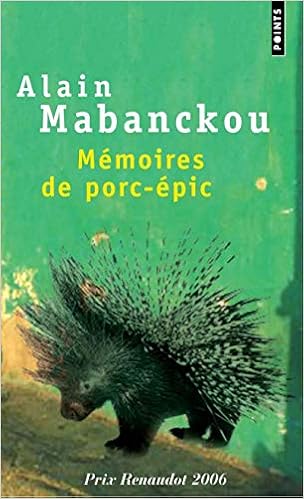
Memoires De Porc-epic


Ostensibly the novel is about the mix of rumour, gossip, jealousy that can overtake a village, the perceived slights - the accusations that poverty and faulty biology can foster. It is also about the compulsion to help one's double no matter what. The premise is surreal but all the outlandish happenings are dealt with in such a matter-of-fact manner that the reader goes along. It just happens. Think about it, a porcupine is talking to that great African confidant, the baobab tree, a porcupine moreover who is perhaps trying to make sense of things, why is he alive when his double has died?

The novel examines matters of identity (see the double motif) and the impact of rumour in traditional societies. If people in the village start dying mysteriously, there must be someone slighted. This leads to tests and various rituals in the community (for example drinking of potions). You would file this under the banner of belief systems, the kind that ethnologists from the West study - they'll call it social anthropology. The porcupine lampoons this kind of cultural subjectivity. Yes the porcupine narrator, in his sophisticated mode turns to lampooning academics. There you have it: the winking eye of Alain Mabanckou, the tall tale you've become engrossed in, the mix of pointed commentary, biting satire, observation of tradition in consonance with modernity, and then the provocation. You're in the realm of the porcupine, and a wily one at that.
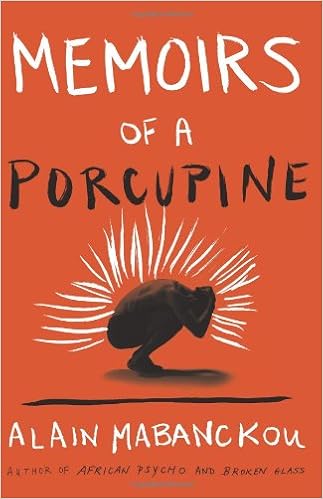
Memoirs of a Porcupine


The porcupine narrator is cowardly and needs to be suborned by his other self into violence. The missions accumulate, suspicion grows and disaster falls. Do these things actually happen? Or does he really tell the truth? Identity is refracted, myths are remade, language is made malleable, reflection, humour and violence intertwine. It's the literary hall of mirrors of Verre Cassé this time elevated into a universe that is Mabanckou's own, one that only intermittently relates to our own Milky Way. The novel is destined to be studied and dissected perennially. It goes far beyond Academy bait (it won the Prix Renaudot) into its own category. It was the intense experience of reading these 'memoirs' that led me to designate Alain Mabankcou as the porcupine of these notes.

The porcupine follows his own path. Like the squirrels he is related to, but with adorned with his protective spine, he is playful at once and prickly at the other. Aware that he needs to keep his wits around him, his is careful in his movements; a hard worker, he pays attention to his craft. He's a social creature engaging with his peers and is so comfortable in his skin that the moments of solitude never lead to loneliness.

VI. Musical


There is a certain rhythm to the writings of Alain Mabankcou, unhurried by default, it meanders at times, skipping occasionally or incorporating extra ideas but always returning to the beat like the best sebene. After two very successful novels (Verre Cassé and Memoirs de Porc-é epic) largely embraced by the academy that played with all kinds of highbrow literary subtexts, he returned to the musical storytelling that characterized his debut.

Black Bazar, the last novel of his I've read, is akin to a stroll down the streets of Chateau Rouge. It's a return to the themes of Bleu Blanc Rouge a decade later. The emphasis isn't so much on the sapeurs this time as on the entire immigrant community that has asserted itself at the heart of Paris.
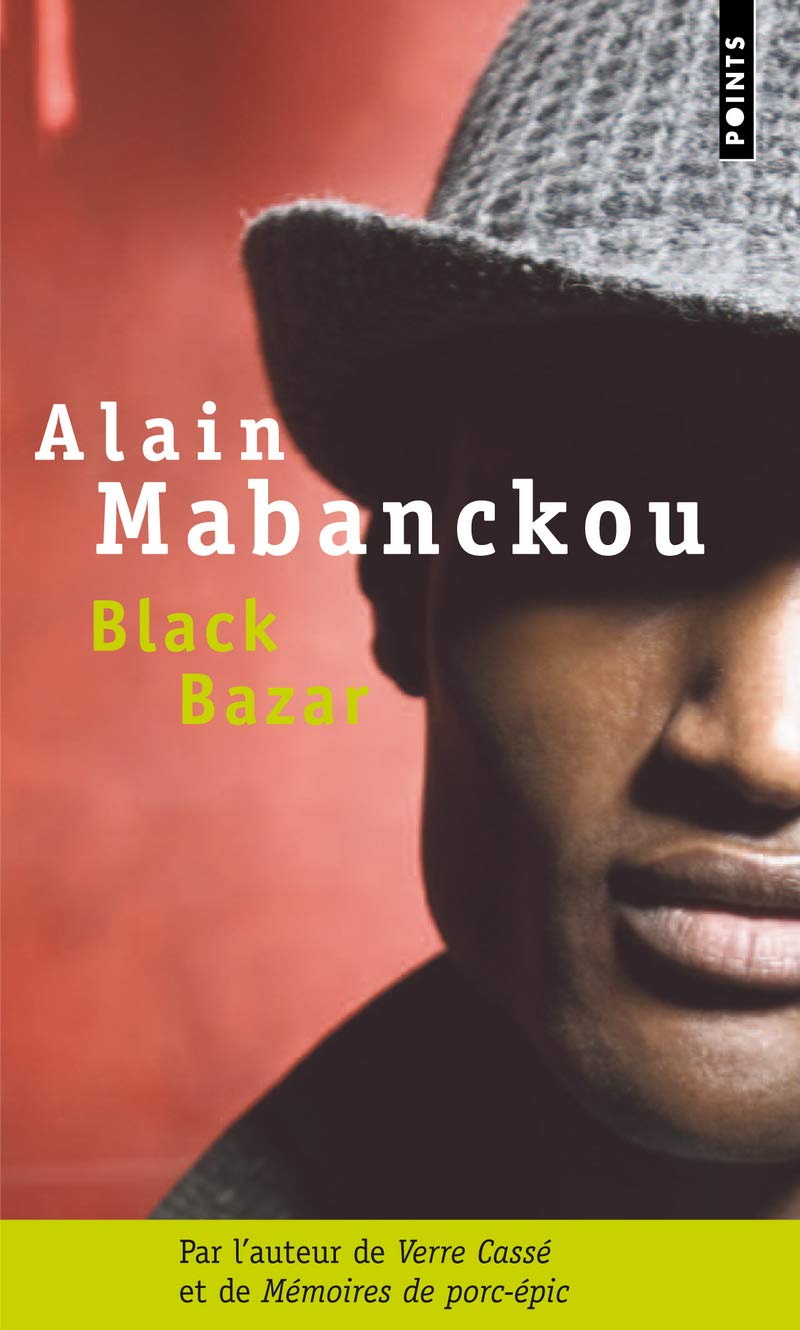

Black Bazar fessologue butt aestheticBlack Bazar fessologue butt aesthetic


The chief narrator is nicknamed Fessologue, which I'd rather translate as connoisseur of fine female derrieres rather than what I've seen elsewhere. Sidenote: would you translate Fessologue as Buttocks Man? Wouldn't you instead go for something more delicate: Butt Aesthetician perhaps, or Professor Gluteal Maximus? Digression on a digression: this is the dilemma an English translator faces with sharp and witty Francophone writers like Mabankcou and Patrick Chamoiseau, how does one unpack the playful language of their musical riffs. One hopes the translators come to capture the delicate humour of their knowing argot.
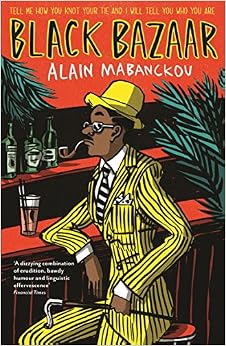


Fessologue then is a comic figure who verges on the tragicomic. A bon vivant sapeur with a heart of gold, he knows he is being used by his girlfriend - cuckolded even, as she has decamped to the Congo. Indeed he might even have been paying and caring for another man's child all these years. That betrayal is of no matter, he wants to do the right thing. The novel follows him his peripatetic attempts to reconcile the codes of his sapeur lifestyle (the constant need for different varieties of crocodile skin Weston shoes say) with the heavy responsibilities he has started to feel (making enough to send that Western Union transfer so that his daughter is cared for wherever she might be) and the pleading for his girlfriend's return. Like many of Mabankcou's characters he is no hero and is unreliable in all too recognizable ways. Hilarity ensues as one might expect. The complications do make indeed for a Black Bazaar.
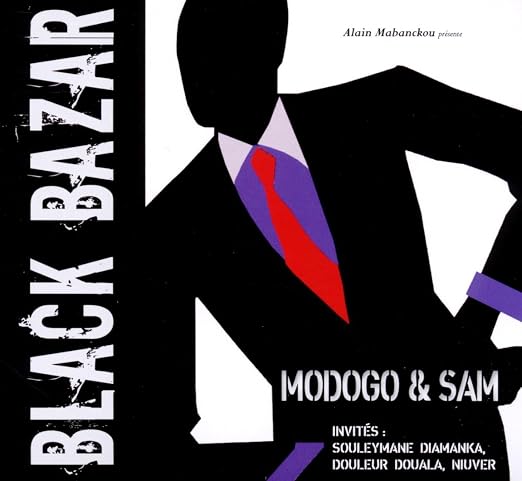
Black Bazaar


Black Bazar even has a musical afterlife with a wonderful album and a tour of a collective of rumba and soukous greats inspired by the novel (lots of videos here). It is fitting since the novel's language felt alive and seemed to move to its own soundtrack.

I have only read half of Mabankcou' novels and, prolific as he is, there is much more to his catalog. Apparently also the poetry and essays loom large for some critics. He is increasingly busy these days enjoying his prime as it were. His works have been already been adapted on the stage and Hollywood must surely be next. Recently he has translated Uzodinma Iweala's Beasts of No Nation into French, Bêtes sans patrie in a quite serendipitous meeting of minds. A highly adept wordsmith capturing the rhythms of another. The author of African Psycho - what with its vaguely aspirational homicidal street kid protagonist, was surely the right one to take on the child soldier.

His craft is undeniable and he is one of the best living African writers. I've found that most treatments of his work in English damn him with faint praise. I suppose this is because he writes in French and is pigeonholed accordingly. The obvious antidotes will be forthcoming as it seems the translations are now coming apace. I hope he is ready for the full glare of the attention that will surely be coming his way. I offer these running notes as a marker before the crowds arrive, an attempt at a reader's quiet appreciation. My only critique is that I have found more rewarding the novels that don't explicitly emphasize his literature professor guise. In these notes then, I have emphasized the works that have felt the most naturalistic.

I want to have a drink at the Credit a Voyage bar and exchange tall tales with its owner, l’Escargot Entêté. I want to share a few beers with mon pôte le porc-épic. I want to discuss exiled souls and the quality of wist in African life. I want to joke about the horde of Congolese barbers who loudly accost you when you step out of the metro station at Château d'Eau and contrast them with the lot at Château Rouge. What gives? Is it Brazzaville versus Kinshasa in the Parisian setting? I wonder about the soukous soundtrack that they seem to dance to as they gesticulate and beckon. I can only hope that my friend the porcupine continues weaving his tales. His latest novels are at the top of my wishlist. I'm going to savour them in the ever so fleeting moments when I can lose myself in a book. I'm digging the ways of the porcupine. A head nod in the direction of Alain Mabanckou.

File under: , , , , , , , , , , , , , ,

Monday, March 18, 2013

Blues of an Omnivorous Reader

Wherein I reproduce a couple of apparently futile musings on the announced death of Google Reader. I've always preferred that my public utterances be available in a feed and Google Plus by design doesn't provide one. Further I received a transatlantic call yesterday from The Parents who are alarmed and incredulous that such an important and incredibly useful tool - an essential part of their experience of the web, would be summarily executed, as it were. They raised a point that I hadn't considered as I've been thinking about Plan B. It is easy to say that there are other feed readers, but almost all the proposed alternatives will not be free if they operate at Google's scale, and this presents complications if you live in a country like Ghana which is a black sheep in terms of e-commerce. Although my parents are undoubtedly willing and able to pay for such a service, they will be locked out because PayPal, Google Wallet and most credit card payment systems are not available to Ghanaians. I'm going to have do the dance of getting their credentials, signing them up for Feedly, Newsblur or what have you and entering in my payment details. Now that's a workable arrangement for my family, but what about others in similar circumstances? I had posited, with some amount of hyperbole, that this was a massive destruction of consumer surplus but I didn't know the half of it.

1487 Feeds (or Blues of an Omnivorous Reader)


A belated, and certainly, redundant comment to this thread.

I suppose I am an outlier in terms of usage as Google Reader is my single most used web application (more than even search and email), but I'll have to repeat the question I've been asking myself for a couple of days now: how does one handle 1487 different content sources efficiently across the up to 10 devices that I might use daily?

The corollary question also comes to mind: how did I come to aggregate that many sources of data?

The answer to both those questions is Google Reader.

Chris Wetherell's thesis was that "feed reading is inherently polymorphic" and he would know as he designed Google Reader.

As I'm having to now export said 1487 feeds to try out various alternatives, I've been thinking through my usage of Reader and I must agree with him on that front, because what I see is a wide variety of sources organized however I want.

Some are blogs, some are news sites, some are topical, some sui generis, some polymath, some from people I disagree with, some are the web output of friends, some from family, some are photo blogs, some are podcasts, comics, or comments. Some are on current affairs, some on Africa (although that tag seems to encompass anything non-US), some on technology, some tagged as general interest, some pure entertainment.

Some are high traffic, some are infrequently updated. An example: a friend recently emerged after a 2 year disappearance in the new parent cone of silence. On his return to blogging, he seems to be no longer interested in writing about technology. No problem: simply tag him or add him to a different folder (feeds can be multiply categorized).

Some are work related. Some are very narrowly focused. Some are alerts that I want to monitor e.g. feeds in Flickr and Delicious (tags or people or groups), Google alerts. For a while I could easily monitor almost everything of interest about Ghana since writing on Ghana and indeed the Ghanaian web footprint has been so small.

Some are forums. Some are for research often more speculative than not (e.g. the two months when I mused about a dissertation on two-sided markets in technology). Some are for archiving purposes (e.g. various synthetic feeds of sorts), and of course there are the vanity feeds (e.g. the defunct Technorati watch lists or Blogdigger searhes, Friendfeed etc.) which are all filed in the Egotism folder).

Anything that could generate a feed is fair game and has an equal opportunity.

Some are full feeds (which I prefer), some only offer headlines and some have article summaries but I've found that using Reader to scan headlines and/or summaries is still more useful as a starting point to distill and decide what to open in a new tab.

The huge variety boggles and has matched my varying interests over time.

Humanity Critic can lie next to Maciej Ceg?owski who lies next to Malcolm Gladwell. Google Reader democratizes the process of information consumption.

All of these sources could be sliced and diced, categorized any which way and sorted however I want.

Each folder can be read differently since Reader accommodates different reading styles. Skimming is easy if need be. You could have a river of news with whatever filtering that you want. You could decide to focus on a particular source or topic and deeply explore.

Sort also is important, some things should be read in order e.g. Doonesbury, for others recency is more important.

Sort by "magic" used to be almost uncanny in surfacing what I found most interesting. The algorithm was changed a couple of years ago and it has suffered greatly (some of the higher traffic sites are overwhelming things) and the All Items view hasn't been as useful ever since in bubbling up interesting content. In mitigation, I've since segregated the high traffic but low signal feeds into different folders where they can be easily triaged and marked read to regain sanity. The loss of the old sharing features (and enforced move to Google+) was hard to take, and perhaps contributed to the decline in effectiveness of sort by magic. One click starring and sharing was the most wonderful thing while it lasted.

Starring and synchronization of unread state across multiple devices are of course the killer features.

The high information density is unmatched on the desktop and mobile. (Indeed the mobile web app is better than the Android app for what it's worth). Keyboard shortcuts for navigation and the visual design are the icing on the cake.

Others have explicated much of these design traits and at length.

A few other things:
  • An invaluable debugging tool for feed development.
    It's hard to remember how long it took to develop robust tools to produce and consume feeds, not to mention how contentious the process was. Google Reader was a major driver and was at the heart of this process. Mark Pilgrim's myth of RSS compatibility is one iconic example in this vein. It was hard work. Now in 2013, every software product can produce a valid Atom or RSS feed, so much so that we can almost retire the heroic feed validator service. Atom stores proliferate everywhere even if only under the covers. Feeds are essential web infrastructure and like all good infrastructure they are only noticed in their absence.
  • Archiving
    Google Reader's archives are second to none: so long as at least one person subscribed to a feed, its content was archived. This obviously includes archives of now-defunct blogs. For example, the only archive of Teju Cole's Modal Minority blog that eventually morphed into his novel Open City is to be found in Google Reader, the Internet Archive doesn't have a copy. Imagine a future, or even current, student with a mind to write a dissertation on the most critically praised blog-turned-novel that we have seen. Well that student has 3 months to get cracking or there will be no discoursing on "The artist as urban exiled soul: witnessing the Bush years through episodic flânerie". Links are ephemeral you see.
    The archiving features have saved many a misconfigured blog's data.
  • A Public Service
    In the same way that people in Iran and other countries were using sharing in Google Reader to do interesting things to route around censorship and political repression (something that came to light when Google+ forcibly became the "one true way" to share from Reader), the impending loss will be felt in other countries. It's hard to arbitrarily filter Google, it's too useful a bundle of services. Filtering Feedly? or Newsblur? Come on, let's be serious.
Arggh.. this was meant to be a one line comment namely:
Google Reader is the single most useful tool I've found "for organizing the world's information".
Not to be facetious, but asking one to articulate its value and what in its design can lead to the above sentiment is really sad. It's hard to believe that it's not obvious. It's hard to believe that it has to be articulated. Really. It's hard to believe.

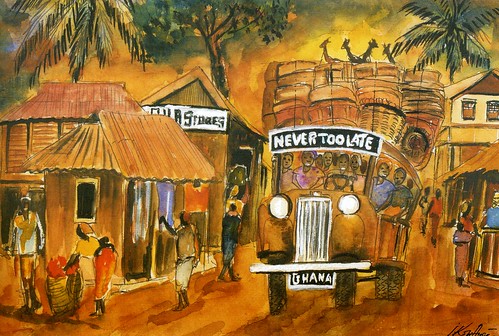
never too late by John Kofi Aryee


Fairy Tale Endings

Responding to Ben Hyde's first take on the matter: Fairy tale is the right metaphor and Google Reader's is a cautionary tale akin to the Tower of Babel. Coordination costs is the issue and what we are seeing is a vast consumer surplus being dissipated.

And it hurts even if you saw the blow coming. I made my peace with the loss of sharing features a couple of years ago and the enforced push to Google+, I made my peace with many other losses, but now I'm been in mourning for the web.

Grievous bodily harm is being done to the web ecosystem. For a good decade, tools and infrastructure were built that wrangled the web with a view of feeds as an ideal medium for information dissemination and consumption. Google Reader's role was crucial and necessary.

Unlike Les Orchard, I didn't go so far as to actually write books or move home to work on the teams that built some of these building blocks (Delicious, Flickr, Reader) but I similarly evangelized and worked on them. It's a shame.

In retrospect, Mark Fletcher (of Bloglines fame) cashed out at the right time, from what I can tell his life post-Bloglines is a lot of safaris. All power to him.

Looking forward more broadly, I can see the outlines of how the story of Amazon will ultimately play out. For a moment that will seem all too brief in retrospect, consumers had use of a vast consumer surplus as the web was built and options value flowed in their direction. Then we heard about "Spring Cleaning"...

I feel sad writing this note in Google+.

Soundtrack for this note

File under: , , , , , , , , , , , , , , , ,

Monday, March 04, 2013

New and Improved

Another case of the new formula, another case of a company juicing the books: the diaper wipes that we had settled on for The Daughter got the New and Improved! treatment last week (the exclamation mark is the usual signifier of duplicity). It's the now customary scenario: a company decides to wring out surplus value by squeezing every ounce out of its means of production, typical latter day capitalism at work.

Working in an industry that is perpetually focused on the new and shiny, I probably shouldn't begrudge innovation in a mature market, and what is more fundamental than diaper wipes after all. Furthermore The Wife suggested I should censor this particular rant - perhaps wanting me to elevate the discourse and not fall into a parental blogging rut. I had even planned initially to use the title of this piece to dissect exactly why the recent redesign of Delicious left me in literal despair, but, well, my muckraking instincts for economic malarkey would not be denied. I'm knee deep in it, so diaper wipes toli it is...

I note:

  1. The number of wipes per box is reduced, 64 rather than 70
  2. The formulation is changed - the material is different and the liquid the wipes are soaked in is different. Presumably cheaper ingredients are being used all around.
  3. The price per box remains the same.
  4. Profit!
Counteracting this, my investigations reveal that the size of each individual wipe is slightly increased now a 17.7 by 17.7 cm square as opposed to a 17.7 by 17.2 rectangle. Thus an individual wipe might feel slightly more substantial in your hand. Such are the fringe benefits.

I won't repeat my usual analysis of the costs of all the raw materials (although I was intrigued by some of the substituted chemicals) - I'll give them the benefit of the doubt that the research and development costs of this process tweak is neutral in that regard.

Doing the math however, even if the same raw material for the tissue was being used, they have managed to get a 6 percent decrease in their costs. This combined with a 8.5 percent decrease in the units per box (their revenues are assuredly tied to the total number of units moved) is the icing on the cake, or should I say, the fruit at the bottom.

And the only thing they had to do was change the packaging. The New Formula is marketed as "New and Improved"!, ostensibly "thicker, more absorbent" and the new box has been given a makeover - green graphics evoking the forest plundered in the manufacturing process, marketing copy about how it is good for the environment, bio-degradable, hypo-allergenic etc.

mother and son by e. bonsu

Impressionable Youth


Most egregious is that the new diaper wipes have a stenciled design of what looks like little Winnie the Poohs to make it more exciting for both the adult wipers and the toddler wipees. The owners of A.A. Milne's copyright (or is it Disney) must be smiling at both the licensing opportunity and inspired product placement, eyeballs are everything and the younger and more impressionable the better.

Some surfer of the conventional wisdom says you have to do something 10,000 times (or is 10,000 hours) before you become a pro. Diapers are in most cases a 2 to 4 year part of a parent's life thus one might approach that virtuosity. Incidentally the diaper companies quite ludicrously say that you should expect to change 10 diapers a day (it is obviously in their interest to encourage inflation in diaper changing rates). Crunching numbers as is my wont, in addition to the economic bonanza gained by the process tweak, there are all those ad impressions that can be monetized, marketed to the highest bidder.

The brand is called Seventh Generation, they must be in Seventh Heaven at this turn of events. Really, think about the impressions here. The best minds of my generation are trying to figure out how to get users to click on ads and here we have literal evidence of bottom power. Various science fiction novels and films have emphasized the permanent advertising that is in our near future. The tissues given to economy passengers on some airlines have advertisements on them; much has been made about catering to captive audiences in toilet stalls and the like. The future has long intruded in the most routine encounters, intimacy and privacy be damned.

I expect that my love for Winnie the Pooh, Peter Rabbit and Kwaku Ananse will remain undiminished, but surely one might wonder about a potential backlash. I expect however such things have been taken into account, brand managers are watching social media for signs of reaction to the rebranding. Indeed my company even markets software for this purpose.

Maker's Mark was pilloried recently for planning to dilute the alcohol content of its bourbon and other products; the company reacted by reversing its decision. Fiddling with the formula is a fine art and perilous especially with food and drink (New Coke and horse meat notwithstanding). They should really have just gone with strategy of smaller containers like the orange juice producers. For other types of product the sky seems to be the limit in this respect. Inertia being what it is, most people won't change their practice even if they notice the difference.

We are all jaded customers, used to being nickled and dimed and singing the inflation calypso - this is par for the course in this Great Recession. Anyway, I noticed and wrote it up for what its worth.

A New and Improved Playlist


A soundtrack for this note as is my custom

File under: , , , , , , , , , , , , , , , , , , , ,

Friday, February 08, 2013

A Temporary Inconvenience

Five times in the last eight years, I've woken up one day having lost the hearing in one ear (the ear in question seems to alternate). It's a matter of physiognomy I've been told: the combination of poor drainage of my sinus cavities (their perversely shaped contours apparently don't help things), small ears, and a latter-day propensity for prodigious production of earwax. These episodes of partial deafness have typically lasted from as little as two hours to a few days. The current assault on my middle ear, however, at ten days and counting, is pushing beyond the realm of temporary inconvenience.

It's not just that I haven't been able to listen properly to the new José James album - hearing his golden voice in muffled mono as if coming from a locked trunk packed with ancient manuscripts hurriedly buried in a desert backyard in Timbuktu under Sharia law, is painful enough, it's that, as the days drag on, I'm beginning to contemplate what might happen if modern medicine and my body's defenses don't resolve things successfully. Incidentally, the album is rather ominously titled No Beginning, No End. Perhaps it's in that vein that I listened blithely (with my good ear) to a doctor cheerily informing me today that my hearing will "probably come back", and "most likely after a couple of weeks". Those hedging qualifiers were what I held on to rather than the alarmingly lengthy time horizon she contemplated.

I write, however, not to bemoan my lot because, obviously, things could be worse. The surprising thing also, once you get over the bewilderment of sinusidal oppression and hearing loss, is that one is able to carry on living a quite full life. Moreover, there's nothing like a temporary disability to make you rethink things; people don't think enough these days, they just act. I'm rather inclined to take the glass half full notion to being half deaf, heck, if you choose strategically where to sit in a hypothetical meeting, you'd avoid having to hear much that annoys you - and others would be none the wiser. And ear splitting cries, to take another example of occupational hazards, can easily become mere pantomimes, even hot air. But I digress..

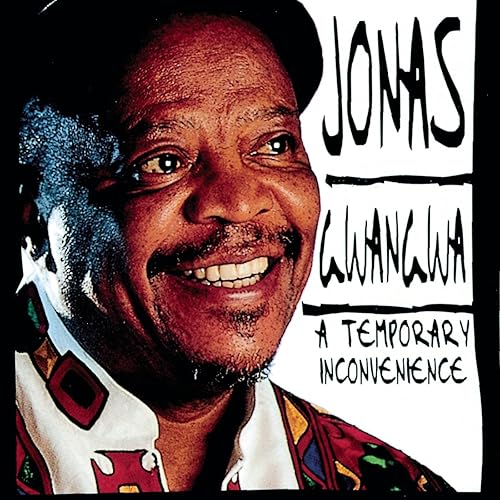
I write, rather, because my aural predicament reminded me of Jonas Gwangwa's song and album aptly titled A Temporary Inconvenience. The great trombonist's fulsome sound materialized in my imagination and got me thinking of a trip I made to South Africa in Christmas 1993, just months before the 1994 elections that marked the notional end of apartheid. Perhaps as I convalesce I'll find time to dig up my dusty notebooks and finally write up an episode that left quite an impression on me.

Jonas Gwangwa A Temporary Inconvenience

A South African playlist immediately conjured itself up. Start with the dearly departed Moses Taiwa Molelekwa, a brilliant jazz pianist whose Genes And Spirits captured the pre-transition mood - a mood akin to pre-millenium tension. Follow up with the the broken strings of Allen Kwela, fondly played wherever we went. Add in a touch of Busi Mhlongo's Urban Zulu for some funkified and righteous dance. And then think to Yvonne Chaka Chaka exuberantly singing Bombani invoking the enduring spirits of Mandela, Tambo and Mbeki père among others.

I'd like to think that the song, A Temporary Inconvenience, related to what Jonas Gwangwa and his contemporaries like Hugh Masekela and Miriam Makeba must have thought as they were first heading into exile from the apartheid state. As time passed and the temporary seemed to become permanent I wonder if they ever doubted they would return. For it was a uniquely unseemly state in world history. I'd certainly like to believe that, over the longue durée, apartheid itself will come be seen as a temporary inconvenience. That has been the challenge, I suppose, of the past 19 years, and perhaps that is the story that people were already suggesting even before Mandela was elected and inaugurated. It simply isn't the case, however, and much effort will need to be expended before that day will come. One wonders when the new South Africa will truly become "The New South Africa"...

But enough procrastination, time to summon up the courage to take that horse pill. I know the first thing I'll be listening to if, and when, my receptor cells resume their role as audio interpreters: the mellifluous trombone tones of a master musician.

A Temporary Inconvenience, a playlist


A soundtrack for this note (spotify version). File under: , , , , , , , , , , ,

Monday, January 14, 2013

The Dark Keys

Chris Ferris rants in typically vicious fashion:

It seems amazing that Newsweek has the cojones to print an article like this so soon after the administration made them their biatch for (correctly) reporting that an anonymous Pentagon source had seen in a report of allegations that the Koran had been flushed down the toilet.
The topic is Good Intentions Gone Bad, the farewell article by Rod Norlan, Newsweek's exiting Baghdad Bureau Chief which has received much skewering in the blogosphere for what it unwittingly reveals about a journalist's conception of his job (as with Judith Miller's Chalabi-exploited naiveté). The article is full of items that could have been Pullitzer material if pursued. Chris highlights this sentence in particular
The most shocking thing about Abu Ghraib was not the behavior of U.S. troops, but the incompetence of their leaders.
Chris rejoins
Actually, what is most shocking is that despite "plain as the nose on your face" knowledge that their leaders have proven to be so incompetent, is the fact that they somehow managed to get re-elected.
I'd add that even worse is that, as Brad Delong also noted - Now He Tells Us (Why Oh Why Can't We Have a Better Press Corps?), this same bureau chief was supremely supine in allowing the kind of reporting that his magazine did in the run up to the Iraq war and also ever since that that black hole began sucking up life from all those around it. Remembering your cojones only with the benefit of hindsight, once you've safely left the Green Zone and don't have to worry about getting cut off from access to highly misleading and stage-managed briefings with Pentagon and anonymous "Senior Coalition Provisional Authority officials", is mighty noble don't you think?
"Just the facts, Ma'am."
And MSNBC, which falls under that same tainted Nothing Bad to report Corporate (NBC) umbrella, is a far more malignant culprit than Newsweek in its flag-waving Pollyanna posturing. It outdoes even Cheery Neverland News (CNN) at the Fox News imitation. I actually respect Fox News because, like all Rupert Murdoch productions, it is simply an articulation of the man's parochial concerns and personality. The Sun in England taps directly into Murdoch's id but Fox News gets quite close to the heart of the matter. The things that matter to him are well known and who can blame anyone for assuming that what they like is what others would like. In much the same way, many Americans assume that what is liked or is good for America must be liked by, or good for, the rest of the world, but that's just an overblown sense of self at work. Besides media à la Murdoch is fun, sexy and exciting with enough sports to satisfy me on a weekend afternoon.

As far how the November vote went, well that's just the way of politics. One needed a savvy opposition figure who would be willing to play as dirty as the incumbent (who controled most of government) and to court all the country instead of preaching to the choir.

The cognitive dissonance of the moment, of the Greek chorus of "The insurgency is wilting! Vctory is right around the corner! We don't torture prisoners!" set against my dread at hearing what horror the BBC World Service will reveal as I wake in the morning, cries out for a sustained response and for someone to speak up incisively and engage the country because the current government has no policy clothes and is plainly what Pentagon planners would call a target rich environment - despite a fawning media.

Joseph Biden's call to Close Down Guantanamo Bay is a step in the right direction, but the critique needs to go beyond foreign policy and needs to address the real domestic and economic train wreck that even leaves that bagman we call Greenspan puzzled (Greenspan Says Low Rates Tempt Investors to Risk More). The socially regressive policies are more difficult to report but they also are interesting to consider and motivate many an interest group. Political journalists can take a look at the Downing Street memo and ask ingenuous questions about dates, people and places.

If that fails, we should remember that Al Capone was ultimately busted for tax evasion (incidentally that fellow-traveler in deviousness called Augusto Pinochet will finally be facing the music for tax fraud if he doesn't again fake illness whenever Riggs Bank or Allende are mentioned). No one expects politians to be choir boys but Dick Cheney and co make Bill Clinton look like the freshest Kuumbabe in town. Looking at the petty corruption from Tom Delay (with him you don't have to even squint) to Bill Frist, to the mismanagement of Iraq's oil revenues, or the way contracts (Haliburton et al.) are being awarded by the CPA in the abortive Iraqi reconstruction effort etc. (your tax dollars at work) should be an easy thing for a patient hack seeking to make a name for themselves. There are so many areas to look at and far more "there" there to grapple with than say something obscure as the Oil for Food program. 2 years of the War in Iraq, 18 months of the CPA or 3 years of the Department of Homeland Security has brought to light in the public domain a larger paper trail than Deep Throat ever handed to Bob Woodward and Carl Bernstein. Will US journalists ask the questions?

On political rhetoric, Dana Millbank has the right idea about the Administration's Amnesty Amnesia.
The folks at Amnesty International are practically begging for a one-way ticket to Gitmo. After the human rights group issued a report late last month calling the U.S. detention center in Guantanamo Bay, Cuba, "the gulag of our times," top officials raced to condemn Amnesty.

President Bush: "It's absurd. It's an absurd allegation."

Vice President Cheney: "I don't take them seriously. . . . Frankly, I was offended by it."

Defense Secretary Donald H. Rumsfeld: "Reprehensible . . . cannot be excused."

Funny -- these officials had a different view of Amnesty when it was criticizing other countries.

Rumsfeld repeatedly cited Amnesty when he was making the case against Saddam Hussein, urging "a careful reading of Amnesty International" and saying that according to "Amnesty International's description of what they know has gone on, it's not a happy picture."

The White House often cited Amnesty to make the case for war in Iraq, using the group's allegations that Iraq executed dozens of women accused of prostitution, decapitated victims and displayed their heads, tortured political opponents and raped detainees' relatives, gouged out eyes, and used electric shocks.
In any case, the only reason that stereotypical American voter cares about Abu Ghraib, Guantanamo or Bagram is that there is a nagging sense that it will cause blowback. Deep down, the American psyche was bloodied and wounded by the temerity of those Bin Laden cultists to attack as they did and a little frontier justice and dead-or-alive treatment is well within the cultural zeitgeist, as evidenced by those recent paens to flagellent revenge Man on Fire and The Passion of The Christ, to name just a few movies (the South Park - Passion of the Jew was better I felt).

The fact that swarthy types are being roughed up is of little matter: you can't fight Al Qaeda without breaking a few bones. Even when you tell them that that Afghan taxi driver was innocent, that he was a witness to the bombing and not a suicide bomber, and that getting beaten to death is a rather steep price to pay for objecting to being one of The Usual Suspects picked up even if said beating is at the hands of clean-cut, wholesome, flagbearing, GI types with crew-cuts that you can bring home to mom.

Showing that the current government policies, in almost every sphere, are not only wrong-headed but counter-productive with daily evidence of blowback in body bags, unphotographed caskets and deficits is only in start.

Talking in plain English about these things is the correct tactic. And the talk should not be in the weasely and vapid pseudo-senatorial lobbyist-lackey lingo. The most shocking aspect of that attention-grabber demagogue, George Galloway's dismantling of Norm Coleman's Senate Committee was that while his rhetoric was rather sober even if quotable, it seemed light years from what any American politician could come up with. From Issue A to Z it should be a matter of repeatedly saying,
  1. The policy is wrong.
  2. It's not working. Indeed it's alienating people and worsening things.
  3. This is how we would change it.
Repeat ad infinitum.

The Democrats' choice of which issues to take stands on is quite puzzling although Harry Reid is getting better. They don't even seem to get to the "It's not working plank let alone proceed fluently to the "How we would change things" aspect. The concept of a strong Whip, of getting strong ground-level organization, of articulating deep policies and positions - an agenda in short, of having a party with a cohort of thinking heads ready to repeat the party's line at every opportunity is missing. In other words what is needed is the equivalent of the work that John Smith did for the Labour Party in 1990s England before his untimely death, work that paved the way for the emergence of Tony Blair and Gordon Brown (and there were 50 others who could have assumed their roles). When Labour took the reins of power from the analagously sclerotic John Major's Thatcherite Conservatives (John Major is at the Carlyle Group along with George Bush Snr), they hit the ground running with a comprehensive program and manifesto that they can still point to today and which has won them 2 consecutive elections (even despite the UK electorate's evident distaste for Blair's embrace of Bush's apocalyptic "Because we could" Empire-building Persian folly and the consequent costs in blood, taxes and peace of mind they are bearing). And the Assyrian conquest looms.

In any case, as I've written before, how Americans chose to mismanage their patrimony is of rather minor concern to me, although housing purchases loom, it's the collateral damage that worries me.

At the risk of repeating myself, and being my father's son, I believe in the joy of repetition, let me harken again to the Ga proverb my father is so fond of recounting
An elephant which is lean is still bigger than a cow.
  • A chastened US will still dictate to much of the rest of the world
  • A lightly grazed GOP elephant could very well be bigger than a rising donkey some might say.
I was discussing with my Afro-French cousins this past weekend the way the French bloodied Chirac with a resounding non in the past few weeks. Their typically Gallic response was "Les Français sont con". Later on we read the Observer and found a quote echoing the same sentiment:
Danielle Larre is tending her tomato plants when I drop by. I ask her whether she will be voting oui or non. 'I'm going to vote yes. Now that the train is on its way, we can't simply jump off. I started reading the constitution, but I decided I had more interesting things to read. It's ridiculous to have a referendum because nobody understands it.'

Danielle's husband is a member of the chasse (the hunt), many of whom oppose the constitution because they fear it would remove their right to trample through people's gardens hunting wild boar. 'My husband, mum, son and sister will all vote yes,' she says firmly. 'We're all voting yes for different reasons. My mum will vote yes because she likes Chirac. Me, I don't like Chirac at all.' Danielle shrugs: 'Les Français, ils sont un peu con. Ils sont jamais contents.' Roughly translated: 'They're awkward sods, the French. They're never happy.'

Jean shows me a computer program he has, analysing the vocabulary of the constitution. The word 'bank' appears 176 times; 'market' 78 times; competition 174 times; and social progress three times. The word fraternity does not appear. 'Services public' appears only once; the preferred term now is services economiques d'interêt general. 'It's not just a choice of words. Services public means something very specific in France. We don't want to lose that distinction,' he says.
In other words, the French chose to vote down an inconsequential constitutional treaty but may still very well vote Chirac and his cronies back into power at the next presidential elections. In much the same way, if no US politician steps up soon to the proverbial plate, the same thing might happen and worse in the 2008 elections. If that comes to pass it will be every man for himself because the Global Goodwill Quotient ® will be maxed out like the US national savings rate is being minimized. Have you bought any euros lately, Chris?

Soundtrack for this political toli posturing:
"Holding Someone Is Truly Believing There's Joy In Repetition."
There's Joy In Repetition. Iraq and Afghanistan are plainly not working
There's Joy In Repetition. Nuclear Proliferation is not working (India, Pakistan). North Korea is not working
There's Joy In Repetition. Economy is not working
There's Joy In Repetition. Human Rights are scarce (Mr Patriot and Tom Ridge's Homeland Security beckon)
There's Joy In Repetition. Job security? Hello? Anyone there?
There's Joy In Repetition. Health care is not working (my insurance copayment is $35 and I'm a lucky camper)
There's Joy In Repetition. Affordable housing or education is a pipe dream for a growing number
There's Joy In Repetition. Retirement Funding? Will your company pay your pensions? Is your 401K safe? Well less said on that
There's Joy In Repetition. Environmental Policy? I've got some Redwood Forest, National Park and some Alaskan oil field drills for you
There's Joy In Repetition. [                             ]


The above space deliberately left blank.
There's Joy In Repetition.Let's cut taxes for the top 1 0.1%.
There's Joy In Repetition. Let's spend the loot like a Long Thief in the Night


Brand America is being flushed down the toilet along with those copies of the Koran.

More toli on The B-Movie Theory

File under: , , , , , , , , , , , , , , , , , , , , , , , ,

Wednesday, March 28, 2012

The Art of Omission

Until recently, my friend Teju Cole's public persona was that of an enigma in the guise of a sphinx. A veritable chameleon who changes identity with each project, the multiple lives and worlds he inhabits make him a true world citizen, cosmopolitan at heart. And yet he'll insist on normalcy, on being quite specific and local.

Luddite that I am, I waited until the paperback was issued to get my copy of Open City. Diaper-changing intervened to delay my immersion into this, his second project, and, further, to prevent me from scratching some words in response. Throughout, I was eager to see what the fragments I had read on Modal Minority had turned into, eager to see how ruthless editing would mold his words in the journey to print publication, eager to see if the omission of the contemporaneous photography would matter, eager to see if the blog/diary episodic feel would leave its imprint on the page. There isn't quite a Metacritic or Rotten Tomatoes for literature, but I haven't encountered such high critical approval for a novel in a long while, and deservedly so. In short, the reception to Open City brings to mind that album, Everybody digs Bill Evans - if not its title.

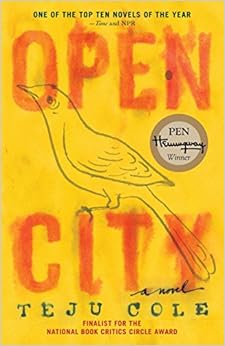
Teju Cole - Open City

Erasures

So, what are we to make of Julius's world - Julius is the novel's chief protagonist? Mere flanery? A roman-a-clef perhaps? Or should one simply revel in the keen sense of observation at work and, especially, the hypnotic vocal performance? Well he leaves clues all over the place, up front even. Like a Beckett (or, my favourite, Ionesco), he delights in words and worlds that are hidden in plain sight - and, to digress on a digression, part of what is most interesting about the critical response is that critics can't resist projecting their literary heroes onto him (I've heard of Sebald, Coetzee and more being thrown his way - although the Will Self comparison seemed a stretch, psychogeography be damned).

But to return to clues to unpacking Julius's world, take this:
"I learned the art of listening from him, and the ability to trace out a story from what was omitted"

It's right there on page 9. Don't call it a provocation and, certainly, don't call it an obfuscation if he hits you on the head with just what was omitted come novel's end. Focusing solely on the considerable art of listening on display in the novel while ignoring what was omitted misses much of the point. And, well, you, Dear Reader, were warned about the complications.

Julius is a great listener, a great observer of people and things and his wanderings form the bulk of the novel. Some might say that Open City is all about listening, call it a guided tour with a peripatetic cipher at its lead. The novel packs erudition in his keen musings, we get to follow him on literal (and intellectual) walks. We learn about a city, its physical embodiment and its history.

And yet, the motifs of omission, erasures and absences remain at the core of the novel and are repeated throughout; the gaps in the novel's archeology are equally interesting as what we unearth.

It's my belief that the greatest of the "post 9/11 works" was 25th Hour, Spike Lee’s paean to the same open city and its walking wounded. If one is to cast Open City in an analogous light, as a post 9/11 novel, what are its phantom limbs? If you'll excuse a political foray, life in George W. Bush's world was all about these absences: extraordinary rendition, black sites and so forth, the holes where proud twin towers once stood, a return to harshness in immigration policy, wars of choice and their associated, disappearing yet ever expanding body counts, in short a world of blind spots and selective amnesia in public discourse. The gloves came off and we, the royal we, that elusive we, were all collateral damage. But, hey, we were protected by the silences. Perhaps it is as it should be, but it is curious that Bush has been an absence, a similar erasure from our hive mind of the past few years of Great Recession (or Lesser Depression).

So then what else is omitted - well, the rush of a narrative plot for one, he's no Elmore Leonard. But this is deliberate and suits the mood. He hasn't delivered the multi-generational family narrative but Open City has similar sweep. Don’t expect overt propagandizing, rather revel in the flow, take the details in, take in the showy learning. It's a soothing balm for these days.

Normalcy

Normalcy is Teju Cole's ultimate project. It is a theme he returns to time and again. In Everyday is for the Thief, it was explicit and remains so in his recent output. He writes as an African writer, as a black male, as a Yoruba writer and as a mid-Atlantic modern traveler. But look: dig the conservative pose, Julius loves the arcana of classical music - he’s part of the academy or aspires to be. From the protagonist of Open City to his author there’s an emphasis on how completely normal they are. Perception is everything and the strategy gleaned is about changing the perspective, about focusing on small things and complicating one's ideas about the norms of society. It’s a tough project and one I am deeply empathetic with.

Although it is early in their careers for such nominations, if Chimamanda Ngozi Adichie is the Jay-Z of the recent wave of African writers, I'd project Teju Cole as the Questlove of African literature (he'd prefer Mos Def perhaps). That is, I pray, a tribute to his deep geekery and knowing and erudite normalcy, his attention to the craft and his ethic of working while others are sleeping. Apropos Questlove, I recently heard him digress on normalcy and perhaps his comments were apt:

"To be seen as normal is to be seen as equal... [it's]... the hardest thing for black people"
And so we should place my friend among those weary sons of Conrad - although stylistically he is more in the vein of Nabokov. His modern urban terrain in Open City is a kind of heart of whiteness - the title of one of the fun fragments that didn’t survive the journey to print. Consider the curious natives his main protagonist tirelessly observes as mere backdrop. Consider their city’s hidden histories as mere fodder for a searching psyche.

If Open City can be read as a work of excavation, what are we to make of the tendency to dwell on the incongruities of atrocities past, when internal displacement is part of parcel of Julius's present? Well he's written an elegy for a city and its exiled souls, surely that suffices. I admire the artful omissions and the elliptical silences amidst the hypnotic flow. The choice to not provide pat answers serves to resist characterization, further, it's good to be angular and playful and to keep some powder dry in reserve.

I settled in and read the book like a thriller, like a Ludlum joint. You've done well, my friend, I dig your sense of normalcy. A head nod in your direction.

Postscript

One of the wryest bits of humour in Open City concerns a neon sign in which two letters don't light up. I'm reminded of the climax of one of Janet Jackson's Rhythm Nation concerts in London (in 1990 perhaps). The song was The Knowledge and at the end there was a montage where some slogans would light up on the stage in call and response: "Ignorance No! Bigotry No! Illiteracy No!". The only problem was that the bulbs for "llit" didn't light up. That snafu is my favourite memory of that plastic performance. Oops.

An observation: when African writers branch out in public intellectual mode, the perils of faint praise often follow in their wake. Brace yourself.

The Art of Omission - a playlist


A soundtrack for this note File under: , , , , , , , , , , , , ,