Sunday, November 09, 2008

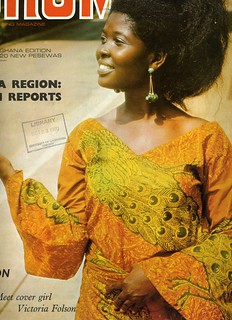
Drum Magazine Ghana 1969

Belatedly, some notes on the year 1969 in Ghana, as viewed through the lens of Drum magazine... (see slideshow)
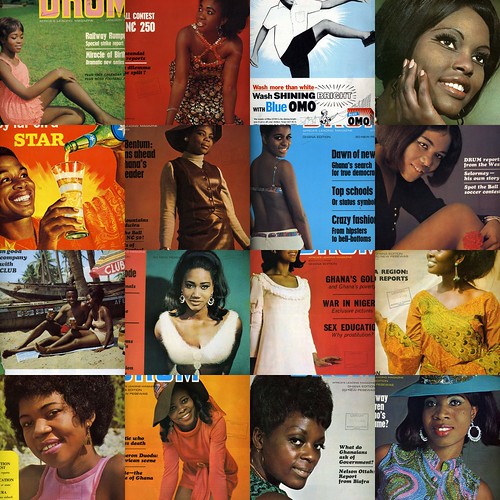
drum magazine 1969 collage covers


I spent some time scanning images from a year's worth of issues of the Ghana edition of Drum magazine. Truth be told, losing myself in the pages was a bit of escapism. I wanted a glimpse of my parents' world, of their aspirations and of the culture from which I emerged. Those pages were a good source of any manner of cultural artefacts and goings-on in the country. Call it nostalgia, call it social anthropology, call it a poor man's history, or perhaps I was simply fascinated by the advertisements. So. Drum Magazine. Ghana. 1969. Here goes.

1969 was an election year in Ghana, Kwame Nkrumah's one-party regime had been overthrown and civilian rule loomed. But that was by the by - the magazine was typically focused on lighter issues. By way of background, Drum magazine is most known from its South African roots but it also had Ghanaian and Nigerian editions from the late sixties until the eighties. The equivalents would be Ebony, Jet or say Essence (alternatively think of Hello and Paris Match) ergo, none too weighty society papers. A good place to start then would be "Drum's fabulous contest to find the prettiest mini-skirt (and its wearer) in Ghana."
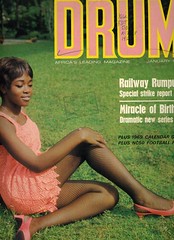
drum january 1969


The singer Rose Small's pink mini-dress "proved irresistible". Her testimony was eloquent:
"Minis are gorgeous and I adore them. With the right figure, pretty legs and a lot of taste a girl simply looks wonderful in a well-made mini. I believe that for a long time to come minis will continue to be ravers.

I wear minis because I feel free in them. In any case what's wrong with showing just a wee bit of thigh? For parties, for casual wear, for public outings when I appear on television or nightclubs my dress is either four inches or six inches above the knee. I have no fixed notions about the length anyway. On a day I feel gay I just slip on a six-inch-above-the-knee dress.

Of course I do not fancy very complicated fashion make-up. For the mini which won the competition I just asked a dressmaker... a fan of mine... to make me a six-inch mini with a matching long-sleeve blouse. That's all. The important thing is the poise and grace which I think I have. The mini cost only eight new cedis to make. No fuss, no mess!"
Dig the insouciant language of the liberated. Others however took offense, Ghana was (and perhaps still is) a fairly conservative society:
"The mini-skirt which you have so irresponsibly patronized is becoming a nuisance in the country"... "most of the girls who put it on do not have the good legs, the shape and poise to do justice to that weird dress of yours".
The fashion spreads contrasted the mini-skirts and bell-bottoms of the time with the more traditional cloths (Dutch wax, batiks and other fabrics).
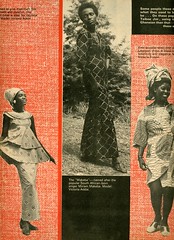
made in ghana


We see the marketing of the Kenyan fabric named Maridadi (from the Swahili word meaning bright and colourful) and its Ethiopian analogue.
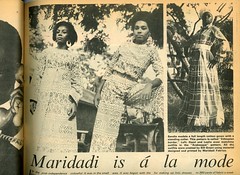
maridadi


Teijin Tetoron, the Japanese polyester brand was trying to make a splash - without much success, as it turns out, cotton works best in our tropical lands.

There was plenty of eye candy throughout the magazines.
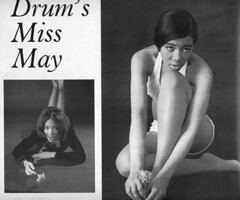
miss may - Monica Edwards


On the perennial question of hair, the influence of Motown was felt with Supremes-styling presumably taking over from the corn roll of yore.
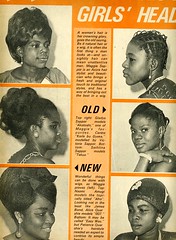
hair fashions 1969


This same dynamic is at work 30 years on, as the following posters from 1999 show.
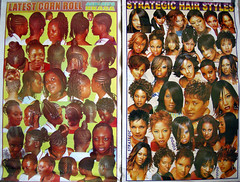
tradition and modernity - ghana hair fashions 1999


Imagine an academic paper: Tradition and modernity, the sociology of hair in post-colonial Africa.

The alternatives were afros and going au naturel of course. Wigs were for the more adventurous - brand 99's wig spray advertisement proclaimed that it was "Ghana's favourite lacquer".

Head scarves abounded, the older, traditional duukuu that had given way to European headgear before independence was now reinvented as the lappa cover cloth.

hair fashions lappa 1969


Timothy Burke made his name as a social historian studying advertisements in Zimbabwe in Lifebuoy Men, Lux Women: Commodification, Consumption, and Cleanliness in Modern Zimbabwe. There is much of the same material here. There was soap, lots of soap, Lux Soap would weigh in against Rexona and its ubiquitous cover girl. Omo competed with Surf.
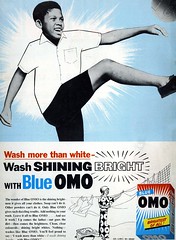
blue omo 1969


Skin lightening products were popular (well at least they were heavily advertised). Fela would sing Yellow Fever a few years hence and bemoan the extremes of the practice. It's not just Africa however and not simply old history, the same thing happens in India and China today. "You deh bleach, oh you deh bleach".

nku cream


A yearlong series on sex education draws a big response from readers, dealing as it does in straightforward terms with everything from birth control and family planning, the pill and other contraceptives, midwives, child birth, relationships (pre-marital and otherwise), passion and even prostitution.

Healthcare advertising is also much in evidence. Presumably the infant formula and powdered milk of the time wasn't contaminated with melamine but the hard sell about infant nutrition was well on the way as breast feeding was deemed passé.

cow and gate


Cod liver oil remedies compete with Milk of Magnesia treatments. Vicks rubs elbows with the various potions and herbal bitters that form the bulk of traditional medicine. The same competition between modern pharmaceuticals and traditional practitioners continues to this day and all now have large advertising budgets. As one would expect, we find adverts for various malaria treatments - Nivaquine gave "sure protection", Resochin claimed to cure malaria. Bayer, Merck and others were targeting Africa.
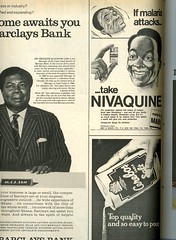
nivaquine


Ghana Airways was continuing its expansion - by the mid 70s it would begin its inexorable decline (it died a few years ago) - well, we could all dream in 1969.

ghana airways 1969


Next to ads about Westinghouse air conditioners or Fan ice cream (which had been launched on the advice of Dr Fred Sai and was instantly favoured in generations to come), you'd find much about beers of course. Star beer and Club lager had large budgets and blanketed much of the magazines. It was all about the good life. The culture and politics of alcohol have been much studied in Ghana. Schnapps was less in evidence but featured - it is used in libations and many of our ceremonies.
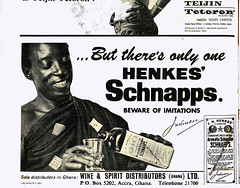
schnapps


My clear favourite is Pepsodent toothpaste with Irium. Be progressive and dig the production values and the light skin.

be progressive use pepsodent


There was a vigourous music scene and perhaps a golden age of music in the country. On the highlife side of things, E.T. Mensah and his Tempos competed with Jerry Hansen and The Ramblers band who were more in the vein of King Bruce's Black Beats. These newfangled Ramblers stepped things up and "brought back the boogaloo" from London and the States.

The Professional Uhuru Dance Band featured the guitar dexterity of Stan Plange. The GBC Band roughed it up with The Revellers, Railway Dance Band and the Nigerian Broadcasting Corporation Band. The Aliens Band, The Planets, the Black Santiagos rounded out the cast. The Sierra Leone Heartbeats, fronted by Geraldo Pino had set up shop in Ghana after the coup and found a receptive audience for their brand of soul music - echoes of Motown were in the air. Paradoxically The Soul Messengers' tour was judged a failure - the competition was too fierce.

e.t. mensah and Geraldo Pino of Heartbeats


Every issue featured the obligatory society puff pieces (sundry ceremonies, weddings, durbars and funerals). Memo to self: finish the long overdue toli on African ceremonies.

The Ga chief, Nii Bonne, the so called "Boycotthene", who made a stand against inflation and organized a national boycott in 1948 against colonial rule, died during the year and his funeral was a major marker. It was unusual for traditional rulers to feature in the independence or nationalist movements but Nii Bonne didn't recoil. You may recall, my previous commentary about E.T. Mensah's song, Inflation Calypso, which marked that episode in lilting music.
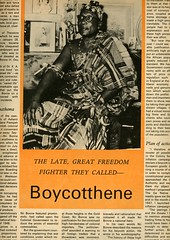
nii bonne boycotthene


On funerals, the thinking was that "it costs too much to die". A certain Moses Ababio in Somanya bemoaned 'senseless, prestigious funeral ceremonies'. Millicent Adamafio in Sekondi chipped in:
'grandiose and extravagant preparations must be condemned in the strongest terms. Some people have become full-time mourners, showing their faces at almost all wake-keeping services. Their explanation is that the more one attends such functions and registers his condolences, the more sympathisers one gets when he is bereaved. In fact there are voluntary organizations whose sole purpose is to give moral and financial support to members who are bereaved'
Others countered:
"what is wrong with a nice colourful and impressive funeral for a loving relative whose face we will not see again. The dead are an important subject in our tradition and should be accorded the due ceremony and honour they deserve".
You'll see much the same debate if you read today's Ghanaian newspapers.

There's a cultural point to be made here. Those "voluntary organizations", those funeral societies are very much tied to the informal sector in the economy. This has always been true and was even moreso during military rule. It was said that during the worst of the Rawlings years the funeral industry was the only growth industry. They provided not only social comfort but financial support. Beyond that, the susu collectors that deal with money management in our markets are intimately coupled with these informal societies and their financial arrangements are our equivalent of the shadow banking system, the essential glue that underpins the Ghanaian economy. Many analysts of the Ghanaian scene seem to dismiss these cultural organizations too readily. The financing of funerals and weddings would make a great dissertation topic for a budding economist or social historian of Ghana. Those considering technological solutions such as mobile payments and the like would do well to start by examining what makes these organizations so effective.

The formal banking and financial sectors were big advertisers, trying to convince the unbanked to start accounts after the hard times under Nkrumah in which banks had fallen out of favour. There was a concerted campaign targeting market women, young professionals, textile workers and entrepreneurs.
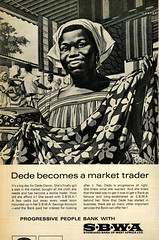
dede becomes a market trader


On ceremonies, there were scenes from the Oguaa Fetu Afahye celebrating the peoples of Cape Coast - the Oguaa traditional area. The headlines: custom and taboo take their turn.
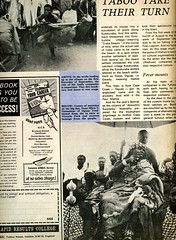
custom and taboo take their turn


The original founders of Cape Coast were said to be the Bentsils and Inkooms who migrated from Sekyere and Techiman and settled in Effutu, nine miles north of Cape Coast. The wandering Effutus soon began to explore their new environment and through the trapping and marketing of crabs, pitched themselves a settlement in this part of Effutu Kingdom called Cabo Corso (Cape Coast) by the trading English and Swede settlers and Oguaa or Gwaa (market) by the "natives"... There were images of "top-level fetish priests" performing the annual purification ceremony (Wohyefa) at Prapratem. These were "top-level", not your garden variety fetish priests.

Closer to my family home, there are the celebrations at Aburi and the Akuapem "mountains" with welcome images of Nana Kwame Fori II, Omanhene of Akuapem, and Nana Dokua II, Queen Mother of Akropong. Family...

nana dokua II Queen Mother of Akropong


Jimmy Moxon was also in attendance, by then he had already spent 25 years with the Akuapems. The so-called "Gentleman Chief" had moved from England and was known by his official name, Nana Kofi Obonya. At other events, you could catch glimpses of members of the Oddfellows Lodge and of various Freemason societies dressed in their distinctive attire.

There was much about student life (the writers were not far removed, if at all from university). Siren, the journal of Mensah Sarbah Hall, University of Ghana, Legon did a satirical end of year issue featuring a cartoon strip that gave rise to the "Wankye Wankye Scandal" - and consequent student riots...

The strip was denounced as 'pornography', students were duly suspended, campaigns were mounted to have them reinstated, demonstrations were started. Things got out of hand.
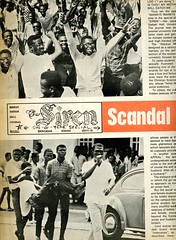
Wankye Wankye Scandal Student Riots at Legon


Reading closely you realize how benign the commentary was, young male students frustrated at the lack of internalists - 'internalists' being those female students who dated fellow students. There were complaints about "the young lecturers who openly fish in the limited pool of Volta Hall - and in the female wing of the controversial Sarbah hall". Student militancy prevailed however. The riot police had to be called in to calm things down. Dig the uniforms.
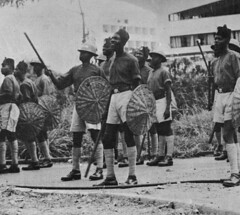
police called in to student riots at legon


When the mood swings there are even looks outward to the deadly costs of the Biafra war in nearby Nigeria. Nelson Ottah termed it a "descent to the abyss" and was shocked by what he saw in Ojukwu's Biafra.
A great magician was abroad, and many things that had no relation with reason were happening. So it happened that the whole people got up like a herd of sheep and followed to their own destruction.

It was all grotesque. it was all an extravagant imbecility. It was all a gigantic political swindle. It was all first-class mass-hypnosis. But it needs an explanation.
On Ojukwu, he didn't mince words:
"the man is a nihilist - a nihilist uninhibited". A magician who "found it so easy to take fourteen million intelligent people down the path of folly, vanity and destruction."
A young Cameron Duodu takes a trip to America at the height of Eldridge Cleaver and the Black Panthers' confrontation with The Man. One gets the sense that he was really there to check out jazz groups like the Sonny Cox Trio or watch Le Roi Jones catching the spirit in live performances but he found that there was no escape from race in his travels in the United States. As he put it: "I see the beauty evaporate". It is interesting to read about America's civil rights trauma through the eyes of a Ghanaian journalist. He titled his pieces America the beautiful with no little irony.
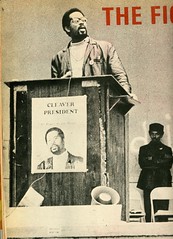
eldridge cleaver


Ghana was looking towards space - playing off the Soviet achievements against the USA's Apollo prowess (the moon landing was duly celebrated) - well anyone could dream and there were even nuclear ambitions (since revived in 2008).
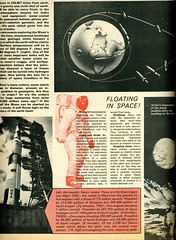
moon - floating in space

On Politics


General Ankrah resigned and handed over to General Afrifa early on in the year. The die had been cast however, and the transition to civilian rule would account for much of the year's manoeuvering.
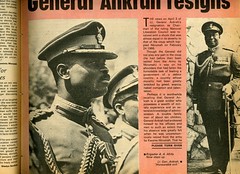
general ankrah resigns II


The Akuffo-Addo commision enjoined that "never again should there be any tyranny in Ghana... little purpose can be served if, having set up a democratic Constitution, we allow anti-democratic forces to overthrow or even attempt to overthrow the democracy that the Constitution ensures." A Constituent Assembly was sworn in to draw up a constitution taking into account its recommendations and those of the general public.

Lt. Gen. Ankrah would state 3 principles to inform the new Constitution:
  • The freedom and liberty of the people and their enjoyment of fundamental human rights
  • To eliminate the possibility of the return of tyranny and dictatorship to the country
  • To prevent the abuse of the Constitution through frivolous and ill-conceived amendments to it.
That last was a reaction to the deposed President Nkrumah and "his disrespect of the Constitution and the frequency of amendments which rendered it a simple tool in his hands for the perpetuation of his rule". With hindsight, the worries about tyranny would prove prescient - Acheampong and his band of rogues would mount a coup in 1972.

There was lots of campaigning and electioneering and much of it would feature in Drum's pages.
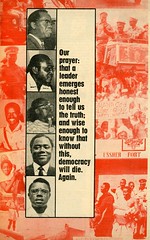
election 1969 candidates


K.A. Gbedemah, finance minister under Nkrumah's CPP was exempted from the vetting conducted by the NLC and threw himself into the campaign with the National Alliance of Liberals (NAL). The association with Nkrumah would harm his performance. The "bearded, bespectacled, mystic-looking Dr. Willie Kofi Lutterrodt" didn't make an impression with his People's Popular Party. Joe Appiah broke with erstwhile colleague, Dr. K.A. Busia and the Progress Party, and founded the Nationalist Party on a platform to economic revitalization and promises to cocoa farmers. It would unite with the Ghana Democratic Party and the All People's Congress. Ex-minister P.K.K Quaidoo led the Republican Party the Dr. de Graft-Johnson led the All People's Party, these last two merging and forming the All People's Republican Party. Their manifestos make for interesting reading.

The elections would be won handily by Busia's Progress Party - the heavyweight brain-trust and shrewd electoral tactics proved overwhelming. Having B.J. Da Rocha on your side counted for a lot on the campaign trail.
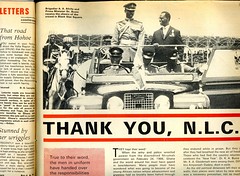
election 1969 handover


Ajax Bukana, the irascible trickster, rabble-rouser and all around general entertainer launched the Mosquitoes Protection Party during the 1969 election. His platform was thoroughly ludicrous but brought some very welcome levity. The minstrel tradition had reached Africa and found fertile ground.
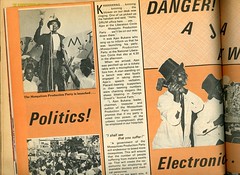
ajax bukana

On Economics


There were complaints about smuggling - Ghana's economy was still dislocated. There were many scapegoats:
"we are asking them not to have a special liking for the Syrians, Lebanese, Indians and Nigerians who are mainly behind the illegal importation of cases of liquors, tobacco, used clothing and cotton prints".
These days, the additions to the list of convenient scapegoats in the Ghanaian discourse are the Liberians who arrived as refugees over the past 15 years. If you press a little harder, some might mention the Chinese but so far their impact on the economy hasn't drawn populist rebukes.

Early on in the year there was the so-called Railway Rumpus - labour disputes with the Ghana Railway and Ports Workers trade unions going on strike. They would face harsh treatment from the NLC - a military government, even a benign one, by definition is not very sympathetic. G.K. de Graft Johnson was then General Manager of those government-run enterprises and had a hard time balancing negotiations with the unions and keeping things running.

Mark Cofie, who started an empire of car garages, becoming an agent of Japanese car companies and dealing with repairing most of the American cars in the country, was given a glowing profile. A consummate entrepreneur, he had grand visions of a Ghanaian auto industry. In retrospect, it wasn't to materialize but he at least made a go at it.

the 1969 car models


On cars... the Hillman Hunter, the Honda S 800, Peugeot 204 Brake, the Mercedes 230 S, the Ford Cortina 1300, the Rover 2000, the Volvo 144 S and of course the Fiat 125 were all available in local showrooms. I still have fond memories of my Uncle Mike's yellow Fiat 125 which somehow survived well into the 1980s. Those Fiats were as indestructible as the Peugeots.

trust the fiat 125


It wasn't clear how popular, or indeed how reliable, Soviet cars like the Moskvitch 408 were - the adverts made sure to note that there were plenty of "spare parts and excellent service available". Sidenote: Ghana had turned towards the Soviet Union in the previous years under Nkrumah - socialism with an African face was the slogan.

The slogan for Chrysler trucks and vans was "Engineering in Action". These days it's more like engineering inaction - and the prospect of bankruptcy.

There were many articles stressing the importance of vehicle assembly in developing countries, for example the Bedford VAM 23 motorway bus assembled locally by Africa Motors. These were the successors to the venerable, bone-shattering Mammy Trucks.
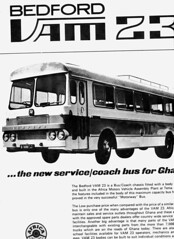
bedford vam 23


The recently opened Akosombo dam was meant to enable a new era of power and support the development of fledgling industries. "Abundant power for Ghana's new industries" read the headline. Manufacturing didn't take off however, and these nascent efforts would falter in the decades to come. It is only forty years on that these same aspirations seem to be taking off in any sustainable fashion. Still there is much on the various factories that were sprouting up.

Reports on the poor and often non-existent infrastructure in the Volta region make for depressing reading: no drainage systems, no street lighting, no water supply (only 8 percent with access to good drinking water), poor feeder roads, few doctors and so forth. The proximity of the Akosombo dam seemed to be of no consequence. A few gestures were being made to promote places like the Wii waterfalls and the mystery rock of Akosombo as tourist venues but the capacity wasn't there yet - indeed it has taken decades for some of those ideas to come to fruition. Certain parts of the country were being left behind and some would exploit the resulting grievances for political gain.

The environmental degradation of Keta and the anxiety of its harried inhabitants were a concern. Those who live between the sea and the lagoon will always find grievances. In any case, some of our best poetry has come out of their predicament, witness Kofi Awonoor's wonderful poem, The Sea Eats The Land At Home.
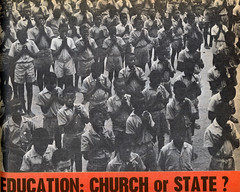
education church or state


The obligatory photo of African school-children in morning prayer raises the issue of church or state. The big question was "whether the churches should continue to manage schools with local, urban and city councils or should the management of all educational institutions come under a unified system to be directed by the Ministry of Education". It was noted that
"the churches spearheaded the drive for education in Ghana... in 1737 the Danish chaplain attached to the Danish Castle at Christianborg in Accra sent two boys from the Castle school to be educated in Copenhagen. Again in 1828 the Danish governor at Osu, Accra invited the Basel Missionary Society in Switzerland to take up missionary and education work in Osu and its neighbouring districts."
During Kwame Nkrumah's reign, his government introduced party politics and the notorious Young Pioneers Movement. A relevant tidbit: when "Rt. Rev Richard Reginald Roseveare, former Anglican Bishop of Accra criticised the Movement's ungodly behaviour at a church synod, he was instantly deported from the country".

The public/private conundrum is very much in the news in today's Ghana, private schools are all the rage, often funded by churches. The jury is still out as to their effectiveness and the question of standards; the Ministry of Education still has to reconcile unyielding demand for public education with limited resources; worse, everyone has an opinion. The easiest way to get any Ghanaian talking for a good hour is to broach the topic of education, we all wax eloquent about what is to be done.
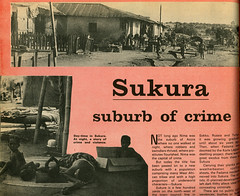
sukura


In 1969, the Sukura neighbourhood of Accra was gaining a reputation for crime and squalor even more lugubrious than Nima. Forty years on it is the aptly named Sodom and Gomorrah that takes the prize as Ghana's school of hard knocks, the place you terrify your little kids about the prospect of leaving them there. Of course this is all a matter of perception, the settlement of shantytowns always gives rise to dark hints of nefariousness by the establishment. Drum was firmly of the establishment and would editorialize about the problems of slums, runaway children and other social ills.

Looking towards East Africa, there is a feature about Pope Paul VI's visit to Uganda - and the story of the Ugandan martyrs. This would be juxtaposed with commentary on Mumiani, the legend of death - the blood sucking myths in Uganda, Kenya and Tanzania. This is about the "ghoulish people who murder for medicinal purposes". The feature recounts the superstition and bloodshed that swept Tanzania in the 1959. The derivation is from "the dark-coloured gum-like substance used by Indians, Arabs and Swahilis as medicine and said to be brought from Persia". Mumiani were viewed as colonial agents so the myth and that kind of mob justice began to fade in the post-colonial era. Our souls were perhaps contemplating other articles of faith.
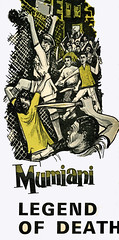
mumiani legend of death

Society Profiles


Dr Stephen Addae receives a great profile showing off his laboratory work. He was gathering materials and experience for his later opuses The History of Western Medicine in Ghana and The Evolution of Modern Medicine in a Developing Country. These tomes are bibles for historians of science and medicine, I should know, I'm married to one.

Pete Myers, the presenter of the BBC's Good Morning Africa whose "swinging career began in an Accra nightclub", was worth a lengthy treatment as an exemplar of the Ghanaian affinity with cosmopolitanism. Born in India, brought up in Caracas, Venezuela, he moved to Ghana as a teenager. He identified strongly with his Ghanaian associates and loathed the way that other expatriates conducted themselves in the newly independent country.
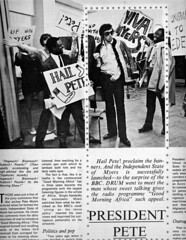
pete myers for president


An interesting tidbit: he became a broadcaster after his friend Smokey Hesse who hosted the 50-minute Jazz Club on Ghana Radio got run over by a bus. He filled in for his friend after that tragedy and came to make a living as a radio presenter. He began to organize Friday discotheque sessions at the Metropole nightclub in the center of Accra, the club rapidly became the center for rock-and-roll and teenage fashion and even inspired mothers to write to the papers that their daughters were being misguided by the "decadence". It bears reminding oneself that Accra used to have a vibrant nightlife.

He went on to direct the Africa's first ever musical, Obradzeng, with sculptor musician Saka Acquaye and Beryl Kari-Kari, dancer and choreographer. After its initial dismissal by Nkrumah, the whole orchestra and 85 dancers were subsequently taken to Russia on one of the Premier's trips. Back in London he started working at the BBC, hoping to change its "colonial mentality" and "the way it talked down to the audience". His efforts were rewarded and the audiences responded to him.
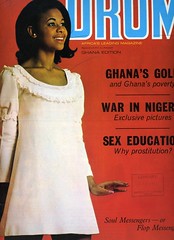
drum july 1969


In contrast to Myers' positivity, consider Geoffrey Bing, the former British Labour MP, who became one of Nkrumah's confidants, first as a constitutional adviser and subsequently as his Attorney General. He of course helped pass "the obnoxious Preventive Detention Act which came to rob Ghana of some of her best brains - it killed the celebrated Dr. J.B. Danquah". Unable to bring authoritarian socialism to Britain, he was glad to have an African playground to test out his ideas. A man who always operated in the shadows, we should compare him perhaps to those faceless European advisers to Idi Amin in the 1970s. After being thrown out of the country as a result of Nkrumah's overthrow, he would head home. Despite his fawning 1968 memoirs, his attempts to return to the political scene in Britain came to naught in 1969.

Baba Yara, Ghana's greatest footballer, the "King of Wingers of West Africa" would die on May 5, 1969 after sustaining a spinal injury in a lorry accident at Kpeve in 1963, three months of treatment at Stoke Mandeville hospital had done nothing to improve his health - nor had the local prophet healer, who had offered his services once he returned to Ghana, been successful. Thus his last six years of life were spent bedridden. Asante Kotoko, the Real Republikans and, of course, the national team, the Black Stars had suffered a grievous loss. The scenes commemorating his life leap off the page.
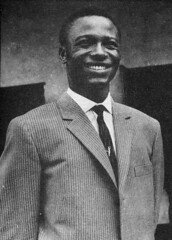
baba yara


Born in Kumasi on October 12, 1936, it was in 1955, his debut year for the national team that he wore the number 7 jersey of the Gold Coast team which massacred Nigeria by 7-0 at the Accra Sports Stadium. Yara scored two goals and was the architect of four of the seven. Decades later his legend as a fearsome attacker is as glowing as say that of the magic hands of goalkeeper Robert Mensah. Those who saw him play wax rhapsodic to this day, my uncle Emma has been known to go on for a good hour about that golden era and those stars. The Baba Yara sports stadium in Kumasi is a testament to his memory.
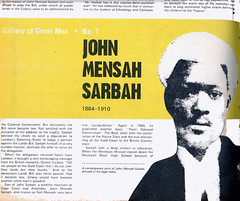
john mensah sarbah


There's an interesting profile of the great Ghanaian nationalist John Mensah Sarbah, born on June 3 1864, who died on November 6 1910. A lawyer he was the first native of the Gold Coast to qualify as a fully fledged barrister-at-Law. He argued against the obnoxious Lands Bill of 1897 which would have placed all public Lands in the Colony under the Colonial Government. It was never passed after legal argument and petitions to Queen Victoria. He waived his retainer for that case saying "I seek no reward in serving the land of my birth" He wrote a treatise on The Fanti Customary Laws in 1897 and the Fanti National Constitution in 1906. The great hall at University of Ghana Legon is named after him in his memory for his educational works. This included his founding of the Fanti Public Schools Limited which eventually became the present Mfantsipim School in Cape Coast. He designing the school's crest and its motto "Dwen hwe kwan - think ahead of time".

There's all that and more - like any society magazine Drum was sometimes shallow, other times profound and even on occasion sublime. Consider this a profile of a country in transition, between military rule and democracy, full of hope and navigating between tradition and modernity.

Ghana is headed to elections in the coming weeks and, from the outside, much of the discourse is akin to that seen here in 1969: great promise amidst reminders of just how far we have to go. I can only hope that my fellow countrymen take heed of those who paved the way for them and remember the words of John Mensah Sarbah: think ahead of time.

drum march 1969drum april 1969


drum june 1969drum august 1969


File under: , , , , , , , , , , , , , ,

Wednesday, October 29, 2008

Maxwell's Suite

For the record, the best $3.13 I've ever spent was for a copy of Maxwell's Urban Hang Suite in May 1996 dug out of a remainder bin in a dusty record store (now defunct) in Davis Square in Somerville, Massachusetts. I remember very clearly looking at the cover and deciding to buy the record on the sole basis of the title, thinking to myself: this is surely some soul music. I was 9 months into my first job and this was the first bit of whimsy I had indulged in all that time, the first thing I had bought for myself beyond bare necessities in all those months. For some silly reason I had worked myself into a state of thrift, subsisting at times on those "bags of burgers" that were the rage at McDonalds - 10 cheeseburgers for something like $4. Well I digress, we'll tackle that toli later... I remember also the look of interest as the guy at the counter rang up my purchase: "Looks like some soul, let me know what you think of it".

When I got to my room, I found the turntable, played the record and discovered that I was in possession of some exceptional soul music, a suite, a trip. This was a new voice that demanded attention, someone I would be proselytizing for even if he wouldn't need it. Looking at the credits I read names that gave me further comfort: Stuart Matthewman of Sade looked to be a key collaborator. Amp Fiddler and Wah Wah Watson were among the musical cast. I dug the voice, I dug the production values, I dug the sound, I dug the message, I dug the execution.

A mood lifted by the time I wore out the needle on the turntable that day. My immediate favourites were Til The Cops Come Knockin' and Lonely's The Only Company; I could identify with the vague longing and perhaps sense of obsession — young adults. Lots of things were resolved to the sounds of the album in the next few months. For one I decided to buy a cd player, that I deserved to have more than that gray room, that — well, lots of things you know.

maxwell urban hang suite

I returned to the store a few days later to buy a cd copy and gave my report to the guy. We listened and talked our way through the album, talked music like those who share our affliction do - for example comparing Maxwell to that other guy, D'Angelo, who seemed hungrier. If they would be MJ and Prince in coming years, we wondered who would be their Madonna. The guy was an R&B traditionalist and kept trying to get me to buy that Brian McKnight album - I kept demurring, that thrift thing. Then he played New Moon Daughter for me and I kicked myself for having been so out of touch that I'd missed out on the release of a new Cassandra Wilson album. I decided to try to do a guest show at WHRB, to get back into things.

So.

There I was about to simply review the concert I attended last night and all of these things came out.

Music is like that. It's a social thing, conveying a sense of time, of place and of comfort. It triggers memories. It's that thing we call soul. I could go on about the vicissitudes of that year, about Boston, about friends and family, about jobs, the travails of finding an apartment and more. All those things came flashing back. I won't though. I'll simply note an album that was part of that year's soundtrack, a mood marker. And I'll hold on to that detail: the album cost $3.13 after tax.

maxwell

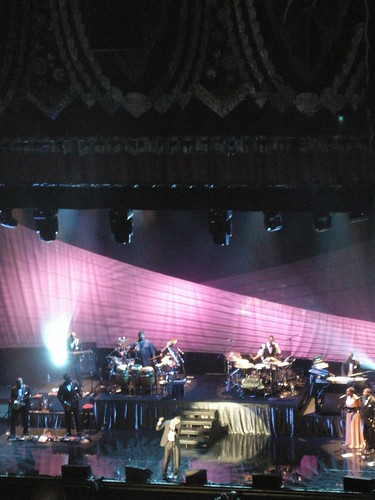
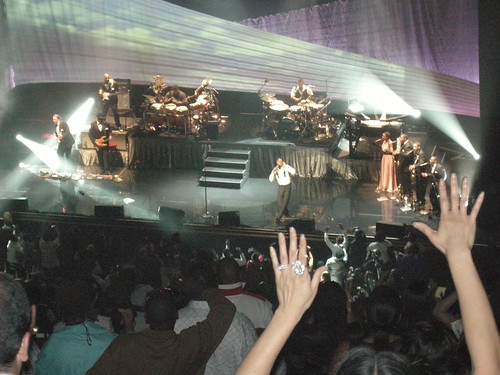
So yes, The Cousin and I were warmed by Maxwell and his 10 piece band last night at the Paramount in Oakland. Escapism from the work week for 3,000 or so souls. It was well worth it. It was, to recycle that phrase I've become fond of, a comfort suite.

I'll leave the detailed reviews to others. It was great show like all others in this tour. The horn section gave an organic feel, the guitars and bass were just right, the percussion was on point, the background vocalist gave nice accents. Briefly stated, the band is tight. When you think about Maxwell, don't just think of the man, the band is as important as the front man. All of them are enjoying the comeback and the overwhelming love from the audiences.

maxwell showman

They played most of the favourites from his songbook and previewed a few new songs. His falsetto is still as pure as ever, he can do the Sam Cooke thing when he wants, or the Prince thing, or the Al Green thing, or the Marvin Gaye circa 1974 thing. There's the dancing and showmanship ala James Brown, he's no longer as skinny obviously, but he still gets down. If he was Mr Mellow Smooth in the past, there's now an additional edge to the performance and to the sound. There's now some experiential blues in his brand of soul. He still thinks in terms of suites, of capturing a mood, and will run with that feeling through its course.

Most of all there's the warm feeling in the music - it's like that groundswell that builds when Maze featuring Frankie Beverly come onstage in D.C.. It's in the crowd too - everyone knows the lyrics and wants to be seduced anew. By the time he got to covering Al Green's Simply Beautiful, he was simply making his intentions explicit. Call it melodious melodies or sensual soul - to pick titles of mix tapes I've made featuring Maxwell.

maxwell

The ladies in the audience were all captivated. The panties were thrown on stage. The atmosphere was headier than a Robin Thicke concert. As expected, The Cousin paid me no mind throughout the concert, absorbed as she was in the aura like many others in the audience. I laughed at some of the scandalous things that those two women in front were screaming. It wasn't just nostalgia however, the music was truly that good. This Woman's Work made me tear up, Ascension (Don't Ever Wonder) hit the soul spot. Sumthin' Sumthin' got us dancing. Lifetime made us sigh. What more could you want on a Tuesday night?

Seven years is a long time out of the limelight but brother man delivered the goods. He's back. The demons are conquered. It was worth it. There'll be more suites in the near future and everyone is on notice that he'll be setting the bar high for all to follow. I'm expecting the same elation when that other guy finally resurfaces but for now, pound for pound, Maxwell's a heavyweight soul champion.

File under: , , , , , , , , ,

Monday, October 27, 2008

Mindless Speculation

I. Geopolitics

The fellow with the fufu usually moves over to the man with the soup, never the other way around.

Elechi Amadi, The Great Ponds
This delightful Nigerian saying distills a lot of economic insight - and it translates quite well even if you've never had the pleasure of eating fufu and light soup. It's a folk lesson that is learned very early in human life and certainly ingrained by the time you master the hard knocks of school playgrounds - or streets as the case may be. Gil Scot-Heron once phrased the sentiment as "all consumers know that when the producer names the tune the consumer has got to dance".

In times of crisis, economists talk about the "flight to quality" or deleveraging; political scientists, in turn, form models about the calculus of power relations. It's not quite a matter of rats and sinking ships but it surely comes down to the perception that the pepper soup would greatly enhance a depleted stock of pounded yams, cassava or plantain fufu.

Anecdotally, we then start reading articles about Americans (belatedly) trying to find jobs in the Middle East
Europeans in investment banking and other financial fields already have been flocking to the oil-flush Persian Gulf for months, propelled by the hope that emerging economies of the East will ride out any global recession better than New York or London. In a phrase often cited by British brokers and bankers, "it's Shanghai, Mumbai, Dubai, or goodbye."
This is at the level of the individual response but presumably this phenomenon extends to the societal scale. Tribes, companies, and countries the world over are now searching for soup.

These days, the men with the soup - or capital, or cash, or credit, or liquidity, or savings, or solvency if you prefer, ostensibly live in places where phrases like "sovereign wealth", "nation of savers", "oligarchy" or "oil producers" are bandied around. If they are called to finance bailouts, they might well extract their pounds of flesh - to continue on the metaphorical route. And yet that is the crux of the matter: who is going to finance bailouts and on what terms?

Warren Buffet is a happy shopper and is very exacting with the terms he demands before deploying his checkbook. Japan's Mitsubishi banking group almost caused Henry Paulson to go into cardiac arrest when it started renegotiating the terms of its proposed bailout of Morgan Stanley. Iceland, to take the other obvious example, was even negotiating with Russia for its bailout before others finally stepped in - the price of Russian army bases on the soil of a NATO member is too high apparently.

Negotiations are always tricky things of course, but when you have the soup you have the benefit of knowing that others will come to you. In this respect the most poignant geopolitical maneuvering has been pointed out by Bernhard of Moon of Alabama and it concerns China and Taiwan.

Item: Selling Out Taiwan To Finance The Bailout
"The Chinese president also praised the good momentum of the development of the Sino-U.S. ties in recent years in various areas.

He said China is ready to work with the U.S. side to intensify dialogue, exchanges and cooperation, and properly handle issues concerning mutual interests and of major concern, particularly the Taiwan question, in a bid to push forward the sustained and steady development of the Sino-U.S. constructive and cooperative ties."

Translated from diplo-speech: "Give us Taiwan and you'll get the loan."
Dig: the reaction was swift
Regulators in Taiwan ordered insurers to limit their holdings of Freddie, Fannie, and Ginnie Mae paper...
The Taiwanese also have some soup they can withhold it appears. These are fascinating times for geopolitics, everything is being laid bare.

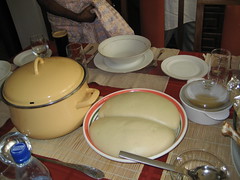
fufu


When confronted with empty bowls and covered pots, you really start to wonder if indeed there is any soup available. More to the point: who's got the soup?

II. Estate Planning


Apropos the notion of death and taxes I was thinking recently about the sad and tragic death of Kenneth Lay, former CEO and erstwhile looter of Enron. I was reminded of the mindless speculation about its timing, for indeed, from some points of view, it was a very convenient death for his estate, coming as it did after his fraud conviction but, and this is crucial, before his sentencing, which meant that said conviction was abated - and the prospect of punitive damages and restitution to those who suffered at his hands disappeared in a coronary heartbeat - or lack thereof. Of course one shouldn't begrudge his family in their time of loss for the consequent beneficial preservation of capital. Still it would have been good to be able to hear his expert opinion on the current "global financial crisis" (as the BBC have branded the current mood - sidenote: the Motley Fool term it Panic 2008) and speculate as to its causes...

The mind is a funny thing and I then remembered the part of The Godfather II where Robert Duvall's Tom Hagen pays a visit to Michael Gazzo's weary Frank Pentangel on a military base and reminisces about the old school Roman solution for unsuccessful conspirators. The good soldier subsequently took those musings to heart. That scenario is the kind of thing that only happens in fictional movies - even if these days people worryingly encourage it in their anger. Moving right along...

Along the same lines, the always astute Floyd Norris was indulging in some mindless speculation himself recently
If Congress takes no action in 2009, the estate tax will fall to zero in 2010, and then bounce back to 2001 levels in 2011. That would create what the Tax Policy Center report, written by Leonard E. Burman, Katherine Lim and Jeffrey Rohaly, delicately calls "grotesque tax planning initiatives." What they mean is that there would be a great temptation to do in dear old (very rich) dad before midnight on Dec. 31, 2010.
There hasn't been much remorse among those who have made out like bandits in the bubble years, it seems however that the gig is up - or at least, pace the observation about who now has the soup, that the shell game will have different winners in the near term.

One starts to wonder what will get in the head of the dissolute offspring of modern day aristocrats when they contemplate the prospect of ill-gotten gains disappearing by fiat as the mandated clawback (albeit a quite lenient clawback) begins. It is quite fitting that those who thrived on moral hazard might find themselves targets of the ineluctable financial logic of perverse incentives. Time will tell, I suppose, if this idle speculation has any grounding.

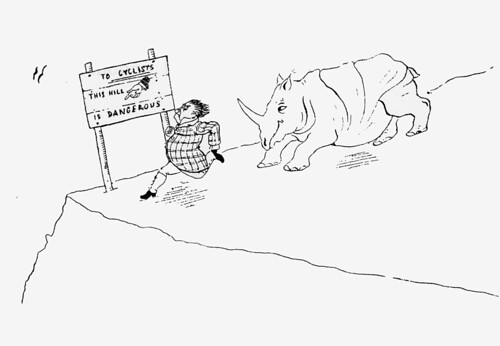
the rhinoceros


On a slightly related note I was reminded of the following poem

Lord Finchley


Lord Finchley tried to mend the Electric light
Himself.
It struck him dead: and serve him
right!
It is the business of the wealthy man
To give employment to the artisan.


Hilaire Belloc's Cautionary Verses
Periodically the social compact that Belloc identified a century ago is forgotten - that is the realm of trickle down economics. When The Masters receive their comeuppance, the reaction is not necessarily one of class warfare - everybody knows their place in society, but rather it is a distinct lack of sympathy for those who fall from grace. A debacle prompted by overblown real estate leads, as it were, to some furious estate planning.

III. A Pepper Soup Soundtrack


A fufu and soup playlist

  • DJ Palm Butta - Fufu N Soup
    The message delivered in this cheeky Liberian hiplife reworking of the Chicken Noodle Soup fad is clear: "with some okro on the side... that fufu and soup is sweet". True enough, we live in an era of microwave fufu, but even with such modern conveniences, we also need some soup. It goes without saying that Palm Butta also has the follow up track Cook My Pepper Soup which dives into the heart of the matter.
  • Eastern Ministers Guitar Band - Uwa Tuto Uwa Fufu
    As discussed at the indispensible Likembe, the literal translation of the title is "The World is Sweet and Painful", the fufu of the title is perhaps the pain, the soup is the sweet.
  • Digable Planets - The Art of Easing
    You had to be there perhaps, but if you flowed with the vibe that was the Blowout Comb album, you'd know all about the art of easing, of laying back in the cut.
  • James Brown - Escape-ism
    Some hot sauce to go with some hot pants, JB delivered wisdom in spades
    You know when you forget that grits is... when you forget that grits is groceries and that eggs is poultry, you lose your thing. Now, you can lose your thing out there wandering around.
    Fred Wesley's horns and the various incarnations of the JBs band were the soup to James Brown's fufu.
  • Donald Byrd - Fufu
    Donald Byrd's 1973 album Kofi is one of my favourite in the jazz funk canon. Perhaps the excursions trips to Elmina and the consequent African-inflected rhythms place this music on the funky jazz side of the spectrum. Whether it is the driving soul jazz of The Loud Minority or the intricate interplay of title track or the blowing session that is Fufu, this is simply inspired.


    I could listen to this for hours on end and indeed, to harken to another song on the album, I do have Perpetual Love for Byrd's music.
The received wisdom is that it was mindless speculation that got much of the world into our present belt-tightening. As things take on serious notes, one hopes that we can at least comfort ourselves with some mindless speculation. I've made my opening contribution, I await yours.

Let's place this note as part of an occasional series, observers are worried.

File under: , , , , , , , , , ,

Saturday, October 11, 2008

Mood Markers

These three songs and a stanza captured much of my mood over the past week. I wonder, what was your soul therapy?

  • Winter in America by Gil Scot-Heron and Brian Jackson
    The full lyrics paint a picture of decline and fall. A harsh season has arrived early and, from all appearances, doesn't want to leave anytime soon.

    People know there's something wrong
    Feels just like winter
    It's winter in America
    Truth is there ain't nobody fighting
    Cause nobody knows what to save
    I used to mishear that last line as "cause nobody knows what to say" and was glad for the ambiguity: say versus save. Are these pieces of the same thing? Which is preferable: being tongue-tied or overwhelmed? Is it the sound of sirens or the sound of silence that is more disquieting in these time?
  • Anger in the Nation by Pete Rock and C.L. Smooth
    Well the title says it all doesn't it? I'm not normally a believer in ritual humiliation nor indeed the incantation of politics as theater, but I did find solace watching a few investment bank executives squirm under the questionning of US congressmen (notwithstanding the fact that said congressmen have been poor regulators). Thinking about the collateral damage that friends and family have already experienced made me appreciate the spectacle of these small discomforts and the promise of more to come. Of these small things are made comfort suites.
  • All Your Goodies Are Gone by Parliament
    The languid rhythm of the track belies the message namely "Let hurt put you in the loser's seat". A essential soundtrack for anyone who deals with the stock market in the year 2008.
  • Ezra Pound's Hugh Selwyn Mauberly is often cited as the great anti-war lament, I rather harken to his characterization of moneyed charlatans and the damage they do
    walked eye-deep in hell
    believing in old men's lies, then unbelieving
    came home, home to a lie,
    home to many deceits,
    home to old lies and new infamy;

    usury age-old and age-thick
    and liars in public places
    .
    Perhaps the silver lining of the current moment will be some good art. I certainly look forward to it.

Mood Markers, a playlist

City (Accra) by Hilton Korley Boye


Next: Heart of Darkness, a playlist


File under: , , , , , , , , ,

Wednesday, September 24, 2008

Sunday Night with Amel Larrieux

Soul singers seem to dig Oakland. Something about the city's vibe resonates with them. Their appreciation is always reciprocated and audiences move rapidly from laidback contemplation to active engagement. Somehow I managed to catch Amel Larrieux and her five piece band last Sunday night in performance at Yoshi's in Oakland. Thus I can share a few notes on a comfort suite...

An electric bass guitar begins warbling, sounding something like an ethereal sitar by the time Amel walks on stage. She hums and launches into a warm acoustic rendition of Morning, the title track of her most focused album. Right out of the gate her voice grabs you as if to say "Pay attention. Get ready for some soul music". She doesn't intend to leave anything on the stage.

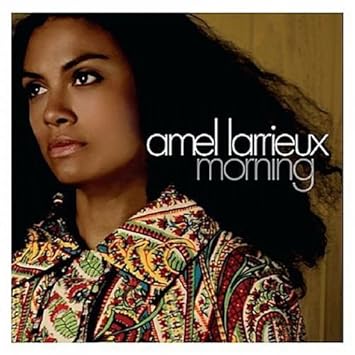
Amel Larrieux Morning

Trouble, is done Latin style with, as is typical in her live performances, an impromptu ending in which she starts scatting with abandon. "Louis Armstrong", she later explains, "All those years trying to be like you". She adds, "Lena Horne too". Well she's a singer's singer, it stands to reason that she has impeccable taste.

Giving Something Up is a bassy funk groove overlaid with increasingly abstract vocal stylings as it progresses, the arrangement is a mixture of jazz, soul and hip hop. Then almost improbably she breaks into Amazing Grace - a song that has never been done in this mode, urgent futuristic blues. How, the listener wonders, can a song contains such multitudes, rendered so seamlessly?

All I Got is an effortless follow up, a march reflecting on our condition. The refrain is all about the set upon (when she sings the passing lyric "slapped down a racist fool", those darker than blue in the Oakland audience respond knowingly). It's about standing strong and living without expecting any big bailout or "helping hand" as she sings: "this is all I got" indeed. As she riffs on the economic climate, "we're thoroughly spent... our credit's jacked up", there is complete empathy with the five piece band. They follow her on that the long walk with those worn shoes.

She gives a stately take on Magic and the zingers are fired rapidly: "still paying for your education when you're sixty six". Again the chorus is revelatory: "stress level's high and the morale's low". It's a blues for our time done with minimalist instrumentation. She ends with a turn as a choir director enlisting the audience in three part harmony. This kind of crowd participation is fun: we all need to "tap into that magic" to overcome our subprime present. Indeed that has been the theme of the whole concert, acknowledging what is going on in the world and finding humour to deal with it. Amel is an unpretentious artist, she makes everyone feel at home. It doesn't hurt that she's very easy to look at, the word chic describes her clothes and the long hair is doing all the right things.

A cheer of recognition greets the start of For Real, the ballad being one of the perennial fan favourites. With deft piano playing in the background, she floats into the upper registers displaying her Minnie Riperton credentials. After welcoming a a few bars from a guest soprano in the audience, she takes over. Her vocal control is breathtaking. Game, set and match, I'd say. To top it off she provides three or four different takes of the song - live remixes on stage. I'm always interested in the way singers manage to keep their trademark songs alive; somehow Amel always comes up with new arrangements subscribing to the jazz improvisation aesthetic. The jazz inclination will keep her in good stead with her audience.

We Can Be New is a warm poem, a melodious ballad very beautifully sung and ends with a reggae tinge. It must be the band's trademark to provide full glimpses of her range and musical comfort zone.

She debuts a new song, Have You?, a lover's lament peppered with humourous lyrics "I've mixed denim with whites, have you?". By this stage we are all spellbound. The elements of her appeal are simple: sympathetic piano, the light accents of her backup singer (Amira) and a singer at her peak. Amel is in full effect.

Then I almost died of joy: she sang Gills and Tails - my favourite song, the very definition of virtuosity. The vocal performance is wonderful; what the professionals would call her cry is a thing to behold. It's emotional, it's cerebral, it's quietly devastating. It's everything I like in soul music.

Amel Larrieux Lovely Standards

Wild is the Wind from her album of standards, shrewdly titled Lovely Standards, is done as a homage to Nina Simone. It's just her and the piano player; she has got the audience clinging to her every note. As the song starts to wind down she brings in the rest of the band and they add a dance groove - whoa, she can do house music, what can't she do? - the groove then morphs into Dear to me. House music man, just for the heck of it. She took a jazz standard, did it with flair and, just to show how fearless she is, she gives you some house. I give up, I'm joining the street team, Amel.

As if she read my mind, she then covers Prince's Pop Life, it's a party pure and simple - she reminisces about the Purple Rain to Parade Revolution era of His Royal Badness (she notes that she even digs Tambourine! claiming by this revelation membership in that purple secret society) and talks about the rush she got performing Take Me With You with Kamal the Abstract a couple of weeks ago.

She closes with two crowd favourites: Get up, the monster club hit from Bravebird and Tell Me (from her Groove Theory beginnings). We're all dancing and singing along. It's a celebration. There's a community feeling. We'll be holding our head high in the weeks to come, smiling on Manic Mondays and Black Tuesdays, lifted above the fray, fortified by some soul music, a soundtrack to our struggles, "this great Mountain of When". This is her thing, this is what she does best: two ninety minute sets, three nights in a row in an intimate jazz venue. Every show sold out, the audience in the palm of her hand, the soul singer performs. Amel Larrieux has done it again.

File under: , , , , , , , ,

Tuesday, September 16, 2008

A Seminal Lunacy

No one was responsible for the great Wall Street crash. No one engineered the speculation that preceded it. Both were the product of the free choice and decision of hundreds of thousands of individuals. The latter were not led to the slaughter. They were impelled to it by the seminal lunacy which has always seized people who are seized in turn with the notion that they can become very rich.

The Great Crash 1929 by John Kenneth Galbraith
I was reading Galbraith's tome last summer in an attempt to clear my thinking about bubbles and their typical aftermath. Later in his life Galbraith would cover financial euphoria more closely, but here it was all about its counterpart: the crash. He surely had a twinkle in his eye as he made his felicitous coinage of "seminal lunacy", lowering the reader's guard before proceeding to skewer at will. The book was a tonic for him to write and it is accordingly a tonic to read.

animals in the sky


News headlines are replete with mantras about sound fundamentals, healthy economies that are resilient, innovations that are safe, disruptions that are contained and so forth. On this trend he had some cutting observations:
By affirming solemnly that prosperity will continue, it is believed that one can help insure that prosperity will in fact continue. Especially among businessmen the faith in the efficiency of such incantation is very great.
Stated another way, this is merely a tactic for dealing with ignorance.
That much of what was repeated about the market - then as now - bore no relation to reality is important, but not remarkable. Between human beings there is a type of intercourse which proceeds not from knowledge, or even from lack of knowledge, but from failure to know what isn't known. This was true of much of the discourse on the market.
It is often effective.
We are a polite and cautious people, and we avoid unpleasantness.
Social beasts that we are, we follow the herd.
Others pointed out that the prospects for business were good and that the stock market debacle would not make them any less favorable. No one knew, but it cannot be stressed too frequently, that for effective incantation knowledge is neither necessary nor assumed.
There is perhaps an echo of Walter Bagehot's observation in Lombard Street
Every great crisis reveals the excessive speculations of many houses which no one before suspected.
the world of riches


We have the spectre of bemused and gray suited serious technocrats making pronoucements with great alacrity. And a wary public begins to ask whither regulation. But that is by the by
One of the oldest puzzles in politics is who is to regulate the regulators. But an equally baffling problem, which has never received the attention it deserves, is who is to make wise those who are required to have wisdom.
The great crash, like other seminal lunacies, caused much revision of the conventional wisdom.
What six months before had been a brilliant financial maneuver was now a form of fiscal self-immolation. In the last analysis, the purchase by a firm of its own stock is the exact opposite of the sale of stocks. It is by the sale of stock that firms ordinarily grow.
There are likely many contemporary equivalents to the deficiencies pointed out about buying your own stock. Modern finance has been shown to favour opacity over transparency and the consequent costs are mounting.

Looking forward we can expect lots of hearings, meetings and busy work. Politicians shown to have been asleep at the wheel will now demand answers.
The rite of the meeting which is called not to do business but to do no business... one of the oldest, most important - and unhappily, one of the least understood - rites in American life.
Action is the theme of the day
Men meet together for many reasons in the course of business. They need to instruct or persuade each other. They must agree on a course of action. They find thinking in public more productive or less painful than thinking in private. But there are at least as many reasons for meetings to transact no business. Meetings are held because men seek companionship or, at a minimum, wish to escape the tedium of solitary duties. They yearn for prestige which accrues to the man who presides over meetings, and this leads them to convoke assemblages over which they can preside. Finally there is the meeting which is called not because there is business to be done, but because it is necessary to create the impression that business is being done. Such meetings are more than a substitute for action. They are widely regarded as action.
When histories are written about our present disillusionment they will surely read like Galbraith's summary of the reasons behind the crash:
In 1929 the economy was fundamentally unsound...
  • the bad distribution of income... highly unequal income distribution meant that the economy was dependent on a high level of investment or a high level of luxury consumer spending or both...
  • the bad corporate structure... the vast new structure of holding companies and investment trusts...
  • the bad banking structure...
  • the dubious state of the foreign balance...
  • the poor state of economic intelligence
By harkening to "fundamentally unsound" and ending with a note about "economic intelligence", Galbraith puts the knife in Herbert Hoover and others of his ilk.

traumatised
It requires neither courage nor prescience to predict disaster. Courage is required of the man who, when things are good, says so. Historians rejoice in crucifying the false prophet of the millenium. The never dwell on the mistake of the man who wrongly predicted Armageddon.
There are lots of emotions when it comes to finance, concern chief among them. During a crash or panic, emotions turn darker and this can be a perilous time.
Despite a flattering supposition to the contrary, people come readily to terms with power. There is little reason to think that the power of the great bankers, while they were assumed to have it, was much resented. But as the ghosts of numerous tyrants, from Julius Caesar to Benito Mussolini will testify, people are very hard on those who, having had power, lose it or are destroyed. Then anger at past arrogance is joined with contempt for present weakness. The victim or his corpse is made to suffer all available indignities.
And a parting warning for those erstwhile masters:
One trouble with being wrong is that it robs the prophet of his audience when he most needs it to explain why.
Shell games do have costs.

A brief soundtrack


File under: , , , , , , , , , , , , , ,

Wednesday, August 27, 2008

Bite-sized

A little inaccuracy sometimes saves tons of explanation.

Saki, The Comments of Moung Ka

It's so convenient when one can tell the truth.

Graham Greene, Travels with my aunt

Honesty hath no fence against superior cunning.

Jonathan Swift, Gulliver's Travels

It is always a relief to believe what is pleasant, but it is more important to believe what is true.
Hilaire Belloc, The Silence of the Sea
These clippings from some recent reading were meant to anchor a number of pieces I've been working on. It struck me however that the verbiage that I might have attached didn't add much, and the plain juxtaposition of these bite-sized pearls sufficed. The first two statements, weighing the expedience of honesty, are paradoxically uttered by notorious dissemblers in the context of the stories in which they appear. Saki and Greene's mouthpieces share their author's sense of irony. In contrast Swift and Belloc are more satirical. [Insert disclaimer: we've all learned that honesty is the best policy.]
He was as American as folding money and waging war.

George Pelecanos, The Night Gardener

He liked his epiphanies American: brief and illusory.

Colson Whitehead, Apex hides the hurt
These last musings on America, by two of the sharpest and hungriest current wordsmiths, seem a little bleak and capture a certain malaise about the country. In the same book (it's nothing too weighty incidentally, and hopefully his next novel will have a greater impact), Colson Whitehead adds this choice piece of cynicism:
It was a good place to make a bad decision, and in particular, a bad decision that would affect a great many people.
I think I'd call this Blues 2.0 - we might as well add a version number to the sentiment.

Soundtrack: Me'Shell NdegéOcello - Elliptical

Taken from an album with the paradoxical title The world has made me the man of my dreams, this is one of the most fluid musical movements I've heard in the past couple of years.

File under: , , , , , , , ,

Friday, March 07, 2008

Lunchtime Heist

Something didn't look right. There he was on his hands and knees in the corner next to the ATM ten feet inside the burger joint. It gave you a little pause but you thought you'd proceed regardless. Someone at the front table was muttering something to him, the sounds lost amidst his chewing. Your bag got stuck in the doorway and, by the time you got unstuck, he had gotten up, turned around and was now facing you as you entered. 2:15 was later than normal for you, the upside was that you had missed the lunchtime rush: the place was a little empty.

For whatever reason you looked him up and down and took in the rest slowly. It didn't feel right. A gray hat haphazardly lay atop his head. A jacket: not quite a technician's jacket, nor even a UPS jacket, more like a fashion piece. You looked downwards as he stepped towards you. His hand brought up a bag from behind, he was gripping it tightly. You'd seen the money bags that the couriers use - this was the financial district after all, you see the couriers all over downtown San Francisco. This wasn't a regular bag. Puzzling.

And of course there was the sheepish grin that he was sporting. That definitely looked out of place. No gun that you could see... Still you dismissed your impulse to tackle him. "Whatever, you're imagining things." You walked past him towards the counter. He nodded imperceptibly as you crossed - still smiling you noted, and began to walk out.

As you made your way to the front counter, you continued to put it all together. "Must be missing something. Didn't look like a technician, nor a armored car courier... Surely he won't walk out of here just like that. Wasn't holding a gun, but could he? Why the smile? Anyway let me order."

Just in case, you tried to fix his features in your memory, late forties, brown hair beginning to gray, white guy, looked a little like Chevy Chase. You wondered if you'd make a good witness.

"May I take your order please."
"The special. No drinks... Hmm..."

You figured you should vocalize something about your disquiet. "Umm ... The guy..", you gesture. "Umm, the ATM.. the machine. Umm"

You turned and looked back to the front of the restaurant and noticed that the guy had indeed walked out. Oh well. Then the clincher: the ATM didn't quite look right. You turn towards the server and begin again: "Umm... The guy..."

Someone appeared by your side, impatient and loudly put the words out there:

"You know that someone just robbed your ATM machine."

That's it, that's what didn't look right. The bottom half of the ATM had swung out into the lane. The cheek of it, he even left the door open. You gesture. The newcomer repeated his words:

"You know that someone just robbed your ATM machine."

The woman taking your order was a little perplexed at first - perhaps it was the language barrier. She was also a little annoyed. The two men in front of her were departing from her script. You remained tongue-tied but Citizen Alert proceeded to spew out the details. Eventually, as he got no response, he asked, "Call the manager." She gestured to the manager and the other servers and grunted a name. Then:

"May I help who's next?"

You never quite liked that awkward formulation, surely she could have said "whoever's next" but the grammar pedant in you, let alone the intrigued potential crime witness, decided to step aside. Your order would be ready in a few minutes.

"Next."

You shuffled to the side and turned to look again at the front of the restaurant. Those now entering the restaurant all raised their eyebrows as they passed the evidently-open ATM. An alarming sight you assumed. You'd never seen the inside of an ATM before - well perhaps on the way out. A few diners started pointing towards the ATM but on the whole, there there was a lot of apathy in this joint. Perhaps it was the time of day, perhaps everyone needed a siesta. Or maybe it was just the nature of the place. Lee's is a tad above a McDonalds but it isn't quite a gourmet Barneys. Well you get what you pay for. You decided to take things in.

The manager eventually sauntered out from behind the counter and walked towards the front, chatting all the time on his cell phone. The newcomer accosted him, as did a few others: amplifying and explaining their consternation. The manager didn't seem impressed and continued his phone conversation. Minutes passed and a little group formed around the ATM bending down and examining it. One guy kept saying "ATM machine" and this again bothered you: you thought "machine" was redundant given the acronym. Eventually someone decided to call the police.

Your order arrived, you picked it up, thanked the server and walked over to the gathering at the front. You wanted to get a look at the ATM. Well, who knew?

You wondered how the robber managed to open the ATM and how long he'd been fiddling with it. Did he have a key or tools?

You heard someone say "He must have been a technician."

At that you smiled and shook your head. You said to no one in particular, "He just walked out with a bag of money and left the ATM open! Come on now."

You wondered how many other joints the robber would be targeting. It was a pretty brazen heist but it worked. The managers would be like the present one - unconcerned since the ATM had nothing to do with them. The clientèle would likely be as lethargic as today's version and, well, no one would be a hero. Indeed you were one of the few people who noticed anything anomalous or could have even attempted to stop it. Of course you didn't, proving the point.

You wrote your name and number on a sheet of paper and gave it to the manager in case the police cared - you didn't have time to hang around for them. Four or five others claimed to have gotten a good look at the guy and they all looked excited about their brush with notoriety. As you reached the office a few blocks away you started to hear the sirens.

You've been hibernating for the past few months; perhaps you too have been behaving like everyone in the restaurant: quiet and simply minding your own business. You need to get back into things, find your voice again. Don't let others just walk all over you and snatch your soul. Come on now.

You passed by the joint the next day and noticed that the ATM was no longer there. You kicked yourself for not having photographed the open ATM. You went to another lunch place. The sign was still outside however: ATM inside.

Soundtrack for this note


Nas - Thief's Theme File under: , , , , , , ,

Saturday, December 08, 2007

Timepieces

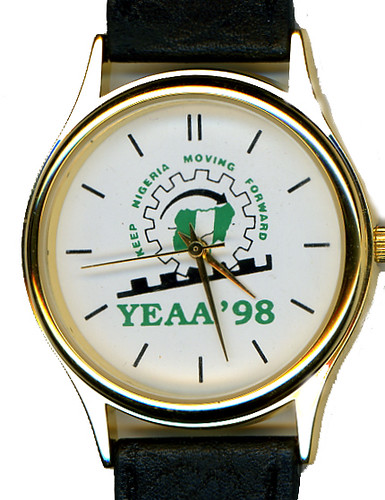
I present the following item from the Remembrance of Rogues Past collection: a campaign watch for the YEAA '98 campaign, namely the Youth Energetically Advocating Abacha shell organization that supposedly was spontaneously formed to campaign for that suffocating, murderous and dictatorial rogue, General Sani Abacha — late, unlamented and so forth.

Abacha watch YEAA 1998

I'm a avid collector of this kind of historical artifact and you'll sometimes find me bidding for a mint copy of the Franco sings for Mobutu album, to take a recent example and different rogue (quite a good album actually). The Abacha watch, while in the mode of praise singers and sycophants, is not your standard piece of dictator chic, it's much more functional and thus perhaps more insidious. In any case, it's worth some brief notes.

Back in the twilight zone of military rule in Nigeria circa 1998, it appeared that the dictator was feeling some pressure to make gestures towards democracy. The response was of course to think about how to hand over to himself, accordingly he devised lots of gestures. Having outlawed all organized opposition, the general decided to organize two approved political parties, "one a little to the left and the other a little to the right". Manifestos and constitutions were written, ostensible political philosophies were crafted and so forth, all by the military. The remaining question was who would lead these newfangled parties and there were any number of sycophants auditioning for the right to head these organic parties sometime in the future, if indeed elections would ever be held.

This is where the Youth Energetically Advocating Abacha came in.

The first order of business, as if this stage managing wasn't enough, was to start a whisper campaign urging both parties to nominate said dictator as their flagbearer. When more than whispers were needed, YEAA was to be the public face of the campaign, ready to whip naysayers into place. The idea was to coronate Abacha and win by acclamation the nomination from both of the parties a little to the left and right. A man of the people, he simply wanted to underlie that the youth wanted him to serve them and, moreover, that they were energetic — an obvious warning to anyone who might oppose the general. The thought was that he would face off with himself in new elections and succeed himself, or something of the sort - the main point was to hold elections.

On the one hand these actions were crude and ridiculous, on the other, they are simply sad. Whenever I look at the watch I think to the whole contingent of lobbyist firms, replete with consultants, who came up with the strategy and the inspirational name (Yeah!), the graphic designers called in to design the logo with the arrow and the wheel mechanism (perhaps fitting, for Nigeria under Abacha was on a road to nowhere), the coinage of the snappy slogan, the time spent uploading artwork and discussing typography with the design firm in California, the negotiations with Singapore factories for the production of watches and other insignia (for there were many containers worth of this stuff produced, T-shirts, key tags etc.), the shipments to Nigeria, the distribution of this largess around the country... The watch is like an open wound in the Nigerian body politic, testimony to the workings of a global criminal enterprise.

No one advocated for Abacha unless they were paid. Youth Energetically Advocating Abacha is a simple byword for coercion, cynicism and an illustration of the lengths to which people can go when in the grip of greed. The depressing thing is the sheer energy of this huhudious regime and the scale of the graft (billions of dollars were stolen for sure) — one wonders how many millions were spent on similar minor accoutrements. What a waste but perhaps such is the world of riches.

From all accounts Nigeria is much changed these days and a few of the victims of the regime are even (belatedly) getting their day in court. Perhaps it's best to move on and call this ancient history, perhaps one's outrage should be curtailed; let's leave it for the historians.

For the record, the battery never worked.

II. Measuring Time


Helon Habila in his second novel Measuring Time continues to make a claim for prominence in the roster of young lions in African literature. Instead of the claustrophobia of Waiting for an Angel (which I recently discussed) he stretches his shoulders and decides to take on entire decades of African history.

His writes in a deceptively simple style and focuses on storytelling. There's no overt lyricism; he'd claim that he is simply channeling the many stories that come to him. Still his is an ambitious agenda and he covers a lot of territory, after all his subject is modernity in Africa and all that means.

The options available to the two twins who tell the story of Measuring Time is a simple statement about Nigerian society. On the one hand, there is life as a mercenary soldier following warlords like Charles Taylor from Chad and Libya to the messy Liberian civil war. For a political junkie like me, this would be enough to focus on for an entire novel, for Habila this is merely interstitial.

On the other hand, the bulk of the book and the other twin's story is about stagnation and making do at home. There is lots of striving but precious little light. Yet the stories of the past need to be told, the politics need be engaged in - however programmatic they may be, the youth need to be taught, we all need to fall in love. There's no time to dance or to succumb to navel gazing. Life has to be lived in full.

In his populist writing mode Helon Habila is perhaps heir to Cyprian Ekwensi whose favourite subject was city life. Like Ekwensi he has a talent for empathy with his characters and draws you in with detailed portraits. He really knows how to capture moments in time. I am also reminded in this novel of another ambitious second novel that packed a lot of ideas albeit in a different genre, Colson Whitehead's John Henry Days. But perhaps we shouldn't tie a talent like Habila to others. He's writing delicate novels of ideas disguised as unvarnished, personal stories of Nigeria; the whole world is his.

III. Wasted Time (a soundtrack)


Me'Shell NdegeOcello - Wasted Time

Wasted Time, my favourite song from her appropriately-titled album, Bitter, finds Me'Shell in a suitably bitter mood. She has an unerring way of capturing an atmosphere in song. Bitterness is a transient emotion but one that is intense when one is in its grip. It's the only vaguely uptempo song of the album, building up the groove slowly as she reflects on a break-up. It's not quite a lament and she hasn't yet resolved the episode. It is a raw meditation on wasted effort. Fittingly the song cuts off abruptly, unsettling the listener. Wasted time never to be recovered.

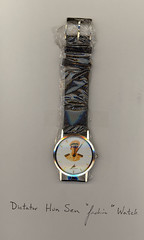
Update: A good friend sends along a Cambodian twist for the collection: a Dictator Hun Sen "fashion" watch. He notes, "Never tried wearing it. Battery assumed dead".

Dictator hun sen fashion watch

File under: , , , , , , , , , , ,

Monday, October 29, 2007

By Way of Ionesco

It must have been a few months ago, I was heading home after work; it was the usual thing, a perfectly ordinary evening. As usual, I was fumbling with my various bags, headphones and such. As I switched trains at Oakland, my sharp elbows ensured that I obtained a seat; I find it pays to be equipped at rush hour. I settled down, rummaged around and found my book. I opened it and relaxed; there's nothing like getting lost in a good book on the commute. A muffled announcement predicted a delay. Oh well, I settled in for the long haul. After a few moments, I heard someone muttering from across the aisle: "Ionesco" or something.

"Yes, yes", I gestured at the distinctive cover of my book, "Ionesco".

The guy continued talking but I couldn't quite hear him since I was listening to music. As I fumbled around with the controls to the cd player (no ipod as yet), it struck me that I had been speaking in French. What I had actually replied was "Oui. Oui. Ionesco... C'est La Cantatrice Chauve."

As I finally removed my headphones (those tangled wires), I realized that the other guy had also been speaking in French.

Well, no matter. If you're reading a French book on the subway, odds are that a passing Frenchman would notice and engage you. Perhaps you look vaguely francophone. It would stand to reason that you would start to speak in French also. Indeed the reason I had been reading that book was one of my periodic attempts to keep up my French. Still it was uncanny how I had unconsciously slipped into that other language, perhaps a switch had been involuntarily flipped as sometimes happens to polyglots (pdf). I don't get to speak the language much these days - I am awful about keeping up with the part of my family in France. True, every few months or so I dream in French (don't ask, don't tell) but I know that my fluency in conversational speech is at risk.

So anyway, there was a little pause as we both assessed each other. A couple of relatively thin thirtysomethings, hungry engineer types. Not many people chat on the subway, one is always wary about being solicited or otherwise bothered. As the song goes: don't talk to strangers. How often, however, does one find someone interesting on the commute?

Well, the conversation began in earnest. Ionesco it was. His plays, his ideas, the theatre.

What do you know, I was sitting across from someone who had directed four Ionesco plays; a fellow Ionesco afficionado no less. I'd acted in Les Chaises during my brief theatrical career at school. Heck I still sometimes view the world through his jaundiced lens. The guy was clearly a creative type, steeped in the stage. A man after my heart. And he knew his stuff it seemed.

Pretty soon we were getting into the intricacies of Ionesco's world. What we liked: the playfulness of the language, the sense of rhythm, the stacatto effects that leapt from the page. The often startling juxtaposition of mundane minutiae with profundity. The pauses and the fumbling to find meaning and the consequent resort to words that obscure rather than reveal. Heady stuff in other words.

My spoken french is a little rusty and, a couple of times, I too struggled to articulate some of these thoughts. It's one thing to write or read about the intricacies of art and another to verbalize them even forgetting the setting. Still it was coming back slowly: the quintessential abstractions of extinct philosophers. The accent too - I was a scion of la Lorraine, straining my 'ains'. Perhaps the long lamented fluency would be returning soon.

Somehow we got onto the nomadic element in Ionesco's writing and the fact that he was Romanian and first gained fame writing in french in a piece about observing the English. What is it about outsiders being such stylists? Why are they often the best bridges and windows on society? Perhaps the margins provide a good standpoint for cultural observation. But what are the downsides of the lives of exiled souls? Does multi-lingualism or the crossing of linguistic borders sharpen one's outlook? We weighed the evidence. I brought up Nabokov who in later life turned out to be perhaps one of the great stylists of the English language. He wasn't impressed, he felt that Ionesco got closer to the gypsy element of modernity than Nabokov ever did. I demurred, both, I thought, were modern travellers that disdained boundaries and pushed the forms in which they wielded their pens. The response: well Ionesco carried less baggage. Anyway we got back to the plays.

la cantatrice chauve

He liked Rhinoceros and Les Chaises for their theatricality but for him La cantatrice chauve was the most playful with the language. We went back and forth on whether it was a play best performed in French. He didn't like the English productions he'd seen and claimed that they got the zaniness all wrong. I thought that so long as you got into the spirit of things, it didn't matter. To him the confusion started with the way the play's title was translated: he preferred The Bald Prima Donna to The Bald Soprano. Thus we found ourselves seriously arguing away in French about which English translation of a nonsensical phrase a Romanian playwright had promulgated was truer to the essence of the play. I can't imagine how we must have sounded to the rest of the train car: flurries of French intermittently interupted by English exclamations: "The Bald Soprano" or "Mais non. The Bald Prima Donna". C'est ridicule, n'est-ce pas?

Funnily enough we never actually mentioned the word absurd although the theatre of the absurd was our ostensible subject. Nor indeed did we get to Beckett who looms large in such matters. To my mind, Ionesco is the more formidable pillar of that theatre, if only because his conceptions weren't as arch as those of Godot's father. The discongruities of modern life are presented simply and with wit. I love Beckett to death yet his edifices were intricate constructions. Ionesco makes the absurd more mundane, it is through almost imperceptible distortions that you find yourself in the realm of the improbable. Each step on that road makes sense.

There was a brief diversion onto Sartre - we discussed Huis clos, and judged him impractical. More to the point, his dilemmas weren't weren't of the everyday variety nor indeed did they work on the stage. No, not quite.

I hipped him to the show I'd seen in Boston a couple of years ago, Ionesco not Ionesco, three rarely performed plays. The takeaway message: Ionesco as the aspirin for modern day life, the playwright of the fringe, the governor of the borderlands. You are easily underestimated if there is a humour to your approach and many did underestimate the fugitive notions of the man.

I forgot myself for a moment, soaking in the discussion, and looked around. The rest of the car looked utterly bemused at the sight of these young men vigourously discussing French literature in their midst, throwing out existential themes — the left bank transplanted to the subway car, heck all we were missing were the berets. No matter.

It was the week of the French elections and I mentioned the story about those old campaign posters of Mitterand that were being resurrected twenty years later as ironic commentary on the choices facing the French. He liked the idea and applauded the juxtaposition. A François Mitterrand 2007 campaign seemed appropriate for this dark time. We wondered how many votes he would get.

The Cold War deserved a Ionesco. The nuclear age deserved a Ionesco. Gremlins and parasites, thine playwright is Ionesco.

ionesco collage

We wondered who were the heirs to Ionesco's ethos. We decided that there was something to be said for plays even in this TV and film era. That the stage often had the right level of pathos for the strange incongruities of the human condition. As we parted (he gave a card, I told him to google me), we resolved that we should get back to the theatre, support it in whatever way we could. Who knows maybe we'll put together a production some time soon. It need not be Ionesco. Heck we would write our own plays.

...

When a week or so later, I received that secret tape of Negroponte meeting Gaddafi, I was struck by the element of malign play among in their discourse and world views. As I transcribed, I found it was all there: words intended to obscure, words that ostensibly communicate were instead combined into phrases that mangle reality: constructive engagement, collateral damage and so forth.

The playground of misdirection is often dominated by politicians but others too have their niches. The lowly bureaucrat and the well-meaning citizen play their part is adopting the language of bromides. Ionesco would have loved the notion of recent non-specific general threats and the obfuscation of the language of homeland security.

Pamscadise by kwesi yankah

In any case, it stands to reason that I am now being read by folks from both the US Navy Marine Corps and Libyan embassies around the world. I do try to bring people together in my writing. A belated welcome to the toli. Enjoy your stay. Excellent. Excellent discussions.

Salut Alex.

File under: , , , , , , , , , , , , , , ,