Thursday, June 08, 2006

Boycott and The Gospel of Toli

I received a note that I almost discarded so slight was it. It was quite troubling at first glance and I reproduce it here in full; make of it what you will.

Part 3 of the Boycott Day Trinity

The Gospel of Toli


Recently scholars unearthed a scorched parchment underneath a library located in bowels of the slums of Nima, in Accra, Ghana. It was found by a young child, Wednesday born, who was playing football (also known as soccer to our American brethren). Barefoot and wearing a tattered Stephen Appiah-labeled Black Stars jersey and khaki shorts (he was skipping out of the library early), he stumbled over a wooden plank that was jutting out of the side of the adjacent chop bar, Mama Opus's Spot. At the sound of his alarming cries (something to do with nails or something), the elders were summoned to investigate the stigmatized youth and they uncovered a heavy wooden chest that led to a serpentine series of catacombs that run under the library and the nearby compound, owned by a wizened retiree who refused to give his name "What is a name after all?", but who, we have since learned, goes under the moniker of Kweku Ananse.

The paths delineated by these tunnels run along the Prime Meridian. It is well known that the line of the Greenwich Mean Time runs from fair London to the heart of darkness in Africa and passes through Nima, that dank armpit of the Dark Continent. Inscribed on the last page of the scrolls that were later discovered was a barely decipherable scrawl that handwriting experts now believe reads: The Gospel of Toli. After painstaking forensic investigations over the past 33 years, including the delicate removal of 6 films of Palm Wine, Schnapps-encrusted dust, and several layers of used kelewele oil, National Geographic is proud to exclusively announce the preliminary findings of this extraordinary and idiosyncratic document which will cause humanity to question its received wisdom. We intend to serialize the scholarly findings in the magazine.

Apparently negotiations are in progress and several Nollywood studios are leading the bidding for the inevitable film treatment. Samuel L. Jackson has been said to desire the role of Papa Ananse and that well known former child star Jamie Bell was also said to be seeking a role portraying the Messiah figure. It was unclear who the frontrunners were for the female leads, the Proud Marys of the plot although Tina Turner and Patti Labelle were whispered to be in the mix. Do note that any leaks on this topic in the so-called blogosphere should be treated as Gnostic misdirection.

The text of the Gospel hews quite closely to the Torah although there are some striking divergences in parts. The first discrepancy in this Apocryphal Gospel concerns Genesis Chapter 2 which has long been thought to read:
Thus the heavens and earth were finished, and all their multitude, And on the seventh day God finished the work that he had done, and he rested on the seventh day from all the work that he had done
Verse 2 has been radically transformed in this "extraordinary rendition" (termed for some reason in this arcane script: erustication). The verse now reads
Thus it was written that on the seventh day God grew so frustrated with things that she engaged in a boycott of all the work that she had to do.
The Good Pope, the erstwhile Cardinal Ratzinger, was said to be studying the issue closely, and his spokesman assured us that an encyclical would undoubtedly be forthcoming from the Holy Church.

Anonymous sources close to the papacy, who asked for anonymity because they wanted a Rove/Libby style protection, were quick to weigh in on the matter to our intrepid reporters.
"First of all, there's the issue of the gender of the deity. If the "s" is confirmed to not be an oily smudge, it would challenge 20 centuries of past practice, and cause us to re-examine the previously thoroughly-discredited Magdalene Propositions in a new light. Further, the notion of a boycott could be construed as an existential threat to the very authority of the Holy Church, a challenge on the order of Martin Luther's Ninety-Five Theses. About the only constructive insight I can find in this tendentious note is that God still has work to do for humanity. Lastly, I am very curious about one of the hieroglyphic symbols that is used throughout the text. The best translation seems to be a biblical concept similar to modern day voice mail. That is deserving of further study and this is where we are concentrating our efforts".
The remainder of the chapter is reproduced exclusively below. Further epistles will be featured exclusively in National Geographic and accompanying DVD and official website.

The Boycott Parable


That's it. I'm opting out. I've had enough. How the hell am I going to remember this many passwords, changed this frequently, at these irregular, staggered and idiosyncratic intervals, with these many different, obscure and undocumented restrictions, with all these different regulations on how often one can repeat said passwords and usernames? Oh sure I can, and do, use Password Safe to manage these things but still, having reached 50 different passwords for the various applications and databases I use, I might be changing things every week...

And now this insanity is being applied to the voicemail systems, increasing the length of the passwords beyond comprehension. I'm supposed to type this absurdly long and ever-varying chain of alphanumeric characters on a numeric keypad? Usability right? It might have made sense on paper to "strengthen password requirements" but did someone actually try to enter that many characters on that small a device?

I give up.

The figures are there I'm sure; someone deep in the bowels of the corporation can calculate the amount of help desk incidents devoted to resetting passwords. Or maybe not, that could well be an outsourced component. In all likelihood this same recipe is cooked in all companies

The Regulation Twist

  • Apply some IT Corporate security standard or other. The actual standard doesn't matter, the most important component is the security bit.
  • Lather with some bureaucratic bromide from the ivory tower, "Operational execution" or similar
  • Rinse with an outsourcing and "efficiency" rationale, belt tightening "to beat this quarter's numbers".
  • Sit back and watch employees do the regulation twist.
I'm working on a toli remix to update the song and dance with a funk break beat; I never realized that the phrase and phenomenon of breakdancing was an ironic commentary on modernity and ludicrous "traditions".

The Great Game of Sarbanes-Oxley, Homeland Security or IRS regulatory arbitrage proceeds apace - a typically American corruption of process that leads to dysfunction, to sleaze at the seams, and absurdity in general.

I know I'm tilting at windmills here but I thought that we were about emphasizing the people while paying lip-service to the process. (Cheers Coté).

Arrggh.

To all correspondents (and that includes my managers and co-workers), don't bother leaving me voice mail messages any longer. It's not worth it, I can only get my password reset so many times before I get disheartened. My job description didn't include daily chats with the help desk - at least I can't recall that in the pitch twelve years ago. I can hear it in the voices: "It's him again... let's take bets on how long until we speak to him". I can only be apologetic or suitably shamed so much and I've long passed that threshold of woe. I have some sense of honour, even if I'm always smiling and nodding my head... From now on try instant messaging or email or something. And even with this last I can occasionally find your signals amongst the noise of spam and officious notes. As I look at the inbox, I note:
"Your action required!"

"Your [redacted] password is about to expire"

"Your [redacted] security token will expire in 14 days"

"Important - Please read [redacted something or other in breathy tones] ...
Sidenote: I wonder why the inbox still stands at around 3,000 unread. Hmmm.

"They", that amorphous they, have finally made the barriers to entry too great and I'm demurring. I thought we were championing Sign-on Simplification in one of our Great Initiatives ™. That can't come soon enough.

I can pinpoint the moment Lotus stopped being Lotus. It was a gradual process and ironically "process" was the culprit. Was it the computer security requirements? Was it that "mandatory legal training" thing to which one needed to breathlessly comply "by tomorrow" (on top of the Business Conduct Guidelines we sign off on every year without fail)? Are we like the American army in Iraq, 3 years into a war and now having to undergo "values training" and re-education about "quaint" Geneva conventions? After a while all these processes became overbearing and I knew I was no longer in Kansas (or Cambridge) anymore. Oh sure I do get work done and I've installed those compliance-checking software thingimijigs (a.k.a. corporate-sanctioned viruses) on (one of) my machines. Still this whole Trusted Computing rhetoric sounds Orwellian...

That layer stripper Bill DeHora was going on recently about web frameworks, terraforming and such and the technical arteriosclerosis analogy is apt for organizational behaviour
It's remarkable that something like a website can have a geology, layer after layer of frozen accidents. Integrators will be used to seeing that in non-web systems. But the difficulty is you can't terraform this kind of site - reskinning means editing every single page.
We seem to be freezing processes in place as part of some intelligent design scheme, I'm hesitating here in believing that it is accidental evolution, it's rather a terraforming (or is it terrorizing?) of corporate peons. There must be a reason that that show called Office Space has been so popular or that Dilbert speaks so deftly to the world every morning.

In queuing theory and operations research one of the key things we try to measure is the balking rate, that is the proportion of users in a system who refuse to join the line or perform the task, and leave for whatever reason. In physics the analogous concept is branded as dark matter and apparently the majority of our universe is made up of this substance. It's been over a year and I still haven't finished writing that article on the dark matter of communities but it looks like I'm accumulating source material daily in my company conclaves. If you want us to use tools to get work done, don't make the process so overbearing that we balk. Or perhaps that's the strategy, as in politics, if you make things distasteful enough, perhaps you can appeal to apathy in your opponents and your motivated base will be the only ones that show up on election day.

Then again, and I repeat myself here, there was that email that I received a couple of years ago asking me to validate that I really did need my office phone (Bean Counting on a mission to Planet Absurdity). And while repeating myself, this is a matter of community dynamics:
The identity of a community is to be found in the most unlikely of things. The things that draw people together to form a cohesive whole are not the explicit things that one thinks, it's not a kind of warlike territoriality or dedication to some mission statement or other, it is rather in small insignificant items that the tribal instinct is articulated.
What are we saying to ourselves when we let patently-ridiculous processes run our lives, when we live in fear of an amorphous "them", when we huddle together and decide not to make waves.

Ben Hyde who makes it his business to study organizational politics and networks recently pointed to an old piece about Exit, Voice and Loyalty that is worth repeating
Members of an organization have three broad choices about how to respond when the organization goes into decline.
  • Exit - They can leave.
  • Voice - They can argue for change.
  • Loyalty - They can remain silent and loyal.
It would be a stretch to say that a company is in decline based on contortionist password requirements for voice mail and I hope I'll be taken to task for even indirectly suggesting as much (for the record, and for gospel readers who can't get by the rhetorical filter, I'm not suggesting so). Still what is it that they say about canaries and mineshafts?

Having read The Organization Man, I am mindful of leavening my dissenting voice with the necessary amount of honey or satire to make it go down well, and agitating for sanity by considered argument, running code, and the occasional call to arms. Still when you focus on small things as your strategy you often loose heart at the repeated losses in your daily battles. I do try to choose my battles with care and I hope this voice mail business isn't my last stand, last straw, or tipping point following Mr. Gladwell.

The Boycott Epistle


  • Elmore Leonard - Last Stand at Saber River

    Elmore Leonard - Last Stand at Saber River

    This is one of "Dutch"'s great westerns, taut, stark and poignant. Like the major protagonist, I just want to be left alone minding my flock and family or something and getting work done.

The Boycott Hymnal

  • Jerusalem (traditional)


    My second favourite hymn is Jerusalem with words by William Blake. My family is fairly secular in its religious traditions with an interesting mix of the devout and the dissolute. The one thing we have in common is a love of hymns. Even the Fabian Socialist types will sing along with the Presbyterians, the Anglicans (Episcopalian for the Americans), or even the normally sedate Quakers and part-time African traditionalists. It is quite interesting that Jerusalem unites us, especially given the lyrics.
    And did those feet in ancient time
    Walk upon England’s mountains green?
    And was the holy Lamb of God
    On England’s pleasant pastures seen?

    And did the Countenance Divine
    Shine forth upon our clouded hills?
    And was Jerusalem builded here
    Among these dark Satanic Mills?
    In boarding school in England I had a friend, Adeel, from the United Arab Emirates, who used to chafe about being forced into our daily chapel services. He was becoming quite a devout Moslem and used to get into furious arguments with House Masters and such about his attendance. The Brits don't believe in separation of church and state and, in an independent school, we know well what force his words carried. We had fought similar battles to no avail but we watched the conversation with amusement over the two years we were classmates. It was always incongruous to me, that my Third World crew of friends would spend our days learning about the outrages committed against our ancestors in the colonial past and post-colonial present and that we would then gather every morning to sing about fair England and the like. Those missionaries got us with their hymns, psalms and that Song of Solomon business. As a sidenote: currently, one of the most popular ringtones in Ghana is the Hallelujah chorus.

    The funny thing is that both of us, Adeel and I, loved this hymn and we could often be found singing it aloud in the most inappropriate of places, sad fellows that we were, we lost a lot of credibility especially with the fairer sex... For some strange reason we loved the line about England's mountains green. I still do.

    I've been thinking seriously of late about this notion of pleasant pastures and perhaps I've been lucky to have found Lotus's equivalent in the community I've been working with over the past decade. On the other hand, blue industrial soot is looming large these days and reviving my childhood asthma... Still I take heart in Blake's protestant work ethic and existential defiance
    I will not cease from Mental Fight,
    Nor shall my Sword sleep in my hand,
    Till we have built Jerusalem
    In England’s green and pleasant Land.
    I must want to build Jerusalem or something...

    The dark Satanic Mills are password requirements and version hell.
  • To Hunt the Wren

    This traditional was the other standby around Christmas time at Aldenham although this was more properly a Boxing Day song. As I remember it, the lyrics were
    Where are you going?
    To Hunt the Wren
    This Christmas morning
    Calls for hunting them

    How will you kill him?
    With sticks and stones
    Hatchets and cleavers
    Honouring his bones.
    It's quite a bloodthirsty song but, sweetly sung, it is as soothing as a Spanish Inquisition. And why not bushmeat or grasscutter, I always wondered, even as I sung Alan Vening's arrangement? When was the last time an African hunted a wren? Still I feel like a wren these days with these passwords being the hatchets and cleavers honouring my bones. Not to mention that the song didn't conclude on an upbeat note, the bit at the end was about
    Yea and Requiem
    Yea and so Amen
    All together now.
  • Michael Jackson - Man in the Mirror


    Keeping things on the gospel front with a soulful tinge, we turn to Mr. Jackson's great anthem, one of my favourite songs of his.
    I'm starting with that man in the mirror
    I'm asking him to make that change
    If you wanna make the world a better place
    Take a look at yourself and make that change.
    There was a performance at which he was so in the moment that he dropped to his feet dramatically during the energetic chorus and split his shins which meant that he couldn't do all the usual moves and limped during The Way You Make Me Feel which followed.

    With regards to my theme, it is sad that MJ changed his appearance and that I'm now boycotting my voice mail. I don't quite think that that was the underlying message of the song but perhaps the Corporate Song booklet could be augmented with this track, especially that "take a look at yourself and make that change" line.
  • Al B. Sure! - Had Enuff


    Have you had enuff? Swingbeat ebonics from the great Al B. With his exclamation point on the Sure! serving as a precursor in punctuation prolixity to Yahoo!, this is an offshoot of the irritation playlist.
  • Prince - Golden Parachute


    This song, on the unreleased High album, is the current soundtrack of my low life. I do wonder about the faceless executives who signed off on the changes to the voicemail password requirements. I wonder about the nature of their pastures. Are they still with us in the commons? Do they have assistants that handle their telephony arrangements? Or am I the only one struggling with this? Can I get a golden parachute to cushion my forthcoming fall?
  • Abide With Me by Henry Francis Lyte (traditional)

    My favourite hymn hands down is Abide With Me, it has everything you could ask for, the lyrics, the melody, the comfort provided by the performance etc. Thelonious Monk did a 55 second rendition at the start of Monk's Music and that was when I knew that I loved Mr. Sphere. On that album, it was followed up with Well, You Needn't and that's the right idea for a boycott especially the point at which the exuberant Monk shouts "Coltrane". The rest is history and Monk is the truth.

    Thelonious Monk - Monk Music

Today is Boycott Day in this joint and with this, the third part of the Trinity, the Holy Ghost can be assuaged. I suspect that I've gone on entirely too long and crave your indulgence if you've read this far. Thankfully the World Cup beckons so maybe I'll shut up about these small things (for the next month or so)... Perhaps...

So dear toli readers: can I get a witness? What are you boycotting these days? Or to put it differently, when was your last boycott day? And when is your next one?

Boycott!

The Boycott Day Trinity is a minor diversion in the Things Fall Apart series.

File under: , , , , , , , , , , , , , , , , , , , , , , , , , , , , , , , ,

Husbanding the Blogcritics Commons

A open note to those who run the Blogcritics community.

First a question: what is wrong with these headlines?

Satire: Partition - A New Solution For Iraq

Satire: Attack of the Killer Immigrants

Satire: How to Write Good

Satire: No Mexicans, Get Congress On The Job!

Satire: Take Cover, There's a Kennedy at the Wheel!
In your mad rush to "professionalize" the Blogcritics community and "drive traffic" to the site, you are losing the plot.

I have been fairly inactive in the community but I have a few comments on the editorial changes that have been made in our joint.

First what's the deal with not allowing product links in the body of the text... The link is the only currency of the web. If someone goes to the effort to punctuate a point, to explain with hypertext instead of footnotes, that should be celebrated. Instead it's a matter of style. Well we have our style. It's the web style. You don't need a print style to become "an official Google News and My Yahoo! source", those folks are coming to you. Fetishizing search engine reach and arbitrage for attention in the current manner gives cause for concern. That style is not the native web style. You should know better.

Which leads me to my second point, what's the deal with the titles? Why that big Satire prefix? Even the New York Times, and that lady is all about style guides, wouldn't label Calvin Trillin's wit and wisdom as "Satire:". That goes under Opinion or Op-Art or something.

And good titles are important to be sure... it's always worth spending a few minutes getting a good title but then you spoil it all with that nasty prefix. It then becomes a case of This Boring Headline Is Written for Google or shall we say Snooze Headlines

The days of the catchy newspaper headlines full of wit and style and the occasional double entendre are fading to blah as a growing number of news outlets are bowing to the 'bots. Search-engine 'bots, that is, designed to scour online newspapers, magazines, and TV news headlines worldwide to rank and list news items for the likes of Google and Yahoo.

News organizations have been rewriting or distilling the traditional eye-catching headlines with more subdued, logical ones for software to catch. One California newspaper recently renamed some of its sections to make them easier for 'bots to find: "Real Estate" became "Homes"; "Scene" became "Lifestyles"; and the dining out section became a bland "Taste/Food." Ironically, search engines often rework their algorithms to avoid self-serving manipulation by news outlets.

I have been on a tear in recent months with lots of material that could well have featured on Blogcritics. After I'd written each piece, I'd first worry that the title I'd chosen would be changed. If I got over that threshold, I would then compose the draft and prepare to hit submit. Out of habit, I'd check the Blogcritics front page and without fail would see another one of those "Satire:" posts on the site and lose heart. To the extent that I've "lost traffic" in the interim that is a shame. But my writing is about changing the perspective and I can't buy into the primacy of traffic and the disembodiment of my writing. Thus I've been conducting a quiet boycott for the past few months.

I suppose if Jonathan Swift had submitted "A Modest Proposal for preventing the children of poor people in Ireland from being a burthen to their parents or country, and for making them beneficial to the public", you would have jumped in to make it more palatable. I can just see the title after it passes through the Blogcritics satirical filter

Satire: Irish Babies have nutritional value and should be eaten.
Why have titles like these?
Satire: How to Become an Onion Ring Connoisseur

Satire: A Deep Man Running for President

Satire: Q & A With the Bookologist
I haven't read the above articles, but really, why mess with the onion rings or the bookologist?

In your current policy you seem to be conforming to the worst stereotypes of Americans as overly earnest people and the notion that it takes "Old World" decadence to appreciate irony and satire. That hogwash about Puritans, Salem and such. At the very least fix the labeling of satire, categories are there for that, don't telegraph your intentions. Part of the shock of the best satire, the savage satire that I love, is that there is a sting of recognition and discomfort. We don't need to be protected from such things.

I dug the notion of the Blogcritics tagline, that "sinister cabal of superior bloggers on music, books, film, popular culture, technology, and politics". That sounds very much like that well-known English word, toli. More broadly, I make a living worrying about community software, hence I can see the classic warning signs of community drift and not just because I am currently drifting afloat in the brackish Blogcritics tide.

The Blogcritics commons is important, it's a community full of people bursting with ideas and wielding their keyboards irreverently. We are the unwashed masses that the energy of the web has unleashed. I love engaging with editors but it strikes me that in trying to tame that horseless carriage, you might neuter it into bland conformity. Consider me part of the dark matter of said community, I'm surfacing for a brief moment to simply say "pay attention to the commons and don't lose your soul". You may claim it's editorial necessity, at the risk of being perceived as deliberately provocative, I'll say it's just the commercial imperative. It appears that it's all about gaming search engines for attention as evidenced in the breathless tomes I read in the Blogcritics mailing list, "the traffic! the traffic!" echoes of that crazy baldhead known as Kurtz. Like that sign I saw on the subway in Boston read:

Buy something, you stupid consumer.
Needless to say I dissent.

The founding mythology of the Ewes, the Ghanaian tribe, my mother's people, is that they were chafing under the reign of an overbearing chief who was restricting them in countless little ways. They aired their complaints in the normal manner in town meetings but were roundly ignored over the years. They made their preparations over months, gathered up their children and belongings, and one night they snuck out through a hole they had secretly dug in the thick walls of the town (a precursor to those walled garden things). They walked backwards so that their tracks in the dust would confuse those who were sure to follow in hot pursuit come morning. It was a long journey until they found their promised land but it was worth it. That is why they don't have chiefs any longer, of if they do tolerate one, why everyone sits on stools at the same level in village meetings.

I am not so sure that clans as a means for social organization is effective - witness the degenerate case of Somalia, but it seems to work for the Ewes. Still they sometimes look longingly at the Akans, my paternal people, with a lump in their throat at their riches and prestige - you may have heard of the Ashantis. Still, things also work in the reverse direction, some of the other tribes look at their entrepreneurial spirit and fearlessness with a touch of wistfulness at the vibrancy that has been lost. And to pursue the analogy further, better financed and more "efficient" or organized sites may garner more traffic but they have far less soul and character. I wonder if you realize the depth of fortitude in your community and how important it is to husband its evolution. From another context, this was my take:

It is in small insignificant items that the tribal instinct is articulated.

Pagerank is not the reason we contribute to Blogcritics despite what you seem to think... Being "official Google News sources" is beside the point. Our irreverent and informed voices are the point.

In any case I've ranted enough, some editor will wordsmith this piece I suppose and make it fit the "official" style guide. I hope I picked a reasonable title, husbanding the commons sounds about right to me, but feel free to prepend some byline that fits the prevailing style (Rant, Nitpick, Satire or something) or maybe this:

Satire: Tempest In Teapot About Title Terminology and Traffic Tendencies
or perhaps:
Satire: Boston Blowhard Boldly Blows Bile on Bubbly Blogcritics Behemoth

With some tongue in cheek, you can consider this note as my raised hand at the village meeting in the blog commons; I've been making my own preparations. I do like the sinister cabal idea and wouldn't want to start walking backwards. Just recently I asked myself

"Must everything be utilitarian? Is a country without whimsy worth worrying about?".

Suffice to say that I'm wondering about Blogcritics in the same vein and those carnival things are looking more attractive. I miss the whimsy in our commons. So please, less of the breathless posturing, leaderboards and such... chill a little on the traffic obsession, and above all don't mess with the satire.

aburi

This is the second part of the Boycott Day Trinity: The Son

[Update] This piece is crossposted at Blogcritics although not under the "Satire:" category that I submitted it in; it got the "Opinion" label. The saga of its publication and the discussion that it is raising has given me ample material and incentive to complete a follow-up piece, something I have been procrastinating about for over a year now. The title of said piece is as relevant now as when it was conceived: The Dark Matter of Communities. Somehow it will write itself between world cup matches and an intense day job.

File under: , , , , , , , , , , , , , , , , , , , , , , , , , , , , ,

A Nine Dollar Vibe

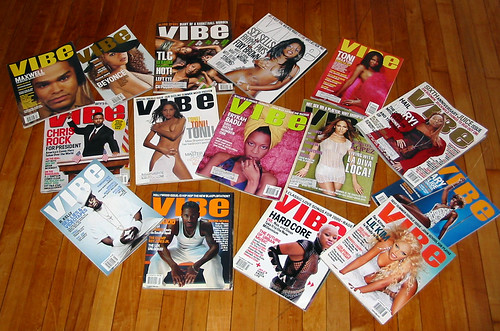
I was a charter subscriber of Vibe magazine; Quincy Jones was quite the salesman and saw a budding market for a publication on a music and culture that was becoming ubiquitous. Up until 2000 or so, the writing was fairly sharp although it appeared that the magazine was becoming a forum for a so-called "hip-hop lifestyle". The commercial imperative is keenly felt in the USA. Still at $9 or so to renew, I persevered with the magazine even as I would get increasingly irked (and last year they started an offshoot Vibe Vixens which, other than fulfilling an eye candy and titillation quotient, was similarly vacuous). Quincy incidentally cashed out some time ago (like Berry Gordy, he knew exactly when the gig was up). When we moved to a new apartment last year I allowed the subscription to lapse. For the past few months I've been picking up a copy in bookstores and flipping through in the hope of finding a reason to get back on the bandwagon, $9 is a such a low threshold. Sadly enough this email from my archives is still relevant.

To: mail@vibe.com
Subject: September 1999 6th Anniversary issue

Don't start a piece titled "We're on a mission" with a clear error in the second sentence: as we all know "Feels Good" was on Tony Toni Toné's second album (The Revival), not on their first (the aptly named Who?). Or were you over-excited by your sixth "Anniversary" (a song on their third album, Sons of Soul)...

Not to be pedantic though, the appeal of Vibe in its first couple of years was its incisive and informed writing about a fairly wide range of music. I can't help but comment that that aspect of the magazine has been overshadowed of late. A couple of recent issues were clearly devoid of content; I kept turning the page looking for something, anything, and ended at the end of the magazine.

On the other hand, it's obvious that you are a success given the amount of your pages devoted to advertisements, fashion and celebrity eye candy so maybe I should shut up. Or maybe I won't: consider this a plea for you to get back to some sharp writing and keep on your toes; there's still some good music out there. No more puff pieces.

I'll give you the benefit of the doubt, For now.

A concerned subscriber
I was ignored the first time and have no illusions that anyone will even care that they've lost my annual $9 contibution especially when others seem to tolerate 3 pages of marginal music commentary amongst 180 pages of advertisements and "lifestyle" bluster. Still I'm a little saddened.

nine dollar vibe

These are the remnants of my Vibe magazine collection. Curiously enough, this is all that survived my last apartment move (at least these are what are in the boxes that I've opened). As you can see these remnants are all eye candy. You have my word that the music reporting was as interesting as the covers. The Maxwell, D'Angelo and Erykah Badu issues were fabulous as was the Chris Rock piece. As regards eye candy the two Toni Braxton issues are collectors items, Toni, Toni Toni! was the title of the middle one. The Foxy Brown, Eve, J. Lo and the two Mary J. Blige pieces were a mixed bag, the music was not as incisive but there was a focus on the culture. The Beyoncé and TLC issues were elegaic while the R. Kelly and Lil Kim bits were pure scandal showcasing the eternal struggle between the sacred and the profane in the music that I love. But that was then, this is now; now there is only eye candy. Thus my hommage to the end of an era and my boycott of the nine dollar Vibe.

It is apparent that best writing on music is now to be found in blogs or various discussion forums. I am old-fashioned enough to like settling down with a good magazine and the occasional meaty book on music or the arts. There are still interesting magazines on literature and the like, why not music? I guess I'm going to have to write my own books since no one wants to cater to my admittedly intense predilection for music.

In all seriousness, what are people reading these days? And if it's not on paper, who should I be adding to my Bloglines' subscriptions?

This is the first part of the Boycott Day Trinity: The Father.

File under: , , , , , , , , , , , , , , , , , , , ,

Sunday, June 04, 2006

Jaundiced Zingers

Further nuggets for the toli scrapbook... ala Dictionnaire des Idées Reçus (Dictionary of Received Ideas) from Gustave Flaubert.

Hatchet Jobs

Choosing Denis Sassou-Nguesso over President Omar Hassan Ahmed Bashir of Sudan is sort of like passing up Idi Amin in favor of Moammar Kadafi.

— From an LA Times editorial, To lead Africa, commenting on the election of a new president of the African Union and how a gun-running rogue won out over the "slow genocide 'moderate' jihadist". The choices we have in Africa... God help us.

The anemic Mr. Shakespeare specializes in meaningful pauses and cryptic silences. A pastel watercolorist, a stylistic vegetarian, he is inadequate to the task.

William Grimes on Nicholas Shakespeare's In Tasmania

The God of Small Things is a hit with coffeehouse book clubs now for the same reason that To Kill A Mockingbird was a hit with Reader's Digest types fifty years ago. Both affirm the dim simplicities: Children are innocent; grownups are bad. Love is good; prejudice is bad.

— John Dolan on Arundhati Roy: The Goddess of Big Lies, part of the "Great Literary Frauds of Our Time" series.

Now, I know it’s customary in D.C. journalism to understand Harry Truman the way Joe Klein does: as a symbol, as a lovable, plain-spoken guy from the "heartland" largely unconnected to actual politics... So maybe it’s a little unfair of me to call attention to what Truman actually said. But Mr. Klein’s repetitive invocation of Truman, plus a little regional pride in the man, compelled me to look up the Turnip Day speech. Having listened to a recording of it, I think Mr. Klein is right in insisting that it be regarded as a model for Democratic candidates. I can also report that what Truman said in the speech is in almost every particular the precise opposite of what Joe Klein advises contemporary Democrats to say.

— Thomas Frank on Joe Klein's Turnip Day. A great piece on the fetishization of "authenticity" which apparently only Joe Klein is able to discern accurately.

Wherefore The Vicar of Bray?


I do love a good savaging of some of the blowhards that pass for public intellectuals, it keeps them on their toes - well it occasionally serves to reduce the chutzpah quotient. I am still gearing up to take on Thomas Friedman whose intellectual acrobatics, like those of David Brooks or Joe Klein, continue to be a source of wonder. When I think about the malleability of their rhetoric, I turn back to the poem and song in which the case was best laid out about willing chameleons and their agility in retooling their message for the talking point of the day, the Church of Rome and its authoritarian ways.
The Vicar of Bray

In good King Charles's golden days,
When Loyalty no harm meant;
A Furious High-Church man I was,
And so I gain'd Preferment.
Unto my Flock I daily Preach'd,
Kings are by God appointed,
And Damn'd are those who dare resist,
Or touch the Lord's Anointed.
Indulgences are many...


Cryptonomicon consisted of nerdish Mary Sues afloat in a sea of Cliffs Notes for popular science books. Angels and Demons retains the nerd protagonists but adds a layer of cack-handed James Bond stuff.

— Kieran Healy cast his jaundiced eye on Dan Brown's Angels and Demons; the result was succint and savage.

The modern Republican Party is the result of collusion between a movement to take U.S. jurisprudence to the pre-Depression era, and a movement to take culture back to the pre-Enlightenment era. It is doomed because the latter would like a theocratic state to regulate culture, and the former want to smoke dope and look at dirty pictures.

— Max Sawicky - Maxspeak Maxim IX. See also Maxim V.

Dada by way of Funkadelic

What is the source of food for thought?
Ego-munchies
Image doggie bags
A me burger with I sauce on it
A myself sandwich
A personal burger
Hamburger
And a glass of constricted cola
Out to lunch with lunch meat
The fear of being eaten by a sandwich

Low calorie logic
Muscle brain, skinny brain
Count the calories of your thoughts

— Funkadelic - Promentalshitbackwashpsychosis Enema Squad (The DooDoo Chasers) from their 1978 masterpiece One Nation Under a Groove.

Singing during a Carterian window (pre-malaise) and shrewdly antipicating a Reagan retrenchment, Star Wars, Iran/Contra, El Salvador and crack epidemics, Mike Hampton's guitar, Bootsy Collins's bass and Bernie Worrell's keyboards laid a musical soundscape that meshed with George Clinton's escapism and scatological insight. The band were at their peak and Doo Doo Chasers and Maggot Brains were on the menu. How I wish the P-Funk crew would provide a musical deconstruction of the current moment. An Emersonian transformation is sorely needed.

On Napoleon's Tooth


A priceless cab ride; you should read it all
"Funniest trip I ever had to make," said the taxi driver. "Now, you'll like this one . . ."

"So I gets a call on me wireless," he continued, "an' 'e says; 'Ere, I've got one for you.'

"I says, 'Oh, yeah,' and 'e says, 'Yeah, you're gonna like this one, I want you to go to this address, in Kensington, pick up Napoleon's tooth and take it to Swindon for auction.'

"I says, 'You what ?' 'E says, 'You 'eard. Napoleon's tooth. An' I 'ope you're insured 'cos it's worth 8,000 nicker.'

[snip further hilarity]

"Well yeah, still, I'll tell you somefin'. You gotta 'and it to his dentist, 'aven't you? 'E shoves that tooth to one side, an' e says, 'I'll 'ave that and I'll keep 'old of it till someone invents eBay.'"

Sentences I Loved Writing

You know too the stereotype about black men, that we have large... vocabularies.

The ballads alone might cause unwanted pregnancies and bring opportunist politicians into your bedroom.

I know my place in America: at the intersection of Tenuous St and Hired Immigrant Worker Alley.

Rendition also reminds one of the worst practices of the meat rendering industry which we know indubitably leads one down the path to Mad Cow Square.

A Title for Future Toli?

Being emotionally in your pajamas.
I'm not quite ready to write something that does does justice to that title hopefully that could be next year's project. In any case feel free to use it.

Delineating Dysfunction


From one of my favourite songs of the past few years that I rediscovered last Christmas.
I really love it when,
I love it when we make mistakes
Because once again,
It gives me reason to complain

I love the battle lines
The battle lines we draw and cross in the mud
I love it when we fight
Standing on the verge of breaking up or making love.

What would I do if we were perfect?
Where would I go for disappointment?

Love without pain would leave me wondering why I stay.

I think of saving myself
But with nothing to complain about up in heaven what would I do?
Saving myself, but I really want to work it out
Down here in hell (with you)

Van Hunt - Down Here in Hell (With You)
I view this beautiful song (discussed recently at Breath of Life, my Sunday morning guilty pleasure) as an update of what Prince has sung: "what's this strange relationship that we hold on to?". In troubled times, when we are all singing the inflation calypso, we are prone to anaesthetize ourselves in nostalgia. Still, artists and grifters will always find a fertile ground celebrating the dsyfunction of the B-movie theory especially in America. It is no surprise that Elijah Muhammed and Berry Gordy arose during the civil rights movement or that Iceberg Slim wrote during Vietnam and Nixonian larceny and so forth. In this vein, it stands to reason that Van Hunt's father was "a part-time painter and a pimp" as he recounts in his musical autobiography. From this springs forth his ground level view of dysfunction and the hard sell. His observations of the hustler ethic informs his music and it leaves him "curious about what it was that happened during the day that makes people do what they did at night". As he puts it, "it is the inner turmoil and struggle to remain sane that stimulates" him. A personal sign of the times and melodious music to boot. You can sample the acoustic version of the song for the next few days.

The Fluidity of Ideas


Circa 1988 or so, I could often be found saying
Dancing is expressing in the perpendicular your intentions for the horizontal.
as part of my teenage flirtation arsenal. It served to lower people's guard in parties and the occasional nightclubs. I continue to use the expression since I believe in sticking with formulas that work. I never quite figured out where I got the witticism from and, for a while, was quite chuffed at myself. Of course that was just intellectual laziness and Google being the great Oracle, it took 0.3 seconds to get the correct source, George Bernard Shaw, and formulation:
Dancing is a perpendicular expression of a horizontal desire.
I prefer the original to the toli remix but I'm tickled also by the derivation. It stands to reason that back in 1988 I directed a George Bernard Shaw play, Passion, Poison and Petrification or the Fatal Gazogene. I was even rereading said play last month and considering giving it a toli remix in the things fall apart series. The sampling of music and hyperlinking of snippets on the web are proxies for the fluidity of ideas in the modern world. We're all standing on the shoulders of giants and I wonder how many other notions are being reinvented and reinterpreted these days.

This Fanon Paddy


There aren't many who write on Ghana in the blogosphere but those that do always bring different perspectives to the conversation and with sometimes startling turns of language. I quite like this pidgin deconstruction of Fanon's ideas.
If we all start live like Americans aa, the earth no go fit handle am.

Apart from that, America too have in own problems. One of den problems be public squalor versus private opulence. Even though most parts be ok, more yards be nasty whereas some other posses dey live in fantastic neighborhoods.

That no shedaa be dangerous for a place where dema middle class be large. But transport such an idea to Ghana den trouble... Few obscenely rich people and many poor people. That just be the recipe for armed robberies and Ataa Ayis, no be so?
Be so, Paa Kwesi, it be so.

Further Proverbial Zingers


A Ghanaian proverb I discovered from a French blog now sadly disappeared from the ether. Said blog apparently doesn't believe that permalinks should be permanent - this brittle web of ours.
Si tu transpire c'est qu'il y a un motif.
roughly translated as
There must be a reason that you find yourself sweating.
If anything the proverb is reminiscent of
where there is smoke there is fire.
It sounds quite nice when rendered in French, I wonder if 5 years from now the French will be claiming it as their font of wisdom. I hope therefore that someone can fill me in on the wording in the original language (is it twi?) I don't remember running across it previously.


I recently pointed out this one
Trust God implicitly but always tie your camel up at night - proverb from Northern Ghana
Nothern Ghanaians have a quite fatalistic outlook on the world as exemplified their proverbial sayings.

[Update] It turns out that the Prophet Mohammed as noted by Al-Tirmidhi was the origin of the above saying, the fluidity of ideas again. The story is that
One day Prophet Muhammad, noticed a Bedouin leaving his camel without tying it. He asked the Bedouin, "Why don't you tie down your camel?" The Bedouin answered, "I put my trust in Allah." The Prophet then said, "Tie your camel first, then put your trust in Allah"
If I recall correctly, Ali Mazrui has a bit about how Mohammed was the only one of the great semitic prophets (following the Rule of Four Mazrui meant Jesus, Mohammed, Marx and Freud) who experienced upward mobility during his lifetime and how it coloured the resulting outlook on life. Hence the practicality and some say dogma of Islam. One of my biggest blindspots in my reading of Africa is that I discount the Islamic influences. Well Mazrui is a good starting point to rectify that and Amazon will be getting more of my money...
If God breaks your leg he will teach you how to limp - Dagbani proverb, Ghana
It stands to reason that they deal with conflict in ways that mystify their fellow countrymen.


On my maternal side, in the Volta region, they are concerned with being prepared and using the right tool
When you have a club, you don't kill a snake with bare hands - Ewe proverb, Ghana
I wonder if the nail and hammer trope sprung forth from this notion or if it is the other way around? Cultural interplay is the order of the day.

Mobile Phone Wisdom


Mobile phones have taken off in a big way in Ghana in the past five years (I am due for some musings on the topic) and, as elsewhere, they are affecting our vocabulary. Thus:
"Out of coverage area."
That was the reply to a question about whether a friend back home currently had a boyfriend. I knew exactly what she meant.

There is much in my life that is out of coverage area, we need some soothing balms for these huhudious times. As it turns out, it is a simple matter of erecting cell phone towers everwhere and building redundancy into the system. But then there's the matter of getting over the "not in my backyard" business. Someone needs to build these metaphorical infrastructural edifices to preserve the commons. I know I'm trying to build a few in this joint. Your contributions are welcome...

See earlier wistful and proverbial zingers.

File under: , , , , , , , , , , , , , , , , ,

Tuesday, May 23, 2006

The Books of Nima

A note I've been meaning to write for perhaps 6 months to "Sir Sky", the author of The Sea and the Bells; a conversation about Nima, a neighbourhood of the mind.

Part 9 of the Things Fall Apart series, this time an entry under the banner of Social Living...

I was looking over your shoulder during your year in Ghana, perusing your travelogue that I came across in a case of web serendipity (the Ghana tag at Technorati, in case you're wondering). When I first read you, and learned that you were going to be staying in Nima, I was apprehensive. Yours would not be the typical volunteer or expat experience; you weren't destined to have the servants, the driver and car, or the air-conditioned office. I don't know if you knew what you were getting yourself into, that you'd be going local and doing the slum housing thing and worse. As an Accra boy, albeit transplanted to Cambridge, I know all about the school of hard knocks called Nima. It looms large in the Ghanaian consciousness, even if there are many worse places these days as you know. It's very far from ideal as an introduction to a visitor.

ghana postcards


The fact that you were willing to give of yourself to us was very generous, and I don't know if Ghana fully reciprocated the generosity... The years from 1982 to 1988 broke the back of the Ghanaian people, and ever since, we've been struggling to recover from scarcity and arbitrariness. Thus we demand a lot of outsiders and of anyone who's been abroad. This is changing, and our current quiet stability is restoring our confidence in parts; still, not everyone has read that script, and the neediness can wear you down. For what it's worth, you're not the only one labelled oburoni; my mid-Atlantic self gets that designation every now and then when I'm home.

I was tempted at many stages to jump in: to suggest creature comforts or avenues that would have made things less wrenching for you. But as is the norm on this web, I remained dark matter, absorbing your energy. Still in mitigation of the head nods I omitted to send your way, I think your experience is all the more richer for being yours alone. Like your country's peacekeepers, you are one of Canada's great exports, and after your experience in Ghana, you'll breeze through anything back home.

You lived through countless lights out and experienced the wasted time spent dealing with simple things like water, food and transportation. And of course, there were those untrustworthy and maddeningly inconsistent people... It's the simple fruits of poverty; we lack infrastructure, physical and otherwise.

You had the daily struggle in that library without resources, where you taught the adult literary classes and wrangled to teach those neighbourhood children. The ironies and absurdities about that task are worthy of a novel and hopefully you'll write one.

Osu library was the scene of some of my fondest memories of my childhood. It was well stocked and the librarians cared and worried about you. No one could ever tear me away from it, even at closing time. It was where I learned that books and ideas are important, where the parental challenges were investigated and puzzled over. Those books were a long winding road, to be read with care as their nuggets would reveal themselves, or the inconsistencies of an argument would appear in relief in the reading light. My greatest heartache about Ghana today is that very few children are getting the same opportunity. True, our lingua franca these days might be radio, television or this internet thing, but really, how many Ghanaians are participating in this conversational web? If only I could hear those missing voices... The notion that so few in my country can bury their heads in books on weekday afternoons or on a lazy Saturday morning at the library is cause for much distress. And don't get me started about what's happened to the Legon university bookstore. Must everything be utilitarian? Is a country without whimsy worth worrying about?

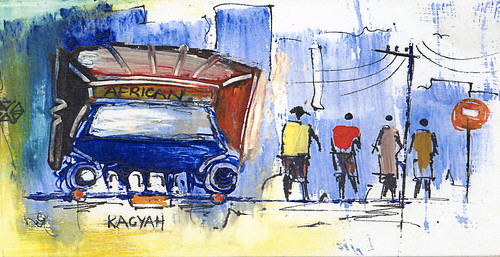
African by Kagyah


I think the emotional violence could have been avoided, and, certainly the physical violence should have been avoided. My heart leaped at such times, but still I kept silent and read on. Nima is such an insular place, it is very wary of outsiders as you probably found. In the past it was where rural migrants came to partake of the Accra dream in the Gold Coast. Thus it has always been messy, and developed in fits and starts as befits the residence of those who live on the fringe.

Even today, two shacks away from the homes of proud middle-class schoolteachers you'll find the "Nima boys", selling 'wee', guns or worse, right under the Kanda highway and close to the police station. The boys can always be counted on to roust any political opposition come election time, and their hard knocks usually come for cheap. True, the stereotypes of Nima boys as uncouth, brash, vicious, and ill-educated are extreme, but they carry a kernel of truth about a small minority that lingers even in the relative prosperity of the moment. Across is a chop bar serving the best banku and fetri in town; Auntie Maggie's spot is packed during the day and there's nice fresh tilapia at night, shantytown chic as it were. Just around the corner is a drinking spot with people playing oware or dominoes and downing bottles of Star beer and Guinness in the early evening. Nowadays there are the occasional interruptions when they'll whip out the latest mobile phone ostentatiously: "talking loud and saying nothing".

But you saw all that and more, you saw how people "disciplined children" and how they meddled in each other's business — or not. As you found out, that "it takes a village to raise a child" business isn't happening much in the slums of Nima; too often it is the garden-variety anomie and indifference of urban life, something that wouldn't be out of place in any big city. I saw the same mix in Soweto a decade ago, although that was more upscale at the time, and well, Inman Square is what it is. It is true that given a few decades of development, Nima could become the Catford of Accra, and, believe it or not, it is much better today than it was in the sixties and seventies, but perhaps that progress is cold comfort for the struggles you faced.

I dug your observations on the press and on street life of Accra. Your look at the street cleaning exercises that took place earlier in the year was priceless. In the year 2006, they're finally worried about rubbish and overflowing gutters! And only for two weekends. Ah yes, that culture of maintenance that was so evident in your encounters with us. Perhaps you too have the journalistic impulse. And that water shortage in certain parts of town, Accra is straining at the seams; I was in Ghana at the time and noted as much, although we had water in our neighbourhood. You picked up on our tro-tro wisdom, our folktales, and the languid way in which we view the world. You even taught me that proverb from Northern Ghana:
"Trust God implicitly but always tie your camel up at night."
I don't know if that's where Ronald Reagan got his "trust but verify" shtick, but it's close. Still, Kweku Ananse's cunning and laziness can be a curse; living by your wits, hustling in short, is no substitute for the prosaic work of development, although it can be quite enjoyable.

I suspect that a lot of Ghana has rubbed off on you; we can be quite infectious (and not just in matters of public health). Do be careful that you don't break out into pidgin when you're back home interviewing for a job; our deconstruction of the English language has its own musical logic, and not everyone is ready for it.
Take care-oh.
And you saw the other side too, the havens of those expats who saw Ghana as a holiday, who kept to themselves and didn't engage with the country and its people. Hell they might as well have been living in Eden; your garden was good old Nima. Well at least you got to know us intimately; that has to count for something. We claim you as our soul sister, and will keep your heart hostage in our town.

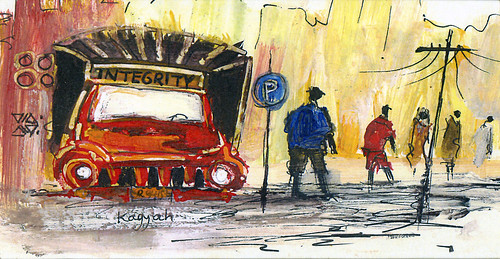
Integrity by Kagyah


You even reported on the beginnings of the cholera outbreak that I encountered last Christmas. When my father began to warn me about taking precautions if I decided to eat out in town, I nodded my head knowingly; for a time you were my favourite Ghanaian newspaper.

And of course there were those malarial episodes, the fevers, the Larium dreams and those hallucinations. How much energy was dissipated in those sweaty nights and days? Those mosquitos, and their cargo of plasmodium falciparum; they are a poverty tax. We may throw our herbal medicine and "bitters" at them, but that is after the fact, to deal with the symptoms. The full panoply of mosquito nets, sprays and lotions counts for nought if you don't deal with sewers and the ever-present pools of stagnant water, or if parents will use their children's nets. And we all know about drug resistance: Darwin's evolution is intelligent design. Still, as they say, mosquitos don't discriminate. Not in Ghana, not on the island of Reunion, and certainly not in Cambridge. We're all singing the West Nile Blues these days. Some call it globalization; I know it as the Mosquito Principle.

You may only have lived in Nima for a while but you got the full Ghanaian experience, unvarnished and cacophonous; three centuries taking place simultaneously in those twisted back alleys. I'll admit to a sense of wistfulness in seeing my country anew through your eyes, and I want to hear more of your thoughts going forward as you carry Ghana in you. I hope we don't weigh too heavily on you. I wish I had been there on the ground; it's hard to be living vicariously through a Canadian woman.

As you'd expect, it's very painful for me as a proud Ghanaian that, almost 50 years after independence, we are still relying, nay depending on you, to teach us how to read, or even to school us about the importance of a book. To read, for God's sake. Hundreds of years after our chiefs started sending their children to Europe to learn these things and we haven't internalized the lessons... But then it works in the other direction, the West relies on people like me to make sense of its world - the technology world in my case. And your southern neighbour, that United States of Anomie, can be a similar school of hard knocks, and not just for lowly immigrants; you don't need to visit New Orleans to get the daily evidence. Still, I wish the cultural interplay was more balanced, that we could each walk tall, rather than smile sheepishly as we do and say, "Only in Ghana" or "That's how it is in Ghana". As if we can't do anything about it. As if it doesn't have to be this way.

You quoted Anthony Hopkins playing C.S. Lewis in Shadowlands:
"Experience is a brutal teacher. But you learn. My God, you learn."
I'll suggest in response, our poet Kwesi Brew's book, African Panorama, and I'll quote one of his elegiac poems. You should recognize the subject matter.

The Slums of Nima


Three neighbours met,
And after a hurried, "I give you rest"
The two young men stood aside for the old man
to pass and then picked their way
in the opposite direction towards the alley on the left.
They were thieves who robbed with violence
But still they stood aside for the old man
And he thanked them.

In a bereaved world questions and comments
Fall on unhearing ears.
Only silence, understanding and
Belonging can put
A blind man's stick in the hands
Of a searcher in that night.

The crumbling walls have leaned
On their chests for decades!
The toll of breathing has shredded
Their lungs, and their eyes are sore
With the smoke of the wicker lamps.
And now we all stand at the edge
Of an abyss
Afraid to plunge headlong, or
Return to the dark of the night with them!
kwesi brew


Ghanaians are natural storytellers. We are cultural interpreters and urban griots; not for us Anglo-Saxon brevity. Even as we consider Kwesi Brew's abyss, or that heart of darkness, you'll hear the musical laughs and see our urge to understand. We want to change the perspective and open things up through observation and humour. As he wrote in another poem, and I won't give the punchline away, things must be sweet for Ghanaians:
How else could they laugh
Like they do when they should weep;
Remembering the voiceless days of the past.
It is quite poetic that you arranged for your class to travel outside Accra - to the beach no less, and even managed to get them that helicopter ride over the city. We are all so caught up in our black boxes, strangers in our own country. It is eye-opening to glimpse those different perspectives, and you too were being a cultural interpreter, making people see themselves anew. It was a small victory in your ongoing journey.

I really hope you don't take your journal down as you threatened recently. The pearls of experience therein are too rich to be simply discarded in the dustbin of the lost web. Allow Google to stumble over your throwaway experiments - they provide comfort even for an audience of one. I dug a lot of the writing (without a doubt, you're on the road to many books). The sound of a voice trying to make sense of an unfamiliar, frustrating yet endearing environment, the large and the small observations, all these things make for a historical document done in best tradition of the web style. The Sea and the Bells, at least that year's version, is a great snapshot of Ghana in the years 2005-2006, a personal introduction to be sure, but it constitutes a compendium of small things to be duly celebrated.

As you might guess, my preferred response to Things Fall Apart is small things: short cuts and bite-sized conversations that engage in the marketplace of ideas. I know you only as "Sir Sky" and the conversation has been one-sided until now. Consider this my opening gambit, my "so what's your name?" approach. I hope you like my brand of small talk; it's known as toli.

Dig: I'm sending some books to the Osu library. I hope it's still there and that someone will receive them. I can only hope that people are still reading. I've been carrying them all these years but never did anything about them; they make a glorious floorscraper. They'll be delivered in your name, and inscribed with the word Nima.

A belated head nod to you.

barbershop portrait and books


Next: Dilemmas.

See also: Poetry as Cultural Memory

File under: , , , , , , , , , , , , , , , , , , , , , , , , , , , ,

Friday, May 05, 2006

Off the Hook

Apropos this afternoon's news of Porter Goss's "unexpected" resignation as Director of the CIA, still unexplained by him or his boss, the 43rd President of the United States, and the "swirling rumours" (as John Roberts of CNN put it) of hookers, suborned Republican Congressmen, dirty defence contractors, the Executive Director of the CIA, a certain Kyle "Dusty" Foggo, plucked out of obscurity into his position by the now departing director, "relaxation" and "poker parties" at the Watergate and other Washington DC hotels, I have to admit that I was momentarily at a loss for words. As I watched the news, and tried to get on with work on this bad-and-buried-news Friday, I wondered whether truth in these times was always stranger than fiction. Thankfully a Kennedy car crash, and recividist rehab, kept things fair and balanced. It is interesting to note the different ways different media outlets report, as well as the order they choose for their coverage. In any case, I'm sure we'll get all the facts in due course; there is no cause for alarm. As is my custom in times of confusion, I turned to music to make sense of things, and was inspired to dig into the crates in search of a theme song for these huhudious happenings. Consider this a musical response to the news...

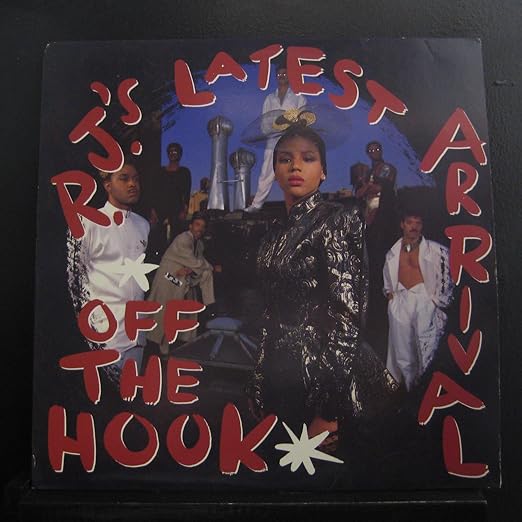
The song is Off the Hook by R.J.'s Latest Arrival, from their 1988 album, Truly Yours. It's available on vinyl in the UK and CD copies show up every now and then, as nostalgia ebbs and flows.

To put it in context, it's a duet between producer R.J. "The Wiz" Rice and his lead singer, whose name escapes me but whose soulful voice kept English boarding school boys entranced on our dorm room and study dancefloors. For the purposes of transcription, I'll give her the admittedly arbitrary intitials, CIA. The song is basically about The Wiz getting caught out in infidelity and his attempt to stay connected to his current squeeze. His problem is that CIA wants him to stay off the hook and she has disconnected her phone. The Wiz's voice is suitably greasy, sounding like a cross between Roger Troutman's electronic vocoder and Keith Sweat at his whiniest. If the song were written today, she'll probably erase him from the speed-dial or remove him from the buddy list. I suppose one could remix the word hook with hookers but that would be too blatant. I prefer instead the delicious connection of hook to a curious person in this tangled web

A CIA agent nicknamed "Nine fingers" so named because he lost one of his digits while on assignment.

The song is out on the file sharing networks but for the musically curious who need instant gratification, it is now available on Youtube.

R.J.s Latest Arrival Truly Yours

Off the Hook by R.J.'s Latest Arrival

The Wiz: Had a masterplan and I did not leave a trace. Never really thought it would backfire in my face. Little did I know it was easier said than done. All I tried to do was have a little fun.

CIA: Off the hook (with your love), I'm over you.

The Wiz: Stay with me. Don't leave.

CIA: Off the hook (with your love), I'm over you.

The Wiz: Don't let it end this way, baby.

CIA: I'm over you. I'm trying to get myself together.

The Wiz: Once in a lifetime baby.

CIA: I'm over you.

The Wiz: Why can't you forgive me?

CIA: I just can't forgive you.

The Wiz: You know I tried to be true.

CIA: You lied to me.

The Wiz: Hanging with the guys... Influence on my thoughts. Won't you understand that I only did it once?

CIA: One time was all it took... Can't run no game on me.

The Wiz: I'm not running a game, baby.

CIA: Won't need no second chance.

The Wiz: I don't need no second chance.

CIA: My life has just begun.

The Wiz: It was a once in a lifetime thing.

CIA: Off the hook (with your love). I'm over you.

The Wiz: Stay with me. Don't Leave. Please.

RJ's final pitch: I don't know what you gonna do. But I know what you really need. I'm a man that made just one mistake And I don't want you to leave. I'm not a tramp with the brain insane, the ego-trippin off my name. You ain't off the hook, take a second look.

[phone hangs up]

CIA: No. No. I... I don't need you no more Cause you lied to me.

The Wiz: Stay with me.

CIA: Your masterplan backfired on you.

The Wiz: Please stay.

CIA: You know I'm... I'm over you.

The Wiz: I never meant to hurt you.

CIA: I'm off the hook.

The Wiz: Stay with me.

CIA: I'm off the hook (with your love).
I'm off the hook (with your love).
I'm off the hook (with your love)

The Wiz: I don't really want it to end this way.

CIA: You mean that's it? Well...

Liner Notes

I'll note in passing that R.J's Latest Arrival's most successful album was their 1995 effort entitled Everybody Here Must Party. I don't know if they meant poker parties or simply spending more time with their families.

It featured their earlier 1984 hit single, Shackles, which is one of the best break dance and electric boogie songs. Shackles was their most famous song and was typical of the early hip-hop grooves of the early 80s. Its lyrics harken to clubgoers trying to avoid perp walks:

Shackles on my feet Our primary objective is keep to the groove.

Musically, Off the Hook is in the same vein as Jerome Prister's Say You'll Be, that is, classic and soulful dance music. The ingredients are drum machines, synthesizers and a woman wailing away to punctuate the points. The song is very danceable and you can imagine the kind of fun workouts one could have in nightclubs or hotel rooms. I also remember it in conjunction with Full Circle's contemporaneous song, Working up a Sweat which I've mentioned before in connection to erustication, which is quite appropriate since we're dealing with CIA connections in this instance.

Porter Goss, I'm off the hook with your love, I'm over you. I suspect you're working up a sweat.

File under: , , , , , , , , , , , , ,