Friday, May 18, 2007

On George W. Bush

I. On Knowledge

His had been an intellectual decision founded on his conviction that if a little knowledge was a dangerous thing, a lot was lethal.

Tom Sharpe - Porterhouse Blue
I turned to Tom Sharpe expounding on knowledge a quarter century ago for insight on the 43rd President of the United States. At first glance, I thought his bons mots were a succinct and definitive summary of what we have seen of said President's attitude towards knowledge. Some have speculated about oedipal reasons or ice queen mothering for his essential incuriousity. I demur; one should give him the benefit of the doubt and ascribe his outlook to conscious decision. He has asserted after all that he is "the decider". Also as Sharpe explained, incuriousity can be a deliberate policy, indeed one founded on conviction, if not an instinct towards self-preservation. This is only human and it is clear that there is a lot of conviction in the President. Upon reflection then, Sharpe's formulation can only be a partial rendering.

Knowledge is all the rage these days. Secretary of Defence, Donald Rumsfeld even proposed a taxonomy of knowledge, iconic in recent memory, in one his jawboning press conference performances — said taxonomy was incomplete as it turned out, he forgot the unknown knowns, and in the war policy he implemented, he discounted even the known knowns. Robert Waldmann recently added a few prescriptions on the matter. Political discourse in the United States of America has thus been all about knowledge: who knew what, when did they know it, should they have known it and so forth. There have even been acrobatics: "If I knew then what I know now, I would etc."

Well, who knew?
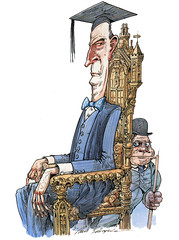
porterhouse blue

II. On Ignorance


It seems to me that one should turn to the other side of the coin in search of insight on the 43rd President of the United States. Thus we'll consider ignorance. For this we'll go back to 1907 and to Hilaire Belloc's delightful essay On Ignorance. As an avid proponent of the collage and remix, let's see how well a sampling of his toli can flesh out our portrait...
On Ignorance by Hilaire Belloc

There is not anything that can so suddenly flood the mind with shame as the conviction of ignorance, yet we are all ignorant of nearly everything there is to be known. Is it not wonderful then, that we should be so sensitive upon the discovery of a fault which must of necessity be common to all, and that in its highest degree? The conviction of ignorance would not shame us thus if it were not for the public appreciation of our failure.

... the biting shame of ignorance suddenly displayed conquers and bewilders us. We have no defence left. We are at the mercy of the discoverer, we own and confess, and become insignificant: we slink away.

... Note that all this depends upon what the audience conceive ignorance to be... Among very young men to seem ignorant of vice is the ruin of you, and you had better not have been born than appear doubtful of the effects of strong drink when you are in the company of Patriots...
Ignorance is an everyday occurence, something that affects every man. It isn't surprising that those who affect to be Everyman would not be immune from its effects.

One wonders about the moods of crowds. Why do people turn when they do? What is it that causes reassessments and shifts in the cultural zeitgeist? Tipping points are only part of the picture. I continue to ponder the essential difference between those two fables: the boy who cried wolf and the emperor's new clothes. This is not to suggest that the 43rd President of the United States is a wolf or indeed an emperor, although there may be latent aspirations to both characterizations. Rather I wonder about the reception to the messages of those boys in the fables. The one was ignored (he cried wolf too often) while the other was celebrated (everyone laughed at the emperor). When does danger or hubris become plainly evident to all? Perhaps everything is local and our evolutionary make-up conditions us accordingly.

But I digress. Back to ignorance...
Nevertheless... we should rather study the means to be employed for warding off those sudden and public convictions of Ignorance which are the ruin of so many.

These methods of defence are very numerous and are for the most part easy of acquirement. The most powerful of them by far (but the most dangerous) is to fly into a passion and marvel how anyone can be such a fool as to pay attention to wretched trifles...
No one can fault the 43rd President of the United States for lack of passion. He is focused. He is a compassionate conservative. He is a war president. Passion and focus on big, serious and era-defining issues are his concern. War by definition is as big an issue as humankind faces. Would it that small things were considered; that however would reek of Clintonian microsteps, trivialities in essence.

No. Crusades. Mushroom clouds. War. Terror. Big picture. Serious.
There are other and better defences. One of these is to turn the attack by showing great knowledge on a cognate point, or by remembering that the knowledge your opponent boasts has been somewhere contradicted by an authority...
The 2004 US presidential election campaign is perhaps a great illustration of this technique, and in this Karl Rove, sometimes labeled Bush's brain, was in full concurrence. John Kerry knows this all too well.
Yet another way is to cover your retreat with buffonery, pretending to be ignorant of the most ordinary things, so as to seem to have been playing the fool only when you made your first error. There is a special form of this method which has always seemed to me the most excellent by far of all known ways of escape. It is to show a steady and crass ignorance of very nearly everything that can be mentioned, and with all this to keep a steady mouth, a determined eye, and (this is essential) to show by a hundred allusions that you have on your own ground an excellent store of knowledge.

This is the true offensive-defensive in this kind of assault, and therefore the perfection of tactics...
The steady mouth, the determined eye, the repeated calls for resolve, the swagger, the obsession with fitness, the cowboy photo opportunities, the outdoors pose of a "Texan" stand in stark contrast to the Connecticut patrician upbringing. This is deliberate it would seem.

The notion of buffoonery is trickier however. The public gaffes during the Queen's recent visit are a case in point. One should ask: is the steady flow of homespun awkwardness calculated or genuine? Dwelling on bushisms as many do, only serves to lower everyone's guard and cause misunderestimation as the 43rd President of the United States so candidly and memorably put it.

This is a theme Belloc covered a decade earlier in The Modern Traveller, a book whose toli I'm a year behind in addressing (real soon now).
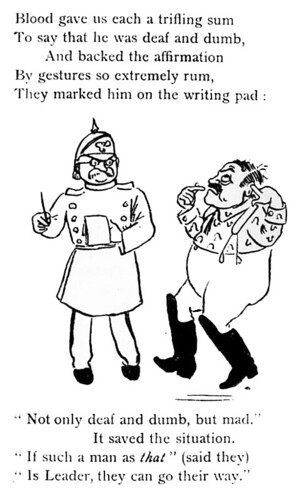
On Ignorance - The modern traveller

Note the name, Blood, and the reaction to his shrewd manoeuvers:
It saved the situation.
"If such a man as that" (said they)
"Is Leader, they can go their way."
That is an efficient take on ignorance, who has the time to scrutinize closely in this fast-paced world? By and large, our decision-making is done on gut feel and liminal signals, with only lip service paid to due diligence. Most of the time things work out, right?
Lastly, or rather Penultimately, there is the method of upsetting the plates and dishes, breaking your chair, setting fire to the house, shooting yourself, or otherwise swallowing all the memory of your shame in a great catastrophe.
I fear that this is the terrain of the current moment; the aircraft carriers ominously deployed in the Gulf, the saber-rattling on Iran, Syria and such bode ill for all of us. Setting fire to the house, whether to its finances or its foundations is a real temptation. One school of thought on the Middle East misadventures is that if you break eggs over there, the natives will be scrambling amongst themselves. "We fight them over there so that etc". This Scrambled Egg Theory of Mesopotamia is a rather dubious historical legacy I must say. I rather thought that blood was precious for most human beings but it seems that a powerful cohort, and the 43rd President of the United States is among equals in these elite ranks, are determined to provide existence proofs of the quantity theory of insanity. This young century is on course to equal the butchery of its predecessor.
But that is a method for cowards; the brave man goes out into the hall, comes back with a stick and says firmly, "You have just deliberately and cruelly exposed my ignorance before this company: I shall therefore beat you soundly with this stick in the presence of them all."

This you then do to him or he to you, mutatis mutandis, ceteris paribus; and that is all I have to say on Ignorance.
The closest we have come to this last method was when newly elected Congressman James Webb refused to shake the hands of the 43rd President of the United States. Decorum sadly did not allow the two to come to blows and thus provide catharsis one way or the other. Thus one must hold one's breadth until January 2009 keeping in mind, as his putative replacement has noted, that "the last throes can still be a violent period, the throes of a revolution".

The great contribution of American capitalism to the world is the notion that the customer is always right. In a London shop over the weekend, I was reminded that such a sentiment is not a cultural universal (don't ask). Indeed rhetoric can often be alienated from practice, witness no child left behind, heckuva job and so forth. In this vein, the popular majority that the 43rd President of the United States received in the 2004 elections causes me to discount the buyer's remorse that is the current, apparent collective hand-wringing. I actually agree with his notion that we've had an "accountability moment". Moreover, he was indeed clear about his intention of spending that capital. So yes, capital is being spent — in all forms. As to the rest, others can add their assessment. I omitted the dialog that Belloc provided out of a sense of dismay, it predicted too closely the discourse we have been treated to.

So, the 43rd President of the United States leads with his notions on knowledge and seems to be assiduously applying all of Belloc's playbook on ignorance. In this respect, he seems to be crossing the line from genial, if miscreant, rogue to fallen angel in the eyes of the American public. I suspect that this judgement, a fallen angel, is one he would be comfortable with. For my part, I only see Blood, but I have a jaundiced outlook on these things. All power to him I suppose, and history will tell the sorry tale. And that is all I have to say on George W. Bush.

Soundtrack for this note

  • Gil Scott-Heron - A Legend in his own Mind
    No comment.
  • Manu Dibango - Bush
    A little Afrobeat and jazz-funk excursion taken from the maestro of Makossa's 1975 original soundtrack to Countdown at Kusini. It's nothing too light nor indeed too deep. The bassline and driving horns are augmented by some demented guitar as the band steadily ratchets up the tension building towards the inevitable crash at the end.
File under: , , , , , , , , , , , , , , , , , , , ,

Wednesday, May 16, 2007

Public Nuisances 63 and 64

Travel this past couple of weeks and considerable jet lag prompt a few entries in an occasional series...

Public Nuisance Number 63


The single greatest improvement in the quality of life for the traveling masses of humanity will be the abolition of those public announcements about "cars left unattended (being) subject to towing". The seven and a half minute frequency of said announcements is a blight on society.

It must drive airport employees mad to hear this business. No wonder bags get misplaced and creative thefts occur. I'd rebel if I had to hear it 72 times a day, 360 times a week, 10,000 times a year. And that is at the laidback airports I've been patronizing where a few hours of flight delays prompted my timing investigations. What, I wonder, is the typical frequency of such announcements, say, at Logan airport in Boston where guilt about terrorists attacks past reigns. Good Lord.

Really, does one need to warn about towing? If you come out on any street and don't see your car, well yes, it's probably been towed, if illegally parked, or stolen, or borrowed if you're lucky. Regardless you're either stupid and/or unlucky. Such is life. Why do you need to be warned? Or is the message intended for a different audience? Is it simply a piece of security theatre deftly designed by security experts to heighten a sense of vigilance, in the best reading, or fear, in the more probable reading. Or is it one of those vestigial announcements that no one questions but that spread inexorably out of bureaucratic inertia. Somewhere a soul dies every time that recording plays. I know that my fortitude was tested...

I can understand the "be on the lookout for suspicious __" or the "don't accept packages" items but that business about towing cars needs to stop. It pollutes our ears. It pollutes our minds. It's that simple. Stop it. Erase that message from the system. Please. Pretty please.

Public Nuisance Number 64


Is there a more diseagreeable verb in the English language than deplane? I believe it is beyond objectionable, nay it is simply indecent in any good company.

Deplane indeed. What's wrong with disembark? The sole saving grace in this sad tale is that board or embark have fewer or the same amount of syllables than emplane which has consequently not seen the same adoption as its obverse (although a Delta employee used it on a recent flight).

But back to deplaning...

May catastrophic bankruptcy befall all airline companies that deploy that verb as part of their linguistic arsenal. Moreover, may the authors of the style guide of said airline companies, those syllabic bean counters who foisted those words on humanity be consigned to a sojurn of no less than six months and a day working at the most gruesome meat rendering factory — I can think of several if consultations are required. Further, may all airline personnel who utter said verb and follow the airline scripts be ignored by their progeny come Mother's or Father's Day.

Deplane! No wonder one hears about air rage even in this post 9/11 world, forget alcohol, I'll deplane you. United Airlines, consider yourself on probation. Continued toli patronage is hanging on a very frayed thread, indeed Jetblue beckons.

Sigh... It's been far too long since my last boycott day. What are you boycotting today?

File under: , , , , , , , , , , , , , ,

Wednesday, May 09, 2007

Briefly Noted

Deadlines are looming and it's also travel season, hence toli must be brief. Here then are some notes on the run...

I. Imperfect Analogies

Item: Before a certain column was published last Friday, a note I wrote used to be the top result for searches for IBM layoffs. I always worried that my musings might attract attention of The Authorities; thankfully, with Cringely taking the hyperbolical lead, they are now firmly (and hopefully permanently) under the radar... It's been almost two years and perhaps I should revisit the France IBM Connection. Back then, I predicted that despite the malaise in France, the French would re-elect the right after Chirac stepped down. Dig: Nicholas Sarkozy was elected president over the weekend in an election that saw record participation. French democracy is proving remarkably healthy. Although ostensibly elected on a mandate for reform, it is interesting that the old guard was the demographic group that voted for him en masse and put him over the top. In a similar vein I will not (cannot?) comment on rumours that IBM is about to decimate the ranks of its global services group and reform that business. One has to tread carefully in this lean corporate world, job (in)security and all that. I never answered the question later put to me: if IBM is France, who was it that was burning cars in the banlieues and would they survive? Implicit also was the issue of whether and how the French establishment would address the wider challenge, modernity and sundry taboos, or in the case of IBM, how it would deal with the web. My analogy was never perfect and I remain at a loss for answers on both fronts. Still, to mix a few sayings:
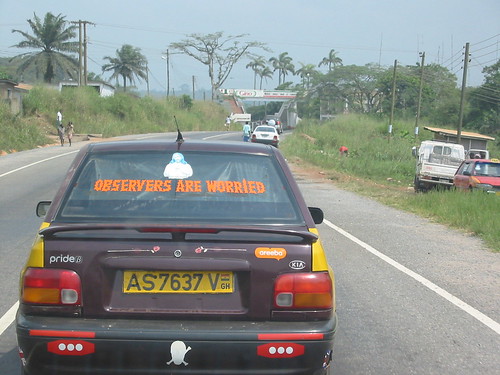
The stakes are high. Observers are worried. Closed due to computer problems.
closed due to computer problems

II. Special Treatment


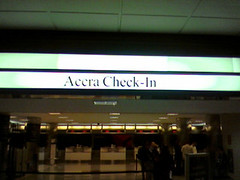
Delta Airways recently (December 2006) began direct flights to Accra from JFK and Baltimore. By all accounts this has been a very successful endeavour for them. Their three weekly flights are fully booked. Clearly they are servicing pent-up demand. Ever since Ghana Airways went out of business, KLM and British Airways had been reaping the wages of monopoly pricing. It's not simply that Ghanaians are homesick or that we are now able to flex our economic muscles. The Nigerians, and others seeking convenient access to West Africa, are also patronizing these flights.

There is a little twist that I observed over the weekend. Delta has done their research well and paid attention to their market. They know all too well that Africans love luggage, what with Ghana must go bags and such, and will seek to haggle over the amount of luggage that they can check in and carry on board. Further, our crowds in airports are often unruly as fellow travelers will attest. Our relationship to authority and order was perhaps poorly served by having rogues rule us for a few decades.

Accra check-in

Thus I noted that there is a separate check-in area for travelers to Accra in the Delta terminal in New York. As I passed it on my way to San Francisco, I overheard a couple in the regular check-in area pointing and asking "What country is Accra in?" The reply: "I don't know, I don't envy them however". I looked over at the long line that was forming, the numerous bags spilling over, and heard the clamour arising from the check-in counters. The airline staff looked a little harried, and well, world-weary. Crowd control is a difficult thing especially when you are dealing with a culture that is all about conversation and the banter of marketplaces. Keep in mind that Kweku Ananse, the cunning and scheming spider, is Ghana's great cultural and literary gift to the world. They must have heard every story in the book, along with sundry inducements for bending of the rules on all forms of luggage, excess and otherwise. I was a little sad at first at our segregation, and embarrassed at being singled-out for cattle-herding. I thought it over for a while, rationalizing rather than wringing my hands, and then smiled: we have our own section, how many others can say that? Our people are being given the special treatment.

Accra check-in
Step right up
Baby steps, baby steps.

III. Triumph of the Penguin


A sidenote: a custom version of Redhat Linux is the operating system running the in-flight entertainment system on Delta flights. This was evident from the scrolling screen messages that we observed as the air hostesses had to repeatedly reboot the system so that the other side of the plane could get their 40 channels of satellite tv. It's heartening to see the spread of Linus' little penguin even if it is only visible when there are problems - the brief flashes of startup screens. The Pentium chip grew into the public's consciousness after its flaws with floating point calculations were exposed. Paradoxically Intel never looked back once it dealt with the initial fallout of that episode. Similarly, folks continue to photograph blue screens of death in machines running Windows say in ATM machines and the like. Again that is an ironic triumph, a display of the spread of Microsoft's software into areas that were formerly the lucrative province of others. As we observe the spread of Linux as core and ubiquitous infrastructure it is good that it is similarly an iconic brand. Infrastructure is normally invisible and only appreciated when things fall apart. In this respect, I should say:

I love infrastructure.
I love glitches.
Infrastructure

IV. Dark Brown


When I wrote my piece on Cultural Sensitivity in Technology, I alluded to a number of incidents involving glitches with Microsoft Word's dictionary or thesaurus. I never managed to track down a good reference to add before it was published. A few weeks ago however the perfect example came up, it concerned the colour dark brown. The headline read:

Offensive couch label traced to China

Toronto. Doris Moore was shocked when her new couch was delivered to her home with a label that used a racial slur to describe the dark brown shade of the upholstery.

The situation was even more alarming for Moore because it was her 7-year-old daughter who pointed out "n----- brown" on the tag.

The rest of the story is a tangled web especially apt these days as we all mind our P's and Q's and hold mock funerals.

It's a wonderful and layered example of the ramifications of small things. The fingerpointing that results in this globalized world of ours is also very interesting. Who is to blame? Is it the manufacturer of the software that translated 'dark brown' in Chinese to the n-word in English? Or is it the supplier of the upholstry that used said software? Or is it rather the furniture store that sold the couch? Who is ultimately responsible for making sure that such things don't occur? Who, if anyone, should apologize? Or are such things what we should expect, the logical endpoint of globalization?

So what do we have here? A simple glitch in the continuum of cultural sensitivity resulted in innocence lost all around the world. The Chinese companies are embarrassed and worried that they will lose business - they are furiously updating all their software, the furniture store is worried about being sued, the mother learned that you can't protect your kids from that thing known as race, the 7 year old learned what a complex world we live in, a world of words that hurt and can even kill.

I was also tickled by the huhudious claim of the Indian store owner that "I've been here (Canada) since 1972 and I never knew the meaning of this word". That is indeed as brazen as it gets.

The remaining absurdity lies in the visiting "friends over from St. Lucia" who "wouldn't sit on the couch." I wish I could meet said friends, they push this toli into sublime territory.

portia portfolio sunflower seed

A Brown Playlist


A soundtrack for this note, some music celebrating the darker shade... Liner notes to follow.

File under: , , , , , , , , , , , , , , , ,

Sunday, April 29, 2007

A Taste of Africa

It is a truth universally acknowledged that the sight of a grandmother running a kitchen in a restaurant brings a sense of warmth to the stomach of any man. The anticipation is further heightened in the sub-species known as the seasoned bachelor. I have seen grown men regress to their misspent and gluttonous youth, instantly shedding the heady shackles of responsibility as fond memories visibly surface. A certain look comes over the face and, for an instant, monosyllabic grunts are all that one is capable of. A food coma in prospect, the salivary glands go into overdrive. You'll notice a lot of involuntary licking of lips. If you listen closely you'll hear them whisper the adjective 'mouth-watering' under their breath. If only one could bottle up that instant cheer. I should know. Even though matrimony has been treating me well, that was me this Saturday.

Food is like that. Homecooked food, made with expert care is like that. Comfort food is by definition richly valued and time-tested, and the visual cues, those Auntie or Grandma figures, are rightly emphasized in advertising. An authentic real-life grandmotherly intervention is to be prized above almost all else.

And there it is, front and center, as you enter: you see her. Smiling her warm welcoming smile, she's surrounded by the pots with perhaps a ladle in hand, stirring, prodding, orchestrating a small slice of culinary nirvana. She's in full control, cooking with glee. You'll hear her dispensing pearls of wisdom, advising the others on spices and such. Still it's her show.

She's a grandmother. It's her thing, she's in it for love. It's the usual story: her reputation for homecooking was outsized, it wasn't just the extended family, but also the friends, and their friends. They all knew. She liked to cook, that's all. First it was a little joint a few blocks away, not much more than a little trailer, yet it kept going for 8 years. Now there is more capital, so it's a full-blown restaurant. They've lost the training wheels as it were; the revamp and grand-opening was late last year. Moving on up like Curtis Mayfield sang.

It's one of those crossroad neighbourhoods. The signs of recent gentrification are mixed with the usual pre-gentrification remnants and indeed holdouts. Transition in short. The restaurant is near the Berkeley/Oakland line, thus it's close enough to the heart of the City of Liberals to be a favourite of the Peace Corps crowd - those wanting to reminisce about a time when life had meaning, while maintaining the close ties to the soulful parts of the Oakland brethren and sistren - you know, those who keep it real. And then of course, there's your tribe of patrons: Africans in America. Ah nostalgia.

It's a family affair. Her daughters and sons cook, serve and clean. On occasion the little grandchildren drop by. I think the word is cute. It's really like spending time in a family home, it doesn't feel like a Formal Restaurant™. You wouldn't come dressed in opera wear.

It's not a dive, but it's suitably intimate, seven or eight tables, perhaps seating 25 inside, and a dozen out on the patio when the weather is right as it often is on this side of the San Francisco Bay. You get the red, gold and green painted exteriors, you get some batik prints. Was there a mask or two? Above all you get food from the Grandmotherland. Glorious Cameroonian cuisine is what you get. Ambiance and comfort are the fringe benefits.

Ethnic food in the Bay Area is mostly Asian (Chinese, Korean, Indian, Indonesian) and obviously the ubiquitous Mexican. African food is represented by the numerous Ethiopian restaurants, their delicate civilization having a strong presence in these parts. Of course there's much more to African food and culture than Ethiopia and slowly that awareness is seeping into the public consciousness.

We live near the Gourmet Ghetto in Berkeley, home to Chez Panisse and 15 or so restaurants. World-renowned, haute cuisine, Californian New World fusion cuisine with complicated ingredients - typical descriptions read like a Restoration Hardware label. You know what I mean: the expensive wines, the high snob quotient, the feel-privileged factor. Your mileage may vary but colour me unimpressed. When I need soul as I often do, living as we do in the midst of God's own people, I like to head out to our people, my people. I try to support the burgeoning West African community. There's Ghanaian Tropical Paradise down the street and, ever since I discovered it in the new year, there's A Taste of Africa.

Thus you might find me there on certain lazy weekend afternoons, sporting my fresh haircut from the nearby barbershops (I have to cross over to the Oakland side of things to get the right hair treatment), sipping on a glass of their homemade ginger delight drink (the last time, I almost declaimed spontaneous poetry in appreciation), chatting with all and sundry, or perhaps quietly reading a novel as the whim might take me. I'll be there taking in the atmosphere, nodding to the music as the family get to work, conjuring up the meals. They chat amongst themselves with the back and forth and intimacy that comes from knowing. It's the easy familiarity of, well, a family.

This is not fast food, it's homemade and unhurried, prepared with care. The menu is only a guideline, a starting point for a conversation. Ask for whatever is good that day. The menu alternates and Ma will cook whatever is her fancy.

"What do you have today?" "Well... I think... today... well... you see... you might like...."
And so forth. The pauses and rhythms are eternal. The sense of time is African. You'll wait a while as the food is prepared. The sweet smell of the fried plantains, the sule as the Cameroonians call it, will gently waft in from the nearby kitchen tickling your sensibility. It's ten feet away; if you could you'd take a few leaps and pick up a few slices, hot off the fryer. But, well, you control yourself. As they say, good things come to those who wait.

By the time the food arrives, you're ready. You dig in. What else is there to say? It's the main course, the main event, the main everything. I shall skip the ludicrous amount of pleasure you derive but I suppose I should describe the food somewhat.

Let's start with the ndole. A sauce of peanuts, spinach, garlic, ginger and something special. Throw it on everything, you can't go wrong. I exchanged a look of delight with a grandchild, perhaps 4 years old, she knew the score about the ndole she was similarly wolfing down.

The jollof rice is different from my customary Ghanaian fare, they don't seem to use long-grain rice, it's not the usual Basmati business, and the tomato treatment makes for a less intense taste. I like it though. Topped with Ndole, the fat lady sang. For the uninitiated, jollof is... well you can google it. Suffice to say that that it's my kind of thing. The sule, as I've suggested is great - again with a twist, I couldn't detect the ginger that would be in Ghanaian kelewele.

The suya, well, that's something else altogether. The spice on the kebab is phenomenal. Cameroon's proximity to Nigeria comes in handy in this respect, the Nigerians have the greatest tradition of khebab. Suya. Suya. Suya! A chorus of approval.

Try the pepper soup, typically with lamb or goat meat - or vegetarian if you must. Of course, this is West African food, so there's the obligatory fufu to accompany it (pounded yams in this case). There's more of course: moi moi or acara (various takes on black eyed peas), ewole which is the essence of Cameroon, egusi, okra and more. I'll let you discover for yourself.

I was struck that everything was light; she cooks with a delicate touch. Some African restaurants go all out with heavy fare that the part of the clientele that are cab drivers appreciate. You will eat a lot here and you won't regret it. You are reminded that the beautiful people live in California. There's sensitivity to the market. Astute, I must say.

Midway through your sustained attack on the delights at hand, she might take a walk around the place surveying the fruits of her labour. She doesn't need to ask; it's a done deal. But she does anyway. And yeah, she knows all right. She's seen it before: your appreciation is plainly evident from the precursors of sweat on your face, even before you launch into the obligatory mumbled 'it's ummm sooo ummm goo umm oood". She smiles. You smile. 6,000 miles away from the continent, diaspora, exile life is forgotten. For an hour of so, you're transported back home. You've gotten your taste of Africa. You're in the realm of the sated.

A Taste of Africa is in Berkeley, California.

Tell Ma I sent you. It's the least I could do.

Soundtrack for this love letter


Al B. Sure! - Just A Taste Of Lovin'

File under: , , , , , , , , , , , , , , , , , , ,

Monday, April 23, 2007

Excellent Discussions

SourSweet

I. Blood Brothers


Apropos strange bedfellows, I came across the following report this week:

Tripoli. U.S. Deputy Secretary of State John Negroponte left Libya on Wednesday without meeting leader Muammar Gaddafi after becoming the highest-ranking U.S. official to visit the country in half a century, officials said.

Negroponte said he held "excellent" discussions with Foreign Minister Mohammed Abdel-Rahman Shalgam and Ali Triki, Libya's envoy on Chad and Sudan, during a 24-hour visit aimed principally at discussing the crisis in Sudan's Darfur region.

Dig: Gaddafi presumably refused to meet Negroponte because the esteemed cold warrior was involved in Ronald Reagan's attempt to kill him in the 1980s (the bombing ostensibly killed Gaddafi's adopted daughter amongst others). There is honor among rogues it seems, and there are still some lines that mustn't be crossed. As we have seen, "he tried to kill my dad" was cited as a motivating factor in the geo-politics of the past 6 years. It stands to reason that "he tried to kill me" would provoke scruples even among those not noted for possessing consciences.

Tom Stoppard in Travesties imagined the scene in 1917 in the Zurich public library at the point where Vladimir Lenin, James Joyce (working on Ulysses) and Tristan Tzara (father of the Dada movement) might have run into each other. The result was inspiration itself.

In this vein I imagine Gaddafi, Omar Al-Bashir of Sudan, and Negroponte all in the same room. You might think that it is unfair to place Negroponte in such exalted company since he's an enforcer and not an idea man; a mere civil servant and career diplomat. He's just doing his job after all, scion of John Foster Dulles. And yes, it would be unfair, not to mention a case of "insinuendo" as it were. And a matter of blood.

Still, Negroponte floating the "El Salvador option" in Iraq in recent years was iconic, and his statements were followed in the ensuing months by, well lets put it this way, a plethora of death squads dumping dead bodies at night with gruesome efficiency in the streets of that sad country. I'm reminded that General "Gitmo" Miller's visit to Iraq and emphasis on Gitmo-izing things obviously had nothing to do with all that Abu Ghraib hullabaloo that also followed. Several Pentagon investigations affirm that insight, right? There's no proven connection. It's all shades of gray when the gloves come off. Necessary exoneration.

One wonders what happens when these lords of war get together. Oh to be a fly on the wall of such encounters. Imagine: the architect of the CIA in El Salvador meeting with the architect of almost every malfeasance in the Middle East and Africa for a good generation. The Good Shepherd meets El Capo, rogue division. Death squads in Latin America meet death squads in West Africa. On Monday: mighty masters of macabre mayhem. The high priests of collateral damage tangle in the desert. Live exclusively on pay-per-view. The Great Game.

Further one wonders: are they truly ideologues? At what point does collateral damage itself become the prime motivation for their misdeeds? What ultimately separates these guys from the blood lust of Ayman al-Zawari and company? There is a difference to be sure. But is it simply style or rhetoric? The panache or subtlety with which they dispatch enemies, real and imagined? For indeed, even at a remove and intentions notwithstanding, their body counts are impressive.

And could one even shed a micro-tear for a millisecond for al-Bashir? Good Lord, you prompted Negroponte to seek out Gaddafi, the first high level meeting in decades. What world class malfeasance must you be orchestrating in Darfur? Carnage of champions. Hell froze over. The enemy of my enemy and all that. The rough beast.

I've often wondered what it was like to attend, say, an OAU meeting circa 1989. That must surely have been a rogues gallery sans pareil. Could you shake hands with everyone in that room and look at yourself in the mirror the next day? For that matter, could you sleep that night? And what did the small talk of the nifty fifty sound like? Scratch that, what exactly was their big talk? Inquiring minds want to know.

Comparing notes about fiscal looteries past
Idle boasts of military efficiencies
The minutiae of collateral damage
The bald soprano

II. Excellent Discussions


The following is a rush transcript of the secret meeting held between John Negroponte and Muammar Gaddafi in Libya on Wednesday April 18, 2007. The videotape was leaked to the toli and was immediately handed over to the relevant authorities for authentication. All transcription errors are mine.

[Inside a tent. Decor is well appointed, if not luxurious. Purple silks, indigo cloths etc. Soothing sounds. Negroponte and an aide are shown in by Libyan foreign minister and envoy. Inaudible exchange of pleasantries as they take up seats and are served cups of tea. After a minute or so Gaddafi walks in, flowing robes as usual. Takes up his seat opposite Negroponte. Stares. Long silence... They appear to be sizing each other up. Eventually, after a few false starts, they begin their conversation.]

Gaddafi: Brother Leader of the Great Socialist Arab People's Jamahiriya.

Negroponte: Deputy Secretary of State

Gaddafi: Guide of the Revolution

Negroponte: Director of National Intelligence

Gaddafi: Grand Commander of The Order Al-Fatah

Negroponte: US ambassador to Iraq and Honduras

Gaddafi [indignant]: He of The Little Green Book

Negroponte [impressed, but not wanting to show it.]: Skull and Bones... [Low steady voice] Death squads in Honduras.

Gaddafi: Death squads in Liberia.

Negroponte: Massacres in El Salvador.

Gaddafi: Small boy units. Charles Taylor. 'Nuff said.

[both men seem to relax... become expansive in their gestures]

Negroponte: El Mozote.

Gaddafi: Sierra Leonean amputations. Heard about Foday Sankoh? Trained a few miles from here.

Negroponte: Special intelligence units, Nicaragua..

Gaddafi: Semtex for the IRA. Provisional and Real IRA. Training camps.

Negroponte: Weapons for Savimbi. Hosting Unita via Mobutu. Heck: Mobutu. The fat lady sang.

Gaddafi [absentmindedly]: Those Basque separatists... um... what's their name, again?

Negroponte [interrupts]: Noriega!

Gaddafi: Oh yeah. ETA.

Negroponte: Paraguay!

Gaddafi [nodding... fondly]: ETA.

Negroponte: The El Salvador Option. Iraq. The latest. Militias. Pershmerga. Shia. Badr corps.

Gaddafi: Propped up Idi Amin.

Negroponte [whistles]: Ancient history... Death squads in Guatemala.

Gaddafi: A pattern. Let's see: Jammeh in Gambia, even gave him a medal.

Negroponte [air quotes]: "Dedication to democracy".

Gaddafi: Operation No Living Thing

Negroponte: Our "special project"

Gaddafi [curt]: Chad.

Negroponte [smiles broadly]: Nicaragua. Iran/Contra baby.

Gaddafi: Mengistu.

Negroponte: Old school... Hmm. School of the Americas.

Gaddafi: Rawlings... Campaore in Burkina Faso.

Negroponte: Small fry. New school. Black ops. Extraordinary rendition.

Gaddafi: No. No. Beat this: Carlos the Jackal.

Negroponte [a brief pause for reflection, then triumphant]: Pinochet!

[It looks like a stalemate... Both men pause to reassess. It's almost as if they are racking their brains for something that could top the other. Negroponte sips his tea. Almost a minute passes... several false starts]

Negroponte [curious]: So... was Black September one of your... affairs?

Gaddafi [wagging his finger]: No. No. Room and board only... Abu Nidal. That guy, now there was a wild one... Black September. Black ops... Let me ask: Abu Ghraib?

Negroponte [quickly]: Rumsfeld, Cambone, Miller. Axis of- [cuts himself off]... Mugabe?

Gaddafi [shaking head]: Nope, strictly business with Bob. Mining interests.

Negroponte: Yes, yes. We also have interests. The United States only has interests.

Gaddafi: Pawns.

Negroponte: Allies.

Gaddafi: Proxies.

Negroponte: Cut-outs. Drill bits.

Gaddafi: Valued partners.

Negroponte: Plausible deniability.

Gaddafi: No fingerprints.

Negroponte: Our hands are clean.

Gaddafi: Clean hands.

Negroponte: Strictly business.

Gaddafi: Only interests.

Negroponte [nods]: Only interests.

Gaddafi: Pragmatism.

Negroponte: Realism.

Gaddafi: Breadth.

Negroponte: Depth.

Gaddafi: Burden of responsibility.

Negroponte: Noblesse oblige.

[leaning closer together]

Gaddafi: Revolutionary sanctions.

Negroponte: Executive orders.

Gaddafi: Decisive principles.

Negroponte: Deterrent facilities.

Gaddafi: Resistance procedures.

Negroponte: Presidential findings.

Gaddafi: Fraternal solidarity.

Negroponte: Covert capabilities.

Gaddafi: Preventive action.

Negroponte: Policy imperatives.

Gaddafi: Independent agitation.

Negroponte: Unitary executive.

Gaddafi: Area of operations.

Negroponte: Spheres of influence.

Gaddafi: Vanguard strategies.

Negroponte: Trade. Lower barriers.

Gaddafi: Uh-uh. Business.

[pregnant pause]

Gaddafi: Business. Never personal.

Negroponte: Strictly business.

Gaddafi: Strictly business.

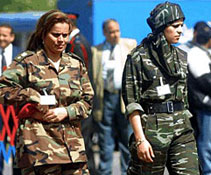
[A bodyguard peeks into the tent, checking on her charge. Her appearance seems to reminds Muammar of something]

gaddafi bodyguard

Gaddafi: Oh yeah. The hare- [gestures] -em Bodyguards. Personally dedi-

Negroponte [nonplussed]: Women from Honduran villages. Just ask Wilkes. Congressmen, agents. They all want more.

Gaddafi [suppresses a look of admiration... then]: Back to business.

Negroponte: The other business.

Gaddafi: Unfinished business.

Negroponte: Business as usual.

Gaddafi: Liberation movements.

Negroponte: Preserve our liberties.

Gaddafi: Unity in freedom.

Negroponte [quickly]: Democracy.

Gaddafi: Liberation.

Negroponte: Manifest destiny.

Gaddafi: Diplomacy.

Negroponte: Diplomacy.

Gaddafi: Freedom fighters.

Negroponte: Freedom fighters.

[louder]

Gaddafi: Weapons.

Negroponte: Weapons systems.

[louder still]

Gaddafi: Blood.

Negroponte: Blood.

Gaddafi: Blood!

Negroponte: Blood!

Gaddafi [infuriated]: Lockerbie.

Negroponte [shocked, then recovers, coldly]: Your daughter.

Gaddafi [smiles inwardly at first, then acts hurt]: Blo- ... I feel... Need to...
[recovers]
Clean hands... That will do.
[shakes his head]
Business. Never personal.

Negroponte: Strictly business.

[Gaddafi gets up and begins to walk out... Imperceptible nod to subordinates who look attentive and acknowledge him. As he reaches the tent exit, he turns.]

Gaddafi: We never met.

Negroponte [nods]: You refused. We never met.

Gaddafi: We never met.

Negroponte : We never met.

[Gaddafi leaves]

[Negroponte sports a self-satisfied smile. He believes he got the better of the exchange. Turns towards aide. Nods. Finishes his tea. Pauses. Then hands his portfolio to aide and starts to walk out. His aide follows.]

Negroponte [to subalterns]: I think we can do business.

Foreign minister and envoy: [inaudible]

[At the exit]

Negroponte: A good meeting. Excellent. Excellent discussions.

[exits the tent]

[A song has been playing in the background throughout. Provisionally identified as Wynton Marsalis - Blood on the Fields. Revisit.]

[end of transcription]

la cantatrice chauve


Strange bedfellows are among my favourite subjects. Consider this note part of an occasional series. The banner is Fallen Angels.

Part III. By Way of Ionesco

Next: He of The Little Green Book

Possibly related: Recent Non-Specific General Threats

File under: , , , , , , , , , , , , , , , , , , , , , , , , , , , ,

Friday, April 13, 2007

Bags and Stamps

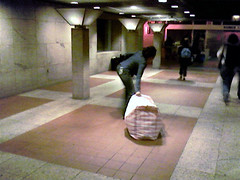
Let's talk about bags if you please. Bags are in the news these days. I don't mean San Francisco's ban on plastic shopping bags. Rather I'm thinking about this type of bag. In Ghana and most of West Africa we call it the "Ghana must go" bag.

ghana must go bag

Alternatively in Ghana, and humourously, they are called "Efiewura Sua Me", literally "help me carry my bag". Indeed there's always someone at the bus or train station who needs help moving such bags. (And yes, I did help that young lady after taking a surreptitious snap with my dodgy cell phone. Chivalry isn't dead even at midnight at the bus terminal).

Last year Sokari Ekine revealed her own bag woman tendencies and opened the discussion - she's a connaisseur. In response, Georgia Popplewell noted that "in Trinidad I’ve heard those bags called Guyanese Samsonite". We learned that in Germany, per contra, they are known as "Tuekenkoffer" or Turkish suitcase. In Boston I've heard them referenced as Chinatown totes, and called Bangladeshi bags in England, presumably after the 1970s influx of Bangladeshi immigrants.

The "Ghana must go" designation resulted from the various expulsions of immigrants that Ghana and Nigeria engaged in between the 1960s and 1980s. Many were only able to pack their belongings in such bags before fleeing, expelled with barely hours or days notice. Thus Ghana must go is ironic at best, and has mocking overtones at worst.

During the Rawlings Chain lean years in the 1980s when it wasn't simply a matter of returning immigrants and the whole country was facing political and economic difficulties (Revolution! Ghana), they were simply called "refugee bags". We were all refugees then.

In any case, the trend in naming is clear, these utility bags designate immigrants, refugees, or those down on their luck. They are emblems of hardship, relative poverty and exigency. I'll argue here that they are object lessons about the fluidity of ideas.

Pattern Matching


Let's first discuss the pattern. The majority of these bags are produced in China and it is fitting, given the interesting history of the pattern that covers them.


from: c r i s


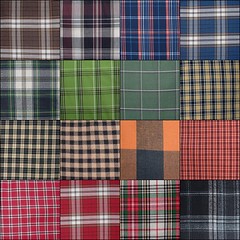
The plaid pattern is thought to originate in the Taklamakan area in Xinjiang Uyghur in China perhaps between 100-700BC and certainly by the 3rd century. The Scots have the most famous claim to it however. The Falkirk tartan in 1707 is thought to be the Scottish debut of the tartan, the rich tradition of the Scottish plaid kilt that various families and clans adopted (this pdf shows a visual timeline of tartan). The Scottish colours are typically rich shades of red and green and only occasionally is the main colour white as in the bags.

The word plaid means a blanket, from the Gaelic plaide. In North America people use it interchangeably for tartans. The etymology of the word tartan is itself in dispute. The French word tiretaine (an amount of material), and the Spanish word tartana (a fine quality cloth) are the main contenders.

Now of course tartans were adopted wherever the British empire cast its wings. Bagpipes and kilts can be found from Ireland through Sierra Leone to India. I need only point you to this piece about tartans and turbans which lovingly traces their legacy in the Indian subcontinent and beyond. Amongst other things Ennis notes that Sikhs in Scotland have even commissioned family tartans; the headline for that episode reads: Singh Adds Spice To The History of Tartan. So: spice, the silk road and the Highlands.

Typically plaids have been woven textiles, used for clothing or decoration. The little plaid skirt evokes many associations. Like all patterns used in visual design, plaid has been applied to all manner of objects. Which brings me back to bags...

Bag Lady


Senam Okudzeto - Ghana must go


The Ghanaian artist Senam Okudzeto has very personal knowledge of the history of "Ghana must go" and has incorporated its iconography into her work. If you look at the fragments of her recent exhibitions, you'll be exposed to a history of dislocation, of fractured, sudden enforced exile.

The question she raises is one of historical memory. Our plaid bags are the physical proof of the way in which the boundaries that meant nothing in our pre-colonial past now loom large in Africa. Indeed their name stems from the 1983 Expulsion Order giving illegal immigrants 14 days to leave Nigeria. But more broadly the bags refer to repeated upheavals in our lands and sub-Saharan Africa knows upheaval all too well. Still, there's a sort of existential defiance in her reclaiming these objects of loss. Divisions are embodied in the cheap, practical and functional bags.

There is considerable wit in her work although it is always combined with a wistful displacement. Note the slogan, Capitalism and Schizophrenia, and some of the quotes she highlights: "deception is fundamental to the system".

Resilience


Plastic bags then. Plastics are the great innovation of the past century and a half and well they are sources of alienation and comfort, pollution and practicality. The famous scene from The Graduate comes to mind
"I want to say one word to you. Just one word."
"Yes, sir."
"Are you listening?"
"Yes, I am."
"Plastics."
If you are confronted with packing up your entire possessions in a hurry for fear of your safety, a Ghana must go bag will undoubtedly be a source of comfort. If you're trying to pack tins of corned beef and sardines, rice and sundry spare parts along with the clothes your relatives back in Ghana lack, you will gravitate towards the Ghana must go bag. At such times, volume and weight is everything. Ghana must go bags are about the most practical and lightweight luggage that exists.

Plastic, rugged and functional, you can even wrap them with tape to ensure additional sturdiness so that they don't split when they are manhandled by underpaid bag handlers. You can place all sorts of foodstuffs in them: smoked fish, yams, meat and spices. And heck they are distinctive: plaid, woven and plastic. As such, they are fixtures in many routes serving the developing world.

I can remember the scene at JFK airport waiting in line for a Ghana Airways flight, watching a market woman and the fifteen young men who would be taking the trip with her wares - all in huge fully packed Ghana must go bags. They had brought a big truck to the airport and were blocking the entrance causing a stir as their cargo was unloaded. This was even after 9/11 but she wasn't minding the Homeland Security folks that approached. Mama Trader wasn't travelling herself but had come to supervise the dispatching of her consignment of goods home. She made it clear that she wasn't planning for any of her workers to pay any excess luggage fees. I'm almost positive they didn't; she must have had a 'business arrangement' with the airline (or at least those manning the counter). Incidentally Ghana Airways went out of business shortly thereafter. Moving right along...

Fashioning Bags


I wrote the foregoing to connect a few dots raised by a recent stir in Ghanaian newspapers. The headline read: Louis Vuitton sells "Ghana Must Go".

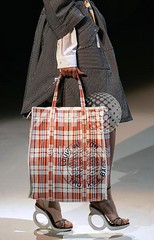
The images of models bounding down the catwalk at Marc Jacob's 2007 collection for Louis Vuitton raised the ire of a few commentators. An example:


The expensive shoes the model was wearing, indeed her entire outfit, stand in sharp contrast to the utility bag she was wielding. A typical review of the show mentions
a funny cheap checked shopping bag that carried a big, passport-style Louis Vuitton stamp...

the collection was a complex refraction of the many inspirational sparks that go into the work here: pieces synthesized to project the simultaneous multinational appeal this brand must maintain
The language of the style section is too clever by half but they captured the incongruousness and appeal of the image. A complex refraction indeed. A close look at a full slideshow of Marc Jacobs' creations shows that the bags of our tale were a leitmotif of the collection.

This is nothing new in fashion; slumming is a trope in the rarefied heights of haute couture. In recent years we have seen much appropriation of the sort and things like service uniforms (UPS, McDonald's etc.) have gained a fashion quotient. This is run of the mill piracy and the kind of tongue-in-cheek sentiment we applaud our designers for.

The author of the article was incensed that Ghanaians hadn't capitalized on the Ghana must go iconography and that others were now about to make hay out of a designer bag frenzy.
Having an idea stolen can be more difficult to deal with especially when the other party makes a bigger name and money off the idea than what it was originally worth...
A tempest in a tea pot in short.

Of course I could have pointed out that a proud Ghanaian artist was blazing these trails long before Marc Jacobs got there. Indeed there is an element of theft in this episode. If you look at Senam's work, you'll also see that she focuses on the passport stamp along with the Ghana must go bag. She highlighted not just the bag, the few personal mementos, photos and such, but also the passport stamp. Those who didn't have the requisite stamp on their residency papers or passports were the ones who were forced into upheaval with only these bags to carry their belongings into the unknown. Thus issues of legitimacy and exile are part of the questions she poses in her ongoing series.

In many ways, Jacobs's shtick was only a high-profile plagiarism. I expect Senam would be tickled by the nexus of commercialization and piracy that she likely provoked. The Akan proverb, humanity knows no boundaries, is one she would have been steeped in. Not to mention that the plaid pattern comes and goes used by all and sundry. The Wife notes incidentally that plaid is in this season in all the fashion magazines and stores. It was inevitable that others would latch on to it.

In any case, what claim does Ghana have to Ghana must go? Shouldn't the Nigerians, who ironically coined the term, have first cuts of any royalties? Heck these bags aren't even produced in Ghana, we are mere buyers and users. Our Chinese friends manufacture them using their native pattern. And, as we have seen, our local name for the bags is not widely known outside of West Africa. We're not the only refugees, immigrants or attendees of the school of hard knocks.

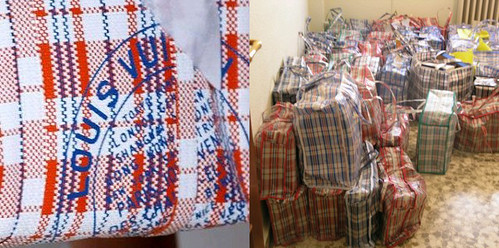
Still like Marc Jacobs, and in the spirit of Senam, I thought a juxtaposition would be appropriate and, rather than link to the original images, I thought I'd perform a creative theft with the following image. The title should be evident:
Ghana must go versus Louis Vuitton
ghana must go vrs louis vuitton
Bags and Stamps: a plagiarism in plaid
So to recap, a Ghanaian, by way of France and England, living in the USA, creates a collage starting with an image of Chinese-produced plastic utility bags taken by a Nigerian living in Spain - a 'theft' of the "Ghana must go" imagery, born of the interlocking episodes of reciprocal deportation and sundry exile between their two homelands, both former British colonies. The plaid pattern on said bags is originally Chinese although it is most celebrated in Scottish fabrics, and the subject of English schoolboy fantasies. Said pattern was transmitted in recent centuries over the corners of the British empire and is rightly part of Indian and especially Sikh heritage.

The symbolism of the bags is the signal subject of the work of a American-Ghanaian artist who grew up in Ghana, Nigeria and the UK (yes I should have mentioned Senam's Nigerian connection - isn't that a complication? And doesn't that explain the resonance of the Ghana must go iconography in her boundary-straddling life? Not to mention her focus on the passport stamp of approval. Sidenote: this modern traveller now has a very sensible Swiss connection, whither neutrality?)

This image is juxtaposed with a recent appropriation by an American fashion designer working for an France-based luxury company whose ironic contribution is to place a seal on the bag, contrasting the pennies on the dollar cost of the bag with a logo that is renowned for its deleterious effects on even the fattest wallets - a logo, moreover, that is often counterfeited by Chinese manufacturers in a global shadow economy of knockoffs that are sold all over the world. The significance of the logo or stamp of approval is iconic in expressing authenticity, legitimacy and belonging, demarcating the boundaries separating countries at once, and luxury status symbols delineating the rich from the poor.

Incidentally this note was prompted by a posting by an Indian American, who is arguably more Ghanaian in sensibility than me from his few years in Ghana, said posting focused on the celebration of National Tartan Day by Scottish Americans and its implications for the Desi community and diaspora.

The mind reels.

I have just booked a trip to England. My ostensible purpose is to get a stamp in my passport that will keep my notional residency in Her Majesty's lands legitimate. I am hedging my bets against this American episode; the stamp is my soul insurance if you will. Refugees all, we in Africa are no strangers to dislocation, in many ways it is our close friend. As the song goes, wherever I lay my hat, that's my home.
Modern travellers
Packing our bags
Seeking out stamps
The mementos of exiled souls

Bags: A Playlist


As usual, some music for the exiled soul...
  • De La Soul - Shopping Bags (She got from you)
    The percussion on this song, a stark array of milk bottles, proves that the boys still have it, appropriating whatever beat is expedient to get the message across.
  • Freestyle Fellowship - Inner City Boundaries
    The inner city griots expound
    Who is that surrounding me?
    Enemy enemy you crossed the wrong boundary
    Wicked witness wizardry
    Disappear from here and end up in a tree
    Crossed the wrong boundary
  • Milt Jackson - Bags' Groove
    Milt Jackson's nickname was Bags. He is most famous as a pillar of the Modern Jazz Quartet, Django being only one of their numerous standards. Bags' Groove is a heavyweight encounter with Miles Davis, Sonny Rollins, Thelonious Monk, Horace Silver, Percy Heath and Kenny Clarke. He played his vibes and the rest is history.
  • Milt Jackson and John Coltrane - Bags & Trane
    Bags and Trane is a more delicate affair, the two great soloists respected each other and are all empathy. I think Milt comes off better than Coltrane, much as Sonny Rollins came off fiercer in his Tenor Madness conversation with Trane.
  • Bob Marley - Exodus
    Movement of Jah people. 'Nuff said.
  • The NPG - The Exodus has begun
    A Prince album in all but name, the title track is sprawling like Bootsy and George would have done it. Oh identity.
  • Digable Planet - Nickel Bags
    Their reunion in 2005, after 10 years apart brought such joy. (I still have a review in the draft pile). Let's hope they head back to the studio. I want some more nickel bags of funk.
  • Herbie Hancock - Three Bags Full
    Herbie Hancock's contribution to this playlist is from the aptly titled Takin' Off album, an affair featuring Freddie Hubbard and Dexter Gordon mind you. This is hard bop at its best. Most airlines only allow two bags but when you fly Air Herbie, you get extra allowances for your baggage, and a bigger plane.
  • Erykah Badu - Bag Lady
    I'll end with the bag lady herself. Ms Badu's Ghanaian heritage is only obliquely referenced these days, if at all; Texas claims her. Still, her musical iconoclasm is plainly mid-Atlantic, her sensibility is that of one who knows no boundaries, a musical refugee in her creative prime. This was the lead single from her last soulful album, the title of course: Worldwide Underground.

A parting question: I wonder if this note could pass as a Things Fall Apart affair. Would it be a case of social living, a comfort suite or rather that rough beast? What say you dear reader?

[Update June 5, 2007]

See also: A plagiarism in plaid

Bags and Stamps - the photo set

File under: , , , , , , , , , , , , , , , , , , , , , , , , , , , , , ,

Tuesday, April 10, 2007

Observers are Worried

I. Ancient History


Item: Stevie Wonder records Happy Birthday on his 1980 album, Hotter Than July, to lobby for a public holiday for Martin Luther King, Jr..

Dig: President Reagan signs legislation creating Martin Luther King, Jr. Day in 1983

Paul Krugman observes:
In 1980, when Ronald Reagan won the White House, conservative ideas appealed to many, even most, Americans. At the time, we were truly a middle-class nation. To white voters, at least, the vast inequalities and social injustices of the past, which were what originally gave liberalism its appeal, seemed like ancient history.
Would history repeat itself, one wondered? Let's pursue an alternate history, if you will. After the maudlin Ebony and Ivory (1982) with Sir Paul, there was a slight pause.

Then: Stevie Wonder releases Skeletons from his Characters album in 1987, raising his voice about the South African situation.
Skeletons in your closet / Itchin' to come outside / Messin' with your conscience / In a way your face can't hide
Effect?: The apartheid government of South Africa begins secret negotiations with Nelson Mandela and company in 1988. Mandela is released two years later and becomes president of the country after the ANC wins the 1994 elections.

The power of latter day Stevie has long been noted; historians would do well to study his writings as they tease out landmarks from our cultural history. Still, along with the passage of MLK day, the USA got the ongoing Reagan retrenchment - mitigated in part by Monsieur Clinton. Guilt was assuaged: first they got votes and affirmative action, then they got the TV mini-series, and now they've even got the holiday. Reversing the perspective, I can imagine the T-shirt:
I fought for civil rights and all I got was a lousy holiday.
On the South African business, Stevie had impeccable timing, ignoring if you will the multitude who joined in that long and ongoing struggle. They say that every thing that happened before 1994 has been reconciled with truth, right? Indeed that chorus started long before the 1994 handover. We still hear it:
Move on, it's all ancient history.

II. Right on Time


Item:
Jacob Weisberg's writing represents the just before banal of the center left in the United States. This is not to say that Mr. Weisberg is stupid, merely that by the time he writes something, there is a vast "The End" spray painted on the wall. He says something just as it is about to become common knowledge.

Stirling Newberry - The Unspeakable Truth discussing the received wisdom in American media and political circles in March 2007, namely that the Iraq war was a mistake
Dig: Barely weeks later, Joe Klein declared George W. Bush unfit to lead.

Per Newberry's spectrum of banality, Klein should be counted as being merely banal. One awaits the post-banal.

III. Risk Avoidance

Only posterity is unkind to the man of conventional wisdom, and all posterity does is bury him in a blanket of neglect.

— John Kenneth Galbraith discussing inequality in The Affluent Society, 1958
Dig the soul singer:
Predicting the loss
before I begin
So it don't cut too deep
when I don't win
I hate it when I'm right
Much rather be wrong
I'd rather be wrong

Amel Larrieux - Mountain of When, 2006

IV. The Bully Pulpit


Ancient history
Idées fixes
Aspirations of prescience

Firm pronouncements of Praetorian guards
Breathless headlines of received wisdom
Platitudinous laments

Ride the wave, over the edge
Light as a feather
That's how the cookie crumbles

Quibbling a la carte
Trend-surfing alacrity
Toothless prophecy

Polemics of convenience
Shrink-wrapped profundity
Trailblazers of the trade winds

Timing is everything
Observers are worried

Observers are worried


File under: , , , , , , , , , , , , , , , ,

Wednesday, April 04, 2007

Crawl Before You Walk

I've been working for the past 18 months in the "emerging web technologies" group at IBM. When I first joined, I was struck by a certain difference in attitude compared to my previous experiences at Lotus. "Eh?", I'd almost hear my colleagues say silently whenever I'd start discussing the merits of any technology. When they responded, there'd be a quite jaundiced sound in their voices. You'd notice the slightly arched eyebrow and perhaps a tightening of the mouth. It wasn't quite incredulity but it was fairly close to wariness. I speculated that this tendency was born of years evaluating countless Next Big Things and was simply the posture of experts and futurologists: "What are you selling this time? Tell me something new...". They've seen standards come and go and the various fashions that sweep the technology world. The group is a little guerrilla outpost of pragmatism, if you will, within Big Blue.

I am fairly cynical about buzzwords and the mechanics of technology adoption, but even my experiences of the Lotus side of things hadn't made me that skeptical. In any case I mention this because I was recently merrily surfing away and came upon the following bullet item in a laundry list of proposed features for Java Server Faces (JSF) 2.0.

Allow for bookmarkable JSF pages. More broadly, if HTTP GET can be used, it should be used.
Quite simply I caught myself saying "Eh? Eh!". My normally sedate eyebrows even arched violently. I couldn't help it.

I haven't closely followed the technology known as JSF, but I think if you wanted to quickly evaluate its prospects as an 'emerging web technology', you could do well to simply dwell on what I've highlighted. Its history, its rate of adoption, its maturity and perhaps even its future prospects are fully encapsulated in that most remarkable passage.

It is striking that it is only in its fifth year of existence that a framework for building web applications is considering allowing bookmarking and might even use the HTTP GET method where applicable.

How can one possibly develop successfully for the web without identifying important resources? That is the first plank of the REST elevator pitch. If you can't bookmark, if you can't cache, if you are invisible to intermediaries, you are willfully ignoring the web.

Technology toli readers might remember an intervention and case study on internalizing the REST style that focused on much the same aspect in the case of WebSphere Portal and its first 3 years of existence. The benefits that I outlined once the portal embraced the web are much the same that will accrue to JSF. Ed Burns and company seem to have staged a REST intervention on JSF. Head nods to them.

My first encounter with JSF was when it was announced at JavaOne in 2002. The name seemed funny ("faces" instead of interfaces?) but I'd seen worse. My snap judgement: yet another framework for building web interfaces, oh well, the more competition the better, we'll see how it pans out.

I note that I've only mentioned JSF once: outlining how its abstractions leaked mightily when it came to html buttons and forms. Three years ago, we had been forced to use it in our forms work because it was deemed "strategic" in the IBM Software Group. I didn't have the clout to affect the decision and, well, I worked to get something to ship to customers. Inwardly however I discounted that project's prospects of success based on my experience with the first releases of JSF. A demo that looks good will get you in the door; an application that works well will actually get deployed and used by Real People™.

In the same piece, I referenced the reaction to the release of Google Web Accelerator and the way it highlighted the large number of web frameworks that were ignoring the basic principles of the web architecture. It seems that those frameworks that were deployed on the broad web and whose flaws were publicly exposed in that episode took that lesson to heart. Their creators have begun internalizing the web style to its core. To take an obvious example, the latest releases of Ruby on Rails seem to be almost religious in the fervour for the gospel of REST.

I suspect that JSF wasn't widely deployed outside of 'enterprises' two years ago hence the outcry that many other frameworks faced to "fix your damn code" wasn't heard. It appears that the message has since been conveyed and that fateful item speaks volumes. REST it is. Sun is going full bore towards embracing the web. And about time too.

Laissez-faire Dynamics


I have described REST, the web style, as being laissez faire distributed computing.

This is a blessing in that its laissez faire approach has the virtue of encouraging participation by as many people as possible. Indeed its embodiment in HTTP might be one of the most successful cases of technology adoption we have seen.

To pursue an argument by analogy on the other hand, I'll note that markets regularly fail. There are the temptations of monopolies seeking rents and that the economics of affluence and attention apply. There are bad faith actors, and you need to create spaces for market lubricants: price discrimination, market makers, arbitrage etc. Income inequality, trickle down economics are widely seen when we fetishize all things laissez faire. Still, there is almost no market which is fully laissez faire; we have laws and regulations even in the freest of markets.

The reigning tension of the low end theory is between participation and control. REST, in favouring participation almost to a fault, enforces very minimal regulations. HTTP is abused daily and advocates of the web style would catch hernias if they dwelled on the extent of the abuse and didn't simply get on with things. You'll only see gentle prodding in my handwaving take at Arrested Development
  • Identify all important resources
  • Use the correct verb
  • Respect browser conventions
  • Layer Stripping and Radical Simplification
There's no coercion in these suggestions. REST is all carrot and no stick. Now the thing is that once you've imbibed the web style and embraced its minimal restrictions, you don't look back and all those externalities begin to accrue. Based on the urgency of that bullet point, I am fully confident that the next few releases of JSF will be bonafide Next Big Things ®.

Most of us had to crawl before we walked, or fall off the bike a few times before we learned how to ride. I only wish that certain technologies would fail faster or at least blunt their noses earlier. Contact with a mass audience on the web seems to be essential in this respect and this presents a dilemma.

Big companies have credibility by virtue of heft and inertia when it comes to purchasing decisions - the technologies they promote get in the door almost by default. Those who sell to big companies also know that, so long as they make the right noises about the strategic direction they are going in, they will get the benefit of the doubt. I would argue that this is only true in times of affluence. When we are all minding our purses, we look more closely at these things and will use what is expedient. Contrast the spread of web native applications like wikis to vertically integrated teamrooms and content management systems. Moreover, the web radically levels the playing field. In the decade or more since the web was adopted as the preferred platform, we have witnessed an inversion of emphasis due to its vastly wider audience and scale.

I'm reminded of the words of a fellow traveller.
I suppose I'd call myself a pragmatist.

I do whatever works. I strive to fail faster. It's the results that matter, and simplicity (stripping layers) is celebrated because time is precious. We don't have time to waste on complexity and buzzwords; we're already behind on inventing the future.
Waiting 5 years before you adopt the native architecture of the web is almost inexcusable. The web won't (and didn't) wait that long. Others will route around you and their dynamism will be adopted by the marketplace. Now it's a game of catch up on that elusive thing known as mindshare and ultimately on cold cash, rueing all those missed opportunities.

The perplexing challenge of the web remains: how do we encourage things to fail faster? Perhaps we should all learn to say "Eh?" more often.

Crawl Before You Walk, a Playlist

A soundtrack for this note
  • The Pharcyde - Passing Me By
    The humourous message of this song from The Pharcyde's hugely influential debut album is that obsolescence awaits if opportunities go wanting. The chorus is wist itself: "she keeps on passing me by".
  • Was (Not Was) - Walk the Dinosaur
    Fun soul music that made the pop charts: "everybody walk the dinosaur".
  • Count Basie - Sleepwalker's Serenade
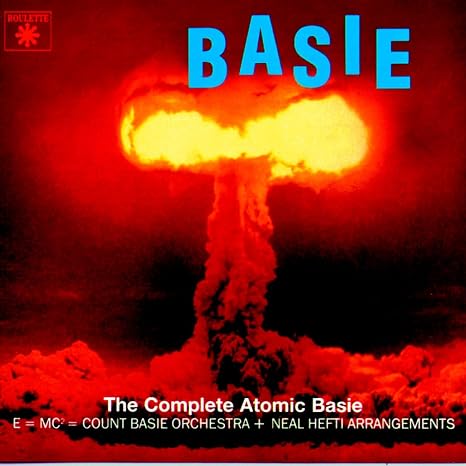
    It appears that the web style is exploding things at Sun and other big companies. It is only fitting that we end with a swinging track from the essence of swing, the big band at its tightest, the horns, the driving bass, not to mention the Count's percussive piano, provide the counterpoint to the ironic serenade of the sleepwalker. The album title: The Complete Atomic Basie. Eh!

    Atomic Basie


File under: , , , , , , , , , , , , , , , , ,